Along the muddy bank of Coldwater Creek in Casey County, Kentucky, thirteen-year-old Everett Crane drove another willow cutting deep into the cold autumn soil. His red-and-black plaid shirt was rolled at the sleeves, his faded overalls were dark with mud, and blisters covered both hands beneath his worn gloves. Behind him, old Gus Whitfield sat sideways on a green tractor, laughing loudly enough for the cattle across the pasture to lift their heads.
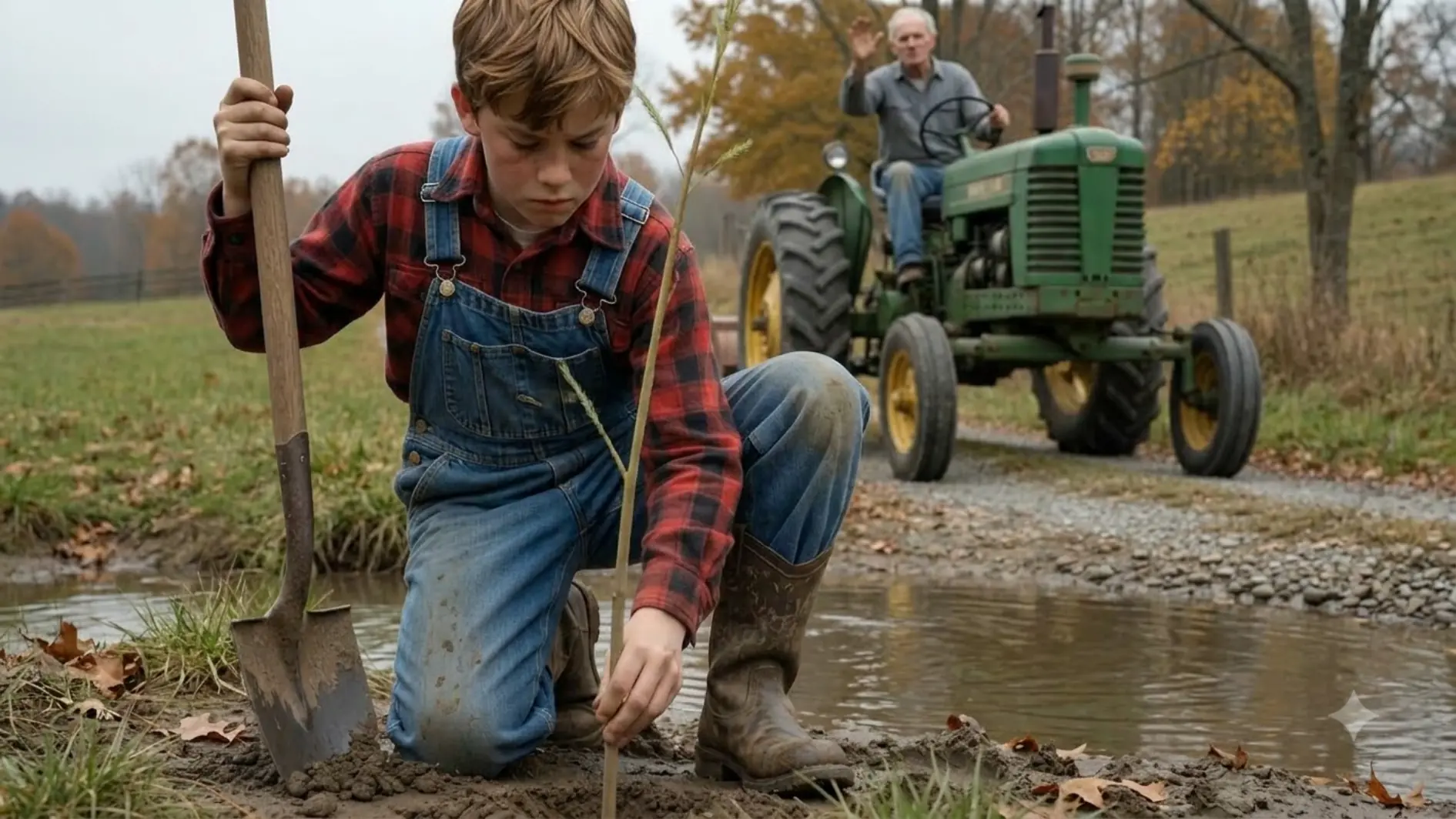
For a moment, the only sound was water moving slowly beneath the bank.
Gus looked from the boy to Dale, perhaps trying to decide whether either one truly meant the challenge. He finally shook his head, turned the tractor toward the road, and drove away with the engine coughing gray smoke into the cool air.
Dale watched until the tractor disappeared beyond the pasture gate.
“You planning to fight every man who laughs at those trees?” he asked.
Everett knelt again and pressed mud around the cutting. “Only the ones who try pulling them out.”
Dale rubbed a hand across his beard. He was forty-five, broad-shouldered, weathered, and not easily impressed by ideas that required more talking than working. Yet Everett had paid for the willow whips himself, finished his chores before touching the creek bank, and asked permission before digging the first hole.
That was enough for Dale to let him continue.
Coldwater Creek curved along the southern edge of the Crane farm, separating the cattle pasture from a low hayfield that had belonged to the family since Everett’s great-grandfather cleared it in 1908. During ordinary summers, the creek moved gently between muddy banks and exposed stones. During heavy rain, it became something else entirely.
Every few years, the water rose hard and brown.
It cut beneath fences, stripped soil from the outer bends, and carried branches, wire, and sometimes livestock far downstream. The farmers along the creek treated those losses as unavoidable, like drought, frost, or death.
Everett did not.
He was the second of four children and the quietest person in the Crane household. His older brother, Micah, won ribbons for cattle at the county fair. His younger sister, Lena, brought home perfect grades and corrected the grammar in church announcements.
Everett walked fence lines.
On Sunday mornings, while the others slept late, he checked posts, drainage channels, animal tracks, and places where the soil had shifted. He noticed when the south field stayed wet longer than usual. He found a loose strand of wire three days before it could injure another calf.
He rarely announced those discoveries.
He repaired what he could and remembered the rest.
The willow idea had begun the previous summer when Everett stayed with his maternal grandfather, Lester Bowen, in Bourbon County. Lester had spent thirty years as a soil-conservation technician, helping farmers protect land they could not afford to replace.
He was seventy-four now, with narrow shoulders, silver hair, and hands permanently stained by earth. Retirement had slowed his walking but not his mind.
One evening, Lester took Everett to a neighboring farm where a creek had eaten nearly twelve feet into a pasture. Fence posts leaned over the new edge, and dark soil collapsed into the water whenever someone stepped too close.
Lester stood there for several minutes before speaking.
“You know what holds a bank like this?”
“Rock?” Everett guessed.
“Sometimes.”
“Concrete?”
“Men love concrete because it looks strong the day they pour it.”
Lester pointed toward a cluster of willow trees downstream. Their trunks bent over the current, and long roots twisted through the exposed bank.
“Those.”
Everett stared at them. “Trees?”
“Roots.”
Lester explained that native willows grew quickly in wet soil. Their roots spread deep and wide, forming a living net beneath the surface. During floods, the trunks bent instead of snapping, while the roots held the bank together and slowed the water near the edge.
“Hard things resist until they break,” Lester said. “Living things bend and keep holding.”
That night, he gave Everett a thin extension-service booklet titled Streambank Stabilization Using Native Vegetation. The pages were worn soft from years of handling.
Everett read it twice before returning home.
The booklet explained where to place willow cuttings, how deeply to bury them, how close they should stand, and why the strongest protection required several growing seasons. It was not magic. It was conservation science practiced quietly across farms most people never heard about.
Everett studied Coldwater Creek with new eyes.
The outer bend below the south pasture had already lost several feet of soil. If the channel shifted farther, it would threaten a fence, a cattle path, and eventually one of the most productive corners of the hayfield.
He began saving money.
All summer, he helped the Atchison family bale hay after finishing his own chores. He stacked square bales inside a hot barn until his shirt could be wrung out like a wet towel. He refused candy, soda, and a new baseball glove because every dollar had another purpose.
By October, he had enough to order two bundles of black willow whips from a conservation nursery.
The package arrived wrapped in damp burlap.
To everyone else, it looked like a bundle of dead sticks.
Everett planted one every few feet from the old pasture gate to the wide bend where the current accelerated after storms. He pressed each cutting deep into the soft bank, leaving only enough above ground for several buds to remain exposed.
Neighbors noticed by Thursday.
Harlan Beecham stopped beside the fence and asked whether Everett was planting shade trees.
“Sort of,” Everett replied.
“For the cows?”
“Not exactly.”
Harlan waited for an explanation that never came. That evening, he told his wife the Crane boy was planting sticks in the mud.
By the weekend, people at the feed store were discussing it.
Some believed Everett wanted a shaded fishing spot. Others thought Lester Bowen had filled his head with impractical government ideas. Gus Whitfield declared that the first serious flood would carry every sapling straight into Tennessee.
Dale heard all of it.
He never repeated the jokes at home.
At supper, Ruth Ann Crane asked what Everett hoped the willows would accomplish. She kept the farm accounts, raised four children, and grew a kitchen garden that produced more vegetables than several larger plots combined.
“I’ll explain when there’s something to explain,” Everett said.
His mother considered him for a moment, then passed the potatoes.
“All right.”
The first winter punished the project.
A hard January freeze killed several whips. Cattle found a weak place in the temporary fence and trampled twelve more. Everett discovered the damage before school one morning and stood silently among the broken stems while sleet tapped against his coat.
Micah found him there.
“Told you the cows would get through.”
Everett pulled the first damaged cutting from the mud.
“You going to quit?”
“No.”
He repaired the fence that afternoon and replaced the destroyed plants with cuttings taken from the survivors. He rooted them in buckets of creek water inside the barn before pressing them deeper into the bank.
Spring brought aphids.
Summer brought drought.
Several young trees nearest the bend turned brown and died when the water level fell. Gus passed on his tractor, studied the thin patchy line, and called them broom handles.
Everett kept replanting.
There were mornings when he doubted the entire plan. The booklet described successful projects, but printed pages did not show the frustration of protecting fragile trees from cattle, insects, frost, and careless boots.
The creek bank still looked weak.
The willows still looked small.
One afternoon, Dale found Everett tamping soil around another replacement.
“How many have you lost?” he asked.
“Twenty-eight.”
“How many living?”
“Sixty-three.”
Dale looked along the bank. “That enough?”
“Not yet.”
His father crouched beside him. “What are they really for?”
Everett hesitated, then handed him Lester’s booklet.
Dale read several pages.
“You think these roots can hold the bank?”
“They will if they get enough time.”
“And if a flood comes before then?”
“They won’t.”
Dale closed the booklet. “That’s honest.”
Everett looked at him. “You think I’m wasting time?”
“I think every farm improvement looks like wasted time before it works.”
He handed the booklet back.
“Finish your planting before dark.”
The second year changed everything slowly enough that most people failed to notice.
The surviving willows thickened. Their trunks remained narrow, but green branches extended across the water. Beneath the surface, roots spread through the bank, wrapping soil, stones, and decaying plant matter together.
Everett could feel the difference when he pressed his boot near the edge.
The soil no longer crumbled as easily.
By midsummer, the willow line formed a ragged green border along Coldwater Creek. Birds nested among the branches. Insects gathered above the water, and cattle rested beneath the developing shade.
Neighbors assumed the shade had been Everett’s goal all along.
He did not correct them.
The summer Everett turned fifteen became one of the driest anyone remembered. Pastures browned by July, ponds shrank, and farmers began feeding winter hay weeks earlier than planned.
Coldwater Creek narrowed to a slow channel between exposed stones.
The willows survived because their roots had reached moisture hidden beneath the bank.
Then October arrived.
The rain began on a Sunday night.
At first, everyone welcomed it. The dry fields needed water, and cisterns had fallen dangerously low. By Tuesday, the soil had absorbed enough.
The rain continued.
It fell steadily through Wednesday, Thursday, and Friday—not a single violent storm, but a relentless weight pressing into every ditch, pasture, and creek channel.
By the seventh day, water stood in low fields.
By the ninth, farm roads softened beneath truck tires.
Old Rufus Dinkins told Dale at the co-op that Coldwater Creek was higher than he had seen since 1993. The county posted a flood advisory, and Dale nailed the notice to the barn door.
Everett watched the birds.
Killdeer that usually fed near the creek had moved uphill three days earlier. Muskrats abandoned lower burrows. The water carried leaves, branches, and pieces of upstream fencing.
He walked the willow line twice that Thursday.
The trunks bent beneath the current. Some roots were exposed, stretched through the soil like cables. Everett pressed one hand against a tree and felt tension running through the bank.
At supper, rain hammered the metal roof.
Ruth Ann looked toward the dark windows. “Will they hold?”
Everett knew she meant the willows.
“I don’t know.”
Micah stared at him. “You planted them for this?”
Everett nodded.
No one spoke for several seconds.
Dale stood and took his coat from the peg. “Let’s check the cattle.”
The family worked until midnight moving animals from the low pasture. Water entered the field before they finished, spreading across the grass in shallow sheets.
By dawn, Coldwater Creek had become a brown, roaring force.
The Whitfield bank failed first.
Sixty feet of Gus’s north pasture collapsed into the current. Fence posts, wire, and topsoil disappeared within minutes. The new edge cut dangerously close to his equipment shed.
At the Atchison farm, three fence lines went down. Tangled wire and debris appeared two hundred yards downstream.
Rufus Dinkins lost much of a hay meadow he had spent twelve years improving. The water peeled away dark topsoil and left pale gravel beneath it.
The low road disappeared entirely.
At the Crane farm, water jumped the bank near the eastern pasture and spread into the lowest ground. A gate twisted beneath debris, and two small trees broke near the upstream boundary.
But the long stretch protected by Everett’s willows held.
The trees bent until branches dragged in the current. Mud covered their trunks. Water tore grass from between them and exposed sections of root.
Still, the bank remained where it had been.
Roots locked through the soil, distributing the force rather than allowing entire sections to break away. Sediment collected between the trunks, and the water near the edge slowed enough to reduce the cutting force.
Dale, Everett, and Micah watched from higher ground through heavy rain.
Micah stared at the creek. “Those sticks are holding it.”
Everett said nothing.
The flood reached its highest point that afternoon.
For several hours, everyone feared the water might rise another foot and overwhelm even the protected stretch. Everett walked the upper fence line repeatedly, checking for cattle and watching the trees strain beneath the current.
Dale found him near the old gate.
“You did what you could,” his father said.
Everett looked toward the flooded pasture. “It might not be enough.”
“That’s farming.”
The water began falling after midnight.
By Saturday evening, the road reappeared. On Sunday, families walked their properties in silence, measuring what remained.
The destruction along Coldwater Creek was impossible to ignore.
Gus Whitfield stood at the edge of his ruined pasture with mud covering his boots. The flood had moved the bank so far that the old fence line now hung above open water.
He climbed onto his tractor Monday morning and drove toward the Crane farm.
Everett saw him coming.
The boy was clearing branches caught among the willows when Gus stopped beside the pasture gate. The older farmer climbed down slowly, no longer laughing.
He walked the entire protected section.
In places, exposed roots formed thick woven patterns across the bank. Several trunks leaned nearly horizontal, but the soil behind them remained largely intact. The channel had not shifted.
Gus stared for a long time.
“Where’d you buy them?” he finally asked.
Everett wiped mud from his hands. “Conservation nursery near Lexington.”
“Black willow?”
“Yes.”
“How deep?”
“Three feet where the soil allowed it.”
“How far apart?”
“About three feet. Closer on the outside bend.”
Gus removed a folded feed receipt and a pencil from his pocket.
Everett wrote down the nursery’s name and the planting instructions. Gus studied the paper before placing it carefully inside his shirt.
“I shouldn’t have threatened to pull them.”
“No.”
“I was wrong.”
Everett looked toward the older man’s damaged pasture.
“You’ll need more than willows where the bank already broke.”
“What else?”
“Regrade the edge first. Plant grass above them. Keep cattle fenced back until the roots establish.”
Gus nodded slowly.
“You help me?”
Everett considered the request.
“Yes.”
That spring, the Whitfield farm planted willows.
Harlan Beecham followed. Then the Atchisons protected their section of creek. Rufus Dinkins installed willow cuttings along the rebuilt edge of his hay meadow and added native grass above them.
No county celebration marked the change.
Useful ideas rarely spread through speeches in farming communities. They spread through damaged fences, muddy boots, handwritten nursery names, and neighbors finally asking the person they had mocked.
Lester Bowen visited the Crane farm that summer.
He walked slowly beside Everett, leaning on a cane while examining the thickening willow line.
“They held,” Lester said.
“Most of them.”
“Most is enough to teach you.”
Everett looked toward the repaired pasture. “I thought I knew they would.”
“No.”
The boy glanced at him.
“You believed they might,” Lester continued. “Knowing comes afterward.”
Everett smiled faintly.
Dale joined them near the wide bend. He shook Lester’s hand and thanked him for teaching the boy.
Lester looked at Everett. “I gave him a booklet. He did the work.”
Coldwater Creek flooded again four years later.
By then, the willows stood taller than Everett, with trunks thick enough that a man could not close one hand around them. Their roots reached deeper, and new shoots filled gaps along the bank.
The water rose high.
The bank held again.
By that time, willow lines appeared along miles of creek throughout Casey County. Farmers who once considered them useless now ordered bundles together to reduce shipping costs.
Everett did not become famous.
He finished school, studied soil conservation, and returned to work with farms across Kentucky. He spent his career teaching people that erosion was not always solved with heavier rock, more concrete, or deeper machinery.
Sometimes the strongest answer began as a living stick pressed into mud.
Decades later, the original willows still followed the curve of Coldwater Creek. Their branches shaded cattle, birds nested above the water, and roots continued tightening through the soil every growing season.
Visitors sometimes assumed the trees had always been there.
Dale would point toward the oldest section and tell them his son planted those willows when everyone else believed he was building shade for cows.
Everett always corrected him.
“Not everyone.”
His father would smile. “No. Not everyone.”
The flood took fences, hayfields, topsoil, and years of work from neighboring farms.
It did not take the Crane bank.
A thirteen-year-old boy had noticed what older men accepted, listened to someone who understood the land, and invested two years in roots nobody could see.
His work looked foolish right up until the water rose.
By the time the creek revealed who had been right, the willows no longer needed Everett to explain them.
The bank was still standing.