The first man to laugh at Emily Carter’s pond was Harold Mercer, but he was not the last.
By the end of September 1978, nearly everyone who traveled County Road 6 had heard that eighteen-year-old Emily was digging a hole in what had once been one of the better cornfields on the Carter farm. Cars slowed beside the fence. Pickup windows rolled down. Men who had never offered to repair the Carter barn suddenly possessed detailed opinions about drainage, soil conservation, and everything an eighteen-year-old girl did not understand about farming.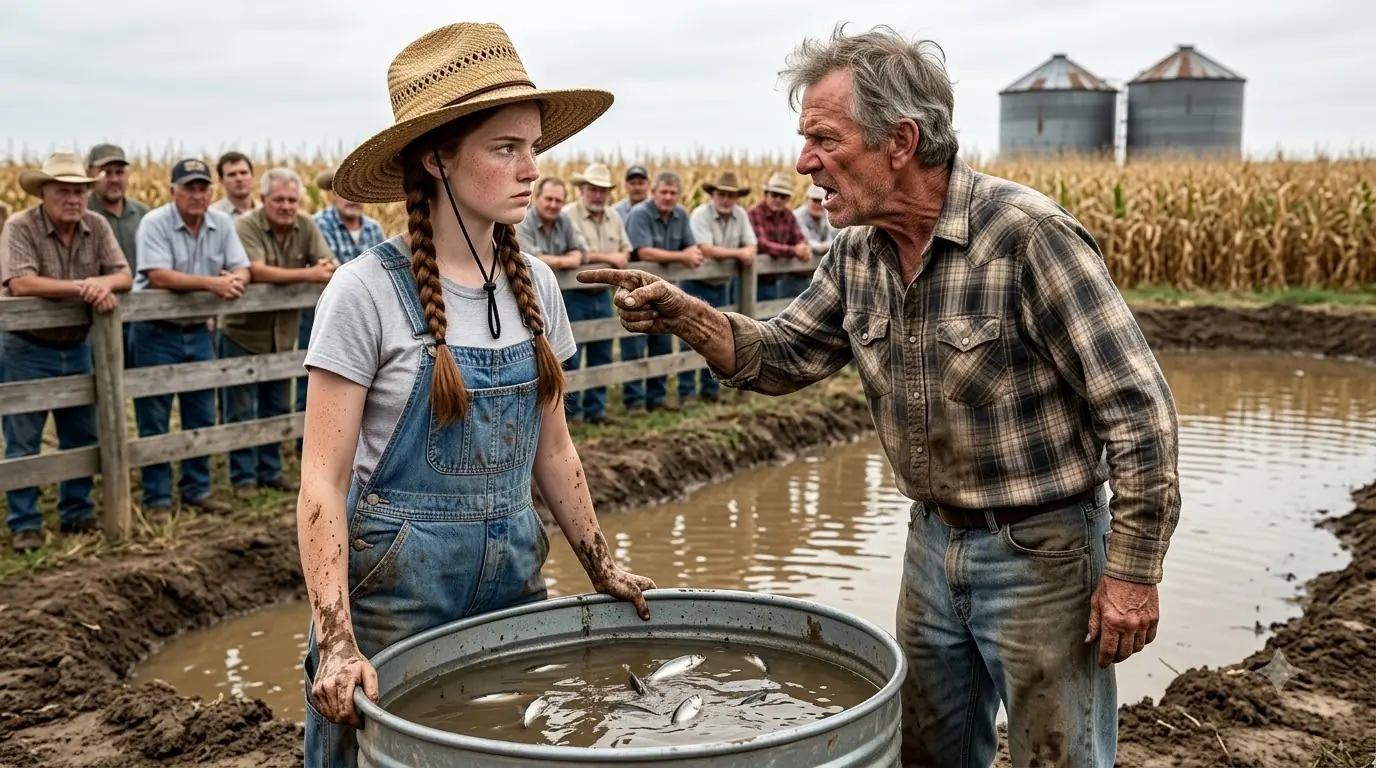
Emily heard most of it.
She answered almost none of it.
The Carter farm covered eighty-three acres outside the little town of Briar Glen, Iowa, where flat cornfields stretched beneath a sky so wide that distant grain elevators seemed closer than they were. Emily had grown up there with her parents, Thomas and Ruth Carter, and a younger brother named Daniel. Her father raised corn, soybeans, and a few cattle, never enough to become wealthy but usually enough to survive.
That balance disappeared in February.
Thomas Carter slipped from a hayloft ladder and shattered his left hip.
The operation saved his ability to walk, but recovery was slow and uncertain. By planting season he could stand only with crutches, and the medical bills consumed money already intended for seed and fertilizer. Ruth took additional shifts at the elementary school cafeteria while Emily postponed plans to attend community college.
Nobody formally told Emily she had become the primary worker on the farm.
She simply woke one morning and realized nobody else could climb into the tractor.
Daniel was fourteen and helped after school, but most responsibility fell on her. Emily had driven machinery since she was twelve, repaired fences since she was ten, and knew every corner of the Carter property better than most adults who offered advice. Still, knowing a farm and running one were different things.
The books frightened her more than machinery did.
Fuel costs had risen.
Fertilizer cost more.
The bank note did not care that Thomas could barely walk.
One evening Emily spread receipts across the kitchen table while her father watched from a chair near the window.
“We can plant forty-eight acres properly,” she said.
Thomas looked at the numbers.
“What about the rest?”
“We either plant cheap and hope, or don’t plant.”
“Neither sounds good.”
“No.”
Thomas rubbed his injured hip.
“We’ve had bad years before.”
Emily nodded.
“But not with hospital bills.”
Her father looked toward the fields outside.
“What are you thinking?”
Emily hesitated.
“I’ve been reading.”
Thomas smiled slightly.
“That usually gets expensive.”
“Catfish.”
The smile vanished.
“What?”
“Channel catfish.”
Thomas stared at her.
“In Iowa.”
“Yes.”
“In our field.”
“Yes.”
Thomas waited for the joke.
None came.
Emily had first encountered the idea in an agricultural extension bulletin describing farm ponds used for supplemental income. Most examples came from warmer states, but the document discussed hardy channel catfish and pond management in the Midwest. Emily requested more material through the county extension office.
She read everything.
Pond depth.
Temperature.
Stocking density.
Feed.
Oxygen.
Winter survival.
Harvesting.
The more she read, the more possible it seemed.
Not easy.
Possible.
She chose the lowest section of the west field because it already collected water after heavy rain. The soil beneath the top layer contained enough clay to hold water, and an old drainage ditch nearby could help with controlled overflow. The area had produced inconsistent corn for years because spring flooding often delayed planting.
Thomas listened.
“You’d lose five acres.”
“I lose yield there anyway.”
“Digging costs money.”
“Not if we do most of it.”
“With what?”
“Old crawler.”
Thomas almost laughed.
The Carter family owned a battered 1952 crawler tractor that had not worked regularly in years. Emily had spent much of the summer rebuilding the fuel system and replacing cracked hoses. It moved slowly, smoked badly, and offended anyone who believed a machine should be less rusty than the soil.
But it ran.
Thomas looked at his daughter.
“This isn’t a garden project.”
“I know.”
“You’re talking about moving thousands of yards of dirt.”
“I know.”
“Then pumps, feed, stock.”
“I know.”
Thomas became quiet.
Emily expected him to refuse.
Instead he asked, “How many fish?”
“If it works? Enough.”
“That is not a number.”
“Six thousand in the first pond.”
Thomas blinked.
“Emily.”
“I said if it works.”
He stared at her for several seconds.
Then he reached for the extension bulletin.
“Show me the numbers.”
That was all the permission she received.
It was enough.
The first week of excavation became entertainment for half the county.
Emily drove the old crawler across the west field, peeling away topsoil, reshaping the slope, and building low compacted berms. She wore a straw hat against the sun, gray T-shirt, blue denim overalls, and work boots that disappeared into mud by noon. Her auburn hair stayed in two braids because loose hair near machinery had frightened her mother since childhood.
Harold Mercer arrived on the fourth day.
His property bordered the Carter farm to the south.
Harold was sixty-two, successful by local standards, and proud of the fact that his sons now farmed almost seven hundred acres. He believed deeply in methods that had already worked for him and distrusted almost everything that had not.
He parked beside the fence.
Emily kept working.
Harold waited until she stopped the crawler.
“What are you doing?”
“Digging.”
“I can see that.”
Emily climbed down.
Harold pointed toward the excavation.
“What’s it supposed to be?”
“Fish pond.”
Harold stared.
Then laughed.
He laughed long enough that Daniel came out of the barn to see what had happened.
“You’re serious.”
“Yes.”
“Your father knows?”
“Yes.”
Harold looked toward the farmhouse.
“Tom! You alive in there?”
Emily’s expression hardened.
“My father knows.”
Harold shook his head.
“You’re digging up corn ground.”
“Poor corn ground.”
“Corn ground.”
Emily wiped mud from her glove.
“I’ve seen the yield sheets.”
“You’ve seen one bad year.”
“Seven.”
Harold stepped closer.
“You don’t fix poor yield by putting it underwater.”
“Maybe I’m not fixing corn.”
He laughed again.
“Girl, this is Iowa. We grow crops.”
“We also eat.”
“What does that mean?”
“Nothing yet.”
Harold looked at the half-dug basin.
“This is the kind of mistake people make when they’ve read too much and worked too little.”
Emily looked at her mud-covered clothes.
“Been working since five.”
“That’s not what I mean.”
“I know.”
Harold pointed toward the field.
“You’re eighteen years old.”
“Yes.”
“You think because a pamphlet says fish survive in a pond, you’ve invented something.”
“No.”
“Then stop before you ruin five acres.”
Emily climbed back onto the crawler.
Harold called after her.
“When that hole fills with mosquitoes, don’t say nobody warned you.”
Emily started the engine.
Smoke rolled from the exhaust.
She continued digging.
By the following Sunday, Briar Glen had developed three versions of the story.
In one, Emily intended to open a recreational fishing lake.
In another, she believed catfish would somehow fertilize surrounding corn.
The third version claimed Thomas Carter’s medication had confused him badly enough that he allowed his daughter to flood the family farm.
Emily heard all three.
She kept working.
A county extension agent named Frank Delaney visited after Emily called asking about pond measurements.
Frank was thirty-six and wore khaki shirts with pens arranged neatly in the chest pocket. Unlike Harold, he asked questions before offering an opinion. He walked the excavation with Emily and examined the clay beneath the soil.
“Where did you get this design?”
“Missouri bulletin, then one from Arkansas.”
“You realize their winters are different.”
“Yes.”
“How deep is your center?”
“Planning eight feet.”
“Good.”
“I’m putting shallow feeding shelves on two sides.”
Frank nodded.
“Drain?”
Emily showed him the pipe route.
He crouched.
“This might work.”
Emily stopped.
It was the first time anyone outside the family had said that.
“Might?”
Frank smiled.
“Farming usually starts with might.”
He warned her about overstocking.
Oxygen depletion.
Algae.
Winterkill.
Emily wrote everything down.
Then he helped her contact a hatchery in Missouri willing to ship channel catfish fingerlings north.
The price nearly ended the project.
Emily sold two calves.
Her mother said nothing when she learned.
Thomas did.
“Those were supposed to cover winter feed.”
“So are the fish.”
“If they live.”
“If the calves stayed, they still eat.”
Thomas stared at her.
“You’ve got an answer for everything.”
“No.”
Emily folded the hatchery invoice.
“I have an answer for this.”
The pond filled gradually through October.
Rain helped.
Emily redirected a small spring-fed drainage line only after checking local regulations with Frank. She installed a screened overflow and built a simple aeration system using a secondhand gasoline pump, lengths of pipe, and fittings purchased from a closing dairy operation.
Harold came back.
This time several neighboring farmers were with him.
Emily stood beside one of the galvanized tanks used to acclimate the fingerlings.
Harold stared into the water.
“You actually bought fish.”
“Six thousand.”
One farmer whistled.
Harold looked at Emily.
“How much?”
“Enough.”
“You tell your father what you spent?”
“Yes.”
Harold turned toward the others.
“Kids.”
One man laughed.
Emily said nothing.
Harold leaned toward the pond.
Tiny silver bodies moved beneath the surface.
“You know those things freeze, right?”
Emily stared at him.
“Water does.”
“Smart mouth won’t keep them alive.”
“No.”
“What will?”
“Depth. Oxygen. Density. Water quality.”
Harold waved dismissively.