The first tree went into the ground on a cold March morning while three neighboring farmers stood beside the fence and laughed. Clare Moss knelt in the loose Nebraska soil, steadied the thin bur oak sapling between her gloved hands, and pressed the dirt firmly around its roots. Behind her waited 339 more trees—bur oak, cottonwood, hackberry, black walnut, eastern red cedar, and American plum—arranged in long rows beside the barren eastern boundary of her family’s farm. To Clare, they represented soil, shelter, moisture, and a future; to Brad Cole, they looked like expensive sticks planted by a woman too inexperienced to understand farming.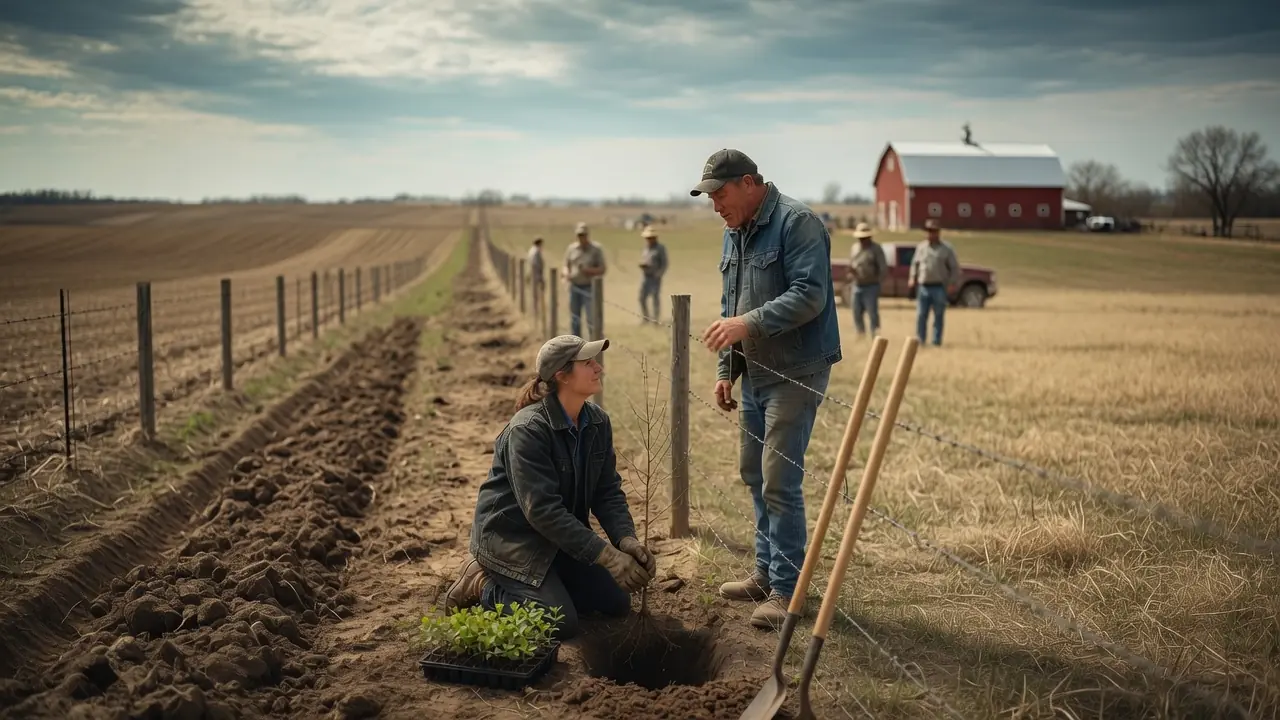
Brad leaned against the fence post in a faded denim jacket, wearing the satisfied grin of a man who had been waiting for Clare to fail. At fifty-two, he owned more than two thousand acres and had broken the county soybean record twice. His fields stretched across the eastern side of the Moss property, bare from fence to road except for corn stubble and deep tractor tracks. Every spring, wind crossed his open ground and struck Clare’s weakest field hard enough to carry away clouds of topsoil.
“You buried 340 sticks in good soil because you’re too clueless to run your father’s farm,” Brad called.
Clare did not look up.
“These roots will save the ground your fields keep bleeding into the wind.”
The men beside Brad laughed louder.
One of them asked how long she planned to wait before the trees became useful. Twenty years? Thirty? Perhaps she expected her grandchildren to harvest acorns after the bank took the farmhouse.
Brad stepped closer to the fence.
“When this little experiment bankrupts you, I’ll buy the farm and rip every tree out.”
Clare rose, brushed the soil from her knees, and met his eyes.
“Bring your checkbook when harvest comes.”
Brad laughed once more and drove away.
Clare watched dust trail behind his pickup, then returned to the next sapling. She had learned quickly that defending a plan before it produced results only gave people more opportunities to mock it. The rows of seedlings would have to answer for her.
The Moss farm had once covered 640 acres, but drought, medical bills, and declining yields had reduced it to 310. Clare’s grandfather bought the original property after returning from Korea and raised corn, wheat, cattle, and three children there. Her father, Daniel Moss, inherited the land and spent thirty-five years trying to preserve it. By the time Clare returned from college, the farm was carrying more debt than profit.
Daniel died from a heart attack eight months before the first trees were planted. He collapsed beside the eastern field while attempting to repair a broken planter alone. Clare found him after sunset with his wrench still in one hand. For months afterward, she could not cross that field without remembering the silence surrounding his body.
Everyone expected her to sell.
Brad offered first.
He came to the farmhouse two weeks after the funeral with a casserole from his wife and an unsigned purchase agreement inside his truck. His offer was below market value, but he described it as generous because the Moss soil had deteriorated badly.
“You don’t need to carry your father’s mistakes,” he told Clare.
She refused.
Brad returned twice with higher offers, but the way he spoke about the land hardened something inside her. He did not see a struggling farm waiting to recover. He saw an exhausted neighbor who could be pressured into surrendering.
Clare had studied agricultural science at the University of Nebraska, focusing on soil health and water management. She spent three years working for a conservation nonprofit before returning home when Daniel’s health declined. Her father respected her education but rarely followed her recommendations, especially those involving trees.
“Trees belong around houses and rivers,” he once said. “Fields are for crops.”
Yet the eastern field proved that crops alone were no longer enough.
Wind erosion had removed nearly three inches of topsoil from sections closest to Brad’s property. Corn there emerged unevenly, struggled during dry weeks, and yielded thirty percent less than the farm average. Every spring storm carved new channels into the surface and left dark Moss soil piled against Brad’s western fence posts.
Clare gathered ten years of yield maps, rainfall records, fertilizer applications, and soil tests. The pattern was undeniable. The weakest ground was not failing because the farm lacked effort; it was failing because nothing protected it.
Her agroforestry plan created five staggered shelterbelt rows along the east boundary. The trees would slow wind, trap snow, provide wildlife habitat, reduce evaporation, and eventually contribute leaf litter and organic matter. Between the rows, Clare planted native grasses, clover, and flowering shrubs to support pollinators and stabilize the soil.
The plan required sacrificing almost eleven acres of cropland.
That was the detail everyone noticed.
Brad calculated the value of the corn she could have grown there and announced the number at the local diner as though reporting a crime. By the end of the week, people said Clare had destroyed fifteen acres, then twenty. Some claimed environmental activists had paid her to stop farming entirely.
The truth was less dramatic.
Clare used a state conservation grant to cover half the saplings and fencing. She paid the remaining costs from her savings, sold an unused grain trailer, and planted almost every tree herself. Her mother, Margaret, helped organize the seedlings while her younger brother, Owen, returned from Omaha for two weekends to run the auger and prepare planting holes.
On the third day, Margaret stood beside the last row and rubbed her aching back.
“Your father would complain about every one of these.”
Clare smiled sadly.
“He would complain while helping.”
“He would.”
That thought made the work easier.
The first summer nearly destroyed the project.
Rain stopped in June, and temperatures remained above ninety degrees for weeks. Clare hauled water using a plastic tank mounted on an old trailer, driving slowly along the rows before sunrise and again after sunset. She lost twenty-seven saplings despite the effort.
Brad saw the dead trees and stopped his pickup beside the road.
“Your forest is dying.”
Clare held the hose beneath a young oak.
“Twenty-seven out of 340.”
“That’s only the beginning.”
“I ordered replacements.”
“You’re throwing money into holes.”
Clare looked toward his field, where dry wind lifted soil behind a cultivator.
“So are you.”
Brad’s expression hardened.
That autumn, Clare measured the first changes.
The trees were too small to block significant wind, but the native grass strips already reduced surface movement. Soil moisture sensors showed the protected edge retained water nearly a day longer after light rainfall. Earthworm counts remained low, yet organic matter had increased slightly where mulch surrounded the trees.
The results were modest.
Clare documented them anyway.
She created a spreadsheet containing every measurement: wind speed, soil temperature, moisture, organic matter, infiltration rate, crop height, pest damage, and yield. She took photographs from fixed locations each month and marked every tree that died, survived, or required replacement.
Brad produced twelve more bushels of corn per acre that year than Clare did.
He mentioned it whenever they met.
At the grain elevator, he asked whether trees could be sold by the bushel. At the hardware store, he suggested Clare open a Christmas tree farm if crops became too difficult. His jokes were sharp enough to embarrass her but casual enough that anyone objecting would appear overly sensitive.
Clare stopped responding.
During the second year, the shelterbelt began taking shape.
Cottonwoods grew fastest, rising above Clare’s shoulders by late summer. The cedars remained shorter but thickened near the ground, filling gaps where winter wind might pass. Plum shrubs produced their first blossoms, attracting bees along a boundary previously almost empty of insect life.
The difference in snow accumulation surprised even Clare.
Winter storms usually swept snow entirely from the eastern field, depositing it in ditches or against the farmhouse windbreak. That year, the young trees and grass rows trapped long white drifts across the protected edge. When spring arrived, the snow melted slowly into the soil instead of disappearing through runoff.
Clare planted soybeans in the field.
By July, the first eighty yards nearest the shelterbelt remained visibly greener than the center. Soil temperatures there averaged several degrees lower during the hottest afternoons. Moisture probes showed less evaporation, and the plants produced more pods despite receiving the same seed, fertilizer, and rainfall.
Mrs. Landry, the county conservation officer, visited after seeing Clare’s data in a grant report.
“You’ve been measuring all of this yourself?”
“Every week.”
Mrs. Landry examined the rows, then knelt beside the soybean plants.
“Most farmers stop collecting data when it disagrees with what they hoped.”
“My father taught me not to trust one good season.”
“Your father didn’t plant trees.”
“No, but he trusted records.”
Mrs. Landry encouraged Clare to present the project at a soil-health workshop. Clare initially refused. She had no desire to stand before farmers who had spent two years laughing at her.
Then she remembered Brad’s certainty that the farm would fail.
She accepted.
Only fourteen people attended the workshop, and half came for the free lunch. Clare explained the shelterbelt design, costs, and early measurements without promising miracles. She openly discussed the failed saplings, labor requirements, and acreage removed from production.
Brad sat in the back row.
When questions began, he raised his hand.
“How much profit have those trees produced?”
“None directly.”
“So you spent money, lost farmland, and created more work.”
“I reduced wind speed by twenty-eight percent near the boundary.”
“Wind doesn’t pay bills.”
“No, but lost topsoil increases them.”
A few farmers murmured.
Brad folded his arms.
“Come back when you have a real harvest.”
Clare closed her laptop.
“I will.”
During the third year, Brad’s western field began creating problems for him.
A powerful April storm crossed Nebraska with winds above fifty miles per hour. Brad had tilled early, leaving loose soil exposed. Dark clouds rose from his property and rolled westward like smoke.
The young Moss shelterbelt caught the first wave.
Soil collected inside the grass strips instead of crossing Clare’s entire farm. Wind speed dropped sharply behind the trees, protecting emerging corn plants. Several cottonwood branches broke, and two cedars leaned badly, but the field remained mostly intact.
Brad lost nearly forty acres of seedlings.
He replanted at significant cost.
At the diner, he blamed the seed company.
Nobody mentioned that his missing soil had accumulated beneath Clare’s trees.
She collected samples from both sides of the fence. Laboratory testing showed that soil trapped in the shelterbelt contained higher organic matter than the worn Moss field. Much of it had come from Brad’s property.
Clare did not tell him.
She incorporated the material into the grass rows and planted additional shrubs.
That summer brought another dry period. County corn yields declined, but Clare’s protected field remained stable. The trees were now tall enough to cast narrow strips of afternoon shade, while their roots improved water movement through compacted ground.
Her yield increased eleven percent.
Brad still outperformed her farm overall, but the gap narrowed.
He stopped joking about Christmas trees.
Instead, he criticized the project as unfairly subsidized. He told people Clare’s government grant gave her an advantage unavailable to “real farmers.” When reminded that the same conservation program was open to him, Brad claimed accepting public money meant surrendering control of his land.
Clare attended more workshops.
She shared her records with university researchers and allowed graduate students to install additional sensors. An agricultural magazine published a short article about the shelterbelt, although the headline called Clare a “young environmental farmer,” which irritated her.
“I’m simply a farmer,” she told the reporter.
The article brought visitors.
Some arrived curious.
Others came searching for flaws.
Clare showed everyone the same data, including measurements that had not improved. She refused to transform the farm into a perfect success story while the experiment remained unfinished.
The fourth year began with heavy spring rain followed by extreme heat.
Conditions varied wildly enough to punish farms dependent on one narrow strategy. Fields with compacted soil flooded early, while shallow-rooted crops suffered later. Brad planted corn across nearly every available acre, expecting strong prices.
Clare diversified.
She planted corn in the central field, soybeans near the shelterbelt, and a cover-crop mixture along drainage areas. She also allowed strips of native grass to remain between tree rows instead of mowing them short.
By June, the eastern field looked different from any surrounding property.
Trees rose twelve to eighteen feet along the fence. Plum and chokecherry shrubs filled the lower level, while grasses moved beneath them. Birds nested inside the windbreak, bees covered the flowering plants, and corn stood visibly taller for several hundred feet west of the trees.
Brad stopped at the fence one afternoon.
He studied the field without speaking.
Clare was replacing a damaged moisture sensor.
“What do you want?” she asked.
“Those soybeans look good.”
“They are.”
“How much extra nitrogen did you use?”
“Less than last year.”
Brad frowned.
“That’s impossible.”
“The soil organic matter increased.”
“From leaves?”
“Leaves, roots, reduced erosion, better moisture, cover crops.”
He looked toward the tree rows.
“Don’t start acting like you invented farming.”
“I didn’t.”
“You got lucky with rain.”
“We received the same rain.”
His face tightened.
“When harvest comes, we’ll see.”
Clare stood.
“Yes, we will.”
In August, the county agricultural board announced that it would verify yields for farms entering the annual production record. Brad registered his best 160-acre corn field and made certain everyone knew. He had broken the record four years earlier and expected to reclaim it after another farmer surpassed him by less than two bushels.
Clare registered the eastern field.
People assumed she wanted publicity.
Brad considered it an insult.
He drove to the Moss farmhouse and found Clare repairing irrigation tubing near the barn.
“You’re entering that tree field against mine?”
“I entered the corn section.”
“You think four rows of windbreak make you a record farmer?”
“Five rows.”
“Withdraw.”
Clare stared at him.
“Why?”
“Because when you lose, every article about this little experiment becomes a joke.”
“That sounds like my problem.”
Brad stepped closer.
“You’ve spent four years pretending those trees make you smarter than men who have farmed twice as long.”
“I spent four years measuring what they changed.”
“You wasted good ground.”
“The poorest section is now the strongest.”
“When your numbers collapse under official measurement, don’t blame anyone else.”
Clare returned to the tubing.
“Bring your checkbook.”
He laughed bitterly.
“What?”
“You promised to buy the farm when the experiment bankrupted me.”
Brad’s face darkened.
“I was joking.”
“I wasn’t.”
He left without another word.
Harvest began in October beneath clear skies.
The county inspector, two agricultural board representatives, and a university observer arrived before the combine entered the eastern field. They checked the machine, measured the acreage, verified moisture levels, and documented each load.
Brad parked beside the road with several neighbors.
He claimed he came to ensure fairness.
Clare knew he came to watch her fail.
The first load tested above expectations.
The second was better.
As the combine moved deeper into the protected zone, yields continued rising. The strongest rows stood within the area Brad once called wasted because trees occupied its boundary.
Clare rode inside the cab with Owen.
Neither spoke much.
Every number appearing on the monitor carried four years of work: watering seedlings before dawn, replacing dead trees, enduring jokes, gathering samples, and believing records when people refused to.
By sunset, the final load reached the scale.
The county representatives entered the measurements into their system.
Brad waited beside the fence.
Clare stood near the last planted oak, now taller than she was.
Mrs. Landry approached holding the official result.
“You should read it.”
Clare looked at the number.
For several seconds, she believed a decimal had been placed incorrectly.
The eastern field had averaged 254.7 bushels of corn per acre.
The previous county record was 246.2.
Brad’s registered field yielded 231.6.
Clare closed her eyes.
Her first thought was not victory.
It was Daniel.
She imagined her father standing beside the rows, searching for something to criticize before finally admitting the trees had worked. She wished he could see soil once thin and gray producing the strongest crop in Harding County.
Applause began near the trucks.
Owen lifted her off the ground despite her objections. Margaret cried openly. Mrs. Landry called the state agricultural office to verify the record.
Brad remained beside the fence.
A local reporter approached him before he could leave.
“You publicly criticized the shelterbelt when Ms. Moss planted it. What do you think now?”
Brad glanced toward Clare.
The camera waited.
He could have admitted he was wrong.
Instead, he said, “One good harvest doesn’t prove anything.”
Clare heard him.
She walked toward the fence carrying the official report.
Brad’s friends became quiet.
“You said these trees would bankrupt me,” Clare said.
“They still cost you acreage.”
“They increased production across more land than they occupied.”
“You had university help.”
“They measured. I farmed.”
Brad pointed toward the field.
“Next year could be different.”
“It will be. That’s why I have four years of data, not one harvest.”
The reporter moved closer.
Brad lowered his voice.
“You think this record makes you better than everyone?”
“No.”
Clare held up the yield report.
“It proves you were wrong when you called me clueless.”
His face reddened.
“You still don’t know what you’re doing.”
Clare gestured toward the inspector.
“Then let him explain why the field you called worthless just shattered your record.”
Brad walked away while cameras followed him.
The story spread across Nebraska.
Headlines praised Clare for breaking the county record through agroforestry. Agricultural organizations invited her to speak, while universities requested access to her long-term data. The state conservation department offered funding to create a demonstration site.
Clare accepted only programs that respected the farm as a working operation rather than a tourist attraction.
The increased harvest paid the overdue loan and funded repairs to the grain bins. It did not make the Moss family wealthy, but it removed the immediate threat of foreclosure. For the first time since Daniel’s death, Margaret stopped keeping bank letters hidden beneath the kitchen telephone.
Farmers began requesting saplings.
The same men who laughed beside Brad’s pickup now asked about tree spacing, species selection, maintenance costs, and lost acreage. Clare answered without mocking them.
She knew pride prevented more good decisions than ignorance.
Brad did not ask.
During the following spring, another windstorm crossed the county. His exposed field lost additional topsoil, and drifting dirt buried part of the roadside ditch. The Moss shelterbelt stood firm.
Two weeks later, Brad appeared at Clare’s barn alone.
He removed his cap before speaking.
“I need advice.”
Clare waited.
He looked toward the trees.
“Which species survived best?”
The question was small, but it cost him something.
“Bur oak and cedar,” Clare answered. “Cottonwood grew fastest, but it needs more maintenance.”
“How many rows?”
“Three can work. Five is better if you have space.”
“I don’t want to lose too many acres.”
“Neither did I.”
Brad studied the ground.
“I was hard on you.”
“You were cruel.”
He looked up.
Clare did not soften the word.
“I thought if your plan worked, it meant the rest of us had been farming wrong.”
“It means conditions changed.”
Brad nodded slowly.
“Would you look at my west boundary?”
“Under one condition.”
“What?”
“You never threaten to buy my farm again.”
Shame crossed his face.
“Agreed.”
Clare helped Brad design a smaller shelterbelt.
The decision surprised the county, but she refused to turn knowledge into the same weapon he had used against her. The land did not care who had once laughed. It responded only to how people treated it afterward.
Over the next decade, shelterbelts appeared across Harding County.
Not every project succeeded. Some farmers selected poor species, failed to water new trees, or planted too close to drainage lines. Clare continued warning that agroforestry required planning, patience, and measurement.
The Moss farm became a training site.
Students measured wind speed, soil moisture, bird populations, root growth, and crop yields. Clare installed a small classroom inside the renovated machine shed, naming it after Daniel Moss.
Above the entrance hung one sentence from his old notebook:
A farmer does not own the soil. A farmer borrows its future.
Margaret claimed Daniel had copied the phrase from somewhere else.
Clare left it anyway.
Twenty years after the first planting, the eastern shelterbelt towered above the fence. Bur oaks spread wide branches, cedars formed dense lower protection, and fruiting shrubs supported wildlife throughout the year.
The farm broke no additional county records.
It did something more valuable.
It remained productive through droughts, storms, and changing seasons that damaged less protected fields. Organic matter continued increasing, erosion declined sharply, and water stayed longer where crops could use it.
Clare eventually purchased back forty acres her father had sold.
She did not remove the trees to create more cropland.
She planted another shelterbelt.
At the dedication of the expanded demonstration farm, Mrs. Landry—now retired—stood beside Clare near the first bur oak planted decades earlier.
“Do you remember how small this was?”
“I remember Brad laughing.”
“He planted almost six hundred trees afterward.”
“People can learn.”
Mrs. Landry smiled.
“Did you know the record would happen?”
“No.”
“What did you expect?”
Clare touched the rough bark.
“I expected the soil to stop leaving.”
That had always been the real victory.
The record made people notice.
The trees made staying possible.
Years earlier, Brad and his friends saw 340 useless sticks consuming valuable ground. They laughed because the trees looked weak, slow, and incapable of changing anything.
Clare understood what they could not see.
Roots were working before branches became impressive.
Soil was healing before harvest numbers proved it.
And sometimes the strongest future on a farm began with something everyone else was certain did not belong there.