By the middle of June, every pasture along County Road 12 had been mowed except one. Darla Brockman’s eastern field stood knee-high and uneven, its grasses waving above the fence while neighboring land looked clipped, neat, and respectable. Drivers slowed as they passed, and some rolled down their windows just long enough to laugh. To them, the unmowed pasture looked like proof that a pretty young woman with a university degree had come home believing she knew more than generations of real farmers.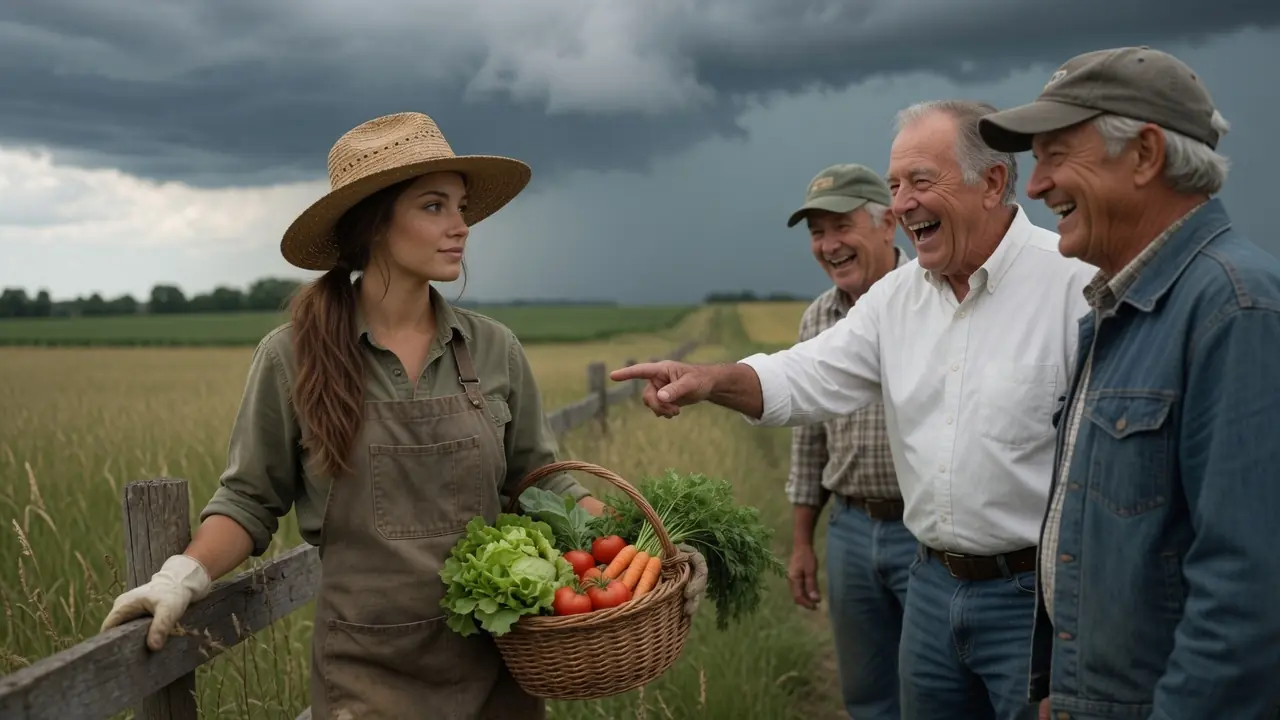
Darla was twenty-three, with softly tanned skin, expressive brown eyes, and long chestnut hair usually tied into a loose ponytail beneath a woven straw hat. She worked in an olive-green shirt, a brown canvas apron, worn boots, and cream-colored gloves that never stayed clean for long. Her appearance attracted attention in town, but the notebook she carried caused far more resentment. Inside were soil readings, grazing records, rainfall totals, forage heights, and every number the older farmers preferred to dismiss as university theory.
Gene Crowley stopped his white truck beside the fence one Thursday morning. At sixty-one, he had sold livestock feed, fertilizer, and pasture treatments in Fillmore County for more than twenty years. Two cattle farmers stood beside him, drinking coffee and studying Darla’s tall grass as though examining a public failure. Gene pointed toward the pasture and laughed loudly enough for her to hear from the vegetable rows.
“That degree made you foolish,” he called. “Mow this mess before your father loses the farm.”
Darla placed her basket of lettuce, carrots, herbs, and tomatoes beside the fence. “Your bad advice sells more feed.”
The two farmers stopped laughing.
Gene’s smile remained, but it became thinner. “July will expose you.”
Darla looked beyond him at the short grass covering his customers’ fields. “Come back when your pastures turn to dust.”
Gene shook his head and returned to his truck. Before driving away, he told the other men that young people usually needed one hard season before they stopped believing every professor with a chart. Darla watched the truck disappear, then opened her notebook and recorded the pasture height beside the date. Fourteen inches in the western section, sixteen near the creek, and soil beneath the plants still soft enough to accept the full length of her pocket knife.
The Brockman family had raised cattle on that land for nearly sixty years. Darla’s grandfather purchased the original farm in 1961, and her father, Lyle, had expanded it to almost seven hundred acres. One hundred forty cattle moved through five major pastures, while hay fields and a small corn operation occupied the remaining ground. Lyle knew every slope, wet corner, weak fence post, and difficult cow on the property.
He had also mowed every pasture in June for more than thirty years.
The system was simple because everyone used it. Cattle entered the fields in May, grazed until the grass became uneven, and then the remaining growth was cut short. Fertilizer encouraged new leaves, and when summer heat slowed the pasture, farmers began feeding hay. Nobody considered the yearly hay expense unusual because their fathers had paid it, too.
Darla had grown up believing the same method was unavoidable. Then she studied animal science and integrated grazing systems at the University of Minnesota. One professor, Dr. Terrence Voss, had spent two decades raising grass-fed cattle before an injury sent him into teaching. He spoke less like an academic and more like a mechanic explaining why an engine failed after years of improper maintenance.
“Grass is not decoration,” he often told his class. “It is a solar panel connected to a root system.”
When cattle grazed plants too closely and farmers immediately mowed what remained, the grass lost most of its ability to collect sunlight. The plant used its stored energy to replace leaves as quickly as possible, sacrificing deeper root development in the process. After years of repeated cutting, roots remained close to the surface. When July heat dried the top few inches of soil, those plants had nowhere else to search for water.
Grass allowed to grow tall behaved differently. Its larger leaf area captured more energy and supported roots reaching into cooler, wetter soil. If livestock grazed the pasture briefly and the field then rested long enough, both the plants and the ground recovered. The system looked neglected above the surface precisely because its most important work occurred below it.
Darla returned home after graduation with diagrams, research papers, and a proposal for the farm. She wanted to divide the eastern pasture into four smaller paddocks using temporary electric fencing. The cattle would graze one section intensely for a few days, then move before eating the plants down too far. Each section would rest for weeks without mowing.
Lyle studied her spreadsheet at the kitchen table without speaking. Her mother, Carol, stood near the sink, watching him turn the pages. The fencing costs were reasonable, but the system contradicted everything Lyle’s experience told him a responsible farmer should do. Tall grass looked wasteful, seed heads looked rank, and an unmowed field invited every neighbor to assume laziness.
“I’ve been cutting that pasture since before you were born,” he finally said.
“I know.”
“And you want me to leave it looking abandoned.”
“I want you to let me prove it isn’t abandoned.”
Lyle looked again at the projected hay savings. “One pasture.”
Darla nodded. “One pasture.”
His agreement was not enthusiasm, but it was enough.
In May, Darla moved the cattle away from the eastern field and installed temporary fencing. By early June, the grass grew beyond the height most farmers considered acceptable. The cattle watched from the adjoining lot and bawled whenever Darla passed, impatient to return to the forage they could see through the wire.
Lyle became quieter each time a neighbor slowed near the road.
At the Preston Co-op, Gene Crowley turned the experiment into a daily conversation. He told customers the Brockmans were starving cattle beside perfectly usable grass. He joked that Darla had learned more about PowerPoint presentations than livestock. Each remark sounded friendly enough to deny malice, but every farmer hearing it understood the warning: trust the young woman, and people might laugh at you next.
Darla entered the store one morning while Gene spoke to Wes Rasmussen and Don Ebersole. They stopped talking when she approached the counter, but Gene appeared pleased by the opportunity.
“I hear you’re resting that pasture for nearly seventy days,” he said.
“Sixty-five minimum.”
“That grass will be all stems by then.”
“The leaves grow above the stems after recovery.”
Gene lifted his coffee. “According to the university.”
“According to field trials in Oklahoma, Missouri, Kansas, and three Minnesota farms.”
He smiled at Wes and Don. “I’ve sold pasture products here for twenty-two years.”
“And farmers still buy emergency hay from you every August.”
The directness surprised him.
Gene set down his cup. “Careful, Darla. You’re suggesting people who have done this their whole lives don’t understand their land.”
“I’m suggesting the land changes whether they admit it or not.”
“You think a notebook replaces experience?”
“No. I think it keeps experience from becoming an excuse.”
The store fell silent.
Gene stepped closer, lowering his voice. “When that useless grass dies, the whole county will remember the pretty little girl who thought she knew better.”
Darla picked up her receipt. “Then make sure they come back in July.”
She walked out before he could answer.
At home, she said nothing about the confrontation. She went directly to the eastern pasture and collected soil samples at four, eight, and twelve inches. The top layer was beginning to dry, but deeper ground remained cool and moist. She recorded the numbers, photographed the plant crowns, and marked several test areas with small orange flags.
Lyle watched from the fence.
“You all right?” he asked.
“Yes.”
“Gene say something?”
“He usually does.”
Lyle looked toward the road. “You don’t need to prove anything to him.”
“I’m not proving it to Gene.”
“Who, then?”
Darla pressed the soil back into the hole. “The farm.”
June ended with almost no rain.
The first week of July brought clear skies, dry wind, and heat that settled over Fillmore County without relief. Daytime temperatures climbed, and the nights stayed too warm for stressed plants to recover. Mowed pastures began losing their color.
By July tenth, cracks appeared in exposed soil. Short grass across the county stopped growing and turned from green to gray. Cattle grazed closer to the ground, searching for leaves that were no longer there. Farmers began opening hay barns earlier than expected.
Gene’s phone rang constantly.
Wes Rasmussen needed delivered hay for sixty cows. Don Ebersole wanted to know whether prices might fall before August. Other farmers asked for protein supplements because their cattle were losing condition on dormant pasture.
The price climbed with every call.
At the Brockman farm, Darla returned to the eastern pasture with a soil probe. At four inches, the earth was nearly as dry as the neighboring fields. At eight inches, it still held measurable moisture. At twelve inches, the difference was greater than she had hoped.
The roots had followed the water.
The grass remained green.
It was not bright spring green, and growth had slowed under the heat, but the pasture was alive while fields surrounding it entered dormancy. Darla walked the fence line twice to ensure she was not imagining the contrast. Then she called her father.
Lyle arrived in the farm truck and stood beside her without speaking.
Across the county road, the Rasmussen pasture looked pale and flat. On the Brockman side, tall stems moved in the wind above dense layers of leaves. The difference was no longer hidden beneath the ground.
“When do you open it?” he asked.
“Tomorrow morning.”
“How many cattle?”
“Forty-seven in the first paddock.”
“You’re sure they’ll eat it?”
“No.”
Lyle glanced at her.
Darla smiled faintly. “I’m confident they will.”
At sunrise, she removed the temporary wire separating the first section. The cattle entered cautiously for only a moment. Then they lowered their heads and began selecting the green leaves growing around and above the mature stems.
They did not hesitate again.
For hours, the animals moved steadily across the paddock, taking bites without pulling the plants to the ground. Darla monitored them, shifted mineral tubs, checked the water line, and measured the grass after they passed. By evening, most plants remained eight inches tall, exactly the residual height she had planned.
Lyle stood at the fence after supper.
He had watched cattle graze for more than three decades. He knew when they were hungry, when they were merely chewing, and when they had found good forage. The animals before him were eating with the quiet concentration of a herd receiving everything it needed.
Darla approached with her notebook.
“They’re holding condition,” she said.
“I can see that.”
“The second paddock should carry them five days.”
Lyle kept watching the cattle. “What would it cost to divide the south pasture next spring?”
She turned toward him. “About twenty-two hundred dollars if we use temporary wire.”
“And water?”
“We can run a line from the existing tank.”
He nodded slowly. “Price it again.”
Darla did not smile until she reached the barn.
The drought continued.
By July eighteenth, hay trucks moved along nearly every county road. Farmers who had expected to begin feeding in August were already opening winter reserves. Those without enough stored hay purchased it at rising prices.
Gene drove past the Brockman farm on his way to visit Wes Rasmussen. He slowed near the eastern pasture.
The cattle grazed in the second paddock. Behind them, the first section showed fresh green growth near the base of the plants. The neighboring fields were brown.
Darla saw his truck from the water tank.
Gene did not stop.
He continued toward Wes’s farm, where cattle stood around a metal feeder consuming hay that had been purchased at emergency prices. Wes leaned against his gate, studying the delivery invoice.
“You drove past the Brockman place?” he asked.
Gene removed his cap. “Yes.”
“Still green?”
“Yes.”
Wes looked at the dead field behind him. “Darla offered you the research.”
Gene did not answer.
By the end of July, the Brockman cattle had moved through all four paddocks without receiving a single bale of hay. Darla calculated the forage used, the days of grazing gained, and the cost avoided. The savings from one field were not enough to transform the entire operation, but the lesson was larger than one month’s bill.
The pasture had survived because it entered the drought prepared.
Its strength had not appeared suddenly when the rain stopped. It had been built during the weeks when everyone laughed at its height. Every uncut leaf had supported deeper roots. Every day of rest had stored energy for the difficult season ahead.
Carol placed the farm’s hay invoices from previous years beside Darla’s current records.
“You were expecting this,” she said.
“I was hoping for proof.”
“Looks like you got it.”
Darla looked toward her father through the kitchen window. Lyle was measuring the south pasture and writing fence distances on the back of an old feed receipt.
“I got permission for another year,” she said.
Carol smiled. “No. You changed his mind.”
In August, the drought eased only slightly. Several storms passed north of the county, leaving little more than dust-speckled wind behind them. Conventional pastures remained dormant, but the Brockman eastern field continued producing enough regrowth to extend grazing.
Ingrid Lindgren arrived one afternoon without calling first. She was a forty-seven-year-old widow who managed four hundred acres alone after her husband’s death. Darla had seen her at auctions and farm meetings but had never spoken with her longer than a few minutes.
“I’ve driven past your field six times,” Ingrid said.
Darla leaned against the gate. “That sounds suspicious.”
“I kept telling myself it was greener because of the creek.”
“The creek doesn’t reach most of it.”
“I know. That’s why I’m here.”
They spent two hours at the kitchen table reviewing paddock maps, rainfall records, soil moisture readings, and hay expenses. Ingrid asked practical questions rather than challenging the idea itself. How often did Darla move cattle? How did she manage water? What happened when the grass appeared too mature?
Before leaving, she took copies of the research and asked Darla to visit her farm in spring.
“You want me to design it?” Darla asked.
“I want you to tell me where I’m wrong before July does.”
Word spread.
Not everyone became convinced, but the jokes weakened. People still called the eastern field untidy, yet they did so while calculating hay bills. Farmers who once slowed to laugh now slowed to study the cattle.
Gene returned in September.
He arrived early, while Darla checked a calf in the barn. His white truck stopped near the gate, but he remained beside it until she approached. For once, he carried no coffee, no audience, and no smile prepared for other men.
“I’ve been visiting farms all week,” he said.
Darla waited.
“Pastures that looked perfect in June now look like parking lots.”
“Yes.”
“I told Wes and Don you would be feeding hay by August.”
“I know.”
Gene looked toward the eastern field. Autumn rain had revived the plants, but its color remained deeper than neighboring ground. “How many grazing days did you gain?”
“Thirty-one so far.”
“And hay savings?”
“On that group, a little over seventeen hundred dollars. The full farm total will be more.”
He nodded. “What would it take to use your system on four hundred acres?”
Darla studied him.
“You offered to show me the citations in June,” Gene continued. “I should have taken them.”
“You should have.”
His eyes tightened, but he accepted the answer. “Will you help me explain it to Wes and Don?”
“I’ll explain what happened here.”
“That’s all I’m asking.”
“No, it isn’t.”
Gene looked at her.
“You want something simple enough to sell,” Darla said. “A new formula that replaces the old formula.”
He placed his hands in his pockets. “People need recommendations.”
“They need questions first. Soil type, rainfall, herd size, recovery time, root depth. This isn’t another product you apply in June.”
Gene remained quiet.
“The ground doesn’t care what worked for twenty-two years,” Darla continued. “It responds to what you did last season and what you’re doing now. If you recommend the same treatment to every farm, then you aren’t managing pasture. You’re managing customers.”
The words struck harder than the insult she had given him at the fence.
Gene looked back at his truck. “Will you come?”
“Yes. But you introduce me as the farmer whose advice you ignored.”
A reluctant smile appeared. “Fair enough.”
The following spring, Darla divided the south pasture into six paddocks. Ingrid Lindgren installed eight on her farm. Wes converted half his grazing land, while Don began cautiously with one field.
Gene stopped recommending automatic June mowing.
He never publicly announced the change. Instead, he began asking customers how long each pasture rested, how low cattle grazed it, and whether anyone had measured soil moisture below four inches. Some farmers noticed the shift, while others assumed those had always been his questions.
The summer that followed was wet, and the difference between systems appeared modest. Critics claimed Darla had benefited from one unusual dry year. She answered by continuing to collect data.
“Good weather is not the test,” she told her father. “Bad weather is.”
The test came two years later.
That summer brought the worst drought Fillmore County had experienced in decades. Rain almost disappeared in June, and July temperatures stayed above normal for weeks. Conventional pastures failed earlier than they had during Darla’s first experiment.
Hay prices rose beyond two hundred dollars per ton.
Some farmers sold cattle because they could not afford enough feed. Others emptied winter reserves before August arrived. The entire county discovered how expensive shallow roots could become.
By then, four of the Brockman farm’s five pastures operated under Darla’s system.
They remained green.
The grass did not grow quickly, but it continued growing. Roots in the oldest restored pasture reached more than twice their original depth, drawing moisture unavailable to neighboring plants. The Brockmans bought almost no hay until the final weeks of summer.
Their total drought-season hay expense was less than two thousand dollars.
A nearby operation spent more than twenty-eight thousand.
Lyle sat at the kitchen table when Darla finished the comparison. He read the figures twice, just as he had read her original proposal years earlier.
“You were right,” he said.
Darla closed the notebook. “You let me try.”
“I gave you one pasture when I should have given you all five.”
“One pasture was enough.”
Lyle looked toward the north field, where forty acres of corn struggled beneath the heat. “What would you do with that ground if it belonged to you?”
Darla stared at him. “Are you asking?”
“I’m listening.”
Years later, Darla stood before nearly one hundred farmers at the county conservation meeting. She wore a canvas work jacket and kept her hair tied behind her shoulders. On the screen behind her were photographs of the tall eastern pasture, soil-core measurements, grazing records, and drought-year expenses.
Gene sat in the third row.
Nobody laughed when Darla displayed the photograph taken in June—the one showing her standing beside grass everyone called filthy and neglected. Nobody mocked her notebook when she showed the difference in root depth three years later.
“The hardest season is the first,” she told them. “Everything above the ground looks wrong because the success is still invisible. Your neighbors see tall grass. You have to understand the roots.”
After the meeting, Gene approached while she packed her laptop.
“I should have listened the first time,” he said.
Darla zipped the case. “You listened eventually.”
“Later than I should have.”
“Earlier than some.”
Lyle waited in the back of the room. When the last farmer left, he walked forward, picked up Darla’s box of handouts, and carried it to her truck without speaking.
His hand rested briefly on her shoulder.
That was enough.
The county remembered the summer when everyone laughed at Darla Brockman’s unmowed pasture. They remembered Gene Crowley promising that July would expose her. They remembered the heat arriving, the rain disappearing, and neat fields turning brown.
But Darla’s grass never needed to prove itself with words.
While the county laughed at what they could see, deep roots continued growing where nobody was looking.
Then July came.
And the ground answered for her.