“Shave her head.”
The order stopped every sound inside the disciplinary room at Fort Blackwood.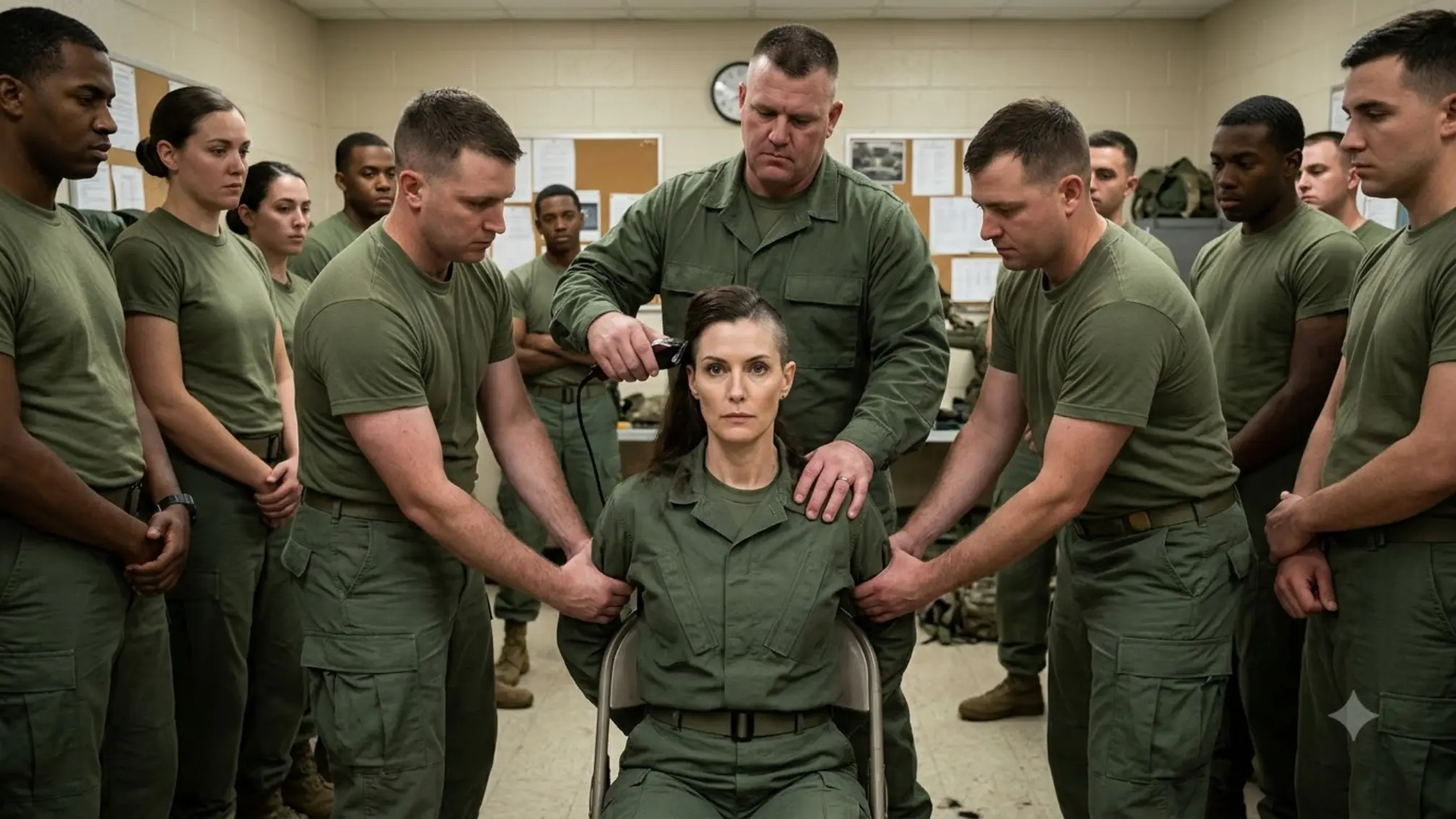
Rachel Scott sat perfectly upright in the metal chair while two soldiers held her arms against her sides. She looked forty-four, older than most of the transfers passing through the installation, with fair skin, sharp blue-gray eyes, elegant features, and long dark-brown hair pulled into a low bun. Nothing on her plain olive-green uniform suggested importance. No visible rank. No decorations. No special insignia. To Sergeant Nolan Brooks, she was simply an inconvenient enlisted transfer who had refused to obey him in front of witnesses.
The electric clippers buzzed in his hand.
Brooks leaned over her shoulder. “Maybe shame will teach you what discipline couldn’t.”
Rachel looked at the soldiers surrounding the chair. Several avoided her eyes. Others stared at the floor. One young man near the wall looked physically sick but did nothing.
Rachel returned her attention to Brooks.
“Do it,” she said quietly. “Just make sure everyone remembers who gave the order.”
A faint smile crossed Brooks’s face. “You still think somebody above me is coming to save you?”
Rachel’s expression never changed.
“No.”
She looked directly into his eyes.
“I came here to find out exactly how far you’d go.”
Something about the sentence bothered him, but only for a second.
Then he pushed the clippers against the side of her head.
Dark hair fell across her shoulder.
Nobody in the room knew they had just reached the end of an investigation that had begun four months earlier.
Back then, Colonel Sarah Miller had been sitting across from General Alexander Vance inside a secured office nearly three hundred miles away. Her actual uniform carried a rank no one at Fort Blackwood would have dared treat casually. She had spent more than two decades managing logistics, maintenance systems, personnel readiness, and operations involving thousands of people.
She was also one of the few officers Vance trusted enough to tell what he truly suspected.
Fort Blackwood looked perfect on paper.
That was the problem.
Its equipment readiness percentage remained unusually high despite repeated supply shortages. Its disciplinary statistics were low even though transfer interviews described constant intimidation. Maintenance reports showed almost no delays, yet mechanics complained privately that damaged equipment was being pushed back into service.
And every time headquarters scheduled an inspection, the installation somehow became flawless overnight.
Files were corrected.
Missing equipment reappeared.
Complaining soldiers suddenly insisted nothing was wrong.
Witnesses transferred.
Sarah studied the reports scattered across Vance’s desk.
“Someone is warning them.”
Vance nodded.
“Or the problems are exaggerated.”
“You don’t believe that.”
“No.”
Neither did she.
One report described a young technician forced to publicly apologize for refusing to sign an equipment certification he had not performed. Another described soldiers made to stand before their peers while supervisors insulted them until they admitted mistakes that did not exist. Three anonymous statements named Sergeant Brooks.
Captain Tyler Reed appeared repeatedly too.
Reed was executive officer for the unit responsible for logistics readiness. On paper, his section had some of the best numbers in the region.
Numbers Sarah no longer believed.
“Send another inspection team,” Vance said.
“They’ll prepare for them.”
“Then what do you suggest?”
Sarah already knew.
“Send me.”
Vance looked up.
She continued.
“Without rank.”
His expression hardened immediately.
“No.”
“I enter under an administrative transfer identity. Older enlisted soldier. No special qualifications. No command connections.”
“No.”
“They won’t perform for me.”
“They may abuse you.”
“That’s what we need to know.”
Vance stood.
“You are asking me to deliberately place a colonel under people we suspect of unlawful treatment.”
“Yes.”
“And if your cover breaks?”
“It won’t.”
“And if somebody hurts you?”
Sarah held his stare.
“Then we stop arguing about whether the reports are real.”
Vance walked toward the window.
For several seconds, he said nothing.
Finally he asked, “What name?”
Sarah answered, “Rachel Scott.”
Three weeks later, Colonel Sarah Miller disappeared from normal administrative systems.
Her visible history was replaced by a deliberately ordinary personnel record.
Rachel Scott.
Age forty-four.
Midcareer transfer.
Average evaluations.
No elite schools.
No influential assignments.
No visible connections.
Only three people outside the investigation knew who Rachel truly was.
When her bus reached Fort Blackwood, nobody saluted.
That was the point.
Captain Tyler Reed barely finished reading the first page of her file before deciding who she was.
“Forty-four?”
“Yes, sir.”
“No advanced qualifications?”
“Nothing listed, sir.”
He tossed the file onto his desk.
“Another slow transfer.”
Sarah recorded the phrase mentally.
Reed pressed the intercom.
“Send Brooks in.”
The sergeant arrived less than a minute later.
Nolan Brooks was forty-five, broad-shouldered, physically imposing, and accustomed to using size before words. His closely cropped hair and hard expression gave him the appearance of someone permanently waiting to find weakness.
He looked Sarah over.
“Problem?”
Reed smirked.
“Not yet.”
Brooks smiled.
“Give me a day.”
Sarah almost thanked him.
Instead she lowered her eyes exactly enough to remain unremarkable.
The first week gave her more evidence than the previous three official inspections combined.
Nobody committed obvious crimes in front of her.
They did something worse.
They behaved normally.
Normal at Fort Blackwood meant soldiers flinched whenever Brooks entered a room.
It meant people signed forms they had not read because questioning a supervisor created problems.
It meant damaged equipment remained categorized as serviceable until somebody could quietly fix it later.
It meant shortages disappeared from inventory through handwritten adjustments that no one could properly explain.
Sarah kept notes in places nobody would search.
Dates inside memorized sequences.
Names attached to ordinary phrases.
Document numbers written beneath laundry labels.
She never stole records.
She did not need to.
She only needed enough specific information for investigators to know where to look later.
On her third day, she saw Specialist Noah Brennan refuse to sign a maintenance sheet.
The young soldier pointed toward a hydraulic assembly.
“This hasn’t been tested.”
Brooks stepped closer.
“You questioning Sergeant Keller’s inspection?”
“No, Sergeant. I’m saying I didn’t witness it.”
“You were told to sign.”
Brennan hesitated.
Brooks leaned into his face.
“Are you calling your leadership dishonest?”
“No.”
“Then sign.”
Brennan signed.
Sarah watched everything.
That evening she found him alone outside the barracks.
“You okay?”
He looked around before answering.
“Don’t do that.”
“Do what?”
“Ask questions.”
“Why?”
His eyes moved toward the building.
“Because eventually he asks them back.”
Sarah said nothing.
Brennan lowered his voice.
“Whatever you see here, keep your head down.”
Sarah almost smiled at the irony.
She had come specifically to do the opposite.
But she waited.
A successful investigation required patience.
Brooks needed to believe he controlled the situation.
So Sarah let him.
She accepted unnecessary extra duties without complaint.
She stood through pointless inspections.
She endured insults about her age.
Brooks repeatedly referred to her as “grandma transfer” in front of younger soldiers.
Sarah never reacted.
That frustrated him.
Bullies preferred anger because anger could be punished.
Calmness gave them nothing.
Eventually Brooks began trying harder.
He ordered Sarah to repeat equipment inventories already completed.
He reassigned her work after she finished it.
He accused her of moving too slowly while simultaneously demanding impossible documentation.
Sarah complied with anything lawful.
That distinction became increasingly important.
Then she found the first serious discrepancy.
A set of vehicle recovery components had been listed as operational even though two pieces were visibly damaged.
Sarah opened the maintenance file.
The certification bore three signatures.
One belonged to a soldier who had transferred two weeks before the inspection supposedly occurred.
Impossible.
She brought the sheet to Brooks.
“This date is wrong.”
He barely looked.
“Then fix it.”
“I wasn’t involved in the inspection.”
“Correct the paperwork.”
“I can’t certify something I didn’t inspect.”
His eyes lifted.
“Did I ask you to certify it?”
“The signature block requires certification.”
“You’re being difficult.”
“I’m reading the form.”
Brooks leaned closer.
“Rachel, nobody here needs a forty-four-year-old transfer teaching us paperwork.”
Sarah held his gaze.
“Then whoever signed it incorrectly should fix it.”
That was the moment his attitude changed.
Before, Sarah had been annoying.
Now she was dangerous.
Not because he suspected her identity.
Because she had shown she would not participate.
Two days later Captain Reed summoned her.
He sat behind his desk with Brooks standing beside the wall.
Reed held the disputed maintenance form.
“You’re creating friction.”
Sarah remained at attention.
“I identified an incorrect certification, sir.”
“You identified something your supervisor already handled.”
“No, sir.”
Reed’s expression hardened.
“Excuse me?”
“The record remains incorrect.”
Brooks smiled faintly.
Reed tapped the paper.
“You are new here.”
“Yes, sir.”
“You don’t understand how this installation works.”
Sarah almost answered with exactly the sentence he deserved.
Instead she said, “Then explain it, sir.”
His eyes narrowed.
“Equipment must remain mission ready.”
“Yes, sir.”
“Paperwork delays create readiness problems.”
Sarah looked toward the form.
“Damaged equipment creates readiness problems.”
Silence.
Brooks shifted behind her.
Reed leaned back.
“You’re ambitious.”
“No, sir.”
“You trying to impress somebody?”
“No.”
“You think regulations make you smarter than everyone here?”
“No, sir.”
“Then why are we having this conversation?”
Sarah answered simply.
“Because the form is false.”
Reed’s face went still.
Brooks stopped smiling.
Sarah knew she had crossed the threshold.
Good.
From then on, the retaliation became visible.
She lost weekend liberty.
Received additional inspections.
Was blamed for minor errors belonging to other soldiers.
Brooks began criticizing her publicly.
Sarah documented everything.
Still, she refused to provoke anything intentionally.
An undercover investigation meant recording reality, not manufacturing it.
Fort Blackwood provided enough reality by itself.
The breaking point came during morning formation.
Brooks distributed readiness certifications concerning twelve vehicles.
Sarah reviewed the sheet assigned to her.
“I can’t sign this.”
He looked at her.
“What?”
“I didn’t inspect these vehicles.”
“Maintenance section did.”
“Then maintenance should certify them.”
Brooks stepped closer.
“You were ordered to sign.”
Sarah kept her voice even.
“I won’t certify an inspection I didn’t perform.”
The formation became silent.
Brooks stared.
He had humiliated soldiers privately and publicly for years because most chose survival over resistance.
Sarah had refused him in front of everyone.
He could not tolerate that.
“Barracks.”
Sarah did not move.
Brooks pointed.
“Now.”
Inside the disciplinary room, he assembled twenty soldiers.
Captain Reed arrived shortly afterward.
Sarah noticed that detail.
Reed was not surprised by what followed.
He was participating.
Brooks placed Sarah in the center.
“Tell everybody why we’re here.”
She answered, “I refused to certify equipment I did not inspect.”
He laughed.
“See?”
Nobody responded.
Brooks paced around her.
“She thinks she’s too good to follow instructions.”
Sarah looked toward Reed.
He remained near the door.
Brooks continued.
“She thinks regulations protect her from consequences.”
Sarah said, “Regulations apply to everyone.”
A few soldiers looked up.
Brooks’s face reddened.
“What did you say?”
Sarah repeated it.
“Regulations apply to everyone.”
The room became still.
Brooks turned toward one of the soldiers.
“Bring me the clippers.”
The young man froze.
Brooks shouted.
“Now!”
Captain Reed said nothing.
That silence told Sarah everything.
The clippers arrived.
Brooks switched them on.
“Shave her head.”
Two soldiers hesitantly held Sarah’s arms.
She did not resist.
Not because Brooks had authority to do this.
Because the investigation had finally reached the point where nobody could claim the abuse was rumor.
Brooks pressed the clippers against her hair.
The first pass exposed a strip of scalp above her left ear.
Hair fell across the olive uniform.
A young soldier whispered, “Sergeant, maybe we should stop.”
Brooks snapped toward him.
“You want next?”
The soldier lowered his eyes.
Sarah memorized his face.
Not because she blamed him.
Because fear itself was evidence.
Another strip of hair fell.
Brooks leaned close.
“You feel important now?”
Sarah looked forward.
“No.”
“Embarrassed?”
“No.”
His jaw tightened.
Sarah finally turned her head slightly.
“You should be.”
Brooks grabbed the back of the chair.
“What did you say?”
Sarah looked at Captain Reed.
“Is he giving this order with your approval, sir?”
Reed hesitated.
That hesitation mattered.
Brooks answered for him.
“He doesn’t need to approve my discipline.”
Sarah looked toward the soldiers.
“Everybody heard that?”
Brooks suddenly stopped.
Something had changed in her voice.
For nine days, Rachel Scott had deliberately softened her posture, reduced her command presence, and spoken like someone accustomed to obeying rather than directing.
Now Colonel Sarah Miller returned.
She sat straighter.
Her eyes changed.
Even with half her hair cut away, the entire room felt the difference.
Brooks noticed.
“What are you doing?”
Sarah ignored him.
She looked toward Brennan.
“Specialist, what time is it?”
He blinked.
“Ma’am?”
“Exact time.”
He checked the wall.
“09:42.”
Sarah nodded.
Then looked toward Reed.
“Good.”
Reed’s face changed.
“Why?”
Sarah did not answer.
At 09:43, the barracks door opened.
Two unfamiliar investigators entered.
Behind them came General Alexander Vance.
Nobody moved.
For perhaps two seconds, Brooks did not recognize him.
Then he did.
His entire body stiffened.
Captain Reed turned white.
Vance entered slowly.
His eyes went immediately to Sarah.
Half of her hair was gone.
The rest hung unevenly across one shoulder.
Two soldiers still held her arms.
Brooks still carried the clippers.
Vance stopped.
Nobody breathed.
He looked toward Brooks.
“Remove your hands.”
The soldiers released Sarah instantly.
Brooks lowered the clippers.
“General, sir, this soldier—”
Vance’s gaze moved toward him.
Brooks stopped speaking.
Vance stepped toward Sarah.
“Colonel Miller.”
The room seemed to physically recoil.
Brooks stared.
Captain Reed’s mouth opened.
No sound came.
Sarah stood.
Even in the plain uniform.
Even with her hair partially shaved.
Even without visible rank.
The moment Vance called her Colonel, every assumption in the room collapsed.
Brooks looked from Sarah to the general.
“No.”
Sarah’s voice remained calm.
“Yes.”
Reed stepped forward.
“Sir, I can explain.”
Sarah looked at him.
“Please do.”
He stopped.
The investigators moved throughout the room.
One collected the clippers.
Another photographed the chair, fallen hair, personnel present, and disciplinary log.
Vance looked at Brooks.
“Did you order this?”
Brooks swallowed.
“She refused a lawful instruction.”
“That wasn’t my question.”
Brooks glanced at Reed.
Sarah noticed.
Vance did too.
“Did you order soldiers to shave Colonel Miller’s head?”
Brooks finally answered.
“Yes, sir.”
Vance turned toward Reed.
“Did you stop him?”
Reed’s face drained.
“No, sir.”
“Did you know?”
Silence.
“Captain.”
“Yes, sir.”
Vance looked around the room.
“Nobody leaves.”
Within two hours, investigators had secured Fort Blackwood’s administrative offices, maintenance records, readiness databases, supply logs, camera systems, and internal complaint files.
What they discovered was larger than Sarah expected.
Readiness numbers had been manipulated for nearly three years.
Equipment defects were delayed in reporting.
Supply shortages were hidden through false transfers.
Several supervisors had pressured junior personnel into signing documents they did not verify.
Brooks had personally conducted dozens of unauthorized public punishments.
Reed knew.
Worse, Reed encouraged the culture because perfect statistics protected his advancement.
The missing supply money turned out not to be a massive theft operation, as investigators initially feared. Instead, managers had redirected funds between unauthorized categories to conceal budget overruns and equipment failures.
It was still serious.
But the greater failure was cultural.
People had learned that telling the truth carried greater personal risk than falsifying records.
Brennan testified first.
Then others followed.
Once Brooks and Reed no longer controlled assignments, the silence collapsed quickly.
Sarah spent three days giving statements.
The shaving incident became only one piece of the case.
Brooks faced administrative and criminal review for unlawful treatment, coercion, falsification, and other misconduct.
Reed was removed from command and later separated after proceedings confirmed he knowingly permitted false certifications and retaliated against personnel raising concerns.
Other leaders received consequences ranging from reprimands to removal.
But Sarah insisted on something Vance initially resisted.
“Don’t destroy everybody.”
He looked at her.
“They participated.”
“Some participated because they were afraid.”
“That doesn’t erase responsibility.”
“No.”
Sarah touched the uneven side of her head.
“But responsibility has degrees.”
The young soldiers who had held her arms were interviewed.
Neither had previous misconduct.
Both admitted immediately that they knew Brooks’s order was wrong but feared refusing him.
Sarah recommended corrective training rather than career-ending punishment.
Vance asked why.
“Because if we punish fear exactly like abuse,” Sarah said, “we teach the next witness to hide.”
Six months later, Fort Blackwood changed.
The readiness numbers initially became worse.
Much worse.
That was considered progress.
Damaged equipment was finally labeled damaged.
Shortages appeared honestly.
Maintenance delays were recorded.
Leadership stopped treating bad statistics as embarrassment and began treating them as information.
Anonymous reporting moved outside the local chain of command.
Supervisors received explicit limits on corrective actions.
Every certification required the signer to have actual knowledge of what they were certifying.
Sarah returned once after the investigation ended.
Her hair had grown into a short, elegant cut.
She walked through the same barracks without disguise.
Brennan saw her first.
He immediately stood.
“Colonel.”
Sarah smiled.
“At ease.”
He looked toward her hair.
“I’m sorry.”
“For what?”
“I didn’t stop him.”
Sarah studied him.
“You were afraid.”
“I should’ve done something.”
“Yes.”
The answer surprised him.
She continued.
“But you’re still here.”
He waited.
“So next time?”
Brennan nodded.
“I do something.”
“That’s the point.”
Before leaving, Sarah walked into the old disciplinary room.
The metal chair was gone.
The room had been converted into a small ethics and reporting office.
On one wall hung a simple framed statement.
A lawful organization does not fear accurate records.
Vance had chosen it.
Sarah stood there for a long time.
The clippers had not broken her.
But she never turned the incident into a story about toughness.
That would have missed the lesson.
The important question was never whether Sarah could endure humiliation.
She already knew she could.
The important question was why an institution had allowed a sergeant to believe humiliation was leadership in the first place.
Years later, when younger officers asked Sarah about Fort Blackwood, they usually expected the famous moment.
The clippers.
The hidden colonel.
The general walking through the door.
The stunned faces.
Sarah always corrected them.
“The reveal wasn’t the victory.”
They usually looked confused.
She explained.
“If I had revealed my rank one minute earlier, Brooks would’ve stopped.”
“And that would’ve been good, ma’am.”
“For me.”
Sarah nodded.
“But what about the next Rachel Scott who really had no rank?”
That question always ended the conversation.
Because Brooks’s greatest mistake was not humiliating a colonel.
A colonel could recover.
A colonel had access.
A colonel had people who would eventually listen.
His real failure was believing someone without visible status deserved less protection.
Sarah had entered Fort Blackwood to discover what happened when powerful people thought nobody important was watching.
They showed her.
And afterward, the reforms were built around one principle Sarah refused to negotiate:
Respect could never depend on discovering that the person in front of you secretly outranked you.
Months after the case closed, Sarah found one photograph from the investigation inside a sealed evidence packet.
She sat in the chair.
Half her hair gone.
Brooks stood behind her holding the clippers.
Soldiers surrounded them.
Sarah stared at the image for several seconds.
Then she wrote one sentence on the back.
This mattered before they knew who I was.
She placed the photograph inside her desk.
Not because she wanted to remember what Brooks did.
Because she wanted never to forget why she had allowed him to finish revealing himself.