The candle shaped like a seven landed beside Ernestine Freeman’s hand after the officer knocked her onto the grass. She had not yet caught her breath when his partner crushed the upper tier of her birthday cake, spreading white frosting across the tablecloth her daughter had ironed that morning. Then the side gate opened, and the man coming through it dropped his gift bag.
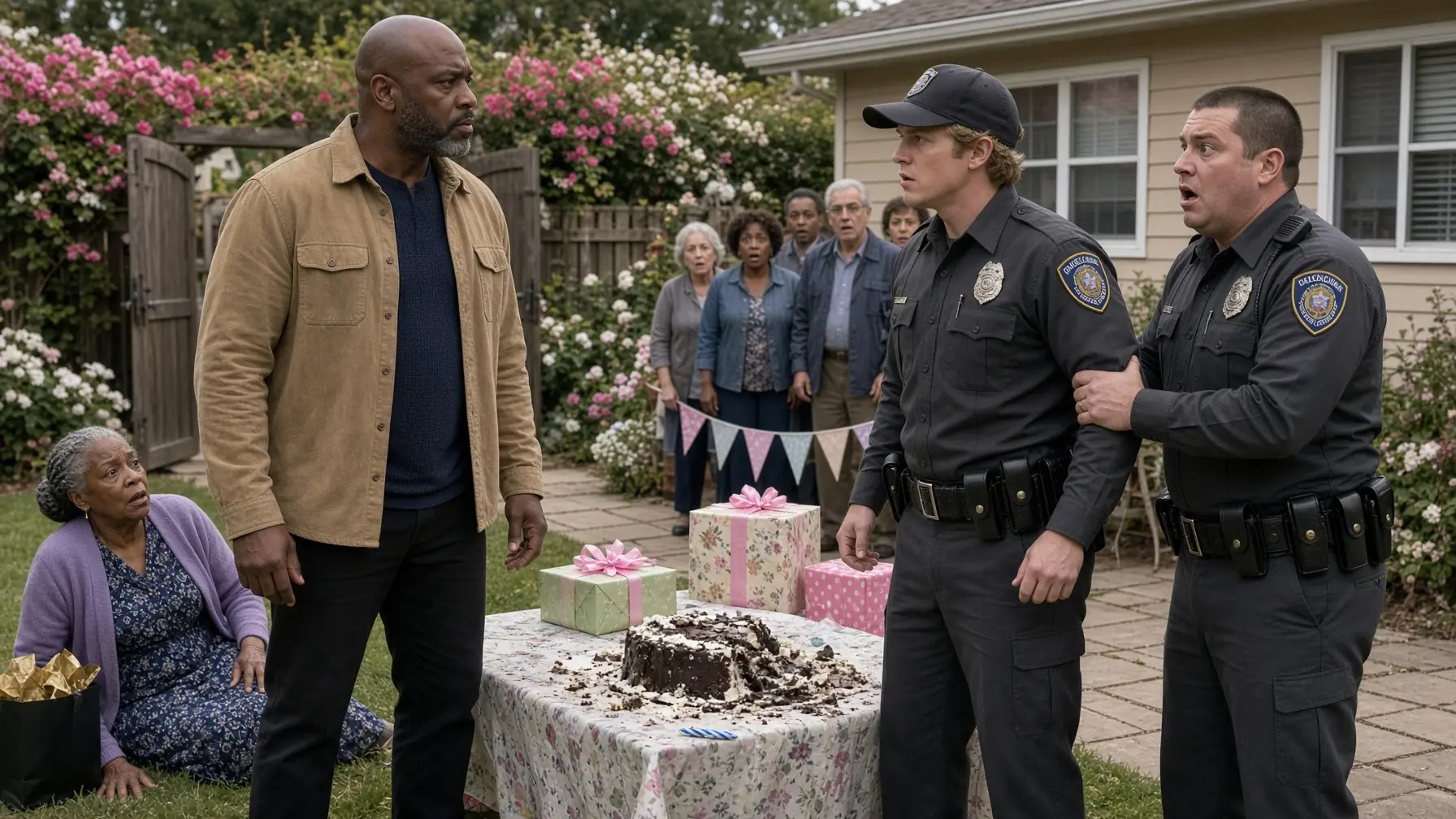
Ten minutes earlier, Ernestine had been complaining that nobody would let her help.
“It’s my house,” she told her daughter, reaching for a stack of paper plates. “I can still put a plate on a table.”
“You can also sit down and turn seventy.”
“I’ve been sitting down and turning seventy since breakfast.”
Her daughter laughed and took the plates anyway.
The courtyard behind the ranch-style house had never looked so cheerful. Fabric bunting stretched beneath the porch roof, wrapped gifts crowded one end of the long outdoor table, and charcoal settled inside the grill while Ernestine’s nephew argued with his cousin about when to put the chicken on.
Flowering hedges bordered the fence. Beyond them lay a quiet suburban street, a few parked cars, and the ordinary late-morning sounds of people mowing lawns and rinsing driveways.
Ernestine wore a lavender cardigan over her patterned navy dress. Her gray braids were swept into the low bun her granddaughter had arranged before the guests arrived, and she had put on the black slip-on shoes she wore when she expected to spend the day standing.
She kept looking toward the side gate.
Her youngest son had promised to come.
Anthony was forty-five now, tall and broad through the shoulders, with a shaved head and a beard she still insisted made him look older. His work kept him away more often than she liked, though he called faithfully and usually managed to ask whether she had eaten before she could ask him.
That morning, he had called from the road.
“Don’t let them cut the cake without me.”
“Then don’t arrive after lunch.”
“I’m close.”
“You said that at Christmas.”
“At Christmas, I was close.”
“To the wrong exit.”
He had laughed, and she had heard the weariness beneath it. For once, she wanted him to walk into a place where nobody needed anything from him except a hug and a plate.
The cake had two tiers, pale flowers around the sides, and the number seventy on top. Ernestine had said it was too much cake for the family.
Her granddaughter had answered, “You always say that, and then you send everybody home with some.”
“That’s how I make sure they come back.”
The first police officer entered while Ernestine was straightening a folded napkin beside the cake.
There was no knock at the front door. No voice announcing a complaint.
The side gate swung inward, and Officer Tyler Grady strode through it, one hand near his duty belt. Officer Nathan Bole followed, filling the narrow opening behind him.
Conversation stopped unevenly. The relatives nearest the gate went quiet first, while a cousin at the grill continued speaking for another second before noticing.
Ernestine turned.
“Can I help you?”
“Get back,” Grady said.
She looked behind herself, uncertain whom he meant. There was only the birthday table and her daughter placing a pitcher beside it.
“Officer, this is—”
Grady reached her before she finished.
“Get back! I said move!”
His hand struck her shoulder hard enough to turn her body. Her heel slipped over the patio edge, and she tried to recover, reaching toward the table without finding it.
Then she fell.
Her hip hit the grass first. One hand scraped across the tile as she caught herself, and pain flashed through her wrist.
For an instant, the courtyard tilted around her.
Her daughter dropped the pitcher and started forward.
“Mom!”
Bole stepped into her path and extended an arm across her chest.
“Stay where you are.”
“You pushed her!”
“Back up.”
“She’s seventy years old!”
“Then she should know how to listen.”
Ernestine propped herself up on one hand. Her cardigan had twisted under her, and grass clung to the side of her dress.
She stared at Grady.
“This is my home. What the hell are you doing?”
He looked down at her without answering.
Bole turned toward the table.
Several relatives thought he was about to move something out of the way. Her nephew even reached toward a platter, expecting an instruction.
Instead, Bole brought his forearm down onto the cake.
The upper tier collapsed beneath his sleeve. Frosting spread across the cloth, flowers broke apart, and the candle shaped like a seven tumbled off the edge.
“Party’s over.”
Nobody spoke.
The small violence of it seemed to freeze them more completely than shouting had. It was a birthday cake, bought by children and grandchildren who had pooled their money to make an old woman feel celebrated.
Bole scraped frosting from his sleeve against the table edge.
Then the gate opened again.
Anthony Freeman entered carrying a gift bag with tissue paper rising from the top.
He saw his sister first, stopped behind Bole’s arm. Then he saw the ruined cake.
Then his mother.
The bag slipped from his hand and landed upright beside the hedge.
“Mom?”
He moved toward her.