Snow came down over Laramie in wet, miserable clumps, turning the town square into a churned field of mud, horse dung, and gray slush. A wagon had been dragged beneath the courthouse balcony and dressed with a sheet of white canvas, as though clean cloth could make the sale of a human being respectable. Nearly a hundred townspeople stood around it, collars raised against the wind, watching a young woman kneel with her hands tied behind her and a coarse burlap sack pulled over her head. No judge had signed an order, no jury had heard evidence, and no law permitted what they were about to do.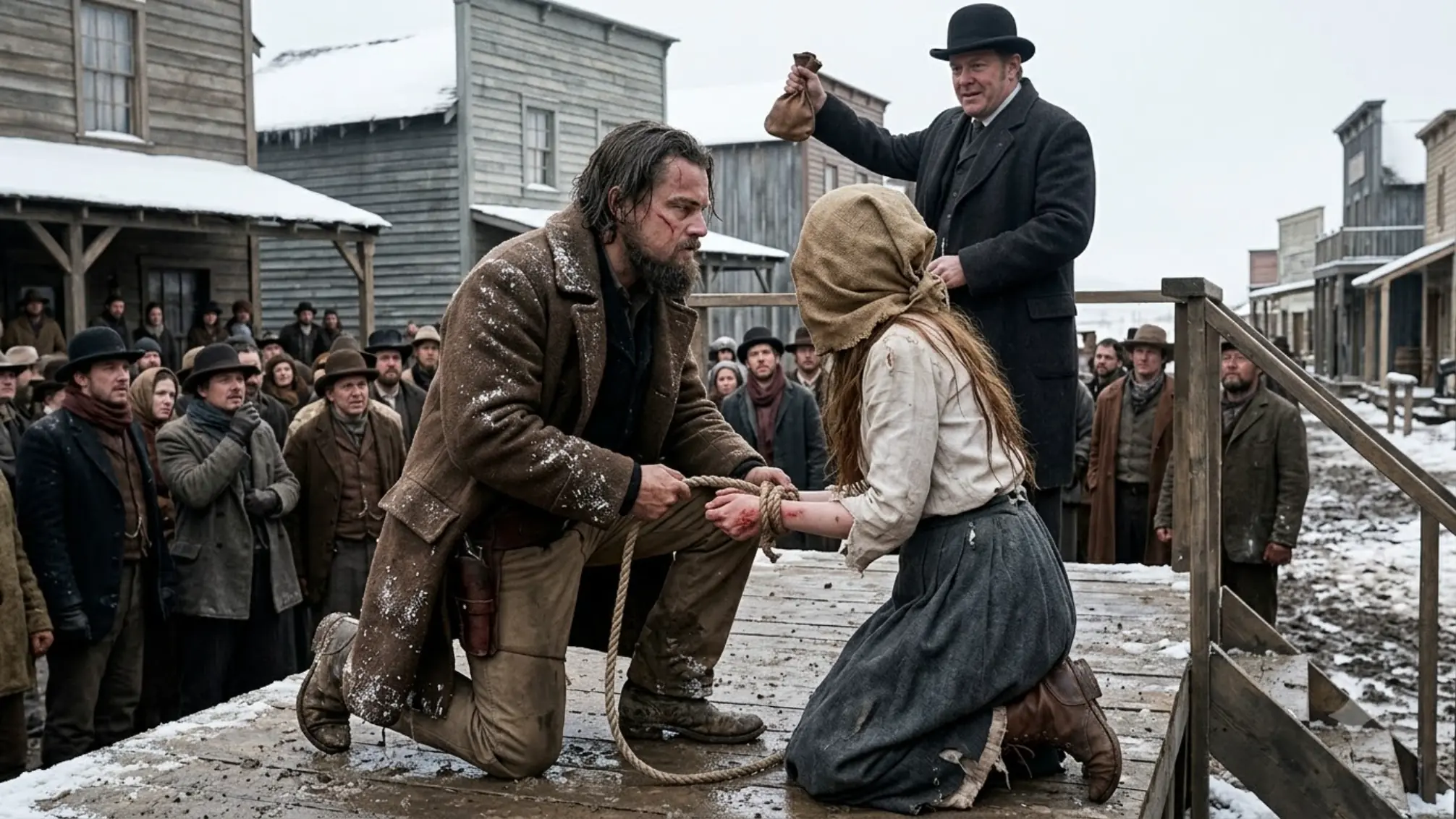
Clyde Mercer stood above her in an expensive black coat, one polished boot planted beside her bent knee. He owned the largest freight company in Albany County, controlled half the merchants through debt, and had learned that frightened people rarely questioned the man who promised to protect them. In one hand, he held a handwritten notice declaring the woman responsible for unpaid obligations left by her dead father. In the other, he shook a brass bell and called the crowd to order.
Auctioneer (smirking, lifting the paper): “Her father’s debts belong to her, and no decent household will take a woman blamed for three deaths, two failed harvests, and a fire.”
A murmur moved through the crowd, not because anyone believed every accusation, but because belief was no longer required. The woman had treated sick families during the summer fever, and several patients had died despite her efforts. A rancher’s wheat had blackened after she crossed his field, though the neighboring farms suffered the same blight. When the church storehouse burned, someone remembered seeing her carrying a lantern two streets away.
Each coincidence had become another stone laid upon her name. By winter, the people who once brought children to her father’s clinic had begun crossing the road when she approached. Her real name was Mara Hart, but Clyde had stopped using it weeks earlier. He called her the Widow’s Curse, though she had never married, because the title sounded better when shouted from a wagon.
At the edge of the square stood Elias Boone, a mountain man whose arrival had quieted more conversations than the ringing bell. He was thirty-nine, tall enough to look over most hats in the crowd, with shoulders broadened by years of chopping pine and carrying winter hides down impossible slopes. Wet black hair clung to his forehead, a thick beard covered his jaw, and a jagged scar ran from the corner of his left eye toward his cheek. A heavy buffalo coat hung from his body, dusted with snow and stained by hard travel.
People in Laramie called Elias a beast when they believed he could not hear them. He had lived alone in the Bighorn Mountains for eight years, appearing only when he needed flour, coffee, ammunition, salt, or medicine. Some said he had killed men in the high country and buried them beneath the pines. Others claimed wolves followed him because they recognized one of their own.
The truth was simpler and sadder. Elias had gone into the mountains after his younger brother Jonah vanished while working a freight route for Clyde Mercer. Search parties found a shattered wagon near Black Hollow and enough blood on the rocks to convince everyone Jonah had died. Elias never found a body, but after two winters without a trace, even hope began to feel like a cruelty he was committing against himself.
Clyde rang the bell again and announced an opening price of ten dollars. A drunken ranch hand offered five, drawing laughter from men who had never once helped Mara carry medicine through a storm. Another bidder promised seven if Clyde included the rope. Mara remained upright beneath the sack, her back straight despite the cord cutting deeper into her wrists.
Elias watched a thin line of blood crawl across her left hand. He had come to town for supplies and intended to leave before nightfall. He wanted no part in Laramie’s grudges, sermons, or cowardly entertainments. Yet the laughter around the wagon sounded too much like other crowds he had known, men hiding cruelty behind numbers because no single one of them wished to carry the guilt alone.
Mountain Man (coldly, stepping from the crowd): “Twenty.”
The word struck the square harder than the bell. Men turned, women stopped whispering, and Clyde’s grin faltered before returning twice as wide. He asked whether Elias understood that the woman’s face had been hidden for everyone’s protection. Elias never looked toward the sack.
Mountain Man (grimly, watching the blood on her wrists): “Thirty, and you cut the rope before it reaches bone.”
No one raised the bid. Elias threw a leather pouch onto the wagon, and silver coins struck the boards with a heavy clatter. Clyde counted them quickly, then announced the sale complete as though he had transferred a horse or winter coat. He slapped Elias on the shoulder and told him not to complain once he discovered what lived beneath the burlap.
Auctioneer (smirking, shaking the coin pouch): “She is yours, mountain man. Keep the sack on if you value your sleep.”
Mountain Man (dangerously calm, gripping the rope): “Cut her loose before I cut the hand that tied her.”
The square fell silent. Clyde stepped back, laughing as if the threat amused him, but his right hand drifted toward the pistol beneath his coat. Elias climbed onto the wagon and knelt in front of Mara, placing himself between her and every watching face. Instead of tearing off the sack, he began loosening the knots around her wrists.
Her hands were cold and trembling, but she did not pull away. Elias told her quietly that the payment did not make her his property and that she could walk in any direction she chose once the rope came free. Mara’s breath caught beneath the hood. Then she leaned toward him and whispered two words.
Hooded Woman (shaken, barely breathing): “Jonah Boone.”
Elias’s fingers stopped on the knot. For eight years, no stranger had spoken his brother’s full name without first hearing it from him. He raised his eyes toward the dark weave covering her face. Beneath the burlap, Mara turned slightly toward Clyde.
Mountain Man (low and controlled, resuming the knot): “Where did you hear that name?”
Hooded Woman (fearfully, holding her bleeding wrists still): “Black Hollow Mine. He was alive when they dragged me away.”
Elias cut the rope instead of untying the final knot. The severed cord fell across the wagon floor, and Mara brought both hands against her chest. Clyde noticed the change in Elias’s expression and ordered two of his freight guards closer. The men came forward slowly, suddenly less amused by the mountain man’s presence.
Elias removed his buffalo coat and placed it around Mara’s shoulders. He left the sack untouched, giving her the choice of when the crowd would see her face. Then he stood and faced Clyde, who insisted the sale included immediate removal from town. Elias said nothing until he had helped Mara down from the wagon.
Mountain Man (coldly, staring at Clyde): “If my brother is buried in your mine, I will find him.”
Auctioneer (mocking, resting a hand near his pistol): “Your brother died in a wagon wreck, Boone. Everyone knows that.”
Mountain Man (fiercely, stepping closer): “Everyone knows what you taught them to repeat.”
Clyde’s guards moved between them, but Elias did not reach for his weapon. Violence in the square would make Mara’s information disappear beneath a story about an uncontrollable mountain killer. He guided her toward his packhorse while the crowd divided to let them pass. No one offered an apology, and no one demanded Clyde return the silver.
They reached the livery stable before Mara removed the sack. Beneath it was not the ruined face Clyde had promised, but a striking young woman with pale skin reddened by cold, clear hazel eyes, and long chestnut hair soaked against her cheeks. A small crescent-shaped scar rested near her right temple, nearly hidden beneath loose strands. The only ugliness visible was the bruising along her jaw where someone had struck her.
Elias offered food, water, and the freedom to leave. Mara drank half a cup from his canteen, then asked whether he truly intended to search Black Hollow. He said he did, but he would not take her into the mountains unless she chose to come. She looked toward the stable entrance, where two of Clyde’s men had appeared across the street.
Woman (urgently, tightening the buffalo coat): “If I stay in Laramie, they will sell me again or bury me before morning.”
Mountain Man (steadily, checking the rear entrance): “Coming with me does not mean owing me.”
Woman (firmly, meeting his eyes): “Then let me choose the trail. I know where they moved Jonah.”
They left through the rear gate before Clyde’s men reached the stable. Elias placed Mara on his strongest horse and led them north across frozen ground, keeping to dry creek beds where tracks vanished beneath drifting snow. By sunset, the town had disappeared behind low hills. The wind sharpened as the Bighorns rose ahead like dark walls beneath the clouds.
Mara spoke little during the first hours. She held the reins with competence, revealing that helplessness had never been her natural condition. Her father, Doctor Nathaniel Hart, had taught her medicine, bookkeeping, and enough Latin to read imported medical texts. After her mother died, Mara assisted at his clinic and treated families who could not pay.
Three years earlier, Clyde offered Doctor Hart a contract to provide medical care at Black Hollow Mine. The mine supposedly produced silver, but the workers Mara treated suffered symptoms that did not match ordinary exhaustion. Their teeth loosened, hands trembled, skin developed strange lesions, and several men lost the ability to walk. Doctor Hart suspected arsenic exposure from ore processing and contaminated water.
When he demanded the mine close, Clyde threatened to destroy the clinic through debt claims. Doctor Hart began copying payroll records, medical logs, and ore reports. Jonah Boone, employed as a freight driver, discovered sealed barrels being delivered at night and agreed to carry the evidence to the territorial authorities. Before he could leave, his wagon was forced from a mountain road.
Mara believed Jonah had died until she saw him in a locked treatment room beneath Black Hollow. His leg had been shattered, but he had survived the crash and was useful because he understood the freight routes. Clyde kept him alive to identify which drivers could be bribed and which had seen too much. Over the years, Jonah had secretly recorded shipments and names in a hidden ledger.
Doctor Hart tried to rescue him and was killed six months later. Clyde announced the doctor had died from fever, then produced false loan papers claiming Mara owed him four hundred dollars. When she resisted, rumors about her began spreading through town. The auction had never been about debt; it was meant to deliver her into the hands of a mine guard who would take her somewhere no questions could follow.
Elias listened without interrupting. At his mountain cabin, he gave Mara the bed near the stove and prepared a pallet for himself beside the door. She expected questions about the rumors, her scar, or the sack. Instead, he warmed water and placed clean bandages on the table, allowing her to tend her wrists privately.
The cabin contained only what Elias needed: a stone fireplace, two chairs, a heavy table, shelves of preserved food, traps, tools, and a locked wooden chest. Above the mantel hung a small metal compass with the initials J.B. scratched into the lid. Mara recognized it immediately. Jonah had carried the compass around his neck until the night Clyde’s guards took it from him.
She explained that Jonah had given the compass to Doctor Hart months before the attempted rescue. The doctor hid it among his medical instruments, and Mara recovered it after his death. When Clyde’s men searched the clinic, she slipped the compass into the coat of a trapper who occasionally delivered herbs. That trapper had unknowingly sold it to Elias the following spring.
For the first time since the auction, Elias’s composure cracked. He sat at the table and opened the compass, staring at the frozen needle as if it might point backward through eight lost years. Mara rested her bandaged hands in her lap and did not offer comfort he had not requested. Grief had taught both of them that silence could be kinder than promises.
At dawn, they planned the journey to Black Hollow. Mara drew the mine entrances from memory and marked a drainage tunnel concealed beneath an abandoned sawmill. Elias knew a ridge trail that avoided the main road and would place them above the mine by nightfall. They packed food, rope, lantern oil, blankets, and medical supplies.
Before leaving, Elias handed Mara a small pistol and asked whether she knew how to use it. She checked the cylinder, corrected his assumption that her father had only taught medicine, and slid the weapon into her coat. Elias almost smiled. It was the first warmth she had seen reach his eyes.
They reached the ridge after dark and found Black Hollow glowing beneath them. Smoke poured from processing sheds while armed guards moved between bunkhouses and ore carts. The operation was larger than Mara remembered, with nearly fifty workers and a new fence surrounding the water tanks. A freight wagon waited near the northern gate beneath a tarpaulin bearing Clyde Mercer’s company mark.
Mara led Elias to the sawmill drainage tunnel. They crawled through icy mud until the passage opened behind a collapsed storage chamber. From there, she followed pipes toward the treatment rooms. The air smelled of chemicals, wet stone, and sickness.
They found Jonah chained by one ankle in a narrow room beside the lower shaft. He was thirty-six but looked ten years older, with hollow cheeks, a badly healed leg, and hair streaked prematurely with gray. When Elias stepped into the lantern light, Jonah stared as though the mountain itself had opened and returned the dead. Neither brother spoke for several seconds.
Missing Brother (overwhelmed, gripping the bedframe): “You took your time.”
Mountain Man (voice breaking, kneeling beside him): “I searched every mile between here and Montana.”
Missing Brother (weakly, touching Elias’s scar): “I knew you would keep searching after everyone else stopped.”
Mara examined Jonah while Elias removed the chain. He was malnourished and showed signs of chronic arsenic exposure, but his heart remained strong. Jonah told them the ledger was hidden inside an abandoned ventilation shaft near the assay office. It contained payment records, false death reports, land deeds, and letters proving Clyde had bribed the county judge and sheriff.
A bell rang above them before they reached the shaft. One of the guards had discovered the open treatment-room door. Elias carried Jonah while Mara guided them through a maze of support beams and ore passages. Shouts spread through the mine, followed by the barking of dogs.
At the ventilation shaft, Mara crawled behind a broken timber and found an oilcloth bundle wedged inside the rock. The ledger remained dry, accompanied by Doctor Hart’s original medical report and letters signed by Clyde. One ordered the sheriff to classify the mine deaths as accidents. Another instructed the county judge to approve Mara’s debt auction before federal land inspectors arrived.
They escaped through the drainage tunnel minutes before guards entered the lower shaft. Elias placed Jonah across the saddle of the packhorse, and Mara rode behind him to hold him upright. Gunfire cracked from the trees, but the falling snow concealed their path. Elias led them along a frozen stream where horses struggled but tracks disappeared beneath running water.
They did not return to Laramie. Instead, they traveled south to the territorial marshal’s station at Fort Sanders, reaching it shortly before dawn. Mara presented the ledger, medical reports, and letters while Jonah gave a sworn statement. The marshal sent deputies to secure Black Hollow and telegraphed a circuit judge in Cheyenne.
Clyde attempted to flee before noon. He was captured at a rail depot carrying cash, forged land deeds, and a list of witnesses scheduled for removal. The county sheriff surrendered after learning that federal warrants had already reached every neighboring jurisdiction. The judge who authorized Mara’s auction destroyed papers in his stove, but fragments recovered from the ashes matched entries in Jonah’s ledger.
The investigation revealed that Black Hollow had contaminated three streams and poisoned dozens of workers and nearby families. Clyde had blamed failed crops and sickness on Mara to redirect anger away from his mine. Doctor Hart had been deliberately given poisoned medicine after announcing his intention to contact the territorial government. His death certificate had been signed by a physician indebted to Clyde’s freight company.
Mara returned to Laramie only after the arrests. This time, she entered the town square without a sack, rope, or lowered head. The wagon used as the auction platform had been seized as evidence, and the courthouse balcony stood empty. Many townspeople watched her pass with the uncomfortable expressions of people hoping shame might count as an apology.
Clyde’s trial took place in Cheyenne because no impartial jury could be found in Laramie. Jonah testified about the wagon attack, years of imprisonment, and the records he gathered. Mara described the poisoned workers, her father’s murder, and the campaign that transformed evidence into superstition. Elias spoke only about the illegal auction and the condition in which he found them.
Clyde was convicted of murder, kidnapping, fraud, unlawful imprisonment, conspiracy, and violations tied to the mine. The sheriff and county judge received prison sentences, while several merchants were forced to repay money taken through fabricated debts. Black Hollow was closed, and compensation from seized assets went to injured workers and families of the dead. The auction paper declaring Mara responsible for her father’s debts was publicly invalidated and preserved with the criminal record.
Jonah chose not to return immediately to the freight roads. He spent the spring at Elias’s cabin, rebuilding strength and learning to walk with a carved brace Mara designed. His recovery was slow, filled with anger, nightmares, and days when hope exhausted him more than illness. Mara treated him without pity, which he said was the first dignity anyone had given him in years.
Elias never asked Mara to remain. When the passes opened, he offered to escort her anywhere in the territory and gave her half the reward paid for evidence in the case. She reminded him that the money belonged equally to Jonah. Elias answered that the choice still belonged to her.
Woman (softly, standing beside the cabin door): “You paid thirty dollars for me and spent the winter proving I was free.”
Mountain Man (quietly, meeting her eyes): “Freedom that depends on my permission is not freedom.”
Woman (emotional, placing her hand over his): “Then I am choosing to stay until the mountains stop feeling like the place where I was rescued.”
Mountain Man (tenderly, closing his fingers around hers): “Stay until they feel like home, and leave the day they do not.”
Mara did not become Elias’s possession, servant, or reward. She established a small treatment room near the trading route and accepted food, labor, or nothing from families who could not pay. Elias built shelves, carried water, and learned to recognize the herbs she needed without pretending expertise he did not possess. Jonah repaired freight wagons and warned every driver who passed near poisoned ground.
Love arrived without a contract. It grew through winter meals, shared work, difficult memories, and the trust of two people who had both been turned into stories by those unwilling to know them. Elias had been called a beast because of his scar and silence, while Mara had been called a curse because powerful men needed fear to protect their crimes. Neither asked the other to become less wounded before being worthy of tenderness.
A year after the auction, Elias and Mara returned to Laramie for supplies. They crossed the same square where the crowd had watched her kneel beneath burlap. The preacher who had remained silent approached and tried to apologize, but Mara told him repentance required protecting the next powerless person before knowing whether someone important would come to save them.
Then she continued walking beside Elias.
People later repeated the story as though the feared mountain man had bought a cursed woman and discovered she was innocent. That version pleased them because it placed courage in one dramatic bid and allowed the crowd to forget its own part. The truth was harder and far more important.
Elias had not saved property he purchased.
He had recognized a person everyone else had agreed not to see.
And when he cut the rope, Mara did not become his.
She became free enough to reveal the truth, rescue the brother they had buried in a lie, and choose the man who had never once asked her to belong to anyone but herself.