“Real farmers buy equipment,” Richard Coleman said, resting one arm against the hood of a rusted tractor. “You collect their rotting garbage.”
Walter Hayes kept his head lowered as he examined a greasy hydraulic valve in his palm. Around him, a dozen abandoned tractors stood in uneven rows across the dusty Nebraska auction yard. Their paint had faded, their tires had cracked, and several were missing engines, seats, or entire front assemblies.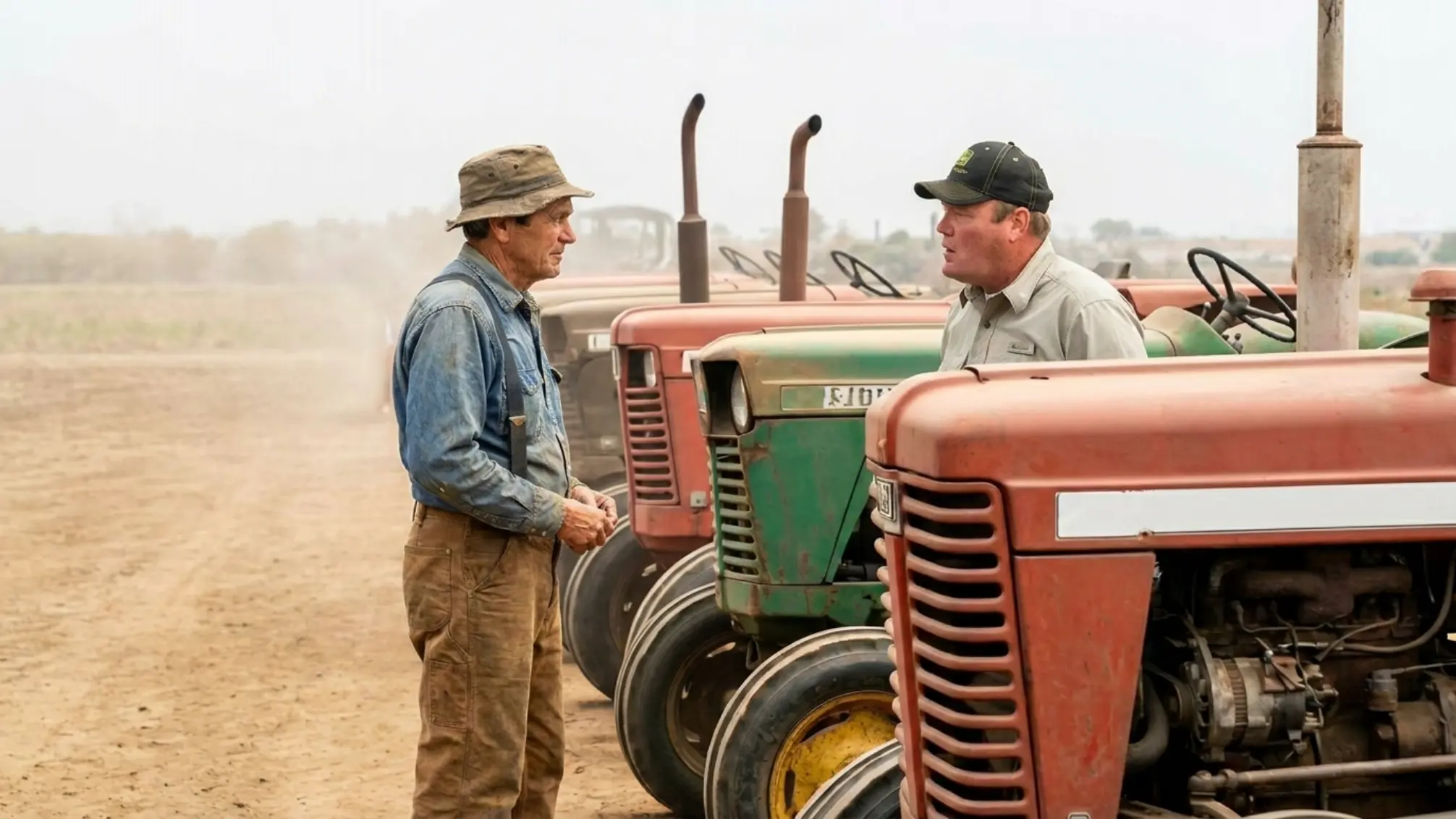
“Garbage only to fools who can’t see value,” Walter replied.
Richard laughed loudly enough for the farmers near the auction office to hear. “You’ll die broke beneath this filthy scrap heap.”
Walter slipped the valve into the pocket of his faded overalls. “Soon, you’ll beg me for the parts keeping your farm alive.”
Richard’s smile disappeared for half a second.
Then the auctioneer called the next lot, and everyone turned toward a battered red tractor that had not moved under its own power in eleven years.
Walter bought it for four hundred dollars.
Most people in Dawson County believed Walter Hayes had finally lost his mind.
He was sixty-two years old, widowed, and living alone on eighty acres of dry Nebraska ground that had once supported three generations of the Hayes family. His corn yield had fallen for two consecutive seasons, diesel prices had climbed, and the debt remaining on his land was larger than he admitted to anyone.
A sensible farmer in Walter’s position would have reduced expenses, sold unused equipment, and preserved every available dollar.
Walter did the opposite.
He began purchasing broken tractors.
At first, there were only three. One had a seized engine, another had burned wiring, and the third had been abandoned after its transmission failed during harvest. Walter dragged them behind the tree line at the western edge of his property, where they could not be seen clearly from the county road.
Within six months, there were fourteen.
By the end of the year, there were thirty-seven tractors, two combines, six grain drills, four balers, and enough rusted attachments to make the western pasture resemble the remains of a forgotten machinery dealership.
Richard Coleman owned the neighboring farm.
At fifty, Richard was younger than Walter, wealthier than Walter, and convinced that every successful decision should be visible from the road. His machinery was newer, his shop was larger, and his name was painted neatly on every truck, trailer, and grain cart he owned.
Richard considered Walter’s growing collection embarrassing.
“You know the county calls this place Hayes’s Graveyard,” he told Walter one morning.
Walter was kneeling beside an old transmission case, cleaning years of hardened grease from the bolts. “The county talks when it has nothing useful to do.”
“You could sell this steel by weight and clear the mess.”
“I could.”
“Then why don’t you?”
Walter removed one bolt and placed it carefully in a labeled tray. “Because this transmission contains parts no company makes anymore.”
Richard looked around at the rusted machines. “Nobody wants parts for dead tractors.”
Walter raised his eyes. “A tractor isn’t dead because a dealer stopped selling it.”
Richard shook his head. “This is what happens when old men get sentimental.”
Walter returned to the transmission. “I’m not sentimental.”
He was telling the truth.
Walter did not buy tractors because they reminded him of his childhood. He did not care about shiny paint, antique shows, or preserving machinery for history. He bought them because he understood something most farmers had forgotten during years of easy dealership financing.
Every machine was a collection of smaller machines.
A tractor with a ruined engine might still contain a working hydraulic pump, steering box, axle housing, fuel tank, drawbar, differential, radiator, and dozens of switches, brackets, gears, and valves. One broken part could condemn an entire machine, but the remaining parts did not become useless simply because the tractor stopped moving.
Walter had learned that lesson from his father.
During the agricultural crisis of the 1980s, the Hayes family had nearly lost everything. Interest rates rose, land values collapsed, and farms across Nebraska disappeared beneath foreclosure signs.
Walter’s father could not afford dealer repairs.
He kept their tractors operating by purchasing abandoned machines, dismantling them, and storing every usable component inside an old wooden barn. Nothing was discarded unless it had cracked, burned, or worn beyond repair.
“Steel remembers what it was made to do,” his father often said. “Your job is to remember where you put it.”
Walter remembered.
The old storage barn still stood behind his house. Its shelves held coffee cans filled with bolts, wooden boxes packed with bearings, and handwritten notebooks describing parts removed from machinery decades earlier.
After his wife, Ellen, died, Walter began spending more time there.
Her death had not caused the tractor collection, but it had removed the person who might have asked him whether he was sleeping enough or spending too much. Ellen had understood his habit of saving machinery, though she had insisted that every part be labeled.
“Otherwise, you don’t own inventory,” she once told him. “You own confusion.”
Walter followed her rule.
Each tractor received a number. Every usable component was inspected, cleaned, photographed, measured, and entered into a paper ledger. Later, his granddaughter taught him to transfer the information into a basic computer database.
Walter recorded manufacturer, model, production year, casting numbers, condition, location, and compatibility with other machines. He built shelves inside two abandoned chicken houses and organized thousands of parts by system.
Hydraulics occupied the first building.
Transmission and drivetrain components filled the second.
Electrical parts, gauges, lights, switches, and wiring harnesses were stored inside the heated workshop, where moisture could not destroy them.
Walter did not advertise.
Farmers heard about him by accident.
The first customer was a man named Paul Brenner, who operated three hundred acres south of Lexington. His thirty-five-year-old tractor lost hydraulic pressure during planting season. The dealership diagnosed a failed control valve but informed him that the manufacturer no longer produced the assembly.
A new tractor would cost more than Paul’s annual income.
A remanufactured valve from another state required six weeks for delivery.
Someone at the feed store mentioned Walter.
Paul arrived expecting an old farmer with several junk machines. Instead, Walter asked for the tractor model, serial range, and casting number. Then he walked into the first chicken house and returned carrying the exact hydraulic valve.
“How much?” Paul asked.
Walter examined the part. “Two hundred seventy-five dollars, with your damaged valve exchanged.”
“The dealership quoted fourteen hundred for a rebuilt one.”
“Then buy theirs.”
“They don’t have one.”
Walter waited.
Paul smiled. “Two hundred seventy-five it is.”
Walter installed the valve that afternoon. The tractor returned to planting before sunset.
Three days later, another farmer called.
Then another.
Within a month, Walter had sold parts from nine machines. The money did not make him wealthy, but it covered fuel, taxes, and the cost of buying more scrap equipment.
More importantly, each sale provided another damaged component.
Walter did not throw those parts away.
He studied them.
Many failures came from the same weak points: worn seals, scored surfaces, broken springs, corroded contacts, or small internal pieces that could be reproduced cheaply. Walter began rebuilding assemblies instead of merely replacing them.
He purchased a used metal lathe from a closed vocational school and repaired it himself. He added a drill press, hydraulic test bench, parts washer, and small sandblasting cabinet.
His workshop slowly became a remanufacturing shop.
Richard continued laughing.
“You spend twelve hours repairing a part worth three hundred dollars,” he said one afternoon. “You could earn more hauling grain.”
Walter adjusted a gauge on the hydraulic test bench. “I’m not repairing one part.”
Richard looked at the identical valves lined across the table.
Walter had discovered that the same internal failure affected several tractor models produced over a fifteen-year period. He designed a stronger replacement sleeve, paid a local machine shop to manufacture fifty, and rebuilt every compatible valve in his inventory.
“I’m repairing thirty-eight,” Walter said.
Richard’s expression changed, but only briefly. “And when those are gone?”
“I’ll rebuild thirty-eight more.”
“What makes you think farmers will keep running old machinery?”
Walter shut off the test bench. “Debt.”
Richard frowned.
Walter wiped his hands. “New tractors cost more every year. Grain doesn’t always follow. Farmers will run the old ones as long as someone can keep them moving.”
Richard looked toward his own farm, where two nearly new tractors stood inside a heated steel building. “That’s not how serious operations work anymore.”
Walter said nothing.
He knew arguing with confidence was rarely profitable.
The first major change came during a year of low commodity prices.
Corn fell below what many local farmers needed to cover rent, seed, fertilizer, chemicals, and machinery payments. Families who had financed expensive equipment began selling secondary tractors and combines to preserve cash.
Auction yards filled.
Dealers offered low trade-in values because used inventory was already rising. Machines that had worked reliably for decades sold for little more than salvage price because they needed one costly repair.
Walter attended every auction he could reach.
He did not bid on clean, running tractors. Those attracted collectors, small farmers, and equipment dealers. Walter waited for machines with cracked blocks, damaged transmissions, burned wiring, or missing wheels.
He bought what nobody else wanted.
One auction contained seventeen tractors from three farms that had closed within the same month. Walter purchased nine of them for less than Richard had recently paid for a new planter monitor.
Richard watched the machines arrive on flatbed trailers.
“You’re buying the county’s failures now?”
“I’m buying inventory.”
“You call anything inventory if you stack it high enough.”
Walter looked toward the tractors. “Every one of those machines contains something your equipment may need someday.”
“My tractors have warranties.”
“Warranties expire.”
“I replace equipment before that.”
“Until you can’t.”
Richard stepped closer. “You always talk like you’re waiting for everyone else to fail.”
Walter’s face hardened. “I’m waiting for machinery to fail. Machinery always does.”
He turned away before the argument became personal.
Walter did not enjoy watching farms close. Every tractor he purchased represented someone’s lost season, unpaid loan, illness, or retirement forced earlier than planned.
He treated the machines respectfully because he understood what they had cost their former owners.
Whenever possible, he wrote down the history of each one.
A faded green tractor had belonged to the same family for forty-two years.
A red row-crop machine had pulled a planter across nearly thirty thousand acres.
A small utility tractor had been purchased by a widow who used it to maintain her husband’s cattle operation after his death.
Walter did not save the stories out of sentiment.
The history often revealed which parts had already been replaced, which systems had been abused, and which components were likely still reliable.
Yet the stories also reminded him that the equipment had once mattered to someone.
Two years after Paul Brenner bought the first valve, Walter’s operation had expanded beyond anything hidden behind a tree line should have become.
He employed a retired mechanic named Earl Simmons three days a week. A community-college student helped catalog parts and manage online requests. Walter’s granddaughter, Lucy, built a simple website listing common assemblies without publishing exact inventory numbers.
The business was called Hayes Agricultural Rebuilds.
Walter disliked the name because he thought it sounded too large.
Lucy insisted that “Walter’s Pile of Old Tractors” would not inspire confidence.
Orders began arriving from outside Nebraska.
Farmers in Kansas needed steering components.
A repair shop in Iowa ordered rebuilt injector pumps.
A cotton producer in Oklahoma purchased three transmission housings for machines his dealer could no longer support.
Walter learned how to package heavy parts for freight shipping. He negotiated commercial rates and built wooden crates from discarded pallets.
Still, the business remained nearly invisible locally.
There was no large sign, public showroom, or polished office. Customers entered through the same gravel driveway Walter had used for forty years. The machinery remained concealed behind trees, and the accounts were kept inside Ellen’s old sewing room.
Richard saw only the scrap.
Then the supply crisis began.
A major manufacturer discontinued several parts for tractor models commonly used across the central United States. At the same time, shipping delays trapped replacement components overseas.
Dealership shelves emptied.
Repairs that once required days began taking months.
Farmers could wait for seats, mirrors, or cosmetic panels. They could not wait for fuel pumps, hydraulic controllers, transmission gears, or axle components during planting and harvest.
Walter’s phone began ringing before sunrise.
The first local emergency came from Brad Miller, who operated eight hundred acres west of town. His primary tractor lost a transmission gear four days before planting. The dealership estimated twelve weeks for a replacement.
Brad called Walter.
Walter asked for the serial number.
“I have the gear,” he said.
“You’re certain?”
“I have three.”
Brad arrived thirty minutes later.
By noon, Earl had opened the transmission. The replacement gear showed little wear, but Walter installed new bearings and seals before closing the assembly.
Brad’s tractor returned to the field the following morning.
After that, the calls did not stop.
Walter’s hidden inventory contained parts for equipment still operating on thousands of farms. Machines that had appeared worthless at auction became donors keeping entire operations alive.
A four-hundred-dollar tractor might contain ten thousand dollars in usable components.
Some contained much more.
Walter never charged desperation prices.
He calculated labor, storage, testing, replacement cost, and a reasonable margin. When a farmer had no money until harvest, Walter accepted signed payment agreements.
Richard mocked that too.
“You’re running a bank for broke farmers.”
“I’m selling parts.”
“You let them leave without paying.”
“I let them harvest.”
“You’ll get cheated.”
“Sometimes.”
“And that doesn’t bother you?”
Walter looked at him. “Losing one invoice costs less than watching a neighbor lose a crop.”
Richard shook his head. “That’s why you’ll never become wealthy.”
Walter almost smiled.
By then, the business had earned more in one year than Richard’s farm.
Walter did not tell him.
Instead of purchasing land, trucks, or a new house, Walter reinvested nearly everything. He bought additional equipment, improved storage buildings, added testing machines, and hired two full-time mechanics.
He also began purchasing manufacturing rights and technical drawings from small suppliers closing their operations.
One company in Ohio had produced obsolete hydraulic components for decades, but the owner wanted to retire. Larger manufacturers had no interest in the limited market.
Walter bought the tooling.
A small gear shop in Indiana closed after losing its largest industrial customer. Walter purchased its agricultural dies, cutters, and inventory.
He did not move every machine to Nebraska. He formed agreements with local shops that had skilled workers but insufficient contracts.
Walter supplied the designs, materials, and customers.
The shops manufactured the parts.
Hayes Agricultural Rebuilds became more than a scrapyard. It became a network.
Lucy built a compatibility system showing how components from different models could be adapted safely. Earl trained younger mechanics to rebuild assemblies dealerships routinely replaced as complete units.
Walter developed kits containing improved seals, bushings, sleeves, and instructions. A failed fifteen-hundred-dollar assembly could often be repaired for less than four hundred.
The business expanded quietly across six states.
Then Richard’s warranty expired.
His largest tractor failed during corn harvest.
The machine stopped at the far end of a field with a full grain cart attached. A dealership technician diagnosed an electronic hydraulic-control module damaged by moisture. The replacement had been discontinued and superseded by an updated system requiring extensive rewiring.
The total estimate was nineteen thousand dollars.
Delivery would take at least five weeks.
Richard called three salvage yards. None had the correct module.
He called repair shops across Nebraska and Kansas. Two refused the work, while another warned that opening the sealed unit would destroy it permanently.
For two days, Richard tried every alternative.
Then he drove across the county line toward Walter’s farm.
He parked beside the workshop shortly after sunset.
Walter was testing a rebuilt pump when Richard entered. The room was brighter and more organized than he expected. Shelves held labeled assemblies, computers displayed inventory records, and three mechanics worked at separate benches.
Richard stopped near the door.
Walter shut down the test bench. “What failed?”
Richard’s face tightened. “How do you know something failed?”
“You wouldn’t be here otherwise.”
Richard placed the damaged control module on the counter.
Walter read the label.
“You have one?” Richard asked.
“No.”
Richard looked almost relieved, as though Walter’s inability would restore the order of things.
Then Walter continued.
“I have eleven.”
Richard stared at him.
Walter walked into the electrical storage room and returned with a sealed container. Inside were four identical modules. The remaining units were stored at partner locations.
“This one has been rebuilt and tested,” Walter said. “The original manufacturer used weak solder joints around the power regulator. Heat and vibration create microscopic cracks.”
Richard looked down at the module. “The dealer said it couldn’t be opened.”
“The dealer replaces it.”
“What do you do?”
“I repair it.”
“How much?”
“Eight hundred sixty dollars, including programming and exchange.”
Richard looked almost angry. “The dealership quoted nineteen thousand.”
“They quoted an updated conversion.”
“Why didn’t they know this could be repaired?”
Walter folded his arms. “Maybe nobody taught them. Maybe replacement pays better.”
Richard glanced around the workshop again. “How many parts do you have here?”
“Enough.”
“How large is this business?”
“Large enough.”
Richard’s eyes moved toward the office, where a wall map showed shipping destinations marked across the country. “You built all this from those tractors?”
“I built it from what still worked inside them.”
Richard remained silent.
Walter slid a repair order across the counter. “Sign there. Earl can install it tomorrow morning.”
Richard did not pick up the pen.
“You remember what you told me at the auction?” he asked.
Walter did.
“You said I’d beg for the parts keeping my farm alive.”
“I remember.”
Richard’s face reddened. “You going to make me beg?”
“No.”
“Why not?”
“Because your crop doesn’t deserve to rot just because you were an ass.”
Richard stared at him, then laughed once without humor. “I suppose I earned that.”
“You earned worse.”
Richard signed the order.
The tractor returned to harvest the next afternoon.
Richard paid immediately.
A week later, he returned carrying a cardboard box filled with old technical manuals from his father’s workshop. Several covered tractor models Walter had never serviced.
“I was going to burn these,” Richard said.
Walter opened one manual and inspected the diagrams.
“You want them?” Richard asked.
“Yes.”
Richard placed the box on the counter. “Then take them.”
It was not an apology, but it was the beginning of one.
The full scale of Walter’s business became public the following year when a regional agricultural magazine published an article about equipment shortages.
The reporter had been tracing how older tractors remained operational despite discontinued parts. Three separate repair shops mentioned the same supplier in Nebraska.
She arrived expecting a large manufacturing facility.
Instead, she found Walter behind the abandoned tree line, standing among hundreds of rusted machines.
By then, his property contained more than four hundred tractors and combines. Many appeared ruined from the outside, but each had been mapped in the database. Colored tags identified machines awaiting dismantling, machines reserved for restoration, and machines holding rare components.
Partner workshops in four states manufactured over one hundred replacement parts under the Hayes name.
The company shipped thousands of rebuilt assemblies each year.
Its annual revenue had passed eight million dollars.
Walter owned the business without outside investors or bank control.
The magazine called it “the hidden empire behind America’s aging farm machinery.”
Walter hated the phrase.
Lucy loved it.
After the article appeared, investment companies called with offers. One proposed purchasing the entire operation for twenty-two million dollars. Another promised to expand the brand nationally, modernize pricing, and increase profits through “market-responsive emergency premiums.”
Walter understood the phrase.
They wanted to charge desperate farmers more.
He rejected every offer.
Instead, he created an employee-ownership plan and transferred part of the company to the mechanics, catalog workers, and partner shops that had helped build it. He established a hardship fund allowing family farms to obtain emergency repairs without predatory loans.
Richard attended the announcement.
Afterward, he walked with Walter through the original tractor rows. Grass had grown around the tires, and evening light reflected from faded hoods in red, green, orange, and blue.
“I called this a graveyard,” Richard said.
Walter rested one hand on the first tractor he had purchased for four hundred dollars. “You weren’t completely wrong.”
Richard looked at him.
“Graveyards hold what people stopped using,” Walter continued. “I just knew some of it wasn’t finished.”
Richard nodded slowly. “I was cruel to you.”
“Yes.”
“I thought you were collecting proof that you’d failed.”
Walter looked toward the workshop buildings beyond the trees. “Most people see only what something looks like after it stops doing its first job.”
Richard placed both hands in his pockets. “And you?”
“I ask what else it can do.”
Years later, Walter finally allowed a modest sign to be placed beside the county road:
HAYES AGRICULTURAL REBUILDS
PARTS, REPAIRS, AND REMANUFACTURING
There was no mention of millions, national shipping, or the hundreds of farms kept alive by machinery that manufacturers had abandoned.
Walter still arrived before sunrise.
He still wore faded overalls, carried grease beneath his fingernails, and inspected every new load personally. He could identify many tractor models by the sound of their engines and often knew which internal part had failed before the machine entered the workshop.
Young mechanics came from across the Midwest to train under him.
Walter taught them to test before replacing, measure before cutting, and label everything before walking away.
Most importantly, he taught them never to confuse age with uselessness.
One winter morning, a young farmer arrived hauling a broken tractor that had belonged to his grandfather. A dealership had declared it beyond repair, and the farmer could not afford a replacement.
Walter walked around the machine slowly.
The hood was dented, the engine leaked oil, and the rear hydraulic system had failed. Yet the frame remained straight, the transmission sounded healthy, and the compression readings were stronger than expected.
“Can you save it?” the young farmer asked.
Walter looked toward the rows behind the trees.
Somewhere among them were the pump, seals, valve body, and brackets the tractor needed.
“Yes,” he said. “It isn’t finished yet.”
The farmer’s shoulders lowered with relief.
Walter understood that expression. He had seen it hundreds of times—the moment a person learned that something essential did not have to be discarded simply because someone powerful had stopped supporting it.
Richard Coleman had once believed Walter was building a monument to failure.
In truth, Walter had built a system that survived by refusing to accept the world’s first judgment.
Farmers sold their tractors because they needed money.
Dealers abandoned old models because the market had moved on.
Manufacturers stopped producing parts because newer machines promised higher profits.
Walter gathered what everyone else had left behind.
One gear at a time, one valve at a time, and one forgotten tractor at a time, he turned their discarded machines into an empire.
Not an empire built on farms failing.
An empire built on giving them another chance.