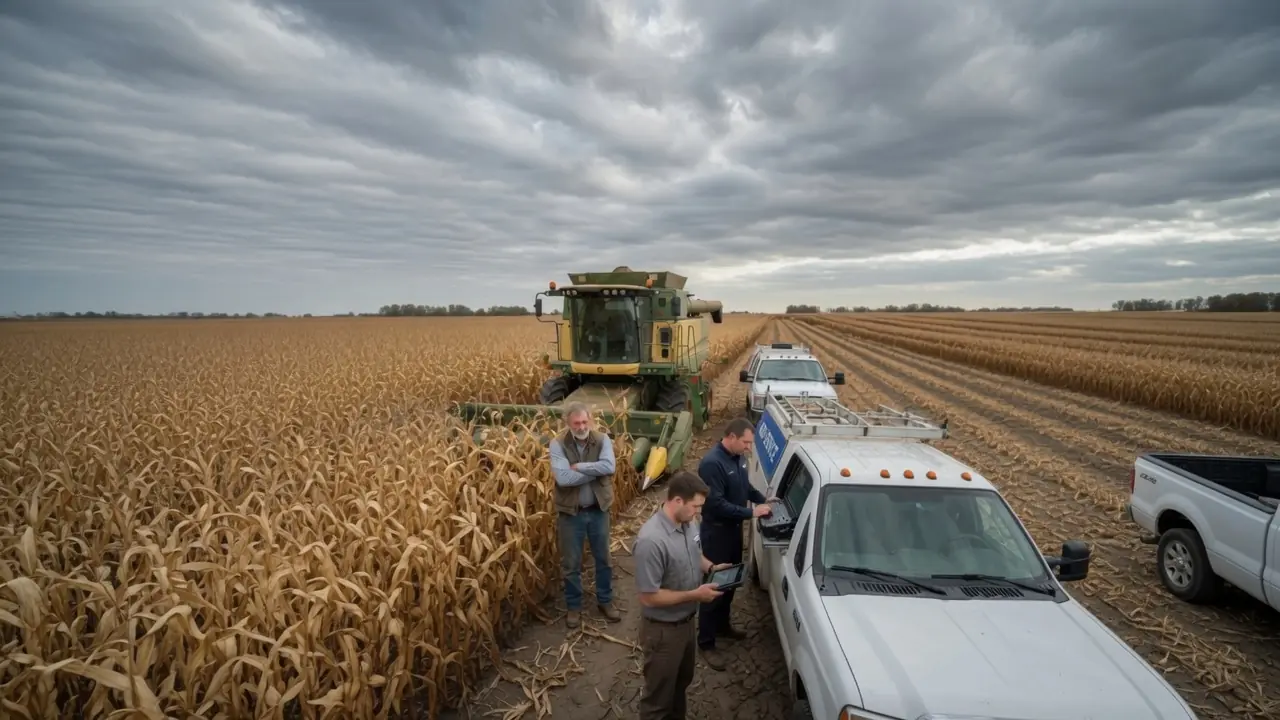
The combine died at 9:17 in the morning, right in the middle of the north cornfield, with three hundred acres still standing and a storm line crawling across the western sky. It was a green machine worth more than most houses in Mill Creek County, tall as a barn door and wide enough to swallow eight rows at once. One moment it was chewing through dry corn with a steady rumble, and the next it coughed, flashed red warnings across the cab monitor, and went silent. Farmer Daniel Hayes sat in the cab with both hands on the wheel, staring at the dead controls like he had just watched his whole harvest stop breathing.
By ten o’clock, two service trucks were parked beside the field, doors open, laptops glowing on tailgates, tablets in hand, cables running into the combine like doctors trying to revive a patient in a hospital room. Ryan Keller, the lead technician, stood nearest the front tire, jaw tight, scrolling through error codes with a frown that deepened every few minutes. He was thirty-two, sharp-haired, clean-uniformed, and proud of the way modern machines obeyed him when he plugged in the right tools. Beside him, his younger assistant, Mark, kept reading numbers aloud while the wind pushed dry leaves against their boots.
Daniel paced between the corn rows, rubbing the back of his neck and looking at the sky every few minutes. His wife had already called twice from the farmhouse, asking if the machine was moving yet, and both times he had lied by saying, “Soon.” The forecast had warned of heavy rain by nightfall, the kind that could flatten dry corn and turn harvest profit into mud. Every hour the combine sat dead, Daniel could feel money slipping out of his hands.
Ryan finally shut the diagnostic tablet case with a hard snap. “Control module failure,” he said, loud enough for Daniel to hear. Daniel stopped walking and stared at him. Ryan took a breath, already wearing the expression of someone delivering bad news he believed could not be challenged. “The main machine controller is not responding properly, and the CAN bus is throwing nonsense codes. We need to tow it, order the module, program it, and hope the harness is still clean.”
Daniel’s face went pale. “How long?” Ryan glanced toward Mark, then back at the farmer. “If the part is available, maybe four or five days. If not, a week.” Daniel looked past them at the standing corn, every row dry, ready, and vulnerable. His hands dropped to his sides like a man who had just been told the storm would get there before his future did.
That was when Amos Reed arrived in his old brown pickup, the engine ticking loudly as it rolled along the field road. The truck looked older than Ryan, with rust around the wheel wells and a cracked windshield that had been repaired with clear tape near the corner. Amos was seventy-three, broad in the shoulders despite his age, with gray stubble, muddy boots, and a tan vest over a blue work shirt. He parked near the ditch, climbed out slowly, and looked at the dead combine without speaking.
Ryan’s eyebrows lifted. “Daniel, with respect, we already ran full diagnostics for four hours.” Amos stopped beside the front axle and glanced at the open laptop on the truck tailgate. “Four hours looking at screens?” he asked quietly. Ryan folded his arms. “That’s how modern equipment is diagnosed.” Amos nodded once, then lowered his eyes to the dirt.
The old farmer did not climb into the cab. He did not ask for the codes, touch the tablet, or request the service history. He walked once around the combine, slow but deliberate, stepping carefully between tire tracks, broken stalks, and dark patches of churned soil. Ryan watched with growing irritation, as if every step Amos took was an insult to his training. Mark looked uncertain, glancing from the old man to the tablet still showing red warnings.
Amos crouched near the front left side of the combine and brushed aside loose dirt with two fingers. The soil there was darker than the rest, marked by a faint black streak beneath the frame and a tiny trail of oily dust near the axle mount. He leaned closer, squinting under the machine, then reached up and touched something hidden behind a bundle of cables. When his fingers came back, they were smudged with black residue.
Ryan gave a short laugh. “You found dirt. Congratulations.” Amos stood slowly, wiping his fingers on a rag from his pocket. His face had not changed, but his eyes had sharpened. “Four hours on screens, and none of you looked where the machine was bleeding,” he said. Ryan’s smile vanished.
Daniel stepped closer. “What did you see?” Amos pointed under the frame, near a metal bracket half-hidden by mud and corn debris. “Ground cable rubbed raw against that mount. Every time the engine vibrated, it arced against the frame until the connection burned weak.” Ryan shook his head immediately. “That wire can’t kill a half-million-dollar combine. You’re guessing.”
Amos turned his head and looked straight at him. “Then why did your fancy codes chase ghosts while this cable burned through?” Ryan’s jaw tightened, and the young technician stepped closer with the tablet in his hand like a shield. “Because electrical faults cascade through the system. A controller failure can cause communication errors across multiple modules.” Amos nodded toward the dirt. “And a bad ground can make every module scream at once.”
Mark swallowed and looked down at the tablet again. The words clearly made sense to him, but he did not dare say so too quickly. Ryan noticed the hesitation and snapped, “Don’t start.” Amos crouched again and reached under the frame, tugging gently until a section of the cable shifted into view. The insulation was worn open, blackened at one edge, and the copper inside showed green corrosion and heat damage.
Daniel covered his mouth with one hand. “Lord,” he whispered. Ryan’s face changed for half a second, but pride rushed in to cover it. “That still doesn’t prove it’s the main failure.” Amos held up the damaged cable so everyone could see the burned section. “It already shut her down, boy, while you spent four hours worshiping a screen.”
The sentence hit harder than the cold wind moving through the corn. Ryan’s face flushed, and he took one step toward Amos. “You don’t get to stand here and talk down to me because you found one ugly wire.” Amos rose to his full height, slower now but steady, and the rag tightened in his fist. “And you don’t get to bury a harvest because you’d rather trust a tablet than the ground under your own boots.”
Daniel looked toward the sky again, where the clouds had thickened and lowered. A low growl of thunder rolled somewhere beyond the far tree line. Mark shifted nervously and finally said, “Ryan, a floating ground could explain the random module dropouts.” Ryan turned on him. “I know what it could explain.” His voice cracked with frustration, and he looked back at the burned wire as if it had betrayed him.
Amos did not gloat. He pulled a small folding knife from his pocket, then paused and looked at Ryan. “You got a spare ground strap in that truck?” Ryan hesitated. “Yes.” Amos held out one hand. “Then get it.” Ryan stared at him, anger burning in his eyes, but Daniel’s face made the decision for him.
Ryan went to the service truck and opened a drawer harder than necessary. He found the ground strap, a wire brush, contact cleaner, and a wrench set, then carried them back without meeting Amos’s eyes. Amos took only the rag and brush, then nodded toward the machine. “Your repair. I’ll point.” Ryan blinked, surprised. “What?” Amos looked at the damaged mount. “You’re the technician. Fix it right, but fix the real problem.”
For a moment, neither man moved. Daniel stood between them in silence, realizing he was watching more than a repair. Ryan had come into the field believing knowledge belonged to him because his tools were newer and his software was expensive. Amos had walked in with mud on his boots and found the truth in thirty seconds, but he was not stealing the repair to humiliate the younger man. He was forcing him to learn while everyone could see it.
Ryan knelt in the mud, jaw clenched, and began disconnecting the damaged cable. His fingers moved fast, but not carelessly. Amos stood beside him, pointing once to the bracket edge that had rubbed through the insulation. “That mount got bent inward,” Amos said. “Probably from stalk trash packed in tight, then vibration finished the job.”
Mark crouched nearby with the tablet and watched the live voltage readings. “The ground reference is unstable,” he said quietly. Ryan’s shoulders stiffened, but this time he did not tell him to stop. Amos leaned down and pointed to the contact point. “Clean that to bright metal. No half-work.” Ryan muttered something under his breath but scrubbed the frame until the black residue disappeared.
The first raindrop hit the dusty hood of the service truck at 1:42 in the afternoon. Daniel looked up sharply. The sky was no longer threatening from far away; it was moving in with purpose, dark and heavy over the cornfield. Ryan worked faster, installing the new strap and rerouting it away from the sharp bracket while Amos watched every movement with hard, careful eyes.
By the time Ryan tightened the last bolt, rain had begun ticking against the dry leaves. Mark checked the tablet and looked up. “Stable ground reading.” Ryan breathed through his nose and wiped mud from his hands. Amos pointed toward the cab. “Clear the codes.” Ryan gave him a resentful look, but there was less certainty in it now. “I know.”
Ryan climbed into the cab and cleared the cascading faults from the system. The monitor blinked, reset, and came back with fewer warnings. He turned the key halfway, waited, then looked down through the glass at Amos. Daniel had both hands clasped in front of him, whispering something that might have been a prayer. Amos only stared back and said, “Start it, boy.”
Ryan turned the key.
For one second, nothing happened except the sound of rain tapping on glass. Then the engine cranked, coughed, and roared back to life so violently that crows burst from the far side of the field. The combine’s lights flickered, stabilized, and the monitor cleared. Daniel shouted once, a broken, relieved sound, and slapped both hands against the muddy tire.
Mark laughed in disbelief. Ryan sat frozen in the cab, one hand still on the key, staring at the dashboard as if the machine had just chosen sides. Amos stepped back from the tire and looked at the spinning belts, the steady idle, and the clean readings on the tablet in Mark’s hands. His expression barely changed, but his shoulders loosened. The machine was alive.
Ryan climbed down from the cab slowly. Rain dotted his uniform and stuck his hair to his forehead. He looked at Amos, then at the ground, then at the repaired cable under the frame. The apology he needed to give seemed to catch in his throat like a piece of dry corn husk. Amos waited, not smiling, not helping him.
Ryan swallowed. “You were right.” Amos said nothing. Daniel looked from one man to the other, knowing the sentence was not enough. Ryan wiped his hands on his pants and forced himself to meet Amos’s eyes. “I was wrong to dismiss you. I was wrong to mock how you diagnose. And I almost cost this farm the harvest because I wanted the computer to be smarter than the dirt.”
Amos held his gaze. “No,” he said. “You almost cost him the harvest because you wanted yourself to be smarter than the machine.” Ryan flinched, but he did not argue. Thunder rolled closer, and the running combine idled beside them like a giant animal waiting to work. Amos pointed toward the field. “Now quit apologizing and help him get corn out before the rain wins.”
That snapped everyone back into motion. Daniel climbed into the cab, Ryan rode along for the first pass to monitor the system, and Mark followed in the service truck with tools ready. Amos stayed near the field entrance, rain darkening his vest, watching the combine move again through the rows. The machine ate corn steadily, the header turning, the grain tank filling, the harvest saved one pass at a time.
For three hours, they worked under gray skies and scattered rain. The storm never broke fully, only threatened, and that thin mercy was enough. By evening, Daniel had cleared more acres than he thought possible after losing half the day. When he finally climbed down, exhausted and shaking from relief, he walked straight to Amos and hugged him hard.
Amos patted his back awkwardly. “Your dad would have skinned you for waiting four hours before calling me.” Daniel laughed through wet eyes. “I know.” Ryan stood a few feet away, tablet tucked under his arm, watching the old man with a different expression now. It was not admiration yet, but it was no longer contempt.
The story spread through Mill Creek County by morning. At the diner, farmers talked about how the service team had wanted to tow the combine and replace a control module. At the feed store, someone said Amos Reed had fixed the machine by looking at mud. By noon, the tale had grown larger, but the truth stayed simple enough: a young technician trusted screens alone, and an old farmer remembered that machines still leave evidence in the dirt.
Ryan hated hearing it at first. Every version made him feel smaller, especially when older farmers slapped Amos on the back and said, “Screens don’t know everything.” He could have protected his pride by blaming the diagnostic system or claiming he would have found the cable eventually. Instead, every time someone asked, Ryan forced himself to say, “Amos found it. I missed it.”
That honesty hurt, but it also changed him. Over the next month, Ryan started doing something he had never done before. Before plugging in a laptop, he walked around the machine. He looked at the ground, touched the frame, smelled for burnt insulation, checked wear marks, and asked the operator what happened before the failure instead of only what code appeared after it. Mark noticed first and hid a grin every time Ryan crouched in the dirt.
One week later, Ryan drove to Amos’s farm after work. The old man was in his shed repairing a grain auger chain, his radio playing softly from a shelf. Ryan stood in the doorway for almost a full minute before Amos looked up. “You planning to stand there until winter?” Amos asked. Ryan stepped inside, holding a paper bag from the diner and a new notebook.
“I brought supper,” Ryan said. Amos eyed the bag. “That an apology or a bribe?” Ryan gave a small, embarrassed smile. “Maybe both.” Amos wiped his hands on a rag and nodded toward an overturned bucket. “Sit.”
They ate in the shed while rain clicked gently on the tin roof. Ryan asked about old combines, mechanical governors, belt slip, hydraulic cavitation, grounding points, crop residue fires, and the strange ways machines reveal pain before they fail. Amos answered slowly, not with lectures, but with stories. Each story began with something small: a smell, a track in dust, a vibration, a line of oil where oil did not belong.
Ryan opened the notebook and began writing. Amos noticed but did not comment at first. After a while, he pointed with his fork and said, “You trying to make a screen out of paper?” Ryan looked down at the page, then back up. “No. I’m trying to learn how to see before I scan.” Amos grunted, which Ryan later realized was the closest thing to approval he was going to get.
By harvest’s end, Daniel’s corn was in the bins, not all perfect, but saved. The storms came late that night after the final load, hammering the fields and turning low spots into black water. Daniel stood on his porch with Nora beside him, watching rain fall on empty rows instead of standing corn. He knew exactly how close he had come to losing it all.
He invited Amos and Ryan to the farm the following Sunday for supper. Ryan almost refused, embarrassed by the memory of his arrogance, but Amos told him, “A man who can take correction can take a meal.” At the table, Daniel raised a glass of sweet tea and said, “To the old eyes that saw what the screens missed.” Amos lifted his own glass, then nodded toward Ryan. “And to the young hands that fixed it once they stopped fighting the truth.”
Ryan looked down, visibly moved. “I deserved worse than that,” he said. Amos shrugged. “Probably. But worse doesn’t teach better.” The table went quiet for a moment, not uncomfortable, but thoughtful. Outside, the repaired combine sat under the machine shed, clean, covered, and ready for another season.
Months later, the service company asked Ryan to train younger technicians on field diagnosis. He built a new checklist, and the first line was not “connect diagnostic tool.” The first line was “walk the machine.” The second was “read the ground.” The third was “listen to the operator.”
When someone asked where those lines came from, Ryan did not mention a manual. He told them about the storm, the dead combine, the burned ground cable, and the seventy-three-year-old farmer who found the problem in the dirt while two technicians stared at screens. He did not make himself the hero of the story. That was how Amos knew the lesson had finally settled.
The next fall, Ryan returned to Daniel’s field for scheduled service before harvest. Amos was already there, leaning against the fence with his arms folded, watching the clouds as if they owed him money. Ryan parked, climbed out, and looked at the ground beneath the combine before opening his toolbox. Amos saw it and smiled just enough for the corner of his mouth to move.
Ryan noticed. “What?” Amos looked toward the machine. “Nothing.” Ryan followed his gaze, then crouched near the front axle out of habit. “You saw something.” Amos chuckled softly. “No, boy. This time you did.”
Ryan ran his hand along the frame, checked the cable routing, and found everything clean and secure. Then he stood and looked across the cornfield, where dry stalks waited under a pale autumn sky. He understood now that technology was not the enemy. Pride was. Screens were useful, but only when the person holding them stayed humble enough to see the world beyond the glass.
Amos stepped beside him and rested both hands on the fence. “Machines don’t hide much,” he said. “People just get too proud to notice.” Ryan nodded, his boots planted in the same dirt he had once ignored. “I know that now.” Amos looked at him with steady old eyes. “Good. Then maybe this harvest won’t need me.”
Ryan smiled. “Don’t count on that.” Amos laughed, a rough, quiet sound carried off by the field wind. Behind them, the combine waited, repaired and ready, no longer just a machine saved from a wrong diagnosis. It had become a reminder that wisdom sometimes arrives in muddy boots, looks at the ground for thirty seconds, and sees the truth everyone else was too busy to notice.