Coffee splashed across Naomi Preston’s navy blazer before the cabin door had even closed. The paper cup hit her chest, folded under the pressure of a man’s careless shove, and sent dark coffee running down her lapel, across her white blouse, and onto the boarding pass in her hand. For half a second, the first-class cabin froze. Then the man in seat 2C leaned back with a satisfied smile, as if humiliating her had somehow restored the order he believed she had disturbed.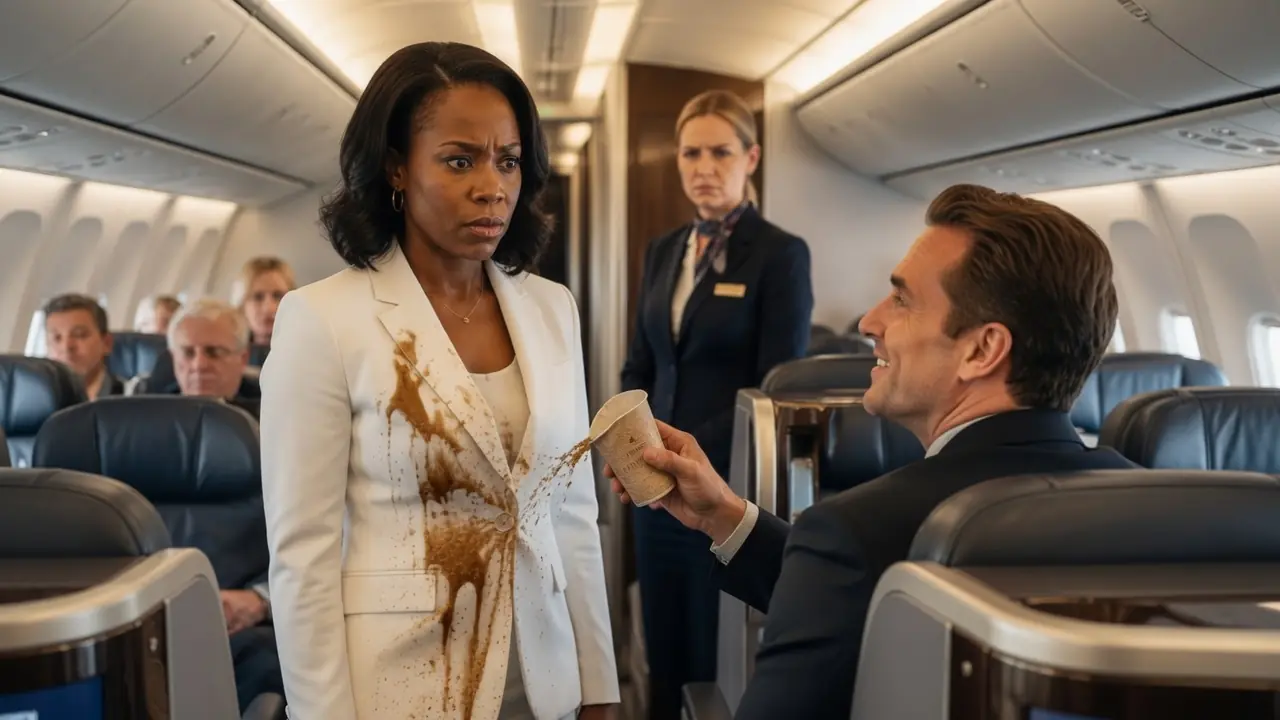
“Move to the back row,” he said loudly. “Some of us paid to sit up here.”
Naomi looked down at the spreading stain. The coffee was hot, not enough to burn badly, but enough to sting through the fabric. Around her, passengers held their phones, their purses, their headphones, and their opinions. No one stood. No one asked if she was all right. They watched the way people watch when they have already decided the person being embarrassed has less power than the person doing it.
A flight attendant hurried down the aisle, her face tight with irritation. Her name tag read Lauren. She glanced at the coffee dripping onto the carpet, then at Naomi’s blazer, then at the man in 2C. In that tiny pause, Naomi watched her choose the story she preferred.
“You are blocking boarding,” Lauren said coldly. “Clear the aisle. Now.”
Naomi slowly lifted her eyes. “Your passenger just created a spill hazard during active boarding,” she said. “And you walked past it.”
Lauren’s jaw tightened. “Ma’am, I need you to step aside.”
“You need to secure the aisle.”
The man in 2C laughed. “Oh, now she’s giving safety lessons.”
Naomi turned her head slightly toward him. He was in his forties, well-dressed, polished, with the kind of smile that came from being believed too often. His tie was loosened just enough to look relaxed, and his watch was angled toward the aisle as if he wanted strangers to notice it. He still held the crushed paper cup between two fingers.
Naomi did not raise her voice. She had learned long ago that anger from a Black woman made certain people feel permitted to stop listening. So she let silence sharpen itself around her. She set the crushed cup upright on the forward galley counter, wiped one drop of coffee from her wrist, and looked past Lauren.
The galley service drawer latch above the counter was still open.
Naomi pointed to it.
Lauren followed her finger, and her face changed.
Then Naomi pointed to the overhead bin above row one. It had been slammed shut minutes earlier, but one corner had bounced back open, barely an inch. A bag strap hung out, small but visible, exactly the kind of thing trained crew were supposed to catch before departure.
The lead flight attendant, a woman named Marissa, stepped out from the front galley. “What’s going on?”
Naomi did not answer immediately. She pointed to the jumpseat panel near the door. Lauren’s hand twitched toward it before she could stop herself. Naomi saw that too.
“You signed the cabin ready check?” Naomi asked.
Lauren’s face lost its color.
The man in 2C sat forward. “What is she talking about?”
No one answered him.
Naomi reached into the inside pocket of her coffee-stained blazer and removed a small sealed envelope. Airline crews recognized that type of envelope faster than passengers did. It was plain, official, and still dry except for one brown stain along the edge.
Marissa stared at it. Her voice dropped. “Who completed preflight?”
Lauren swallowed. “I did.”
Naomi held the envelope flat against her palm. “Then explain why I found three incomplete cabin readiness items before the door closed.”
The cabin became quiet enough to hear coffee drip from Naomi’s sleeve onto the carpet.
The cockpit door opened, and the captain stepped into view. He was tall, gray-haired, and already wearing the controlled expression pilots used when they sensed a problem that could become paperwork. His eyes moved from Naomi’s stained blazer to the paper cup, then to the open latch and the unsecured bin.
Marissa turned toward him. “Captain, we may have a failed cabin readiness signoff.”
The man in 2C stopped smiling.
Naomi looked at him then, not with rage, not with triumph, but with the icy patience of someone who had been underestimated into authority. She had not boarded Flight 482 as a regular passenger. She was traveling under a concealed safety audit for Meridian Air after three complaints in six months suggested the airline’s first-class service team had begun treating safety as secondary to status.
Her job was not to embarrass crews. Her job was to see what crews did when they thought no one powerful was watching.
And now everyone was watching.
The captain stepped into the aisle. “Ma’am, may I see your credentials?”
Naomi looked at Lauren first. “Now someone asks.”
The words landed softly but heavily. Lauren looked down at the carpet.
Naomi opened the envelope and removed her identification card, audit authorization letter, and sealed operational notice. She handed them to the captain. He read the first page, then the second, and the muscles in his face tightened with every line.
“Ms. Preston,” he said carefully. “You are the aviation safety compliance auditor assigned to this flight.”
“Yes.”
The man in 2C shifted in his seat. “This is ridiculous. She was standing in the aisle blocking everyone.”
Naomi turned to him. “You shoved a cup into my blazer during boarding.”
“I barely touched you.”
“You created a spill hazard, interfered with passenger movement, and mocked a safety concern before knowing who I was.”
He leaned back, defensive now. “I thought you were—”
Naomi waited.
He stopped.
That unfinished sentence told the entire cabin more than the finished one would have.
The captain handed her documents back. “Ms. Preston, I apologize for what happened. We will handle the passenger.”
Naomi’s eyes moved to Lauren. “And the crew?”
Lauren’s mouth tightened. “Captain, I was trying to keep boarding moving.”
“No,” Naomi said. “You were trying to keep a certain passenger comfortable. That is not the same thing.”
Marissa looked at Lauren with disappointment now, but Naomi noticed the timing. Disappointment after evidence was easy. Courage before proof was rare.
The captain turned to the cabin. “Ladies and gentlemen, please remain seated. Boarding is paused.”
A wave of murmurs moved through first class and into the rows behind them. A businessman near 1A lowered his phone, realizing the video he had been recording might no longer show the story he thought it did. A woman near the window whispered an apology Naomi knew was not meant for her ears. The cabin air, so full of judgment minutes before, had changed into embarrassment.
The captain looked at the man in 2C. “Sir, please step into the jet bridge.”
The man stiffened. “Excuse me?”
“We need to discuss your behavior before this aircraft departs.”
“I’m not going anywhere. I paid for this seat.”
Naomi looked at him. “You paid for transportation, not permission to assault someone with hot coffee.”
His face reddened. “Assault? That’s dramatic.”
The captain’s expression hardened. “Sir, step off the aircraft.”
For the first time, the man looked around for support and found very little. The passengers who had been amused before now became fascinated by their phones, their shoes, or the cabin wall. The same people who had watched Naomi be humiliated were suddenly unwilling to be seen supporting the wrong side.
He stood with a sharp movement. “This airline will hear from my attorney.”
Naomi glanced at his coffee-stained cup. “So will mine.”
Marissa escorted him toward the front door, but he paused near Naomi, lowering his voice. “You people always make everything about race.”
Naomi’s gaze did not move. “No. People like you make race the first thing you see, then get offended when we notice.”
The captain heard it. Marissa heard it. Half of first class heard it.
The man walked off the aircraft without another word.
Only after he disappeared into the jet bridge did Naomi allow herself one slow breath. The coffee was cooling against her blouse now, sticky and uncomfortable. Her arm still hurt where the cup had hit. Her pride hurt less. Pride healed quickly when truth had witnesses.
The crew began moving faster now. The galley latch was secured. The overhead bin was opened, adjusted, and closed correctly. The carpet was cleaned. Lauren stood near the galley with her hands clasped too tightly in front of her.
The captain approached Naomi again. “Ms. Preston, we will reseat you immediately. We can also have someone bring you a garment bag if you’d like to change before departure.”
Naomi looked down at the ruined blazer. “No.”
He blinked. “No?”
“I will remain exactly as I am until I finish my report.”
Lauren looked up sharply.
Naomi held her gaze. “This stain is part of the audit now.”
The captain nodded once, slow and serious. “Understood.”
A ground supervisor entered the aircraft a few minutes later, followed by a station manager and an airport security officer. Naomi gave a concise statement. She did not exaggerate. She did not need to. The facts were ugly enough.
Passenger in 2C created a spill hazard and made discriminatory comments. Flight attendant failed to address passenger misconduct. Cabin readiness checklist had been signed despite incomplete items. Lead crew intervened only after auditor identification became apparent.
Lauren’s face collapsed slightly at that final line.
When the station manager asked if Naomi wanted to remove Lauren from the flight, the cabin went still again. Lauren looked at Naomi with fear now, but also something like anger. People often resented the person who revealed the consequences of their own choices.
Naomi studied her for a moment.
“What would you have done if I were not an auditor?” Naomi asked.
Lauren’s lips parted, but no answer came.
“That is the answer,” Naomi said.
The station manager turned to the captain. “We’ll replace her.”
Lauren’s face went pale. “Please. I made one mistake.”
Naomi’s voice stayed calm. “No. You made several choices. The mistake was believing none of them would matter.”
Lauren was escorted off the plane. She did not cry loudly. She looked embarrassed, shaken, and angry enough to blame Naomi for the fall instead of the step she had taken. Naomi watched her leave and felt no satisfaction. Accountability was not joy. It was weight returning to the person who had dropped it.
A replacement flight attendant arrived fifteen minutes later, introduced herself as Tessa, and immediately addressed Naomi by name. She offered a towel, sparkling water, and a private moment to clean the coffee from her jacket. Naomi accepted the towel but declined the privacy.
The captain came over the speaker a short time later. “Ladies and gentlemen, thank you for your patience. We have completed additional safety checks and will depart shortly.”
No one complained.
The rest of the flight was painfully polite. Passengers avoided staring directly at Naomi, though she felt their awareness like heat. Tessa handled service with careful professionalism, but Naomi noticed that she checked every latch twice. Marissa moved through the cabin with a clipboard and a face set with quiet shame.
Naomi spent the first hour writing.
Not emotional notes. Not personal reflections. She wrote timestamps, sequence of events, crew responses, cabin conditions, and passenger behavior. She wrote what was said and what was not said. She wrote the way Lauren saw coffee on the floor before seeing the man who caused it. She wrote that the first safety failure was not the open latch.
It was assumption.
By the time the plane landed in Chicago, her report was twenty-three pages.
Two senior Meridian Air executives met her at the gate. They had the strained expressions of people hoping an apology could arrive before consequences. One was the vice president of inflight service, a man named Robert Kell. The other was Dana Cho, the chief safety officer.
Dana spoke first. “Ms. Preston, I’m sorry.”
Naomi looked at her and heard the difference. Dana was not apologizing to protect the brand. She was apologizing because she understood the failure.
Robert Kell tried next. “We are deeply troubled by the passenger’s behavior.”
Naomi looked at him. “You should be more troubled by your employee’s response.”
He nodded too quickly. “Of course. That too.”
“No,” Naomi said. “Not ‘that too.’ That first.”
His face tightened.
Dana glanced at him, then turned back to Naomi. “We will treat it as a safety culture failure.”
“Good,” Naomi said. “Because that is what it was.”
The video was online before Naomi reached her hotel.
Someone in row three had posted the moment Daniel Mercer told her to move to the back row. Another clip showed Naomi pointing out the open latch, the bin, and the cabin-ready issue. By evening, the story had spread across business news, aviation forums, social media, and every corner of the internet where people loved watching arrogance meet consequences.
The comments were predictable.
Some called Naomi calm, brilliant, powerful. Others said she had overreacted. Some insisted the passenger was just rude, not biased. Others wanted to know why she had been walking in the aisle in the first place, as though standing while Black required a special explanation.
Naomi did not respond publicly.
She had work to do.
At 8:00 the next morning, she met with Meridian Air’s executive safety committee. She wore a clean navy suit, but she brought the stained blazer in a clear garment bag and laid it on the conference table before anyone could offer coffee. The room went quiet.
“This is not a public relations issue,” she said. “This is an operational issue.”
Robert Kell shifted in his chair. “We understand the seriousness.”
Naomi opened her report. “Do you?”
She showed them the cabin timeline. She showed them the signed readiness report. She showed them photos of the unsecured latch and overhead bin. She played the audio of Lauren telling her to clear the aisle instead of addressing the spill. Then she paused the video on the moment Mercer smiled with the crushed cup in his hand.
“This man believed the cabin would protect his comfort over my safety,” Naomi said. “He was right for almost two minutes.”
No one interrupted.
“Two minutes is a long time in aviation,” she continued. “Two minutes is enough for a spill to spread, for boarding to compress, for passengers to lose balance, for crew authority to become visibly biased, and for trust to collapse.”
Dana nodded slowly. “Agreed.”
Naomi turned a page. “Your retraining must not begin with politeness. Politeness is not enough. It must begin with verification, intervention, and equal enforcement. A passenger’s status cannot decide whether crew respond to misconduct. A crew member’s assumption cannot decide who gets blamed first.”
Robert’s face was red now, but he wrote notes.
By the end of the meeting, Meridian Air agreed to a full safety culture review, retraining for all first-class cabin crew, new passenger misconduct escalation rules, anonymous reporting protections, and a temporary suspension of the crew involved pending investigation. Daniel Mercer, the man in 2C, was placed on the airline’s no-fly list for abusive conduct.
Lauren’s case was reviewed separately.
Two weeks later, Naomi received a letter from her. It was short, handwritten, and difficult to read in places because the pressure of the pen had torn through the paper.
Ms. Preston, I blamed you because it was easier than challenging a passenger I thought mattered more. I am ashamed of that sentence because I did think it, even if I would have denied it yesterday. I am sorry for what I chose not to see.
Naomi read it twice.
She did not forgive Lauren immediately. Forgiveness was not a courtesy owed to anyone who found regret after evidence appeared. But Naomi respected one thing about the letter: it did not hide behind misunderstanding.
Months passed.
Meridian Air implemented the changes. Naomi reviewed progress reports, training modules, incident data, and passenger complaint patterns. She noticed improvement, not perfection. Perfect systems did not exist. Accountable ones did.
Six months after the incident, Naomi boarded another Meridian Air flight.
This time, she boarded as a regular passenger, no sealed envelope, no hidden audit, no official reason to watch. She wore a cream blazer and carried a black leather tote. Her seat was 2A.
A young flight attendant greeted her at the door. “Welcome aboard, Ms. Preston.”
Naomi smiled slightly. “Good morning.”
As she moved through first class, she saw a man in 2C lift his coffee cup too quickly and nearly bump a woman passing in the aisle. Before Naomi could react, the flight attendant stepped forward.
“Sir, please keep hot beverages clear of boarding passengers,” she said firmly. “Ma’am, are you all right?”
The woman nodded, surprised but grateful.
Naomi continued to her seat.
No one else knew why that tiny moment mattered. No one applauded. No video went viral. The plane did not stop. The crew simply did what should have been done the first time.
That was the kind of change Naomi trusted most.
Quiet change.
Change that worked when no one powerful was watching.
After takeoff, the young flight attendant brought Naomi water. “Ms. Preston,” she said softly, “I know you probably hear this too much, but thank you.”
Naomi looked up. “For what?”
“For making them train us differently.” The attendant glanced down the aisle. “They teach us now that safety starts with who we believe first.”
Naomi felt something loosen in her chest.
She looked out the window at the clouds below. “Then make sure you believe carefully.”
“Yes, ma’am.”
Naomi leaned back as the plane leveled out.
She thought about the coffee stain, the crushed cup, the laughter from 2C, and the silence of people who had watched her be blamed before she was known. Then she thought about the open latch, the unsecured bin, and the question that had changed the cabin.
You signed the cabin ready check?
It had seemed like a small question.
But small questions could stop planes.
Small questions could expose systems.
Small questions could force rooms, cabins, companies, and people to admit what they had failed to secure.
The flight attendant passed down the aisle, checking every bin as she went. Naomi watched her pause at one latch, press it firmly, then continue.
Naomi smiled faintly.
This time, the cabin was ready.