Every town has a man people stop noticing after a while.
In Millfield County, that man was Walter Boone.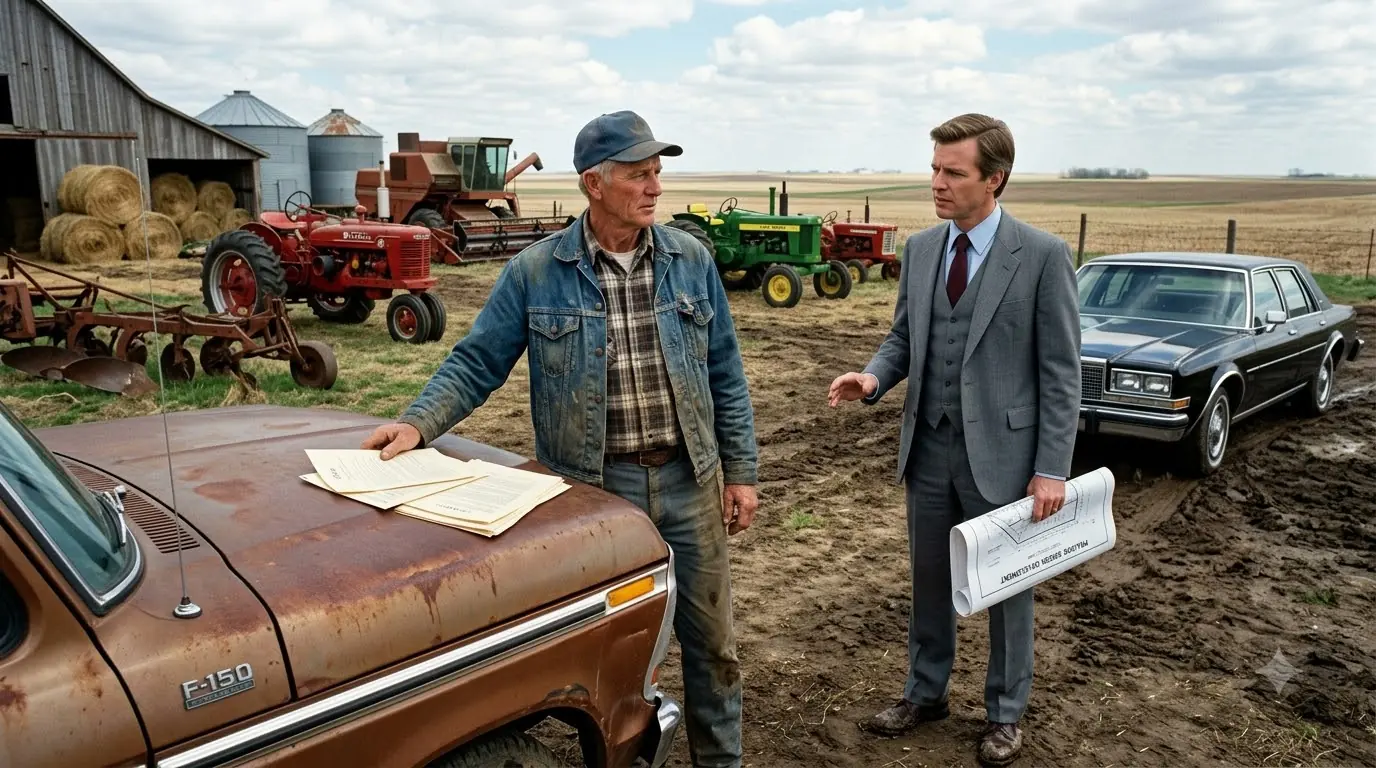
For thirty years, he repaired broken tractors for farmers nobody else wanted to help. Most people thought he barely survived.
He drove the oldest truck in town, paid cash for everything, never borrowed money, and never upgraded anything he owned. Some people called him cheap. Others called him strange.
But nobody ever called him important, even though half the county trusted him with machines worth more than their homes.
Walter rarely spoke longer than necessary, but he remembered everything.
Especially land.
At night, after the repairs were finished, he studied property lines. He learned who owned what, who owed money, and who might lose everything before the following winter.
“The bank cannot wait any longer, Earl. It is done. You have thirty days.”
“Thirty days? This land has been in my family for four generations. You cannot simply take it.”
Fields disappeared. Auctions multiplied. Debt spread faster than drought.
Every farmer who walked into Walter’s shop talked too much.
They told him which bank was calling, which payment was late, and which piece of land might be sold next.
He only listened.
While everyone believed he repaired tractors for a living, Walter Boone had been buying land for years.
One field here.
Another pasture there.
They were quiet purchases nobody noticed.
By 1984, the mechanic everyone ignored secretly owned farmland in every direction around the town.
Most people simply did not know it yet.
Every morning, Walter opened the garage before the sun came up. Every morning, another farmer arrived carrying bad news.
Crop prices were collapsing. Interest rates were exploding. Banks wanted money nobody had.
Walter listened to every story without interrupting, but unlike everyone else, he paid attention to the land beneath the story.
After people left, he wrote everything down.
Acres.
Debt amounts.
Auction rumors.
Missed payments.
Eventually, even the bankers began bringing their machines to Walter for repairs.
Bankers talked even more than farmers.
“With the mortgage in default, we can begin foreclosure proceedings immediately. This farm is as good as gone.”
Most people saw dying farms.
Walter saw discounted futures.
He inspected land the same way other men inspected engines.
Carefully.
Patiently.
Without emotion.
At auctions, Walter barely spoke at all. Nobody worried about the quiet mechanic standing near the back.
Then he would raise one hand and quietly purchase another eighty acres in cash.
Most people assumed it was the only land he owned.
They were wrong.
Very wrong.
Walter Boone had spent twenty years quietly building a ring of farmland around the entire county seat.
Then, one spring morning, a development company arrived from Omaha with plans to purchase thousands of acres surrounding the town.
The company called itself Prairie Horizon Development.
Its representatives arrived speaking as though the county already belonged to them.
They presented plans for industrial storage facilities, new grain terminals, commercial trucking routes, and major infrastructure projects.
Some residents saw opportunity.
Others saw outsiders.
Walter Boone saw numbers.
Most of the land marked in red on the company’s maps already belonged to him.
Prairie Horizon believed purchasing the county would be easy.
Its executives had no idea one silent mechanic had arrived first.
After the public presentation, one of the executives finally walked over to Walter.
“Well, that was interesting. Thank you for attending.”
The executive smiled politely.
“Sir, we may eventually be interested in purchasing your small parcel outside town.”
Walter stared at him for several seconds.
“Which parcel?”
The executive pointed toward the west side of town.
Then he indicated the northern fields.
Finally, he pointed toward the southern highway access road.
With every place he mentioned, Walter already owned the land.
The conversation became quieter.
Walter reached into his coat.
He produced one deed.
Then another.
Then another.
The mechanic they had ignored controlled nearly every access point surrounding the town.
He owned the rail access, storage roads, drainage routes, and future expansion corridors.
Without Walter Boone, Prairie Horizon’s entire project would collapse.
For thirty years, people believed he was only the man who repaired tractors.
Now they realized the quiet mechanic owned the ground beneath their future.
Walter returned to work the same way he always did.
Quietly.
As though nothing had happened.
Farmland prices continued rising for the third consecutive quarter.
Meanwhile, the entire county began talking about Walter.
Nobody could understand how a tractor mechanic had acquired so much land.
The truth was simple.
Walter never spent money trying to look successful.
While other men financed larger machines, Walter purchased dirt.
He repaired old equipment instead of replacing it.
He saved every extra dollar.
Year after year, field after field, his land holdings grew around the town.
By 1985, Walter Boone quietly controlled more farmland than some regional banks.
Prairie Horizon now had a serious problem.
“This is a disaster. We are finished.”
“It is your fault. Your projections were worthless.”
Every major route required for the project crossed Walter’s land somewhere.
Once the executives understood the seriousness of the situation, they returned to his garage.
For the first time, they asked politely.
Walter continued working while they spoke. He never stopped turning the wrench in his hand.
They offered partnership deals, leasing agreements, and shares in the development.
Walter listened quietly to all of it.
Then he remembered something the businessmen had never seen.
He remembered the men who had cried inside his garage after losing family farms.
Walter had spent decades watching outsiders profit from local collapse.
When the executives finally asked what he wanted, the garage became completely silent.
Walter Boone, the quiet mechanic nobody respected, gave them an answer they never expected.
“I am not selling,” he said. “Not one acre.”
Suddenly, some of the most powerful businessmen in the state realized the county no longer belonged to them.
The executives believed Walter was bluffing.
Most men would have sold immediately.
The offer was enormous.
Their final proposal could have made Walter one of the richest men in Nebraska overnight.
Walter Boone had never cared about looking wealthy.
He cared about ownership.
Real ownership.
Every acre he purchased had cost him years of work.
Long nights.
Cold winters.
Missed vacations.
No debt.
The businessmen left angry.
Walter returned to work.
Within days, the entire county knew the truth.
The mechanic they had ignored for thirty years was one of the largest landowners in the region.
“We appreciate your business, Walter. Times are changing, and we are here to help.”
Walter never changed.
He continued repairing tractors for struggling farmers who could not afford new equipment.
Sometimes, he barely charged them at all.
Walter Boone never purchased land to impress anyone.
He purchased it because land remained while money, people, and companies disappeared.
Within two years, Prairie Horizon abandoned the entire project.
Everyone finally understood something they had overlooked for decades.
The fields surrounding the town, the roads, and nearly every route connected to its future growth belonged to the silent mechanic.
People believed Walter Boone had spent his life fixing tractors.
While everyone else was busy trying to look important, the quiet mechanic had been buying the world around them.