Samuel Carter opened his tractor repair shop every morning at six, even though most people in Mill Creek, Tennessee, believed he had no reason to hurry anymore.
He was seventy-two, gray-bearded, and usually dressed in patched overalls with grease buried deep in the lines of his hands.
His shop sat at the edge of town beside an old gravel road, with broken plows, rusted mower decks, and two tractors waiting under a tin roof.
To strangers, Samuel looked like a tired old mechanic holding onto work the modern world had already outgrown.
But Samuel had never cared much about what strangers saw.
He liked the quiet before sunrise, the smell of oil and cut grass, and the steady honesty of machines that only lied when someone ignored their warning sounds.
Farmers brought him tractors that coughed, sputtered, leaked, and refused to start, and Samuel brought them back to life with patience and stubborn hands.
He did not advertise, did not wear a company shirt, and did not talk much unless the person across from him knew how to listen.
People in town respected him, but not in the way they respected men with money.
They respected him the way people respect an old fence post that has stood through too many storms to be questioned.
They waved when they passed his shop, asked him to fix small engines, and sometimes paid late when harvest was bad.
Samuel never chased anyone for money, though he remembered every debt and every kindness with equal accuracy.
What people did not know was that Samuel Carter owned more land than almost anyone in the county.
Not the pretty land people noticed from the highway, and not the big square fields that developers circled on maps.
Samuel owned the ugly strips, the narrow corridors, the half-forgotten easements, the muddy drainage cuts, the old rail crossing approaches, and the strips of gravel road nobody else wanted.
He had spent thirty years buying pieces of land that richer men called useless.
It began after his wife, Ruth, died.
She had been the only person who fully understood how Samuel’s mind worked, because she saw value in quiet things before others did.
When she was alive, they used to drive the county roads on Sunday afternoons, looking at abandoned fence lines, old survey markers, and small forgotten parcels tangled in weeds.
Ruth would point out a ditch and say, “Sam, someday somebody will need that little piece more than they know.”
After her funeral, Samuel kept driving those roads alone.
At first, he did it because grief made the house too silent, and the old truck gave his hands something to hold.
Then he began remembering Ruth’s words and looking more carefully at the land everyone ignored.
A ten-foot strip beside a rail spur, a drainage easement behind a closed feed mill, an access road to an abandoned soybean field, and a utility corridor running along a tree line.
The owners were often glad to sell.
Some had inherited land they did not understand, some were tired of paying taxes on parcels too awkward to farm, and some laughed when Samuel offered cash.
They thought the old mechanic was sentimental, foolish, or simply lonely enough to buy dirt nobody needed.
Samuel let them think that, because correcting people usually cost more energy than silence.
By the time Mill Creek began changing, Samuel already owned the pieces that connected everything.
The old rail line north of town had been quiet for years, but Samuel knew rail companies never forgot a route completely.
The state had improved the highway, and survey flags had started appearing near soybean fields that used to sit unnoticed.
Samuel watched, listened, and kept repairing tractors while men in clean trucks drove past his shop without slowing down.
Then the logistics company arrived.
Its name was Dominion Freight Systems, and its plans were bigger than anything Mill Creek had seen in decades.
The company wanted to build a three-hundred-million-dollar logistics hub with warehouses, loading docks, rail access, truck routes, drainage basins, and utility extensions.
The mayor called it the future, the county commission called it opportunity, and the newspaper called it the project that would put Mill Creek on the map.
Samuel read every article and said nothing.
He listened to people talk at the diner about jobs, road widening, land prices, and how farmers were finally going to make real money.
He heard others worry about noise, flooding, and whether small family roads would become truck routes overnight.
When anyone asked Samuel what he thought, he only said, “A big machine still breaks if one small part is missing.”
Most people thought he was talking about tractors.
He was not.
On a bright Monday morning in late spring, three black SUVs rolled into Samuel’s gravel yard.
They parked in a neat row outside the tractor shop, their polished sides reflecting the old red tractor Samuel had been rebuilding for Mrs. Elkins down the road.
Two men in hard hats stepped out first, carrying rolled maps and tablets.
Then a man in a dark suit stepped from the middle vehicle, adjusting his cuffs as if the country dust had personally insulted him.
His name was Preston Hale.
He was a corporate development executive from Atlanta, hired by Dominion to secure the final land pieces for the logistics hub.
Preston was handsome in the clean, expensive way of men who practiced confidence in hotel mirrors.
He looked at Samuel’s shop, the rusted implements, the oil stains, and the old mechanic in patched overalls, then decided the meeting would be easy.
Samuel stood in the open doorway wiping his hands on a rag.
He had known they were coming before they turned off the highway, because nothing with three black SUVs arrives quietly in a small town.
He watched Preston approach with the two surveyors behind him and waited without stepping forward.
The old red tractor behind him sat half-repaired, its hood open like a patient under careful hands.
“Mr. Carter?” Preston asked, offering a smile that never reached his eyes.
Samuel nodded once.
“That’s what my mail says.”
Preston gave a short laugh, then gestured toward the men behind him.
“I’m Preston Hale with Dominion Freight Systems,” he said.
“We’re here regarding several small parcels connected to the Mill Creek logistics development.”
Samuel folded the rag slowly and placed it on the workbench beside a tray of bolts.
“I figured you boys would find your way here eventually.”
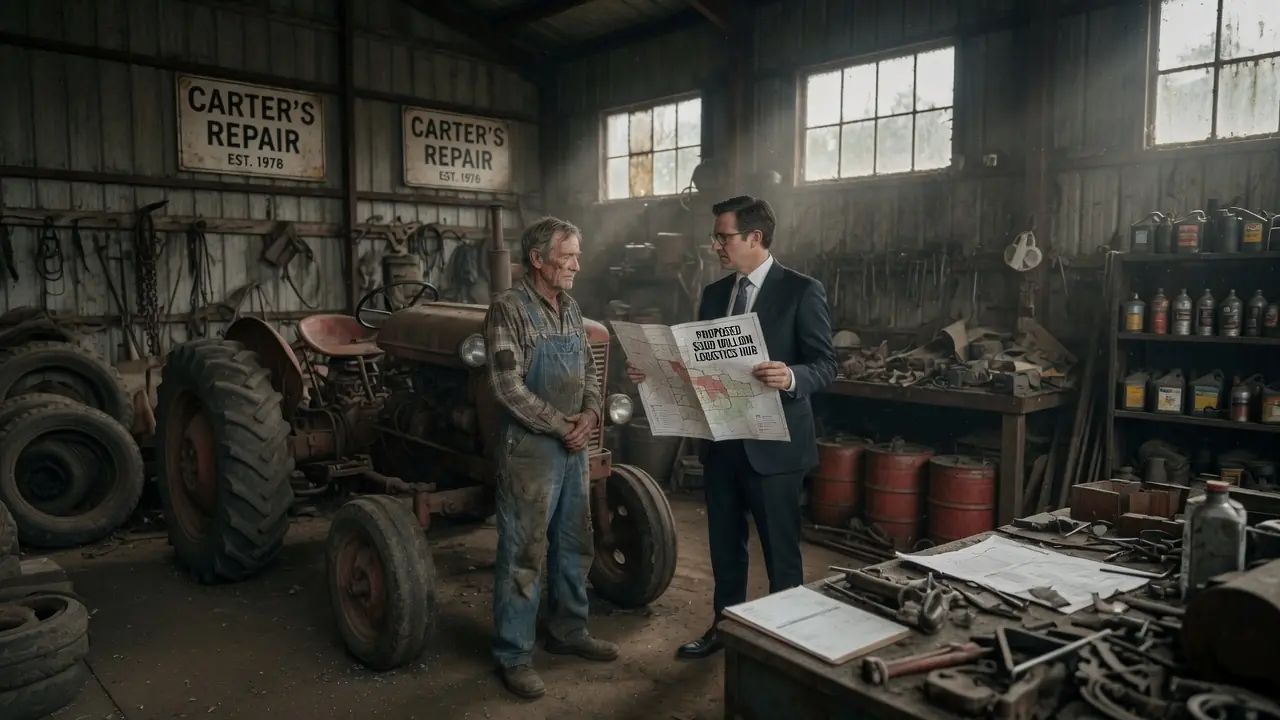
Preston’s smile tightened.
He took the large map from one surveyor and spread it across the hood of a broken tractor without asking permission.
Samuel’s eyes moved to the map, then to the tractor hood, but he did not speak.
Preston tapped a highlighted yellow corridor running from the highway to the proposed warehouse site.
“We need cooperation on a few narrow pieces of land,” Preston said.
“Nothing significant, mostly access, drainage, utility, and rail approach matters.”
Samuel looked at the map for a long moment.
“Nothing significant,” he repeated quietly.
One surveyor shifted awkwardly.
Preston did not notice.
He was too busy opening a leather folder and removing an offer sheet.
“We are prepared to make this very worthwhile for you.”
Samuel did not take the paper.
“How worthwhile?” he asked.
Preston smiled wider, believing the old man had reached the only part that mattered.
“Two million dollars for immediate sale and cooperation.”
The shop went quiet except for a fan turning slowly near the back wall.
Samuel looked past Preston toward the gravel yard, where the SUVs gleamed in the sun.
Two million dollars was more money than most people in Mill Creek would see in a lifetime.
It was also much less than Dominion would lose if Samuel refused.
“No,” Samuel said.
Preston blinked.
“I’m sorry?”
Samuel picked up a small wrench and set it into the correct drawer.
“I said no.”
Preston’s expression changed, but he recovered quickly.
“Mr. Carter, perhaps you do not understand the scale of what we are offering.”
Samuel smiled faintly.
“I understand scale. I’ve been fixing machines bigger than your confidence since before you were born.”
The surveyors looked down at their boots.
Preston’s jaw tightened.
He placed the offer sheet on the workbench as if Samuel’s refusal were only a temporary inconvenience.
“Men like you do not turn down this kind of money.”
Samuel’s eyes lifted.
“Men like me built this town while men like you ignored it.”
The words were calm, but they struck the room hard.
Preston stopped smiling completely.
“Let’s keep this professional.”
Samuel nodded.
“Then take your paper off Mrs. Elkins’s tractor.”
Preston looked confused for a second, then glanced at the map spread across the machine.
One of the surveyors quickly lifted it away, sensing danger better than his boss.
Preston inhaled slowly.
“Mr. Carter, Dominion has legal teams, state support, and public backing.”
Samuel closed the tractor hood with a heavy metallic thud.
“Sounds expensive.”
Preston stepped closer. “It can become expensive for you too.”
The first threat had arrived.
Samuel had expected it, but hearing it spoken in his shop still settled something cold in his chest.
He thought of Ruth standing beside him years ago, pointing toward a drainage ditch with sunlight in her hair.
He thought of every farmer who had paid him in tomatoes, eggs, or promises when money was short.
Preston lowered his voice.
“If you refuse, our lawyers will make this very painful.”
Samuel reached beneath the workbench and pulled out a rusty metal cabinet key.
He opened the old cabinet slowly, letting the hinges complain.
Then he removed a stack of deeds tied with twine and placed them beside Preston’s clean corporate map.
The surveyors leaned forward.
Preston stared at the old papers, his face showing irritation first, then confusion.
Samuel untied the stack with careful fingers.
He laid out one deed, then another, then another, each marked, copied, filed, and recorded over decades.
The silence in the shop changed as the two surveyors began understanding before Preston did.
“This is the north access road,” Samuel said.
He placed one document on the bench.
“This is the drainage ditch your engineers marked for storm runoff.”
He placed another beside it.
“This is the rail crossing approach, this is the utility corridor, and this little strip here is the only legal turn radius for your truck entrance.”
Preston’s face went pale beneath his expensive tan.
One surveyor whispered, “Sir…” then stopped himself.
Samuel looked at him.
“Go ahead. Tell him.”
The younger surveyor swallowed.
“He owns the corridor pieces.”
Preston snapped his head toward him.
“I can see that.”
The surveyor looked back at the map with fear in his eyes. “No, sir. I mean he owns all of them.”
Samuel folded his arms.
“One man can’t control the whole corridor,” Preston said, though his voice had lost its strength.
Samuel’s face remained calm.
“One man didn’t.”
He tapped the deeds gently. “Thirty years of being ignored did.”
Preston stared down at the papers as if they had betrayed him personally.
His project, his schedule, his board presentation, his victory, all depended on the man standing in front of him in patched overalls.
Samuel watched the realization reach him piece by piece.
It was not joy Samuel felt, exactly, but justice had its own quiet temperature.
Preston changed tactics.
“Twenty million,” he said.
One surveyor turned sharply toward him.
Preston kept his eyes on Samuel. “Twenty million dollars, today, if you sign a letter of intent.”
Samuel looked at the offer sheet still sitting untouched on the bench.
“Is that supposed to make me dizzy?”
Preston’s face hardened.
“It is supposed to make you reasonable.”
Samuel picked up the map, folded it once, then again.
“I’m not selling.”
Preston opened his mouth, but Samuel finished before he could speak.
“Not one acre.”
The words moved through the shop like a door closing.
Preston’s hands curled at his sides.
“You would stop three hundred million dollars in development over stubborn pride?”
Samuel’s eyes sharpened.
“No. I would stop it over water, roads, farms, and graves.”
Preston frowned.
Samuel walked to the open door and pointed across the gravel road toward a low tree line.
“That drainage ditch you want to widen feeds into Miller Creek.”
He pointed farther south. “That access road runs past three family farms, two homes with elderly folks, and a school bus stop.”
Then he pointed west. “And that rail approach cuts fifty yards from the old Blackwood cemetery.”
The surveyors looked at the map again.
Preston looked angry because Samuel was no longer simply refusing money; he was naming consequences.
“Those issues can be mitigated,” Preston said.
Samuel nodded.
“Corporate men love that word.”
Preston stepped closer.
“You are standing in the way of jobs.”
Samuel did not back up.
“You are using jobs as a shield for greed.”
For the first time, Preston’s polished control cracked fully.
“You think this town will thank you for blocking opportunity?”
Samuel’s hands tightened, but his voice stayed steady.
“I think this town deserves opportunity that doesn’t poison its creek, crush its roads, or bury its dead under truck noise.”
A truck pulled into the yard behind the SUVs.
Then another.
Then a third.
Preston turned and saw Mayor Ellen Brooks stepping out, followed by two county commissioners, Sheriff Tom Willis, and several farmers Samuel had known for decades.
Behind them came Nora Elkins, whose tractor sat inside Samuel’s shop, and Pastor Henry Blackwood from the church near the cemetery.
Preston’s face stiffened.
“What is this?”
Samuel picked up the rag again and wiped one hand slowly.
“A meeting.”
Preston looked furious. “You called them?”
Samuel shook his head.
“I told them you were coming. They decided whether to show up.”
The mayor entered the shop first, her expression tight with worry.
“Mr. Hale,” Mayor Brooks said carefully, “we need to discuss what your company failed to disclose.”
Preston straightened his jacket.
“With respect, Mayor, this is a private negotiation.”
Samuel looked at the deeds on the bench.
“Not when every road into your project runs through public life.”
Pastor Blackwood stepped forward holding an old cemetery map.
“My great-grandparents are buried near that rail approach.”
Nora Elkins stood beside him, arms crossed.
“My grandchildren wait for the school bus on that road.”
Farmer Pete Lawson added, “And Miller Creek floods my back pasture if that ditch gets widened wrong.”
Preston looked trapped, but not defeated yet.
He turned to Mayor Brooks.
“Dominion brought a serious investment to this county.”
The mayor nodded.
“And we welcomed it based on incomplete information.”
Preston pointed at Samuel.
“This man has been quietly buying land to hold the project hostage.”
Samuel did not answer immediately.
He walked to the back of the shop and returned with a faded photograph.
It showed Ruth Carter standing beside him many years earlier near an overgrown ditch, smiling like she had discovered treasure.
“My wife and I bought those pieces long before your company knew Mill Creek existed,” Samuel said.
His voice softened, but no one mistook softness for weakness.
“We bought them because forgotten land still matters to somebody.”
He set the photograph beside the deeds. “Turns out she was right.”
The room went quiet.
Even Preston looked briefly uncertain, as if he had never considered that land could hold memory instead of only value.
Then his phone rang.
He glanced at the screen and stepped outside to answer.
Everyone inside the shop waited.
Through the open door, they could see Preston speaking sharply near one of the black SUVs.
His face changed several times as someone on the other end of the call spoke longer than he liked.
When he returned, his confidence had become thinner.
“My board is willing to increase the offer,” he said.
Samuel shook his head before Preston finished.
“Your board is asking the wrong question.”
Preston’s lips pressed together. “Then what is the right question?”
Samuel looked around the shop at the mayor, the farmers, the pastor, the sheriff, and the workers who had gathered by the door.
“The right question is what kind of project this town can live with after your company leaves the ribbon-cutting.”
Mayor Brooks looked at Samuel carefully.
“You have terms?”
Samuel reached into the cabinet again and pulled out a typed folder.
Preston stared as if the old man had produced a weapon.
In a way, he had.
The folder held months of notes, alternative access designs, drainage protections, cemetery buffer demands, local hiring requirements, road repair guarantees, and a community land trust proposal.
Samuel laid it on the bench.
“I’m not selling ownership,” he said.
“But I’ll consider long-term access leases under conditions that protect this town.”
Preston looked at the folder, then at him.
“You prepared this?”
Samuel smiled faintly.
“I repair tractors for farmers. Planning ahead is how you survive.”
Mayor Brooks stepped closer and picked up the first page.
Her eyes moved quickly over the terms, and her expression shifted from surprise to respect.
“These are strong conditions,” she said.
Samuel nodded.
“They need to be.”
Preston’s voice sharpened. “They are impossible.”
Samuel looked at him calmly.
“No, they’re just inconvenient to people who thought they could buy silence.”
Sheriff Willis coughed once to hide a smile.
Preston noticed and flushed.
The argument lasted nearly two hours.
Preston pushed, threatened delays, warned of lost investment, and repeated the phrase economic growth until it sounded empty.
Samuel answered each point with a deed, a map, a photograph, or a person standing in the room whose life would be affected.
By the end, even the surveyors had stopped defending the original plan.
The board called Preston again.
This time, he took the call inside the shop, unable to escape the eyes on him.
He spoke softly, listened angrily, and finally said, “Yes, I understand.”
When the call ended, his face had gone stiff.
Dominion would pause the project for redesign.
Preston Hale would no longer lead negotiations in Mill Creek.
A regional vice president would arrive the following week to meet with Samuel, the mayor, and community representatives.
No one cheered, because the matter was not finished, but everyone understood the first fight had been won.
Preston gathered his papers with shaking hands.
Before leaving, he looked at Samuel with resentment and reluctant fear.
“You could have been rich today.”
Samuel glanced around his shop, at the old tractors, the neighbors, the deeds, and Ruth’s photograph.
“I already knew what I owned.”
Preston had no answer.
He walked out to the SUVs, followed by the surveyors and hard-hatted men who no longer looked quite so certain.
As the vehicles rolled out of the gravel yard, dust rose behind them and drifted across the sunlight.
Samuel watched until they reached the highway.
Then Nora Elkins laughed softly.
“Well, Sam, I suppose you’re not just fixing my tractor today.”
The tension broke.
People began talking at once, some angry, some relieved, some still frightened about what might happen next.
Mayor Brooks placed a hand on Samuel’s shoulder and said, “You should have told us.”
Samuel looked at her.
“Would you have believed me?”
The mayor’s face softened with regret.
“Maybe not soon enough.”
Samuel nodded, accepting the honesty.
That evening, Samuel stayed late in the shop alone.
The old red tractor still needed work, and machines did not care about corporate drama.
He tightened a fuel line, checked the starter, and listened as the engine turned over on the third try.
When it finally caught, the sound filled the shop like a rough kind of music.
He shut it off and stood in the quiet afterward.
On the workbench, Ruth’s photograph rested beside the stack of deeds.
Samuel picked it up and brushed dust from the corner with his thumb.
“You were right,” he whispered.
A week later, Dominion returned with different people.
They arrived in ordinary trucks instead of black SUVs, and they asked more questions than they answered.
Samuel did not trust them completely, but he respected the change in posture.
This time, the meeting took place at the town hall, not in his shop.
The redesign took months.
The access road shifted away from the school bus stop, the drainage plan included creek protections, and the cemetery received a permanent buffer.
Dominion agreed to local hiring targets, road repair funding, and a community land trust that would preserve several farms from future development pressure.
Samuel still did not sell one acre, but he leased limited access under terms written to outlive handshakes.
Some people in Mill Creek called him a hero.
Samuel disliked that.
Heroes, in his opinion, were usually people who got mentioned after everyone ignored their warnings.
He preferred being called what he had always been: a mechanic.
But things changed anyway.
People stopped looking at his patched overalls the same way.
They came to the shop not only with broken tractors but with questions about land, contracts, and whether a small person could stand up to a large company.
Samuel answered when he could and told them to read everything twice.
One afternoon, a boy named Caleb Miller came by with a bicycle chain that kept slipping.
Samuel fixed it for free, then saw the boy staring at the old deeds in the cabinet.
“You really owned all that land?” Caleb asked.
Samuel tightened the chain and smiled. “I owned enough of the right land.”
Caleb frowned.
“How did you know it would matter?”
Samuel looked out toward the road, where trucks now slowed near the new survey signs.
“I didn’t know everything,” he said. “But I knew ignored things don’t stop being important just because people look past them.”
Years later, when the logistics hub finally opened, it did not look exactly like Dominion’s first map.
It was smaller, cleaner, and slower to expand than the company wanted.
The creek still ran clear after heavy rain, the old cemetery remained quiet behind a line of trees, and the school bus stop was moved to a safer road.
Some farmers leased land, some refused, and for once, refusal had been treated as a right instead of an obstacle.
Samuel attended the opening only because Mayor Brooks insisted.
He stood near the back in patched overalls, ignoring the chairs reserved for important guests.
When a company executive thanked local partners, the crowd turned and looked at him.
Samuel gave one small nod and wished everyone would face forward again.
After the ceremony, he returned to his shop and opened the big roll-up door.
The old red tractor sat near the entrance, fully repaired, ready for Mrs. Elkins to pick up.
Sunlight fell across its faded hood, across the tools, across the floor stained by decades of honest work.
Samuel stood there and felt Ruth beside him in the quiet.
He had never wanted to stop the future.
He had only wanted the future to remember who was already standing on the land before the maps arrived.
Men like Preston Hale believed power came from money, pressure, and polished shoes.
Samuel Carter knew power could also come from patience, memory, and thirty years of buying the pieces nobody respected.
That was why the story lasted in Mill Creek.
Not because an old mechanic became rich.
Not because a corporation was embarrassed.
But because Samuel Carter proved that a man could be underestimated for decades and still be the one holding the key when everyone else finally needed the door.