Outside, the wind was doing something it only did in January in Montana, not howling, not dramatic, just pressing, steady and absolute. It was the kind of wind that made the walls of a ranch house feel like an argument instead of a shelter. She lifted the canister lid, looked inside, then put the lid back. She did not say anything because there was no one to say anything to. The hired men were in the bunkhouse, the rancher was in town, and the cattle were in the low pasture. What the cattle were doing was no longer her problem to manage. She was the cook. She knew how much flour she had. She also knew something else, something she had been knowing quietly since the sky changed color that afternoon, since the temperature dropped eleven degrees in forty minutes, and since the horses in the near corral turned their backs to the north and stood pressed together without moving. She went to the window. The first flakes were coming sideways. This was not going to be an ordinary storm. The Alderman Ranch sat in the Boulder Creek Valley of Meagher County, Montana, and had been there since 1873. Fourteen years earlier, Thomas Alderman had built it from a government claim and forty head of longhorn cattle that had not been suited to Montana winters and had mostly proved it by dying in the first one. He had rebuilt from that, which was the kind of thing that either made a man or finished him. It had made Thomas Alderman into something specific, a man who was very good at the work and very poor at the things that were not work. He had built an operation worth two thousand acres and one hundred sixty head around those two facts. He had five hired men. Two were reliable and two were willing. The fifth was Pete Hallett, seventy-one years old, who had been with the ranch since 1875 and had lost three fingers on his left hand to a rope in 1879. Pete's value now was what he knew rather than what he could do. The ranch also had a cook. Her name was Nora Greer. She had come to the Boulder Creek Valley in the spring of 1886, nine months earlier, after her husband Daniel died in a horse accident outside Billings and left her with eleven dollars, a wagon, and a very clear understanding of her own capabilities. She was thirty-four years old. She had cooked in two mining camps, one hotel, and a cattle drive from Texas to Abilene before she was twenty-five. She had also forgotten more about the way weather moved through that part of the country than most men on the Alderman spread had ever known. Nobody at the ranch knew this last thing. They knew she made excellent biscuits. They knew she was quiet. They knew she kept the kitchen organized in a way that seemed fussy until you needed something at midnight and found it in the dark without looking. They did not know what she knew about blizzards. They were about to find out. Thomas Alderman had ridden to Boulder Creek that morning, eight miles away. He had gone for feed-supply receipts and a conversation with the bank that he had been postponing since October and could not postpone any longer. He had expected to be back by two o'clock. It was now four-thirty. The temperature was dropping at a rate Nora had felt only twice before in her life. Once in Wyoming in 1878, and once on a cattle drive somewhere in the Indian Territory, when three men had made the mistake of not listening to the trail cook's instructions and had not been found until March. She went to the bunkhouse. She knocked, not the way you knock when you want to come in, but the way you knock when you need someone to understand that you are not asking. A voice said, “Yeah?” Nora said, “I need all of you in the main house.” Silence followed. Then Frank Mears, twenty-six, who had been with the ranch eight months and already had the opinions of an older man regarding people who told him what to do, asked, “What for?” Nora said, “Because in about four hours it's going to be thirty below and the bunkhouse stove won't hold it. And because the cattle need to be moved before it gets dark, and there are only three hours of light left.” Another silence followed, longer this time. Then Pete Hallett spoke in the slower voice of a man who had been alive long enough to recognize when someone knew what they were talking about. “How bad?” he asked. “Bad enough that I'm standing here instead of in the kitchen.” Pete said, “Boys.” They came out. Nora did not give orders. She said what needed doing, in what order, and why, briefly, the way you explain things when time is the actual problem and not the people. The cattle came first. The two reliable men, Joe Birch and Calvin Pratt, knew the low pasture well enough to get there and back in the dark if it came to that. Nora told them the south draw was the wrong place to shelter the herd. She told them the canyon east of the dry creek had a natural windbreak and floor-level snowmelt from the cliff face that would keep it about three degrees warmer than anywhere else on the property. She explained this without preamble, in the same voice she used when she told someone where she kept the coffee. Joe Birch looked at her, then at Pete. Pete said, “Canyon east of the dry creek. Go.” They went. Nora sent Frank Mears and a quiet young man named Avery Dodd, twenty-one, who usually did whatever the person nearest to him did, to bring in the horses from the near corral and pack the bunkhouse stovepipe with extra clay seal. She showed Avery how because he had never done it before. He was fast and did not ask twice. Nora went back to the kitchen. She added four logs to the stove, not two, but four. She moved the water barrels from the cold side of the kitchen to the warm side, which would matter in about six hours. She pulled every quilt from every room on the main floor and stacked them in the hallway, which would be the warmest passage once the outer walls started losing the fight with the temperature. She found Thomas Alderman's emergency whiskey. She had found it months earlier and had said nothing, the kind of restraint that costs something and costs it quietly. She put it on the kitchen shelf where it would be needed without anyone having to search for it. Then she boiled a pot of beans, made four dozen biscuits, started a second pot of coffee, and did not stop the first one. Pete Hallett came in at dusk, his seven-fingered hands already white at the knuckles from the cold. He looked at the kitchen, the quilts in the hall, the moved water barrels, and the food on the stove, then stood there for a moment. “You've done this before,” he said. “Texas, '79. Indian Territory, '81. Wyoming, '78.” Pete looked at her. Nora handed him a cup of coffee. He sat down at the kitchen table. He did not get up from that table for the next eleven hours, not because he was tired, but because that table was where Nora Greer was. Pete Hallett had been alive long enough to know that you stayed near the person who knew what they were doing. The storm changed all at once. Montana blizzards did not do things gradually. One moment the snow was heavy and the wind was what it had been, and then the wind changed direction. That was not a small thing; it was the thing. The temperature dropped eight more degrees in twenty minutes. The snow became something else entirely, something horizontal, something that made the windows whiten from the inside as frost formed where the cold touched the glass. The five men were in the main house by then. Frank Mears had not argued about it. He had looked at the bunkhouse windows and made his own calculation. At eight o'clock, Nora fed them beans, biscuits, and the dried beef she had been rationing since November but was no longer rationing that night. She did not explain the change, and nobody asked. Frank Mears ate three servings. “You knew this was coming this morning,” he said. “This afternoon,” Nora replied. “The horses told me.” Frank looked at her. “Horses?” “They turned their backs to the north at three o'clock, all of them at the same time. When that happens in January in Montana, you move things.” Frank looked down at his biscuit. He did not say anything else. Avery Dodd sat near the stove with both hands wrapped around his cup. “I didn't know that,” he said quietly, mostly to himself. “Now you do,” Nora said. At nine o'clock, the stovepipe in the kitchen rattled, not from the wind but from a pressure drop Nora recognized and the others did not. She added two more logs, checked the pipe seal, added a third log, then checked the window seals on the north side of the house. She found one that was letting cold in at the lower-left corner and packed it with a strip of cloth from her apron pocket. She did not mention it. Pete watched her from his chair. He said nothing. There are men in this world who are made uncomfortable by competence in a direction they did not expect it. Pete Hallett was not one of those men. He had lived too long and seen too many people die from not listening to the right person at the right time. He picked up his coffee and remained comfortable. At ten-thirty, Calvin Pratt reported that the cattle were settled in the canyon east of the dry creek and the wind had not touched them. Joe Birch added, “She was right about the canyon.” Nobody looked at Nora when he said it. That was how you knew they were all thinking it. Thomas Alderman came in through the kitchen door in the state a man reaches after riding through a Montana blizzard for three hours because he has no other option. His coat was so thick with ice that it nearly stood on its own when he set it on the hook. His hands were wrong and his face was wrong. He was not in danger because he had made it, but he was the kind of cold that takes two hours to leave properly. Nora had a cup of hot coffee on the table before he sat down. She had the whiskey open beside it. She did not say, “I told you this was coming.” She did not say, “The cattle are in the canyon east of the dry creek where it's three degrees warmer.” She did not say, “The bunkhouse would have lost men tonight if they had stayed in it.” She only said, “Drink the coffee first, then the whiskey, in that order.” Thomas Alderman was forty-seven years old, had run the ranch for fourteen years, and had never in those years been given an instruction in his own kitchen. He looked at her. Then he drank the coffee. After that, he drank the whiskey. He sat at the table while the cold worked its way out of him. At some point, Pete told him about the cattle, the canyon, the bunkhouse, and the window seal. Thomas listened. He looked at his coffee cup. “She knew,” he said. “Since this afternoon,” Pete replied. Thomas said, “She didn't say anything to me.” “You weren't here.” Thomas looked toward Nora. “She's the cook.” Pete lifted his coffee. “Among other things.” Thomas looked at Pete. Pete looked at his cup. Outside, the blizzard did everything it was going to do all night. Inside, the kitchen was warm, the beans were hot, and the biscuits were on the table. Five men, one woman, and fourteen years of a ranch were still standing because the right person had stood at a window that afternoon, seen the snow come sideways, understood what it meant, and moved. The storm left behind thirty-one inches of snow and a temperature of twenty-two below zero. The silence afterward was so complete that the first sound anyone heard when they opened the kitchen door was a single crow somewhere to the east, which meant the worst was over. The cattle were fine, all one hundred sixty head. In the canyon east of the dry creek, sheltered by the cliff face with access to the small seep spring that ran even in hard cold, not one had been lost. In an ordinary blizzard year, the Alderman Ranch might lose eight to twelve head. Some ranchers in Meagher County had lost a quarter of their herds that night. Thomas Alderman stood at the canyon fence and looked at his cattle for a long time. Then he came back to the house and went directly to the kitchen. Nora was making breakfast, eggs and salt pork with the last of the biscuits from the night before warming on the stove. The kitchen smelled like coffee, wood smoke, and the warm animal scent the men had brought in with them from the barn. Thomas stood in the doorway. “The canyon,” he said. “The cliff face blocks the north wind,” Nora replied. “The spring keeps the floor temperature up, and the animals would have found it themselves eventually, but not fast enough.” “How did you know about the canyon?” “I walked the property in April when I first came.” “Why?” Nora turned from the stove and looked at him with the expression of a woman who had been asked a question she had answered a thousand times in a thousand different ways and had not been heard. “Because I was going to be here through the winter and I wanted to know what I was dealing with.” Thomas said nothing. She turned back to the stove. “The south draw floods in April. The fence on the north ridge has three sections that won't hold a hard spring.” She continued, “The creek runs about six weeks longer than you're planning for on your grazing calendar. The near corral's east post is going to need setting before the ground softens.” Thomas remained in the doorway. “You've been here nine months.” “I know.” “You know my property better than two of my hired men.” “Three of them.” He did not answer immediately. He stood in the doorway of his kitchen while the eggs cooked and the coffee ran, and understood that the ranch he had built over fourteen years was intact because a woman he had been paying to make biscuits had walked his land in April and remembered everything she found. “What else?” he asked. Nora turned around. She looked at him for a moment. “Sit down.” He sat. What followed took forty minutes. Nora talked about the south draw, which would become a problem every spring thaw if he kept running the herd through it. She explained the creek schedule and the grazing rotation that would account for it. She talked about the north ridge fence and identified the specific frost-heaved posts that could be reset and the ones that needed replacement. She described the east pasture drainage problem she had identified in October and the simple fix that would prevent it from becoming a two-hundred-dollar problem in May. She did not use notes. She said all of it the way she did everything, without preamble and without seeking agreement, the way you say things when you have had them ready for nine months and have been waiting for the right question. Thomas listened. He was a man who did not write things down while listening because he remembered them. That was useful because there was a great deal to remember. When Nora finished, silence settled over the kitchen. The eggs had gone cold, and Thomas had not noticed. “Why didn't you tell me any of this before?” he asked. “You didn't ask.” “You should have said something.” Nora looked at him. “I'm the cook.” He looked back at her. “That's what I hired you as.” “Yes.” “It's not what you are.” “No.” Thomas picked up his coffee. It was cold, but he drank it anyway. “I have a foreman position,” he said. “It's been empty since Jake Holt left in September.” “I know. I've been doing half of it.” Thomas looked at her. “The other half Pete's been doing,” Nora added. “He won't say so.” “Pete's seventy-one.” “He's also the only person on this property who knew what I knew and didn't need convincing.” Thomas set down the cup. “I'd need to pay you differently.” “Yes.” “The men?” “Frank Mears will take three days and then he'll be fine. Joe and Calvin won't have a problem.” She added, “Avery Dodd will do whatever he's told by whoever tells him clearly.” “You've thought about this.” “I've been here nine months.” Thomas looked at his cold eggs. “There's another thing.” Nora waited. He said it while looking at the table rather than at her, the way men say things they have been carrying when they have finally found someone they think can hold the weight. “It's a hard life, this valley, these winters.” He stopped and looked at his hands. “I'm not easy to be around when it gets hard.” “I know. I've been watching.” He looked up. “You get quiet,” Nora said. “You go to the north fence and work the line alone.” She continued, “You don't ask for help because you think asking means something is wrong with you. It doesn't.” “It means you're tired.” Thomas was silent for a long moment. “How long have you known that?” “April.” Outside, the snow lay thirty-one inches deep across the Boulder Creek Valley. The temperature was twenty-two below, and the cattle were in the canyon east of the dry creek exactly where they were supposed to be. Thomas said, “I'm asking you to stay, not as the cook.” “I know what you're asking.” “Is that a yes?” Nora looked at him with the expression she had worn while looking at the flour canister the night before, counting, making the numbers come out right. “Ask me when spring comes and the south draw floods and the north fence needs work, and you've seen what I'm actually like when I'm not managing a crisis.” “I know what you're like.” “You know what I'm like in nine months and one blizzard.” “That's enough.” “Ask me in April.” He asked her in April. She said yes. The south draw flooded in April as she had said it would. Nora was at the fence line before Thomas, carrying a plan for redirecting the runoff so it would not undercut the east pasture bank. Thomas looked at the plan and approved it. He handed it to Calvin Pratt, who built it in three days. The north fence was reset in May. Nora was right about which posts could be saved and which ones were gone. She was right about everything on that property, which Thomas Alderman already knew but which the spring confirmed in the methodical, specific, undeniable way that spring confirms things in Montana. He had asked her in April. She had said yes. They were married in June in the Boulder Creek Church, which had stood since 1880 and had held the weddings and funerals of nearly everyone in the valley. On that particular Saturday, it was full. Not because Thomas Alderman was a popular man. He was a respected one, which is different. People came because Nora Greer had become, over nine months and one blizzard, something the valley did not yet have a name for but recognized immediately. She was the person who knew. Pete Hallett stood at the back with his seven-fingered hands and cried a little. He later claimed it was on account of a speck of dust. Frank Mears had been converted not by argument but by the simple passage of time and the growing evidence of his own experience. After the ceremony, he shook Thomas's hand, then Nora's. “You were right about the canyon,” he said. “I know.” “I should have moved faster.” “Next time you will.” Frank nodded. That was all. The following winter was harder than the one before. It is the way of Montana winters to teach you not to be proud of having survived the last one. The Alderman Ranch lost three head. Every other spread in the Boulder Creek Valley running more than one hundred head lost between eight and twenty. The Alderman cattle were in the canyon east of the dry creek as they had been the year before. The timing was better this time, and so was the preparation. Nora had written out a one-page storm protocol and nailed it to the bunkhouse door. Pete referred to it as the Bible, not unkindly. The men followed it. On the afternoon of January 14th, Frank Mears watched the horses at two o'clock and came inside to tell Nora. She was already standing at the window. “I know,” she said. “What do you need?” She told him. He went. That was how it worked when it worked. Not because anyone declared it, not because a meeting was called, not because a title was conferred, and not because anyone had a formal conversation about who was in charge. It worked because a woman knew what she knew and had the patience to wait for the people around her to stop being surprised by it. There is a kind of competence that does not announce itself. It walks a property in April and remembers everything it finds. It counts the flour, moves the water barrels, packs the window seals, studies the horses, and knows which canyon will hold warmth when the temperature falls. It understands that being underestimated is a temporary condition if you simply keep doing the work. Nora Greer had known this for a long time. The blizzard had only helped everyone else understand it. What mattered was not merely the night of the storm. It was the morning after, when she turned from the stove and told Thomas Alderman what she had been holding since April. She had known the south draw, the north fence, the creek schedule, the east pasture drainage, the horses, the storm, and the rancher's habit of carrying too much alone. She had known all of it for nine months and had kept it ready in the particular way capable people keep things, not resentfully and not strategically, simply ready for when the question was finally asked. Thomas had spent fourteen years building a ranch and nine months assuming the woman in his kitchen was only the cook. One blizzard forced him to look again. When he finally asked what else she knew, Nora answered. When he finally asked her to stay, she made him wait until spring. Spring came. The south draw flooded, the north fence failed exactly where she had said it would, and Thomas saw that the storm had not made Nora capable. It had only made her capability impossible to overlook. By June, the ranch had a foreman, a partner, and a new wife in the same woman. By the next winter, the men were no longer surprised when Nora looked at the horses and knew what weather was coming. They simply asked what needed doing. Then they did it.She was counting the flour. Not scooping it, not measuring it, counting it the way you count something when you are trying to make a number come out different than it is.
The tin canister sat in both hands, the lamp behind her on the shelf throwing her shadow long across the kitchen floor. Outside, the wind was doing something it only did in January in Montana, not howling, not dramatic, just pressing, steady and absolute.
It was the kind of wind that made the walls of a ranch house feel like an argument instead of a shelter. She lifted the canister lid, looked inside, then put the lid back.
She did not say anything because there was no one to say anything to. The hired men were in the bunkhouse, the rancher was in town, and the cattle were in the low pasture.
What the cattle were doing was no longer her problem to manage. She was the cook.
She knew how much flour she had. She also knew something else, something she had been knowing quietly since the sky changed color that afternoon, since the temperature dropped eleven degrees in forty minutes, and since the horses in the near corral turned their backs to the north and stood pressed together without moving.
She went to the window. The first flakes were coming sideways.
This was not going to be an ordinary storm.
The Alderman Ranch sat in the Boulder Creek Valley of Meagher County, Montana, and had been there since 1873. Fourteen years earlier, Thomas Alderman had built it from a government claim and forty head of longhorn cattle that had not been suited to Montana winters and had mostly proved it by dying in the first one.
He had rebuilt from that, which was the kind of thing that either made a man or finished him. It had made Thomas Alderman into something specific, a man who was very good at the work and very poor at the things that were not work.
He had built an operation worth two thousand acres and one hundred sixty head around those two facts. He had five hired men.
Two were reliable and two were willing. The fifth was Pete Hallett, seventy-one years old, who had been with the ranch since 1875 and had lost three fingers on his left hand to a rope in 1879.
Pete's value now was what he knew rather than what he could do. The ranch also had a cook.
Her name was Nora Greer. She had come to the Boulder Creek Valley in the spring of 1886, nine months earlier, after her husband Daniel died in a horse accident outside Billings and left her with eleven dollars, a wagon, and a very clear understanding of her own capabilities.
She was thirty-four years old. She had cooked in two mining camps, one hotel, and a cattle drive from Texas to Abilene before she was twenty-five.
She had also forgotten more about the way weather moved through that part of the country than most men on the Alderman spread had ever known. Nobody at the ranch knew this last thing.
They knew she made excellent biscuits. They knew she was quiet.
They knew she kept the kitchen organized in a way that seemed fussy until you needed something at midnight and found it in the dark without looking. They did not know what she knew about blizzards.
They were about to find out.
Thomas Alderman had ridden to Boulder Creek that morning, eight miles away. He had gone for feed-supply receipts and a conversation with the bank that he had been postponing since October and could not postpone any longer.
He had expected to be back by two o'clock. It was now four-thirty.
The temperature was dropping at a rate Nora had felt only twice before in her life. Once in Wyoming in 1878, and once on a cattle drive somewhere in the Indian Territory, when three men had made the mistake of not listening to the trail cook's instructions and had not been found until March.
She went to the bunkhouse. She knocked, not the way you knock when you want to come in, but the way you knock when you need someone to understand that you are not asking.
A voice said, “Yeah?”
Nora said, “I need all of you in the main house.”
Silence followed. Then Frank Mears, twenty-six, who had been with the ranch eight months and already had the opinions of an older man regarding people who told him what to do, asked, “What for?”
Nora said, “Because in about four hours it's going to be thirty below and the bunkhouse stove won't hold it. And because the cattle need to be moved before it gets dark, and there are only three hours of light left.”
Another silence followed, longer this time. Then Pete Hallett spoke in the slower voice of a man who had been alive long enough to recognize when someone knew what they were talking about.
“How bad?” he asked.
“Bad enough that I'm standing here instead of in the kitchen.”
Pete said, “Boys.”
They came out.
Nora did not give orders. She said what needed doing, in what order, and why, briefly, the way you explain things when time is the actual problem and not the people.
The cattle came first. The two reliable men, Joe Birch and Calvin Pratt, knew the low pasture well enough to get there and back in the dark if it came to that.
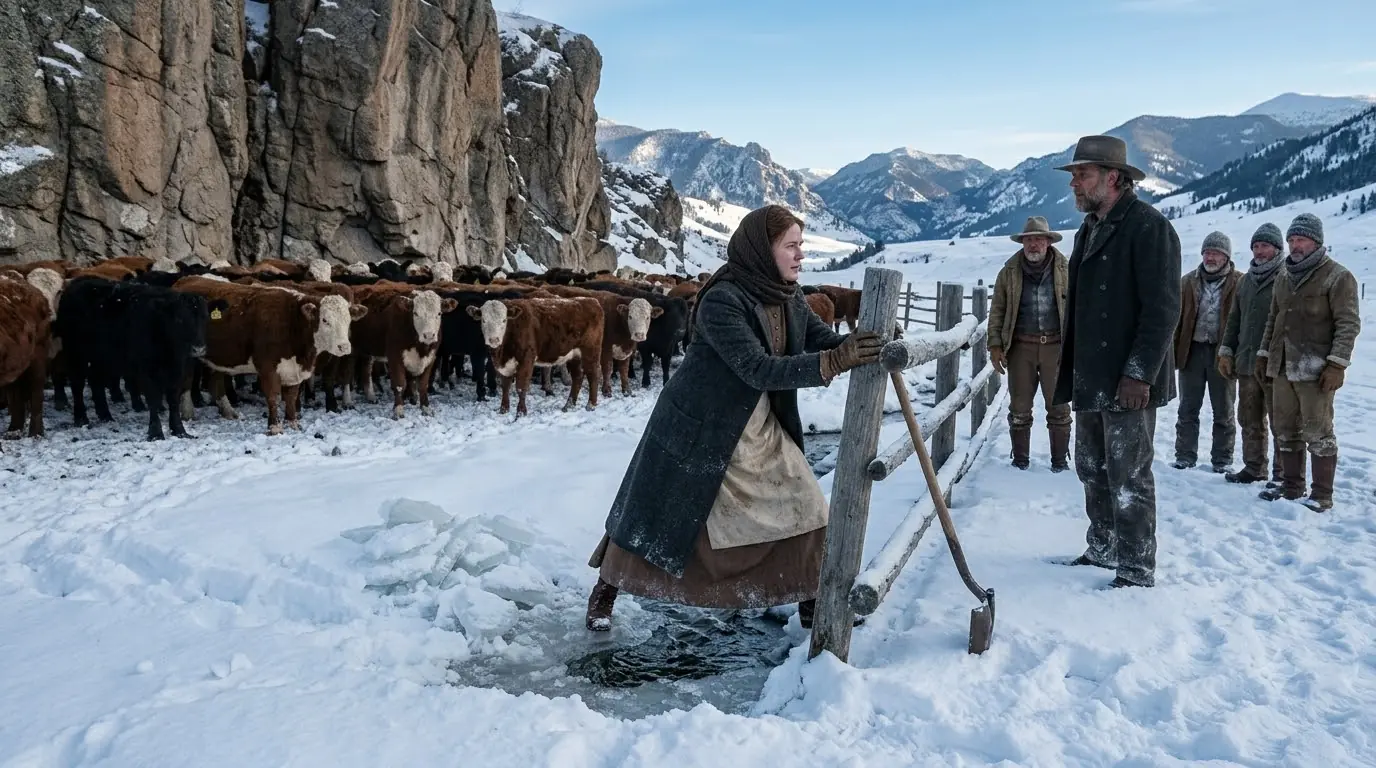
Nora told them the south draw was the wrong place to shelter the herd. She told them the canyon east of the dry creek had a natural windbreak and floor-level snowmelt from the cliff face that would keep it about three degrees warmer than anywhere else on the property.
She explained this without preamble, in the same voice she used when she told someone where she kept the coffee. Joe Birch looked at her, then at Pete.
Pete said, “Canyon east of the dry creek. Go.”
They went.
Nora sent Frank Mears and a quiet young man named Avery Dodd, twenty-one, who usually did whatever the person nearest to him did, to bring in the horses from the near corral and pack the bunkhouse stovepipe with extra clay seal. She showed Avery how because he had never done it before.
He was fast and did not ask twice.
Nora went back to the kitchen. She added four logs to the stove, not two, but four.
She moved the water barrels from the cold side of the kitchen to the warm side, which would matter in about six hours. She pulled every quilt from every room on the main floor and stacked them in the hallway, which would be the warmest passage once the outer walls started losing the fight with the temperature.
She found Thomas Alderman's emergency whiskey. She had found it months earlier and had said nothing, the kind of restraint that costs something and costs it quietly.
She put it on the kitchen shelf where it would be needed without anyone having to search for it. Then she boiled a pot of beans, made four dozen biscuits, started a second pot of coffee, and did not stop the first one.
Pete Hallett came in at dusk, his seven-fingered hands already white at the knuckles from the cold. He looked at the kitchen, the quilts in the hall, the moved water barrels, and the food on the stove, then stood there for a moment.
“You've done this before,” he said.
“Texas, '79. Indian Territory, '81. Wyoming, '78.”
Pete looked at her. Nora handed him a cup of coffee.
He sat down at the kitchen table. He did not get up from that table for the next eleven hours, not because he was tired, but because that table was where Nora Greer was.
Pete Hallett had been alive long enough to know that you stayed near the person who knew what they were doing.
The storm changed all at once. Montana blizzards did not do things gradually.
One moment the snow was heavy and the wind was what it had been, and then the wind changed direction. That was not a small thing; it was the thing.
The temperature dropped eight more degrees in twenty minutes. The snow became something else entirely, something horizontal, something that made the windows whiten from the inside as frost formed where the cold touched the glass.
The five men were in the main house by then. Frank Mears had not argued about it.
He had looked at the bunkhouse windows and made his own calculation.
At eight o'clock, Nora fed them beans, biscuits, and the dried beef she had been rationing since November but was no longer rationing that night. She did not explain the change, and nobody asked.
Frank Mears ate three servings. “You knew this was coming this morning,” he said.
“This afternoon,” Nora replied. “The horses told me.”
Frank looked at her. “Horses?”
“They turned their backs to the north at three o'clock, all of them at the same time. When that happens in January in Montana, you move things.”
Frank looked down at his biscuit. He did not say anything else.
Avery Dodd sat near the stove with both hands wrapped around his cup. “I didn't know that,” he said quietly, mostly to himself.
“Now you do,” Nora said.
At nine o'clock, the stovepipe in the kitchen rattled, not from the wind but from a pressure drop Nora recognized and the others did not. She added two more logs, checked the pipe seal, added a third log, then checked the window seals on the north side of the house.
She found one that was letting cold in at the lower-left corner and packed it with a strip of cloth from her apron pocket. She did not mention it.
Pete watched her from his chair. He said nothing.
There are men in this world who are made uncomfortable by competence in a direction they did not expect it. Pete Hallett was not one of those men.
He had lived too long and seen too many people die from not listening to the right person at the right time. He picked up his coffee and remained comfortable.
At ten-thirty, Calvin Pratt reported that the cattle were settled in the canyon east of the dry creek and the wind had not touched them. Joe Birch added, “She was right about the canyon.”
Nobody looked at Nora when he said it. That was how you knew they were all thinking it.
Thomas Alderman came in through the kitchen door in the state a man reaches after riding through a Montana blizzard for three hours because he has no other option. His coat was so thick with ice that it nearly stood on its own when he set it on the hook.
His hands were wrong and his face was wrong. He was not in danger because he had made it, but he was the kind of cold that takes two hours to leave properly.
Nora had a cup of hot coffee on the table before he sat down. She had the whiskey open beside it.
She did not say, “I told you this was coming.” She did not say, “The cattle are in the canyon east of the dry creek where it's three degrees warmer.”
She did not say, “The bunkhouse would have lost men tonight if they had stayed in it.” She only said, “Drink the coffee first, then the whiskey, in that order.”
Thomas Alderman was forty-seven years old, had run the ranch for fourteen years, and had never in those years been given an instruction in his own kitchen. He looked at her.
Then he drank the coffee. After that, he drank the whiskey.
He sat at the table while the cold worked its way out of him. At some point, Pete told him about the cattle, the canyon, the bunkhouse, and the window seal.
Thomas listened. He looked at his coffee cup.
“She knew,” he said.
“Since this afternoon,” Pete replied.
Thomas said, “She didn't say anything to me.”
“You weren't here.”
Thomas looked toward Nora. “She's the cook.”
Pete lifted his coffee. “Among other things.”
Thomas looked at Pete. Pete looked at his cup.
Outside, the blizzard did everything it was going to do all night. Inside, the kitchen was warm, the beans were hot, and the biscuits were on the table.
Five men, one woman, and fourteen years of a ranch were still standing because the right person had stood at a window that afternoon, seen the snow come sideways, understood what it meant, and moved.
The storm left behind thirty-one inches of snow and a temperature of twenty-two below zero. The silence afterward was so complete that the first sound anyone heard when they opened the kitchen door was a single crow somewhere to the east, which meant the worst was over.
The cattle were fine, all one hundred sixty head. In the canyon east of the dry creek, sheltered by the cliff face with access to the small seep spring that ran even in hard cold, not one had been lost.
In an ordinary blizzard year, the Alderman Ranch might lose eight to twelve head. Some ranchers in Meagher County had lost a quarter of their herds that night.
Thomas Alderman stood at the canyon fence and looked at his cattle for a long time. Then he came back to the house and went directly to the kitchen.
Nora was making breakfast, eggs and salt pork with the last of the biscuits from the night before warming on the stove. The kitchen smelled like coffee, wood smoke, and the warm animal scent the men had brought in with them from the barn.
Thomas stood in the doorway. “The canyon,” he said.
“The cliff face blocks the north wind,” Nora replied. “The spring keeps the floor temperature up, and the animals would have found it themselves eventually, but not fast enough.”
“How did you know about the canyon?”
“I walked the property in April when I first came.”
“Why?”
Nora turned from the stove and looked at him with the expression of a woman who had been asked a question she had answered a thousand times in a thousand different ways and had not been heard. “Because I was going to be here through the winter and I wanted to know what I was dealing with.”
Thomas said nothing. She turned back to the stove.
“The south draw floods in April. The fence on the north ridge has three sections that won't hold a hard spring.”
She continued, “The creek runs about six weeks longer than you're planning for on your grazing calendar. The near corral's east post is going to need setting before the ground softens.”
Thomas remained in the doorway. “You've been here nine months.”
“I know.”
“You know my property better than two of my hired men.”
“Three of them.”
He did not answer immediately. He stood in the doorway of his kitchen while the eggs cooked and the coffee ran, and understood that the ranch he had built over fourteen years was intact because a woman he had been paying to make biscuits had walked his land in April and remembered everything she found.
“What else?” he asked.
Nora turned around. She looked at him for a moment.
“Sit down.”
He sat.
What followed took forty minutes. Nora talked about the south draw, which would become a problem every spring thaw if he kept running the herd through it.
She explained the creek schedule and the grazing rotation that would account for it. She talked about the north ridge fence and identified the specific frost-heaved posts that could be reset and the ones that needed replacement.
She described the east pasture drainage problem she had identified in October and the simple fix that would prevent it from becoming a two-hundred-dollar problem in May. She did not use notes.
She said all of it the way she did everything, without preamble and without seeking agreement, the way you say things when you have had them ready for nine months and have been waiting for the right question.
Thomas listened. He was a man who did not write things down while listening because he remembered them.
That was useful because there was a great deal to remember.
When Nora finished, silence settled over the kitchen. The eggs had gone cold, and Thomas had not noticed.
“Why didn't you tell me any of this before?” he asked.
“You didn't ask.”
“You should have said something.”
Nora looked at him. “I'm the cook.”
He looked back at her. “That's what I hired you as.”
“Yes.”
“It's not what you are.”
“No.”
Thomas picked up his coffee. It was cold, but he drank it anyway.
“I have a foreman position,” he said. “It's been empty since Jake Holt left in September.”
“I know. I've been doing half of it.”
Thomas looked at her.
“The other half Pete's been doing,” Nora added. “He won't say so.”
“Pete's seventy-one.”
“He's also the only person on this property who knew what I knew and didn't need convincing.”
Thomas set down the cup. “I'd need to pay you differently.”
“Yes.”
“The men?”
“Frank Mears will take three days and then he'll be fine. Joe and Calvin won't have a problem.”
She added, “Avery Dodd will do whatever he's told by whoever tells him clearly.”
“You've thought about this.”
“I've been here nine months.”
Thomas looked at his cold eggs. “There's another thing.”
Nora waited.
He said it while looking at the table rather than at her, the way men say things they have been carrying when they have finally found someone they think can hold the weight. “It's a hard life, this valley, these winters.”
He stopped and looked at his hands. “I'm not easy to be around when it gets hard.”
“I know. I've been watching.”
He looked up.
“You get quiet,” Nora said. “You go to the north fence and work the line alone.”
She continued, “You don't ask for help because you think asking means something is wrong with you. It doesn't.”
“It means you're tired.”
Thomas was silent for a long moment. “How long have you known that?”
“April.”
Outside, the snow lay thirty-one inches deep across the Boulder Creek Valley. The temperature was twenty-two below, and the cattle were in the canyon east of the dry creek exactly where they were supposed to be.
Thomas said, “I'm asking you to stay, not as the cook.”
“I know what you're asking.”
“Is that a yes?”
Nora looked at him with the expression she had worn while looking at the flour canister the night before, counting, making the numbers come out right. “Ask me when spring comes and the south draw floods and the north fence needs work, and you've seen what I'm actually like when I'm not managing a crisis.”
“I know what you're like.”
“You know what I'm like in nine months and one blizzard.”
“That's enough.”
“Ask me in April.”
He asked her in April. She said yes.
The south draw flooded in April as she had said it would. Nora was at the fence line before Thomas, carrying a plan for redirecting the runoff so it would not undercut the east pasture bank.
Thomas looked at the plan and approved it. He handed it to Calvin Pratt, who built it in three days.
The north fence was reset in May. Nora was right about which posts could be saved and which ones were gone.
She was right about everything on that property, which Thomas Alderman already knew but which the spring confirmed in the methodical, specific, undeniable way that spring confirms things in Montana.
He had asked her in April. She had said yes.
They were married in June in the Boulder Creek Church, which had stood since 1880 and had held the weddings and funerals of nearly everyone in the valley. On that particular Saturday, it was full.
Not because Thomas Alderman was a popular man. He was a respected one, which is different.
People came because Nora Greer had become, over nine months and one blizzard, something the valley did not yet have a name for but recognized immediately. She was the person who knew.
Pete Hallett stood at the back with his seven-fingered hands and cried a little. He later claimed it was on account of a speck of dust.
Frank Mears had been converted not by argument but by the simple passage of time and the growing evidence of his own experience. After the ceremony, he shook Thomas's hand, then Nora's.
“You were right about the canyon,” he said.
“I know.”
“I should have moved faster.”
“Next time you will.”
Frank nodded. That was all.
The following winter was harder than the one before. It is the way of Montana winters to teach you not to be proud of having survived the last one.
The Alderman Ranch lost three head. Every other spread in the Boulder Creek Valley running more than one hundred head lost between eight and twenty.
The Alderman cattle were in the canyon east of the dry creek as they had been the year before. The timing was better this time, and so was the preparation.
Nora had written out a one-page storm protocol and nailed it to the bunkhouse door. Pete referred to it as the Bible, not unkindly.
The men followed it.
On the afternoon of January 14th, Frank Mears watched the horses at two o'clock and came inside to tell Nora. She was already standing at the window.
“I know,” she said.
“What do you need?”
She told him. He went.
That was how it worked when it worked. Not because anyone declared it, not because a meeting was called, not because a title was conferred, and not because anyone had a formal conversation about who was in charge.
It worked because a woman knew what she knew and had the patience to wait for the people around her to stop being surprised by it.
There is a kind of competence that does not announce itself. It walks a property in April and remembers everything it finds.
It counts the flour, moves the water barrels, packs the window seals, studies the horses, and knows which canyon will hold warmth when the temperature falls. It understands that being underestimated is a temporary condition if you simply keep doing the work.
Nora Greer had known this for a long time. The blizzard had only helped everyone else understand it.
What mattered was not merely the night of the storm. It was the morning after, when she turned from the stove and told Thomas Alderman what she had been holding since April.
She had known the south draw, the north fence, the creek schedule, the east pasture drainage, the horses, the storm, and the rancher's habit of carrying too much alone. She had known all of it for nine months and had kept it ready in the particular way capable people keep things, not resentfully and not strategically, simply ready for when the question was finally asked.
Thomas had spent fourteen years building a ranch and nine months assuming the woman in his kitchen was only the cook. One blizzard forced him to look again.
When he finally asked what else she knew, Nora answered. When he finally asked her to stay, she made him wait until spring.
Spring came. The south draw flooded, the north fence failed exactly where she had said it would, and Thomas saw that the storm had not made Nora capable.
It had only made her capability impossible to overlook.
By June, the ranch had a foreman, a partner, and a new wife in the same woman. By the next winter, the men were no longer surprised when Nora looked at the horses and knew what weather was coming.
They simply asked what needed doing. Then they did it.