Brooke came back to my new penthouse with flowers in her hands and forgiveness on her face, as if she had not helped throw me out of my own home and leave me in a motel for six months.
“We heard you bought a penthouse,” my son Ryan said, standing in my doorway like silence had an expiration date. “So we came to make peace.”
His voice was soft.
Too soft.
The kind of voice people use when they are not sure whether the door in front of them will open or close forever.
Brooke stood beside him in a camel coat that probably cost more than a month of that motel room. In her arms was a bouquet wrapped in cream paper and tied with satin ribbon. Expensive flowers. Downtown flowers. Flowers chosen by someone who wanted the apology to look beautiful before it had to sound honest.
She smiled at me.
Not warmly.
Carefully.
Like she was arriving for a photograph.
Six months earlier, that same woman had stood in the living room of the house I had shared with my husband for forty-five years and told me I had one week to leave.
My name is Lori Parker. I am sixty-six years old. I am a widow.
And for most of my life, I believed a mother could be hurt by her child, disappointed by her child, even forgotten for a little while by her child.
But discarded?
No.
I had not believed that.
Not until Ryan looked me in the eye and said, “Mom, the house is too big for one person.”
Not until Brooke rested one hand on her pregnant belly and added, “The baby needs a stable home.”
Not until the word family became something polished and pretty in their mouths while they took everything Robert and I had built.
The house on Maple Ridge Lane was not just property.
It was my marriage in walls and windows.
Robert’s coffee mug still sat in the cabinet, the blue one with the chipped rim he refused to throw away because, according to him, good coffee needed a loyal cup. His reading chair still faced the front window where the afternoon light came in soft across the carpet. The pantry door still held the pencil marks from Ryan’s childhood, each crooked line labeled with a year and a little smiley face Robert had drawn beside it.
There was the kitchen tile Robert and I picked after saving for two years. There was the back porch where we drank coffee every Saturday morning. There was the narrow hallway where Ryan used to run in socks, sliding into the wall while I told him to slow down and Robert laughed behind his newspaper.
When Robert got sick, he refused to let me move his chair from the window.
“I like seeing the trees,” he said.
So I turned that corner of the living room into his little kingdom.
His blanket on the armrest. His books stacked on the side table. His reading glasses beside the lamp. His medication schedule taped inside the drawer because Robert hated seeing reminders that he was not as strong as he used to be.
He passed away in that house three years before Ryan came with the papers.
For months after the funeral, I would wake up and listen for him. I would still buy his favorite coffee. I would still turn my head when the back door creaked, expecting him to come in from the yard with dirt on his shoes and some small story about the neighbors.
Grief makes the ordinary cruel.
A coffee mug becomes a memorial. A chair becomes a shrine. A quiet hallway becomes proof that someone who filled your whole life is not coming back.
Ryan knew that.
He knew what that house meant to me.
He also knew that Robert had put his name on the deed years earlier.
Robert thought it would make things easier after we were gone. He had seen friends lose money, time, and peace over estate paperwork, and he wanted Ryan to avoid all of that. He believed our son would always protect me because that was the kind of boy we had raised.
Robert never imagined Ryan would use that name on the deed while I was still alive.
When Ryan first brought up the house, he did it over coffee at my kitchen table. He was thirty-nine then, handsome in the quiet, tired way men become when they have a demanding job and a wife who expects everything to look perfect from the outside. He kept stirring his coffee even though he had put nothing in it.
“Mom,” he said, “have you ever thought about downsizing?”
I looked at him over my mug.
“Sometimes,” I said. “But not seriously.”
He nodded too quickly.
“It might be easier for you. Less maintenance. Lower expenses.”
“I manage.”
“I know. I just worry.”
That was how it began.
Worry.
It always sounds so kind at first.
Then Brooke joined the conversation.
Brooke Parker had been in my life for four years. She was beautiful in a controlled, sharpened way. Smooth hair, pale nails, perfect posture, and a voice that could turn sweet or cold without ever rising. She worked in marketing, though I never fully understood what she did. All I knew was that she could sell anything if she had enough time to shape the room around it.
At first, I tried to like her.
I made her favorite lemon chicken. I bought her birthday gifts she returned for store credit. I asked about her family, her work, her plans. I told myself that sons marry women who are not like their mothers, and that was natural. I told myself Brooke and I simply needed time.
But some people do not want time.
They want position.
The first time Brooke called the house “underused,” I laughed because I thought she was joking.
She was not.
“Four bedrooms for one person is a lot,” she said, looking around my living room as if measuring it with her eyes. “Ryan and I are still in that cramped rental, and now with the baby coming, it just feels backwards.”
The baby.
That changed everything.
When Ryan told me Brooke was pregnant, I cried into his shoulder. Not because I expected to become the kind of grandmother who controlled everything, but because I thought life had given us a light after years of loss.
I imagined a crib in the spare room. A high chair in the kitchen. Little socks in my laundry. A child touching the pencil marks on the pantry door while I told stories about the father who had once stood there barefoot, trying to be taller than the year before.
I was ready to love that child before I knew its name.
Brooke knew that too.
She used it gently at first.
“The baby needs stability.”
“The baby needs space.”
“The baby should grow up near family.”
Each sentence sounded reasonable until I realized that in her version of family, I was expected to step aside.
One Sunday afternoon, Ryan and Brooke came over with a folder.
That is when reasonable ended.
Ryan sat on the sofa. Brooke remained standing. I remember that clearly because it made the room feel like a meeting instead of a conversation. She rested one hand on her belly and held the folder with the other.
Ryan would not look directly at me.
“Mom,” he said, “the house is too big for one person.”
I set down the dish towel I had been folding.
“We have discussed this.”
“I know,” he said. “But we need to make a real plan now.”
Brooke opened the folder.
“We’ve spoken to someone,” she said. “Since Ryan is on the deed, and since the house is legally partly his, it makes sense for him to take over the property before the baby comes.”
Take over.
Such a clean phrase.
As if she were talking about changing a utility bill instead of removing a widow from the home where she had buried her whole married life.
I looked at Ryan.
“Is this what you want?”
His mouth tightened.
“It’s what makes sense.”
“No,” I said quietly. “That is not what I asked.”
Brooke exhaled through her nose.
“Lori, this does not need to become emotional.”
I almost laughed.
My husband’s chair was six feet away.
His coffee mug was in the cabinet.
His handwriting was still on boxes in the garage.
But apparently emotion was the problem.
Brooke slid a paper toward me.
“You should find something more practical,” she said. “An apartment. Maybe a senior community. Somewhere easier.”
“I am not ready to leave my home.”
“Memories do not pay bills.”
The sentence landed flat and cold.
Ryan flinched, but he said nothing.
Brooke continued.
“You have leaned on the family long enough. Ryan has responsibilities now. We cannot keep pretending things are the same as they were when Robert was alive.”
I looked at her hand on her belly.
There is my grandchild under that hand, I thought.
Maybe that was what broke me most. Not that she was cruel. Cruel people exist. But that she stood there using a child I already loved as the reason I should disappear.
“Ryan,” I said, “tell me you are not asking me to leave in one week.”
His silence answered first.
Then he said, “Mom, please don’t make this harder.”
Brooke’s eyes sharpened.
“That baby needs a stable home,” she said.
“And I need mine,” I replied.
For the first time, Brooke’s careful expression cracked.
“That is not our problem.”
There are sentences that do not shout but still change the temperature of a room.
That one did.
I remember staring at her, waiting for Ryan to correct her. Waiting for my son to stand up and say, “Brooke, no. That is my mother.” Waiting for the boy I raised to appear inside the man sitting on my sofa.
He did not.
He looked at the carpet.
One week later, I left my own home with six cardboard boxes, Robert’s watch, our wedding photo, two sweaters, my medications, a stack of paperwork, and the blue chipped coffee mug wrapped in a towel.
On the kitchen table, I left a note.
Be happy.
I meant it when I wrote it.
That may have been the saddest part.
The motel off Aurora Avenue smelled of wet carpet, old smoke, and bleach that never reached the corners. The hallway lights flickered above doors with scratched numbers. The ice machine was always broken, though someone had taped a handwritten sign to it that said, “Working soon.”
It never worked.
My room had a bedspread with faded flowers, a small table with one uneven leg, and curtains that did not fully close unless I clipped them together with a hairpin. The heater made a clicking sound at night. The bathroom mirror had dark spots around the edges where the silver backing had worn away.
The first night, I sat on the edge of the bed wearing my coat because the room would not warm fast enough.
I stared at the six boxes lined against the wall.
Forty-five years reduced to six boxes.
Robert’s watch sat on the nightstand. I kept looking at it as if time itself might explain how I had ended up there.
I called Ryan three times.
He never called back.
The next morning, I texted Brooke once.
Is the baby okay?
Hours later, my phone lit up.
Stop contacting us. We do not want anything to do with you.
I read the message again and again.
Not because I misunderstood it.
Because I understood it too well.
I sat on the edge of that motel bed for a long time, holding the phone in both hands.
Not crying.
Not yet.
Sometimes pain is too large to come out right away.
At first, I lived hour by hour.
Coffee from the lobby machine. Toast from a plastic bag. Discount soup from the drugstore across the street. Long walks near the bus stop because sitting too long in that little room made my grief feel like another person breathing beside me.
I learned the motel sounds.
The man in room 214 coughed every morning at six. The woman in room 209 watched game shows too loudly. The housekeeper hummed old songs while pushing her cart down the hall. Somewhere outside, sirens passed at night like the city was reminding me how far a person could fall without anyone turning their head.
I tried to be invisible.
There is shame in being put out by your own child.
People tell you not to feel it, but they are not the ones standing at a motel sink washing a coffee mug from a house they no longer live in.
For the first month, I still checked my phone too often.
Ryan’s name never appeared.
Brooke’s message stayed at the top of my mind even after I deleted it.
Stop contacting us.
We do not want anything to do with you.
I wondered what story they told people.
Maybe I had chosen to move. Maybe I was difficult. Maybe I had become too emotional after Robert died. Maybe they said they had offered to help and I had refused.
People who take from you often need a cleaner story than the truth.
So survival became routine.
Pay for the room on Monday.
Buy groceries on Tuesday.
Call the insurance company on Wednesday.
Walk to the small public library on Thursday because it was warm, quiet, and no one there asked why a woman my age carried important papers in a grocery bag.
On Fridays, I sat in the back corner of that library and read old newspapers on a computer with keys rubbed shiny from use.
I was not looking for anything at first.
I only needed somewhere to be.
But grief has a strange way of cleaning your eyesight.
When you have nothing left to protect, you begin seeing everything clearly.
I stopped waiting for Ryan to remember he had a mother.
I stopped checking my phone.
I stopped asking what kind of woman raises a son who can leave her behind.
Then one evening, while unpacking the last cardboard box, I found Robert’s old leather address book.
It had been tucked inside a file folder with old tax documents. I opened it mostly because I wanted to see his handwriting. Robert’s handwriting had always been steady, square, and careful, like him.
Inside the back cover, he had written a note in blue ink.
Lori, if anything ever feels wrong with the house after I am gone, call Nora Whitcomb before you sign anything. Promise me.
Under it was a phone number.
I remembered the name immediately.
Nora Whitcomb had been Robert’s attorney years ago, back when he and two partners invested in a small waterfront storage company that eventually became something larger. I had barely understood the business then. Robert handled those things. He would mention meetings, documents, and quarterly statements, and I would nod while making dinner.
Once, about a year before he passed, Robert had taken my hand at the kitchen table.
“Lori,” he said, “if something happens and you ever feel pressured about the house, call Nora. Don’t argue. Don’t panic. Call her.”
I told him not to talk that way.
He smiled sadly.
“Promise me.”
I promised.
Then grief came.
Then paperwork.
Then Ryan.
And somehow I forgot.
That night in the motel, with rain tapping against the window and Robert’s watch on the nightstand, I called the number.
Nora answered the next morning.
Her voice was older than I remembered, but sharp and alert.
“Lori Parker,” she said, after I gave my name. “I have been waiting for your call longer than you know.”
Those words made me sit down.
Within two days, Nora came to the motel herself.
She arrived in a dark suit with a leather briefcase and silver hair cut neatly at her jaw. She did not look shocked by the motel, and I was grateful for that. She sat at the little uneven table, placed a folder in front of her, and asked me to tell her everything.
So I did.
I told her about Ryan. About Brooke. About the deed. About the folder. About the one week. About the text message. About the six boxes.
Nora listened without interrupting.
When I finished, she removed her glasses and folded them slowly.
“Lori,” she said, “Robert did put Ryan’s name on the deed.”
“I know.”
“But Robert also created a separate recorded agreement giving you lifetime occupancy rights to that house. Ryan could inherit his portion later, but he had no right to force you out while you were alive.”
The room tilted around me.
“What?”
“He had no right,” Nora repeated. “And if Brooke or Ryan represented otherwise, they either misunderstood the paperwork or chose not to understand it.”
I could not speak.
For weeks, I had believed I had been foolish. Weak. Naive. A woman too old to understand the paper in front of her. But Robert had protected me. Even from beyond the life we shared, he had tried to protect me.
Nora reached across the table and touched the folder.
“There is more.”
That was the phone call that changed everything.
Not overnight.
Life is rarely kind enough to rebuild itself all at once.
But piece by piece, the floor came back under my feet.
Robert had also left me more than I knew.
Years earlier, he had invested in a waterfront development partnership that I had mostly forgotten about. The buyout had been delayed by lawsuits, zoning arguments, and financial complications that bored me whenever Robert tried to explain them. But the final settlement had closed after his death, and because Robert had placed his share in a trust for me, the money had been waiting.
Waiting while I lived in a motel.
Waiting while I ate soup from a paper bowl.
Waiting while I believed my son had taken the last secure thing I had.
Nora had sent letters to the house after Robert died, but Brooke and Ryan had moved in by then. I never received them. Whether they had been thrown away, ignored, or hidden, Nora did not say at first. But her mouth tightened when she heard that I had not seen a single one.
Over the next months, Nora and her team worked quietly.
They confirmed my lifetime rights to the Maple Ridge house.
They traced the missed letters.
They reviewed the documents Ryan had brought me.
They found that one paper, the one Brooke had said was just a “transition acknowledgment,” had never been properly explained and did not remove my right to live there.
Then they found something else.
A home equity loan application had been started after I left.
Attached to it was a statement claiming I had voluntarily vacated the property and had no remaining claim of residence.
My signature was typed beneath it.
But I had never signed it.
When Nora showed me the copy, I stared at my own name like it belonged to a stranger.
“Who did this?” I whispered.
“That,” Nora said, “is what we are documenting.”
For the first time since Robert died, I felt something stronger than sorrow.
Not anger.
Something steadier.
A decision.
I did not move back into the Maple Ridge house.
People were surprised by that.
Nora asked twice if I wanted to reclaim it immediately. Legally, we had strong grounds. Emotionally, everyone assumed I would want the house back because it had been taken from me.
But the day I stood outside it again, watching Brooke’s white curtains in my windows and Ryan’s car in Robert’s driveway, I realized something painful and freeing.
The house still held my memories.
But it no longer held my peace.
They had changed the locks. Removed Robert’s chair. Painted the living room a color Brooke called “clean beige.” The pantry door with Ryan’s childhood height marks had been taken off its hinges and placed in the garage because, according to a neighbor, Brooke wanted “a smoother look.”
That hurt more than I expected.
I stood in the driveway with Nora beside me and looked at the home where my life had happened.
Then I said, “I do not want to live where I had to fight to be allowed to exist.”
Nora nodded.
“What do you want?”
I looked toward Seattle’s skyline in the distance.
“I want a door no one can make me leave.”
That was how I ended up forty floors above Seattle, in a penthouse with glass walls, a view of Elliott Bay, and a front desk that called me Mrs. Parker with more respect than my own son had shown me in years.
I did not buy the penthouse to impress anyone.
I bought it because the first time I stepped inside, I could breathe.
The living room opened toward the water. Ferries moved across Elliott Bay like white paper cutouts. At night, the city lights trembled in the glass, and in the morning, the sky turned pale over the buildings before the streets came fully alive.
There were no pantry marks on the door.
No ghost of Robert’s chair.
No hallway filled with old footsteps.
But there was room for peace.
I placed Robert’s blue chipped mug in the kitchen cabinet. I set our wedding photo on a low table near the window. I kept his watch beside my bed, not because I was trapped in the past, but because love is allowed to travel with you.
For the first month in the penthouse, I told almost no one.
I needed quiet.
I needed to learn what it felt like to wake up without fear of the front desk asking for another week’s payment. I needed to learn how to grocery shop again without counting every dollar twice. I needed to stand in my own kitchen and make coffee in Robert’s mug without smelling bleach and wet carpet.
Then somehow Ryan heard.
Of course he did.
People hear about money faster than they hear about pain.
The first call came on a Thursday afternoon.
Mom, I heard you moved. Can we talk?
I stared at the message for a long time.
Then I placed the phone face down.
Two days later, he called.
I let it go to voicemail.
His voice sounded strained.
“Mom, it’s Ryan. I know things got complicated. Brooke and I want to see you. We want to make peace.”
Complicated.
That was the word he chose.
Not wrong.
Not cruel.
Not unforgivable.
Complicated.
I did not call back.
But Nora did.
She contacted him through proper channels and informed him that any meeting with me would occur at my home, with legal counsel present, and with a clear record of what had happened regarding the Maple Ridge property.
Ryan must have told Brooke.
Because three days later, they arrived at my penthouse door with flowers.
Now they stood in front of me, smiling as if smiles could bridge six months of abandonment.
I looked at Ryan first.
He had aged in six months, though not from hardship.
From worry.
His eyes kept moving past me into the penthouse, searching for answers in the marble floor, the quiet lighting, the expensive silence. He looked like a man who had come to apologize but had also come to measure what apology might be worth.
Then I looked at Brooke.
She was still beautiful in that sharp, controlled way. Hair smooth. Chin lifted. Smile measured. Her coat was perfect. Her shoes were perfect. Even the flowers seemed arranged to suggest humility at a luxury price.
But there was something behind her eyes now.
Calculation.
“May we come in?” Ryan asked.
The word may nearly made me laugh.
Once, he had not asked permission to remove me from my home.
Now he stood on my threshold waiting for mine.
I stepped aside.
Brooke entered first.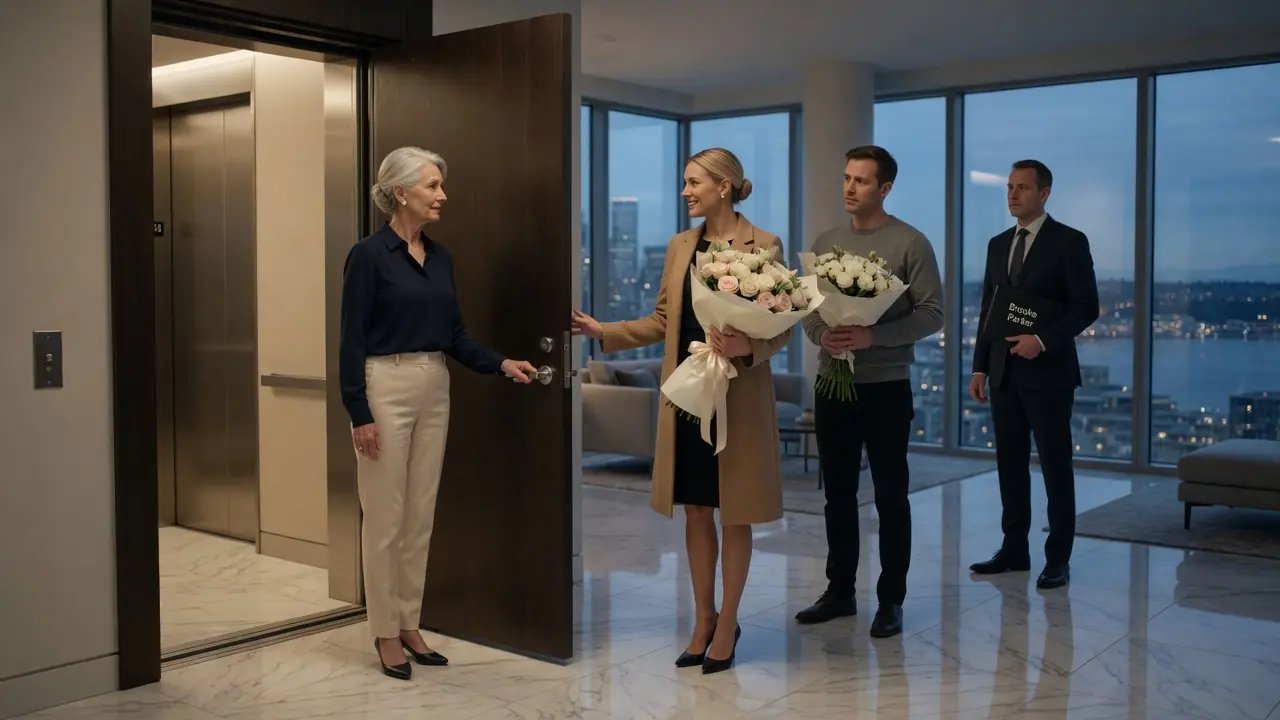
Her heels clicked softly against the marble floor.
Ryan followed, holding the bouquet like a peace offering he did not fully believe in.
For three seconds, neither of them spoke.
They saw the living room. The glass walls. The wide sweep of Seattle beneath the evening sky. The dark water of Elliott Bay catching the last silver light. The kitchen island with fresh fruit in a ceramic bowl. The framed photograph of Robert and me near the window.
Ryan’s mouth opened slightly.
Brooke’s fingers tightened around the flowers.
But it was not the view that froze her.
It was not the furniture.
It was not the money.
It was the person standing near the windows.
Nora Whitcomb stood in a dark suit, holding a folder with Brooke’s name printed neatly across the tab.
Brooke stopped walking.
The bouquet shifted in her arms.
One stem cracked.
Ryan turned toward me, his face losing color.
“Mom,” he whispered, “what is this?”
Brooke did not whisper.
She could not seem to speak at all.
Her eyes stayed fixed on the folder.
The smile she had worn so carefully at my door began to disappear, piece by piece, until there was nothing left but recognition.
And fear.
I closed the door behind them.
The sound was soft.
Final.
Then I walked past my son, past the flowers, past the woman who had once told me my pain was not her problem.
I stopped in the center of the room, where the city lights had just begun to glow beneath us.
“This,” I said, looking directly at Brooke, “is the peace you came for.”
Nobody in that room was prepared for what came next.
Ryan looked from Nora to me.
“Mom, why is your attorney here?”
“Because six months ago, you brought papers into my home and told me I had one week to leave,” I said. “Today, if we are going to speak about peace, we are going to begin with truth.”
Brooke found her voice at last.
“This feels unnecessary.”
Nora opened the folder.
“No,” she said calmly. “It is necessary.”
Brooke’s eyes flashed.
“I was not speaking to you.”
“But I am speaking for Mrs. Parker,” Nora replied. “And I suggest you listen carefully.”
Ryan’s face tightened.
“Brooke, what is going on?”
She turned to him with a quick, wounded expression.
“I don’t know. Your mother is obviously still angry.”
I almost admired how quickly she reached for that old tool.
Make the hurt person look unreasonable.
Make the facts look emotional.
Make accountability look like cruelty.
But I had lived in a motel for six months.
I had learned the difference.
Nora removed the first document from the folder.
“Ryan,” she said, “your father placed your name on the deed to the Maple Ridge property. That is true. But he also recorded a lifetime occupancy agreement protecting your mother’s right to live there as long as she chose.”
Ryan stared at her.
“What?”
Nora slid a copy across the table.
“You were not legally entitled to remove her from the home.”
Ryan did not pick up the paper.
His eyes moved to me.
“Mom, I didn’t know.”
“You did not ask,” I said.
Brooke stepped forward.
“That is not fair. The deed had Ryan’s name on it. We acted based on what we understood.”
Nora looked at her.
“That would be more convincing if this were the only issue.”
Brooke went still.
Ryan turned toward his wife.
“What does that mean?”
Nora removed another page.
“After Mrs. Parker left the property, a home equity loan application was initiated. Attached to the file was a statement claiming Mrs. Parker voluntarily vacated the residence and gave up any remaining occupancy interest.”
Ryan’s brow furrowed.
“I never saw that.”
Brooke said quickly, “Loan companies ask for all kinds of documents. This is being twisted.”
Nora continued.
“The statement contained Mrs. Parker’s typed name and an electronic acknowledgment. Mrs. Parker never signed or approved it.”
The room became very quiet.
Ryan slowly looked at Brooke.
“Did you know about this?”
Brooke’s mouth opened, then closed.
I watched her make calculations behind her eyes. Deny everything. Blame a clerk. Blame confusion. Blame me. Blame grief. Blame paperwork. There were so many roads available to someone who had practiced avoiding truth.
She chose the one that had worked on Ryan before.
“We were trying to build a future,” she said.
Ryan stepped back as if the sentence had pushed him.
“That is not an answer.”
Brooke’s hand moved to her belly.
The gesture was automatic.
Protective, or perhaps performative. I no longer knew.
Nora removed a third page.
“There are also messages recovered from email correspondence between Brooke and her sister Brittany. Mrs. Parker will not read them aloud unless necessary, but one of them says, and I will quote only the relevant portion, ‘Use the baby. He folds when you mention stability.’”
Ryan’s face changed.
Not all at once.
First confusion.
Then disbelief.
Then something worse.
Understanding.
“Brooke,” he said quietly.
She turned on Nora.
“You had no right to dig through my private life.”
Nora’s expression did not change.
“These were provided voluntarily by a party included in the correspondence after concerns arose about financial transfers connected to the Maple Ridge property.”
Brittany, I thought.
Of course.
Greed often becomes loyal only until the money slows down.
Ryan looked sick.
“Financial transfers?”
Nora placed another document on the table.
“Funds from the preliminary loan advance were directed toward a business account associated with Brooke. Additional transfers appear to have gone toward personal expenses.”
Ryan stared at the papers as if they were written in another language.
“I thought that money was for renovations.”
Brooke’s voice sharpened.
“It was all for us.”
“For us?” Ryan repeated.
“For our family,” she snapped.
The word family returned to the room like a thief wearing perfume.
I finally stepped closer.
“No, Brooke,” I said. “Family was the word you used when you wanted my house. Family was the word you used when you wanted my silence. Family was the word you used when you told me my pain was not your problem.”
Her cheeks flushed.
“I was pregnant. I was scared. We needed security.”
“So you took mine.”
Ryan lowered himself into a chair as if his legs had lost strength.
“Mom,” he said. “I swear I did not know about the signature.”
I believed him.
That was the painful part.
I believed Ryan had been weak, selfish, and willing to look away. I believed he had chosen peace with Brooke over loyalty to me. But I also believed he had not understood the full depth of what she had done.
Still, ignorance did not make him innocent.
“You knew I was in a motel,” I said.
He covered his face with one hand.
“Yes.”
“You knew I called.”
“Yes.”
“You knew I had nowhere else to go.”
His shoulders shook once.
“Yes.”
“And you did not come.”
He looked up at me then, and for the first time in six months, I saw the boy I had raised trapped behind the man who had failed me.
“I was ashamed,” he whispered.
“That did not help me pay for the room.”
He bowed his head.
Brooke seized the silence.
“Ryan, do not let her do this. She is turning you against me.”
I looked at Brooke.
“No. You did that yourself.”
Brooke’s fingers crushed the ribbon around the flowers.
“What do you want, Lori? Money? The house? An apology? Fine. I am sorry.”
The apology hit the floor between us, empty and useless.
I smiled sadly.
“You still think this is about getting me to stop being inconvenient.”
Nora closed the folder halfway.
“Mrs. Parker asked me to present two facts before this conversation goes further. First, she has no financial obligation to either of you. Second, she will not be pressured into dropping any civil claims regarding the property, the attempted loan, or the false documentation.”
Brooke’s face lost more color.
“Civil claims?” Ryan asked.
Nora nodded.
“The matter is already in motion.”
Ryan looked at me.
“Mom, are you suing me?”
There it was.
The panic.
Not because I had been in a motel.
Not because his wife had used my name.
Because consequence had finally walked into the room wearing a dark suit.
“I am protecting myself,” I said. “That is what I should have done the day you brought those papers.”
Ryan pressed his palms against his knees.
“I will cooperate.”
Brooke turned sharply.
“Ryan.”
He did not look at her.
“I said I will cooperate.”
For the first time since I opened the door, Brooke looked truly frightened.
Not polished frightened.
Not offended frightened.
Real frightened.
The kind of fear that comes when a person realizes the old rules no longer work.
She set the bouquet on the coffee table, but her hands were unsteady.
“You cannot do this to us,” she said.
I looked at the flowers.
Cream paper. Satin ribbon. Perfect arrangement. They had probably cost two hundred dollars, maybe more. They were beautiful, and not one petal had anything to do with remorse.
“You came here because you heard I had money,” I said.
Brooke’s eyes flicked away.
Ryan did not deny it.
That hurt too, but it did not surprise me.
“You came here because the woman you left in a motel now lives above the city,” I continued. “You came because you thought my new home meant there might be something here for you. Forgiveness. Access. A check. A softer ending.”
Ryan whispered, “Mom, I came because I missed you.”
I turned to him.
“Then why did you wait until I had something worth noticing?”
The question broke whatever he had been holding together.
Tears filled his eyes.
“I don’t know,” he said. “I hate that I don’t have a better answer.”
Brooke made a small sound of disgust.
“That is pathetic.”
Ryan looked at her then.
Really looked at her.
Something quiet shifted in his face.
“No,” he said. “What’s pathetic is that my mother was living in a motel and I let you convince me she was being dramatic.”
Brooke’s mouth tightened.
“I did not convince you of anything you did not want to believe.”
The room went still.
Even Nora looked up.
Ryan stared at his wife.
And there it was.
The closest thing to honesty Brooke had given all evening.
She had manipulated him, yes.
But she had not created his weakness from nothing.
She had found what was already there.
Ryan turned back to me.
“I am sorry,” he said.
This time, he did not say it softly to make the moment smaller.
He said it plainly.
“I am sorry I let you leave. I am sorry I did not answer your calls. I am sorry I cared more about avoiding conflict in my marriage than protecting my own mother. I am sorry I made you feel like you had to survive without me.”
I waited.
The words mattered.
But words had carried papers into my house too.
“Thank you,” I said.
He flinched slightly, perhaps expecting more.
But I was not ready to hand him comfort.
Brooke reached for her purse.
“I am leaving.”
Nora’s voice stopped her.
“You may leave, but you should expect formal correspondence from my office.”
Brooke laughed once, sharp and bitter.
“You people are enjoying this.”
“No,” I said.
She looked at me.
“I am not enjoying it. I enjoyed my old life. I enjoyed my husband’s chair by the window. I enjoyed believing my son would never leave me in a motel. This is not enjoyment, Brooke. This is what happens after someone survives what you thought would keep her small.”
For once, she had no answer.
She walked to the door.
Ryan did not follow.
That was the first choice he made that night that gave me even a small reason to hope.
When the door closed behind Brooke, the penthouse became painfully quiet.
Ryan sat hunched forward, elbows on knees, staring at the floor. The city moved beyond the glass behind him, bright and indifferent. Ferries crossed the water. Office lights blinked on. Somewhere below, people were eating dinner, catching buses, walking dogs, falling in love, forgetting to call their mothers.
Life had continued while mine had been reduced to a motel room.
Nora gathered the papers.
“I will step into the study,” she said. “You two may speak privately if Mrs. Parker wishes.”
I nodded.
When she left, Ryan looked smaller.
Not younger exactly.
Smaller.
“Is there a baby?” I asked.
He swallowed.
“Yes. A girl. Due in January.”
I closed my eyes for a moment.
A granddaughter.
There it was again, that tender place Brooke had used so easily.
“What is her name?”
“Emma,” he said. “At least, that is the name I wanted.”
Emma.
I let the name settle in my heart without giving it permission to rule me.
“I hope Emma is healthy and loved,” I said.
Ryan’s voice broke.
“She should know you.”
“That will depend on many things.”
“I know.”
“No,” I said gently. “You do not. Not yet. Knowing means understanding that my love for Emma will not become a bridge for people to walk across me again.”
He nodded, crying quietly now.
“I understand.”
“Not yet,” I repeated. “But perhaps you can learn.”
For a long time, we sat without speaking.
Then Ryan said, “What happens now?”
I looked toward Robert’s wedding photo.
“Now you cooperate with Nora. You tell the truth about the papers, the loan, and everything Brooke asked you to do. You stop pretending silence is peace. You stop calling harm complicated because the truth makes you uncomfortable.”
He nodded.
“And with us?” he asked.
I looked at my son.
The child I had carried.
The man who had failed me.
Both were sitting in front of me, and loving one did not erase what the other had done.
“With us,” I said, “you begin again from a distance.”
His face tightened, but he accepted it.
“How?”
“You call once a week. If I answer, we talk. If I do not, you leave a message and wait. You do not ask for money. You do not ask to move in. You do not ask me to fix what you broke with Brooke. You do not bring flowers instead of truth.”
“I can do that.”
“And Ryan?”
He looked up.
“If you ever again allow someone to treat me like I am disposable, there will not be another conversation like this.”
He nodded slowly.
“I know.”
I believed that he wanted to mean it.
That was not the same as trust.
But it was a beginning.
Over the next months, the truth came out piece by piece.
The Maple Ridge house was placed under legal review. The loan application was withdrawn before it could do more damage. Brooke’s business account became part of the dispute. Brittany, angry over money Brooke had promised and never paid, provided additional messages that confirmed what Nora already suspected.
Ryan moved out before Christmas.
He did not ask to stay with me.
That mattered.
He rented a small apartment twenty minutes from his office and began attending counseling alone. He called every Sunday evening at seven. The first few calls were awkward and short. Sometimes we talked about paperwork. Sometimes about the weather. Sometimes he only said, “I just wanted to hear your voice.”
I did not always answer.
When I did, I kept my voice steady.
Repair, I learned, is not the same as reunion.
Repair is slow.
It is uncomfortable.
It is full of moments when the person who hurt you wants relief faster than they have earned it.
Emma was born on a cold January morning.
Ryan sent one photo.
A tiny face. Closed eyes. A pink hat. One small fist near her cheek.
My granddaughter.
I cried when I saw her.
Then I placed the phone down and breathed until the ache softened into something I could carry.
I met Emma when she was three weeks old, in the lobby of my building, not upstairs in my penthouse. That was my choice. Ryan brought her in a little carrier, moving carefully, looking exhausted and humbled in the way new parents often do.
Brooke was not with him.
I did not ask where she was.
Ryan lifted Emma gently and placed her in my arms.
For a moment, the world narrowed to the weight of that child.
She smelled like powder and milk. Her fingers curled against my sweater. Her tiny mouth moved in a dream.
“Hello, Emma,” I whispered. “I am your grandmother.”
Ryan turned away and wiped his face.
I did not forgive everything in that moment.
A baby is not an eraser.
But she was a beginning untouched by the choices that brought her here.
Months passed.
The Maple Ridge house was eventually sold under terms Nora negotiated. My share came to me properly. Ryan’s share was reduced by repayments, legal costs, and obligations connected to the attempted loan. He did not argue. Brooke did, through her own attorney, loudly and often, but loudness no longer frightened me.
The pantry door with Ryan’s childhood marks was found in the garage.
Ryan brought it to me himself.
He carried it into my penthouse wrapped in a moving blanket, his face pale with emotion.
“I thought you might want it,” he said.
I ran my fingers over the pencil lines.
Age five.
Age seven.
Age ten.
Robert’s little smiley faces beside each year.
For the first time in a long time, I missed my old house without wanting to return to it.
“Thank you,” I said.
We mounted the pantry door along one wall in the study. It looked strange there at first, a simple piece of old wood inside a penthouse of glass and stone. But after a while, I loved it. It reminded me that I had not lost my whole life. I had carried the truest parts forward.
One Sunday evening, almost a year after Brooke stood at my door with flowers, Ryan came over with Emma.
He did not bring gifts.
He did not bring apologies wrapped in expensive paper.
He brought diapers, a tired smile, and a willingness to wash coffee cups after dinner.
Emma sat in a high chair beside the kitchen island, banging a spoon against the tray with great seriousness. Ryan laughed, and for a second, I heard the boy he used to be.
After dinner, he stood by the study wall, looking at the pantry door.
“Dad would hate what I did,” he said.
I came to stand beside him.
“Yes,” I said.
He closed his eyes.
“I know.”
“He would also want you to become better than your worst choice.”
Ryan looked at me then.
“Do you think I can?”
I thought about the motel. The unanswered calls. Brooke’s text. The flowers at my door. The folder with Brooke’s name. The six months I spent learning how to stand without anyone holding me up.
Then I looked at my son.
“I think you can,” I said. “But I will not do the work for you.”
He nodded.
“That’s fair.”
From the kitchen, Emma squealed and dropped her spoon.
We both turned toward her.
Life, in all its stubbornness, kept asking to continue.
That night, after Ryan and Emma left, I stood by the glass wall and watched Seattle glitter beneath me. The ferries moved across the dark water. The city hummed quietly below. Robert’s watch sat beside our wedding photo, and his chipped blue mug rested in the cabinet where I could reach it every morning.
Six months in a motel had taught me what no comfortable house ever could.
A home is not always the place where your memories live.
Sometimes home is the place where you finally stop begging to be valued.
Brooke came to my door thinking forgiveness was something she could stage with flowers.
Ryan came thinking peace might be easier than truth.
But peace without truth is just another room where someone expects you to stay quiet.
I had stayed quiet long enough.
They threw me out of the house where I had built my life.
They thought I would shrink inside a motel room and wait for permission to matter again.
Instead, I found the note Robert had left me.
I made the call he told me to make.
I learned that love does not require a woman to hand over her dignity just because the person asking calls himself family.
And forty floors above Seattle, with the city shining beneath my feet, I finally understood something Robert had spent forty-five years trying to teach me.
A person can lose a house and still come home to herself.
That was the part Brooke never saw coming.
That was the part Ryan had to earn the right to witness.
And that was the part of me no one would ever be allowed to evict again.