“I’m just fixing my van.”
“This is a restricted military area. Civilians aren’t supposed to be working on vehicles here.”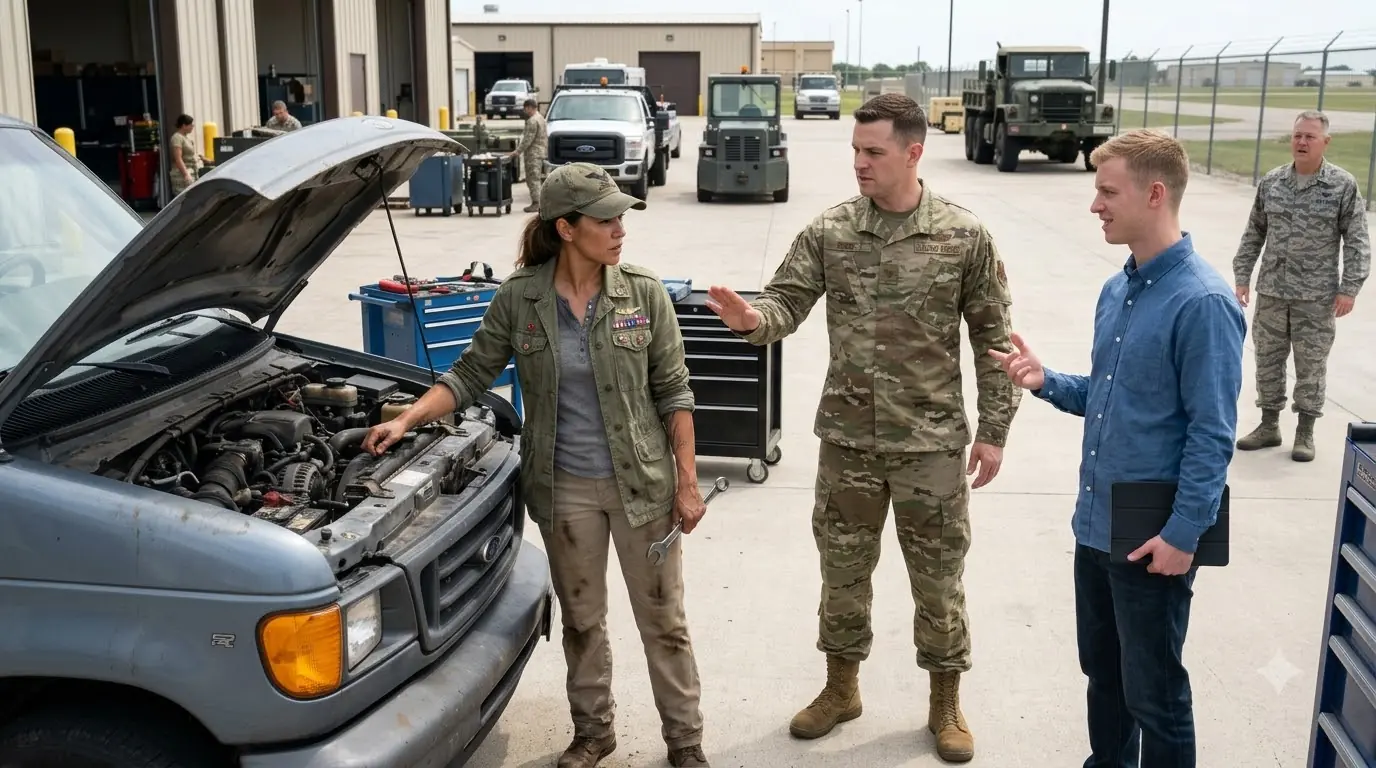
A young engineer stepped forward, already preparing to call security. The woman standing beside the open hood did not argue. She simply pulled up the sleeve of her faded gray work shirt to wipe the sweat from her forehead.
That was when an older officer standing nearby froze.
His eyes fixed on the faded silver mark on her right arm.
“That tattoo,” he whispered. “It’s real.”
Her name was Lena Morales.
She was thirty-eight years old, small-framed, with brown hair tied back and a face that most people forgot almost immediately after meeting her. She wore an old gray work shirt, oil-stained khaki pants, and practical boots that had clearly seen years of use.
That morning, Lena was doing nothing more remarkable than repairing her aging van in an auxiliary parking area near the technical section of Val Ridge Air Force Base.
At least, that was what everyone around her believed.
Lena was not active-duty military. She worked part-time as a civilian contractor supporting basic water-treatment and maintenance systems connected to the base cafeteria. It was the kind of job almost nobody noticed unless something stopped working.
Her van had broken down on the access road outside the base. A gate guard who recognized her contractor badge allowed her to push it into an empty section of the technical yard so she could inspect the problem without blocking traffic.
She had been leaning over the engine compartment for several minutes when a young engineer walked past and laughed.
“You sure you should be touching vehicle systems in here?”
Lena glanced up.
“It’s my van.”
Before the young engineer could answer, a lieutenant approached with the stern expression of someone already convinced he had discovered a problem.
“Who are you?” he demanded. “Let me see your access card.”
Lena wiped one hand on a cloth and calmly showed him the badge.
“I work maintenance support. My van broke down outside the gate. The guard said I could move it here long enough to repair it.”
The lieutenant barely looked at the card.
“This section isn’t cleared for general civilian work.”
“I’m not working on base equipment,” Lena replied. “I’m fixing my own vehicle.”
“Doesn’t matter.”
The young engineer folded his arms, clearly entertained by the confrontation.
Lena looked from one man to the other.
Then she lowered her head.
“All right.”
No argument.
No complaint.
Her hands were covered in grease, and sweat had gathered along her forehead in the afternoon heat. She raised her right arm and pulled the sleeve higher so she could wipe her face.
A faded tattoo appeared.
It was unlike the ordinary military-style designs people sometimes wore years after leaving service.
A broken-winged hawk.
Beneath it were several faded unit markings.
Colonel Thomas Monroe happened to be walking through the nearby technical area while reviewing maintenance operations. He glanced toward the small gathering almost casually.
Then he stopped.
The clipboard in his hand lowered.
His expression changed completely.
The lieutenant continued speaking, unaware.
“Pack up your tools and move the vehicle outside the technical section.”
But Monroe was no longer listening to him.
His eyes were locked on Lena’s arm.
He took one slow step forward.
Then another.
The young engineer saw a civilian contractor who did not belong in the yard.
Colonel Monroe saw something he had spent fifteen years believing no longer existed.
That broken-winged hawk had belonged to Hawkbreaker Unit 09, a specialized mobile engineering team associated with classified support operations during the early years of the Afghanistan conflict.
The unit had disappeared during Operation Cinderline.
Officially, everyone attached to the team had been listed as lost after a remote installation was overrun during a major emergency.
No confirmed survivors.
Incomplete recovery records.
Fragments of reports buried behind classification.
For most people, Hawkbreaker Unit 09 was little more than a line inside an old operational archive.
But Monroe knew the symbol.
Years earlier, he had read a restricted report concerning an isolated base whose critical navigation and communications support had somehow remained operational during a prolonged emergency.
The report mentioned an unidentified engineer.
Most details were redacted.
There was only one photograph.
A small woman standing near badly damaged equipment, her face obscured by protective gear and soot. Her right sleeve had been torn back enough to reveal part of a tattoo.
A broken-winged hawk.
Monroe had never forgotten it.
He had survived that operation.
So had many other people.
And according to the report, an unknown engineer had played a crucial role in keeping enough of the technical infrastructure working for evacuation and support teams to reach them.
Monroe had spent years wondering who she had been.
Lena lowered the hood.
“All right,” she said quietly. “I’ll move it.”
The lieutenant stepped aside.
She packed her tools into a worn metal box without showing any irritation.
Monroe still had not moved.
As Lena pushed the box toward the passenger side of the van, he finally spoke.
“Wait.”
Everyone looked at him.
Lena did too.
For half a second, something passed through her expression.
Recognition.
Not of Monroe personally.
Of what his stare meant.
Then it disappeared.
Monroe pointed toward her arm.
“Where did you get that tattoo?”
Lena looked down at it.
“Long time ago.”
“What unit?”
She pulled her sleeve down.
“Doesn’t matter anymore.”
To everyone else, the answer sounded dismissive.
To Monroe, it sounded like confirmation.
He took another step toward her.
“Hawkbreaker?”
The young engineer’s expression shifted.
The lieutenant looked between them.
Lena remained very still.
Monroe lowered his voice.
“Unit 09?”
For the first time, Lena looked directly into his eyes.
She did not answer.
She did not need to.
Monroe felt the old photograph return to him with astonishing clarity.
The half-hidden face.
The damaged station.
The small figure standing among exhausted personnel after communications had been restored.
He remembered reading the report late one night many years earlier, long after he had stopped expecting to learn the woman’s identity.
Lena broke eye contact first.
“My vehicle needs to be moved, Colonel.”
Monroe looked toward the lieutenant.
“Let her finish securing it.”
Then he looked back at Lena.
“I need to speak with you afterward.”
“I have another maintenance shift.”
“It can wait.”
Her expression tightened.
“No disrespect, sir, but I’ve spent a long time avoiding conversations that begin like this.”
That sentence settled the matter in Monroe’s mind.
There was history here.
Something enormous.
But Lena still refused to explain.
She finished packing the van and drove out of the technical yard.
Monroe watched the old vehicle disappear beyond the gate.
Then he turned toward his aide.
“I need an authorized verification on Hawkbreaker Unit 09.”
The aide blinked.
“Sir?”
“You heard me.”
Within minutes, secure requests were moving through the proper military channels.
The first response was limited.
Operation Cinderline.
Hawkbreaker Unit 09.
Restricted engineering support element.
Most personnel listed as killed or missing during the emergency.
Additional records remained classified.
Monroe requested review authority.
He referenced his own involvement in the operation and the possibility that a person officially listed as dead was currently working as a civilian contractor on Val Ridge Air Force Base.
That changed the urgency immediately.
Later that afternoon, Monroe sat alone in his vehicle with an old laptop open in front of him.
He pulled up a photograph he had kept for fifteen years.
The image was grainy.
The background showed equipment damaged during the Cinderline emergency.
Several exhausted service members stood nearby.
And near the edge of the frame was the woman.
Small.
Silent.
Protective covering obscuring most of her face.
Her right arm bore the same broken-winged hawk.
Monroe enlarged the image.
Then he thought of Lena Morales leaning into the engine compartment of an old van as a twenty-something engineer laughed at her.
His hands tightened around the laptop.
It could not be coincidence.
The woman in the photograph had helped save his unit.
And if Monroe was right, she had spent the last several years quietly servicing cafeteria infrastructure on the same base without anyone knowing who she was.
A secure notification appeared.
Additional records had been released for review.
Operation Cinderline: Final Engineering Summary.
Monroe read slowly.
Hawkbreaker Unit 09 had been assigned to mobile technical support during the emergency.
Its official status after the base was overrun was catastrophic.
Most of its personnel were listed as lost.
Then Monroe reached an exception buried several pages into the report.
Unidentified female engineer.
Maintained critical navigation support during the emergency.
Continued repair work despite injuries and deteriorating conditions.
Final status: missing, presumed dead.
Monroe leaned back.
He kept reading.
The engineer had remained behind while evacuation routes were being established. She restored enough navigation and communications support to allow aircraft and rescue teams to coordinate with personnel trapped around the installation.
The technical details were heavily redacted.
What remained was enough.
She had continued working while almost every system around her was failing.
The final confirmed sighting placed her near a communications structure shortly before the last major evacuation movement.
Afterward, no one could locate her.
No body was recovered.
No confirmed communication ever reached military authorities.
For fifteen years, she had been dead on paper.
Monroe closed his eyes.
He remembered that day.
Confusion.
Failed equipment.
Men waiting for support that could not locate them.
Then systems coming back online unexpectedly.
Coordinates stabilizing.
Navigation returning.
The route home appearing where minutes earlier there had been nothing.
At the time, nobody knew who had restored it.
The report had simply described an unidentified engineer.
Monroe now knew her name.
Lena Morales.
He made another call.
“I need Ms. Morales contacted.”
His aide hesitated.
“Detained?”
“No.”
Monroe’s answer came immediately.
“Absolutely not. Ask her to return voluntarily. Tell her we have questions regarding her old service record.”
An hour later, the aide called back.
“Sir, we found her.”
“And?”
“She said she knew this day would eventually come.”
Monroe said nothing.
“She also said she hoped it never would.”
That evening, additional personnel records arrived.
Lena Morales had indeed served between 2004 and 2008.
Her specialty had involved mobile engineering and technical support.
Her assignments matched the general location and timeframe of Operation Cinderline.
Then the records ended.
Missing after the attack.
Presumed killed.
No formal separation.
No confirmed recovery.
No documented reintegration.
On paper, Lena Morales had effectively stopped existing as a service member fifteen years earlier.
Yet for the past three years, a civilian woman using the same name had been working low-profile maintenance contracts at Val Ridge.
Monroe finally understood what he had been looking at.
She had not merely disappeared.
She had deliberately built a life where nobody would ask questions.
Small jobs.
Limited attention.
No ceremonies.
No veteran profiles.
No public recognition.
She fixed water systems.
She repaired her own van.
She went home.
It was an extraordinary way for someone associated with one of the most unusual engineering survival stories in the archive to live.
The following morning, Lena entered a temporary command office at Val Ridge.
She wore the same work clothes.
Her hair was tied back.
There was still grease beneath one fingernail from the previous day.
She did not look intimidated by the officers waiting inside.
She looked tired.
Monroe stood.
“Ms. Morales.”
“Colonel.”
“Thank you for coming.”
“I didn’t think I had much choice.”
“You did.”
Lena gave him a skeptical look.
Monroe gestured toward a chair.
She sat.
He placed the old photograph on the table.
Lena looked at it.
For a long time, she said nothing.
Monroe watched her face.
“That’s you.”
It was not phrased as a question.
Lena slowly exhaled.
“Yes.”
The room became completely quiet.
“You were at Cinderline.”
“Yes.”
“You were part of Hawkbreaker Unit 09.”
Lena nodded.
Monroe stared at the woman he had unknowingly walked past around the base for years.
“You’re the engineer from the photograph.”
“I was one of the engineers.”
“The report says you restored the navigation system.”
“I repaired enough of it to work.”
“That system helped get people out.”
“Other people did the hard part.”
Monroe leaned forward.
“Lena, I was there.”
Her eyes lifted.
That finally surprised her.
“I was part of one of the groups waiting for evacuation coordination.”
Lena stared at him.
Monroe continued.
“We had almost nothing. Then the navigation signal came back.”
His voice became quieter.
“I remember watching people realize that somebody had gotten the system running.”
Lena looked away.
“We had equipment. I knew how to repair it.”
“That’s all you’re going to say?”
“What do you want me to say?”
“That you saved lives.”
“I fixed a system.”
“People lived because that system worked.”
Lena folded her hands.
“People lived because pilots flew. Medics worked. Security teams held positions. Drivers moved people. Engineers repaired equipment. I was part of that.”
Monroe studied her.
“Why didn’t you come back?”
For the first time, Lena looked genuinely uncomfortable.
She remained silent long enough that Monroe wondered whether she would answer at all.
Then she did.
“Because when I came out, everyone from my team was gone.”
Her voice stayed controlled.
“I didn’t know who was alive. I didn’t know what command structure still existed. I was injured. I was exhausted. I wasn’t even sure where our lines were anymore.”
She paused.
“I survived.”
Monroe waited.
“That should have felt like good news.”
“But it didn’t?”
Lena shook her head.
“Not when everyone around you didn’t.”
She stared at the old photograph.
“I spent months recovering outside the military system. By the time I was strong enough to start asking questions, the official records already said I was dead.”
“You could have corrected them.”
“Yes.”
“Why didn’t you?”
Lena looked directly at him.
“Because being dead was quiet.”
No one in the office moved.
“I didn’t want investigations. I didn’t want interviews. I didn’t want people asking me why I survived when other people didn’t. I didn’t want someone turning seventeen days of fear and repair work into a story about glory.”
Monroe sat back.
“You were missing for seventeen days.”
Lena nodded.
The report had described the period only in fragments.
For more than two weeks, she had moved through damaged support areas, repairing whatever systems could still be made functional and staying out of exposed sections whenever possible.
She had no grand strategy.
No heroic plan.
She kept working because there were systems people needed.
Power distribution.
Navigation support.
Communications equipment.
Water.
Anything that could still help keep people alive long enough for evacuation.
When rescue teams finally regained access to the installation, they found several critical systems still operating.
But Lena was gone.
The original assumption was that she had died somewhere in the destruction.
In reality, she had escaped the immediate area and eventually reached civilian medical care.
Her identity was confused during treatment.
She was in poor condition, without proper records, and for a time she did not correct the assumptions made about her.
Weeks became months.
Months became years.
Eventually, staying invisible became easier than returning.
Monroe looked down at her service file.
“There’s something else.”
Lena’s eyes narrowed.
“You weren’t even supposed to be at Cinderline.”
“No.”
“You were on medical leave.”
“Knee injury.”
“Then why were you there?”
Lena’s answer was immediate.
“I heard the distress traffic.”
Monroe waited.
“I knew the navigation systems being used there. I was close enough to reach the site.”
“You went anyway.”
“Yes.”
“While officially off duty.”
“Yes.”
“Why?”
Lena looked almost confused by the question.
“Because people were asking for help.”
“That wasn’t your assignment.”
“My ability to help didn’t disappear because a schedule said I was off duty.”
Monroe stood.
He moved toward the window and stared out over the base.
For fifteen years, he had imagined the engineer in that photograph as a mysterious figure buried somewhere in the desert.
Now she was sitting behind him, explaining the most extraordinary decision of her career as though she had stopped to change a tire.
“You saved Cinderline Base.”
“No.”
Monroe turned.
“I repaired equipment.”
“Without those systems, our coordination was falling apart.”
“Other people saved the base.”
“Without navigation support, aircraft could not reliably reach us.”
Lena’s expression tightened.
“I did what I knew how to do.”
Monroe almost smiled.
“That is exactly what makes this difficult.”
The investigation that followed was not an investigation of wrongdoing.
It became a reconstruction of a missing life.
Records officers compared old deployment documents, medical fragments, personnel photographs, and testimony from surviving members connected to Operation Cinderline.
Piece by piece, the impossible story became official.
Lena Morales had survived.
The woman listed as dead for fifteen years had spent those years living quietly, taking maintenance work, repairing equipment, and refusing every opportunity to make herself visible.
Military records were corrected.
Her status was restored.
She was officially recognized as the surviving member of Hawkbreaker Unit 09 connected to the final engineering operations at Cinderline.
Monroe gathered a small group of senior staff when the administrative process was completed.
“Lena Morales has been formally restored to the record,” he announced. “She is under no obligation to return to active service, but what happened at Cinderline will no longer remain attributed to an unidentified engineer.”
Lena stood near the back of the room.
She looked deeply uncomfortable.
Afterward, Monroe approached her.
“There will be interest in this.”
“I know.”
“Media requests.”
“No.”
“Veterans’ organizations.”
“No.”
“Possibly a formal ceremony.”
“No.”
Monroe sighed.
“You could let me finish occasionally.”
Lena almost smiled.
“I already know my answer.”
“What do you want?”
“That’s easy.”
She looked toward the maintenance hangar visible through the window.
“I want to keep fixing things.”
Monroe stared at her.
“That’s it?”
“I have work here.”
“You’re talking about cafeteria water systems.”
“They need to work.”
“You’re the surviving engineer from Cinderline.”
“And tomorrow morning, the filtration monitor in building three is still going to be unreliable.”
Monroe laughed despite himself.
Lena’s expression remained serious.
“I don’t need newspapers. I don’t need a stage. I don’t need people calling me a hero.”
“What do you need?”
“A good set of tools would be nice.”
That answer spread through the technical staff faster than the official announcement.
Young engineers who had laughed at Lena’s van now watched her differently.
The lieutenant who had ordered her from the technical yard found her several days later beside the same vehicle.
He stood awkwardly nearby.
“Ms. Morales.”
Lena looked up from the engine.
“Yes?”
“I owe you an apology.”
She waited.
“I assumed you didn’t understand where you were.”
“You were responsible for access control.”
“I could have handled it differently.”
“Yes.”
He nodded.
“I’m sorry.”
Lena wiped her hands.
“Apology accepted.”
The young engineer who had laughed was even more uncomfortable.
“Ma’am, I didn’t know.”
Lena glanced at him.
“That’s usually why people shouldn’t laugh first.”
He lowered his eyes.
“Yes, ma’am.”
She returned to the van.
After several seconds, the young engineer remained standing there.
Lena looked up again.
“Do you actually want to learn something, or are you going to stand there feeling guilty all afternoon?”
His head snapped up.
“Learn?”
She pointed into the engine bay.
“Tell me what you think is wrong.”
He stepped closer.
That was how Lena Morales began teaching at Val Ridge.
Not through a formal appointment.
Not through an announcement.
By asking a young engineer to diagnose an old van.
Within weeks, technicians started seeking her out when systems behaved strangely.
Lena never simply gave them answers.
She asked questions.
“What changed before the failure?”
“What are you assuming is still working?”
“What did everyone else already check?”
“What part of the system are people ignoring because they think it can’t be responsible?”
Her lessons were less about emergency improvisation than disciplined observation.
Understand the system.
Respect the equipment.
Do not panic.
Do not assume expensive technology means simple mechanical principles no longer matter.
And never become so impressed by your title that you stop listening to the person standing beside the machine.
One young technician eventually asked Lena the question everyone seemed to be thinking.
“Ma’am, why did you risk so much for a base you weren’t even assigned to?”
She answered without hesitation.
“Because when people are calling for help, the paperwork telling you whose responsibility it is becomes less important than whether you can actually help.”
Monroe heard about the exchange.
Later, he found Lena replacing a sensor connected to one of the base water systems.
“You’ve been here three years,” he said.
“Yes.”
“Fixing our water systems.”
“That is the job.”
“You’ve been taking care of people on this base without any of us knowing who you were.”
Lena tightened a fitting.
“That’s what engineers do.”
Monroe leaned against the doorway.
“What?”
“Take care of people.”
She looked toward him.
“Doctors do it directly. Firefighters do it directly. Sometimes engineers do it through machines nobody notices until they fail.”
Monroe smiled.
“You really don’t know how to accept recognition, do you?”
“I know how.”
“You reject it every time.”
“That’s still a form of accepting the information.”
Monroe laughed again.
Lena declined every major interview request that followed.
When newspapers asked for profiles, she said no.
When television producers offered documentary appearances, she refused.
When organizations requested speeches, she declined most of them.
“I don’t want people studying my face,” she told Monroe. “I want engineers studying why systems fail.”
Val Ridge eventually created a small technical workstation for her in the maintenance hangar.
It was not named after a battle.
There was no giant photograph.
Someone installed a simple wooden nameplate.
LENA MORALES
FIX WHAT MATTERS
When Lena saw it, she stared at the sign for several seconds.
“This is too much.”
“It’s a piece of wood,” Monroe replied.
“It has my name on it.”
“You’ll survive.”
She gave him a flat look.
“Poor choice of words, Colonel.”
Monroe winced.
“Fair.”
The nameplate stayed.
Young engineers began passing down lessons associated with Lena.
When an equipment failure looked impossible, someone would inevitably say, “Ask Morales what everyone is overlooking.”
Her approach became informally known among the technical staff as the Lena 09 method.
It was not a secret emergency procedure.
It was a mindset.
Slow down.
Understand the complete system.
Protect the people depending on it.
Repair the simplest failure first.
Do not waste time protecting your ego.
And if the obvious solution fails, question the assumption that made it obvious.
Whenever Lena’s aging repair van rolled toward the maintenance section, guards who once viewed her as another contractor now recognized her immediately.
She still showed identification.
She insisted on it.
When a new guard waved her through without checking, Lena stopped the van.
“You didn’t look at my badge.”
“I know who you are, ma’am.”
“That’s not the procedure.”
“Yes, but—”
“Check the badge.”
The embarrassed guard did.
Only then did she drive through.
Monroe later heard about it and shook his head.
“You could make your life easier.”
“That’s how systems get sloppy.”
“You sound like Ratchet from maintenance.”
“Ratchet learned it from me.”
Three months after Lena’s identity became known, a major hurricane threatened communities along the Gulf Coast.
A civilian hospital in the projected storm path required technical volunteers to support emergency evacuation operations.
Lena signed up.
Monroe found out only after the paperwork crossed his desk.
“You volunteered?”
“They needed engineers.”
“You’ve done enough.”
“That sentence doesn’t make sense.”
“Lena.”
She looked at him.
“I’m not going into combat.”
“I know.”
“I’m helping maintain hospital systems during an evacuation.”
“You could still stay here.”
“Yes.”
“But you’re going.”
“Yes.”
“Why?”
She raised an eyebrow.
“Have we really learned nothing about each other?”
Monroe surrendered.
During the evacuation, Lena worked alongside hospital technicians and emergency crews to keep essential support equipment functioning while patients were moved to safer facilities.
The storm damaged local infrastructure.
Backup systems became unreliable.
Lena remained with the maintenance teams until the final patients were transferred.
Nobody filmed her.
No television crew knew her name.
There were no ceremonies.
Hospital staff later wrote that her calm technical leadership had been crucial when portions of the facility’s normal support systems became unreliable.
Lena returned to Val Ridge several days later.
Monroe saw her walking across the hangar.
“You planning to tell anyone what happened?”
“No.”
“Of course not.”
“The patients got out.”
“Yes.”
“The equipment worked long enough.”
“Yes.”
“Then the story is complete.”
Six months after the tattoo had been discovered, maintenance reliability across Val Ridge had improved significantly.
The reason was not a new multimillion-dollar technology package.
It was culture.
Technicians inspected differently.
They documented small failures.
Junior engineers were encouraged to speak.
Senior personnel stopped dismissing observations merely because they came from contractors or lower-ranking staff.
Lena had spent months quietly teaching lessons she had learned under circumstances none of them could fully imagine.
A year later, new engineers arriving at Val Ridge were told a simple rule.
“If you think something cannot be repaired, talk to Lena before you give up.”
Most new arrivals assumed she was a senior engineer.
Then they met the small woman in faded work clothes who still spent part of her week maintaining ordinary base infrastructure.
Somebody would eventually tell them about Cinderline.
Lena hated that part.
Usually, she interrupted.
“They exaggerate.”
Monroe, if nearby, would respond, “They actually leave things out.”
Lena would glare at him.
The argument became part of base folklore.
More important than the story itself were the principles that spread from it.
Engineers began sharing Lena’s practical philosophy with other maintenance teams.
Not the classified details.
Not the operational history.
The useful parts.
Remain calm when systems fail.
Look at the whole system before replacing parts.
Never confuse technology with understanding.
Respect technicians who work with the equipment every day.
Do not overlook small failures because they seem too simple.
And when human lives depend on a machine, responsibility begins with the person capable of helping, not merely the person whose name appears on a duty roster.
Years passed.
Many people who eventually used techniques shaped by Lena’s teaching never knew her story.
They did not know about Hawkbreaker Unit 09.
They did not know about the seventeen missing days.
They had never seen the photograph Monroe kept.
They did not know why a faded broken-winged hawk remained on Lena’s right arm.
They simply learned from engineers who had learned from her.
That suited Lena perfectly.
One afternoon, a young technician noticed the tattoo while Lena worked beneath the hood of a utility vehicle.
“Can I ask what it means?”
Lena looked down at it.
For many years, she would have pulled the sleeve over it and changed the subject.
This time, she did not.
“It belonged to my team.”
“Are they still around?”
Lena remained quiet.
The technician immediately regretted asking.
“I’m sorry. You don’t have to—”
“No.”
She touched the faded ink.
“They’re gone.”
The young man nodded.
“Then why keep the tattoo?”
Lena looked toward the maintenance hangar.
Because for her, the symbol had never been about recognition.
It was not proof of heroism.
It was memory.
A reminder of people whose names belonged beside hers even if the public never knew any of them.
“So I don’t forget who taught me,” she said.
The technician seemed to understand enough not to ask anything else.
Lena returned to the engine.
She had never needed glory.
She did not need rank restored for her identity to feel complete.
She did not need newspaper stories describing her as a legend.
Give her a reliable wrench, a machine worth repairing, and people depending on that machine, and Lena Morales understood exactly who she was.
The contractor repairing the water system.
The civilian beside the broken vehicle.
The quiet person doing work no one noticed until it stopped being done.
Fifteen years earlier, Colonel Monroe had survived a desperate evacuation because an unidentified engineer refused to abandon a failing technical system.
For years, he imagined that engineer had died.
Then one afternoon, he nearly walked past her while she repaired an old van.
So did everyone else.
The young engineer saw stained clothes.
The lieutenant saw a civilian in the wrong area.
Other workers saw a part-time contractor.
Monroe happened to look at her arm.
One small faded tattoo forced him to look closer.
And behind the ordinary appearance was a story almost nobody would have believed without the records.
A lost unit.
A missing engineer.
Seventeen days erased from public knowledge.
A woman who had survived something extraordinary and then chosen an ordinary life.
That was ultimately the part Monroe respected most.
Lena had not spent fifteen years waiting for somebody to discover her.
She had spent them continuing to be useful.
Repairing machines.
Maintaining systems.
Helping people.
Quietly.
When asked years later how she wanted Cinderline remembered, Lena refused to talk about herself.
“Remember the people who stayed at their jobs when leaving would have been easier,” she said. “Remember the people who kept the systems running. Remember the ones whose names never made it into reports.”
Someone asked whether she considered herself one of those people.
Lena smiled faintly.
“I consider myself an engineer.”
And for her, that was enough.