In the spring of 1950, the most valuable thing on the Bell farm that was not dirt stood beneath a leaking shed roof with one rear tire half sunk into the floor.
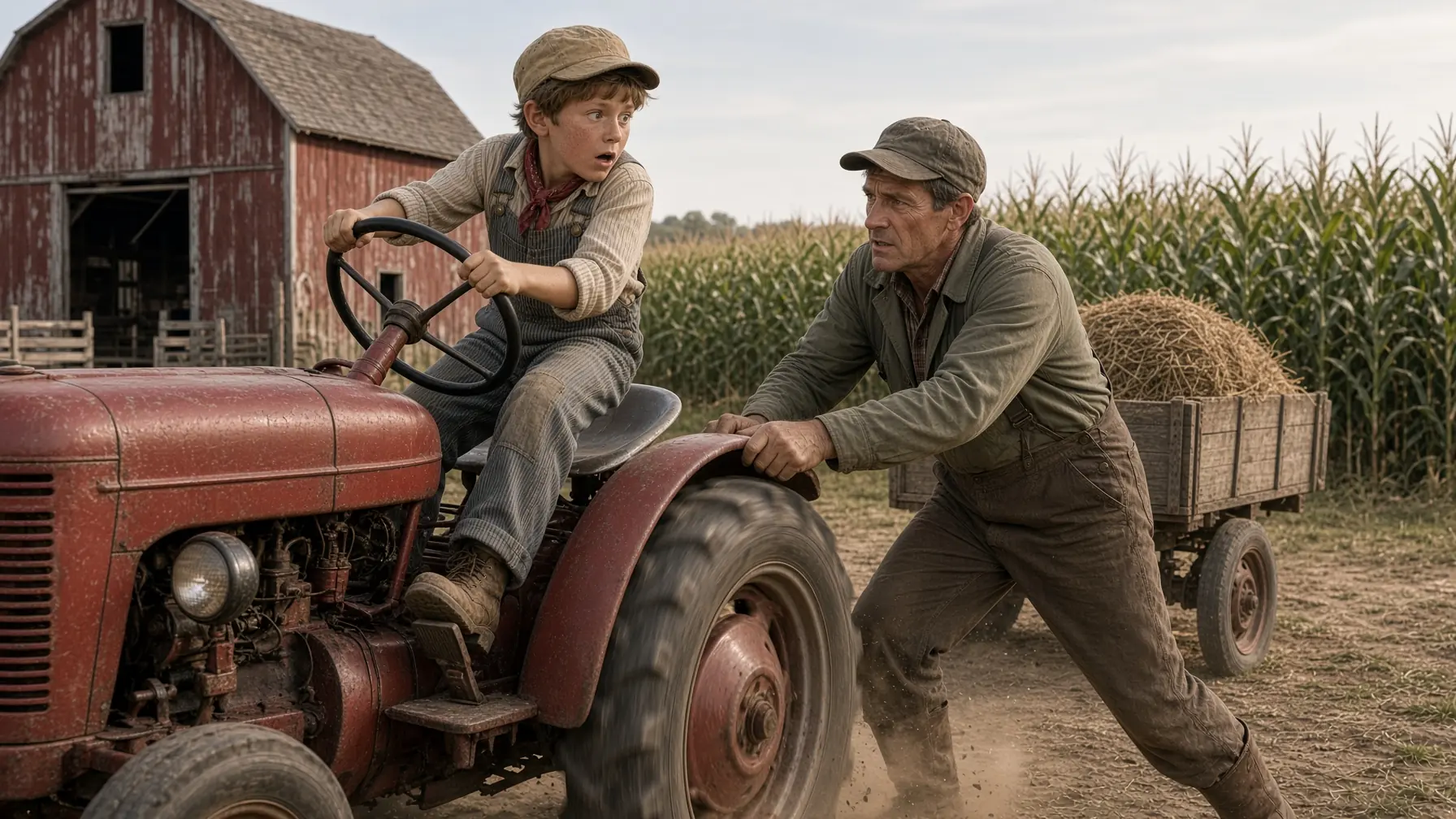
It was a Farmall H.
Red once.
Now mostly rust, grease, faded paint, and memory.
Fourteen-year-old Caleb Bell had never seen it look new.
To him, the tractor had always looked tired.
Its steel pan seat had a crack near one mounting bolt. A folded feed sack was wired across it because his father said ten hours on bare steel could make a man feel eighty before supper.
The right headlight worked.
The left one had been broken against a barn door before Caleb was born.
A steel toolbox bolted beside the seat contained an adjustable wrench, two cotter pins, one screwdriver, a spark-plug wrench, and three square-headed plow bolts that seemed to have been there since Franklin Roosevelt was president.
Above the hood, the exhaust pipe wore a little hinged rain cap.
When the tractor was idling, that cap jumped.
Click.
Click.
Click.
Caleb could see it moving from the kitchen window before he could hear the engine.
His father, Henry Bell, claimed that if a boy grew up on a farm long enough, he eventually learned to understand machinery without touching it.
“You hear that?”
Henry asked one morning.
Caleb listened.
The Farmall sat thirty yards away.
The engine held one steady note.
“No.”
“Governor opened.”
Caleb listened harder.
Still nothing.
Henry smiled.
“Ground got heavy.”
“How can you tell?”
“Same way your mother knows you're lying before you finish the sentence.”
From the porch, Ruth Bell called:
“I heard that.”
Henry lowered his voice.
“See?”
Caleb laughed.
Then Henry handed him the fuel can.
“Fill the little tank.”
Not the big one.
The little gasoline tank.
The large tank beneath the hood held cheaper tractor fuel. The engine had to start and warm on gasoline first. Once the cylinders were hot enough, Henry would reach down and turn the valve.
At the end of the day, he would switch back to gasoline before shutting down.
Caleb had forgotten once.
Only once.
The next morning the Farmall refused to start.
Henry had made him walk from the shed to the house three times for hot water, tools, and finally breakfast while the tractor sat there as stubborn as a dead mule.
Henry never shouted.
That made it worse.
When the machine finally coughed to life, he looked at his son and said:
“Bet you'll remember tonight.”
Caleb did.
Every night afterward.
Because on the Bell farm, mistakes were rarely theoretical.
They usually meant something did not run the next morning.
And when the Farmall did not run, almost nothing else did either.
It pulled the plow.
Cultivated corn.
Hauled wagons.
Powered the grinder.
Ran the elevator.
Turned the belt for the saw.
Pumped water when the electric motor failed.
During silo filling, it stood in one place all day and became the power plant for half the farm.
Henry had bought it used after the war.
He had paid more money for that machine than he had ever held at one time before.
Ruth once told Caleb that Henry had sat at the kitchen table for nearly an hour before signing the purchase note.
“Your father looked like he was buying a courthouse.”
Henry denied it.
“I was calculating.”
“You were sweating.”
“It was August.”
“It was February.”
Henry would usually leave the room after that.
But Caleb understood why his father had been frightened.
Before the Farmall, the Bells had horses.
Prince and Duke.
Two heavy geldings Henry’s father had used for years.
Caleb remembered Prince vaguely.
A broad brown back.
Steam from nostrils on cold mornings.
Leather harness hanging from pegs.
Henry walking into the barn before daylight.
The tractor changed all that.
It did not get tired.
It did not eat while standing still.
It did not need rest after lunch.
It did not care if the field went another hour after sunset.
What it required instead was gasoline, oil, grease, water, tools, patience, and the constant understanding that machinery did not forgive stupidity simply because the person making the mistake was tired.
Henry taught Caleb that lesson early.
The first time he let the boy touch the hand crank, Henry wrapped his own large hand around Caleb’s.
“Thumb.”
Caleb looked down.
“What?”
“Put your thumb with your fingers.”
Caleb adjusted his grip.
“Never wrap it around.”
“Why?”
“Because if that engine kicks back, the crank comes with it.”