On a cold Tuesday morning in March of 2003, Dale Whitmore stood in the gravel lot behind Consolidated Industrial Supply’s warehouse in Charleston, West Virginia, watching two rented box trucks being loaded with cardboard cartons, steel bins, wrapped pallets, and wooden crates. A yellow excavator moved slowly across the rear yard, shifting obsolete machinery and scrap while warehouse workers in fluorescent safety vests guided drivers between loading bays. Dale stood beside a battered industrial diesel engine resting on a steel cart, his faded brown canvas jacket marked with years of grease that no washing machine had ever completely removed. Across from him, thirty-four-year-old inventory manager Kevin Stall looked at the old engine, then at Dale, and shook his head with the impatient confidence of a man who believed the future had already settled the argument.
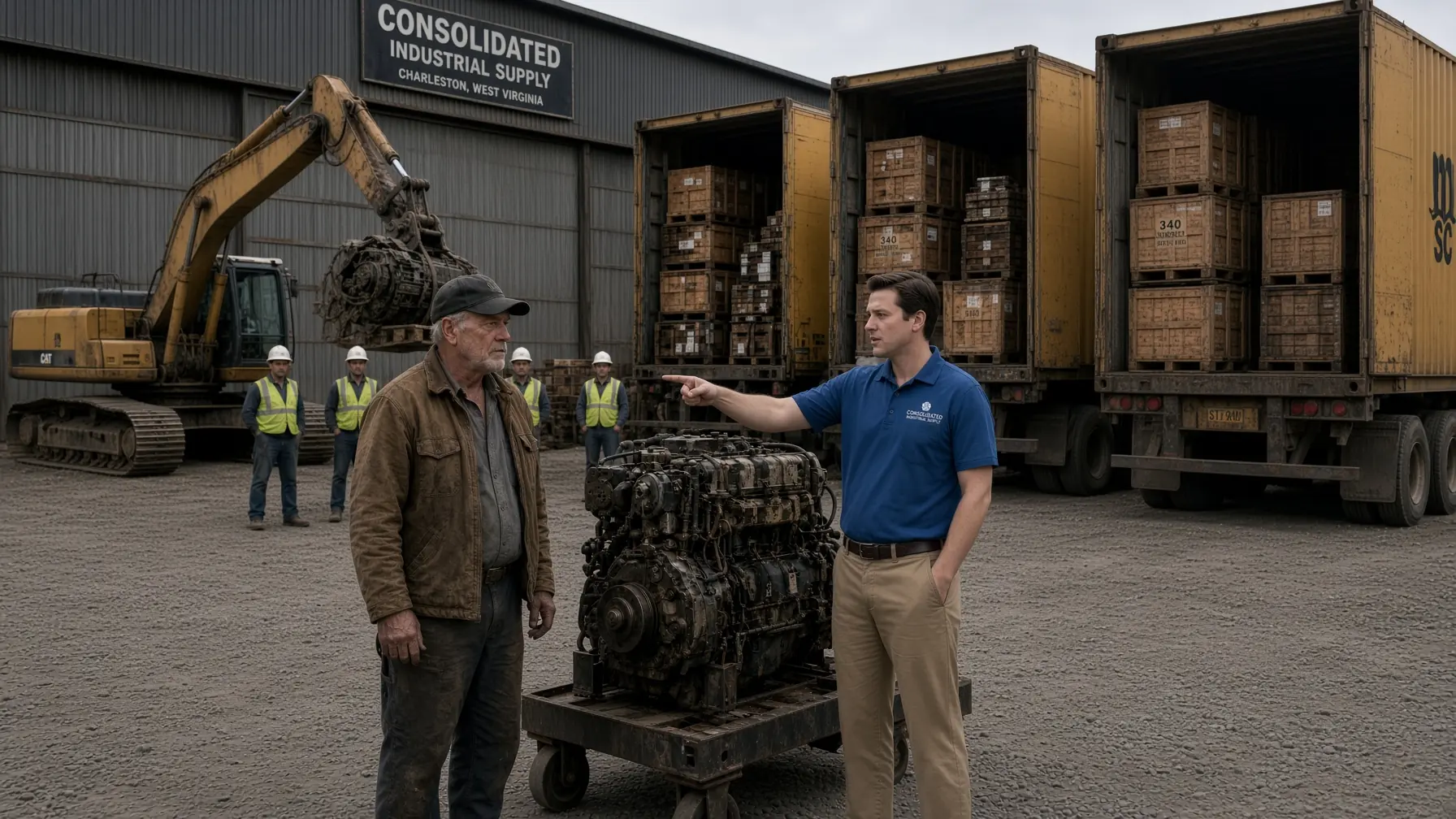
Kevin wore a clean blue polo embroidered with the logo of Consolidated’s new parent company, pressed khaki pants, and work shoes that had never spent a full day beneath an engine block. He had a degree in supply chain management from West Virginia University and had spent the previous eighteen months helping evaluate thousands of products according to sales volume, carrying cost, warehouse space, and margin. To Kevin, the rows of discontinued bearings, valve guides, piston rings, cam followers, gaskets, and oversized pistons were numbers on a spreadsheet. To Dale, they were the difference between a county grader working through winter and sitting useless behind a maintenance shed.
Kevin pointed toward the old diesel engine.
“Look at that junk, old man. Nobody with a brain is wasting money keeping this garbage alive.”
Dale did not answer immediately. He looked at the engine, then at the pallets disappearing into the trucks.
“Funny,” he finally said. “Men like you keep bringing those garbage engines to men like me when you can’t fix them.”
Kevin laughed.
“Buy whatever scraps you want. When those boxes are gone, your little shop dies with them.”
Dale lifted his eyes and held the younger man’s stare.
“Load every box on those trucks. When you come begging for these parts again, I’ll be the man making them.”
Kevin laughed again.
Dale did not.
For thirty-one years, Whitmore Engine and Machine had stood beside Route 119 in Harlan County, Kentucky. The shop covered forty-four hundred square feet on half an acre of ground Dale’s father had left him. It was not polished, modern, or impressive to someone accustomed to corporate facilities. The roof was steel. The floor was concrete. The sign above the bay doors had been painted by hand.
Inside sat machines that would have looked old even in 2003.
There was a Blanchard grinder Dale had purchased from a closing Knoxville shop in 1987. There was a lathe that had spent decades turning crank journals, bushings, sleeves, and piston blanks. There was a boring mill, a surface grinder, a honing machine, and a valve-seat grinder that Dale had rebuilt from the pieces of another machine in 1989. Nothing in the building had been purchased because it looked impressive. Every machine had stayed because it still did useful work.
That philosophy came from Everett Whitmore, Dale’s father.
Everett had spent forty years working as a mechanic for the county road department. When Dale was young, Everett taught him that an engine was not mysterious. It was a system of clearances, temperatures, pressures, materials, surfaces, and tolerances. If a man understood why every piece existed and how every piece interacted with the others, Everett said, then he could often repair what someone else had already declared finished.
He also taught Dale something else.
“The part usually ain’t the real problem,” Everett once told him. “The real problem is the fellow who never learned why the part failed.”
Dale carried that sentence into adulthood.
He opened Whitmore Engine and Machine in 1972 with a used engine stand, secondhand micrometers, basic machine tools, and the reputation his father had spent a lifetime building. At first, work came slowly. A trucker brought in a damaged head. A farmer needed an old gasoline engine rebuilt. The county sent him a worn motor from a road grader.
Dale fixed them.
The engines stayed fixed.
That mattered more than advertising ever could.
By the 1980s and 1990s, people were hauling machinery from several counties to Dale’s bay doors. Coal operators brought industrial diesels. Logging contractors brought engines that had been overheated, starved of oil, or damaged by years of heavy work. Independent truckers brought blocks with spun bearings. Farmers brought old motors that dealerships had stopped supporting.
Dale rebuilt them.
For fifteen years, flatbeds backed into his gravel lot carrying engines other shops had already refused. Some arrived with cracked blocks. Some had warped heads. Others had damaged pistons, destroyed bearings, or worn cylinder bores that no dealer wanted to touch because replacement was simpler and more profitable.
Dale did not care what was easier for the dealer.
He cared whether the engine could still be made right.
And for years, he almost always had the parts.
Consolidated Industrial Supply was a major reason.
The company had been founded by Harold Prater in Charleston. Harold believed there was value in supporting machinery long after manufacturers had moved on to newer models. Consolidated stocked industrial and agricultural components dating back decades, including bearings, rings, valve guides, pistons, gasket sets, and other parts most national distributors had stopped carrying.
Dale trusted Consolidated because it understood his customers.
Then Harold Prater died in 1998.
Three years later, his family sold the company to a regional consolidator.
The new owners did not think like Harold.
They reviewed inventory through profitability reports. Slow-moving products were assigned carrying costs. Shelves were evaluated according to revenue per square foot. Older machinery became a problem because the customers who needed its parts were too scattered and the order quantities too small.
In early 2003, Consolidated mailed letters to account holders announcing that 340 part numbers would be permanently discontinued within ninety days.
Dale opened his letter beside his workbench.
He read it once.
Then again.
Of the 340 discontinued numbers, ninety-four were components he used regularly.
Some were parts for older Caterpillar diesels. Others supported Detroit two-strokes, Continental flatheads, and engines still operating in county equipment, logging machines, industrial pumps, and agricultural machinery across the region.
To the new ownership group, the parts represented weak margins.
To Dale’s customers, they represented machines they could not afford to replace.
Dale placed the letter beside a Cummins block he was machining for a logging contractor and remained still for several minutes.
He could have started calling customers.
He could have warned them that certain repairs would soon become impossible.
He could have slowly reduced the kinds of engines he accepted until Whitmore Engine and Machine became just another modern shop refusing older equipment.
Instead, Dale took out a legal pad.
He opened thirty-one years of repair records.
Every engine he had rebuilt had been recorded. Every customer, every component, every recurring failure, every replacement part, and every purchase order sat inside filing cabinets in the shop.
Dale began counting.
He calculated annual use of each affected part number. He separated fast-moving components from rare ones. He estimated how long his current stock would last. He identified the engines most likely to remain in commercial use.
A few days later, Dale climbed into his 1991 Ford F-250 and drove to Charleston.
At Consolidated, he asked for the inventory manager.
That was how he met Kevin Stall.
Kevin explained the situation politely at first. The product lines were finished. Whatever remained would be liquidated at forty percent below normal price. After the deadline, the parent company wanted the warehouse space cleared for faster-moving inventory.
Dale handed him the list of ninety-four part numbers.
“How much you got left?”
Kevin brought up the inventory.
Depending on Dale’s usage, there was between roughly eighteen months and four years of stock across the affected categories.
Dale studied the numbers.
“I’ll take it.”
Kevin looked at him.
“All of it?”
“All of it.”
The total came to approximately $112,000 after the liquidation discount.
Dale had nowhere near that much available.
He had about $47,000 in his operating account and a $30,000 line of credit at Harlan National Bank that he had never touched.
Kevin probably expected Dale to reduce the order.
Instead, Dale walked outside.
He sat inside his Ford for twenty-two minutes with the figures on the legal pad beside him.
He was fifty-eight years old.
His shop property was paid down enough to borrow against.
He had customers depending on him.
He also understood something Kevin’s spreadsheet did not.
The engines were not disappearing just because their parts were being discontinued.
County governments were not going to replace entire fleets because a supplier wanted better warehouse margins. Small contractors could not spend hundreds of thousands replacing machinery that still performed useful work. Farmers would keep old equipment running because paid-off machinery was often the only equipment they could afford.
The demand would remain.
Only the supply was disappearing.
Dale returned inside.
“I said I’ll take it.”
He called Patricia Graves at Harlan National Bank, a loan officer who had known Everett Whitmore. She arranged a short-term note against the shop property. Dale rented two box trucks and had the liquidation stock loaded.
Kevin watched the old machinist commit himself to a mountain of parts the corporation considered obsolete.
He thought Dale was buying inventory.
Dale knew he was buying time.
Back in Harlan County, boxes filled the shop.
Carol Whitmore stood in the doorway one evening while Dale built wooden shelving across the rear wall.
“You sure about this?” she asked quietly.
Dale tightened another bracket.
“Yeah.”
Carol knew him well enough to hear what he did not say.
He was not completely sure.
But he had a plan.
Over the next four to seven years, depending on the part, Dale expected that inventory to keep his customers working while he solved the larger problem.
The finished parts themselves taught him where to begin.
After three decades of rebuilding engines, Dale knew the materials, dimensions, clearances, and surface finishes required for many of the components he bought. He knew which parts needed hardened steel, which required bronze, which could be machined from aluminum alloy, and which depended on carefully controlled cast iron.
What he lacked was not knowledge of the finished component.
He lacked raw material.
So he started building a supply chain backward.
He visited machine shops in Pikeville, Hazard, and Corbin. He called suppliers in Cincinnati and Louisville. He found a steel service center in Knoxville capable of cutting bar stock to his specifications.
Then he found a foundry in Barboursville.