The envelope was halfway inside Officer Ryan Mason's jacket when the woman beside the guardrail said, very softly, “You might want to put that back.”
Mason grinned. Twenty-five thousand dollars had been lying in the saddlebag of a black Harley-Davidson, and he was already deciding how much of it his partner would expect. Officer Derek Cole stood between the woman and the motorcycle, blocking her view with a shoulder that seemed deliberately broad. Cars rushed past on Route 18. Nobody stopped.
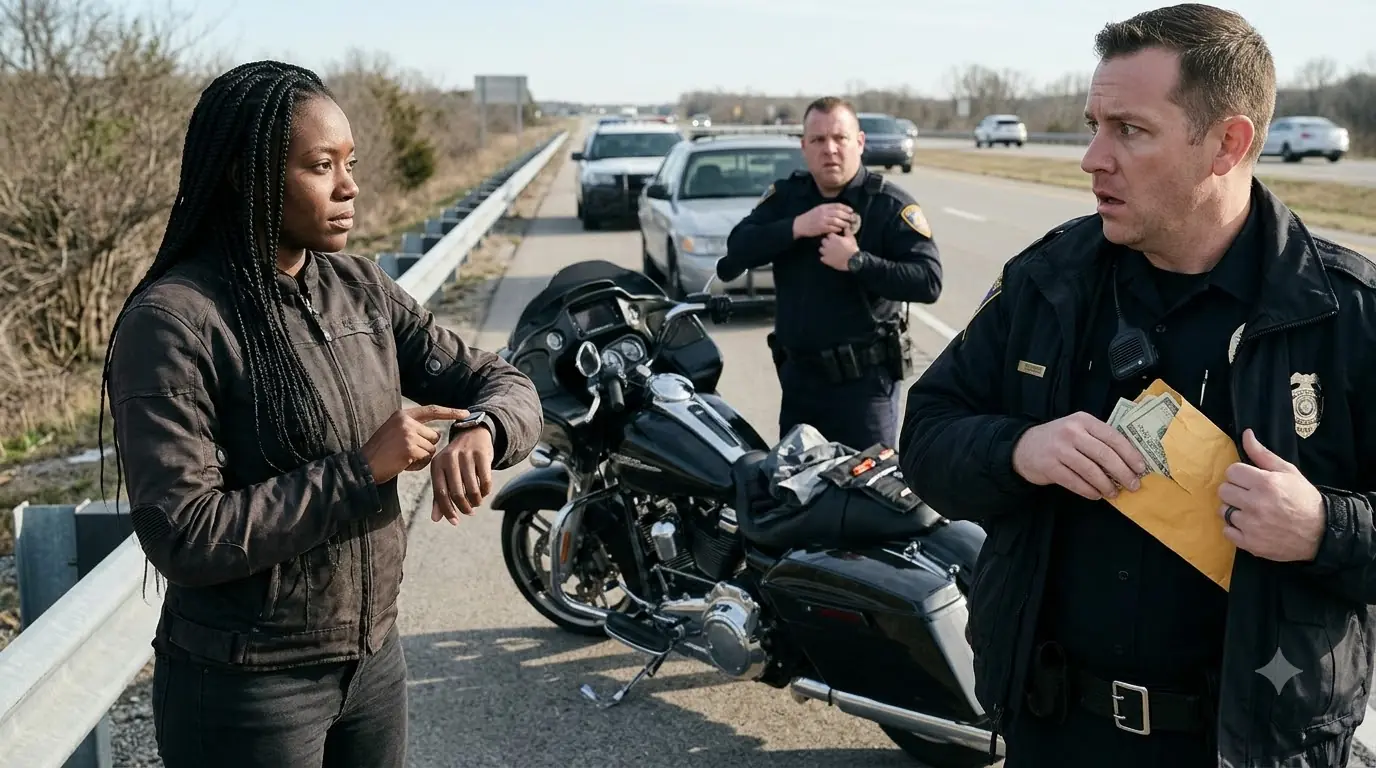
“Or what?” Mason asked. “You gonna report us?”
The woman looked neither at his face nor at his badge. Her eyes moved toward the envelope. Then she touched the face of her watch.
“No,” she said. “I just needed you to actually take it.”
Three seconds passed. Static snapped from Cole's shoulder microphone. At precisely the same moment, Mason's patrol radio crackled to life.
“Unit Twelve. Unit Fourteen. Stand by for command traffic.”
Cole turned, his smug expression slipping. A man's voice followed, calm enough to be terrifying. “Cole and Mason, step away from the woman and the money. Do not touch your weapons. Do not access your vehicles. Keep your hands visible.”
Mason pulled the envelope from his jacket as though it had burned him. Cole stared at the woman he had stopped for an alleged traffic violation, searching her face for the answer she had been keeping from him. Beyond the curve in the road, engines rose together. There were no sirens, only the sound of vehicles approaching from both directions.
“Who are you?” Cole demanded.
She did not answer. Not yet.
Forty minutes earlier, neither officer had imagined hearing his own name over a radio in that particular voice. And ten months earlier, the people who had tried to tell the truth about this stretch of highway had almost stopped trying.
It began with an ordinary complaint that nobody wanted to make extraordinary.
Samuel Ortiz was a truck driver who knew Route 18 so well he could recognize a bad bend by the sound of his tires. One chilly evening he was pulled over after crossing from one county into another. The officer said his lane change had been unsafe. Samuel disagreed but handed over his papers, hoping the stop would end with a warning. It did not. The officer noticed a cash envelope in his cab and began asking where Samuel was going, why he had money, and whether he understood how quickly suspicious currency could be held as evidence.
Samuel had savings from several months of deliveries. He was not transporting drugs. He was not fleeing anyone. He was trying to reach a family gathering before dark. By the time the officer told him he could avoid a prolonged seizure by leaving some of the money behind, Samuel was frightened enough to think the offer was merciful. He paid. He drove away. He hated himself for paying. Then he hated the fact that the official complaint he filed was dismissed because the officer denied receiving anything.