The Black woman had been awake for less than twenty minutes when the first police cruiser stopped outside her house.
She did not notice it immediately.
She was standing in her new kitchen in a loose navy sweatshirt, matching navy joggers, and soft house slippers, holding a ceramic mug while deciding which of the twenty-four moving boxes surrounding her should be opened first.
The house was quieter than she expected.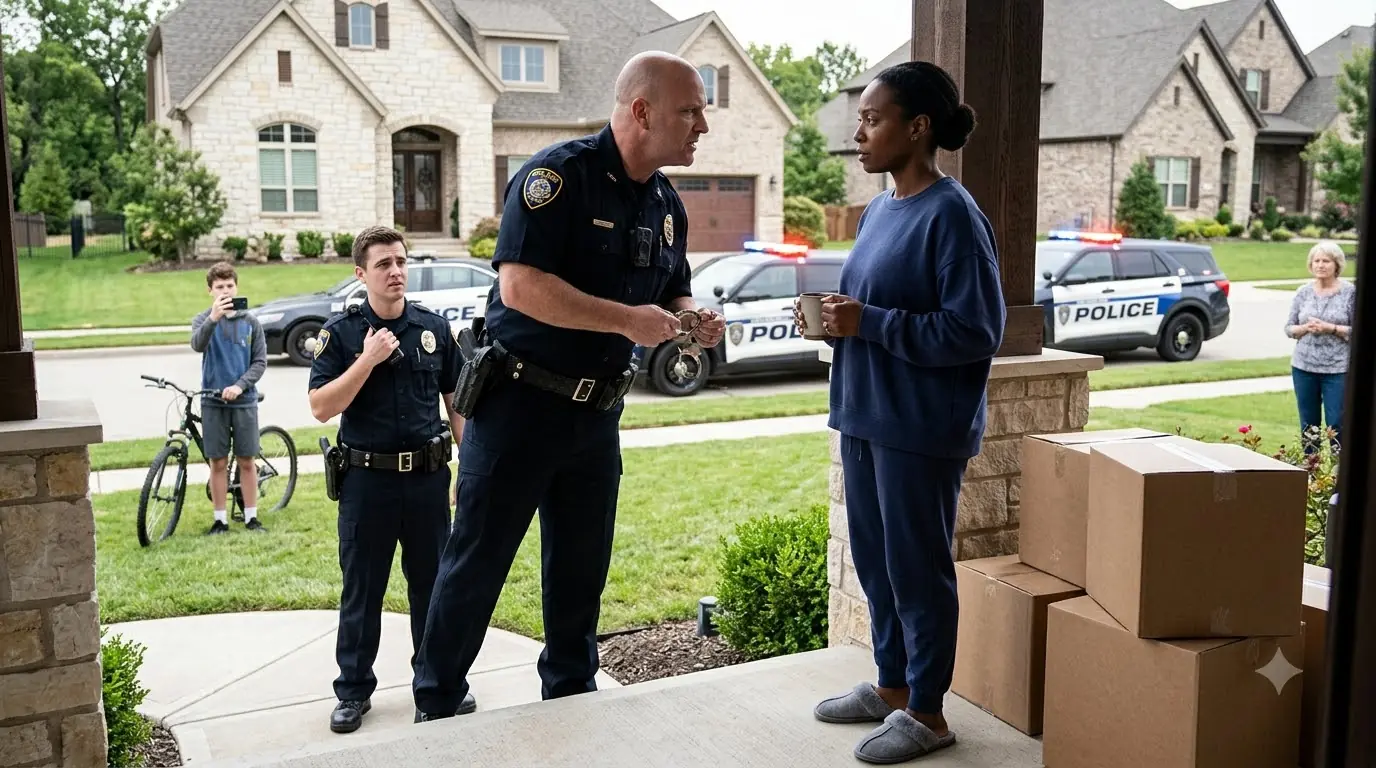
That was one reason she had bought it.
For years, her workdays had been defined by phones, court filings, urgent meetings, difficult decisions, and rooms full of people waiting for her to say something important.
She wanted home to feel different.
No microphones.
No marble hallways.
No assistants waiting with folders.
No security detail hovering near the driveway.
Just a house.
A garden.
A porch.
Enough distance from downtown to hear birds in the morning.
The stone house sat at the end of a curved residential street lined with mature trees and wide lawns. It was larger than anything she had owned before, though she had not bought it to impress anyone.
She wanted space for her mother to visit.
A guest room for her younger sister.
A quiet office that did not share a wall with someone else’s conference room.
Most of all, she wanted a front porch.
Her father had loved front porches.
He used to sit outside with coffee before sunrise and tell her that the best time to understand a neighborhood was before everyone started performing for the day.
She had thought of him when she signed the closing papers.
Now she stood inside the kitchen of that house with half the cabinets empty and three boxes labeled CASE BINDERS sitting beside cartons marked BOOKS and KITCHEN.
It was Saturday.
Her first full morning there.
She had no meetings until Monday.
That alone felt luxurious.
Then she heard a car door slam.
She carried her mug toward the front window.
A marked patrol cruiser was parked at the curb.
The Black woman frowned.
Another cruiser turned onto the street moments later.
Its lights were flashing.
She set the mug on the windowsill.
Across the road, an older white woman stood near her driveway with one hand raised toward the officers.
The Black woman recognized her.
The woman lived two houses down.
They had exchanged exactly one conversation the previous afternoon.
It had lasted less than three minutes.
The Black woman had been carrying a box from the moving truck.
The older woman had walked over and said, “Are you helping the new owners?”
The Black woman had smiled.
“I am the new owner.”
The older woman had looked surprised.
Then embarrassed.
“Oh. I thought the house sold to a family from Virginia.”
“It did.”
The Black woman had not explained further.
She had lived in Virginia for several years.
The older neighbor had nodded awkwardly and walked away.
At the time, the Black woman had dismissed the exchange.
Now she watched the neighbor point toward her house while two officers crossed the street.
One officer was older, bald, broad through the shoulders, and moved with the heavy confidence of someone accustomed to people stepping aside.
The second officer looked younger.
He stayed half a step behind.
The Black woman picked up her coffee again.
Then someone knocked hard on the front door.
Not a polite knock.
Three heavy strikes.
She walked toward the entrance.
Through the narrow glass panel beside the door, she could see both officers standing on the porch.
The lead officer knocked again.
“Police.”
The Black woman opened the door halfway.
“Good morning.”
The lead officer looked past her into the foyer.
“Who are you?”
The question was so abrupt that she initially thought she had misheard it.
“I live here.”
The officer’s expression did not change.
“Name?”
The Black woman gave it.
The younger officer glanced at the tablet in his hand.
The lead officer continued staring inside.
“Anyone else in the house?”
“No.”
“Where are the owners?”
She looked at him.
“You’re speaking to the owner.”
The lead officer’s jaw shifted slightly.
“We received a call about an unauthorized person entering this property.”
“I entered because I own it.”
“Do you have identification?”
“Yes.”
“Get it.”
The Black woman remained in the doorway.
“My wallet is upstairs.”
The officer sighed.
“Then go get it.”
She looked toward the patrol cars.
“Before I do that, what exactly was reported?”
“Someone saw a person entering a recently sold house who didn’t appear to belong here.”
The sentence hung between them.
The Black woman looked toward the older neighbor across the lawn.
The older woman immediately looked away.
“I moved in yesterday.”
The younger officer looked down at his tablet again.
The lead officer said, “We’ll verify that.”
“That’s fine.”
The Black woman turned slightly.
“Wait.”
The lead officer’s voice sharpened.
She stopped.
“I thought you told me to get identification.”
“Keep your hands where I can see them.”
The Black woman slowly turned back.
“My wallet is upstairs. I cannot bring you identification without walking upstairs.”
The younger officer looked at his partner.
The lead officer ignored him.
“Do you have anything downstairs with your name on it?”
The Black woman glanced toward the boxes.
“Several things.”
“Bring one.”
She moved toward a box beside the entry table.
The lead officer stepped forward.
“Slowly.”
The Black woman stopped again.
She had spent years questioning witnesses.
She had spent even longer studying how people behaved under pressure.
The officer was not gathering information anymore.
He was looking for confirmation of a conclusion he had already made.
That distinction mattered.
She looked directly at him.
“Officer, I’m cooperating with you. But every time I follow your instruction, you give me another one that prevents me from completing the first.”
His face tightened.
“Don’t start.”
“I’m not starting anything.”
“Then get something with your name on it.”
The Black woman walked to one of the boxes.
She set her coffee mug on top.
Printed across the side in black marker were the words CASE BINDERS.
She opened the flaps.
Inside were thick legal binders, folders, and several framed certificates wrapped in packing paper.
She reached for one folder.
The lead officer stepped inside the doorway.
She looked at his boot crossing the threshold.
“I did not invite you inside.”
“I’m making sure you don’t disappear somewhere in the house.”
“It’s my house.”
“We haven’t established that.”
She held up the folder.
“You can establish it right now.”
The younger officer shifted uneasily.
“Sir, maybe we should run the property record.”
The lead officer looked at him.
“We will.”
Then he returned his attention to the Black woman.
“Hand me the folder.”
She did.
He opened it.
Inside was a copy of the closing statement from the property purchase.
The Black woman watched him scan the first page.
His eyes moved over the document.
Then back.
Then again.
The younger officer leaned slightly closer.
“What does it say?”
The lead officer closed the folder.
“Could be a copy.”
The Black woman stared at him.
“Of course it’s a copy. The original closing documents are with my attorney.”
“You have something official with a photo?”
“My driver’s license.”
“Upstairs.”
“Yes.”
“And you expect us to just let you wander through the house?”
The Black woman’s expression changed.
Only slightly.
“Let me understand this. You came to my house because a neighbor said I did not look like I belonged here. I showed you closing paperwork with my name and this address. You still refuse to let me retrieve the photo identification you requested.”
The officer took one step closer.
“You need to watch how you’re speaking to me.”
The Black woman looked at his body camera.
Then back at him.
“I’m speaking clearly.”
“Don’t get smart.”
“I’m being precise.”
The younger officer looked increasingly uncomfortable.
The lead officer returned the folder.
“Come outside.”