Snow was falling hard outside the massive windows of the private aviation terminal in Denver, covering the tarmac in a thin white sheet and softening the roar of engines beyond the glass. Inside the lounge, everything looked expensive enough to make silence feel rehearsed. Cream leather chairs sat in perfect rows, polished tables held fresh coffee and crystal water glasses, and business travelers spoke in low voices while checking watches that cost more than most people’s cars. Near the far window, an elderly man in a worn brown jacket sat alone with a small plastic shopping bag resting on his knees.
His name was Edward Whitaker, though no one in the room seemed interested in asking. He was seventy-nine years old, with a white beard, tired blue eyes, and boots that still carried salt stains from the sidewalk outside. His jacket had a tear near one cuff, and his gray shirt was buttoned unevenly because his fingers had stiffened in the cold that morning. Compared to the executives in tailored suits and the women with designer luggage, he looked like someone who had accidentally wandered in from the bus station.
Edward did not mind being overlooked. A man who had spent nearly six decades building a company from a two-truck freight operation into Whitaker Global Aviation learned the value of quiet rooms. He had sat in polished offices with governors, billionaires, and airline chiefs, but he had also slept in truck cabs during snowstorms and eaten gas station sandwiches with mechanics at three in the morning. Power, to him, was not a suit or a watch. Power was knowing exactly who you were when nobody else did.
That morning, he had asked his driver to drop him off at the public entrance instead of the executive gate. His assistant, Nora Fields, had argued with him on the phone for ten minutes, telling him the board was already nervous and the weather might delay the meeting. Edward only smiled and told her he needed to see something for himself. The private lounge contract at Denver had been under review for months, and complaints about staff treatment had reached his desk too many times to ignore.
The lounge was operated by CrossGate Hospitality, a luxury service firm that handled private terminals, executive lounges, and premium travel facilities across the country. On paper, their standards looked flawless. Their reports spoke of discretion, safety, guest recognition, and elite service. But Edward had learned long ago that reports rarely showed how people behaved when they thought the customer in front of them had no money, no status, and no voice.
So he came as himself, just without the symbols people worshiped. He carried no visible badge, no assistant beside him, and no driver standing behind his chair. The small plastic bag on his lap held a scarf his late wife had knitted, a paperback book, and a wrapped sandwich from a corner deli he still visited because the owner remembered him before he became rich. If people could not respect him dressed like this, then they did not respect people at all.
Across the lounge, Vivian Cross stood near the reception desk, speaking sharply to a young attendant named Lydia Price. Vivian was forty-six, elegant, tall, and dressed in a navy business suit that looked severe even before she crossed her arms. Her blonde hair was pinned into a perfect twist, and her expression carried the cold certainty of someone who believed every room improved when she controlled it. She was not just the lounge director; she was the daughter of CrossGate’s founder, which meant people corrected themselves before correcting her.
Vivian had noticed Edward the moment he sat down. At first, she assumed he belonged to one of the maintenance crews waiting for instructions. Then she saw him open his plastic bag, remove the sandwich, and begin eating quietly in the corner reserved for premium passengers. Her mouth tightened. Luxury, in Vivian’s mind, depended on keeping the wrong people from making the right people uncomfortable.
She walked toward him slowly, heels clicking against the marble floor. Several executives looked up, sensing a confrontation before any word was spoken. Edward heard her approach but did not raise his head immediately. He finished wrapping the remaining half of his sandwich, placed it neatly back into the bag, and folded his hands over it.
“Excuse me,” Vivian said, though there was no courtesy in her voice. “This lounge is restricted.” Edward looked up at her calmly. “I know.” Her eyes narrowed slightly, irritated that he did not sound confused. “Then you understand you cannot just sit here.”
Edward glanced at the empty chair beside him, then back at her. “I’m waiting here.” A man in a charcoal suit two seats away smirked into his coffee. Another traveler leaned toward his colleague, already entertained. Vivian seemed to notice their attention and straightened, as if she had been given a stage.
“Waiting for what?” she asked. Edward’s gaze moved toward the window, where a white private jet sat through the falling snow. “A meeting.” Vivian gave a short laugh that made several people glance up from their phones. “A meeting in this lounge?”
Edward nodded once. “Yes.” Vivian crossed her arms tighter. “Sir, this is not a public waiting area.” Her voice grew louder. “These seats are for confirmed private aviation clients, board members, and approved guests.”
“I’m aware,” Edward said. His calmness bothered her more than resistance would have. It suggested that he believed he belonged, and Vivian had already decided he did not. She looked down at his boots, his old jacket, and the plastic bag with visible disdain.
“Leave before security,” she said. The lounge went quieter. Edward’s eyes lifted slowly to hers, not angry, not frightened, only disappointed. “I’m waiting here,” he repeated.
Vivian let out a breath of disbelief. “You cannot simply say that and make it true.” She turned slightly toward the watching executives. “This happens when people confuse airport lounges with warming shelters.” A few people chuckled softly, not because it was funny, but because cruelty often invites cowards to prove they belong.
Edward heard the laughter and looked at the faces around him. A young man with a silver laptop looked away quickly. A woman in a red coat pressed her lips together but said nothing. Lydia, the young attendant at the desk, looked ashamed and frightened, gripping a tablet against her chest like a shield.
Vivian pointed toward the snowy runway. “Which plane, old man?” Her voice carried across the lounge. “Which one of those jets is supposedly waiting for you?” The man with the coffee laughed louder this time. Someone near the snack counter whispered, “This is awkward,” but still did not stand.
Edward looked through the glass at the white jet, its steps down, its crew waiting near the open door. He had bought that aircraft six years earlier after his doctor told him commercial travel was becoming too hard on his health. He did not love private jets the way some men loved them. To him, they were tools, like freight trucks with wings.
“The white one,” Edward said simply. Vivian followed his gaze, then smiled as if he had given her exactly the answer she wanted. “That aircraft is reserved for Whitaker Global executives.” She leaned closer, her face cold. “And I know for a fact they are expecting their chairman.”
Edward studied her. “Do you?” Vivian’s smile sharpened. “Yes. Which means you need to move before someone important arrives and finds you sitting here with a grocery bag.”
That was when Lydia stepped forward. Her voice was small but clear. “Ms. Cross, maybe we should check the manifest first.” Vivian turned on her so quickly the young woman froze. “Did I ask you to interrupt?” Lydia lowered her eyes. “No, ma’am.”
Edward looked at Lydia with quiet gratitude. Courage did not always arrive loud. Sometimes it appeared in a trembling sentence spoken at the wrong moment to the wrong superior. Vivian turned back toward him, irritated now, and lifted one hand toward the security guard near the door.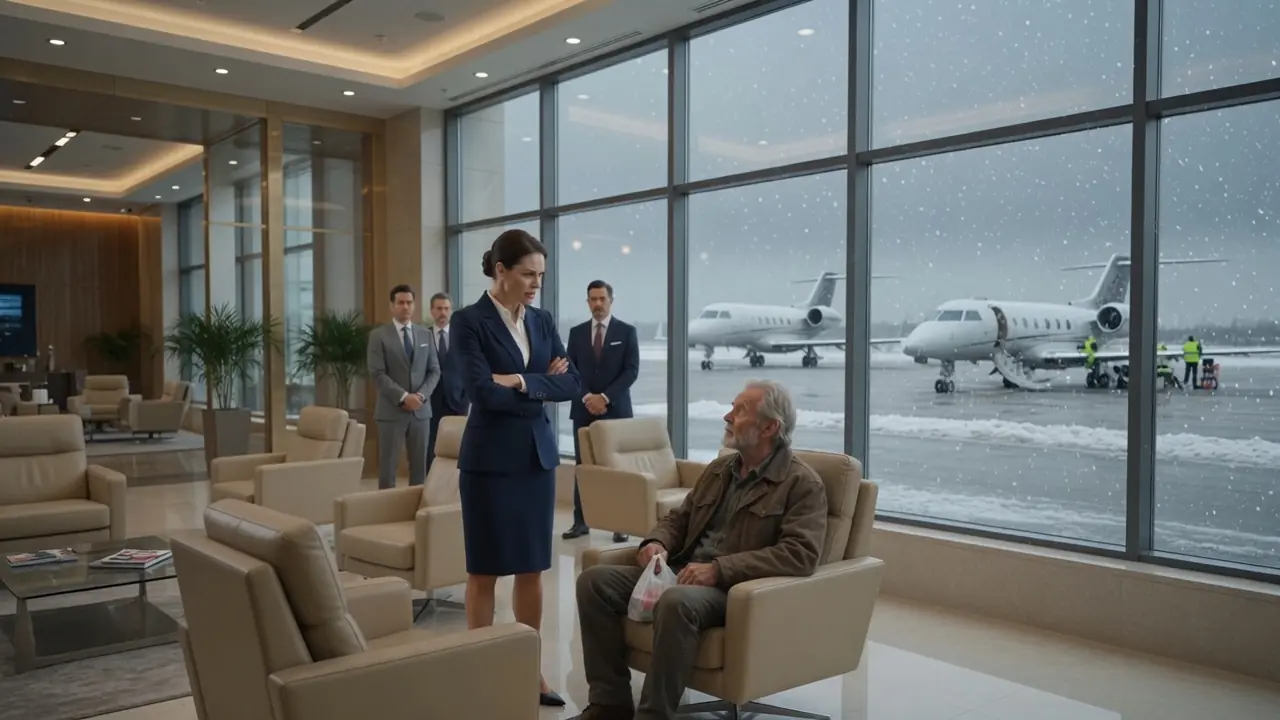
“Marcus,” she called. A uniformed guard named Marcus Hill stepped forward reluctantly. He was a large man in his early fifties, with careful eyes and the expression of someone who had been placed in unfair situations before. “Please escort this gentleman out of the lounge.”
Marcus looked at Edward, then at Vivian. “Sir, do you have identification or a boarding confirmation?” he asked, his tone respectful. Vivian snapped, “Marcus, he is not a passenger.” Edward reached slowly into his jacket, but Vivian barked, “Do not reach into your pocket.”
The room stiffened. Marcus raised one hand gently. “Ms. Cross, please.” Edward paused, then lowered his hand. He did not want the guard blamed for her fear. He had seen too many working people punished for trying to make arrogant decisions look less cruel.
Vivian stepped closer. “You people always make this difficult.” The sentence landed heavily. Edward’s expression changed for the first time, just slightly, a tightening around the eyes. “You people?” he asked.
Vivian seemed to realize the phrase had been heard. A woman in the red coat finally looked up sharply. Lydia’s face went pale. Marcus’s jaw tightened, but he remained professional.
“I mean unauthorized people,” Vivian said quickly. Edward nodded slowly. “Of course.” He looked around the room again, taking in every person who had heard the insult and chosen silence. “That explanation came very quickly.”
Before Vivian could respond, the lounge doors opened. Cold air swept in from the corridor, followed by a group of six executives walking fast. At the front was Nora Fields, Edward’s chief of staff, a silver-haired woman in a black suit whose calm competence had frightened weaker executives for twenty years. Behind her came board members, legal counsel, and Whitaker Global’s aviation division president, Samuel Grant.
Nora scanned the room once, then saw Edward near the window. Relief flooded her face so openly that several people turned to follow her gaze. “Mr. Whitaker,” she said, hurrying toward him. “Finally.”
The laughter vanished. The room fell into a silence so complete that the hum of the air system became noticeable. Vivian’s face emptied of color. Marcus stepped back, and Lydia’s mouth parted slightly as the executives gathered around the elderly man in the worn jacket.
Edward stood slowly, holding the plastic bag in one hand. Nora reached him first. “The board is ready, sir. Weather window opens in forty minutes, and the legal team has the revised acquisition papers.” Samuel Grant nodded respectfully. “Good morning, Mr. Whitaker.”
The man with the coffee lowered his cup. The woman in the red coat whispered, “Oh my God.” Vivian stared at Edward as if the room had betrayed her personally. Beyond the glass, the white jet waited in the snow, suddenly no longer a vague symbol of wealth but an answer to every mocking question she had asked.
Edward looked at Nora. “Thank you. Give me a moment.” Nora’s eyes moved to Vivian, then to Marcus and Lydia. She understood immediately that something had happened, and her expression cooled. “Of course, sir.”
Vivian recovered enough to speak. “Mr. Whitaker, I am so sorry. I didn’t recognize you.” Edward turned toward her. The plastic bag hung lightly from his fingers, almost absurd in the expensive lounge. “Yes,” he said. “That was the test.”
Her face tightened. “Sir, there was a misunderstanding.” Edward’s gaze did not soften. “No, Ms. Cross. A misunderstanding is when two people hear different things. I heard you clearly.” Vivian swallowed.
Samuel Grant glanced toward Marcus. “What happened?” Marcus hesitated, looking at Vivian first. Edward noticed. “Mr. Hill,” he said gently, “tell the truth and do not worry about your job.”
Marcus straightened. “Ms. Cross asked him to leave, sir. She said the lounge was restricted, questioned which plane he was waiting for, and called security to remove him.” He paused, then added, “She also made a comment about ‘you people’ making things difficult.”
The lounge seemed to shrink around Vivian. She turned toward Marcus with betrayal in her eyes, but he did not look away. Lydia took one small step forward, surprising herself. “I suggested checking the manifest,” she said. “Ms. Cross told me not to interrupt.”
Edward looked at Lydia. “Thank you for trying.” Her eyes filled slightly, and she nodded. Vivian clasped her hands in front of her, trying to regain the polished posture that had served her for years. “Mr. Whitaker, I was protecting the lounge standards.”
Edward turned toward the window, looking at the falling snow and the jet waiting beyond it. “Standards,” he repeated quietly. “That word gets used in many ugly ways.” Then he faced her again. “If your standards require disrespecting an old man because his coat is worn, then your standards are not luxury. They are decay.”
No one spoke. The executives who had laughed earlier sat frozen in their chairs, suddenly fascinated by their shoes, phones, and empty cups. Edward looked at them too. “And the rest of you heard it.” Several faces flushed. “You watched because you thought the humiliation was harmless as long as it was not yours.”
The man with the coffee cleared his throat. “Sir, I didn’t realize—” Edward raised one hand, and the man stopped. “That is becoming the most common sentence in this room.” He looked at Vivian again. “I didn’t realize who you were. I didn’t realize what was happening. I didn’t realize silence was participation.”
Nora stepped closer. “Sir, we can move this discussion to the conference suite if you prefer.” Edward shook his head. “No. This began in public.” His voice stayed calm. “It can be corrected in public.”
Vivian’s breathing became shallow. “Please, Mr. Whitaker, I apologize.” Edward studied her for a long moment. He did not enjoy watching fear replace arrogance. Fear did not repair what arrogance damaged. But consequences had to begin somewhere.
“Apologize to Lydia,” he said. Vivian blinked. “To Lydia?” “Yes. You humiliated her for suggesting proper procedure.” Vivian turned stiffly toward Lydia. “I’m sorry if you felt—” Edward cut in softly. “No.”
Vivian froze. Edward’s voice remained controlled. “Not if she felt. Not if you were offended. Not the apology of someone trying to escape. Try again.” Lydia stared at the floor, trembling.
Vivian’s face burned red. “Lydia, I’m sorry I dismissed you when you were right to ask for verification.” Lydia looked up slowly. “Thank you,” she whispered. Edward nodded once. “Now apologize to Mr. Hill for placing him in a position where he might have been forced to remove a legitimate guest because of your pride.”
Vivian turned toward Marcus. “Marcus, I’m sorry.” Marcus did not smile. “Thank you.” Edward watched both apologies carefully, then lifted his plastic bag slightly. “And now you may apologize to me.”
Vivian faced him. Tears had gathered in her eyes, though Edward could not tell whether they came from shame, fear, or the collapse of control. “Mr. Whitaker, I’m sorry I judged you unfairly and disrespected you in this lounge.” Edward nodded. “That is closer to the truth.”
Then he looked at Samuel Grant. “What is the status of the CrossGate contract renewal?” Samuel opened his tablet quickly. “Pending final review today, sir. Five-year extension, national scope, including Denver, Seattle, Dallas, and Atlanta executive terminals.” Vivian’s face went still.
Edward held her gaze. “Suspend approval.” Nora began typing immediately. Samuel nodded. “Yes, sir.” Edward continued, “Effective now, Whitaker Global will open a full service conduct review of every CrossGate-managed facility under our contracts.”
Vivian gripped the back of a chair. “Sir, please. Thousands of jobs depend on those contracts.” Edward’s eyes hardened. “Then those thousands of employees deserve leadership that does not treat dignity as optional.”
He turned to Lydia. “Who supervises employee complaints here?” Lydia glanced at Vivian, then answered. “They go through Ms. Cross first.” Nora looked up sharply. Edward nodded as if that confirmed something he already suspected. “That changes today.”
The next twenty minutes unfolded with controlled precision. Nora contacted Whitaker Global legal. Samuel froze the contract renewal. A compliance team was dispatched to Denver. Marcus and Lydia were asked to provide statements, not as suspects, but as protected witnesses. Vivian stood near the counter with her arms no longer crossed, watching her authority drain from the room.
Edward did not raise his voice once. He did not need to. Quiet power, honestly held, made more noise than shouting. Every executive in the lounge understood that a five-minute insult had just opened a multi-million-dollar investigation.
When the board members finally urged him toward the conference room, Edward looked once more at the chair where he had been sitting. The plastic bag still rested in his hand. Vivian noticed it and seemed ashamed all over again, as if the smallness of the bag proved how little it had taken for her to judge him. Edward slipped the bag under his arm and turned toward the corridor.
Before leaving, he stopped beside Marcus. “You handled a difficult moment with restraint.” Marcus nodded. “Thank you, sir.” Edward looked at Lydia next. “And you tried to stop the wrong thing before you knew I could protect you.” Lydia’s eyes filled again. “I should have done more.”
Edward’s face softened. “Most people say that after they do nothing. You did something while you were still afraid.” He handed Nora a card. “Make sure Ms. Price is contacted directly by our review team, not through local management.”
Then he walked out with the executives surrounding him, not as a rescued old man, but as the chairman everyone had been waiting for. The lounge remained silent after he left. No one returned immediately to coffee, calls, or conversations. The room had been forced to look at itself, and that kind of mirror takes time to forget.
In the conference suite, the board was waiting. Edward took his seat at the head of the table, still wearing the worn brown jacket. A few members looked at it, then quickly looked away. Nora placed the acquisition papers before him, but he did not open them yet.
“Before we discuss expansion,” Edward said, “we discuss culture.” The room became still. “A company reveals itself not in how it treats people it recognizes as powerful, but in how it treats people it believes can do nothing in return.” He looked around the table. “This morning, I saw enough to know our contracts have been measuring the wrong things.”
The acquisition meeting changed after that. Instead of only revenue projections, Edward demanded worker complaint channels, mystery guest audits, dignity standards, and direct contract penalties for discriminatory conduct. One board member tried to warn that these measures might slow growth. Edward looked at him and said, “Growth in the wrong direction is not progress.”
By the end of the day, CrossGate’s national contract was under review, and Vivian Cross had been placed on administrative leave by her own company after Whitaker Global sent the preliminary report. Her father called Edward personally that evening, voice heavy with embarrassment and negotiation. Edward listened politely, then said, “I am not interested in protecting anyone’s family name at the expense of people your family trained staff to overlook.”
Three weeks later, the investigation found more than one incident. Staff members in multiple lounges described pressure to “maintain image” by discouraging guests who looked poor, elderly, disabled, or out of place, even when their reservations were valid. Employees had reported concerns, but those reports often died with local managers. Vivian’s behavior had not been an accident. It had been a symptom.
CrossGate lost the Denver contract and two others. Lydia Price was offered a management training role under a new hospitality partner, and Marcus Hill became part of the security review board for private terminal conduct. The changes made business news for a week, but Edward cared less about headlines than whether the next old man in a worn jacket could sit down without being treated like a stain.
Months later, Edward returned to the Denver lounge after the new operator took over. Snow fell again, though softer this time, drifting across the tarmac like ash from a quiet fire. He wore the same brown jacket and carried the same plastic bag. Nora offered to walk with him, but he shook his head and entered alone.
A young attendant at the desk looked up and smiled. “Good morning, sir. Are you waiting for a flight or meeting someone?” Her voice was professional, respectful, and ordinary in the best possible way. Edward smiled back. “Both, I think.”
She did not look at his boots with contempt. She did not ask which plane in a mocking tone. She simply checked the system and said, “Mr. Whitaker, your party will arrive shortly. Please sit anywhere you like, and let me know if you need anything.” Edward thanked her and sat near the same window.
The white jet waited beyond the glass. The lounge was still expensive, still quiet, still full of people with polished shoes and urgent phones. But something in the air felt different. Not perfect. No place run by humans ever was. But different enough that Edward allowed himself a small breath of satisfaction.
Lydia appeared from the corridor a few minutes later, now wearing a manager’s badge. When she saw him, she smiled with nervous pride. “Mr. Whitaker, welcome back.” Edward looked at the badge and nodded. “It suits you.”
She glanced toward the window, then back at him. “We changed the intake process. Staff can verify discreetly now, and nobody is removed without supervisor review and documentation.” Edward smiled faintly. “Good.” Lydia hesitated. “And we added the dignity language you requested.”
Edward’s eyes softened. “It should not have needed my request.” Lydia nodded. “I know. But it’s there now.” She stepped away to help another guest, and Edward watched her speak with an elderly woman carrying a cloth bag and a nervous expression.
The woman’s coat was worn, and her shoes looked wet from the snow. Lydia walked around the desk, offered her a seat, and called someone to verify her pickup. No one stared. No one laughed. No one asked her to leave before understanding why she had come.
Edward looked down at the plastic bag in his lap and thought of his late wife, Margaret, who had spent their early years reminding him that success meant nothing if it made a man forget hunger, cold, or embarrassment. The scarf in the bag had been hers, knitted badly and loved deeply. He carried it on hard days because it reminded him of the life before private jets, when kindness was not branding but survival.
Nora arrived with the board team a few minutes later. “Sir, they’re ready.” Edward stood slowly, knees aching, hand steady on the bag. Before leaving the lounge, he looked once more toward the chairs, the travelers, the windows, and the snow falling beyond the glass.
He knew people would tell the story as if it were about a billionaire hiding in plain sight. They would enjoy the reversal, the shocked faces, the woman who learned too late that the old man owned the jet. But Edward knew the real lesson was not that Vivian had misjudged a rich man. The tragedy was that she would have felt justified if he had been poor.
That was why he kept returning without the suit, without the entourage, and without the symbols people used to decide who mattered. Not to trap workers for sport, but to test whether the systems carrying his name could recognize dignity without needing wealth as proof. Some rooms passed. Some failed. And when they failed, Edward Whitaker made sure the correction was louder than the insult.