The cold came in off the highway like something with intention.
It pressed through the gaps in the Iron Covenant’s clubhouse walls, old timber and older insulation, a building that had absorbed decades of cigarette smoke and engine grease and arguments that never quite resolved.
It settled into the room the way cold always does in places where people have been hurting for a long time.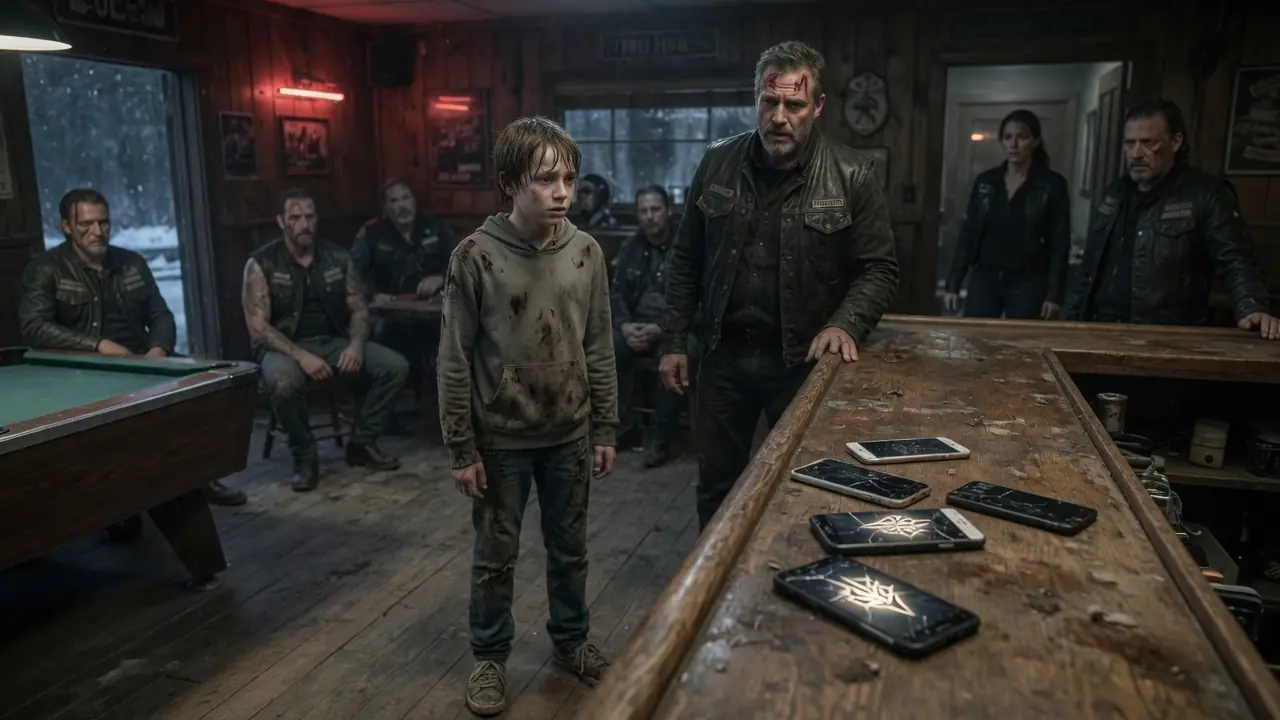
Slow.
Patient.
Familiar.
Outside, 11 Harleys sat beneath the parking overhang, their engines clicking and contracting as they cooled in the dark. The neon hammerhead sign above the door, the club’s unofficial mascot, a chrome shark mid-lunge, threw pale red light across the gravel lot.
It buzzed and flickered. It had been doing that for three weeks.
Nobody had fixed it.
Some things you just learn to live with.
Inside, Ronan Vale was doing what he usually did at 7:40 on a Tuesday. Nothing that looked like anything.
He sat at the far end of the scarred oak bar, a coffee mug between his palms, staring at the middle distance between the back wall and whatever decade his mind had retreated to.
His cut, black leather, Iron Covenant patch on the back, President’s rocker below it, was draped over the stool beside him.
He had taken it off an hour ago, which meant something to anyone paying attention.
The cut was armor.
When Ronan Vale took it off and set it beside him instead of across the room, it meant he was tired in a way that sleep didn’t fix.
Mac Ryder was at the far table with a laptop open and three energy drinks arranged in a loose triangle around it, like offerings. His fingers moved across the keyboard in short bursts, then stopped, then started again.
He had the particular posture of a man who was looking for something and wasn’t sure he wanted to find it. The scar that ran from his left ear to his jaw caught the light every time he turned his head.
Cass Rowan was in the back hallway, on the phone, her voice low. The words weren’t audible from the bar.
Ronan could tell from her shoulders, that specific set, both of them tight and squared, that whoever was on the other end of that call was delivering news she had already known was coming and had been hoping was wrong.
Three other riders were scattered across the room. Boots and Hector were at the pool table, not playing, just existing near it. Denny was on the couch with his eyes closed, though no one believed he was actually asleep.
This was what the Covenant looked like on a quiet night.
Not peaceful.
Not relaxed.
Just contained.
That lasted until the door came open.
It didn’t creak. It didn’t swing gently.
It came open the way a door comes open when something small but absolutely committed to forward momentum hits it at full speed.
What fell through it into the amber light of the clubhouse was a boy, 11 years old, maybe small for it, wearing a gray hoodie with a torn drawstring and jeans that were wet from the knee down.
He had no coat. His sneakers left wet prints on the wood floor. His face was the particular shade of pale that only happens when a body has been running in freezing air for longer than it should.
He stopped in the middle of the room.
Every head turned.
The boy’s chest was heaving. He was carrying something, a backpack, unzipped, held against his chest with both arms.
Before anyone could speak, before Ronan could rise from his stool, or Mac could close the laptop, or Boots could set down his pool cue, the kid crossed the room in eight steps and upended the backpack onto the bar.
Five smartphones clattered onto the oak.
Cracked screens, cheap cases, one with a cracked back panel held together with electrical tape. They skidded and spread.
The boy looked at Ronan, only at Ronan, like he had known exactly which man in this room to look at.
“I stole them,” he said.
His voice came out steadier than it should have, given everything.
“So they can’t stream it.”
The room went the kind of quiet that has weight.
Ronan’s eyes moved from the boy’s face to the phones on the bar. One of them had its screen cracked but still lit. A background image was partially visible through the fracture lines.
A logo.
Simple.
A stylized eye with a single slash through it.
Ronan had seen that logo before.
Everyone in this room had seen that logo before.
They had seen it 18 months ago on a hard drive that Mac had pulled from a server they had burned a man’s operation to the ground to reach.
They had seen it in a folder of files that Cass had spent six weeks going through page by page until she had stopped being able to eat.
They had seen it, and they had believed, because they had needed to believe, that when that server went dark and that man went to prison and the Covenant’s intel went to three different law enforcement task forces simultaneously, they had burned the Eye shut.
They had been wrong.
Mac’s chair scraped back. He was already moving toward the bar, one hand extended, not touching the phones yet.
His eyes were doing that rapid inventory thing they did when he shifted from regular human Mac into analyst Mac, taking in angles and positions and details that other people’s eyes slid past.
“Don’t touch them,” Ronan said.
Mac stopped.
Ronan looked at the boy.
“What’s your name?”
Not a question, statement-shaped. The kind of question that wasn’t asking for permission.
“Nolan,” the boy said. “Nolan Mercer.”
“How old are you, Nolan?”
“Eleven.”
“Where’d you come from tonight?”
A pause, long enough that it meant something.
“The Greenvale Group Home on Alder Street.”
Ronan knew the name. Knew the street. Knew specifically the reputation of the facility administrator there, a man named Darren Pike, who appeared in two separate case files Cass had cross-referenced 14 months ago and who had, both times, managed to be just peripheral enough to the documented wrongdoing to avoid anything sticking to him.
“How’d you get here?” Ronan said.
“Ran, mostly. A truck driver gave me a ride for the last six miles.”
The boy’s jaw tightened.
“He didn’t ask questions.”
“Smart truck driver.”
“Yeah.”
The phones on the bar sat between them. None of them were ringing.
No one was calling because Nolan had taken them and run, and whoever those phones belonged to didn’t yet know the boy was here, or what he had done, or who he had brought the evidence to.
That window, that specific narrow window, was the only advantage they had.
And it was closing at a rate Ronan could almost feel.
“Tell me about the logo,” Ronan said.
Nolan’s eyes went to the lit screen. He looked at the fractured eye symbol for a moment, the way a person looks at something they have been trying to unsee.
“The men who come to the home,” he said. “Not all of them. Some of them. They use that to show each other they’re in it. Like a sign.”
His throat moved.
“I saw one of them show it to Mr. Pike on his phone, and Pike smiled.”
The silence after that had a different quality than the one before.
Heavier.
It pressed down.
Cass Rowan appeared from the hallway. She had ended her call. Ronan didn’t know when, hadn’t heard her.
She stood at the edge of the room with her arms folded and her face doing the careful stillness it did when she was holding something back that would come out wrong if she didn’t hold it.
She looked at the phones.
She looked at the boy.
Her voice, when it came, was level, practiced. She had spent eight years as a youth counselor before she had ended up here, and she knew how to make her voice level when everything else inside her was not.
“Hey,” she said. “You cold?”
Nolan looked at her. Something in his posture shifted fractionally toward her, the way a person shifts toward warmth without deciding to.
“Yeah,” he said.
“Come on.”
She didn’t touch him. Didn’t reach for him. Just turned and walked toward the kitchen, leaving the decision to him.
He looked at Ronan.
Ronan nodded once.
The boy followed Cass.
Mac moved to the bar and crouched to look at the phones at eye level, still not touching.
“If these have GPS active—”
“They’ll know where he ran,” Ronan finished. “And where he stopped.”
Their eyes met.
Mac straightened. He went to his table and came back with a Faraday pouch, the kind that blocked signals.
Ronan used a pen to slide each phone into it without fingerprints.
Five phones.
Five devices that had been in the hands of people who used that logo to identify themselves to each other, which meant they were networked, which meant they were organized, which meant the thing they were doing wasn’t amateur and wasn’t isolated and wasn’t happening only in Greenvale.
Ronan had known all of that 18 months ago.
He had just let himself believe the network died with the server.
He sat back on the stool and picked up his coffee.
It had gone cold.
From the kitchen came the sound of the kettle, a cabinet opening, Cass’s voice low and even.
Then silence.
Then, quieter than anything else in the room, the sound of a boy crying.
Brief. Contained. Swallowed almost as soon as it started, the way kids cry when they have been taught that crying is a vulnerability they can’t afford.
The kind of crying that comes out sideways when something finally safe is offered after too long without it.
Boots and Hector exchanged a look across the pool table. Neither of them spoke.
Denny opened his eyes from the couch, looked at the ceiling, then closed them again.
Ronan set down the cold coffee.
“Mac,” he said.
“Yeah.”
“Pull everything we had on the Eye logo. Eighteen months. Everything.”
“Already opening it.”
A pause.
“Ronan.”
“What?”
“The file size is bigger than when we closed it.”
Ronan turned slowly to look at him.
Mac’s jaw was tight. He was staring at the screen with the expression of a man who was doing the math and not wanting to confirm the answer.
“Someone added to the archived file.”
“That shouldn’t be possible unless—”
He stopped.
“Unless someone with access to our archive has been updating it,” Ronan said.
“Yeah.”
“How recent?”
Mac’s eyes tracked across the screen.
“Last update, four days ago.”
The clubhouse went very quiet again.
Ronan stood up from the stool. He picked up his cut and put it back on.
The leather settled across his shoulders like it always did, like a second skin, like armor, like something that had been molded to the shape of the person he had to become.
He buttoned the bottom snap without looking.
From the kitchen doorway, Cass appeared. She had a mug of something in her hand. Not for herself.
She stopped in the doorframe and looked at Ronan with the particular look she had developed over two years of working alongside men who carried damage they would never fully name.
“He’s talking,” she said. “There’s more.”
“How much more?”
“Enough that you need to hear it from him directly.”
She paused.
“His friend, his roommate, Eli Dawson. He’s 12.”
Another pause.
“Nolan says he saw them put Eli in a car at the home this afternoon.”
Her voice stayed level. Barely.
“He says they do it in the forest. He says tonight.”
The word hit the room like a physical thing.
Tonight.
Ronan looked at the clock on the wall behind the bar.
7:52 in the evening.
He had no idea how long they had. He had no idea what location and what forest. He had no idea how many men, or what security, or what structure, or any of the hundred operational details that made the difference between intervention and catastrophe.
What he had was five phones in a Faraday pouch, a boy in the kitchen, a file that someone had been updating without authorization, and the particular tight burn behind his sternum that he had learned to recognize as the feeling of a mistake from the past arriving to demand repayment.
He walked to the kitchen doorway.
Nolan Mercer was sitting at the small table, both hands wrapped around a mug, looking at the surface of the table with the focused attention of a person who is not actually looking at the surface of the table, but is instead looking at something inside their own head that they cannot stop seeing.
The wet jeans. The torn hoodie. The sneakers still damp from running miles through freezing air to bring this to people he had never met before tonight.
Because somewhere in whatever calculus an 11-year-old brain runs when it has no good options, the Iron Covenant had seemed like less of a gamble than anything else within running distance.
Ronan leaned against the doorframe.
He didn’t sit.
Sitting would have made the conversation feel permanent, and he needed the boy to feel like there was still momentum, still forward motion, still something active being done.
“The car they put Eli in,” he said. “What did it look like?”
Nolan looked up.
“Dark blue. No back windows. Had a dent in the rear bumper on the driver’s side. The license plate had a three and two eights in it. I don’t remember the rest.”
Ronan stared at him.
“I know plates matter,” Nolan said with a flatness that didn’t belong on an 11-year-old’s face. “I’ve been paying attention to what matters for a while.”
“How long have you been at Greenvale?”
“Seven months.”
“And before?”
“Two other homes. Before that, my mom.”
He said the word without inflection.
“She’s been in treatment for 14 months. That’s good. That part’s good. But the court says I can’t go back until she completes the full program. And the program is—”
He stopped.
“It doesn’t matter right now. Eli matters right now.”
Ronan pulled out the chair across from him and sat down after all.
“Tell me about Eli.”
Nolan’s hands tightened around the mug.
“He’s been at Greenvale longer than me. He doesn’t... He’s quiet. Not shy. Different. Like he learned quiet as a strategy.”
He paused.
Another pause.
“I should have gotten him out earlier. I knew this was coming. I’ve been watching Pike and those guys for three months, and I should have—”
“Hey,” Ronan said.
Nolan stopped.
“You’re 11. That’s not... You ran six miles in the cold with no coat and brought us five pieces of evidence before anyone knew you had taken them.”
Ronan kept his voice flat. Not gentle. Not performatively warm. Level.
“That’s not nothing. That’s not something most adults would do.”
The boy looked at him for a moment, then looked back at the table.
“I didn’t know where else to go. The cops—”
He stopped.
“There’s a cop. Officer Tully. He comes to the home. Not for calls, just to talk to Pike. They stand out back by the dumpsters, and they’re friendly.”
His voice went flat on the last word.
“I tried the county child welfare line two months ago. I didn’t say my name. I told them what I’d been seeing. They said they’d look into it and to call back if I had more specific concerns.”
He said the last four words with a precision that made clear he was repeating them verbatim from memory.
“I called back three weeks later, different person. No record of my first call.”
Mac appeared in the kitchen doorway. He had the laptop. He turned it to show the screen, a grid of thumbnails, documents, partial records, all tagged with the Eye logo.
“Kid,” he said. “These men who come to the home, can you describe any of them?”
Nolan looked at the screen. He was quiet for a moment.
Then he pointed to a photograph in the lower left quadrant.
It was a DMV headshot, slightly grainy, the face of a man in his late 40s with wire-framed glasses and the mild, forgettable appearance of someone who spent their life deliberately not standing out.
“That one,” Nolan said. “He was there last week. He talked to Pike for a long time in Pike’s office with the door closed.”
Mac looked at Ronan.
His face had done something, compressed, gone tight, that Ronan read instantly.
“Who is he?” Ronan said.
“Victor Sloan,” Mac said. “Former IT contractor for the city’s Department of Children and Family Services. He was let go 18 months ago, around the time the server went dark. Exactly around that time.”
The timeline reassembled itself in Ronan’s head with the sick efficiency of pieces that had always fit together, had always been waiting to fit together, but that he had been forcing into the wrong shape because the right shape was too ugly to accept.
Sloan hadn’t disappeared after the server went dark.
Sloan had rebuilt.
Eighteen months of rebuilding with access to the child welfare database he had built the back-end architecture for, with knowledge of which children were most isolated, which facilities had the least oversight, and which administrators were most susceptible to the specific kind of offer that made men like Darren Pike smile at a logo on a stranger’s phone.
Ronan pushed back from the table and stood.
“Cass,” he said, “stay with him.”
He meant it in the specific way that she understood. Not a babysitting instruction.
Protection.
She nodded.
He walked back into the main room.
Boots and Hector and Denny were all standing now. Not gathered around anything, just standing in the distributed readiness that the Covenant had developed over years of doing this work in the spaces where other people’s systems had failed.
They knew something was happening.
They had known it since the door came open.
“Wake everyone up,” Ronan said. “Full call, 30 minutes.”
Boots reached for his phone.
“Not on the network,” Ronan said. “Personal cells. Tell them come in person if they can. If they can’t, they don’t get told the details until tomorrow.”
He paused.
“We don’t know who’s been watching our network.”
That landed.
The room absorbed it.
“Mac,” Ronan said.
Mac came out of the kitchen.
“The file updates,” he said. “I’m still cross-referencing, but Ronan, whoever has access to our archive is inside our communication structure. Not just adjacent to it. Inside.”
“You mean a member?”
“Or someone with access to a member’s credentials, or a member’s device.”
He paused.
“I don’t think it’s anyone in this room.”
“How confident are you?”
“Seventy percent.”
Ronan looked at him.
Seventy percent meant 30% of doubt, and 30% was not a number he could operate on in a situation like this one.
“Find the other 30,” he said, “before we move.”
He went to the window beside the door and looked out at the parking lot.
The neon sign buzzed and threw its red light across the Harleys. Cold air pressed against the glass.
Somewhere out there, in a forest he hadn’t identified yet, in a clearing he couldn’t picture, there was a 12-year-old named Eli Dawson who had learned to go small as a survival strategy, and who was right now, in this moment, while Ronan stood at a window in a heated room, being prepared for something that no child should ever be prepared for.
The last time Ronan had been too slow, a boy named Marcus had ended up in a hospital room that he eventually walked out of physically intact, but in every other way permanently altered.
Ronan had visited him once.
Marcus hadn’t looked at him.
Ronan had not gone back because his going back had seemed, in a way he couldn’t precisely explain, like a performance of absolution that he had no right to.
He carried Marcus as a constant instead, a name he said to himself on nights when the work felt abstract or procedural, to make sure it stayed real.
He turned from the window.
“Find me that forest,” he said to Mac.
“Working on it.”
“How?”
“The phones. If I can get a data pull from the devices without triggering the GPS, there’s a chance they’ve cached location data from prior trips. The Eye network is organized. If they’ve used these devices at prior events, there’ll be breadcrumbs.”
“How long?”
“Forty minutes. Maybe less if I’m lucky.”
“Be lucky.”
Mac went to the table with his laptop.
Ronan went to the far end of the bar and sat back down. He did not pick up the cold coffee.
He sat with his hands on the bar top and his eyes on the door, his mind moving through the operational variables with the particular precision that had made him an effective soldier once, a long time ago, before the things that precision had been applied to had rewritten him into something he still wasn’t entirely sure he could name.
The door opened again.
Priest came in first.
Then Lena.
Then Cage.
Then, in the next four minutes, six more riders.
They came in without speaking, read the room, found positions. The clubhouse filled with the smell of cold leather and cigarette smoke and winter air off Harleys.
Nobody asked what was happening yet because when Ronan called a full pull at 9:00 on a Tuesday night, the specifics could wait until everyone was present.
Cass came out of the kitchen. She closed the kitchen door behind her. Nolan was inside. The door was between him and the room, and Cass positioned herself slightly to the side of it.
Not blocking it.
Just present.
Ronan looked at her.
She shook her head once, fractionally, meaning the boy was as okay as he could be, meaning don’t worry about the kitchen right now.
When everyone was in the room, Ronan spoke.
He laid it out without performance.
The phones. The logo. The boy. Eli Dawson. Victor Sloan. The updated file. The corrupt cop and the worthless hotline call. The administrator who smiled at a symbol that should have made any decent person sick.
He said it all in the flat, declarative way he said everything that mattered.
No inflection. No editorializing.
Just the architecture of the situation, presented clearly enough that the people in the room could make their own assessments.
When he finished, there was a silence.
Then Priest said, “The forest. Do we have any location?”
“Working,” Mac said from the table.
“Timeline?”
“Tonight.”
“We don’t have a window.”
“Eli’s 12,” Cass said.
The room looked at her.
She said it without expression.
“He’s been at Greenvale longer than Nolan. That means they’ve been watching him longer. Whatever they’re planning tonight...”
She stopped.
“We don’t have time to build a perfect plan.”
Ronan looked around the room.
At Boots, who had lost a younger brother to a system that hadn’t moved fast enough.
At Lena, who had spent three years working court advocacy before she had concluded that the courts were too slow for what she had started calling the real emergencies.
At Cage, who never talked about his time in the service, but who Ronan knew had specific skills that the Covenant used only when nothing else was available.
At all of them.
Broken in the specific ways that this kind of work breaks people who do it long enough and care enough not to insulate themselves from what it costs.
“We’re not charging in,” Ronan said. “We’re not making noise. We are going to find that clearing, and we are going to get those children out, and we are going to do it in a way that doesn’t give anyone a reason to bury the evidence or scatter the people responsible.”
He paused.
“That means we need the location, a count, a layout, and we need Mac on the stream.”
“The stream?” Priest said.
“If they’re broadcasting,” Ronan said, “we turn that into the thing that ends them.”
He looked at Mac.
“Can you reroute it?”
Mac looked up from the laptop. He had the expression he always had when he was running the technical answer against the ethical weight of what the technical answer was being asked to accomplish.
“I can try,” he said. “If I can get into their stream architecture before they go live, yeah. I can reroute. Turn their broadcast into evidence delivery. Every news organization, every law enforcement tip line, every advocacy group with a monitored inbox.”
“Do we have enough for that?”
“We’ll have more in—”
He checked something on the screen.
“Twenty-two minutes. One of the phones had location caching turned on. It’s been to the same spot in the Caulfield State Forest three times in the last two months.”
He looked up.
“Same GPS coordinates. Sixty-eight acres of pine. There’s a service road.”
The room tightened.
Sixty-eight acres.
A service road.
Three prior visits.
Organized. Prepared. Not improvised.
Ronan stood up from the stool for the second time that evening, and this time he didn’t sit back down.
“We ride in 40 minutes,” he said. “Dark. No lights on the last two miles. Mac, you’re in the equipment van. Lena drives.”
He looked at Cass.
“You’re coming. You stay back until the children are secured, and then you are the first face they see. Clear?”
“Clear,” she said.
He looked at the kitchen door. He could hear nothing from behind it.
The boy had gone quiet.
The particular quiet of a person who is waiting for the only adults in his life who have shown any sign of treating his emergency as an emergency.
Ronan walked to the kitchen door and opened it.
Nolan Mercer looked up from the table. He had both hands still on the mug. His face was the careful face of a child who had stopped hoping for things to be different and had started simply cataloging the evidence of whether they were.
Ronan leaned on the doorframe.
“We know where the forest is,” he said. “We’re going tonight.”
The boy held very still.
“We’re going to get Eli,” Ronan said.
Flat.
No promise wrapped in language that could fail.
Just the statement.
Nolan looked at him for a long moment. Then he looked down at the mug. His jaw moved. His throat moved.
When he looked back up, his eyes were dry. But only in the specific way that eyes are dry when a person has decided the crying can happen later.
“Can I come?” he said.
Ronan looked at him.
Eleven years old. No coat. Wet sneakers. Fourteen months without his mother. Seven months in a group home with a corrupt administrator. Two failed calls to a hotline that had deleted his voice.
And still here.
Still trying.
“No,” Ronan said.
Nolan’s face tightened.
“You stay here with Denny. You are the reason we know where to go. That matters more than you know.”
Ronan paused.
“When we come back, Eli comes back with us.”
The boy looked at him for a long time, reading him, testing the weight of it, looking for the crack where the lie would be if this was a lie.
Then he gave a single nod.
Ronan pushed off the doorframe and went back into the main room.
The riders were already moving, pulling on gear, checking phones, talking in the low, clipped exchanges that meant everyone had shifted into operational mode.
The clubhouse smelled of cold leather and coffee and the particular charge of people preparing to do something they knew was dangerous and doing it anyway because the alternative was intolerable.
Mac looked up from the laptop. His face had the expression of a man who had just found something and was deciding whether to say it now or wait.
He didn’t wait.
“Ronan,” he said. “The file update. The unauthorized access to our archive. I cross-referenced the timestamp against our communications log.”
He paused.
“The access came from inside the system on a night when we had a full club here. Three weeks ago, Tuesday.”
Another pause.
“Same night Officer Tully came to the home and talked to Pike by the dumpsters, according to Nolan.”
He let that sit for exactly two seconds.
“Someone in our network fed them information that night about us. About what we knew.”
The room went very quiet.
Ronan stood in the center of it and felt the cold come through the walls again.
That patient, settling cold.
And he understood, in the slow way that the worst understanding arrives, that tonight was not only about a forest and a clearing and a 12-year-old who had been taught to go small.
Tonight was also about whoever in this room, or near it, had been carrying the Eye logo’s loyalty underneath their Iron Covenant cut.
And they had 40 minutes to figure out which one before they rode into the dark.
Nobody moved for three seconds.
Three seconds in a room full of people who had spent years learning to read each other. Learning the specific weight of each other’s silences. The way a jaw sets when something is being held back versus when something is being calculated.
The difference between a man looking at the floor because he’s thinking and a man looking at the floor because he already knows the answer and doesn’t want to give it.
In those three seconds, Ronan watched every face in the room do something different with the information Mac had just delivered.
Priest looked at the wall. Lena looked at Mac. Cage looked at Ronan. Boots looked at Hector.
And Hector, who had been with the Covenant longer than almost anyone in the room, looked at no one.
He looked at the space between himself and the pool table, and he kept his face entirely still in a way that was itself a kind of information.
Ronan filed it.
He didn’t react to it.
He filed it the way he filed everything in the first seconds of a crisis, quietly, without attachment, to be retrieved and examined when he had the operational space to examine it properly.
“Who was here three weeks ago Tuesday?” he said.
The question landed without drama. He had made it flat on purpose.
People looked at each other. The mental calculation happening around the room was visible, not in any single expression, but in the collective pause, the half-second delay before anyone answered.
The way a group of people processes a question that has just turned them into potential suspects for each other.
“Full house,” Boots said. “We had the quarterly review. Everyone was here.”
“Hangers-on?”
“Decker was here for part of it, and Walsh. Walsh left around 9:00.”
Mac was already typing.
“Walsh’s access credentials were used in the archive at 11:47 that night.”
The name hit the room differently than Ronan expected.
Not with surprise.
With something closer to the specific tired deflation of a thing that has been suspected for a while and is only now being confirmed.
Cage let out a slow breath through his nose. He said nothing.
“Walsh left at 9:00,” Lena said. Her voice was careful, not emotional, the way she got when she was making sure her voice stayed ahead of what she was feeling. “His credentials were used at 11:47.”
“Which means either he came back without anyone seeing him,” Mac said, “or someone used his login remotely.”
“Which means either Walsh gave someone his credentials or someone took them from him,” Ronan said.
“Or both,” Cass said from the kitchen doorway.
She had come back out. She was leaning against the frame with her arms crossed and her eyes moving between Ronan and Mac with the particular attention of someone trained to watch what people do when they’re scared and when they’re lying, and when those two things are happening at the same time.
“Walsh isn’t stupid,” Cass said. “He’s also not brave. If someone had leverage on him, something from his past, something about his record, he might have handed over access without needing to understand what it was being used for.”
“That’s a generous read,” Priest said.
“It’s a useful read,” Cass said. “Because if Walsh is being coerced, he might be willing to talk. And if he’s willing to talk, we learn more about the network structure before we walk into those trees tonight.”
Ronan looked at her.
Then he looked at the clock.
Thirty-one minutes until they were supposed to ride.
“Where is Walsh now?” he said.
“He’s been staying at the Pelham Motel on Route 9 since his girlfriend kicked him out,” Boots said.
He said it without looking at Ronan, which meant he had known this for a while and hadn’t mentioned it, which was its own small thing to note.
“About 12 minutes from here.”
Twelve minutes there, 12 back, whatever happened in between.
That was the variable.
“Cage,” Ronan said.
Cage straightened off the wall he had been leaning against. He was the tallest man in the room and the quietest, which was a combination that people tended to mistake for slowness until they had seen him operate.
He had two tours in his body and a medical discharge that he had never explained to anyone in the Covenant, and that no one had asked him to explain. He had simply arrived one day, fixed three things that were broken in the clubhouse without being asked, and stayed.
“Yeah,” he said.
“Take Priest. Bring Walsh here. Don’t call ahead.”
“He’s going to run,” Priest said.
“Let him try,” Cage said.
He was already moving toward the door.
Ronan looked at the remaining riders.
“Everyone else, gear up. We stage outside. When Cage gets back with Walsh, we take 15 minutes, no more, and then we go regardless of what Walsh tells us or doesn’t.”
“And if Walsh tells us something that changes the plan?” Hector said.
He had finally looked up. He was looking directly at Ronan with the careful, measured attention of a man who was either deeply concerned or working very hard to appear deeply concerned.
Ronan still could not tell which.
“Then we adjust,” Ronan said. “On the road.”
People moved.
The room broke into motion. Jackets, keys, the low murmur of two people coordinating logistics, the sound of boots on floorboards, the back door opening and letting in a cold gasp of night air.
Mac stayed at the table. Cass stayed near the kitchen door.
And Ronan stood in the middle of the room’s motion and let it flow around him while he thought about Hector.
Hector Vela.
Eleven years in the Covenant. Former correctional officer, which was a detail that had seemed like useful background when Ronan had voted him in, and which now, with the specific reframing that tonight was imposing on everything, felt like it carried different weight.
Correctional officers and city employees and IT contractors and group home administrators didn’t seem unrelated anymore.
They seemed like infrastructure.
They seemed like exactly the kind of interlocking institutional access that a network like the one running the Eye logo would need.
Ronan did not believe Hector was dirty.
He was 73% sure of that.
He didn’t like 27%.
He walked to Mac’s table and crouched beside it so their conversation wouldn’t carry.
“Hector,” he said very quietly.
Mac didn’t look up from the screen.
“I know,” he said.
“Tell me.”
“He left the quarterly review early, before Walsh, around 8:30. Said he had a thing with his sister.”
A pause. Keys clicking.
“I don’t have a sister on record for Hector.”
Ronan stood up. He walked to the back door and stepped outside.
The cold hit him immediately, full face, the way cold hits you in open country at 9:00 in the evening in November without negotiation. His breath came out visible.
The parking lot was filling with riders checking their bikes, talking in low voices, the collective pre-mission energy of people who had done this before and knew what it cost and were doing it anyway.
Engines hadn’t started yet.
The silence was the kind that lives just before noise. It was dense, pressurized.
He stood in it for a moment with his hands in his pockets and his eyes on the dark line of the highway beyond the lot.
He thought about Marcus.
He thought about the specific moment 18 months ago when they had pulled back from the building where Marcus had been and waited for law enforcement to arrive.
Law enforcement had taken 47 minutes.
The men inside had used 31 of those minutes to move certain things and certain people. By the time the doors opened, the evidence configuration had changed.
Not enough to unravel the prosecution.
But enough.
Enough to let two of the men most directly responsible walk out of the resulting investigation with their names never formally attached to anything provable.
He had replayed those 47 minutes more times than he could count.
He was not going to replay tonight.
The back door opened.
Cass stepped out. She closed it behind her and stood beside him, not quite shoulder to shoulder, a foot of cold air between them.
She didn’t speak immediately. She had the quality sometimes of knowing when someone needed company without conversation, and she usually got it right.
Tonight, she got it right for about 40 seconds.
Then she said, “You’re thinking about Marcus.”
He didn’t answer.
“I’m thinking about Marcus, too,” she said. “And I’m thinking about the fact that what happened with Marcus happened because we had a clean plan and clean information and we still got it wrong.”
She paused.
“Tonight, we have a possible informant in our own network and a timeline we can’t control and a 12-year-old already in a car somewhere in the Caulfield forest. I need you to tell me the version of this that ends with both those kids intact, because I’m having trouble finding it right now.”
Ronan looked at the highway.
“You find the forest,” he said. “You get to the children first. You’re the first face they see, and you don’t let anyone else be the first face they see. The rest of it—”
He stopped.
“The rest of it is what it is.”
“That’s not a plan.”
“It’s the part of the plan that matters most.”
Cass was quiet.
“Nolan asked me while you were in the other room if Eli is going to be okay.”
She paused.
“I didn’t answer him.”
Ronan said nothing.
“I didn’t answer him because I don’t lie to children,” she said. “I’ve never lied to a child about the thing they’re actually asking about. And what he was actually asking was: Did I do enough? Did I come here in time? Is the thing I’m afraid happened already going to have happened by the time we get there?”
Her voice stayed level. The steadiness of it cost her something. Ronan could hear the cost.
“And I don’t know the answer. I need to be honest with you that I’m holding that right now, and it’s heavy.”
He looked at her then.
She was looking at the highway, too. Her jaw was set. Her breath was visible in the cold air, short and controlled.
She had the same quality she always had, a kind of structural solidity that wasn’t the same as hardness, that bent under weight without breaking, that had been tested often enough and thoroughly enough that the testing had become a kind of proof.
“I know,” he said.
It was inadequate.
He said it anyway.
She nodded once.
They stood there in the cold for another 30 seconds.
Then headlights turned into the lot.
Cage’s truck, moving fast.
Walsh was in the passenger seat. Even from across the lot, Ronan could see that Walsh was not there voluntarily. Not because he was restrained, but because of the particular posture of a man who has been found somewhere he thought he was hidden and is still recalibrating.
Walsh was 34, medium height, soft around the middle, the face of a man who spent most of his life trying not to be noticed and had developed a skill set around that goal.
He had been a peripheral member of the Covenant for two years. Not patched, not prospecting toward a patch, just present in the way that some men are present around organizations like this one, attached to the edges of the brotherhood without committing to the interior of it.
Ronan had always read that as fear of commitment.
He was revising that reading now.
Cage pulled Walsh out of the truck by the upper arm. Not rough, not violent, but not offering any choice about direction or pace either.
Walsh looked at Ronan, and something moved through his face that wasn’t quite guilt and wasn’t quite fear and was some third thing that lived between them.
“Inside,” Ronan said.
They went in through the back.
The main room had thinned. Most riders were outside staging. Mac was still at his table.
Hector was at the bar, which Ronan noted.
Hector being at the bar meant Hector had not gone out to stage with the others, which meant Hector was either staying close to the situation on purpose or had decided to stay close to the situation on purpose.
And Ronan could not currently determine which of those two things was the same thing.
Cage walked Walsh to the center of the room and stepped back. Walsh stood there with his hands at his sides and his eyes moving around the room in the rapid, involuntary sweep of a man taking inventory of exits.
“There’s one door,” Ronan said, “and you’re not going through it until we’re done talking.”
Walsh looked at him.
“Your login was used to access our protected archive three weeks ago at 11:47 at night, four hours after you left here.”
Ronan kept his voice level. Not angry.
Anger would have given Walsh something to push against.
Level gave him nothing.
“Tell me what happened.”
Walsh’s jaw worked. He looked at the floor. He looked at Mac. He looked at Cage.
He did not look at Hector.
Ronan noticed that.
“It wasn’t—”
Walsh stopped, then started again.
“I didn’t know what they were going to use it for. I want to be clear about that.”
“Who’s they?”
“A guy. He came to the motel about a month ago. Said he was doing a compliance audit on data security for groups like this one. Community organizations, he called it. Said he’d been contracted by the county.”
Walsh’s voice had the particular quality of a rehearsed story wearing thin.
“He said he needed to verify that our member access logs were properly secured, and I...”
He stopped.
“I gave him my login to show him the interface. He said he’d only need 10 minutes.”
“You gave a stranger at a motel your Covenant archive credentials?” Priest said from behind Ronan without inflection.
“He showed me paperwork.”
“Walsh,” Ronan said quietly. “Stop.”
Walsh stopped.
“The man at the motel. Describe him.”
“Forties. Glasses. Kind of forgettable-looking. He drove a gray sedan.”
Mac turned the laptop screen.
Victor Sloan’s DMV photo.
Walsh looked at it for two seconds and then looked away, which was its own complete sentence.
“Sloan,” Ronan said.
“I don’t know his name. He didn’t give me a name.”
“What did he take from our archive?”
Walsh hesitated.
“I don’t know exactly. He was on the system for—”
Another hesitation.
“Longer than 10 minutes. I fell asleep. When I woke up, he was gone.”
The room absorbed this. The specific ugly shape of it, a man falling asleep in a motel room while a stranger with the Eye logo’s loyalties moved through the Covenant’s protected files for however long he needed.
It settled over everything like a second layer of cold.
“What was in the archive that he’d want?” Cass said. She was standing near the kitchen door again. “Specifically, what were we storing there three weeks ago that we hadn’t stored before?”
Mac answered before Ronan could.
“The Greenvale assessment,” he said. His voice was flat. “I uploaded it three weeks ago Wednesday. The preliminary cross-reference between Pike’s background and the Eye network’s known infrastructure. I flagged it as low priority pending follow-up.”
He paused.
“Which means Sloan knew we’d started looking at Greenvale. And he had our timeline.”
The room went very quiet.
Ronan understood it then, the full shape of it.
Sloan hadn’t rebuilt the network and hoped no one was watching.
Sloan had rebuilt the network while watching the people who were most likely to notice, and had been adjusting his timeline based on how close they were getting.
The event tonight, Eli Dawson in a car heading toward a forest in the dark, wasn’t a random schedule.
It was an acceleration.
Sloan had seen the Greenvale flag in the archive and moved the timeline up before the Covenant could move first.
They had been outmaneuvered.
For three weeks, without knowing it, they had been outmaneuvered.
Walsh was looking at Ronan with the expression of a man who had understood, somewhere in the last two minutes, the full dimensional weight of what his motel room carelessness had set in motion.
His face had done something, collapsed inward slightly. Not dramatic, just the specific private subsidence of a person confronting that they are partly responsible for something that cannot be undone by apology.
“I didn’t know,” Walsh said, quieter now.
The rehearsed quality was completely gone.
“I know,” Ronan said.
He meant it.
It didn’t change anything.
He looked at Cage.
“He stays here with Denny and the boy. Nobody in or out that Denny doesn’t clear.”
Cage nodded.
Walsh looked up.
“I want to help.”
“You just did,” Ronan said. “Sloan knew we were looking at Greenvale. Now we know he knew. That means he’s going to have people watching for us tonight.”
He turned to the room.
“We don’t ride in together. We break into three groups. Separate routes. Cold phones except Mac’s secure line. No Covenant colors visible until we’re at the tree line.”
He looked at Mac.
“You’re still on the stream.”
“I need to be physically close enough for signal intercept. Within 100 meters, ideally.”
“Lena gets you there?”
Lena called from across the room, “Define there.”
“As close as we can get the van without sound.”
She nodded.
She had the expression she always had before something difficult. Alert. Contained. Any fear she was carrying pushed below the operational surface where it couldn’t interfere with function.
Ronan had asked her once how she did that. She had said she didn’t do anything, that it was just that the fear had nowhere useful to go, so she stopped feeding it.
He hadn’t entirely believed her, but he had respected the answer.
He looked at Hector.
Hector was still at the bar. He had been listening to everything. He was too experienced to appear to not be listening, and the Covenant was too small for a man to plausibly pretend he hadn’t heard something said in the same room.
He met Ronan’s gaze with the same careful steadiness he had been maintaining all evening.
“Hector,” Ronan said.
“Yeah.”
“You’re with my group, direct route. I want you close.”
Something moved through Hector’s eyes. Ronan couldn’t name it precisely.
It might have been gratitude. It might have been the specific relief of a man who expected to be benched and was being trusted instead.
Or it might have been something else entirely that Ronan couldn’t read from this distance in this light.
“Copy,” Hector said.
Ronan picked up his cut from the stool where he had laid it again at some point in the last hour without noticing.
He put it on.
The leather was still cold. It hadn’t had time to warm.
He buttoned the bottom snap.
“Fifteen minutes,” he said to the room.
People moved.
Outside, engines began to turn over.
The sound built in the cold air, the specific low-frequency accumulation of Harley engines finding their rhythm. Individual sounds merging into something that was less like noise and more like weather.
Like something the landscape was generating rather than machines.
The neon sign buzzed red light across gravel.
Mac was packing equipment into a hard case. Cables, a laptop, a device that Ronan didn’t know the technical name of but that Mac had once described as being able to find a Wi-Fi signal through 12 inches of concrete.
He moved with the focused efficiency of a man who had converted anxiety into checklist items and was working through the list. His jaw was tight. The scar caught the light.
Cass went back into the kitchen. Ronan heard her voice low and even, talking to Nolan. He couldn’t make out the words. He wasn’t trying to.
Whatever she was saying to that boy, she would say it better than he could, and that was what she was for.
Not because Ronan couldn’t care, but because caring without the specific vocabulary of care, without the ability to translate it into the words and sounds and small physical gestures that made children feel held, was its own kind of failure.
And Ronan knew his failures clearly enough to route around them.
He went outside.
The night was fully dark. Stars, but thin ones. The sky had the particular opacity of late autumn that suggested clouds building behind the visible layer.
Temperature dropping.
His breath came out in a long stream.
He walked between the bikes, some already running, their exhaust mixing with the cold air in pale clouds. He stood at the far edge of the lot where the gravel met the dark grass, and the dark grass met the beginning of the night.
He was thinking about the forest.
Sixty-eight acres of pine. A service road. Three prior visits.
That meant paths, probably. Not literal trails, but the compacted, slightly altered ground that repeated foot traffic creates in the kind of terrain where no one official is watching.
It meant familiarity.
Sloan’s people knew those trees.
The Covenant did not.
A hand appeared on the fence rail beside him.
Boots.
He was a head shorter than Ronan, wider across the chest, with the permanently weathered face of a man who had spent 15 years doing outdoor construction before the construction industry had moved on to workers who didn’t have his particular legal history.
He looked at the dark grass. He said nothing for a moment.
Then, “You think Hector’s clean?”
Ronan said nothing.
“Because I think Hector’s clean,” Boots said. “But I thought Walsh was clean, and Walsh handed our archive to a predator ring’s IT guy over a bottle of motel bourbon.”
He paused.
“I’m not calibrated right now.”
“Nobody is,” Ronan said.
“That’s not reassuring.”
“It’s not meant to be.”
Boots let out a breath.
Steam.
“My brother was in a system like Greenvale,” he said.
He said it the way people say things they have said before, not for the first time, but in a specific context that makes saying it again necessary. That makes the specific weight of it relevant to what is being prepared for.
“He was 15. The counselor at his facility was...”
He stopped.
He didn’t need to finish.
“I got there three months after. After the investigation that went nowhere, and the counselor who got reassigned instead of prosecuted, and the system that documented what happened and then buried the documentation.”
Boots stared out into the dark.
“Three months after my brother looked at me like he was looking at something very far away that he used to be able to reach and couldn’t anymore.”
Ronan listened.
“I’m just saying,” Boots said. “Eli Dawson, he’s 12. I don’t know what they’ve already done to him before tonight. And I don’t know what state he’s going to be in when we get there. I am riding into those trees regardless, but I need you to know that I am not—”
He stopped. His jaw moved.
“I am not neutral about this.”
“Good,” Ronan said. “Stay not neutral. Just stay controlled.”
“Yeah.”
A pause.
“Yeah, I know.”
They stood there in the cold for another moment. The engines idled behind them. A low, collective heartbeat.
Ronan’s phone buzzed.
He looked at it.
Mac’s secure line, a text.
Stream architecture located. They’re not live yet. Estimated go-live based on traffic pattern: 47 minutes. We have a window.
Forty-seven minutes.
He had been here before.
Not here. Not this forest. Not these specific trees.
But here in the sense of a number. A number of minutes that either was enough or wasn’t. That would either be looked back on as sufficient or as the count that defined the line between what was saved and what wasn’t.
He typed back.
We ride in 10. Be in the van.
He put the phone in his jacket and turned back to the lot.
Cass was standing at the clubhouse door. She had her jacket on. She looked at him across the lot with the look she sometimes had in the moments before they moved on something.
Not asking permission. Not waiting for instruction.
Just checking that they were still in the same place on the same thing, that the understanding they had built over two years of this work was still intact.
He nodded at her.
She nodded back.
He was halfway to his bike when Mac appeared at the van’s side door, hard case in hand, and said with the specific precision of a man who had found something at the worst possible time, “Ronan, I need you to see this.”
Ronan stopped.
Mac held up the laptop.
The screen showed a partial document, a formatted spreadsheet, partially decrypted, the kind of file that had headers and rows and columns.
In the third column from the left, in a row near the top, was a payment record.
The amount was significant. The date was four months ago. The recipient’s notation was encrypted, but the source notation was not.
It was a routing number, and next to the routing number was a hand-typed memo field, the kind you add in an electronic transfer when you want the record to carry context.
The memo field said:
For services as discussed. R.V.
R.V.
Ronan Vale.
Ronan stood in the cold parking lot with the Harley engines idling behind him and looked at his own initials in a payment record inside a file belonging to the underground network that he had spent two years trying to dismantle.
He felt something very cold and very specific move through him that had nothing to do with the night air.
Someone had put his initials in that record.
Someone wanted it to look like he was on their payroll.
Someone had been building this. Not just rebuilding the network, not just updating the archive, but building a structure in which, if the Iron Covenant ever got close enough to threaten a real exposure, the president of the Iron Covenant could be named as a paid participant.
And everything the Covenant had ever documented could be framed as the protective operation of a man running cover.
Ronan stood in the cold and read his own initials until the letters stopped looking like letters and started looking like what they were.
A weapon.
Assembled carefully over time by someone who understood that the most effective way to destroy a man who operated outside institutional structures was to make it appear that his operating outside those structures had always been self-serving.
R.V. Four months ago.
A payment.
A memo field that someone had typed by hand, which meant someone who understood that hand-typed memo fields felt more authentic than auto-generated ones.
Which meant someone who understood documentation, who understood how evidence was read and weighted and contextually interpreted by investigators who were already primed to believe that a motorcycle club president was dirty.
Victor Sloan had spent 18 months rebuilding the network.
He had also spent 18 months building the exit strategy. The version of events that would survive if the network got exposed anyway.
And in that version, Ronan Vale wasn’t the man who had been trying to dismantle it.
He was the man who had been protecting it.
Mac was watching him, not speaking, giving him the seconds he needed to complete the thought before the thought became action.
Ronan looked up from the screen.
“How deep does the record go?”
“Three entries. Four months ago, six weeks ago, and—”
Mac paused.
“Eight days ago.”
Three days before Nolan took those phones and ran.
Eight days ago.
Which meant Sloan had made the third payment entry, fabricated it, planted it after he had seen the Greenvale flag in the archive.
Which meant the payment record wasn’t just a contingency.
It was a deployment.
Sloan had decided eight days ago that the Covenant was close enough to warrant activating the frame, and he had done it.
Then he moved the event timeline up, and now they were here in a cold parking lot with 43 minutes before a live stream went live in a forest.
And Ronan Vale was also simultaneously a documented paid participant in the network he was about to ride into the dark to dismantle.
He thought about what that meant operationally.
If anyone in that forest tonight had a way to push that record to law enforcement, if Sloan had a dead man’s switch, a contact, a contingency that triggered if the operation was interrupted, then the night could end with the children recovered, the network exposed, and Ronan Vale arrested for participating in it.
And the document would exist.
And documents existed independently of what was true.
He thought about Marcus again.
Not the hospital room this time.
The moment before.
The moment when Ronan had made the call to pull back and wait and trust the system to move at a speed that mattered.
The specific instant when he had chosen institutional deference over instinct and paid for it in a currency he still hadn’t finished spending.
He was not going to make a choice based on self-preservation tonight.
He had already made that decision before he had seen the record.
The record didn’t change the decision.
It only changed what the decision was going to cost.
“Send it to yourself on the secure line,” he said to Mac. “Then pull the three phones we haven’t fully processed and cross-reference the payment timestamps against any outgoing data packets. If Sloan used one of those devices to plant the record, there’ll be a trace.”
“And if there is?”
“Then we have counter-documentation.”
“And if there isn’t?”
Ronan looked at him.
“Then we do what we came here to do, and we sort the rest out afterward.”
Mac held his gaze for a moment.
Then he closed the laptop and picked up the hard case.
“Copy,” he said.
They rode out in three groups as planned.
Cold air. No colors visible. Phones in airplane mode except Mac’s isolated secure device.
The highway took them north for eight miles, and then Ronan peeled off onto a county road that turned to gravel after three-quarters of a mile.
The gravel ran between fields that had gone to frost. Then the fields gave way to tree line, and the tree line became forest, and the forest became the particular thick dark of old pine stands that absorbed headlights rather than reflecting them.
He killed his headlight at the two-mile mark.
The others followed.
One by one, the lights went out, and they were riding in starlight and the thin ambient glow of a cloud-filtered half-moon, following the road by the texture of the gravel under tires, by feel, and by the barely visible tree shapes on either side.
The cold was absolute at this speed. It pressed through leather and against skin and into the particular spaces between joints where cold always finds its way eventually.
His eyes adjusted. His hands stayed steady on the grips.
Behind him in the darkness, he could hear, barely, just at the edge of audible, the breathing of other engines.
They were there.
They were with him.
Lena had taken the van on a separate route, wider, accessible to the van’s clearance. She had Mac in the back.
She had 12 minutes on them, enough to get positioned and set up before the main group reached the tree-line perimeter.
At the one-mile mark, Ronan stopped. He put a boot down on the gravel and held up a fist.
The group behind him stopped, too.
Five bikes arrayed in a loose cluster, engines dropping to idle.
He could hear the forest from here. Pine sounds different in cold wind than other trees, a lower register, denser, less individual than the sound of deciduous trees.
The sound pressed down from above.
He pulled out the secure phone.
One text from Mac, 11 minutes old.
Van positioned. Service road to the clearing is 340 meters northeast from your current coordinate. I can see heat signature on thermal. Count of approximately 14 individuals in the clearing. Children separate from adults. I make three small heat signatures clustered left side of clearing. Guard position visible at the road entrance to the clearing. Armed.
Fourteen people.
Three children clustered.
Armed guard at the road entrance.
He passed the phone to Hector, who read it and passed it to Boots, who read it and passed it left.
Hector came up beside him. He kept his voice below the wind.
“Guard at the road entrance means they’re expecting vehicle approach, not foot approach from the tree line.”
“Yeah.”
“If we come in from the northeast through the pines, we bypass the road entirely.”
“There’ll be noise.”
“Less than engines.”
Ronan looked at the tree line.
The pines were dense enough that moving through them in the dark was going to be slow, and it was going to require footwork that some of the riders, men who spent their lives on machines, were not practiced at.
It was also the approach that assumed Sloan’s security model was oriented toward the road, which was a reasonable assumption for people who believed their location was unknown and who were focused on managing an event rather than defending a perimeter.
Reasonable assumptions were what you made when you had no better option and the clock was running.
“Engines off,” he said. “We walk from here. Keep 10 feet between each person. Don’t use the lights. If someone goes down, you stop and you wait. You don’t call out.”
People nodded.
Kickstands down.
Engines off.
The silence that replaced the engine sounds was enormous. It filled immediately with wind and pines and the distant, unidentifiable sounds of a forest at night in winter.
Somebody’s boot shifted on gravel.
Somebody exhaled.
They moved into the trees.
It was hard going in the dark. The pine floor was layered with needles that compressed silently underfoot, but also concealed roots and drops and the occasional depression that caught an ankle wrong.
Ronan moved slowly, deliberately, testing each step with his front foot before transferring weight.
Behind him, he could hear the others doing the same.
The careful, effortful quiet of large men trying to become something the forest wouldn’t notice.
Hector was directly behind him. Boots behind Hector.
Lena’s position was ahead. The van was somewhere off to the left, parked on a forest service maintenance path that barely qualified as a road. Mac was in the back of it with his equipment and his concentration and whatever portion of himself he kept in reserve for moments that required the specific kind of cold focus that his work demanded.
At 200 meters into the trees, Ronan stopped.
He could see light ahead.
Not direct light. Reflected light. The glow of something being projected upward and catching the underside of the pine canopy in irregular patches.
Floodlights.
The clearing was there, beyond the remaining tree density, closer than he had expected.
The heat signatures Mac had read were real.
The people were there.
He crouched.
The others crouched behind him.
He pressed the secure phone screen against his jacket to kill the light and typed one-handed.
In position. 140 meters from clearing. Status of stream?
Mac’s response came in 20 seconds.
Not live yet. Equipment active. Cameras running. Stream connection established but holding. Someone is waiting for a signal to go live. I’m inside the stream architecture. I can reroute on your mark. But Ronan, there’s a second feed I didn’t see before. A backup stream on a separate server. Different architecture entirely. If I reroute the primary, the backup goes live automatically as a fail-safe. I need more time to get into the backup, or we risk the primary going dark and the backup going live to a private channel instead of our redirect targets.
Ronan read it twice.
He handed the phone to Hector.
Hector read it and passed it back without expression, which was its own expression.
The fail-safe changed the math.
A backup stream going live to a private channel meant that even if Mac successfully redirected the primary broadcast to news organizations and law enforcement tip lines, a private feed could still distribute to participants who would then have evidence of what had occurred and no exposure.
The point of the redirect was total exposure, making the event impossible to contain or deny.
A private backup feed that reached its intended audience undermined that entirely.
They would have the children. They would have arrests at the scene. And Sloan would have the distribution record that reached private accounts that law enforcement would then need months to trace and subpoena and build cases around.
Months, in that context, meant disappeared evidence and relocated people in a network that survived by going further underground.
He needed more time for Mac.
He didn’t have more time.
The stream was holding for a signal, which meant someone in that clearing was about to give it. And once it went live, the window for a clean redirect closed.
He made the decision in the particular way he had learned to make decisions in the field. Not by eliminating uncertainty, because uncertainty could not be eliminated, but by identifying the variable he could most directly control and controlling it.
He could delay the signal.
He typed, How long do you need for the backup?
Mac replied, 12 minutes minimum, possibly 18.
He looked at the light through the trees. He looked at his watch.
He thought about what 12 minutes inside that clearing looked like and what it would cost the children who were clustered on the left side of it.
He made himself think about it completely, without looking away from it, because making decisions that involved that cost without fully accounting for it was the thing that produced outcomes he couldn’t live with.
Then he typed, You have 10. Work faster.
He put the phone away.
He looked at Hector.
“I’m going in,” he said.
Just to Hector.
Very quiet.
Hector stared at him.
“Alone.”
“I need to get close enough to delay the signal without triggering the security response. One person moving in the trees draws less attention than six.”
He paused.
“If I cause a disturbance at the clearing edge, something that makes them think there’s an animal, a patrol issue, anything that gives me a reason to keep their attention internal for 10 minutes—”
“If they make you, you’re alone in there with 14 people and an armed guard,” Hector said.
His voice had the quality of a man who disagrees completely and is saying so plainly without theater, because theater was not a thing either of them had time for.
“That’s not a plan. That’s an execution.”
“I’ve been in worse odds.”
“When?”
Ronan looked at him.
“Fallujah. 2006.”
Hector held his gaze. Something moved through his face, not quite recognition, not quite surprise, more like a piece of information landing in a place that already had a space for it.
“You were Army.”
“Rangers before.”
“Before what?”
“Before I wasn’t anymore.”
Hector was quiet for a moment.
Then he said very quietly, “I was corrections for 11 years. I had an inmate, young guy, non-violent offense, wrong-place situation, and I flagged him three times to the administration as a safety risk for his cell block. Three times. They said they’d look into it.”
He paused.
“They found him on a Tuesday. I’ve been here six years because of that Tuesday.”
He looked at Ronan steadily.
“I’m not dirty. I need you to know that, not because it changes what we do tonight, but because—”
He stopped.
“Because I need one person in this world to know that.”
Ronan looked at him for a long moment.
The trees moved above them. Cold air pressed down. The light from the clearing threw faint shapes through the pine trunks.
“I know,” Ronan said.
He meant it.
He had meant it for most of the evening. The doubt had been procedural, the appropriate operational doubt that the situation demanded.
And it had been dissolving incrementally across the hours in the specific way that doubt dissolves not through declaration, but through observation.
Through the accumulated evidence of how a person moves and speaks and where their eyes go and where they don’t.
He put his hand briefly on Hector’s shoulder. Not a grip, not a hold, just a point of contact in the dark that meant something without needing to name what it meant.
Then he moved forward.
The pines thinned as he got closer to the clearing edge. He moved with the particular economy of a man who had once been trained to move this way and whose body remembered even after his mind had spent years on other things.
Low. Slow. Weight always over his base.
Eyes not focused on any one thing, but taking in the whole field of vision in the soft-focus way that peripheral movement registers better than direct attention.
He got to the tree line and stopped behind a trunk wide enough to give him cover.
The clearing was lit with four portable floodlights on tripods, the kind used for construction sites. Powered by a generator somewhere off to the right that he could now hear.
A low mechanical thrum that had been inaudible from the distance.
The light was harsh and directional, creating pools of brightness and hard edges at the margins.
The ground inside the light was a mixture of dead grass and frozen mud, rutted where vehicles had turned.
There were 12 adults visible. Some standing, some at folding tables with equipment on them. Two men near the camera setup. Professional-grade equipment, the kind that didn’t suggest amateur organization.
Three people at the far edge he couldn’t get a clean read on from this angle.
And on the left side of the clearing, near a stand of younger pines that hadn’t been cleared, three children.
Two sitting. One standing.
The standing one was small with the posture of a child who has been told not to move and is holding very still with the particular totality of a child who has learned that perfect stillness is sometimes the only form of control available.
Ronan looked at the standing child for a long moment.
Small.
Still.
Face tilted slightly down.
He couldn’t see the features clearly at this distance and in this light. But the posture was specific enough, that learned total stillness, that something moved through him that he didn’t have a clean name for and didn’t try to name.
He looked for Darren Pike.
He had seen a photograph: a heavy-set man in his 50s with a city-employee office pallor and small, careful eyes.
He found him near the generator, talking to a man with wire-framed glasses.
Sloan.
Both of them in the same clearing, 40 meters away, with their backs partially to him and their attention on whatever they were discussing.
Ronan checked his watch.
Six minutes had passed since he had told Mac 10.
He needed four more.
He looked around the clearing edge, identifying positions, mapping the guard’s range of attention.
The armed guard at the road entrance, a man in a dark jacket with something at his hip that was either a holstered handgun or a radio, possibly both, was oriented toward the service road, away from the tree line.
His attention was on the approach vector, not the forest.
Ronan moved along the tree line to his right, keeping the trunk cover between himself and the clearing. He got to a position where he could see the generator more clearly.
A standard portable unit, diesel, with a fuel line running to a secondary reserve tank on a small wheeled cart. The fuel line was a standard connector, the kind with a pressure-release coupling that would disconnect cleanly with about 12 pounds of lateral force and would cause the generator to begin losing power within approximately 40 seconds of disconnection.
He looked at the distance.
Fifteen feet of open ground between the tree line and the generator.
His phone vibrated twice, the silent double pulse that Mac used for a non-emergency signal.
He looked at it.
Primary redirect confirmed. Still working backup. Need four more minutes. Do not let them go live.
Four minutes.
He moved to the edge of the trees and waited for the guard to complete his leftward scan and begin tracking right.
When the guard’s head turned away, Ronan moved.
Fifteen feet, fast but controlled, but not sprinting. The specific quick walk of someone who belongs somewhere and is moving with purpose, which registers differently to peripheral vision than a person who is trying not to be seen.
He reached the generator and crouched behind it, put his hand on the fuel line coupling, and held very still.
Nobody shouted.
Nobody turned.
He exhaled very slowly through his nose.
The generator thumped and vibrated against his shoulder.
Diesel exhaust.
His eyes were level with the bottom of the reserve tank. He could see, from this angle, Sloan and Pike’s feet. Sloan in city shoes that were entirely wrong for frozen ground, Pike in rubber-soled boots that had seen real outdoor use.
He could hear their voices. Not words, just the cadence of two people managing logistics, the flat, business-like tone of people who had done this before and were treating it as routine.
The ordinariness of it was the worst part.
Not the equipment. Not the organization. Not even the children standing still 40 meters away.
The worst part was the tone.
The way two men could stand in a forest in the cold and speak in the measured, practical cadences of event coordination, as if the specifics of what they were coordinating were equivalent to any other logistical problem that required management.
His hand stayed on the coupling.
Three minutes.
Then his phone vibrated again.
Single pulse.
Mac’s emergency signal.
He looked at it.
Guard moving your direction.
He pressed flat against the back of the generator. The vibration of it moved through his jacket into his spine.
He could hear boots on frozen ground, deliberate, unhurried.
A man doing a sweep rather than responding to a specific alert.
The guard was moving along the clearing edge, angling in his direction.
Twenty seconds.
Maybe 30.
The phone vibrated again.
Mac.
Backup server. I’m in, but it’s not what I thought. Ronan, it’s not a backup stream. It’s a file transfer. They’ve been building a distribution archive during prior events. If they complete the transfer tonight, it goes to 47 private accounts simultaneously. I can block it, but only if I have the clearing’s Wi-Fi node address, and I can only get that from inside the signal range. I need someone physical within 30 meters of the router.
He looked up.
The router.
There was equipment on one of the folding tables. He had seen it from the tree line. A router unit, something with external antennas. The kind of portable setup that someone with Sloan’s technical background would use to create a private network in a location without infrastructure.
Thirty meters.
The folding table was at the center of the clearing, not the edge.
The center.
The guard’s boots were getting louder.
Ronan looked at the fuel line coupling in his hand.
He looked at the clearing.
He looked at the darkened tree line where he knew Hector and Boots and the others were crouched in the cold, waiting for a signal that he had not yet sent, because the situation had just changed shape entirely in the space of 40 seconds.
And then the guard came around the corner of the generator and stopped.
And found Ronan Vale crouching in the dark with his hand on the fuel line of the generator that was powering the lights and the cameras and the equipment of an underground child exploitation network.
The two men looked at each other.
The guard was younger than Ronan had expected, late 20s maybe, with the physical build of someone who worked out with discipline and the face of someone who had not yet had enough experiences to know what his face was capable of expressing beyond surprise and the beginning of a response to surprise.
His right hand moved toward his hip. Not slow. Not fast. The automatic movement of trained muscle memory.
Ronan moved first.
Not toward the guard.
He disconnected the fuel line coupling with a single lateral pull and stepped left into the guard’s approach angle at the same moment, which put the guard in the path of his own momentum with nothing in front of him.
Ronan caught him by the jacket collar and swung him into the body of the generator with controlled force. Enough to take the air out of him, not enough to do anything worse.
The guard hit the metal housing and went down onto his knees on the frozen ground. Ronan had his radio away from him and his hand over his mouth before the sound came out.
The generator coughed.
It didn’t die immediately.
Fuel lines take a moment to starve, but the cough was audible.
Someone in the clearing said something.
Not alarm. Not yet.
Inquiry.
The generator coughed again.
The lights flickered.
In the clearing, everyone’s attention went to the lights.
Ronan held the guard down with a forearm across his back and looked at the clearing.
Fourteen people, all of them now oriented toward the flickering lights, all of them watching the equipment instead of the perimeter.
And he typed one-handed into the phone.
Get to the router. Now. I’ll get you 30 seconds.
He sent it to Mac.
Then he stood up and did the thing that every instinct built by years of careful, controlled, strategic operation told him was the wrong thing.
He stepped out of the shadows and into the edge of the generator’s fading light and said, loudly enough to carry across the clearing, “Victor Sloan.”
The name hit the clearing like a stone hitting still water.
Every head turned.
Sloan turned last. He turned slowly, with the particular deliberateness of a man whose first response to the unexpected is to control his own visible reaction, to not give his surprise to whoever caused it.
He found Ronan at the clearing edge and looked at him for two full seconds with the expression of a man running calculations. Then something crossed his face that was almost recognition.
Not of who Ronan was, but of what this moment represented. Of the specific shape of the thing he had been building toward and had now somehow failed to prevent.
“You’re out of your depth,” Sloan said.
His voice carried, calm, practiced. The voice of a man who was buying seconds and knew that was what he was doing.
“There are people watching this location right now.”
“If you’re standing here, your name has already been transmitted to the payment records,” Ronan said.
He kept walking forward, slow, into the light.
Every step he took drew eyes toward him and away from the clearing’s edges, away from the tree line, away from the folding table with the router.
“R.V. Four months ago. Six weeks ago. Eight days ago. I know you built it. I know what it’s for.”
He paused.
“I also know that Mac Ryder has been inside your stream architecture for the last nine minutes and that the backup server you thought was your insurance is currently being taken apart from the inside.”
Sloan’s face did something very small and very controlled and very revealing.
“You had one play,” Ronan said. “You spent it on a document. And now it’s your document against everything we’ve been building for two years. I’ll tell you plainly, in front of every person in this clearing, that I am not afraid of your document.”
He stopped walking.
He was 30 feet from Sloan, 25 from the folding table.
“What I am is done waiting.”
Someone at the edge of the clearing moved. Ronan tracked it without looking directly. Peripheral.
A large man starting to angle around toward the tree line, reaching for something at his belt.
Ronan didn’t react.
He kept his eyes on Sloan, and he kept his voice level, and he waited for the single thing he needed.
The double vibration of Mac’s confirmation signal in his jacket pocket.
It came.
And then the lights went out.
Not flickered. Not dimmed.
The generator finally starved completely, and the four floodlights cut to black simultaneously.
The clearing went from harsh artificial light to the thin, cold dark of a forest at night.
In that transition, in the three seconds while 14 adults were adjusting, while hands reached for phones, for flashlights, while the collective disorientation of sudden darkness pressed down, Ronan put two fingers in his mouth and whistled.
Three short.
One long.
The signal he had given the riders at the tree line 40 minutes ago, standing in the parking lot of the Iron Covenant, before they had known about payment records or backup servers or the specific shape this night was going to take.
The tree line erupted.
Not with violence.
With sound first, which was its own form of violence.
The sound of six people moving fast through pine forest in the dark. Branches. Boots on frozen needle beds. The crackle and snap of underbrush that had been still for hours.
And behind that sound, from the far side of the clearing, the sound of Lena’s van coming down the service road with its lights off.
Until it wasn’t.
Until it was at the clearing entrance with its headlights on full and its horn down, which was the signal to the three small figures on the left side of the clearing that the noise and the light and the chaos were not the threat.
Cass was out of the van before it fully stopped.
She moved with the specific, targeted efficiency of a woman who had spent years moving toward frightened children in the moments after systems had failed them. Who knew that the first voice and the first face and the first body language mattered more in those seconds than anything else.
That a child in shock does not hear words so much as register the feeling temperature of the person delivering them.
And the feeling temperature Cass Rowan projected in those moments was something she had spent years and considerable personal cost developing. It had nothing to do with performance and everything to do with the specific, hard-won knowledge of what it felt like to be small and terrified and to have someone arrive who was not going to leave.
She reached the three children.
She went to her knees in the frozen mud.
In the center of the clearing, people were running. Buyers, technicians, support staff.
The people who were present at events like this one were never the kind of people who fought when the alternative was flight.
They scattered toward the trees, toward the road, toward the darkness at the clearing’s edges.
Two of Ronan’s riders intercepted the road. Two more flanked the tree line to the south.
Victor Sloan did not run.
He stood in the headlight wash from Lena’s van with his wire-framed glasses catching the light and his city shoes sinking into frozen mud.
He looked at Ronan across the clearing with the expression of a man who had spent 18 months building something and was watching it disassemble in real time, and was still, even now, running the calculation, looking for the move, finding the angle.
“The payment record you started,” Mac said from behind Sloan, “is evidence that you fabricated a payment record.”
Mac had come out of the van with the hard case and his laptop open to the page, the screen brightness turned up against the dark.
“I have the metadata. The document was created eight days ago on a device that has been tracking to your address for the last three months. The timestamp says four months ago. The creation date says eight days.”
He paused.
“That’s the kind of mistake that happens when you’re moving fast.”
Sloan looked at him. Then he looked at Ronan. Then he looked at the laptop screen.
Whatever calculation he had been running landed somewhere final, somewhere conclusive, and his face settled into the particular stillness of a man who had run out of moves and knew it, and was deciding how to hold that.
Darren Pike had found the tree line on the south side.
He had not found it unguarded.
Somewhere in the chaos, and the headlights, and the sound of distant sirens that were now finally audible from the direction of the county road, Mac’s redirect of the primary stream had reached its targets, and someone had made a call, and the response was 12 minutes out and closing.
Somewhere in all of that, Cass Rowan was on her knees in frozen mud with her arms open, and three children were deciding whether to move toward her.
Two of them moved.
The third one didn’t.
The third one stood very still with his face tilted slightly down and his arms at his sides.
Cass did not reach for him or speak to him or do anything except stay on her knees in the frozen mud with her arms open and wait.
Because she understood, in the specific, hard-won way that she understood these things, that some children had been taught to mistrust the extended hand so many times that the only thing that could reach them was the willingness to wait without condition.
Ronan watched from across the clearing.
He watched the boy who stood still.
He watched Cass on her knees in the mud.
He watched the sirens getting louder.
Then, from somewhere behind him, from the service road, from the direction the van had come, he heard a sound that cut through everything else.
A motorcycle engine.
Single bike.
Coming in fast.
He turned.
Headlight coming down the service road.
Not one of his group.
His group was all on foot, all in the clearing.
This was someone else. Someone who had come in on the road, which meant someone who knew the road, which meant someone who had either followed them from the clubhouse or had been waiting on a separate signal.
The headlight came in fast and low, the engine note wrong for a casual approach. Too high in the rev range. Too committed to the line.
The sound of a rider who knew exactly where he was going and had decided that speed was more important than concealment.
Ronan stepped to the side of the service road and let the light wash past him.
The bike was a dark-colored touring model, heavy, the kind that ate highway miles and didn’t apologize for the weight.
It stopped 10 feet inside the clearing entrance, and the engine dropped to idle. The rider killed the headlight and sat there for a moment in the van’s ambient wash.
Ronan looked at the rider.
The rider looked at Ronan.
Then the rider took off the helmet.
Tully.
Officer Gerard Tully. Forty-seven years old. Eighteen years on the county force. The man who came to Greenvale Group Home to talk to Darren Pike by the dumpsters with the friendly ease of people who had known each other long enough that the pretense of formality had stopped being necessary.
He was in civilian clothes. Jeans. A dark jacket. No uniform. No badge visible.
His face in the van’s light was the face of a man who had been running a calculation for the last hour and had arrived at a conclusion he didn’t entirely like but was committed to.
He was not pointing a weapon. He had both hands on the bars.
He was looking at Ronan with the specific, measured attention of a man who was deciding something in real time.
“You got here faster than I expected,” Tully said.
Ronan said nothing.
“The boy,” Tully said. “Nolan.”
“He came to you.”
It wasn’t a question.
He had worked it out on the way here or before.
“I’ve been watching that home for six months, waiting for something clean enough to move on without—”
He stopped. His jaw moved.
“The department has a leak. Not me. Someone above me who’s been sitting on what I’ve been building.”
He paused.
“I came here tonight because I couldn’t sit on it anymore.”
Ronan looked at him for a long moment.
The sirens were louder now.
Three minutes, maybe less.
In the clearing behind him, he could hear Cass’s voice, slow and even, and the sounds of his riders moving people and containing what needed containing.
He could hear Sloan being walked to the van by Priest, not gently, but not violently, with the controlled physical efficiency of a man who understood the difference between what was necessary and what was extra.
He could also hear, very faintly, a child crying.
Not Cass’s voice anymore.
The crying.
He looked at Tully.
“Get off the bike,” he said.
Tully got off the bike.
“You have documentation,” Ronan said. “Six months of it. Where?”
“Encrypted drive. In my apartment.”
“Who else knows about it?”
“Nobody in the department I’d trust.”
A pause.
“I called an FBI field contact two weeks ago. Left a message. Nobody called back.”
“Give me the contact name.”
Tully hesitated.
The hesitation of a man who had spent 18 years operating inside a structure that trained him to withhold information from people outside it, and who was now in a frozen forest in the dark, being asked to override that training in real time.
The hesitation lasted four seconds.
Then he gave the name.
Mac, who had positioned himself near enough to hear, typed it immediately into the secure device.
Ronan looked at Tully for another moment.
He was running the same probability calculation he had run on Hector. Sixty-something percent, with the specifics depending on variables he couldn’t fully assess in the time available.
A cop who showed up at a crime scene in civilian clothes on a personal motorcycle was either the most credible kind of witness or the most dangerous kind of threat, and the difference between those two things was not something that the next four minutes could definitively resolve.
What he could assess was this.
Tully had come in fast on a road he knew, which meant he had been watching Greenvale long enough to know about the forest location, which meant his surveillance was real.
He had come without backup, which meant either the department leak had forced his hand or he was managing his own exposure.
And he had not drawn a weapon, which in a clearing full of people he had legal authority to detain meant either that he was making a choice about how this moment was going to go, or that he had already decided Ronan was not the problem he needed to solve tonight.
“Stay visible,” Ronan said. “When the units arrive, you’re the one who makes first contact. You tell them what you have, and you get the FBI field contact on the phone within the next 20 minutes.”
“And you?”
“I’ll be where I need to be.”
He walked back into the clearing.
The scene had the particular quality of aftermath. Not finished, not fully safe, but the acute peak of danger having passed.
What remained was the harder, slower work of managing what the peak had left behind.
Three of Sloan’s people were on the ground near the road entrance, seated with their hands visible, Boots standing over them with the contained, patient energy of a man who could do this all night.
Two more had been collected by Hector near the camera equipment. The cameras themselves were still dead without the generator’s power, their lenses catching the van’s headlights in flat reflective circles.
Pike was not among the people seated near the road.
Ronan felt that absence before he consciously registered it. The specific, instinctive awareness of a threat variable that was no longer in its last known position.
He looked at Hector.
Hector read the question.
“South tree line,” he said. “Cage went after him.”
“How long ago?”
“Four minutes.”
Four minutes in dense pine forest in the dark was enough time to either catch a man or lose him completely.
The variables that determined which depended on how well each of them knew the terrain and how motivated each of them was.
Cage had two tours and a medical discharge that no one had ever explained.
Pike had rubber-soled boots with real outdoor use on them.
And four minutes was a long time.
Ronan moved to the south tree line.
He went in without a light.
His eyes had adjusted. The van’s headlights behind him gave enough ambient light that the first 30 meters were navigable.
Beyond that, his vision shifted to the particular high-sensitivity mode that the human eye achieves in genuine darkness after enough time in it.
Pine trunks. Needle bed. The faint depression in the ground where multiple people had crossed earlier in the evening.
He tracked south by the compressed needle path, moving faster than was comfortable for the terrain, faster than was entirely controlled.
He could hear nothing ahead of him that told him anything. The wind in the pines above was too consistent to let individual sounds through cleanly.
He went on feel and on the particular sense of direction that the forest had been pressing on him since they had first come in from the north.
The slow accumulation of environmental data that the body processes below the level of conscious thought.
He heard them before he saw them.
A voice, Pike’s, pitched high with exertion and something close to panic.
“Get your hands off!”
And then a sound that wasn’t a voice, something hitting the frozen ground with weight.
He pushed through the last screen of branches and found them 15 meters in from where the pines thickened.
Cage had Pike against a tree trunk. Not by the collar. By the upper arm, pinned.
Cage’s body weight was doing the structural work while his other hand was braced on the trunk beside Pike’s head.
Pike was breathing in the ragged, desperate pulls of a man who had sprinted hard and was now being held without any outlet for the physical energy that the sprint had generated.
His face was pale in the thin light. His boots were slipping on the needle bed as he tried to find purchase that wasn’t there.
Cage looked at Ronan.
He said nothing.
He didn’t need to.
Ronan came up and stood in front of Pike.
Pike looked at him.
The small, careful eyes were not careful anymore. They were doing what eyes do when the careful has run out, when the management and the performance and the administrative distance between a man and the direct reality of what he does has collapsed, and there is nothing between him and it anymore.
They were doing what eyes do when a man sees clearly, possibly for the first time in a long time, what he actually is.
“The children,” Ronan said.
His voice was completely flat. No heat. No edge.
The specific flatness that came not from control, but from having moved past the register where heat lived.
“How long?”
Pike’s jaw worked.
“How long?” Ronan said again.
“I want—”
Pike’s voice broke slightly.
“I want a lawyer before—”
“You’re not under arrest,” Ronan said. “I’m not law enforcement. You’re in a forest.”
He let that sit.
“How long has Pike been running events out of Greenvale?”
Silence.
The wind in the pines. Cage’s breathing, steady and slow.
“Three years,” Pike said, barely audible, like the words cost him something on the way out that he couldn’t get back.
Three years.
The Greenvale Group Home.
Three years of facilitated access to children in a facility that was supposed to be the system’s last line of protection, and the man managing that facility had spent three years running it as its opposite.
Ronan did not move.
Did not react.
He stood with the information and let it sit in his chest and breathed through it the way he had learned to breathe through information that would have undone him if he let it move through him at its actual temperature.
“Victor Sloan,” Ronan said. “How did he contact you originally?”
“Email. Encrypted. He said he’d worked with other facilities. Said it was—”
Pike stopped, then started again with a different kind of voice. Not the calculating voice or the frightened voice, but the third voice that comes when both of those have given out and what is left is something closer to the bare, degraded truth.
“He had documentation on me from before Greenvale. Something from my previous posting. He said if I didn’t cooperate, he’d release it.”
A pause.
“I told myself it was—”
He stopped.
“I don’t know what I told myself.”
Ronan looked at him for a long moment.
In the distance, through the trees, the sirens had arrived. Red and blue lights strobed distantly through the pine trunks, visible only as color changes in the light that reached them.
Voices. The organized sound of first responders establishing a perimeter.
“You’re going to walk back to that clearing,” Ronan said. “You’re going to sit down with the others. You’re going to tell the investigators everything you told me and everything you didn’t, and you’re going to do it without a lawyer for the first 20 minutes because the first 20 minutes determines which version of the next 10 years you get.”
He paused.
“And if I find out that what happened at Greenvale is more than what you’ve described tonight, if there are children from before the three years, if there are other facilities, if there is anything you’re holding back right now, I will find out. And the version of this that you’re hoping for will not be available to you.”
Pike looked at him.
Something very specific moved through his face.
Not remorse.
Remorse was a thing that required some functional moral self to generate it. And what was in Pike’s face was less structured than that, more primitive.
It was the look of a man who had been seen completely and could not, from this position, construct any version of himself that was not what he was.
He nodded.
Cage released him.
They walked back through the pines.
The clearing was different when Ronan came back into it. More light now.
Two county cruisers at the road entrance, their light bars going. Behind them, an unmarked vehicle and a van with no municipal markings that suggested county rapid response.
People in uniform were moving with the organized purposefulness of a response that had arrived at a scene already substantially managed.
Sloan was sitting on the ground near the van’s front tire with his hands zip-tied and his glasses slightly askew, his city shoes soaked through from the mud.
His face was doing something that might have been calculation and might have been the exhaustion of a man who had been running calculations continuously for 18 months and had just run out.
Tully was at the road entrance talking to a uniform. He had a phone in his hand.
Ronan watched him dial a number, hold the phone to his ear, and wait.
The FBI contact.
Whether that call produced something useful in the next 24 hours or disappeared into the same institutional silence that had swallowed Tully’s first message two weeks ago was not a variable Ronan could control.
What he could control was the next five minutes.
He went to Cass.
She was at the side of the van, on the ground, with her back against the passenger door and her legs stretched out on the frozen mud.
Two of the children were beside her. Small. Close. Not quite touching her, but within the specific radius that meant something.
The third child, the one who had stood very still with his face tilted down, was sitting approximately two feet away from the group. Separate. Knees pulled up. Face down.
Ronan crouched in front of Cass.
“Medical’s coming?”
“Thirty seconds behind the units. I’ve already spoken to the lead responder.”
Her voice was level.
Her eyes were not.
There was something in them that happened when the professional surface and the personal cost stopped being entirely separable.
She had it under management.
It was costing her to keep it there.
“The two girls are physically okay. They’re scared. They need warmth and they need familiar adults and they need about three hours of everything that we can’t give them in a forest in the dark.”
She paused.
“The boy?”
She looked at the child sitting separate.
Ronan looked, too.
Small. Dark jacket two sizes too large. Sneakers on frozen ground.
His posture had changed from the clearing. Not the total stillness of before, but a different kind of withdrawal. Curled slightly around himself. Present physically and somewhere else entirely in every other sense.
“Eli,” Ronan said very quietly.
The boy’s head came up fractionally, not looking at Ronan, not looking at anything in particular, but registering the name.
Registering that someone in this place knew his name, which was either comfort or a new threat, and the body’s processing of that ambiguity was visible in the micro-tension of his shoulders.
Ronan did not move closer.
He stayed crouched at the distance he was at.
He had no training for this moment. He had no vocabulary for it that he trusted.
What he had was the specific animal understanding of a man who had spent years operating in situations where the wrong movement at the wrong moment undid everything that the right movements had built.
That understanding told him to stay still and stay low and keep his voice below the noise of the surrounding activity and let the boy take whatever time the boy needed.
A sound from the road.
Fast and low.
Another engine, and this one he recognized without looking.
The specific note of a bike he had known for 11 years, the way the idle dropped and the exhaust note changed when it came off a highway onto gravel.
He stood.
Hector was at the tree line already, facing the road with his hand near his belt.
The bike came in and stopped, and the rider got off, and Ronan saw who it was.
Everything in the clearing went very still for a moment that had nothing to do with what was happening around them.
It was Walsh.
Walsh, who was supposed to be at the clubhouse with Denny and Nolan.
Walsh, who had been left behind specifically because Ronan had not been willing to bet the night’s operation on a man whose credentials had been used by Victor Sloan’s network.
Walsh, who was standing at the clearing entrance in the red and blue strobes, with his face doing something that Ronan had not seen on it before.
Not the guilt surface of a man managing exposure, but the raw, terrified face of someone who had just run through the math of a situation and arrived at an answer that made the running non-optional.
Ronan crossed the clearing in 12 steps.
“Where’s the boy?” he said.
Not loud.
The specific frequency of a voice that is not raising itself because the control required to not raise it is the only thing keeping it from doing something else entirely.
Walsh was breathing hard. He had come fast.
“Denny’s with him. He’s fine. The boy is fine.”
He held up both hands. Not surrender. The gesture of a man who needs the person in front of him to receive information before reacting to the person delivering it.
“Ronan, there’s something you need to know. It didn’t come out earlier because I didn’t know it was connected.”
“Talk.”
“Victor Sloan. Before Greenvale, before the Eye network, I knew him.”
Walsh’s voice had the particular texture of a confession. Not fluent. Not rehearsed. The irregular rhythm of a person pulling words from a place where they have been sitting unexamined for a long time.
“Not well. Four years ago. He came around the Covenant’s outreach program.”
“So what?”
“Once. The one we ran for two years before we shut it down. Youth outreach. At-risk kids.”
He paused.
“He volunteered three times. Said he was interested in the work.”
The outreach program.
Four years ago.
Ronan had run it, a brief, ambitious, ultimately unsustainable attempt to formalize the Covenant’s informal protection work, to give it structure and visibility.
It had folded after 18 months because the structure had attracted a different kind of attention than the informal work did, and Ronan had decided the visibility cost more than it provided.
Victor Sloan had been inside for three sessions.
Three opportunities to observe the Covenant’s operations, its relationships with the children it worked with, its internal communication structure.
Three opportunities to understand from inside what the Covenant was capable of, and what it would do, and who it would do it for.
“He mapped us,” Mac said from behind Ronan.
He had come up without being heard, or Ronan had stopped hearing things that weren’t this.
“Four years ago, he wasn’t building the network yet. He was building the intelligence on who would be most likely to interfere with it when he did.”
Ronan stood in the red and blue light and looked at Walsh, and felt something that wasn’t anger.
Anger was too immediate, too reactive.
This was instead the slow, geological sensation of understanding arriving at a level below the surface where quick reactions lived.
The sensation of recognizing that the thing you have been fighting was not just organized and resourced, but patient.
That it had looked at you four years ago and decided you were worth understanding before you became a problem.
That the 18 months of rebuilding after the first network’s collapse had included, from the beginning, a comprehensive model of how Ronan Vale thought and moved and made decisions.
The payment record.
The outreach program access.
The archive infiltration through Walsh.
The accelerated timeline when the Greenvale flag appeared.
None of it improvised. None of it reactive.
All of it built from observation that had started when Sloan had walked into the Covenant’s outreach space four years ago with a volunteering form and a forgettable face and wire-framed glasses.
Ronan turned and looked at Sloan, still sitting near the van’s front tire with his hands zip-tied.
Sloan was watching him.
Had been watching him.
With an expression that was, now that Ronan knew what to look for, not the deflated look of a man whose plan had failed, but the more complicated look of a man whose plan had failed in a specific way that he had accounted for as a possibility and was now assessing against his remaining options.
Ronan walked to him.
Sloan looked up. The glasses were still askew. He didn’t fix them.
His hands were behind him and his city shoes were soaked and the mud had gotten to the knees of his trousers, but none of that was reaching his face.
His face was doing the thing it had done in the clearing.
Running the calculation.
Still running it.
“You’re still looking for a move,” Ronan said.
Sloan said nothing.
“The 47 accounts. The distribution archive. Mac blocked the transfer.”
Ronan crouched to Sloan’s eye level.
“You’ve got nothing going out tonight.”
Sloan looked at him.
“The payment record goes out automatically,” he said. “It doesn’t require me to do anything. It’s already in a system that releases it on a timer if I don’t cancel it.”
He looked at the sky rather than a watch.
“Tonight. In 40 minutes.”
Ronan held his gaze.
“What system?”
“One you can’t access.”
“Mac,” Ronan said without breaking eye contact.
“I heard,” Mac said from behind him, already typing.
“It releases to six media contacts and two law enforcement databases,” Sloan said.
His voice was completely even, the voice of a man who had been managing his visible affect for so long that the management had become the default state, the ground floor from which all other emotional expression rises or doesn’t.
“The documentation linking you to the network is comprehensive. The metadata is clean. I was careful about the metadata this time.”
A pause.
“You can have me arrested. You will be arrested alongside me. The documentation will be treated as evidence, and the burden of disproving falsified evidence is—”
He stopped.
He almost smiled.
“You know what that burden is.”
Ronan was quiet for a moment.
Behind him, the medical responders had arrived. Two vehicles, white and yellow light mixing with the red and blue. The clearing was now fully lit and fully populated with people who belonged to systems that had not been here when the systems were needed and were here now in the aftermath to manage the territory that the non-system people had cleared.
He could hear radio calls. He could hear a child being spoken to by a paramedic in the careful, modulated voice of professional crisis management.
He could hear very faintly, from the direction of where Cass was sitting against the van, a different sound.
Not crying.
Something smaller than crying.
The sound a person makes when crying has been compressed into something that can be held rather than expressed.
The sound of a child who is not ready to let go of what they are holding, but whose body is beginning, despite everything, to recognize that it might be safe to.
He looked at Sloan.
“The timer release,” he said. “You have to cancel it manually.”
“Yes.”
“And you’re willing to let it run unless I give you something.”
“I’m willing to have a conversation about what a reasonable outcome looks like for everyone involved.”
Ronan stood up.
He looked at Sloan for three more seconds. Then he looked at Priest, who was standing two meters away with his arms folded and his face doing the contained, combustible stillness it did when he was holding something at a distance that he would rather be doing something more immediate with.
“He stays here,” Ronan said. “Nobody touches him. Nobody speaks to him. He sits in the mud until the FBI gets here, and he can have his conversation with them.”
“The timer,” Sloan started.
“Mac,” Ronan said.
“I’m already in three of his cloud systems,” Mac said. “Give me eight minutes.”
“You have six.”
He walked away from Sloan.
The clearing was transforming around him. The controlled chaos of a crime scene being organized, jurisdictions being established, the complex bureaucratic metabolism of law enforcement arriving after the fact.
Two detectives he didn’t know were talking to Tully near the road entrance. A county sheriff’s deputy was photographing the camera equipment.
A woman in a dark jacket with a federal ID clipped to her lapel, not local, had appeared from the second unmarked vehicle and was doing the slow, methodical perimeter walk of someone who was forming a picture rather than reacting to one.
Ronan noted her.
She noted him.
Neither of them spoke yet.
He was halfway to the van when his phone buzzed.
Secure line.
Not Mac.
Different number.
He looked at it.
Unknown.
Eight digits, no area code, a format he didn’t recognize.
He answered.
The voice on the other end was not Victor Sloan. It was not anyone from the clearing.
It was a woman’s voice, mid-40s, with the flat, regionless American accent of someone who had either been trained to speak that way or had lived enough places that origin had been averaged out of her.
She said three words before she said anything else.
“Don’t hang up.”
He didn’t.
“My name is irrelevant right now,” she said. “What’s relevant is that the timer Sloan described to you doesn’t release to six media contacts and two law enforcement databases. It releases to one place, and the one place is not a media contact or a law enforcement database.”
A pause.
“It releases to the network’s client registry. All 47 accounts. With a package that includes not only the fabricated documentation on you, but the real documentation, the actual record of what happened tonight, what was prevented, who was involved, and most importantly, where each of the three children will be placed for protective custody in the next 48 hours.”
Ronan stopped walking.
The clearing noise continued around him.
Voices. Radio calls. The sound of a generator, a different one belonging to the response vehicles, being started somewhere.
Cold air.
His own breath.
“Sloan told you that version,” she said, “to keep you focused on the wrong threat.”
“Yes,” he said.
“Who are you?”
A pause.
“Someone who has been inside the network for 11 months trying to build a case that would survive prosecution. Someone who is currently standing at the edge of a pine forest watching a county sheriff’s deputy photograph camera equipment and calculating whether the last 11 months are about to be wasted.”
Another pause.
“The client registry release goes out in 31 minutes. If it does, 47 people receive the placement information for three traumatized children. Sloan built this as his final move, not to protect himself, but to ensure that even if he goes down, the network’s clients know where to find the children he promised them access to.”
The words landed in a specific order, each one displacing the one before it until the complete architecture of what Sloan had actually built was visible.
Not a threat to Ronan’s freedom.
Not really.
That had been the distraction, the thing to focus on while the real mechanism ran on its separate timer and its separate system.
The payment record, the fabricated documentation, all of it had been designed to occupy Ronan’s attention and Mac’s technical capacity, and the Covenant’s operational bandwidth for exactly long enough.
Thirty-one minutes while the actual weapon, the placement data, the children’s next location, delivered directly to 47 people who had already demonstrated what they did with that kind of information, ran uncontested in the background.
Sloan hadn’t been trying to escape tonight.
He had been trying to make sure that tonight wasn’t the end.
Ronan turned and looked across the clearing at the man sitting in the mud near the van’s front tire.
Sloan had not moved, was not struggling, was not trying to speak to anyone.
He was sitting with the specific, contained patience of a man who is waiting for a clock he can hear and no one else can.
“The system,” Ronan said into the phone. “Can you get into it?”
“No,” she said. “But I know where the physical server is. It’s not remote. He’s been running it local, a precaution against exactly the kind of remote access your technician is attempting right now. It’s in Sloan’s vehicle, the gray sedan, parked on the service road 140 meters north of your current position.”
Thirty-one minutes.
One hundred forty meters north.
A gray sedan on a dark service road with a physical server inside it that was counting down to the delivery of three children’s placement information to 47 people who had paid to access those children.
Ronan looked at the tree line to the north.
He looked at the time.
He looked back at Sloan.
And Sloan, from across the clearing, looked back at him with the expression of a man who knew exactly what the person looking at him had just understood.
For the first time since Ronan had spoken his name in the dark of the clearing, Sloan’s face allowed itself something that was not quite a smile, but was the shadow of one.
The specific, minimal expression of a man who still believed, even now, even here, that he had built something that could not be stopped.
Ronan ran.
Not the controlled tactical movement of earlier, the careful foot placement and weight distribution and operational economy of a man who understood that noise was a variable to be managed.
He ran the way a man runs when the calculation has collapsed into a single number, and that number is 31 minutes, and the distance is 140 meters, and everything else, the clearing, the investigators, the red and blue light, Sloan’s almost smile, falls away from the edges of perception until there is only the dark service road and the pine trunks and his own breathing and the frozen ground under his boots.
He keyed the secure phone as he ran.
One press.
Mac picked up in two seconds.
“Gray sedan, service road, 140 north of the clearing.”
He was breathing hard. The cold air hit his lungs with each inhale like something physical.
“Physical server inside. Sloan’s real release system. The placement data goes to 47 accounts in—”
He checked the math.
“Twenty-nine minutes.”
A pause.
Three seconds.
The specific silence of Mac processing information at the speed that Mac processed information when the stakes had gotten past a certain threshold.
“I need physical access to the device. You can’t remote into a locally networked server without—”
“I know. I’m going to the car.”
“If it’s encrypted, then you’re going to have to be fast.”
“Mac.”
“If I can’t break the encryption in time, we need the password from Sloan.”
He didn’t answer that.
He saved his breath for the running.
The service road north of the clearing was narrower than the approach road. Barely two tire tracks in compacted mud and pine needles, dark between the tree walls on either side.
He pushed through the dark with one hand in front for branch clearance and his boots hitting the frozen track in the rhythm of someone who had stopped managing their noise signature and committed entirely to speed.
He saw the sedan at 120 meters.
Dark gray, parked tight against the right tree line, angled in a way that suggested it had been reversed in deliberately.
Positioned for a forward exit if the night required one.
No lights.
Engine cold.
He reached it in 30 more seconds.
The driver’s side door was unlocked.
He stood in the road for a half second with his hand on the handle and his breath coming in visible clouds, and his mind running the final version of the decision tree.
What he was about to do was not a legal search, was not conducted with any warrant or authority, would be documented by the investigators in the clearing as having occurred before their involvement, and would be entirely inadmissible if done incorrectly.
What it also was, on the other side of the tree, was the only thing between 47 accounts and three children’s next addresses.
He opened the door.
The interior of the car smelled of fast food and old coffee and the particular synthetic smell of electronics running in an enclosed space.
In the back seat, wedged between the seat back and a soft-sided equipment bag, was a black rack-mount server unit the size of a hardback book running on a portable battery pack, its activity light blinking green in a slow, patient rhythm.
Counting down.
He had it out of the car and on the road and had taken three photographs of its port configuration before the adrenaline had fully registered that he had found it.
He sent the photographs to Mac.
Mac’s voice came back in 40 seconds.
“Okay. I need you to locate the Ethernet port. It’s on the left side of the unit, second from the bottom. And I need you to connect the field cable from the hard case.”
“The hard case is in the van.”
“I don’t have the hard case.”
A pause.
“The van is 140 meters away.”
“Yes.”
“Ronan.”
“What else?”
Another pause.
Longer.
The specific quality of Mac thinking through a problem that did not have a good solution and was looking for the least bad one.
“There’s a USB diagnostic port on the top of the unit. If the diagnostic mode is active, and it might be, Sloan’s the kind of technician who leaves diagnostic mode active because he needs remote access to his own systems, I can talk you through a manual interrupt of the scheduled task. But I need you to have a laptop or a phone with a USB adapter, and I need the diagnostic mode to be active, and I need—”
“My phone has a USB-C port.”
“The adapter. Do you have the adapter?”
He went through his jacket pockets with one hand.
He found a multi-tool, his wallet, a mechanical pencil that had been in the inner pocket since whenever he last wore this jacket to something that required writing, and a small flat cable that he had been carrying for eight months because Mac had told him eight months ago to always carry it.
He had put it in the pocket and forgotten it was there.
He held it up in the dark and looked at it.
USB-C to USB-A.
Two inches long.
He had forgotten it was in his pocket for eight months.
He plugged it into his phone and connected the phone to the diagnostic port.
“Mac.”
“I see it.”
A pause.
One second. Two.
“Diagnostic mode is active. Okay, I’m in the task scheduler. I can see the release task. It’s set to execute in—”
A pause.
“Twenty-two minutes.”
“Kill it.”
“Working.”
Keys.
Silence.
Keys again.
“It’s got a confirmation lock. A secondary authentication that has to be manually entered to modify or delete scheduled tasks. It’s a PIN or a passphrase.”
A pause.
“I can brute-force it, but not in 22 minutes. I need the passphrase.”
He stood on the dark service road with his phone connected to a server by a two-inch cable and looked at the activity light blinking green.
He thought about Victor Sloan sitting in the mud near the van’s front tire with his hands zip-tied and his almost smile.
He thought about the woman on the phone.
Eleven months inside the network. The flat, regionless voice. She had known the car’s location. She had known the system’s architecture. She had known what Sloan had built and how it worked in a level of operational detail that came from proximity.
He pressed redial on the unknown number.
She picked up on the first ring.
“I’m at the car,” he said. “I’m connected to the server. My technician is inside the task scheduler. He needs the confirmation passphrase.”
A pause.
Three seconds. Four.
“He changes it,” she said, “every event. He sets it before he leaves for the location. I don’t know what this one is.”
“What does he base them on?”
“He uses—”
She stopped.
“He uses children’s names. Specific ones. The children from each event.”
Her voice stayed flat.
It cost her something to keep it flat.
“The child he’s most focused on for a given event. He uses the name as the passphrase.”
Ronan stood in the dark.
The child Sloan had been most focused on. The one he had put in the car that afternoon. The one who had been placed in the clearing on the left side, separated from the others.
The one who had stood very still with his face tilted down and his arms at his sides.
The one who was still sitting two feet away from Cass against the van when Ronan had last seen him, knees pulled up, somewhere else entirely in every sense that mattered.
“Eli,” Ronan said into the phone.
“Try variations,” she said. “First name, last name, combined.”
“Mac,” Ronan said. “Try Eli, E-L-I, then Eli Dawson, then Eli Dawson no space, then Dawson Eli.”
Keys.
Silence.
Keys.
“Eli Dawson,” Mac said. “No space. Capital E, capital D.”
A pause.
Two seconds. Three.
“I’m in the task scheduler. Deleting the release task.”
A longer pause.
“Deleted. Confirming.”
The longest pause.
“Confirmed. The task is gone. The release is canceled.”
Ronan stood on the service road and breathed.
The activity light on the server continued its slow green blink, patient, unaware that its purpose had just been removed from it.
The pines moved above him in the cold wind. His breath came out in slow, visible clouds. His legs ached from the run in a way that he hadn’t noticed until the urgency dropped, the way pain waits until the body has permission to report it.
He disconnected the phone from the server.
He stood with the server unit in his hands and the two-inch cable dangling, the cold pressing into every gap in his jacket.
For a moment, he stood in the particular way a person stands in the immediate aftermath of a thing that mattered, before the next thing asserts itself, in the few seconds of genuine stillness that get harder to find the older you get and the more you have been doing.
Then he walked back to the clearing.
It took longer going back.
The adrenaline had metabolized, and what was left was the specific bone-tiredness of a body that had been running on stress chemistry for six hours and was presenting the invoice.
His boots were wet through from the mud. His left knee was doing the thing it had done since Fallujah, when he pushed it past a certain threshold.
A dull, grinding complaint that wasn’t quite pain and wasn’t quite not.
The cold had settled fully into his hands despite the gloves.
He came out of the trees into the clearing’s light, and the first thing he saw was Cass.
She was still against the van. One of the girls was asleep against her shoulder. Actually asleep, head tipped sideways.
The total, trusting sleep of a child whose body has finally decided the immediate danger has passed, even if the mind hasn’t caught up.
Cass had one hand resting very lightly on the girl’s back.
Not moving.
Just there.
Her eyes were open, and she was looking at the sky above the clearing with the look of someone who had been holding still for a long time and had gotten very good at it.
She looked at Ronan when he came out of the trees.
She looked at the server unit in his hands.
She didn’t ask.
Her eyes asked, and he gave a minimal nod.
Something in her face shifted. Not relief exactly, not the dramatic exhale of a movie moment, but the smaller, realer thing that happens when a person who has been holding tension at a specific point releases it and the surrounding muscles quietly rearrange.
Eli was still two feet away.
Still knees up.
Still somewhere else.
Ronan sat down on the frozen ground. Not beside Eli. Not close to him.
He sat down approximately four feet to the boy’s left, put the server unit in his lap, and looked at the activity light blinking green.
He said nothing at all.
He stayed there.
The clearing activity continued around them. Voices. Radio calls. The organized movement of people doing their jobs.
Sloan was being walked to a federal vehicle by two people Ronan didn’t recognize, people with the particular bearing of those who had been doing this specific kind of work for long enough that it no longer registered on their faces.
Tully was still at the road entrance, still on the phone, his posture now different from when he had arrived.
Not the compressed urgency of someone managing exposure, but the slightly slouched, exhausted posture of a man who has been carrying something very heavy for a very long time and has just set it down and is surprised to find that setting it down doesn’t feel the way he expected.
Pike was in the back of a county cruiser. Ronan could see his profile through the window. That office pallor, the small careful eyes now directed at the seatback in front of him.
The posture of a man in the early hours of understanding the geometry of what comes next.
Four feet to his right, Eli Dawson remained very still.
Ronan remained very still also.
Three minutes passed. Maybe four.
Long enough that the quality of the stillnesses existing near each other shifted into something more like a shared one.
Then Eli said, without looking up, without changing his posture, “You ran.”
Ronan didn’t answer immediately.
Let the words sit.
“I heard you,” Eli said. “Running before, in the trees.”
A pause.
“You weren’t running away.”
“No.”
Another pause.
Eli’s knees stayed pulled up. His face stayed down. But something in his shoulders had changed.
The absolute containment of before had loosened one degree, the way containment loosens when a body starts to trust, without the mind having given permission yet, that the immediate threat has a perimeter now.
“Is Nolan here?” Eli said.
“No. He’s at a safe place waiting.”
Ronan paused.
“He’s been waiting for a while.”
A long silence.
The kind of silence that isn’t empty, but is full of the specific contents that a 12-year-old boy is sorting through when the thing he has been waiting to end has ended, and the thing that comes after it has not yet been defined.
“He came for me,” Eli said.
Not a question.
“He ran six miles in the cold with no coat and brought us what we needed to find you,” Ronan said.
Flat.
Just the information.
“He didn’t stop until he knew we were coming.”
Eli’s chin moved down further, then back up.
The micro-movement of a person absorbing something.
“He’s always doing that,” he said, barely audible.
The ghost of something that in other circumstances, on a different night, might have been a wry remark.
“Doing too much.”
“Yeah,” Ronan said. “He does.”
They sat in the cold for another minute.
Then Eli uncurled his legs.
He didn’t move toward Ronan. He just let his legs extend in front of him on the frozen mud, which was a different posture than the one before it.
Less defended.
Not open.
Not yet.
But with the defended posture released enough to indicate that the decision to maintain maximum defense had been revisited.
Ronan put the server unit on the ground beside him and looked at the activity light.
It had slowed, or he was imagining it had.
The blinking green of a machine that was still running, still doing its function, just with the specific function that mattered removed from it.
The woman with the federal ID and the methodical perimeter walk appeared beside him. She looked down at the server unit. She looked at Ronan.
“That’s Sloan’s local server,” she said.
“Yes.”
“It was in his vehicle.”
“Yes.”
She was quiet for a moment. She had the face of a woman who was doing the same thing Ronan had done all evening, taking in information and sorting it for later. Not reacting. Not editorializing. Building the picture.
She looked at Eli. She looked at Cass against the van with the sleeping girl on her shoulder. She looked at the clearing with its aftermath configuration.
“You’re Ronan Vale,” she said.
“Yes.”
“The payment documentation in Sloan’s system names you as a paid participant.”
“I know.”
“You know I’m going to need to—”
“I know,” Ronan said. “Mac Ryder has the metadata disproving the document’s stated creation date. It’s on a secure device. He’ll give you everything.”
He looked at her.
“The children’s placement information needs to be held from any electronic system that interfaces with the county’s DCFS database until Mac has confirmed that Sloan’s backdoor access to that system has been fully closed. The back-end architecture for that database was built by Sloan when he was a contractor. He has access points that your people may not have found yet.”
She looked at him for a long moment.
“You know a lot about our database architecture.”
“I’ve been trying to protect children from it for two years,” Ronan said. “You learn the weak points.”
She was quiet for another moment.
Then she took out a card and held it down toward him.
He was still on the ground.
He took it.
Special Agent Dana Reyes.
A Chicago field office number.
And below that, in handwriting added to the printed card, a different number, different area code.
“That’s my direct line,” she said. “Not the field office. Me.”
She paused.
“The 11 months of work that went into tonight... There were people who made that possible from inside the network. People who took real risks. I’d prefer those risks weren’t wasted because the local coordination is slow.”
She looked at him once more.
Then she walked away toward the federal vehicle.
He looked at the card.
He put it in his jacket pocket next to where the two-inch cable had been for eight months.
Mac appeared from the direction of the van, hard case in hand. His face wore the particular look of a man who had been running at full technical capacity for six hours and whose body was beginning to generate the error messages associated with that.
The scar on his jaw caught the light.
He sat down on the ground on Ronan’s other side without asking, which was the thing Mac did when he had something to say and was choosing the timing of it.
Ronan waited.
“The fabricated payment records,” Mac said. “Full metadata chain is documented. Sloan’s device fingerprint. The creation timestamp. The modification history. It’s clean.”
A pause.
“Nobody’s going to believe that document once they see the metadata.”
“Unless they want to believe it.”
“Some of them will want to believe it,” Mac said.
He said it without bitterness, which was its own kind of hard-won thing.
“That’s not something we can fix tonight.”
He paused.
“We can fix what we fix tonight.”
Ronan looked at the clearing, the people being processed, the equipment being photographed and tagged, the generators and the camera rigs and the folding tables and all the physical infrastructure of a thing that had been running for three years in a facility designed to protect children from exactly what it had been running.
“The woman on the phone,” Ronan said. “The FBI contact Tully called two weeks ago who never called back. Was it Reyes?”
Mac was quiet for a moment.
“The 11 months she mentioned,” he said. “That’s not typical field operation timeline. That’s...”
He paused.
“Someone who went in from outside, not official. The kind of case that gets built unofficially and then handed to the official machinery once it’s complete enough to survive.”
Another pause.
“I think she’s been in the network for 11 months the way Sloan was in our outreach program for three sessions. The way some people have to be somewhere before it’s safe to do what they actually came to do.”
Ronan thought about that.
About the specific, long cost of patience that kind of work required. The 11 months of saying the right things and being in the right rooms and knowing that the thing you were there to end was continuing while you were there.
The specific damage that did to a person and the specific kind of person it required to sustain it.
“She’s the one who told me about the car,” he said.
“Yeah,” Mac said.
They sat with that.
Forty minutes later, the clearing had cleared.
The federal vehicle had left with Sloan in it. Two county cruisers had left with Pike and two of the other men.
The remaining individuals had been processed, documented, and released pending further investigation, a formulation that Ronan had heard enough times to know it meant different things in different cases, and that the difference was usually determined by what the documentation said and who was motivated to follow it.
Tully had left. Not in cuffs, which Ronan had watched with the specific suspended attention of a man who was not sure until it happened which way it would go.
Tully had left in his car after two hours of talking to Reyes and a county detective, with the expression of a man who had made a decision that he had been building toward for six months and was, for the first time in those six months, not alone with it.
The children had gone in the medical vehicle.
Cass had gone with them, which was not standard procedure and had required a brief, very direct conversation between Cass and the lead paramedic that Ronan had not been close enough to hear.
But its conclusion was evident in the fact that Cass was in the vehicle when it left.
Eli had gone with them.
Before he got in, he had stopped at the door and looked back at Ronan, still on the ground, still against the van’s front tire in the spot where Sloan had been.
He had not said anything.
He had looked at Ronan with the specific, careful assessment of a 12-year-old who had learned to read people the way people who have been given too many reasons to read people learn to do it.
And then he had gotten into the vehicle.
It was enough.
Ronan and what remained of his riders left the forest at 3:14 in the morning.
Not in formation, not in the ceremonial, coordinated departure of people making a statement about themselves, but in the loose, staggered sequence of people who are tired in the particular way that doing something that mattered makes you tired.
Engines on. Lights on. Cold highway.
He didn’t go back to the clubhouse directly.
He pulled off at the Blue Anchor Diner on Route 9, which had been open 24 hours since 1987 and which smelled of coffee that had been brewing since roughly the same year.
It had a counter with 12 stools and a woman named May, who had been working the overnight shift for longer than some of the Iron Covenant members had been alive, and who did not ask questions about what people had been doing when they arrived at her counter at 3:30 in the morning wearing mud-soaked boots and leather jackets with road grime in the creases.
She poured coffee without being asked.
Boots sat on one side of Ronan, Hector on the other. Mac sat at the end of the counter with his laptop closed beside him, which was the most significant indicator of the evening’s toll.
Mac with his laptop closed was Mac who had decided that whatever was on the screen could wait, which almost never happened.
The coffee was terrible. Burnt and over-brewed and served in mugs that had been through enough cycles that their surfaces had the faint, permanent staining of long use.
Ronan wrapped both hands around the mug and felt the warmth move up through his palms and into the spaces in his hands where the cold had settled and stayed.
Hector said, after a long while of nobody saying anything, “You knew it was me behind you in the trees.”
Ronan looked at him.
“At the clearing edge,” Hector said. “When you went in alone. You knew I came in after you.”
“I heard you at about 60 meters,” Ronan said.
“You didn’t say anything.”
“You were moving the right direction.”
Hector looked at his coffee. He turned the mug with both hands, a slow, deliberate rotation, like a man working something out through his palms.
“I should have told you about the inmate,” he said. “Marcus Teel, the reason I came to the Covenant. I should have told you from the beginning.”
“Yes,” Ronan said.
He didn’t add anything to it.
The acknowledgement was what it was. Adding to it would have made it into something else.
Hector nodded. He kept looking at his coffee.
Then he said, very quietly, “I didn’t go to my sister’s that night, three weeks ago. I stayed in my car in the lot for two hours. I couldn’t make myself go inside.”
A pause.
“I don’t know why I said sister. I don’t have a sister.”
Another pause.
“I was trying to... I don’t know what I was trying to do.”
Ronan looked at the counter. The Formica surface, old and clean and scratched along its length by decades of mugs and plates and arms leaning on it.
“You know what the 30% was?”
Hector looked at him.
“The doubt I had about you.”
“Thirty percent.”
Ronan looked at him directly.
“You know what it wasn’t.”
Hector held his gaze. Then he looked back at his coffee.
He said nothing.
But something in his posture released.
The same degree of release, Ronan thought, that Eli’s posture had released on the frozen ground of the clearing.
One degree.
The degree that meant the body had decided before the mind caught up that the containment could ease.
Boots said from Ronan’s other side, without preamble, “My brother’s doing okay, by the way, in case anyone was wondering.”
He was looking at the counter.
“He lives in Tucson now. He teaches woodworking at a community center.”
A pause.
“He doesn’t know I do this. What the Covenant does. I’ve never told him.”
Another pause.
“I’m going to tell him.”
Nobody responded to that.
It didn’t need a response.
It was the kind of thing that gets said at 3:30 in the morning in a diner that smells of burnt coffee after a night like this one, and the saying of it was its own sufficient thing.
May refilled the mugs without being asked.
Ronan sat at the counter and drank the bad coffee and let the warmth from the mug work upward through his hands, and he thought about Nolan Mercer.
Still at the clubhouse with Denny, waiting.
A boy who had run six miles with no coat and had not stopped until something moved.
And he thought about what came next, which was the question that all of this eventually resolved into.
Not what happened tonight.
What happened tomorrow?
What happened in 30 days when the county system began to assert its own ideas about where these children should be and with whom, and the Covenant’s leverage over that process was exactly what it had always been, which was to say not structural, not institutional, not legally codified, but real nonetheless in the specific way that real things are sometimes real without any formal recognition of their reality.
He left the diner at 4:40 and rode back to the clubhouse in the thin, lightening dark of November pre-dawn.
The highway was empty. The cold had dropped another degree.
His headlight cut a clean channel in the dark, and the engine sound was the only engine sound for miles.
The familiar weight of it, the specific physical conversation between a machine and the road, was the thing it had always been.
Not comfort, exactly.
Not peace.
Something more functional than those words.
Something that said, You are moving. You are upright. You are still here.
The clubhouse lights were on when he pulled in.
He killed the engine and sat on the bike for a moment in the parking lot.
The neon hammerhead sign was still buzzing, still throwing its red light across the gravel, still flickering at the same irregular interval it had been flickering at for three weeks.
He looked at it.
Then he got off the bike and went inside.
Denny was on the couch, awake, which meant he had been awake all night, which was the thing Denny did when he was assigned to protect something.
He stayed awake with the steady, unremarkable constancy of a man who had decided that sleep was simply not relevant to his current function.
Nolan was at the kitchen table.
He was not asleep.
He was sitting exactly where Ronan had last seen him, hands around the same mug, cold now certainly, looking at the table with the focused internal gaze of a person who has been waiting for so long that the waiting has become its own state rather than a temporary condition.
He looked up when Ronan came through the kitchen door.
Ronan sat down in the chair across from him.
He was still in his jacket, still in the mud-soaked boots.
He put his hands on the table and looked at the boy.
“Eli is safe,” he said. “He’s at the county medical center. Cass is with him.”
Nolan’s face did something very specific.
Not the Hollywood version of relief, not tears, not a collapsing into emotion.
The real version.
The version that looks from the outside like almost nothing.
A small exhale. A fractional softening around the eyes. A slight drop in the tension that had been holding the jaw for however many hours it had been holding it.
The private, tiny reconfiguration of a person who has been braced for a specific weight and has just been told they can stop bracing.
“Is he—”
Nolan started, stopped, then started again.
“Is he okay?”
Ronan thought about Eli on the frozen ground, four feet away, knees up, somewhere else.
He thought about the one degree of release.
He thought about the question, which was a real question about a real thing, and about what the honest answer looked like.
“He’s going to need time,” Ronan said. “He’s going to need a lot of things that take time. But he’s out, and he’s with Cass.”
He paused.
“And you got him out.”
Nolan looked at the table.
“You did. You ran six miles,” Ronan said.
“I drove.”
The boy almost smiled.
Almost.
The ghost of it at the corner of his mouth. There for a second, then gone. Then there again, slightly longer.
The specific, fragile emergence of something that had been trained out of a person by circumstance and was finding its way back through a very small opening.
“What happens now?” Nolan said.
Ronan had been thinking about that on the highway, turning it over against the engine sound and the cold and the lightening sky.
He had thought about the county system and its own ideas and about the specific practical question of what a man who ran a motorcycle club in a building with old insulation and a flickering neon sign could actually offer a child who needed something stable and real and present.
He had thought about what he could not provide.
He had thought about what he could.
“There’s going to be a process,” he said. “The county is going to be involved, and there are going to be people who make decisions about where you go next. I can’t change that process. But I can be in it.”
He looked at the boy.
“Cass is a licensed foster placement supervisor. She’s been certified for two years. She’s never used it because the right situation hadn’t come up.”
He paused.
“She thinks the right situation might have come up.”
Nolan looked at him.
Really looked at him.
The full, careful, honest assessment that children do when they have been given enough wrong information by enough well-meaning adults to have learned that the delivery matters less than what is underneath it.
That the question isn’t whether someone sounds sincere, but whether the sincere thing they are saying is actually attached to something real that will still be real in 30 days and 60 days and after the paperwork and the complications and the parts that don’t go smoothly.
“Here?” Nolan said.
“There’s a small unit behind the building,” Ronan said. “Used to be a storage space. We put work into it last year. Bed, heater, kitchen setup.”
He looked at the boy.
“It’s not much, but it’s solid and it’s warm and it’s ours.”
Nolan was quiet for a long moment.
Then he said, “Does it stay warm? Like actually warm? Not warm for a couple hours and then the heat goes out at 2:00 in the morning?”
“The heater’s a Mitsubishi split unit,” Ronan said. “Three years old. Mac installed it himself. It stays warm.”
The boy looked at the table. He looked at the cold mug between his hands. He looked at the kitchen doorway and then back at Ronan.
“Okay,” he said.
Not dramatic. Not tearful.
Just the word.
Small. Unadorned.
Carrying about 12 layers of meaning underneath its single syllable in the way that small words carry large things when the large things have been waiting long enough.
Ronan nodded.
They sat at the kitchen table in the Iron Covenant clubhouse while the November sky outside went from black to the particular deep blue that is not yet dawn but is no longer dark.
The heater hummed, and somewhere across the county, a boy named Eli Dawson was in a warm room with Cass Rowan nearby, and the specific tentative beginning of the knowledge that the thing he had been waiting to be over was over.
And the thing that came after it had people in it who were going to stay.
Three weeks later, Cass opened the door to the unit behind the clubhouse.
She had been in it before, helped set it up, put the blankets on the bed, figured out the corner where the light was best in the morning.
But she stood in the doorway and looked at it with Nolan behind her and tried to see it the way he would see it, which was the specific discipline of her work.
Not seeing the thing for what it was to you, but for what it was to the person you were standing with.
A bed with clean blankets. A heater that worked. A window that faced east. A small kitchen area with a two-burner setup. A coffee maker that Boots had contributed from his apartment with the particular gruff ceremony of a man who expresses care through objects rather than words.
A shelf that didn’t have anything on it yet.
“You can put things on the shelf,” she said.
Nolan walked past her into the room. He stood in the middle of it and looked at the shelf, then at the window, then at the bed.
He put his hand on the blanket and left it there for a moment.
“Eli’s coming on Saturday,” Cass said from the doorway. “The supervised visit. He asked if this was going to be the place.”
Nolan didn’t look at her.
He kept looking at his hand on the blanket.
“What did you say?”
“I said yes.”
Outside, past the small window with its east-facing light, the sound of engines starting in the parking lot filtered through the glass.
Not loud. Not close.
Just present.
The Covenant staging for an afternoon ride. The particular low accumulation of Harley engines finding their rhythm, individual and then collective.
The sound of the place doing what the place did.
Continuing.
Moving.
Carrying whatever it was carrying forward into the next thing and the thing after that.
Nolan took his hand off the blanket. He went to the window and looked out.
He didn’t say anything, but he stayed at the window for a long time watching the lot, watching the bikes, watching the riders in their leather and their colors getting onto machines that looked dangerous and were, in the specific complicated way that things can be two things at once, also something else.
Also the sound that could come down a dark road in a cold forest and mean that the thing you had been waiting for had finally arrived.
He watched them go.
And for the first time in a very long time, the sound of motorcycles leaving didn’t feel like something going away.
It felt like something that would come back.