Emma Carter had been working at Washington Metropolitan Medical Center for exactly four days when Charge Nurse Denise Okafor pushed a tablet across the counter toward her.
“Room fourteen.”
Emma looked down at the patient assignment.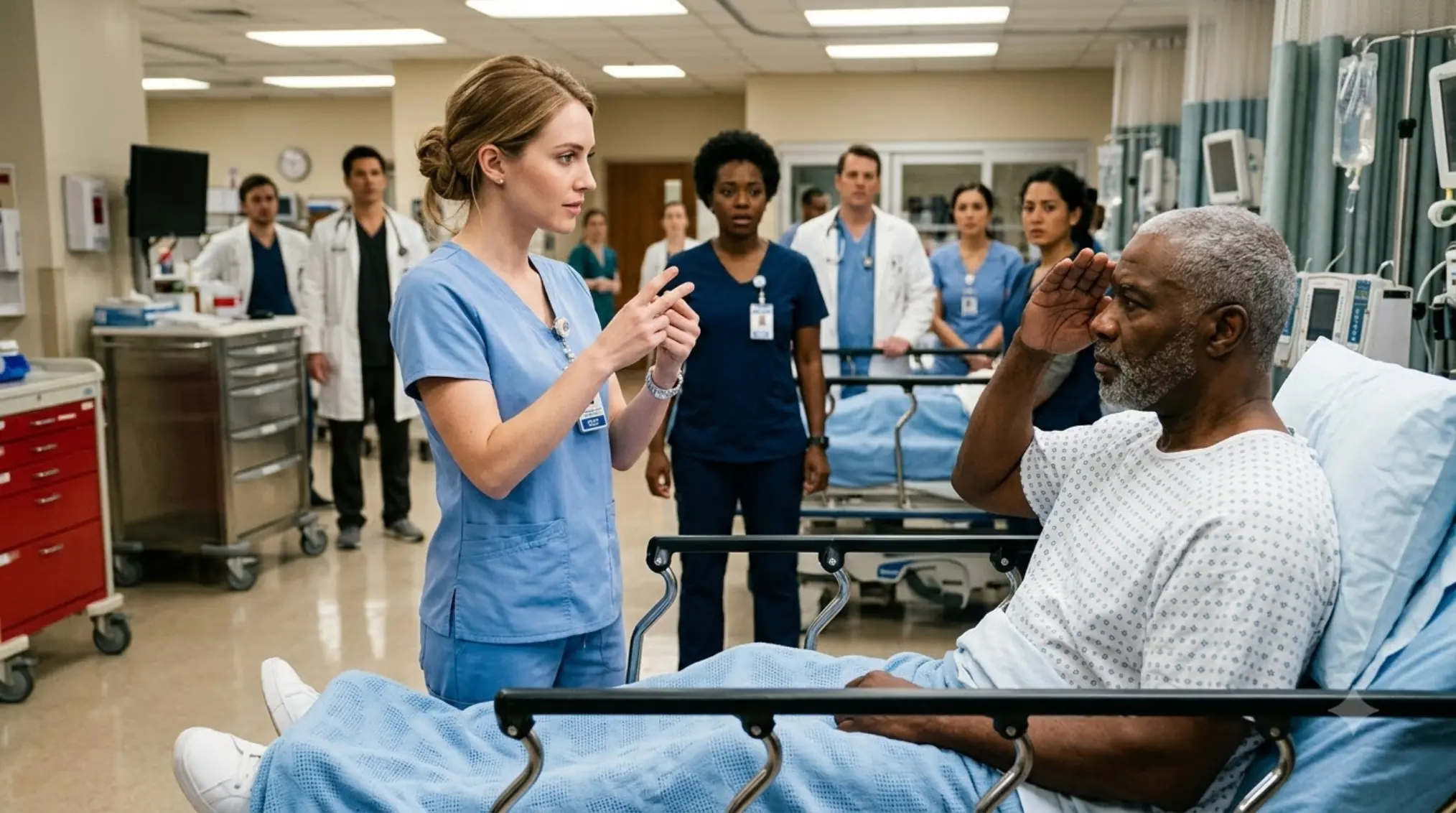
Denise was forty-eight, sharp-eyed, exhausted, and carrying the expression of someone who had already solved twenty problems before breakfast and expected twenty more before lunch.
“Fair warning,” Denise added. “He doesn’t cooperate, doesn’t answer questions, and nearly knocked an aide down yesterday. Three nurses have already asked to be reassigned.”
Two staff members standing beside the medication cart exchanged a glance.
One whispered, not quite quietly enough, “Four days here and they’re giving her that room?”
The other smirked.
“Let the new girl learn.”
Emma heard them.
She said nothing.
At twenty-nine, Emma was extraordinarily beautiful in a way that caused people to underestimate how quickly she noticed things. She had luminous blue eyes, flawless fair skin, delicate features, and honey-blonde hair pinned into a loose bun above the collar of her light-blue scrubs.
She looked gentle.
And she was.
But gentle had never meant careless.
Emma picked up the tablet.
“What does ‘doesn’t cooperate’ mean?”
Denise exhaled.
“He refuses vitals unless somebody forces the issue. Won’t answer questions. Pulls away when staff touch him. Yesterday he nearly tore out his IV when someone approached from behind.”
Emma looked at the chart.
“Has he spoken at all?”
“No.”
“Has anyone documented whether he can hear?”
Denise stopped.
Only for a second.
Then she glanced toward the screen.
“Nothing in the admission note.”
Emma continued reading.
Harlan Voss. Age 63. Found disoriented in a parking structure three nights earlier. Confused. Aggressive during transport. Resistant to examination. Non-compliant.
The same words appeared repeatedly.
Combative.
Uncooperative.
Refuses instructions.
Emma scrolled backward.
Then forward.
No hearing assessment.
No detailed neurological history.
No explanation for why a man who apparently understood nothing being said to him had been treated as though refusing to answer was a personality flaw.
Emma handed the second tablet back to Denise.
“I’ll take him.”
The aide near the medication cart chuckled.
“Good luck.”
Emma looked at him.
“I’m not planning to fight him.”
The aide shrugged.
“He might have different plans.”
Emma walked away.
Room fourteen was at the far end of the emergency observation wing.
Emma stopped outside the doorway before entering.
Through the glass she saw Harlan Voss sitting upright beneath a blue hospital blanket.
He was a powerful Black man in his early sixties with short gray hair, a neatly trimmed gray beard, broad shoulders, and a face carved by years of discipline and exhaustion. One wrist was wrapped from an injury sustained before admission, and several adhesive pads from earlier monitoring remained stuck against his chest.
His eyes moved constantly.
Door.
Window.
Monitor.
Hallway.
Every person who passed.
Emma watched him for perhaps five seconds.
Then she understood the first part of the problem.
A technician entered before Emma did.
The technician approached Harlan from his left side while looking down at a blood-pressure cuff.
“Mr. Voss, I need your arm.”
Harlan did not react.
The technician stepped closer.
“Sir.”
Nothing.
He grabbed Harlan’s wrist.
Harlan jerked violently and shoved the hand away.
The technician retreated.
“See?” he muttered.
Emma stepped inside.
“Give me a minute.”
The technician looked relieved.
“Be my guest.”
He left.
Emma did not approach the bed.
She stood six feet away.
Harlan’s eyes found her immediately.
Emma kept both hands visible.
No tablet held against her chest.
No equipment.
No sudden movement.
She raised one hand slowly.
Harlan watched.
Emma pointed toward him.
Then toward her own ear.
Then shook her head slightly.
Harlan’s eyes narrowed.
Emma tried something she had not used regularly in years.
American Sign Language.
Her hands were rusty.
The first motion came awkwardly.
She corrected herself.
Then asked:
Are you in pain?
Harlan became completely still.
Emma held the question.
She did not repeat it.
Did not walk closer.
Did not fill the silence.
His eyes moved from her hands to her face.
Then something extraordinary happened.
Harlan straightened.
His shoulders squared.
His entire posture changed from defensive patient to disciplined professional.
Slowly, he raised his right hand toward his forehead in a sharp formal salute.
Through the doorway window, Denise Okafor stopped walking.
The stack of papers in her hand lowered slightly.
She stared into the room.
The man three nurses had described as impossible had just responded to the newest nurse on the floor within thirty seconds.
Emma lowered her hands.
Then signed:
Thank you.
Harlan’s face softened.
Barely.
But enough.
Emma reached for the whiteboard hanging beside the bed.
She wrote in large letters:
CAN YOU HEAR ME?
Harlan shook his head.
Emma wrote:
ANY HEARING?
He held up two fingers very close together.
Very little.
Emma looked toward the observation window.
Denise was still standing there.
Emma turned the board around and wrote:
HOW LONG?
Harlan thought.
Then took the marker himself.
16 YEARS.
Emma stared at the number.
Then at his chart sitting on the counter.
Three days.
Three days in a hospital.
Three days of staff documenting silence as refusal.
Nobody had asked the most basic question.
Emma spent the next thirty minutes learning more about Harlan than the existing chart contained.
He had severe hearing loss.
He also had a history of neurological trauma from a blast during an earlier public-safety assignment overseas, though the exact details were less important than what the injury had done.
Memory disruptions.
Sensory overload.
Occasional disorientation.
Difficulty processing sudden movement.
Harlan could read lips somewhat, but not reliably.
He knew limited sign language.
Emma knew limited sign language too.
Between the whiteboard, slow gestures, writing, and patience, they managed.
What staff had called “combative” began making sense.
People approached from behind.
He did not hear them.
They touched him suddenly.
His body reacted defensively.
Staff interpreted that reaction as aggression.
So more people surrounded him.
That increased his confusion.
Then restraint followed.
The cycle fed itself.
Emma wrote:
PARKING LOT?
Harlan stared at the board.
Then drew a crude rectangle.
A car.
He pointed outside.
Then made a confused circular gesture.
Emma understood slowly.
“You couldn’t find your car?”
Harlan watched her mouth.
She repeated the sentence more slowly.
He nodded.
Emma wrote:
POLICE?
Harlan nodded.
He mimed someone grabbing him.
Then two hands closing around his wrists.
Emma felt something cold move through her chest.
Not anger at the officers.
Not yet.
Frustration at how easily a frightened person could become “dangerous” when nobody understood what they were experiencing.
She finished the conversation, checked his injured wrist with permission first, and walked directly back toward the nurses’ station.
Denise looked up.
Emma placed the tablet down.
“He’s severely hearing-impaired.”
The entire station became quiet.
Denise frowned.
“What?”
“He can’t hear most normal speech.”
“You’re sure?”
“He told me.”
“How?”
Emma raised both hands.
“Sign. Writing. Lip reading.”
One of the aides stared.
“He knows sign language?”
“A little.”
Emma’s voice sharpened.
“Enough that someone should have tried communicating with him before calling him combative.”
Denise looked toward room fourteen.
“We didn't know.”
“That’s the problem.”
Denise looked back.
Emma continued.
“He also has a neurological injury that makes sudden sensory confusion worse. Every time somebody comes up behind him and grabs him, you’re creating exactly the response everyone is complaining about.”
A physician nearby looked over.
“What neurological injury?”
Emma handed him the tablet.
“The one nobody asked about.”
The physician read Emma’s note.
Then read it again.
“We need neurology.”
“Yes.”
“And audiology.”
“Yes.”
He looked toward Denise.
“Why isn't this already in the record?”
Denise bristled slightly.
“He came in confused and aggressive. The intake team was trying to stabilize him.”
Emma understood the defensive reaction.
She did not attack it.
“Then we correct it now.”
Denise looked at her.
The challenge dissolved.
“Write the consult requests.”
“I already did.”
That almost made the physician smile.
Emma returned to Harlan’s room.
Over the following day, the change was immediate.
Staff stopped touching him without warning.
A sign was placed beside his bed:
HEARING IMPAIRED — APPROACH WITHIN VISUAL FIELD.
A communication board appeared.
Emma taught two nurses several basic signs.
Pain.
Water.
Bathroom.
Wait.
Doctor.
Safe.
Harlan’s so-called aggression nearly disappeared.
He still looked intimidating.
He was still stubborn.
He still refused things he did not want.
But refusal was not the same as confusion.
Once he understood what staff were asking, he became remarkably cooperative.
That difference embarrassed several people.
Nobody more than Denise.
She entered room fourteen late that afternoon and stood where Harlan could see her.
She pointed toward herself.
Then wrote:
I’M DENISE. CHARGE NURSE.
Harlan read it.
Denise continued writing.
WE SHOULD HAVE UNDERSTOOD SOONER.
Harlan looked at her.
Then nodded once.
Denise added:
I’M SORRY.
Harlan read the sentence longer than the others.
Finally he wrote:
NOW YOU KNOW.
Denise gave a small smile.
“Yes.”
He could not hear the word.
But he read her lips.
The following afternoon changed everything again.
The hospital intercom malfunctioned.
A sharp electronic feedback burst through every speaker on the floor.
People jumped.
Monitors beeped.
A series of red emergency indicators began flashing in several rooms.
Harlan could not hear the noise.
He could see everyone reacting to something invisible.
Nurses suddenly ran.
Lights flashed.
An aide rushed into his room.
Harlan’s body reacted before his mind could understand why.
He threw back the blanket.
His IV line pulled tight.
The aide reached for him.
Harlan shoved the hand away.
Another aide entered.
“Sir, calm down!”
Useless.
He could not hear.
Both aides moved toward his arms.
Emma came around the corner.
“Stop!”
Her voice cut through the chaos.
The aides froze.
“Back away.”
“He's going to pull the line.”
“Back away.”
Something in Emma’s tone ended the argument.
She entered Harlan’s visual field.
Then dropped into a crouch several feet away.
Harlan’s eyes found her.
Wild.
Confused.
Breathing hard.
Emma raised both hands.
One sign.
Safe.
Again.
Safe.
Harlan stared.
Emma repeated it.
Slowly.
No rushing toward him.
No restraint.
No grabbing.
His breathing remained fast.
Then slightly slower.
Emma pointed toward herself.
Then toward him.
Safe.
The emergency lights stopped flashing.
Harlan looked upward.
Then toward Emma.
The room became visually still again.
His hands lowered.
He sat on the bed.
Emma waited another thirty seconds before moving.
Then she approached.
Harlan nodded permission.
Only then did she touch his forearm.
Denise stood in the doorway.
Behind her were two physicians, three nurses, and the aides who had nearly restrained him.
Nobody spoke.
Denise looked at Emma.
“What do you need?”
Emma stood.
“His chart fixed.”
Denise nodded.
“Done.”
“No. Completely.”
Emma pointed toward the computer.
“Remove ‘combative.’ Remove ‘non-compliant.’ Replace it with what’s actually happening.”
Denise listened.
“Severe hearing loss. Communication barrier. Neurological injury. Sensory disorientation. Staff must approach visually and explain before touching.”
Denise nodded.
“What else?”
“A real interpreter.”
“We can request one.”
“Not request. Get one.”
Denise studied the beautiful young nurse standing beside the patient everyone else had given up on.
Then said:
“I’ll make the call myself.”
Audiology arrived that evening.
The results were worse than anyone expected.
Harlan had profound hearing loss in one ear and severe impairment in the other.
The audiologist looked genuinely frustrated.
“With appropriate devices, he could regain meaningful functional hearing.”
Emma frowned.
“How long has this been possible?”
The audiologist checked the history.
“Years.”
Emma looked toward Harlan.
He was watching their faces.
She wrote the explanation carefully on the board.
Harlan read it.
Then looked away.
Not angry.
Something more painful.
Sixteen years.
Sixteen years of misunderstanding.
Meetings he could barely follow.
People believing he ignored them.
Neighbors assuming he was rude.
Medical appointments where he nodded instead of admitting he had not understood half the conversation.
Years of isolation that might have been reduced with proper care.
Emma sat beside him.
He wrote:
MY WIFE USED TO REPEAT EVERYTHING.
Emma waited.
Harlan continued.
SHE DIED 11 YEARS AGO.
That explained another piece.
After his wife died, there had been no one left to fill the gaps.
No one standing beside him quietly repeating words.
No one noticing when he misunderstood.
No one interpreting the world.
Emma wrote:
YOU SHOULDN’T HAVE NEEDED ONE PERSON TO DO ALL OF THAT.
Harlan read it.
Then gave a sad smile.
The neurology consult confirmed long-standing effects from an old traumatic brain injury.
The doctor explained that hearing loss and neurological damage were amplifying each other.
Confusion produced stress.
Stress worsened cognition.
Poor hearing made orientation harder.
Isolation made everything worse.
The parking-lot episode was not random aggression.
Harlan had become disoriented while searching for his vehicle after the garage’s entrance configuration had changed.
He could not understand the security officer trying to direct him.
The confrontation escalated.
Then police arrived.
Again, nobody realized he could barely hear.
Harlan eventually stopped trying to explain.
Emma understood that choice.
Sometimes silence was not refusal.
Sometimes it was exhaustion.
Denise found Emma alone near the nurses’ station late that night.
“You've done this before.”
Emma looked up.
“Done what?”
“Seen someone everyone else misread.”
Emma went still.
Denise waited.
Emma finally said, “Yes.”
“Patient?”
“A long time ago.”
“What happened?”
Emma looked toward room fourteen.
“We were right about what was wrong.”
Denise sensed the rest.
“But?”
“Nobody listened fast enough.”
Denise did not ask for more.
“Is that why you fought this hard?”
Emma answered quietly.
“I wasn't going to watch it happen twice.”
Harlan’s condition improved rapidly once the hospital stopped fighting symptoms it had misunderstood.
He slept.
Ate.
Participated in evaluations.
Accepted treatment.
By the end of the week, he had been fitted temporarily with an assistive hearing device while permanent options were arranged.
The first time the device activated, Emma stood across from him.
“Can you hear me?”
Harlan frowned.
Emma repeated, slightly louder.
“Can you hear me?”
His eyes widened.
Not perfect.
Not clear.
But something.
He nodded.
Emma smiled.
Harlan touched the device.
Then looked toward the hallway.
A cart rolled past.
He turned toward the sound.
His face changed.
Emma realized he was hearing wheels.
Something ordinary.
A sound most people would find irritating.
Harlan looked almost overwhelmed.
Then someone laughed several rooms away.
His head turned.
He heard that too.
Harlan closed his eyes.
Emma remained silent.
This moment belonged to him.
Getting him medically stable was not enough.
Emma knew where the next failure waited.
Discharge.
Send him back to an empty apartment with new equipment, complicated instructions, and no structured support, and eventually the cycle could begin again.
So Emma started calling programs.
Rehabilitation services.
Neurological support.
Hearing specialists.
Community assistance.
The first three calls went nowhere.
The fourth transferred her twice.
The fifth disconnected.
The sixth person actually listened.
A rehabilitation center outside the city specialized in neurological recovery combined with communication support.
Emma sent the records.
Called again.
Then again.
A social worker eventually said:
“We may have a place.”
Emma smiled for the first time all morning.
“May?”
“I’ll know tomorrow.”
“Call me either way.”
The next morning the placement was approved.
Emma brought the paperwork to Harlan.
He read it.
Then looked at her.
WHY?
She understood.
Why had she done all this?
Emma sat.
For several seconds she considered lying.
Professional responsibility.
Patient advocacy.
Standard care.
All technically true.
None complete.
She took the marker.
BECAUSE SOMEONE LIKE YOU NEEDED HELP ONCE.
Harlan waited.
Emma wrote more.
I SAW THE PROBLEM. OTHER PEOPLE DIDN’T LISTEN.
Another line.
HE DIDN’T GET A SECOND CHANCE.
Harlan’s expression changed.
Emma stared at the board.
Then finally wrote:
YOU DID.
For a long time, Harlan said nothing.
Then he reached across the bed.
Placed his large hand gently over hers.
No salute.
No grand gesture.
Just acknowledgment.
Emma looked down at their hands.
Something she had carried for years shifted slightly.
Not gone.
Grief did not work that way.
But shifted.
Enough.
Harlan left the hospital nine days after Emma first walked into room fourteen.
No reporters.
No ceremony.
No crowd.
He wore ordinary dark trousers, a blue shirt, and a charcoal coat.
His new hearing equipment had arrived that morning.
An interpreter stood nearby.
Denise came to say goodbye.
So did two aides.
Even Corey, the employee who had joked about Emma learning “the hard way,” appeared awkwardly at the door.
“Sir,” Corey said slowly, making sure Harlan could see him. “I’m sorry about the first day.”
Harlan watched his mouth.
Then nodded.
“Do better next time.”
His speech was rough but understandable.
Corey nodded.
“I will.”
Harlan turned toward Emma.
The room became quiet.
He raised his hands.
His signing was slow.
Emma followed.
YOU ASKED ME BEFORE YOU TOUCHED ME.
She swallowed.
He continued.
THAT SHOULDN’T BE SPECIAL.
Emma nodded.
“No.”
Harlan’s eyes softened.
BUT IT WAS.
He lifted his right hand.
The familiar salute.
Sharp.
Controlled.
This time Emma understood exactly what it meant.
Not hierarchy.
Not rank.
Respect.
She raised her hand slightly in acknowledgment.
Harlan lowered his.
Then walked through the door.
Six weeks later, a letter arrived.
Emma almost missed it beneath scheduling notices and administrative paperwork.
Her name was handwritten on the envelope.
She recognized Harlan’s careful lettering immediately.
The note was short.
He had received permanent hearing devices.
He was attending neurological rehabilitation three times a week.
He had begun formal sign-language lessons.
The rehabilitation center paired him with another older man who loved fishing.
Harlan said they disagreed about almost everything except coffee.
Then came the final sentence.
Emma read it twice.
I finally feel heard.
She folded the letter.
Placed it inside the top drawer of her locker.
Beside another old piece of paper she rarely looked at anymore.
The report involving the patient she had failed to save years earlier.
For a long time that report had represented everything she could not change.
Now Harlan’s letter sat beside it.
Not replacing it.
Nothing could.
But answering it.
Proof that sometimes recognition could arrive early enough.
Sometimes asking the correct question could change the ending.
Sometimes the person labeled difficult was simply tired of surviving inside a world that refused to communicate with them.
And sometimes all it took to begin fixing everything was one nurse standing six feet away with her hands visible, looking directly at a man everyone else had already judged, and asking:
Are you in pain?
Harlan had answered with a salute.
The hospital had seen a miracle.
Emma knew better.
It was not a miracle.
It was what happened when somebody finally listened.