By noon, three recovery trucks had failed.
By two in the afternoon, the road shoulder looked like a machinery exhibition staged inside a mud pit.
By four, everyone had stopped offering useful suggestions.
The grain truck had not moved more than a few inches.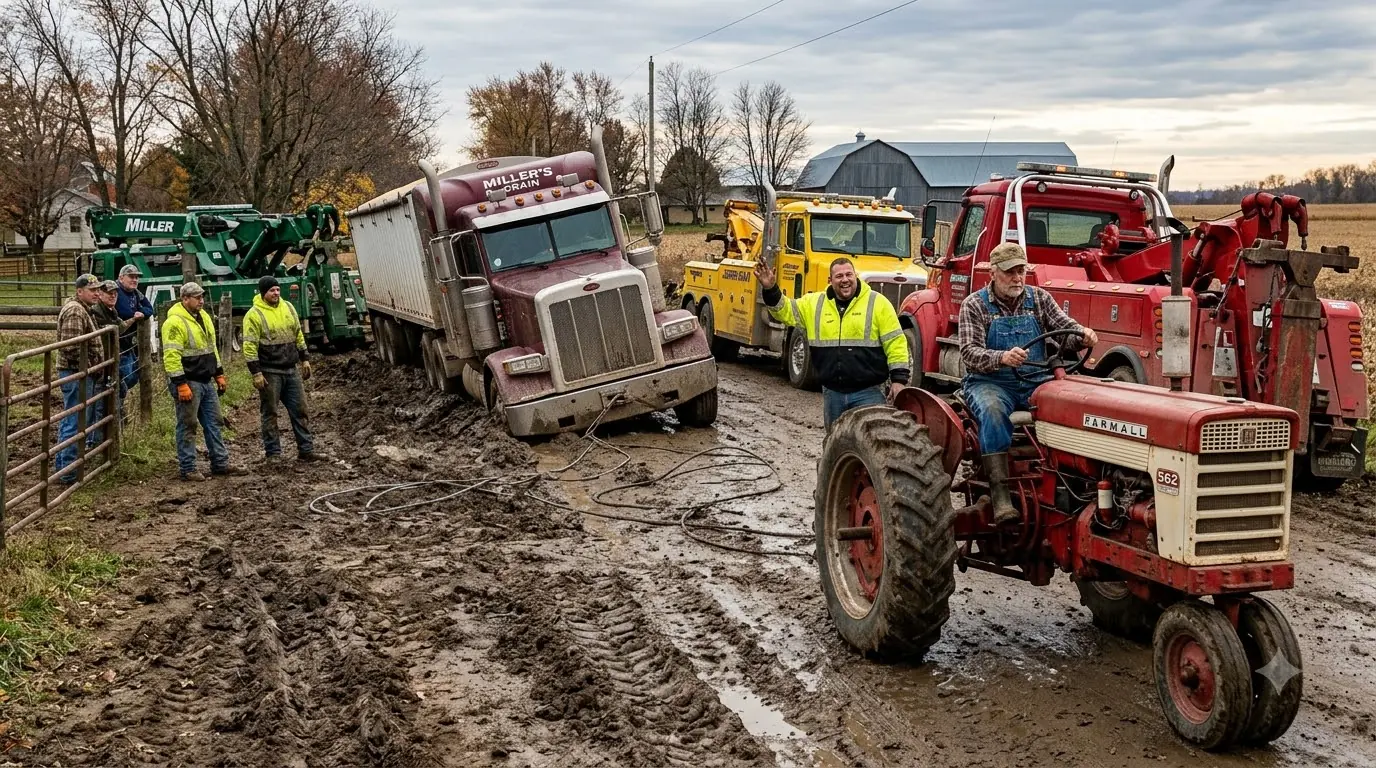
It sat tilted beside a narrow county road somewhere in the American Midwest, its right-side wheels buried deep in black autumn mud and its heavy grain box loaded almost to the top.
Rain had fallen for two straight days.
The drainage ditch beside the road had overflowed into the soft shoulder, turning what normally looked like firm ground into a deep, sticky trap.
The grain truck driver had known better than to get too close.
He had done it anyway.
A pickup had approached from the opposite direction that morning.
The county road was narrow.
The grain truck driver moved right to give the pickup more space.
His front tire touched the shoulder.
For one second, nothing happened.
Then the earth gave way.
The truck leaned.
The driver tried easing back toward the pavement.
The rear wheels spun.
Mud sprayed.
The truck sank deeper.
By the time he stopped, the passenger-side wheels were almost buried to the hubs.
The driver climbed down and stared.
He knew immediately that this was no longer a problem he could solve alone.
He called a local recovery company.
A large recovery truck arrived less than an hour later.
The recovery supervisor stepped out wearing heavy work boots, dark coveralls, and the expression of a man who had seen every kind of stuck vehicle the county could produce.
He walked around the grain truck once.
Then again.
He looked at the mud.
The weight.
The angle.
The road.
The ditch.
“No problem,” he said.
The grain truck driver felt relief.
The first attempt changed that.
The recovery truck strained.
The line tightened.
The grain truck rocked.
Its engine growled.
Mud shifted beneath the buried tires.
But the truck did not climb out.
They reset.
Tried again.
Nothing.
The recovery supervisor stopped smiling.
A second recovery truck was called.
Then a third.
By midday, nearly half the farming community seemed to know what was happening.
A pickup stopped.
Then another.
Farmers leaned against fences.
Neighbors parked along the road.
A county worker arrived to help control traffic.
Someone brought coffee.
Someone else brought sandwiches.
Children returning from school later in the afternoon convinced their parents to slow down so they could stare at the enormous grain truck stuck in the mud.
The recovery supervisor hated the audience.
Every failed attempt made the crowd larger.
Every new truck made the expectation greater.
The second recovery operator inspected the situation.
“How much grain?”
The driver told him.
The operator whistled.
“Should’ve unloaded first.”
The driver looked toward the grain box.
“With what?”
Nobody had an answer.
There was no convenient auger.
No second truck positioned nearby.
No dry area beside the shoulder where unloading could happen safely.
The recovery crews decided power was the answer.
More power.
Better angles.
Different equipment.
Patience.
They tried again.
The first recovery truck pulled.
The second assisted.
The grain truck rocked.
Mud boiled beneath one rear tire.
The engine roared.
Then everything stopped.
Someone in the crowd said:
“Thought those big trucks could pull anything.”
The recovery supervisor heard him.
He pretended not to.
They tried from another position.
Again, the line tightened.
Again, the grain truck seemed to resist with a stubbornness almost unnatural.
It would move slightly.
Then settle back.
The recovery supervisor wiped mud from his gloves.
“What’s holding that thing?”
The driver shrugged.
“Weight.”
The supervisor looked toward him.
“No kidding.”
By the fourth hour, frustration had changed the atmosphere.
This was no longer an ordinary recovery job.
It had become personal.
The recovery supervisor had built a reputation over twenty years.
He had moved overturned delivery trucks.
Farm machinery.
Loaded trailers.
Vehicles trapped in snow.
Vehicles trapped in ditches.
Vehicles that people swore could never be recovered without a crane.
He took pride in difficult jobs.
He enjoyed them.
Usually.
But this grain truck had become embarrassing.
A farmer standing near a fence called out:
“Maybe it likes the ditch.”
The crowd laughed.
The supervisor turned.
“You want to try?”
The farmer raised both hands.
“Nope.”
More laughter.
The supervisor returned to the truck.
One of his younger operators whispered:
“We should stop.”
The supervisor frowned.
“What?”
“Ground’s getting worse.”
He looked.
The operator was right.
Repeated attempts had churned the soil.
The shoulder was becoming softer.
Every pull disturbed more mud.
The recovery trucks themselves needed to stay on firm pavement now.
The supervisor looked toward the sky.
Clouds were returning.
More rain might arrive before evening.
He hated the idea of leaving.
But he hated the idea of damaging something more.
The grain truck driver climbed down again.
“What now?”
The supervisor stared at the truck.
“We wait.”
“For?”
“I don’t know.”
That answer traveled through the crowd.
People began leaving.
Some had chores.
Some needed to feed cattle.
Some had simply become bored watching expensive machines fail.
By late afternoon, the audience had shrunk to maybe a dozen people.
The grain truck remained exactly where it had been that morning.
One rear tire almost completely hidden.
The front wheel turned slightly toward the road.
Mud packed around the undercarriage.
The driver sat on the running board drinking cold coffee.
The recovery supervisor stood beside his largest truck.
His coveralls were streaked brown.
His face looked tired.
Then someone heard an engine.
Not a diesel recovery truck.
Not a pickup.
Something slower.
Older.
The sound came from beyond the curve.
A steady mechanical rhythm.
One of the farmers looked down the road.
“You’ve got to be kidding.”
Around the bend came a faded red tractor.
A 1962 Farmall.
Its paint had dulled from decades of sun.
The hood showed scratches.
One fender carried an old dent.
The rear tires were large but clearly used.
The exhaust sent a thin dark puff into the cool afternoon air.
And sitting behind the steering wheel was a 72-year-old farmer.
He wore denim overalls over a faded plaid work shirt.
A brown canvas cap sat low over gray hair.
His face was lined deeply by sun, wind, and years outdoors.
He drove slowly toward the scene.
The recovery supervisor stared.
The farmer brought the tractor to a stop near the edge of the crowd.
Shut it down.
Climbed off carefully.
The first person to laugh was a younger recovery operator.
Not cruelly.
More from disbelief.
“That your backup unit?”
A few people smiled.
The old farmer looked toward him.
“No.”
He walked past.
The supervisor folded his arms.
“What are you doing?”
The old farmer looked at the grain truck.
“Looking.”
The supervisor glanced at the Farmall.
“You planning to pull that truck out with that?”
“Maybe.”
That produced actual laughter.
One farmer slapped another on the shoulder.
The younger recovery operator grinned.
“Three recovery trucks couldn’t move it.”
The old farmer nodded.
“I saw.”