By the sixth hour, Derek Collins had stopped blaming the mud and started blaming everyone around him.
Three heavy-recovery trucks occupied nearly half of County Road 7 in rural Iowa, their red-and-black bodies streaked with rain, clay, and diesel grime. Warning lights flashed against a low gray sky while workers dragged chains, repositioned cables, checked anchors, and shouted over idling engines. Twenty feet below the shoulder, a loaded silver tanker leaned heavily into the ditch, its wheels buried so deeply in black Iowa mud that only the upper halves of several tires remained visible.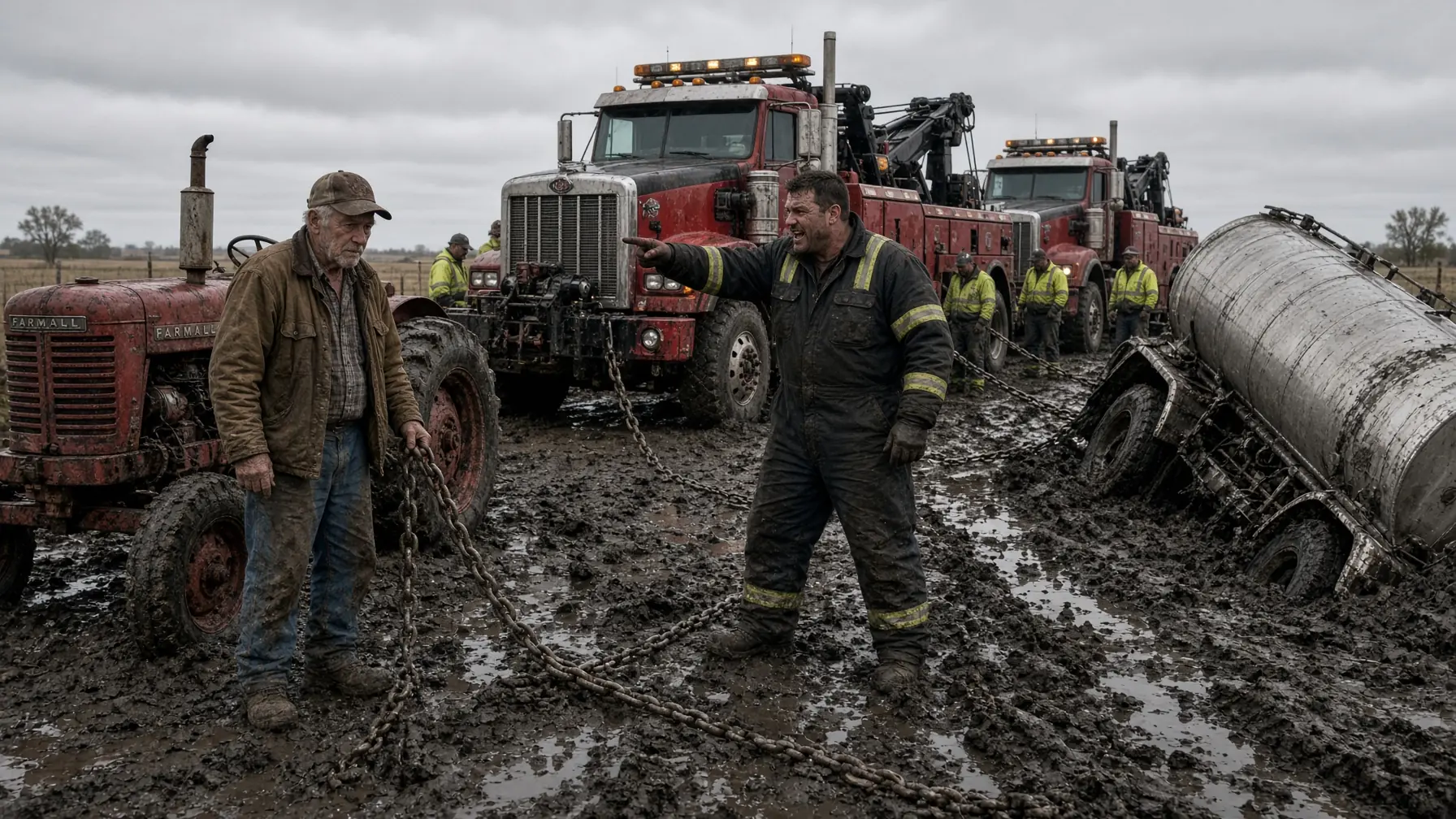
Derek stood beside the largest wrecker with both hands on his hips.
“Again.”
One of his operators stared at him.
“Boss, we already tried that angle.”
“I said again.”
The operator glanced toward the tanker.
“The ground under truck two is starting to move.”
Derek’s jaw tightened.
He was forty-three, broad through the shoulders, with short dark hair, a grease-streaked face, and the confidence of a man who had spent twenty years being called whenever something enormous needed to move. His company, Bulldog Heavy Recovery, owned equipment worth more than most houses in the county. Their flagship rotator could lift loaded semitrailers, buses, farm equipment, and construction machinery.
Today, none of that seemed to matter.
Derek pointed toward a steel anchor buried near the opposite shoulder.
“Reset the line.”
Nobody moved immediately.
That irritated him more.
“Did everyone suddenly forget how to work?”
A younger recovery operator named Mason Reed finally spoke.
“We’re not forgetting. We’re telling you the tanker is digging deeper every time we pull straight up the embankment.”
Derek walked toward him.
“And what do you suggest?”
Mason looked at the muddy ditch.
“Different approach.”
“What different approach?”
“I don’t know yet.”
Derek laughed without humor.
“Then reset the line.”
The crew obeyed.
Across the road, a seventy-two-year-old farmer watched silently.
His name was Earl Hutchins.
Nobody from Bulldog Heavy Recovery had asked him to be there.
Technically, the accident had happened along the southern edge of his property, where County Road 7 bordered a soybean field Earl’s family had farmed for nearly eighty years. The tanker driver had lost traction early that morning during freezing rain, drifted off the shoulder, and settled into the ditch without overturning.
The driver was unharmed.
The tanker was stable.
The problem was getting forty tons of truck, trailer, and cargo back onto solid ground without making things worse.
Earl arrived around eight carrying coffee.
At first, Derek assumed the farmer was merely curious.
Six hours later, Earl was still there.
He wore a battered brown cap, a mud-stained canvas jacket over an old plaid shirt, faded jeans, and work boots that looked older than half Derek’s crew. Gray stubble covered his jaw, and every exposed inch of skin looked weathered by decades of wind and sun.
Beside him sat a faded red 1962 Farmall tractor.
Derek noticed it every time he turned around.
Eventually, annoyance got the better of him.
“You planning to watch all day?”
Earl looked toward him.
“Probably not.”
Derek nodded at the Farmall.
“That thing still runs?”
“Most days.”
Several crew members smiled.
Derek did too.
Then another recovery attempt began.
The three wreckers tightened their lines.
Steel cables drew straight.
Engines climbed.
Mud churned beneath the tanker.
For several seconds, the huge trailer shifted.
Then stopped.
The front recovery truck slid backward almost eight inches.
Mason immediately raised his hand.
“Stop!”
The operators backed off.
The tanker settled deeper.
Derek swore beneath his breath.
Earl removed his cap and scratched his head.
“You’re making a hole.”
Derek turned.
“What?”
“The more you pull from there, the deeper she’ll settle.”
Derek stared at the old farmer.
“With all due respect, sir, we do this professionally.”
Earl nodded.
“I figured from the logos.”
A few workers tried hiding smiles.
Derek pointed toward the tanker.
“You ever recover a loaded commercial tanker?”
“No.”
“Operate a sixty-ton rotator?”
“No.”
“Run synchronized recovery lines?”
“No.”
Derek spread his arms.
“Then maybe let us work.”
Earl put his cap back on.
“All right.”
He turned toward his tractor.
Derek should have let the conversation end.
Instead he noticed the chain hanging from Earl’s hand.
“What are you doing with that?”
Earl looked down.
“Thought I might pull it out.”
Silence.
Then Derek laughed.
Not a chuckle.
A full laugh.
Several workers joined him.
Earl waited.
Derek pointed toward the faded Farmall.
“Three hundred-thousand-dollar wreckers couldn’t move that tanker, old man. Your museum tractor won’t even tighten the chain.”
Earl’s expression did not change.
“Your trucks aren’t weak.”
“Glad we agree.”
“You’ve just been pulling from the wrong angle for six hours.”
The laughter stopped.
Derek stepped closer.
“What did you say?”
Earl pointed toward the ditch.
“You’re treating that field edge like ordinary ground.”
“It is ordinary ground.”
“No.”
Earl looked past him toward the muddy embankment.
“That ditch was moved in 1978.”
Derek frowned.
“What?”
“My father and I dug the original drainage line twenty feet farther east. County widened the road and filled part of it.”
He pointed toward the tanker’s rear axle.
“Under that mud is an old gravel drainage bed.”
Mason walked closer.
“How deep?”
“Depends where you stand.”
Earl pointed toward the rear wheels.
“Right there? Maybe fourteen inches.”
Then forward.
“Under the tractor cab, more like three feet of packed clay over old fill.”
Derek stared.
“And?”
“And your lines are lifting the heavy end into the softest section while dragging the wheels against the bank.”
Mason looked toward the tanker again.
Earl continued.
“You need the wheels moving along the old drainage bed first.”
Derek crossed his arms.
“And your Farmall is going to do that?”
“No.”
Earl lifted the chain.
“Gravity is.”
That got everyone’s attention.
Derek shook his head.
“I don’t have time for riddles.”
Earl walked toward the ditch.
Mason followed.
After a moment, Derek did too.
Earl pointed at the tanker’s angle.
“See how the trailer sits?”
“Yes.”
“Rear wheels are lower than the tractor.”
“Obviously.”
“You keep pulling toward the road.”
“That is where we need it.”
“Eventually.”
Earl drew a line in the mud with his boot.
“First you need to move the rear about six feet south.”
Derek stared.
“Deeper into the ditch?”
“Sideways.”
“That makes no sense.”
“It does if you know what’s under it.”
Earl pointed toward a narrow rise in the field.
“There’s hard gravel beneath that strip. Always has been. Water used to drain through there before the county changed everything.”
Mason studied the ground.
“If we move the trailer sideways first…”
“The rear wheels get out of the suction.”
Derek looked between them.
“Using what?”
Earl nodded toward the Farmall.
Mason almost smiled.
Derek did not.
“You’re serious.”
“Usually.”
“You want to attach your tractor to forty tons?”
“No.”
Earl shook his head.
“I want my tractor pulling one line to change the direction while your wreckers handle the weight.”