Walter Hayes was seventy-two years old when Cody Wrench and two younger men walked into Hayes Corner Cafe on a rainy Tuesday night and decided that being old, alone, and quiet made him an easy target.
They were wrong, but Walter understood something they did not: sometimes consequences arrive slowly, then all at once.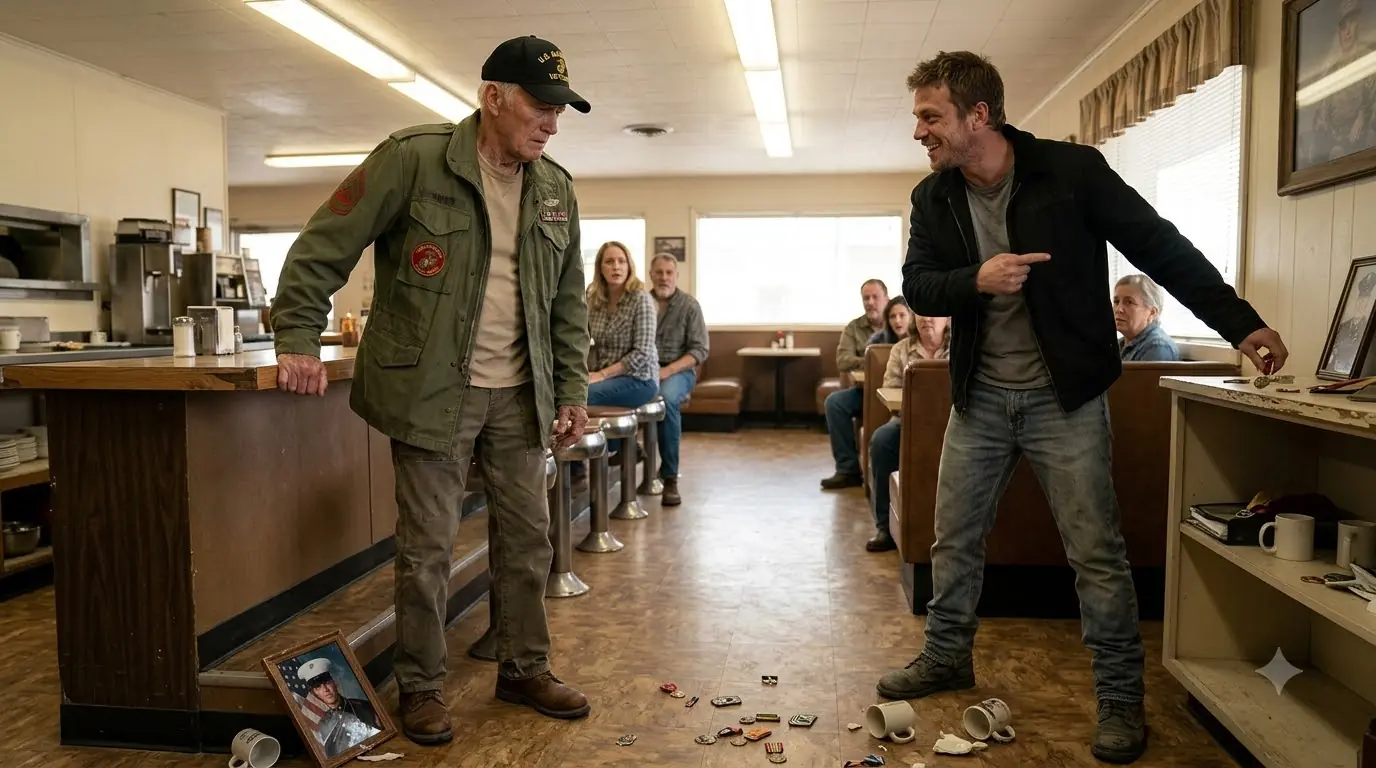
Hayes Corner Cafe sat off Highway 93 in Nevada, a place too ordinary to appear in any travel guide and too dependable to need one. Walter had opened it twenty years earlier, not because he wanted attention, but because after a lifetime of noise he wanted one place where people could sit, eat, and leave a little less burdened than when they arrived.
He had served in the United States Marine Corps and had completed two tours in places he rarely discussed. A piece of shrapnel had left a permanent pull in his left leg, and cold desert mornings still sent a dull line of pain from below his knee into his hip.
Walter had learned to treat pain as proof that he was still alive. His hair had gone fully white years earlier, his hands were broad and scarred from military service, engine work, and two decades of running a diner, and his gray eyes carried the quiet of a man who had already seen the worst thing that could happen and had chosen to keep moving.
The diner seated twenty-two people when every table was full. Four booths lined the front window, six tables filled the center, and eight stools faced the counter where Walter worked from five in the morning until nine at night.
The walls held things that mattered rather than things chosen to decorate. A photograph of Walter's Marine unit from 1974 hung in a plain black frame, and above the coffee station was a hand-lettered sign that read, “We don't close when it's hard.
We close at 9:00.”
Near the entrance stood a small shelf holding seven military medals. None belonged to Walter; each belonged to a man who had died and who had mattered to him in a way that ordinary language could not carry.
Walter looked at those medals every morning when he unlocked the diner and every night before he locked it again. Regular customers knew not to ask directly, because if they stayed long enough and proved they could hold the weight of the stories, Walter would eventually tell them who the men had been.
He fed people with food, but that was only part of what he offered. Hayes Corner Cafe gave tired people a place that felt as though it had always been there and intended to remain.
On that Tuesday in late October, desert rain came sideways across the flats and wind found every gap in the doorframe. Seven customers were inside when the trouble began.
Donna Briggs, sixty-one, a mail carrier who stopped in three evenings a week, sat in her usual booth with vegetable soup, cornbread, and a paperback novel. Carl and Melinda Pacheco occupied the middle booth, quietly debating for the sixth month in a row whether their daughter's boyfriend was good enough for her.
Two truckers Walter recognized from regular highway runs sat at the counter finishing pot roast without conversation. At the corner table, seventeen-year-old Marcus Teal ate pie with his headphones in, carrying the grief of a mother he had recently lost and unaware that Walter had begun charging him only for the coffee because the boy's father worked two jobs and money was tight.
At 7:43 p.m., the door opened and three young men entered. Walter registered them with the kind of attention learned by anyone who has spent enough time around danger: not fear, not prejudice, simply recognition that the room had changed.
The tallest was Cody Wrench, a lean, loud man in his late twenties who had discovered early in life that intimidation often worked. Beside him stood his shorter, thick-necked cousin Derek, while nineteen-year-old Tyler Greer hung a step behind with uncertainty in his eyes.
They did not sit down. People who enter a diner in the rain and refuse a table are usually not there to eat.
Walter set down the coffee pot and placed both hands flat on the counter. “Evening.
What can I get you?”
Cody moved along the counter, dragging two fingers across the surface as if demonstrating ownership. He lifted a sugar dispenser, looked at it, and set it down sideways.
“We're not here to eat, Walter.”
The use of Walter's first name was deliberately familiar and contemptuous. Donna looked up from her novel, the Pachecos stopped talking, and the two truckers remained still while listening carefully.
“I know who you are,” Walter said. “What do you want?”
“Heard you've been doing pretty well out here,” Cody replied, leaning on the counter. “Quiet place, good location, lots of regulars.
Seems like a business that could benefit from a little protection.”
Walter knew the language immediately. He had heard versions of it in another life and understood exactly what came after a person said yes and exactly what followed if the answer was no.
“I don't pay protection money,” Walter said. “This is a diner.
I serve food. If you'd like to order something, I'll take your order.
Otherwise, the door is right behind you.”
Silence held the room for several seconds. Then Cody smiled the way a man smiles after already deciding he intends to hurt something.
“You know what your problem is, Walter? You think because you wore a uniform forty years ago that makes you somebody.”
Walter did not answer. His hands stayed where they were.
“All I see is an old man running a broken-down lunch counter in the middle of nowhere,” Cody continued. “Your little war buddies aren't coming.
You got nobody, and nobody out here cares what happens to you.”
Donna closed her book. Marcus removed one earbud, and Carl Pacheco went completely still.
Walter's voice remained level. “I'm going to ask you one more time.
Leave my diner.”
What followed took less than ninety seconds. Derek grabbed a rack of coffee mugs from the back shelf and threw it to the floor, and the crash of ceramic exploded through the small room.
The two truckers stood at once. Cody drew a hunting knife, placed it on the counter with a metallic click, and told them to sit back down because the matter did not concern them.
Then Cody walked to the shelf near the entrance. Walter's voice changed for the first time.
“Don't.”
There was no pleading in the word. Something under Walter's calm had shifted, the way ground changes an instant before an earthquake.
Cody looked at the shelf, then at Walter, and deliberately picked up a Purple Heart. He turned it in his fingers as if he had found a worthless object at a garage sale.
“This supposed to impress somebody?”
“That belongs to a man named Raymond Sorrell,” Walter said. “He was twenty-three years old.
He had a daughter he never got to meet. Put it back.”
“Raymond Sorrell,” Cody repeated, using the dead man's name with deliberate disrespect. He placed the medal face down on the shelf, an act that somehow felt worse than dropping it.
Walter came around the counter. The old injury made him move carefully, but he crossed the room with enough directness that Cody involuntarily stepped backward before catching himself.
“I am asking you,” Walter said, stopping three feet away, “to take these boys and walk out before this becomes something neither of us can undo.”
For one brief instant, Cody blinked. Then Derek struck Walter from behind across the shoulder and spun him sideways.
The diner erupted. Derek swept two tables while Cody ripped the framed Marine photograph from the wall and threw it face down, shattering the glass.
Melinda Pacheco screamed. Marcus pressed himself against the wall with his phone raised, recording even as his hands shook.
Walter tried to get back to his feet. Derek grabbed his shirt and threw him against the counter, and Walter's hip struck the edge hard enough to send the old shrapnel pain burning through his leg.
The cash register toppled, coffee equipment went over, and the daily-specials board crashed. The hand-lettered sign above the coffee station tore free and dropped with a piece of drywall still attached to the nail.
Then Cody returned to the memorial shelf. He did not merely touch the medals this time; he pulled the shelf from its brackets and dropped the entire thing.
Seven medals belonging to seven dead men scattered across the linoleum among broken mugs, shattered glass, and overturned furniture. Walter, still on one knee and gripping the counter, made a sound that was not quite a word.
It was not simply the sound of physical pain. It came from the place where a man keeps memories protected for decades and suddenly watches someone trample them without understanding what they are.
Cody stood over him, breathing harder now. “You think anybody's coming for you, old man?
You think anybody cares?”
The youngest of the three laughed nervously as he watched the medals lying in the wreckage. Walter looked at Cody with the stillness of someone who already knew there would be an ending to this, even if he did not yet know what form it would take.
Tyler Greer remained near the door. He had not broken anything, struck anyone, or touched the memorial shelf, but he had also done nothing to stop the others.
His face had gone pale. While Cody and Derek walked toward the door laughing, Tyler stared at the scattered medals, then at Walter on the floor.
Then Tyler followed the others outside, and the door swung shut behind him as rain continued to strike the highway windows.
Walter stayed on the floor longer than he physically needed to. He could get up, and he had gotten up from worse things without witnesses, applause, or anyone present to call him strong.
He stayed because he needed a moment. Donna came around the counter, crouched beside him, and did not offer a hand; she simply stayed there, which was exactly the right thing to do.
Carl helped Melinda into her coat, one trucker called 911, and Marcus remained near the wall with the recording still running and tears on his face. The diner, which had felt permanent ten minutes earlier, now looked as if a storm had passed through it.
“Walter,” Donna said softly.
“I'm all right.”
“I know. I was going to say some of the medals are still in one piece.
We should pick them up before anything else.”
Walter looked at her for a long moment. Then something moved through his eyes that was neither grief nor gratitude but part of both.
“Yeah,” he said. “We should.”
They got down on their knees and gathered the medals together. Raymond Sorrell's Purple Heart came first, followed by the others, each turned right side up and held as if it carried more weight than metal should possess.
The police arrived eighteen minutes later. Walter gave his statement with the flat, precise cadence of a man who had given official statements before: sequence, description, fact, no unnecessary emotion.
The young deputy taking notes was named Garrett. He looked as though he was still growing into his uniform, and he promised investigation, follow-up, and everything else officers are trained to say in rooms where people have just discovered that promises are not the same thing as consequences.
“You know those boys?” Walter asked.
Garrett paused. “Sir, I can't really speak to—”
“You know who they are,” Walter said, not unkindly. “And you know this isn't the first time.
I've heard things from other business owners on this road.”
Garrett met Walter's eyes, then returned to his notepad. The silence between them told Walter more than the deputy's official answer could have.
After the deputies left, Carl stayed to help right the tables, Donna swept broken ceramic into a pile, and Marcus finally put away his phone before leaving with red eyes. Eventually Walter stood alone in what remained of Hayes Corner Cafe.
The Marine photograph had survived even though its glass had not. Twenty-three young faces remained visible through the creases, some belonging to people still alive somewhere in the world and some belonging only to memory.
Walter lifted the photograph carefully and set it on the counter. Then he walked into the small back office and opened the bottom drawer of a filing cabinet beneath old tax records and supplier invoices.
Inside was a small metal box. It had never been locked because no one who entered that office knew to look for it.
Walter opened it. A worn piece of paper lay inside with a phone number written in ink that had faded from black to brown, and beside the number were only two words: “Only emergencies.”
He stared at it for a long time. Walter was not a man who called for help, not because of foolish pride but because he had spent twenty years building a life that gave more than it took and required very little from anyone else.
Calling that number would change something. He knew it before he lifted the phone.
He dialed. It rang three times before a rough, alert male voice answered.
“Yeah.”
Walter closed his eyes. “Jack.
It's Walter Hayes.”
Silence lasted four seconds. When the voice returned, it had opened wider somehow, like a door pushed fully back on its hinges.
“Walt.” Another pause.
“Twenty years.”
“I know.”
“We thought—” Jack Lawson stopped himself. “Where are you?”
“Nevada. Highway 93.
I've got a diner.”
“Are you hurt?”
“Some. That's not why I called.”
“Then tell me why.”
Walter looked at the open metal box and the old paper. “Because they broke Raymond's medal.”
The silence that followed was different from the first. It carried twenty years of distance, old promises, and shared names neither man needed explained.
“Give me your address,” Jack said quietly.
Walter gave it. Jack wrote it down without asking for details, without saying he needed time, and without asking Walter whether he was sure.
“Stay put,” Jack said. Then the line went dead.
Walter remained seated in the office with the phone in his hand. After a while, he stood, returned to the diner, and started cleaning.
He cleaned because it was 10:30 at night, the diner opened at five, and Walter Hayes had never left a mess for tomorrow that he could handle tonight. He swept ceramic, glass, sugar, and debris from corner to corner with the same methodical discipline he had once used for tasks that required total attention.
His hip ached and the old shrapnel injury burned up his leg, but he moved through it by refusing to give it all of his mind. Pain could come along; it did not get to drive.
Walter was righting the last overturned table when someone knocked on the glass door. Marcus Teal stood outside in a rain jacket soaked through, one hand lifted in an uncertain half wave.
Beside him stood a woman in her forties with the same jaw and eyes. She introduced herself as Renata, Marcus's aunt, and touched Walter's arm once before looking away as if she were holding back more emotion than she wanted him to see.
“We can't stay,” Marcus said. “She has work at six, but I needed you to know something.”
Walter stepped aside and let them in. Marcus pulled out his phone.
“The video. I posted it.”
Walter looked at him without speaking.
“I know I should have asked first. I just posted it before I really thought about it, and now it's…”
Marcus turned the screen toward him. The video was four minutes and twelve seconds long, shaky, badly lit, and unmistakably clear.
Cody's face, Derek's face, the shelf falling, the medals on the floor, and Walter on one knee were all there. The view count read 67,000.
“It went up two hours ago,” Marcus said. “Veterans are sharing it.
Somebody said he served with one of the men in the picture.”
Walter handed the phone back. “You did right.”
“I wasn't sure.”
“You did right,” Walter repeated. “Those men deserve to be seen.
What happened to them deserves to be seen.”
He paused. “Go home.
Get your aunt home.”
Renata touched his arm again on the way out. “Thank you,” she whispered.
The words were not about that night. They were about pie, coffee, and the quiet table Walter had made available to a grieving seventeen-year-old without ever making the boy feel poor or pitied.
Walter locked the door behind them and stood in the repaired silence. The tables were upright, the floor was clean, and the medals were lined carefully on the counter waiting for their shelf to be rehung.
He thought about 67,000 people watching the video. He thought about the one phone call he had just made.
For the first time since Cody Wrench entered the diner, Walter felt something other than pain. Two different forces were beginning to move toward the same point, and neither fully understood the other yet.
He poured himself coffee from the surviving urn, sat at the counter, and waited for morning. Four states away, Jack “Hammer” Lawson was not sleeping.
He was fifty-eight, six-foot-two, and still carried the physical presence of a man rooms seemed to rearrange themselves around.
Jack had once been president of a Nevada desert motorcycle chapter and had stepped away from the formal structure years earlier. Even in retirement, the men who called him Hammer were not joking.
He stood in the kitchen of his Flagstaff home holding the notepad where he had written Walter's address. Above it, before realizing what he was doing, he had written two words: “All hands.”
His wife Carol appeared in the doorway. After thirty-one years of marriage, she knew the difference between ordinary silence and the kind that meant something serious had arrived.
“Who called?” she asked.
“Walt Hayes.”
Carol went still. “Walter is alive?”
“Yes.”
“Is he all right?”
“He will be. I need to make some calls.”
“How many, Jack?”
“As many as it takes.”
Carol looked at him for a moment. “I'll put on coffee.”
Jack carried his phone into the back room. The list he needed was not written anywhere; it lived in his memory because some lists matter enough that paper is unnecessary.
He was not calling young men looking for excitement or people who wanted to be seen. He called men and women in their fifties and sixties who had been through enough to know the difference between spectacle and showing up.
The first call went to Peter Roscoe in Albuquerque, a sixty-one-year-old retired electrician and Vietnam-era veteran who had known Walter during a period in the late 1970s neither man discussed publicly. Peter listened for less than a minute and said, “I'll have people from here by morning.”
The second call went to Sandra Keel in Las Vegas. She ran a veteran-outreach organization from a modest warehouse near Henderson and had connections across three states far larger than anyone would guess from the size of her office.
“How many people does he need?” she asked.
“I don't know yet. Start making calls.”
“Already started,” Sandra said, and Jack could hear her typing.
The third call went to Bobby Reese in Utah. Bobby was fifty-four, had been out of formal club roles for six years, and still answered calls like a fire station answering an alarm.
“Walter Hayes,” Bobby repeated after Jack told him. “I thought he was—”
“He's not.”
“What does he need?”
“Show up. That's all.
Just show up.”
By one in the morning, Jack had made eleven calls. By two, those eleven people had made their own calls.
By three, brief messages were moving across six states. They were functional rather than dramatic: “Walt Hayes.
Nevada. Highway 93.
He needs us.”
That was enough. Walter was not famous in the conventional sense, but he was known in the quieter way a person becomes known through decades of accumulated acts that ripple outward without the person keeping count.
Men who had ridden beside him in the late 1970s remembered the way he had shown up when somebody was in trouble. Veterans who had stopped at Hayes Corner Cafe during long highway drives remembered the coffee, the food, the listening, and the fact that Walter never made kindness feel like charity.
People remembered being helped. Twenty years of doing good without keeping score had accumulated like interest, and now it was being called due all at once.
By six the next morning, Walter had the diner open. He had reattached the memorial shelf using a replacement pine board, rehung all seven medals, and placed the Marine unit photograph in a spare frame that was slightly too large but serviceable.
The broken urns were gone, the counter was cleared, and the tables were set. He had not rehung the hand-lettered sign because the nail had torn out a chunk of drywall, and Walter had decided that if he fixed it, he would fix it properly.
Donna Briggs came in at 6:20, earlier than usual. She looked at the bare patch above the coffee station, looked at Walter, and said nothing.
He poured her coffee. They sat in the silence together for a while.
“How many views?” Donna finally asked.
Walter glanced at her. “I didn't check.”
Donna placed her phone on the counter, already open to the video. The number read 340,000.
Walter looked, then gently turned the phone back toward her. He did not comment.
“Walter, this is bigger than Cody Wrench,” Donna said. “People from the VA are commenting, a veterans group is sharing it, and a Reno news station picked it up last night.”
“I know.”
“Are you scared?”
Walter considered the question honestly. “No. I made a call last night.
What I'm not sure about is how big the door was going to be when I opened it.”
“Was it the right call?”
Walter thought of Raymond Sorrell's Purple Heart on the floor and the Marine photograph in the wrong-sized frame. “Yeah.
It was.”
The breakfast rush came and went, eight customers across ninety minutes. Walter moved through the familiar work automatically while his mind stayed on Jack Lawson.
Ten hours had passed since the phone call. Jack's “Stay put” meant the same thing it had meant forty years earlier: things are moving; do not make new decisions until you see what arrives.
Walter was washing the last breakfast dishes when Deputy Garrett entered wearing civilian clothes. The lack of uniform told Walter immediately that the visit was not official.
“Coffee?” Walter asked.
“Yeah. Thanks.”
Garrett sat at the counter and wrapped both hands around the mug. “The video.”
“I know about the video.”
“There are people calling the station, not just local people. A veterans group in Sacramento called this morning, and a congressman's office called.”
Garrett paused. “My lieutenant is not thrilled.”
“Is he going to do something about Wrench?”
Garrett looked up. “That's why I came.
The DA's office called this morning. They have the video, your statement, and they want to move.”
Walter nodded, but Garrett remained seated. Something else was still waiting behind the words.
“I want to tell you something as a person, not as a deputy,” Garrett said. “Those three boys, Wrench especially, there are people in this town who have wanted something done for a long time.”
Walter dried his hands slowly. Garrett continued.
“Other businesses got quiet because they thought nobody would believe them or because they were scared what would happen if they talked. That video opened something.
The station phone rang for three hours this morning.”
“How many other businesses?” Walter asked.
Garrett hesitated. “Six confirmed.
Probably more.”
“Anything else?”
“There may be a county connection. Wrench has a cousin in the assessor's office, and we're looking at whether code violations disappeared for businesses that paid and appeared for businesses that didn't.”
Walter set down the towel. “So this isn't just boys shaking down diners.”
“No,” Garrett said. “It goes deeper.”
Walter looked at the Marine photograph on the wall. He remembered Cody saying nobody was coming for him with the absolute confidence of a man who had gone unchallenged for so long he no longer believed consequences existed.
“Thank you for coming,” Walter said.
Garrett lifted the mug. “Thank you.”
At 11:45 that morning, Walter heard a sound that did not belong to ordinary highway traffic. It was not a single engine or even several engines, but a layered resonance deep enough to be felt before it was fully understood.
He set down his pen. Donna looked up from her third coffee, and Carl Pacheco, who had arrived at 10:30 for no stated reason and had not left, stood and walked to the window.
The sound grew like a storm moving across open country. Carl looked through the glass, turned back toward the room, and said quietly, “Walter, you need to come see this.”
Walter came around the counter. From the north, as far as he could see along Highway 93, motorcycles filled the road.
There were too many to count from the diner window and more were still cresting the distant horizon. Chrome, leather, and engine noise rolled forward in a mass with purpose rather than chaos.
Donna came to stand beside him. “How many people did you call?”
“One.”
She looked at him.
“I called one person,” Walter repeated.
The front edge of the column turned onto the access road. At its head rode Jack Lawson on an older motorcycle that had accumulated enough scars to have earned them.
Jack stopped twenty feet from the diner door and cut his engine. The riders behind him shut theirs down in sequence, a wave of silence moving backward through the column.
Then Jack dismounted, walked to the door, and opened it. He and Walter looked at one another across the diner for the first time in twenty years.
Jack's eyes moved first to the repaired memorial shelf, then the photograph in its temporary frame, then the empty place where the sign belonged. Finally, he looked back at Walter.
“You look like hell,” Jack said.
“You're late.”
Jack smiled slowly, the kind of smile that comes from the deep end of a friendship. “Yeah.
Traffic.”
They shook hands, and the grip carried what neither man intended to say in public after two decades apart. Outside, engines continued shutting down.
Riders began dismounting. Some were strangers to Walter, but others were faces he had not seen since another era of his life, older now, heavier or thinner, grayer, but still recognizable.
Peter Roscoe had come from Albuquerque, Bobby Reese from Utah, and Sandra Keel from Las Vegas. Behind them stood men and women with the posture of people who had lived through hard things and chosen afterward to keep showing up for others.
“How many?” Walter asked.
Jack glanced over his shoulder and estimated. “Right now, maybe two hundred eighty.
More coming.”
“There are more?”
“Word moves fast.” Jack looked directly at him.
“You weren't nobody, Walt. You were never nobody.
You just forgot to keep track.”
Walter absorbed that, then turned and walked behind his counter. There were hundreds of people outside who were going to need coffee, and sometimes the only sensible response to something enormous is the next concrete task in front of you.
He started another pot. Then he looked at Donna.
“Call Carl's wife. Tell her to come in, and anybody else who can work a counter for a few hours.”
Donna already had her phone out. “Already texting.”
Outside, hundreds of riders found their footing in the desert air. Their presence was loud without being disorderly, organized, purposeful, and unmistakably real.
Still, from the north, more engines appeared on the horizon.
After his first cup of coffee, Jack went outside and began organizing people. His instructions were short, economical, and free of performance because he had long ago learned that the fewer unnecessary words a leader uses, the faster useful work begins.
Within twenty minutes, the riders had arranged themselves into something that looked less like a rally than a work crew finding rhythm. Many had brought tools without being asked, because when they showed up for someone they came ready to work.
Hammers, drills, levels, hand tools, and repair supplies appeared from saddlebags and trailers. A rider named Ray had somehow brought drywall supplies on his motorcycle, an absurd load under ordinary circumstances and exactly the right one that morning.
Peter Roscoe entered the diner, examined the damaged wall above the coffee station, and asked, “You got mud and tape?”
Walter pointed to the back room. Peter nodded and disappeared toward it.
Sandra Keel opened a laptop at the corner table and began running three things at once. She coordinated donated supplies from a hardware store in Hawthorne, organized a media-response plan for the video approaching half a million views, and contacted a veterans-advocacy attorney in Reno.
“I don't know if I need an attorney,” Walter said while passing with the coffee pot.
“You don't,” Sandra replied without looking up. “But six other business owners on this highway might, and when the DA moves on Wrench, you want somebody involved who already knows the pattern.”
Walter stopped. “How do you know about the other businesses?”
“Deputy Garrett put out a request for other possible victims to contact law enforcement. Fourteen people answered in the first two hours.”
Walter's hand stayed on the coffee-pot handle. “Fourteen.”
“This has been going on for at least three years,” Sandra said.
Walter stood there long enough to feel the weight of the number. Fourteen people had been paying, refusing, being damaged, or being frightened, and fourteen had believed silence was safer than being heard.
Then he picked up the coffee pot and kept moving. The first news van arrived shortly after noon.
The reporter who stepped out looked young enough to be nervous and experienced enough to know she had been sent to cover a story larger than the assignment she received.
Jack had already circulated one instruction through the riders: do not perform for cameras, do not turn Walter's story into theirs, and direct reporters to the man whose diner had been attacked. Most riders simply kept working.
The reporter eventually found Walter behind the counter. He glanced at her press badge and said, “I'll talk to you in ten minutes.
You want coffee while you wait?”
She blinked. “Sure.”
Ten minutes later she had seen the repaired memorial shelf, the Marine photograph in its temporary frame, and Peter Roscoe patching the wall where the old sign had hung. She asked Walter how long he had owned the diner.
“Twenty years.”
“And before that?”
“Marines. Then some other things.
Then this.”
She mentioned the video and the rapidly rising view count. Walter told her he knew.
“What do you want people to understand?” she asked.
Walter poured himself coffee he did not need and held the mug in both hands before answering. “What happened to me happens to people every day, small business owners, people without lawyers or connections, people who think nobody will believe them or care.”
He paused. “Most of the time, they're right.
But sometimes somebody does care, and when that happens it matters more than people expect.”
The reporter nodded toward the parking lot. “The bikers outside, people are calling them Hells Angels and comparing this to—”
“Friends,” Walter interrupted. “They're friends.”
“There are reports of nearly three hundred riders.”
“I called one person. He called other people, and those people called other people.
That's not a stunt. That's what loyalty looks like when it's real.”
The reporter stayed another half hour. Walter decided she was probably good at her job because she asked more than she talked.
A second news van arrived forty minutes later. By two in the afternoon, there were four.
Cody Wrench watched the coverage at 1:15 p.m. from the apartment he shared with Derek. News footage showed the diner, motorcycles packed across the lot, people repairing damage, and locals beginning to gather along the roadside.
He watched Walter's interview clip. Then he watched Marcus Teal's original four-minute-and-twelve-second video again.
Derek sat in the kitchen eating cereal. “It's nothing.
Media circus. It'll blow over.”
Cody said nothing at first. Whatever else could be said about him, he was not unintelligent, and his intelligence was now telling him something his ego desperately wanted to reject.
He had miscalculated completely. Fourteen times before, he had looked at vulnerable business owners with no obvious legal representation or political protection and concluded that isolation meant safety for him.
With Walter, the same calculation had seemed perfect: old man, remote diner, no visible family, no obvious network, no one coming. He had dismissed the one variable that mattered most, Walter's past.
“Derek.”
“What?”
“Stop saying it'll blow over.”
The spoon stopped against the bowl.
“There's a lawyer named Pratt in Reno,” Cody said. “Call him.”
“We don't need—”
“Call him.”
Cody returned to the comments under Marcus's video. Veterans, small-business owners, and people from other towns were describing similar experiences, and his name appeared repeatedly.
Then someone knocked at the apartment door. It was not a neighbor's knock; it carried the rhythm of authority.
“Cody Wrench,” a voice called. “Detective Halverson, Mineral County Sheriff's Department.
We'd like to speak with you.”
Cody sat still. The cereal spoon in the kitchen stopped moving.
He opened the door. Detective Halverson was in his forties, calm, solidly built, and wore the expression of a man who had good evidence and no reason to hurry.
“We'd like you to come in voluntarily,” Halverson said.
“Am I under arrest?”
“Not at this moment. We have some questions we'd like answered before that determination is made.”
Cody nodded and reached for his jacket. His phone buzzed on the table behind him.
He glanced at the screen, and a name appeared that changed his face. It belonged to a county official, not the assessor's-office cousin Garrett had mentioned, but someone much higher.
Halverson saw the reaction and filed it away. Nineteen years in law enforcement had taught him that involuntary reactions often mattered more than rehearsed answers.
Back at Hayes Corner Cafe, Walter knew none of that. What he knew was that the parking lot now held roughly three hundred twenty people and that Carl Pacheco's wife Maria had arrived at noon and was running part of the counter with the calm efficiency of a woman who had raised four children.
The wall above the coffee station was patched and drying. A local lumber supplier had delivered materials donated by four businesses, and several riders were repairing minor exterior damage without requiring much discussion among themselves.
Something larger was also beginning inside the town. It started when Gloria Torres, owner of a dry-goods store three miles down the highway, entered around noon.
Walter knew her by sight but had never had a real conversation with her. She stood inside the doorway, looked at him, and said loudly enough for the room to hear, “He hit me, too.”
Walter stayed still.
“Fourteen months ago. I paid,” Gloria said.
“I've been ashamed of it ever since, and I shouldn't have been.”
Maria Pacheco set down the coffee pot. Donna looked up from her phone.
“I'm calling Deputy Garrett,” Gloria continued. “I wanted to say it here first.
You didn't do anything wrong, Walter. Neither did I.
I just needed somebody to say that out loud in a room with other people.”
Walter looked at her for a moment. “You want coffee?”
Gloria laughed through the emotion in her throat. “Yeah.
I would.”
She sat at the counter and called Garrett while Maria refilled her cup. Before the call ended, two more people arrived: a man who operated an auto-parts business in the next town and a woman who ran a food truck on the weekend market circuit.
Both carried the same expression Gloria had brought through the door. It was the look of people who had been carrying something alone and had finally found a room where others were carrying the same thing.
The counter filled. Walter moved behind it, pouring coffee and letting the room become whatever it needed to become.
Jack found him near the far end around three. “You holding up?”
“I'm fine.”
“Walter.”
“I said I'm fine, Jack.”
Jack looked at him with the patience of someone who had known him long enough to hear beneath the words. “You know what I keep thinking about?”
Walter kept his eyes on the counter. “Tell me.”
“That summer in '79 when you drove four hours to help me get out of a situation I should have left a year earlier. You didn't call first.
You just showed up with your truck.”
“I remember.”
“You didn't make a thing of it. You didn't expect anything back.
You just did it, then went home.”
“That's what you do,” Walter said.
Jack wrapped both hands around his coffee. “Yeah.
That's what you do.”
They stood quietly while the diner moved around them. Then Walter told him Garrett believed fourteen businesses might be involved and someone in county government appeared connected.
“How high?” Jack asked.
“Don't know yet.”
“Are they going to bury it?”
Walter looked toward the parking lot, the news vans, local witnesses, and hundreds of riders who had appeared after one phone call. “Not now.”
Jack followed his gaze. “No. Not now.”
At four in the afternoon, the temperature of the room changed again. Tyler Greer walked through the door alone.
He wore jeans and a plain gray sweatshirt, no jacket despite the cold, and looked as though he had not slept. The room went quiet around him.
Walter came out from behind the counter and stopped in front of the nineteen-year-old who had stood inside the diner while his companions destroyed it the night before. Tyler looked down, then forced himself to meet Walter's eyes.
“I didn't touch anything,” Tyler said. “Last night.
I need you to know that.”
“I know.”
“I should have stopped them.”
“You were nineteen years old in a room with two people you thought you had to follow,” Walter said. “But you're here now.”
Tyler's jaw tightened. “The video is everywhere.
My mother saw it this morning. She called me and asked what I was doing in it.”
Walter waited.
“I have information,” Tyler said. “About Wrench, who he's connected to, who told him which businesses to hit and which ones to leave alone.”
He swallowed. “I'm scared.”
“I know.”
“What do I do?”
Walter studied him. Then he turned toward the corner table.
“Sandra.”
Sandra Keel looked up from her laptop.
“This young man needs to speak to that attorney in Reno,” Walter said. “Today.”
Sandra already had her phone in hand. Tyler stood there amid the noise of hundreds of people who had arrived because of what happened the night before and looked like someone who had stepped from a ledge without yet knowing whether the ground below would hold.
Walter placed a hand on his shoulder. “You made the right call.
The rest we'll figure out.”
Then Walter returned behind the counter because coffee still needed pouring. When the world becomes louder than expected, the next right thing is often still the next small thing.
Tyler talked for two hours and forty minutes. Sandra set him at the corner table with a Reno attorney named Claire Fontaine on speaker, and Claire asked questions with fast, exact precision that left no room for Tyler to drift away from facts.
Walter did not hover. He kept the diner moving because he understood that Tyler needed to make the statement without feeling every eye in the building on him.
What Tyler revealed changed the shape of the case. He had been around Cody Wrench for two years, drawn into the older man's orbit the way directionless young people sometimes mistake confidence for wisdom.
Tyler had driven the car on three of the fourteen known incidents but waited outside each time. He had told himself that not entering the businesses meant he still had a line he would not cross.
Now he admitted the truth. The line had not made him innocent; it had only allowed him to avoid seeing the faces of the people being harmed.
The critical name was County Commissioner Dale Briggs. He was not related to Donna Briggs and was not the assessor's-office cousin already under suspicion.
Dale Briggs had served in county government for eleven years. He sat on the zoning board, licensing committee, and highway-development subcommittee controlling which Highway 93 businesses received improvement grants and which were subjected to compliance review.
His public reputation was efficient and invisible, which was exactly the kind of reputation a person needed to operate a quiet scheme. According to Tyler, the arrangement between Briggs and Wrench was simple in structure and careful in execution.
Wrench targeted cash-generating businesses with weak institutional protection. Businesses that refused to cooperate with his “protection” payments suddenly faced code violations, license delays, inspections, or rejected grants through channels Briggs could influence.
Businesses that paid saw problems disappear. Fourteen were already known, and Tyler believed there were more.
The connection between Wrench and Briggs had been kept almost entirely out of sight. It existed through prepaid-phone communication and financial records Tyler knew about because he had once been in a car when Cody made a call believing Tyler was asleep.
Tyler also possessed a forty-three-second audio recording captured accidentally while his phone was in his jacket pocket. Cody's voice and a second male voice discussed a specific highway business and a dollar amount that would make the owner's licensing problem disappear.
The second voice, Tyler said, was Dale Briggs.
Claire Fontaine went silent for several seconds. Then she spoke with absolute clarity.
“Do not send that recording to anyone. Do not post it, copy it, or let it leave your physical possession.
I'm coming to you tonight.”
Tyler looked at Sandra. “Tonight?”
“She means it,” Sandra said. “That's what serious sounds like.”
Claire Fontaine arrived at 8:15 that evening after driving from Reno in under three hours. She was in her early fifties, dressed practically, and carried herself with the unhurried certainty of someone who had entered complicated rooms before and knew how to leave with what she needed.
She spent forty minutes alone with Tyler. Then she made two calls from the parking lot before returning to sit across from Walter at the counter.
“I need you to understand something,” Claire said.
Walter stopped pouring coffee. “Tell me.”
“What Tyler has is significant. The recording, combined with the financial pattern Sandra has been building and the statements Garrett has collected from the business owners, gives prosecutors a serious case.”
She folded her hands. “But if we take this to the county DA, Dale Briggs will know before we finish submitting it.
Briggs has relationships in that office.”
“What does that mean?”
“It means we do not take it to the county DA. We go directly to the Nevada Attorney General's office tonight.”
Walter looked at her. “Can you do that?”
“I already made the call. They're expecting documents before midnight.”
Walter turned his coffee cup slowly in his hands. He thought about fourteen business owners who had stayed silent because they believed the local system was not arranged in their favor and, apparently, had been correct.
“What about Tyler?” he asked.
“He cooperates fully,” Claire said. “Given his age, his limited role, and the fact that he came forward voluntarily, I will argue for probation and community service with no incarceration.”
She paused. “I will represent him without charging him, and I give you my word that I will do everything I legally can to keep his cooperation from destroying the rest of his life.”
Walter studied her. Seven decades of reading people had given him a strong sense of when someone meant what they said.
“All right,” he replied. “Just so.”
Jack learned about Dale Briggs at nine that evening. He listened in the kitchen with Walter and Sandra, saying nothing until the full explanation was finished.
“Who else knows?” he asked.
“In this room, six people,” Sandra answered. “Outside, Claire and the Attorney General contact.”
“Keep it that way until the state moves,” Jack said. “Briggs is going to hear something eventually, and when he does, he's going to start looking at everyone connected to Wrench.”
He glanced toward Tyler. “That includes him.”
“Claire is handling him,” Walter said.
“Make sure he doesn't go home tonight. Put him somewhere quiet.”
Sandra was already typing. “Motel in Tonopah.
My card, cash for incidentals, and no one needs his room number.”
Jack nodded. “Do it.”
People who saw Jack only from the outside often assumed his authority came from size or volume. Walter knew better; it came from the quality of his attention and his habit of making decisions one step before the room realized they were necessary.
By ten, Tyler was checked into a Tonopah motel under Sandra's card. By 10:30, Claire's documents were on their way to the Nevada Attorney General's office in Carson City.
At eleven, Sandra received confirmation that the submission had been received and flagged for priority review. Walter finally locked the diner after the last riders had settled into the camp Jack organized on the flat ground behind the property.
He walked through the building the way he did every night, checking the grill, coffee urns, back door, and lights. Then he stopped at the memorial shelf.
The seven medals were back in their places. Raymond Sorrell's Purple Heart sat at the left end where it had always been.
Walter touched the new pine board with two fingers. It was level, solid, and tight against the brackets.
He was not a formally religious man, but in quiet moments he practiced something that functioned like prayer. He said the names of the seven men inside his mind, giving each one a moment.
Then he turned out the light and went to bed.
Three events began moving the next morning before Walter knew about any of them. At 7:42 a.m., Dale Briggs received a quiet warning from someone inside the county DA's office that the Wrench case had expanded beyond what anyone expected.
Briggs understood immediately. He called his personal attorney, then the Reno lawyer associated with Wrench, and began trying to create distance between himself and the younger man's operation.
At seven that same morning, the Nevada Attorney General's office formally opened a public-corruption investigation involving Briggs under statutes covering extortion, abuse of public office, and conspiracy. The case was assigned to senior investigator Quang Walsh, who had spent twelve years handling public corruption.
Walsh had read Claire Fontaine's submission the night before. At 11:30 p.m., he had called his supervisor from his personal phone and said only, “This is real.”
The third development was public. By seven in the morning, Marcus Teal's video had been viewed 4.2 million times.
Walter learned of the state investigation from Claire, of Briggs's nervous movement from Sandra, and of the video count from Donna. She simply held up her phone when she came in at 6:30.
Walter looked at the number. “Your coffee's getting cold.”
Donna put down the phone. “Walter, four million people have watched it.
Veterans groups across the country are sharing it, somebody in Georgia started a fundraiser for the diner, and it raised sixty thousand dollars overnight.”
Walter kept working the grill.
“There are active-duty service members posting responses,” Donna continued. “And a Nevada senator issued a statement this morning calling for a full investigation into the targeting of veteran-owned small businesses.”
Walter finally turned around. “What senator?”
Donna named the office and held his gaze. “Walter, this is national.”
He looked at her, then back at the eggs on the grill. “Scrambled?”
Donna stared at him, then laughed despite herself. “Scrambled.”
Sometimes the only thing to do with a man that determined not to become the center of his own story is to love him for it and eat breakfast.
Jack found Walter on the back step at nine. Walter had gone there with coffee because it was the one place he could think without being watched.
Jack sat down beside him without invitation, a habit established in 1978 and never formally discontinued. They looked out at the temporary camp where hundreds of riders were waking in the subdued, human sounds of morning.
“Briggs is running,” Jack said.
“I know.”
“He won't get far.”
“I know that, too.”
They drank quietly for a while. Then Walter turned his cup in both hands.
“You know what I keep thinking about? Tyler sat in that parking lot two nights ago while his friends wrecked my diner.
Last night he gave us the thing that may break the case open.”
Jack considered the question seriously. “He's nineteen.
He had been telling himself not going inside made him different.”
Walter said nothing.
“Then he watched a seventy-two-year-old man pick up his dead friend's medals off the floor,” Jack continued. “Some people see that and feel nothing.
Tyler isn't one of them.”
“What happens to him?”
“Claire is good. He'll have to answer for what he did, but I think he'll be all right.”
Walter nodded and looked toward the open desert. “There's sixty thousand dollars in a fundraiser I didn't ask for.”
“Sandra told me.”
“I don't know what to do with it.”
“I have some ideas,” Jack said. “Veterans' families along this highway.
Medical bills, a widow trying to keep a farm, and the county school lunch program has been underfunded for two years.”
Walter thought about Marcus eating pie several nights a week while Walter quietly covered part of the bill. He thought about Raymond Sorrell, who had died before meeting his daughter.
“Set up a committee,” Walter said. “Sandra, Donna, Garrett.
Add Carl Pacheco. They know this community, and they decide together.”
He finished the coffee. “I want the school lunch program first.”
Jack only nodded.
At eleven that morning, Cody Wrench and Derek were formally arrested at the Mineral County Sheriff's Department. This time there was no voluntary interview and no ambiguity.
The charges included extortion, vandalism, conspiracy, and assault. They covered Hayes Corner Cafe and nine of the fourteen confirmed businesses, with supplemental filings being prepared for the remaining five.
Deputy Garrett called Walter at 11:20. His voice was trying to remain professional and failing around the edges.
“It's done. They're booked.”
“Thank you, Garrett.”
“Thank you, Walter.”
The same words carried the same multiple meanings as before.
News reached the camp behind the diner within minutes. Hundreds of people who had driven from six states and spent two days repairing, waiting, and supporting did not erupt into celebration.
Instead, a long collective exhale moved through them. It was the sound of people who had been holding something tense and had finally been told they could release it.
Walter heard it from inside. He looked at the memorial shelf and the freshly patched wall waiting for paint.
“You going out there?” Donna asked.
“In a minute.”
Walter untied his apron, folded it on the counter, and lifted Raymond Sorrell's Purple Heart. He held it carefully with both hands for several seconds, then placed it back where it belonged.
He walked outside into the cool desert air. The crowd saw him, and the exhale turned into something fuller, not triumph exactly, but recognition.
Walter did not make a speech. He raised one hand slowly, partly acknowledgement and partly gratitude too large for his vocabulary.
Jack stood ten feet away. Walter looked at him, and Jack gave the smallest possible nod.
That was enough.
What none of them knew was that Quang Walsh in Carson City was already sitting across from a county official who had decided self-preservation was more important than loyalty to Dale Briggs. Briggs's name was becoming a door, and behind it was another name.
The machinery of accountability had begun moving. It was nowhere near finished.
Walsh did not sleep that night. He sat in his Carson City office with three monitors and a legal pad, and every time he thought he had reached the edge of the network, another thread led outward.
Dale Briggs began cooperating within forty minutes of his attorney arriving. Innocent people with good lawyers usually wait, think, and construct; Briggs spoke with the speed of a man who had calculated that the safest available position was not being the last person through the door.
What came out changed the scale of the case. Wrench and Briggs had operated locally, but Briggs had not created the model.
Three years earlier, Briggs had attended a regional conference for county officials in Las Vegas. There he met Gerald Fitch, owner of a Henderson consulting firm that advised municipal governments across six western states on regulatory compliance and development strategy.
Fitch's firm had fourteen county clients. In eleven of those counties, investigators found business complaints showing patterns of selective enforcement remarkably similar to what had happened along Highway 93.
Walsh stared at the number for a long time. Eleven counties, six states, and one legitimate-sounding consulting firm occupying the comfortable space between government and private business where misconduct can hide behind paperwork.
At 12:30 a.m., Walsh called his supervisor. “This is federal.”
“How confident are you, Quang?”
“Confident enough to say it at 12:30 in the morning.”
“I'll make a call.”
By three, the FBI's Las Vegas field office had been notified. By five, a federal parallel inquiry was formally open alongside the state case.
At 7:15 the next morning, Gerald Fitch woke in his Henderson home to federal agents at the door. He opened it in a bathrobe, looked at their badges, and said with the confidence of someone who had spent decades believing caution made him untouchable, “There must be some mistake.”
There was not.
Walter learned about Fitch from Sandra, who arrived at the diner at 9:30 with her laptop and an expression that could not maintain professional neutrality. She told him to sit down.
“I'm working.”
“Walter, sit down.”
He sat. Sandra explained the consulting firm, the eleven counties, six states, federal inquiry, and morning action in Henderson in four uninterrupted minutes.
When she finished, the diner was quiet. “This started here, Walter.
Your diner, your refusal to pay, one phone call.”
Walter looked at the counter. “I didn't start anything.
I just didn't stop.”
Sandra considered that. “That's the same thing sometimes.”
She closed the laptop. Walter got up and went back to work.
By noon, the story was national. The combination was irresistible to newsrooms: a seventy-two-year-old Marine veteran in a roadside diner, hundreds of riders arriving after one phone call, and a corruption network expanding from one Nevada county into a multi-state investigation.
The detail broadcasters returned to most often was the memorial shelf. Raymond Sorrell's Purple Heart had been thrown onto a diner floor, and the men responsible were now facing criminal charges.
Walter's phone rang repeatedly that morning. He did not answer the media calls.
Donna fielded several requests for interviews, politely said Walter was unavailable, wrote down contact information he never used, and returned to her coffee. The diner remained a diner even while television trucks idled outside.
Around one in the afternoon, Jack found Walter in the kitchen. “There's a man outside who drove from Bakersfield.”
Walter looked up.
“He says he knew Raymond Sorrell. Saw the medal on the news and needed to come.”
Walter went still. “He's outside?”
“He didn't want to intrude. Said he'd leave if you didn't want to see him.”
Walter untied his apron and walked out. The man waiting near the parking-lot edge was in his late sixties, heavyset, and wearing a veteran's cap faded by years of weather.
“Danny Morrow,” the man said. “I was in country with Ray in '73.
I came home. He didn't.”
He stopped and looked down at his cap. “I saw the news.
Saw that medal. I just needed to see it in person, if that's all right.”
Walter stepped back and held open the door. Danny walked inside and went directly to the memorial shelf.
He stood in front of Raymond Sorrell's Purple Heart without speaking. His face moved through the private stages of grief carried for half a century before finding a physical place where it could finally rest.
Danny reached into his jacket and produced a small folded photograph, its colors faded into the orange-yellow cast of pictures from the early 1970s. He placed it against the wall beside the medal.
“That's Ray,” he said. “Taken in '69, before everything.”
Walter studied the photograph. Raymond was barely more than a boy, grinning at the camera with the unguarded ease of someone who had no idea what the next years would ask of him.
“Thank you,” Walter said.
Danny stood for another moment, nodded once like a period at the end of a long sentence, then shook Walter's hand. The grip carried more than either man tried to say.
After Danny left, Walter remained by the shelf. He looked at Raymond's young face for a long time, then returned to work because lunch had started and people needed feeding.
At some point in his seventy-two years, Walter had learned that the most important things do not always require a person to stop moving. Sometimes you carry them as part of the motion.
The legal proceedings that began that November continued for fourteen months. What started as the assault and extortion at Hayes Corner Cafe expanded into the most significant small-business protection and local-corruption prosecution the county had seen in decades.
Cody Wrench was convicted on seven counts, including extortion, conspiracy, assault, and related offenses tied to multiple businesses. He received a nine-year sentence, with six years expected to be served before release eligibility under the terms of the judgment.
Derek received five years. Evidence showed that he had repeatedly accompanied Cody, participated in intimidation, property destruction, and threats, and helped make the operation's reputation credible enough that many victims paid rather than resist.
The Reno attorney who had represented Wrench, Pratt, was investigated separately after records showed his role extended beyond ordinary legal representation. He was ultimately disbarred and faced charges arising from his knowledge of the wider scheme and actions prosecutors said helped conceal it.
Dale Briggs resigned from the county commission two days after his attorney learned the federal investigation had expanded. He later pleaded guilty to four counts involving abuse of office and conspiracy in exchange for cooperation.
Briggs received a four-year sentence and served three. His cooperation was a transaction familiar in corruption cases: once the protection around a powerful person disappears, loyalty becomes less valuable than being useful to prosecutors.
Gerald Fitch chose the opposite route. He denied wrongdoing, fought every count, and retained expensive attorneys who challenged the government's case through nearly a year of motions and technical arguments.
The evidence survived those challenges. Fitch was convicted on twelve federal counts spanning conduct in four states and received a sixteen-year sentence.
He was sixty-one at sentencing. The number carried its own meaning without anyone needing to explain it.
Investigations opened in nine of the eleven counties connected to Fitch's consulting network. Six produced prosecutions, while others resulted in audits, resignations, settlement agreements, or policy changes.
Business owners who had paid protection fees or suffered selective enforcement received restitution and settlements that could not undo what had happened but at least acknowledged that the failures had been institutional as well as personal. County governments were forced to admit that the problem was not merely one violent man on a highway.
Walter followed most of the proceedings from behind the diner counter. Donna showed him updates on her phone, Sandra called between hearings, and Deputy Garrett occasionally stopped in with information he was allowed to share.
Walter attended only when required. He testified once, gave his account with the same plain precision he had used the first night, and drove back to Highway 93 in time to open for dinner.
The moment that broke through his composure was not a verdict. It was a letter that arrived six months after the arrests.
The envelope carried a Mineral County return address. Inside were three handwritten pages from Tyler Greer.
Tyler had received probation and two hundred hours of community service. Sandra had helped arrange for him to complete the hours at a veterans-outreach center in Reno, believing the work should mean something instead of merely occupy time.
He had also enrolled in community college to study criminal justice. That surprised nearly everyone except Sandra, who said she had suspected it the moment Tyler walked back into the diner and admitted he was scared.
The letter did not perform remorse. It simply told the truth.
“I've been thinking about why I didn't go inside on those other nights,” Tyler wrote. “I told myself it was because I had a line, but I think the real reason was that I knew what we were doing was wrong and I didn't want to see the faces of the people we were doing it to.”
He continued, “I thought staying outside made me better. It didn't.
You only get to be better by what you actually do, not by what you manage to avoid.”
Tyler wrote about the memorial shelf. “I think about those medals on the floor a lot.
Those were real men with real lives, and I stood there. I'm going to think about that for a long time, and I think I should.”
At the end, he wrote, “I don't know if making it right is even completely possible. But I'm going to spend my life trying to do work that means something, and I think the reason I know what that looks like is because I saw you do it.
Thank you for opening the door. You didn't have to.”
Walter read the letter twice. Then he folded it carefully and placed it in the small metal box in the back office beside the faded paper with Jack Lawson's number.
He sat at the desk for a while. Eventually he stood and returned to the front because the coffee urn needed filling.
The fundraiser Donna had mentioned continued growing and eventually reached $112,000. Walter refused to treat it as compensation for himself.
The committee he requested consisted of Sandra Keel, Donna Briggs, Deputy Garrett, and Carl Pacheco. Over eight months they distributed the money in allocations Walter approved without changing.
The county school lunch program received the first disbursement. Four veteran families received direct help with medical bills, mortgage arrears, and one daughter's college tuition for a year.
A grant went to a Reno organization providing transitional housing for homeless veterans. The final allocation, specifically requested by Walter, established the Highway 93 Small Business Legal Fund.
The fund gave small businesses access to legal representation when regulatory pressure or official intimidation would otherwise be too expensive to challenge. Claire Fontaine agreed to serve as its pro bono director for the first two years.
“You're creating the thing you needed,” Jack told Walter.
“No,” Walter said. “I'm creating the thing the next person needs.
I had you. Not everybody has a Jack.”
Jack was quiet. “You're going to make me say something sentimental.”
“Don't.”
“Yeah. All right.”
Hayes Corner Cafe held what everyone else called its post-restoration reopening in mid-January. Walter refused the phrase “grand reopening” because he believed grand reopenings required bunting, and he had strong opinions about bunting.
To him, it was simply the day the new sign went up. Peter Roscoe had lettered it himself.
It was not a copy of the old sign. The old words belonged to an earlier season of Walter's life.
The new sign read, “This is a place where good people find each other.”
Walter stood beneath it before the morning customers arrived. Donna entered at 6:20, looked at the sign, sat at the counter, and held her coffee in both hands.
Neither of them spoke about it. Some things become smaller when explained too much.
Marcus Teal returned after school during the first week. He sat at his corner table, ate pie, and for the first time Walter could remember, did not wear his headphones.
The memorial shelf stood level, the photograph was finally in a correctly sized frame Jack had quietly found over the holidays, and Raymond's old photograph from Danny Morrow remained beside the Purple Heart. The diner looked familiar again, but it no longer meant exactly the same thing.
When Walter came around with water, Marcus looked up. “Can I ask you something?”
“Go ahead.”
“Were you scared that night?”
Walter did not reach for an easy answer. He thought about the moment on the floor, the silence after the door closed, and the two faded words in the metal box.
“Not of them,” he said. “I was scared of being alone in it.
Of it mattering to nobody.”
He refilled the glass. “But that's not what happened.”
“Because you called Jack?”
“Because I called,” Walter said, “and because a seventeen-year-old kid had his phone out.”
Marcus looked down at the table. A slow, genuine smile appeared.
“I'm applying to journalism school,” he said.
Walter set down the water glass. “Tell me which one you get into.”
“I will.”
Walter returned behind the counter. Marcus finished his pie without headphones, listening to the ordinary sounds of the room he had helped change.
Jack came back every November after that. He never announced a formal event, but within a day or two of the anniversary motorcycles began appearing on Highway 93 from several directions.
Not hundreds like the first time, but enough. Thirty riders one year, forty another, familiar faces mixed with people who had only heard the story and understood what the return represented.
They ate and helped with whatever needed doing. One year they repaved part of the parking lot, and another year, when the walk-in cooler failed in September, three riders arrived the following month with a replacement unit and the knowledge to install it.
They never asked for anything in return. That was the whole point.
On the second anniversary, Jack sat at the counter at seven in the morning before anyone else arrived. Walter poured him coffee, and the two men were quiet together in the way old friends become quiet when silence is already complete communication.
“You ever think about riding again?” Jack asked.
Walter considered his leg, his age, and desert roads he still remembered in his body. “Sometimes.”
“We could find something that fits you.”
“I know you could.”
Walter poured his own coffee. “Maybe next year.”
Jack smiled. “You've been saying maybe next year for forty-five years.”
“One of these years I'll be right.”
Jack laughed, short and warm. Walter smiled with him.
Outside, Highway 93 ran flat toward the horizon in both directions. Along that road, nine businesses had received restitution, and county leadership had changed after a special election that drew the highest voter turnout in eleven years.
Across six western states, eleven counties had been forced to examine the machinery of their own enforcement systems. Not every problem had been solved, not every reform lasted perfectly, but something real had shifted.
Tyler Greer was in Reno studying criminal justice and still thought about medals on a diner floor. Marcus Teal was preparing journalism-school applications because one night he learned that recording what happens can matter.
Raymond Sorrell's photograph rested beside his Purple Heart, a nineteen-year-old face grinning from 1969 in a place where people now knew his name and said it with the weight it deserved. Seven medals stood together, not as decorations, but as evidence that the dead still shaped the living.
And Walter Hayes, now seventy-three, stood behind the counter of Hayes Corner Cafe pouring coffee for his oldest friend. He remained surrounded by proof that his life had never been as solitary as it sometimes felt.
He unlocked the door at five every morning and locked it at nine every night. He intended to keep doing it for as long as his leg held, his hands worked, and someone traveling Highway 93 needed a hot meal and a place that felt dependable.
That was the part articles and television reports rarely understood. Walter did not keep the diner open to prove resilience, build a legend, or turn what happened into a permanent monument to himself.
He kept it open because Donna came at 6:20 and held the coffee cup in both hands. Carl and Melinda Pacheco still sat in the second booth and found new subjects to disagree about gently.
Truckers came off the highway exhausted and left fed. Sometimes a young person carrying grief needed a quiet table, a slice of pie, and someone who understood how to help without making kindness feel humiliating.
That was enough. It had always been enough.
Some people leave marks by building things that rise above skylines. Others fight battles that become lines in history books.
Walter Hayes left his mark the way many good people do: one ordinary day at a time, through the accumulated weight of showing up, giving a damn, and refusing to look away when doing the right thing cost him something.
Cody Wrench had told Walter that nobody was coming because he had mistaken quiet for isolation. He had looked at an old man and seen only the visible surface, never understanding that loyalty can remain invisible for decades and still answer on the first call.
They came for Walter because Walter had spent a lifetime being worth coming for. Not because of rank, reputation, or spectacle, but because of the hundreds of small acts he had never recorded in a ledger.
The lesson of Hayes Corner Cafe outlasted the trials, headlines, investigations, fundraisers, and reforms. Goodness is not passive, and loyalty is not a slogan.
It shows up. Sometimes before sunrise, sometimes after twenty years of silence, sometimes on hundreds of motorcycles moving down a desert highway toward one small diner.
Every morning, Walter unlocked the door and put the coffee on. When the day was hard, he did what the old sign had always promised.
He did not close because it was hard. He closed at nine.