“Get down.”
Derek Collins grabbed sixty-seven-year-old Marcus Thompson by the collar and forced him toward the floor of Soul Food Sanctuary. His friends stood nearby filming and laughing as the elderly man caught himself against the edge of a table.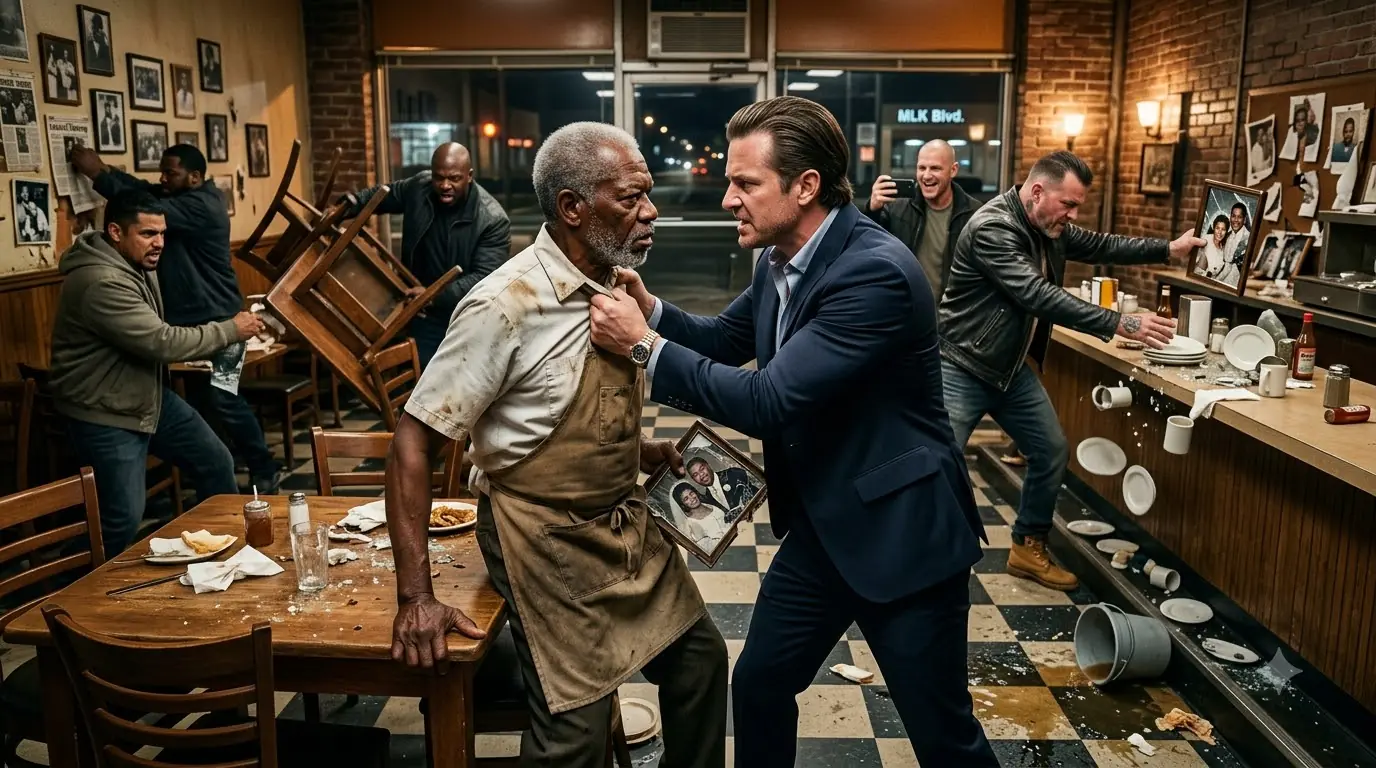
“That’s where people like you belong,” Derek said with contempt. “Always beneath somebody else.”
Then he kicked over Marcus’s cleaning bucket, sending dirty water across the worn diner floor.
“Clean it up, old man.”
Derek looked around the restaurant for something else he could use to hurt him. His eyes settled on a framed wedding photograph sitting behind the counter.
Marcus’s late wife stood in the picture wearing her Sunday dress, smiling beside him on the happiest day of his life.
Derek picked it up.
“Put that down,” Marcus said.
It was the first time his voice changed.
Derek noticed.
He smiled.
“So this matters to you?”
Marcus took one step forward.
“Put it down.”
Instead, Derek deliberately disrespected the photograph and threw it against the wall.
The frame shattered.
Marcus froze.
Pieces of glass scattered across the floor around the image of the woman he had loved for nearly forty years.
Derek stepped over the broken frame.
“Maybe I should come back tonight and finish what I started.”
Marcus slowly lowered himself to one knee and began collecting the pieces.
His weathered hands trembled.
Not from fear.
The three men walked out laughing, completely unaware that they had just threatened a man whose quiet life hid a past almost nobody in the neighborhood fully understood.
Soul Food Sanctuary sat like a weathered guardian on the corner of MLK Boulevard and Peach Street in Atlanta. Its faded yellow paint carried four decades of sun, storms, laughter, arguments, celebrations, and funerals. The hand-painted sign over the entrance had chipped around the edges, but two words remained bold and unmistakable beneath the restaurant’s name: ALL WELCOME.
Inside, mismatched tables and chairs created an atmosphere of worn comfort. The walls displayed community photographs, yellowed newspaper clippings, and boxing memorabilia that most customers barely noticed anymore. One corner held a small memorial to Marcus’s wife, a larger portrait surrounded by flowers and the wedding ring she had worn for most of their marriage.
Marcus Thompson moved through the restaurant every morning with quiet precision. At five o’clock, he unlocked the front door and began the same ritual he had followed for twenty years: chopping vegetables, checking the grits, brewing the coffee that construction workers, nurses, sanitation crews, and overnight employees depended on before beginning or ending their shifts.
His hands told stories.
They were calloused from decades of work, but anyone paying attention might have noticed something unusual in the way he moved. His balance was almost perfect. His steps through the narrow kitchen were economical and controlled. When he reached above his head for a heavy pot, his shoulders moved with surprising flexibility for a man approaching seventy.
“Morning, champ.”
Maria Santos hurried inside one morning still wearing her hospital scrubs after another overnight shift.
Maria was raising two children alone. She stopped at Soul Food Sanctuary almost every morning before collecting them from a neighbor’s apartment and taking them home.
“Your usual?” Marcus asked.
“You already know.”
He slid a container of grits, eggs, and toast across the counter.
Maria reached for her wallet.
Marcus waved her away.
“Kids need breakfast money more than I do.”
“You say that every morning.”
“And every morning I’m right.”
Soul Food Sanctuary survived on an informal system nobody had ever written down. People who could afford full price paid it. Some paid extra. Those who could not afford much paid whatever they could, and occasionally they paid nothing.
Somehow, year after year, the numbers almost worked.
Young Tommy Washington arrived three afternoons each week after school. At sixteen, he was all elbows, long legs, and nervous energy, trying hard to become a man before he had figured out exactly what being one meant.
“Mr. Marcus, homework’s done. Can I help with prep?”
“Tables first.”
Tommy grabbed a cloth.
He earned a little money at the diner and used most of it for boxing lessons at the community center. His technique was enthusiastic but rough. Marcus never offered formal boxing instruction, yet while teaching Tommy how to mop or move crates without hurting his back, he occasionally demonstrated foot placement or balance that mysteriously improved the teenager’s movement in the gym.
Detective Alicia Williams noticed more than most people.
She stopped by many Friday evenings after her shift. Sometimes she was still in uniform, sometimes in plain clothes. Unlike most customers, Alicia actually studied the faded photographs hanging between family portraits and church announcements.
One showed a much younger Marcus standing in boxing gloves.
Another clipping read:
THOMPSON WINS GOLDEN GLOVES.
Another announced his advancement to a national tournament.
“You ever miss it?” Alicia once asked.
Marcus was wiping down the counter.
“Miss what?”
She nodded toward the photographs.
“Being somebody people were afraid to underestimate.”
Marcus paused.
Then he resumed cleaning.
He never answered.
Alicia noticed the change in his eyes anyway.
The neighborhood around Soul Food Sanctuary had transformed rapidly. New condominiums rose three blocks away where Mrs. Johnson’s flower shop had once stood. A trendy coffee shop replaced a family barbershop. Young professionals jogged past the diner in expensive exercise clothes, often treating the aging building like part of the scenery.
Marcus watched it all without complaint.
His rent had increased nearly thirty percent in two years. The roof leaked in two places. The electrical system needed updating. The old floor creaked whenever someone crossed the dining room.
Still, every morning at five o’clock, Marcus unlocked the door.
Every evening, he counted whatever money remained and decided how much food he could afford for the next day.
The neighborhood depended on Soul Food Sanctuary.
Marcus Thompson did not abandon his post.
What few people understood was that the gentle man serving grits had once spent years in competitive boxing and later worked with military personnel learning disciplined defensive techniques. He had left that world behind after one match ended with an opponent badly injured.
Marcus had carried the guilt ever since.
For twenty years, he had chosen restraint.
Until Derek Collins decided restraint meant weakness.
The morning after the wedding photograph was destroyed, Derek returned alone.
He walked into Soul Food Sanctuary carrying a thick manila folder.
Marcus looked up from the cutting board.
Yesterday’s confrontation remained between them like smoke.
“Morning,” Derek said with exaggerated politeness.
He dropped the folder on the counter.
“Hope you slept well.”
Marcus wiped his hands and opened it.
Violation notices.
Health department infractions.
Fire code problems.
Structural concerns.
Every page carried official-looking stamps.
Marcus studied photographs allegedly showing exposed wiring, infestations, and structural cracks.
He knew the building.
Some of what the paperwork described simply did not exist.
“These are false.”
Derek examined his fingernails.
“Prove it.”
Marcus continued reading.
“You’ve got thirty days,” Derek said. “Fix everything or they close you down.”
“Fifty thousand dollars in penalties.”
Marcus looked up.
Fifty thousand dollars might as well have been fifty million.
Derek smiled.
“Of course, maybe I can help.”
“What kind of help?”
“Simple. Sign over your lease for ten thousand dollars. I deal with these problems, and you walk away with enough money to start over somewhere cheaper.”
Marcus understood immediately.
This was not code enforcement.
It was a shakedown.
“How many people have you done this to?”
Derek’s smile disappeared.
“You should worry about yourself.”
Marcus closed the folder.
“I’ll review it.”
“Time is the one thing you don’t have.”
That evening, Marcus sat alone at the counter reading every page.
As he studied the documents, another part of his mind awakened.
The part that had spent years studying opponents.
People revealed weaknesses in patterns.
Derek had a pattern.
Marcus simply needed to see it.
The campaign against Soul Food Sanctuary began early Monday morning.
The electricity went out during breakfast.
Marcus served whatever he could without power while workers from the utility company insisted it was routine maintenance.
It happened again the next day.
And the day after that.
By Thursday, Marcus noticed Derek’s silver BMW parked across the street while the outages occurred.
Derek sat inside making phone calls.
Friday brought another problem.
The water company arrived and announced an emergency shutdown.
Without running water, Marcus could not properly operate the kitchen.
Customers left disappointed but promised to return.
The following week, suppliers began canceling.
His produce distributor sounded nervous.
“Sorry, Mr. Thompson. New risk policy.”
“What risk?”
A long pause.
Then the man lowered his voice.
“Some people came around the warehouse. Suggested drivers might have problems if they kept delivering to certain addresses.”
Marcus understood.
“My employees have families,” the distributor said.
“I understand.”
The same thing happened with the meat company.
Then dairy.
Then even the company providing paper products.
One by one, every lifeline to Soul Food Sanctuary disappeared.
Anonymous emergency calls followed.
Reports of gas leaks brought fire crews multiple times in a single week. Each evacuation emptied the restaurant during business hours. Inspectors arrived repeatedly and found little, but the constant official presence created exactly the impression Derek wanted.
People began whispering.
Then came the social media attacks.
Individuals Marcus had never seen before entered during lunch and created staged complaints for their phones.
One woman claimed she found insects in her food.
Another posted that the chicken was spoiled.
The videos spread quickly.
Fake negative reviews flooded local listings.
People who had never eaten at Soul Food Sanctuary wrote long descriptions of supposedly terrible experiences.
Derek was no longer attacking the restaurant physically.
He was attacking trust.
Then someone broke in at night.
Nothing valuable disappeared.
That made the purpose obvious.
Marcus arrived before sunrise and found overturned chairs, damaged walls, and broken decorations.
The memorial to his wife had been destroyed again.
Her restored picture lay beneath broken glass.
Someone had marked across the frame.
Marcus stood motionless.
Then he knelt.
He gathered every piece carefully.
Across the street, Derek sat inside his car watching.
By the third week, the pressure spread to anyone close to Marcus.
Maria arrived one morning crying.
“I’m sorry.”
Marcus looked up.
“What happened?”
“My supervisor told me I can’t come here anymore.”
“Why?”
“Someone called the hospital. They said I’m associating with people being investigated.”
Marcus sighed.
“You need that job.”
“I know.”
“Then go home to your babies.”
Maria began crying harder.
“I feel terrible.”
“Don’t.”
He put her breakfast into a bag anyway.
“Fear is expensive when you’ve got children.”
Tommy faced even worse pressure.
Men connected to Derek began following him after school.
Anonymous complaints were made about Marcus’s relationship with the teenager.
Tommy’s mother arrived one Friday evening with fear written across her face.
“You can’t work here anymore.”
“Mom.”
“They know where we live.”
Marcus looked at her.
She could barely meet his eyes.
“I’m sorry.”
“You protect your boy.”
Tommy stared at Marcus.
“Mr. Marcus…”
“It’s all right.”
It was not all right.
But Marcus refused to make the teenager choose between loyalty and safety.
Detective Alicia Williams was called into her captain’s office after anonymous complaints suggested she had an improper relationship with a businessman under investigation.
Her career was threatened if she continued appearing publicly at Soul Food Sanctuary.
Their last conversation took place quietly near closing time.
“They’re dismantling everything around you,” Alicia said.
“I know.”
“This is coordinated. Whoever is behind Collins has money and access.”
Marcus glanced toward the empty place where his wife’s photograph had once hung.
“Can you prove any of it?” Alicia asked.
“Not yet.”
Then his bank account was frozen because of supposed suspicious activity.
His landlord raised his rent again, citing a new market assessment.
By the end of the month, Marcus sat in his empty restaurant counting twenty-three dollars.
No customers.
No suppliers.
Almost no allies.
Derek arrived that Thursday evening with five associates.
Marcus sat at a corner table.
“Still here?” Derek asked.
The men began turning over chairs and knocking objects from tables.
Marcus watched silently.
Derek found an old newspaper clipping from Marcus’s boxing career.
He tore it slowly.
Pieces drifted onto the floor.
“You keep pretending you’re somebody special.”
Marcus said nothing.
Then Derek pulled out his phone.
On the screen was a photograph of Tommy walking home from school.
Marcus’s eyes changed.
“That kid who used to work here?”
Derek smiled.
“Would be unfortunate if he started having problems.”
The restaurant became completely still.
Derek did not recognize the significance of Marcus’s silence.
He thought he had finally broken him.
He had not.
He had finally found the one boundary Marcus would not allow him to cross.
After Derek’s men left, Marcus remained in the dark restaurant for a long time.
Then he walked into the storage room.
Beneath old inventory sheets sat a dusty box he had not opened in years.
Inside were old hand wraps.
A notebook filled with training combinations and notes written in his younger handwriting.
A photograph of himself at twenty-five, gloves raised after a victory.
Marcus studied himself in the cracked mirror above the prep sink.
The man looking back was sixty-seven.
Tired.
Grieving.
But not helpless.
Marcus took off his wedding ring and set it beside his wife’s damaged photograph.
“Forgive me,” he whispered. “But I can’t let them hurt that boy.”
For the first time in decades, he began stretching.
Not because he intended to attack anyone.
Because Derek would return.
And Marcus intended to be ready if Derek brought violence through that door.
The following morning, Derek came back with six men.
These were different from his usual companions.
They moved like professionals accustomed to intimidating people.
Marcus stood behind the counter wiping the same spot.
Mrs. Henderson sat quietly in a booth, pretending to read the newspaper.
“Time’s up,” Derek announced. “Sign the papers.”
Marcus continued wiping.
One of the larger men stepped toward him.
People called him Tank.
He reached for Marcus’s arm.
“Let go,” Marcus said.
Tank laughed.
“Or what?”
“Please let go.”
The politeness confused him.
Tank shoved Marcus backward.
Marcus did not fall.
His feet shifted almost automatically into balance.
Something deeply practiced returned.
“I’m asking nicely,” Marcus said.
Tank moved toward him aggressively.
Marcus avoided the first attack with a small step and responded only enough to stop the immediate threat.
Tank staggered and dropped to one knee, struggling to catch his breath.
The entire restaurant went silent.
A second man named Leon rushed forward.
Marcus redirected the movement instead of meeting it head-on, and Leon ended up against the wall, dazed but conscious.
Derek backed toward the entrance.
“You’re finished. That’s assault.”
Marcus looked directly at him.
“Self-defense.”
Mrs. Henderson lowered her newspaper.
“And I watched the whole thing.”
Her granddaughter was visiting from college.
She had recorded the encounter on her phone from the beginning.
Marcus opened his first-aid kit.
He took out cold packs and bottled water and placed them beside the two men who had tried to hurt him.
“You need to leave,” he said. “Take care of yourselves.”
Tank stared at him.
“What are you?”
“An old man who knows when somebody is trying to hurt him.”
Derek pointed toward Marcus.
“This isn’t over.”
But the threat sounded different now.
Derek had discovered something he had failed to calculate.
The quiet elderly restaurant owner had spent decades learning discipline.
Mrs. Henderson’s granddaughter uploaded the footage.
Within hours, thousands had watched it.
By evening, the number had climbed into the millions.
People saw Derek arrive with a group of men.
They saw the confrontation begin.
They saw Marcus defend himself.
More importantly, they saw what happened afterward.
Marcus offered water and first aid to the same men who had come to intimidate him.
Comments flooded social media.
People began calling him a neighborhood legend.
A fundraising campaign appeared to save Soul Food Sanctuary.
Within hours, donations poured in.
For the first time in weeks, Marcus seemed to have momentum.
Then Derek’s legal team responded.
They released edited footage showing only Marcus’s defensive movements.
The beginning disappeared.
The threats disappeared.
Tank’s aggression disappeared.
The new headline portrayed Marcus as a violent former fighter who had attacked businessmen during a disagreement.
A professional public relations firm began spreading the story.
They dug into Marcus’s past.
His boxing career.
His military-related defensive training.
A match decades earlier in which an opponent had suffered a serious injury.
Context disappeared.
Every piece of his history became evidence that he had always been dangerous.
The same internet that celebrated him began turning against him.
The fundraising account was temporarily frozen pending review.
People demanded refunds.
Maria watched the news at home with her children.
Tommy argued with his mother.
“They’re lying about him.”
“The video shows him fighting.”
“Because they came after him.”
Even Tommy began questioning himself after hearing the same accusations repeated everywhere.
That was exactly what Derek wanted.
If you repeat a lie long enough, eventually even witnesses begin doubting their own memory.
Marcus was charged with serious assault offenses.
His public defender, Sarah Carter, was young, exhausted, and carrying far too many cases.
During their first meeting, she studied the prosecution file.
“They have video.”
“It’s edited.”
“I believe you.”
“Then fight it.”
Sarah sighed.
“I’m trying to explain what a jury will see. They see a sixty-seven-year-old man with extensive combat and boxing experience dropping two younger men. Without the beginning, it looks bad.”
“I defended myself.”
“I know.”
“Then say that.”
“I will.”
But she also warned him that the state had more money and resources than they did.
District Attorney Robert Hayes announced that he would personally oversee the prosecution.
He was seeking reelection.
The case had become politically useful.
At a press conference, Hayes portrayed Marcus as proof that communities needed stronger law-and-order enforcement.
Derek’s lawyer, Vincent Morrison, held another press conference.
Derek appeared wearing medical supports and moving slowly for cameras.
“My client attempted to discuss a legitimate business matter,” Morrison said. “Instead, he and his associates were met with extreme violence.”
Derek stood beside him looking wounded and frightened.
The performance worked.
At the preliminary hearing, Derek described himself as a businessman trying to help an aging restaurant owner retire with dignity.
“I wanted him to have a fair transition,” Derek said.
Sarah Carter stood.
“Isn’t it true you threatened his business?”
“No.”
“His suppliers?”
“No.”
“His employees?”
“Absolutely not.”
“Did you show Mr. Thompson a photograph of a sixteen-year-old boy and suggest something might happen to him?”
Derek’s expression barely changed.
“I have no idea what she’s talking about.”
Sarah continued.
“Did you destroy a photograph of Mr. Thompson’s late wife?”
“No.”
“Did you ever pressure him to sell his lease?”
“I offered him a business opportunity.”
He was polished.
Prepared.
Convincing.
Then he added something subtle.
“Some neighborhoods resist change. Certain people see progress as an attack.”
Sarah looked at him.
“What people?”
Derek smiled.
“I said certain people.”
He never explicitly mentioned race.
He did not need to.
Detective Alicia Williams watched from the gallery.
Her hands were clenched.
While everyone else had been watching television, she had been investigating.
Quietly.
Off duty when necessary.
Carefully enough to avoid alerting Derek.
She had found twelve -owned businesses that had faced remarkably similar pressure over three years.
City violations suddenly appeared.
Utilities became unreliable.
Landlords changed terms.
Anonymous complaints damaged reputations.
Then Collins Development arrived with an offer.
Property values mysteriously dropped before purchases and rose dramatically afterward.
Inspectors who aggressively targeted minority-owned businesses ignored comparable problems elsewhere.
Alicia began building a pattern.
But a pattern was not yet a case.
Marcus’s bail was set at fifty thousand dollars.
He could not pay.
The same neighborhood that had once embraced him now watched him being led away on television.
Marcus spent the night in jail with men young enough to be his grandchildren.
One inmate recognized him.
“You the diner guy?”
Marcus nodded.
“They say you took down two dudes.”
“I defended myself.”
The young man smiled sadly.
“System doesn’t always care about the difference.”
Marcus lay awake on a thin mattress staring at the ceiling.
For the first time, he wondered whether Derek had already won.
Not because Marcus believed the lies.
Because he understood how effectively they had replaced the truth.
The trial began on a Monday morning.
Marcus wore his only good suit, borrowed from Tommy’s father after the man finally decided fear had kept his family silent long enough.
The courtroom was packed.
Some people were curious.
Some hostile.
Many had already decided.
Prosecutor Hayes opened confidently.
“Appearances can deceive.”
He pointed toward Marcus.
“The defendant wants you to see a harmless elderly restaurant owner. But his history reveals a man with decades of specialized fighting experience who responded to a business disagreement with trained force.”
Medical testimony described Tank and Leon’s injuries.
Experts described Marcus’s boxing background.
The edited footage played repeatedly.
Each viewing made the missing beginning less visible to jurors who had never seen it.
Derek testified again.
“I approached Mr. Thompson hoping to find a peaceful solution.”
His voice cracked at exactly the right moment.
“What happened next terrified me.”
Sarah Carter attempted to challenge him.
“Mr. Collins, your company has acquired multiple properties in this neighborhood, correct?”
“Yes.”
“Several from owners who initially refused to sell?”
“That happens in development.”
“And several faced violations shortly before selling.”
“Coincidence.”
“Utility problems?”
“Cities have aging infrastructure.”
“Supplier pressure?”
“I don’t control suppliers.”
Derek smiled.
Sarah could not yet connect the pieces.
The prosecution called Tank and Leon.
They described themselves as passive witnesses.
“All I did was stand there,” Tank said.
Marcus watched silently.
Then Sarah called Mrs. Henderson.
She described what she had seen.
Derek’s team attacked her credibility.
“You receive discounted food from Mr. Thompson, correct?”
“Yes.”
“So you benefit financially from his restaurant remaining open.”
Mrs. Henderson stared at the lawyer.
“I benefit from having decent neighbors.”
The lawyer smiled.
“That was not my question.”
Marcus eventually took the stand.
He spoke quietly.
“I spent decades learning control.”
Hayes leaned forward.
“Control?”
“Yes.”
“You were a competitive boxer.”
“Yes.”
“You trained with military personnel.”
“Yes.”
“You once injured an opponent badly enough that he spent weeks recovering.”
Marcus swallowed.
“Yes.”
“And yet you expect this jury to believe you are peaceful?”
“I stopped fighting because of what happened to that man.”
“So you admit your hands are dangerous.”
“I admit strength has consequences.”
Hayes approached.
“Then why did you use it?”
“Because they attacked me.”
“The video shows you attacking them.”
“The video starts after everything began.”
“So evidence is wrong and you are right?”
“No.”
Marcus looked toward the jury.
“The video is incomplete.”
Hayes smiled.
“Convenient.”
The prosecution rested after days of testimony.
Sarah Carter knew they were losing.
Then Detective Alicia Williams entered the courtroom carrying a thick folder.
She walked directly toward the defense table.
Sarah looked up.
“What is that?”
“Everything.”
Sarah requested an emergency recess.
The judge hesitated.
Then granted it.
Inside a conference room, Alicia spread documents across the table.
Bank records.
Property acquisitions.
Emails.
Witness statements.
Inspection histories.
Business records.
She had connected Derek Collins to a systematic campaign targeting legacy businesses in rapidly redeveloping neighborhoods.
“This is bigger than Marcus,” Alicia said.
Sarah stared at the papers.
“How did you get this?”
“I wasn’t the only one looking.”
Alicia placed another folder down.
“Federal investigators have been examining Collins Development for potential civil rights and financial offenses.”
Sarah looked up sharply.
Alicia continued.
“They were waiting until they could connect the intimidation to specific transactions.”
“Can they?”
“Now they can.”
Then she produced the most important piece.
A recording made during the investigation.
Derek’s own voice.
When court resumed, Sarah requested permission to introduce newly disclosed evidence.
The prosecutor objected.
Judge Martinez reviewed the material privately.
Her expression changed.
“Objection overruled.”
The courtroom went silent.
A recording began playing.
Derek’s voice came through the speakers.
He discussed pressuring older neighborhood business owners who resisted selling.
He described exploiting personal vulnerabilities.
Then Marcus heard his own restaurant mentioned.
“The diner situation is useful,” Derek said in the recording. “Break him publicly. Make an example. Everyone else understands what resistance costs.”
The courtroom froze.
Derek shot to his feet.
“That recording is illegal!”
For a man who had spent months presenting himself as physically fragile, he suddenly moved without difficulty.
Jurors noticed.
His lawyer grabbed his sleeve.
“Sit down.”
Derek did not.
“You can’t use that!”
Judge Martinez struck the gavel.
“Mr. Collins, sit down.”
The recording continued.
Derek discussed using fear to influence property owners.
He referenced Tommy.
He talked about Marcus’s attachment to the community.
The polished businessman disappeared.
What remained was the person Marcus had seen from the beginning.
A man who viewed human beings as obstacles between himself and profit.
Once the first piece fell, the rest followed quickly.
Business owners who had been too frightened to speak came forward.
A barber testified.
Then a grocery store owner.
Then the widow who had owned a flower shop two blocks away.
Their stories were almost identical.
Inspections.
Threats.
Financial pressure.
Cheap purchase offers.
Then disappearance.
Federal investigators confirmed they were examining multiple connected cases.
Sarah Carter recalled witnesses.
This time Marcus’s boxing history no longer looked like evidence of aggression.
Former students described his philosophy.
“Mr. Thompson taught control before anything else.”
A former military trainee took the stand.
“Marcus could have caused far more harm if that had been his intention. What I saw in the full footage was restraint. He stopped threats and then disengaged.”
Sarah asked, “How do you know?”
“Because that’s exactly what he taught us.”
“Meaning?”
“Protection is not punishment.”
The sentence stayed with the jury.
Maria returned.
So did Tommy.
Tommy took the stand despite his mother’s fear.
“Mr. Marcus never taught me how to hurt people.”
“What did he teach you?”
“How not to become the kind of man who needs to.”
Sarah paused.
Tommy continued.
“He taught me balance. Patience. He said if somebody makes you angry enough to control what you do, then they already beat you.”
Across the courtroom, Marcus lowered his head.
Derek’s case continued collapsing.
Investigators confirmed that some violations issued against Soul Food Sanctuary were unsupported.
Financial records showed connections between development interests and contractors who had pressured suppliers.
The prosecution itself now faced an uncomfortable truth.
Its supposed victim had been running an organized intimidation campaign.
District Attorney Hayes requested time to reassess the state’s position.
Judge Martinez gave him very little sympathy.
“You brought this prosecution into my courtroom,” she said. “You will finish it in front of the same jury.”
Marcus took the stand again.
Sarah asked one final question.
“Mr. Thompson, did you want to fight that morning?”
“No.”
“Why not?”
“I spent forty years learning what violence costs.”
“Then why defend yourself?”
Marcus looked toward Tommy.
“Because somebody threatened a child I care about.”
He turned back toward the jury.
“I never wanted to fight again. But peace doesn’t mean pretending danger isn’t real.”
Sarah waited.
Marcus continued.
“Sometimes protecting peace means refusing to let somebody destroy people who cannot protect themselves.”
The defense rested.
The prosecution’s closing argument was far shorter than anyone expected.
Hayes could no longer portray Derek as an innocent businessman without ignoring evidence the jury had heard with their own ears.
Sarah Carter stood for the defense.
Three weeks earlier, she had been an exhausted public defender preparing to recommend a plea.
Now her voice carried through the courtroom.
“This case began with an assumption.”
She looked toward Marcus.
“That because Mr. Thompson knew how to defend himself, he must have been the aggressor.”
She turned toward the jury.
“But strength is not guilt.”
She paused.
“Skill is not guilt. Age is not weakness. Poverty is not guilt. And refusing to surrender your home, your business, or your dignity is not violence.”
She pointed toward the screen containing still frames from the complete video.
“Marcus Thompson did not go looking for these men.”
“They came to him.”
The jury left.
They returned eighteen minutes later.
Marcus stood.
The foreperson unfolded the paper.
“We, the jury, find the defendant Marcus Thompson not guilty on all charges.”
Marcus closed his eyes.
For several seconds, he did not move.
Then Sarah grabbed his arm.
She was crying.
Behind them, the gallery erupted.
Tommy shouted.
Maria covered her mouth.
Mrs. Henderson simply nodded as though the verdict confirmed something she had known all along.
Derek stood abruptly.
“This is ridiculous!”
His lawyer grabbed for him.
Derek pulled away.
He moved freely now.
No limp.
No hesitation.
No visible sign of the limitations he had claimed for months.
Jurors watched.
“This neighborhood was falling apart before people like me invested in it!”
Judge Martinez struck the gavel.
“Mr. Collins.”
“You don’t understand what I was trying to do!”
“Control yourself.”
Derek continued.
His language became increasingly contemptuous toward the people who had resisted him.
The mask was gone.
Judge Martinez called for the bailiff.
“Remove Mr. Collins.”
As officers approached, Alicia Williams stood near the aisle with federal investigators.
The next case was already waiting.
Extortion.
Conspiracy.
Financial offenses.
Potential civil rights violations.
This time Derek Collins would be the defendant.
Outside the courthouse, Marcus found hundreds of people waiting.
Tommy reached him first.
He wrapped both arms around Marcus.
Maria arrived with her children.
“I should have stood beside you.”
Marcus shook his head.
“You kept your babies safe.”
“I was afraid.”
“So was I.”
She stared at him.
“You?”
“Every day.”
Mrs. Henderson approached.
“Some of us never stopped believing, champ.”
Marcus smiled.
“Some of you were louder about it than others.”
News crews surrounded him.
The same media cycle that had helped destroy his reputation now wanted the story of his vindication.
Reporters shouted questions.
Marcus raised one hand.
The crowd quieted.
“I’m not interested in revenge.”
Cameras leaned closer.
“I want my restaurant back.”
That line appeared on national television that evening.
So did Derek’s recordings.
Federal investigators announced a broader inquiry into Collins Development and related companies.
Multiple former property owners came forward.
Investors began withdrawing.
Business partners distanced themselves.
Accounts connected to the investigation were frozen.
Within days, the empire Derek had built through pressure began collapsing under the weight of documentation.
City officials faced uncomfortable questions.
How had so many complaints against legacy businesses appeared shortly before acquisition attempts?
Why had inspectors repeatedly targeted the same kinds of owners?
Why had nobody connected the pattern sooner?
The answers were not flattering.
The city council introduced new protections for long-standing small businesses facing coordinated displacement.
Community advocates called it the Marcus Thompson Anti-Displacement Act.
Marcus disliked the name.
“They could’ve called it anything else.”
Tommy laughed.
“You famous now.”
“That is not a good thing.”
The original fundraiser was restored.
Donations passed five hundred thousand dollars.
Marcus kept only what was necessary to repair Soul Food Sanctuary and resolve debts created during the campaign against him.
The rest became the beginning of a legal defense fund for small business owners facing similar pressure.
Soul Food Sanctuary reopened with a neighborhood celebration.
Construction workers repaired the roof.
An electrician replaced outdated wiring at cost.
A local contractor fixed the floor.
People repainted the exterior while preserving the faded yellow color everyone associated with the restaurant.
The ALL WELCOME sign stayed exactly where it had always been.
Marcus returned behind the counter.
Maria returned to her morning stool.
Tommy returned after school.
Alicia Williams became a regular again, no longer whispering about the investigation.
Marcus’s wife’s photograph returned to the wall.
A restoration specialist had repaired the original image and placed it inside a new frame.
The first morning Marcus saw it hanging there, he stood silently for a long time.
Then he touched his wedding ring.
“Made it through another one,” he whispered.
Tommy pretended not to notice.
Months later, Marcus began holding small classes in the back room.
He called them Defense and Dignity.
They were not fighting classes in the way people expected.
The first lesson involved awareness.
The second involved boundaries.
The third involved leaving dangerous situations early.
Physical techniques came later and remained focused on creating space and getting to safety.
Elderly residents attended.
Single mothers came.
Small business owners joined after experiencing intimidation.
“Strength isn’t about what you can do to somebody,” Marcus told them. “It’s about what you refuse to let somebody do to you, your family, or your community.”
Six months after the trial, Soul Food Sanctuary was busier than it had been in decades.
On Tuesday and Thursday evenings, the tables were moved against the wall.
Eighty-year-old Grace Patterson practiced slow defensive movements with padded equipment.
Maria worked on balance and footwork while her teenage daughter learned how to recognize unsafe situations before they became emergencies.
Tommy, now seventeen, helped younger students.
“Keep your hands up, Mrs. Patterson,” Marcus said.
“I’m eighty years old. My hands go where they want.”
The room laughed.
“Your hands are eighty. Your attitude is sixteen.”
“Watch yourself, champ.”
Marcus grinned.
The curriculum expanded beyond physical skills.
“Self-defense starts up here.”
Marcus tapped his temple.
“Know your worth. Recognize pressure early. Understand when somebody is trying to make fear choose for you.”
Tommy eventually wrote his college application essay about Marcus.
A documentary crew asked him what he had learned.
“Mr. Marcus taught me strength isn’t hurting people.”
Tommy looked toward the older man.
“It’s being capable of hurting somebody and choosing restraint until protection becomes necessary.”
Marcus overheard.
“Too long.”
Tommy laughed.
“It’s my essay.”
“Admissions officer will fall asleep.”
The legal consequences for Derek continued.
Federal prosecutors obtained convictions connected to extortion, conspiracy, financial crimes, and discriminatory schemes.
The sentence removed him from the business world he had once controlled.
Restitution claims followed.
His recorded statements became evidence in other cases involving property owners who had experienced similar tactics.
Derek’s methods were eventually included in investigative training materials showing how apparently separate inspections, supplier pressure, financing problems, and reputation attacks could form one coordinated economic coercion campaign.
Cities beyond Atlanta began examining comparable cases.
Some adopted new anti-displacement protections.
Community business groups used Marcus’s case when challenging suspicious development practices.
The fund created from public donations continued growing.
Eventually, it became the Marcus Thompson Foundation.
Marcus protested the name again.
Nobody listened.
The foundation provided legal referrals, emergency grants, compliance assistance, and professional support to small businesses facing coordinated harassment.
It expanded into several cities.
Success did not change Marcus’s mornings.
Five o’clock.
Unlock the door.
Start the coffee.
Check the grits.
Slide meals across the counter.
Charge what people could afford.
Alicia Williams was eventually promoted after the investigation received national attention.
She helped develop a specialized unit focused on economic intimidation and discriminatory business practices.
One Friday, she sat at the counter drinking coffee.
“You know none of this would’ve happened if you’d just sold the diner.”
Marcus looked at her.
“That supposed to be funny?”
“A little.”
“You detectives need hobbies.”
“I have one.”
“What?”
“Watching stubborn old men accidentally change laws.”
Marcus shook his head.
“I didn’t change anything.”
Alicia glanced around the packed restaurant.
“Sure.”
Tommy eventually launched a small online project documenting similar struggles in other neighborhoods.
He connected business owners with legal resources, local journalists, and community groups.
What began as a teenager’s blog became a national resource.
Marcus pretended not to understand social media.
Nobody believed him.
One evening, Tommy showed him a video from a small business owner in another state.
“She said she fought the fines because she saw your story.”
Marcus watched quietly.
Another clip showed a neighborhood organizing before several family businesses could be forced out.
Another showed an elderly shop owner meeting with volunteer attorneys from the foundation.
Marcus handed the phone back.
“You did that,” Tommy said.
“No.”
Marcus looked around at Maria, Alicia, Mrs. Henderson, and everyone else inside Soul Food Sanctuary.
“We did.”
The most important transformation happened in the neighborhood itself.
Residents began attending development meetings.
Older business owners learned to request documentation.
Younger residents volunteered professional skills.
Lawyers offered occasional pro bono consultations.
Accountants helped owners understand financing.
Contractors inspected buildings before questionable citations could be used against them.
Development did not stop.
Marcus never wanted it to.
What changed was who had a voice in deciding what development looked like.
New businesses opened.
Older ones survived.
Investment became harder to separate from accountability.
Soul Food Sanctuary remained on its corner.
The yellow paint was fresher now.
The sign was repaired.
But Marcus insisted the old tables stay.
“They wobble,” Tommy complained.
“They got history.”
“They got uneven legs.”
“History.”
“Mr. Marcus, one table needs three napkins under it.”
“Historic napkins.”
Tommy laughed and walked away.
On the wall, Marcus’s boxing photographs were no longer hidden between community announcements.
They had been cleaned and reframed.
Visitors sometimes stopped to study the young fighter Marcus had once been.
The photographs no longer represented violence to him.
They represented discipline.
A life spent learning strength.
Then another life spent learning when not to use it.
One afternoon, a young man asked him about the famous confrontation.
“You really took those guys down?”
Marcus kept slicing onions.
“I protected myself.”
“Come on, Mr. Thompson. The video’s everywhere.”
“Videos don’t teach context.”
The young man leaned on the counter.
“So what’s the lesson?”
Marcus stopped cutting.
“The lesson is not that an old fighter can beat younger men.”
The boy waited.
“The lesson is that Derek spent months trying to make me angry enough to become exactly what he told everybody I was.”
Marcus resumed chopping.
“And the day I finally had to defend myself, I had to remember who I was before he decided for me.”
The boy nodded slowly.
“That’s harder than fighting.”
“Exactly.”
The back room filled again that evening.
Grace Patterson wrapped her hands.
Maria stretched.
Tommy organized equipment.
Mrs. Henderson sat in her favorite chair claiming she was only there to supervise.
Marcus stepped into the center.
“Today we’re working on stance.”
A young mother raised her hand.
“What if somebody’s stronger than me?”
“Most people are stronger than somebody.”
Marcus pointed toward his head.
“That doesn’t decide everything.”
“What does?”
“Preparation.”
He looked around the room.
“Awareness.”
Then toward the photograph of his wife beyond the doorway.
“And knowing what you’re protecting.”
The room quieted.
Marcus demonstrated a stable stance.
“Strength isn’t proving you’re dangerous.”
He adjusted one student’s shoulders.
“It’s having enough control that danger doesn’t get to decide who you become.”
Outside, MLK Boulevard moved through another Atlanta evening.
Traffic passed.
New buildings stood beside old ones.
People walked in and out of Soul Food Sanctuary.
Some knew the story.
Some did not.
Marcus preferred it that way.
He had never wanted to become a symbol.
He had only wanted to serve breakfast.
But years later, people still told the story of the sixty-seven-year-old restaurant owner everyone mistook for helpless.
They remembered Derek Collins arriving with money, influence, lawyers, media connections, and a system of pressure designed to make resistance feel impossible.
They remembered Marcus losing customers, suppliers, money, reputation, and nearly his freedom.
They remembered how easily the public had believed an incomplete video.
They remembered Alicia Williams refusing to stop following the evidence.
They remembered Tommy returning when fear told him to stay away.
They remembered Maria admitting she had been afraid.
They remembered Sarah Carter walking into court overmatched and walking out having defended a man everyone had already judged.
Most of all, they remembered Marcus.
Not because he had once been a formidable fighter.
Not because millions watched him defend himself.
Not because a law eventually carried his name.
They remembered him because after everything Derek had done, Marcus reopened the same diner and hung the same sign over the door.
ALL WELCOME.
Even after betrayal.
Even after fear.
Even after people who once abandoned him returned asking forgiveness.
Marcus still served them breakfast.
That was the part Derek Collins had never understood.
Marcus Thompson’s greatest strength had never been hidden in his hands.
It was in his refusal to let cruelty teach him how to become cruel.
It was in the patience to endure long enough for evidence to matter.
It was in the discipline to defend without becoming consumed by revenge.
And it was in the belief that a neighborhood was worth protecting even when protecting it carried a personal cost.
Years after the trial, a reporter asked Marcus whether he regretted not leaving when Derek first offered him money.
Marcus looked around Soul Food Sanctuary.
Maria was laughing near the register.
Tommy, home from college, was repairing a loose chair.
Alicia sat at her usual table.
Mrs. Henderson was complaining that the coffee was weaker than it had been twenty years earlier.
Children were eating breakfast near the window.
Marcus looked back at the reporter.
“No.”
“Not even once?”
Marcus smiled.
“I thought about leaving.”
“What stopped you?”
He glanced toward his wife’s photograph.
Then toward the neighborhood outside.
“Somebody had to stay.”
The reporter waited.
Marcus picked up his dish towel.
“That’s all.”
For everyone else, Marcus Thompson became proof of something larger.
Age did not erase relevance.
Silence did not mean weakness.
Restraint did not mean fear.
A person could lose almost everything and still refuse to surrender the one thing nobody else had the right to take.
Dignity.
Marcus saved more than Soul Food Sanctuary.
He helped preserve the idea that ordinary people, when supported by evidence, community, courage, and law, could challenge systems designed to make them feel powerless.
And every morning at five o’clock, long before the neighborhood fully woke, Marcus still unlocked the old diner door.
He turned on the lights.
Started the coffee.
Checked the grits.
Then he looked once toward his wife’s restored photograph.
And opened Soul Food Sanctuary for another day.