The last piece of the driver’s license fluttered from Officer Marcus Hale’s fingers and landed faceup on the gravel shoulder. For half a second, the young woman’s photograph remained visible beneath his polished boot before the wind lifted the fragment and carried it toward the ditch. Marcus smiled through the open window of the black sedan, satisfied by the silence he had created. He expected the driver to cry, apologize, or finally give him the phone number he had demanded.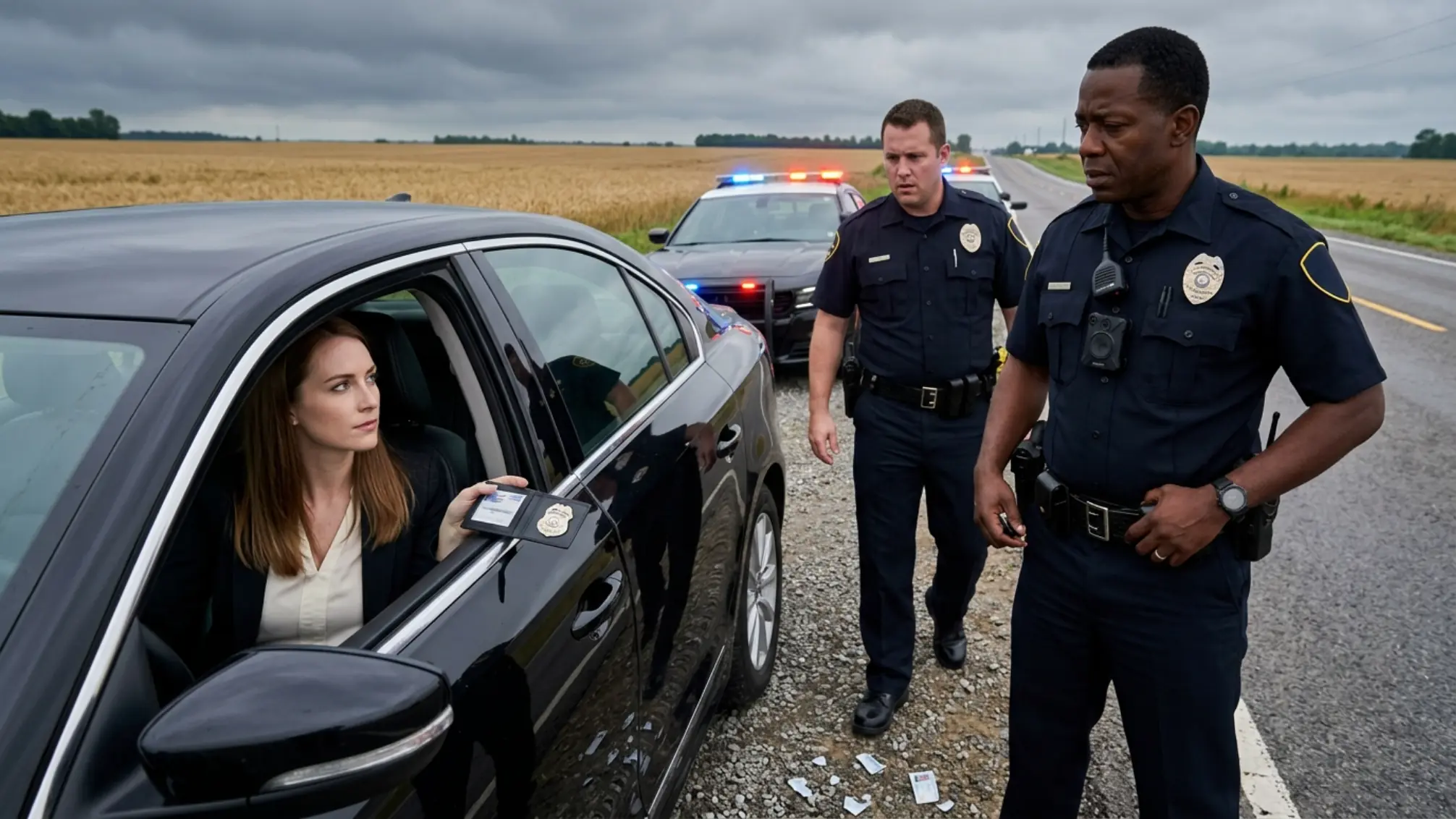
Instead, thirty-two-year-old Evelyn Carter looked at the scattered pieces with an expression so calm that it unsettled him. Her green eyes moved from the torn plastic to the body camera mounted on his chest, then to the hand resting near his holster. She wore an ivory blouse beneath a dark fitted blazer, and her straight chestnut-brown hair fell neatly past her shoulders despite the wind moving through the wheat fields. Without saying a word, she reached across the passenger seat and opened the glove compartment.
Marcus stared at the slim black credential wallet in Evelyn’s hand. Inside it was a gold badge bearing the seal of the Tennessee Bureau of Law Enforcement Standards, beside an identification card naming her as Senior Special Agent Evelyn Carter. Beneath her name were the words Professional Integrity Division—Special Investigations Supervisor. The color drained from his face as he read them twice.
A second patrol vehicle had arrived behind Marcus’s cruiser only moments earlier. Officer Daniel Price, a thirty-eight-year-old white American patrolman with short brown hair, stepped onto the gravel and studied the torn license scattered around Evelyn’s car. His gaze moved to Marcus’s dark body camera, where the status light should have been blinking. It was not.
“Sir,” Daniel repeated carefully, “step away from the vehicle.”
Marcus turned toward him. “This is my stop.”
“Dispatch just identified her.”
“I heard the radio.”
“Then back away.”
Marcus’s expression hardened as humiliation replaced uncertainty. He had served on the Westfield County Highway Unit for seventeen years and had trained nearly half the younger officers working traffic enforcement. He was accustomed to being obeyed, particularly on isolated roads where no supervisor could arrive quickly enough to challenge his version of events. Daniel’s order, spoken in front of the woman Marcus had tried to intimidate, felt like an attack on the authority he believed the uniform guaranteed him.
Evelyn closed the credential wallet but kept it visible. “Officer Price, is your body camera active?”
Daniel checked the green light on his chest. “Yes, ma’am.”
“Keep it running.”
Marcus gave a short laugh. “This is being blown out of proportion. Her license was already damaged.”
Evelyn looked down at the sharp plastic fragments. “You tore it four times.”
“She became confrontational.”
“I remained seated with both hands visible.”
“She challenged a lawful inspection.”
“There was no lawful inspection.”
Marcus pointed toward the sedan. “I observed suspicious driving.”
Evelyn’s voice remained even. “Then state the violation.”
He opened his mouth but did not answer.
The stop had begun eleven minutes earlier on State Route 47, a nearly empty road cutting through miles of harvested wheat fields outside Nashville. Evelyn had maintained the speed limit, signaled every lane movement, and pulled over immediately when Marcus activated his lights. The vehicle’s registration was valid, its insurance current, and its inspection record clean.
Marcus knew that because he had examined every document.
After finding no violation, he shifted the conversation. He asked whether Evelyn lived alone, whether she often traveled that road, and whether she would give him her number. When she refused, his tone changed. He accused her of making the stop difficult, held her license outside the window, and destroyed it while his body camera remained deliberately disabled.
What Marcus did not know was that Evelyn had entered Westfield County under instructions from the state commissioner. She was leading a confidential audit of the Highway Unit after twelve complaints involving women stopped on rural roads. The allegations included personal questions unrelated to traffic enforcement, demands for phone numbers, retaliatory citations after rejection, unlawful vehicle searches, and body-camera failures occurring during the most serious encounters.
Officially, Evelyn was visiting the county records office to review citation data. Unofficially, only the police chief, state commissioner, and district attorney knew her true assignment. She had driven an unmarked civilian sedan because the audit required her to observe ordinary enforcement practices without warning officers that state investigators were nearby.
Marcus had provided the clearest evidence she could have imagined.
Daniel moved between Marcus and the sedan. “Place both hands where I can see them.”
Marcus’s eyes widened. “Are you detaining me?”
“I am securing the scene.”
“You are a patrol officer. I trained you.”
“And I am recording you.”
That stopped Marcus from stepping forward.
Evelyn unlocked her door and exited slowly. She was five feet seven, slim, and far less physically imposing than either officer, but her controlled posture changed the balance of the roadside. She photographed the license fragments without touching them and instructed Daniel to request a supervisor, an evidence technician, and a representative from the district attorney’s office.
Marcus shook his head. “For a torn piece of plastic?”
“For destruction of state-issued identification, possible evidence tampering, an unlawful detention, misuse of authority, and retaliation after a personal rejection,” Evelyn replied. “The final classification will depend on what your recording equipment and vehicle systems show.”
“My body camera malfunctioned.”
“When?”
“Before the stop.”
“Did you report the malfunction?”
“I intended to.”
“Did you notify dispatch before initiating enforcement without a functioning camera?”
Marcus said nothing.
Daniel used his radio to request Lieutenant Raymond Cole, the shift supervisor. He also asked dispatch to preserve the complete radio channel, vehicle-location data, and computer activity associated with Marcus’s cruiser. Evelyn watched Marcus’s face as each request was transmitted. His confidence diminished not because anyone had raised a voice, but because the case was being built around him one documented step at a time.
A county evidence technician arrived twenty minutes later. Every piece of the torn license was photographed, numbered, and placed into a clear evidence envelope. The technician measured the distance from the fragments to Evelyn’s vehicle and documented the location of both cruisers. Marcus stood beside Daniel’s patrol car with his arms crossed while passing vehicles slowed to observe the unusual scene.
Lieutenant Cole arrived last.
He was fifty-four and had supervised Marcus for nine years. Before leaving his SUV, he looked toward the torn license, Evelyn’s credential, and Marcus’s inactive camera. His shoulders lowered slightly, suggesting he understood the danger before anyone explained it.
“Agent Carter,” Cole said. “I apologize for this misunderstanding.”
Evelyn studied him. “You have not reviewed the evidence. How do you already know it was a misunderstanding?”
Cole hesitated. “That may have been the wrong word.”
“It was.”
Marcus spoke quickly. “Lieutenant, she refused to cooperate during a traffic stop.”
“What was the violation?” Evelyn asked again.
Marcus looked toward the road. “Possible lane deviation.”
Evelyn pointed to the front windshield of her sedan. “My vehicle has an integrated dash camera. It records continuously while the engine is running.”
The silence that followed was different from the earlier silence. Marcus no longer looked angry. He looked trapped.
Evelyn retrieved the camera’s memory card under the evidence technician’s observation. The roadside playback showed her sedan centered within its lane for the five miles preceding the stop. It also recorded Marcus’s cruiser accelerating from a side road and following her for nearly two minutes before activating its lights.
There was no lane deviation.
The interior microphone captured the entire exchange through the open window. Marcus could be heard confirming that the license and registration were valid. Then came his questions about Evelyn’s relationship status, his request for her phone number, her refusal, and the unmistakable snapping sounds as he tore the license.
Lieutenant Cole watched the playback without speaking.
Evelyn turned toward him. “How many complaints have been filed against Officer Hale involving female drivers?”
“I would have to check.”
“I already did. There were nine in the last four years.”
“Some were unsubstantiated.”
“Seven were closed by you.”
Cole’s eyes shifted toward Marcus.
Evelyn continued. “In six of those cases, his camera was listed as malfunctioning. In four, the complainants received citations only after refusing to answer personal questions.”
Marcus stepped forward. “Those women are lying.”
Daniel raised one hand. “Stay where you are.”
“You believe her over a decorated officer?”
“I believe the recording.”
The district attorney’s investigator arrived and interviewed Evelyn separately. Daniel provided his body-camera footage, beginning from the moment he reached the scene. Marcus was relieved of his firearm, radio, and patrol authority pending an emergency administrative review. Lieutenant Cole protested that such action normally required approval from the county chief.
Evelyn handed him a signed directive.
“The chief approved it thirty minutes ago.”
Cole read the order and went pale when he saw that it also suspended his authority to access internal complaint files. State investigators were already entering the Highway Unit headquarters with a preservation warrant covering body-camera logs, disciplinary records, dispatch audio, citation databases, personnel messages, and equipment-maintenance reports.
The torn license had not created the investigation.
It had removed the final reason to keep it confidential.
At headquarters, investigators found that Marcus’s camera had not malfunctioned. Device records showed he had pressed and held the deactivation button seventeen seconds before reaching Evelyn’s window. He reactivated it only after Daniel ordered him away from the sedan, but the local storage buffer preserved several minutes of pre-event video without audio.
The footage showed Marcus smiling as he approached Evelyn’s vehicle. It also showed him looking directly at the camera before switching it off.
Further review uncovered a pattern. During the previous eighteen months, Marcus initiated sixty-three rural traffic stops involving female drivers traveling alone. Twenty-one produced no warning or citation. Fourteen ended with citations issued only after extended roadside conversations, and eleven contained body-camera interruptions longer than five minutes.
Investigators contacted every driver.
Several women had kept notes, text messages, or photographs. One had written Marcus’s badge number on a gas receipt immediately after he asked her to meet him when his shift ended. Another had received a citation for careless driving after refusing to unlock her phone and add his number.
A twenty-four-year-old nursing student named Kayla Reeves had filed the most detailed complaint. She reported that Marcus kept her beside the road for forty minutes, asked whether her boyfriend treated her well, and suggested he could “make the ticket disappear” if she agreed to dinner. Lieutenant Cole closed her complaint after Marcus claimed the body camera failed because of rain.
Weather records showed no rain that day.
Kayla had considered appealing the decision but could not afford an attorney. The citation added points to her license and increased her insurance premium. She eventually paid the fine because she believed challenging a police officer would only make her life worse.
Evelyn interviewed her personally.
“You believed me?” Kayla asked after recounting the stop.
“I believe your account is consistent with the evidence.”
“No one at the department even called me back.”
“They should have.”
Kayla looked down at her hands. “He told me nobody would believe a nervous girl over him.”
Evelyn placed a copy of the reopened case notice on the table. “He was wrong.”
The investigation expanded beyond Marcus.
Digital records showed Lieutenant Cole repeatedly changed complaint classifications from “misconduct allegation” to “service dissatisfaction,” a category that did not require formal internal review. He also approved camera-malfunction reports without sending the devices for technical inspection.
The equipment technician assigned to the unit told investigators that Marcus’s camera had never been submitted for repair.
Cole initially claimed he was protecting the department from frivolous complaints. Then investigators recovered deleted messages between him and Marcus. In one exchange, Marcus wrote that a woman was “making noise” after a stop and asked Cole to “handle the paperwork.”
Cole replied, “Leave the camera issue to me.”
Another message discussed keeping rural stops away from Daniel Price because Daniel “writes everything down.” The younger officer had unknowingly earned distrust within his unit simply by following procedure.
Evelyn asked Daniel why he had responded to the roadside scene that day.
“Dispatch said a motorist might be refusing to comply,” he explained. “I was less than two miles away.”
“Did Marcus request backup?”
“No.”
“Then why did dispatch send you?”
Daniel looked uncomfortable. “The dispatcher recognized your name after running the plate. She knew the chief had flagged it for direct notification.”
“You still could have supported Officer Hale without questioning him.”
“I saw the license pieces.”
“And?”
“My father was a cop for thirty-one years. He taught me that the badge does not make an officer’s version automatically true.”
Evelyn nodded. “He taught you well.”
Marcus was formally interviewed with an attorney present. He admitted tearing the license but called it a momentary lapse caused by Evelyn’s “hostile attitude.” When shown the dash-camera recording, he changed his explanation and said he believed the document might be fraudulent.
Investigators asked why he had not seized it as evidence.
He had no answer.
When asked about requesting Evelyn’s phone number, Marcus claimed he was attempting to establish emergency contact information. The interviewers pointed out that drivers were never required to provide personal numbers during routine stops. Marcus then said he had been joking.
“Was tearing her license also a joke?” Evelyn asked.
His attorney ended the interview.
The county placed Marcus and Cole on unpaid suspension. The district attorney dismissed twenty-eight citations linked to stops where camera footage was missing or misconduct allegations had not been properly investigated. Drivers received refunds, court records were corrected, and the state ordered insurance-point adjustments where legally permitted.
Kayla’s citation was among the first vacated.
Marcus’s disciplinary hearing took place six weeks later. The department presented the dash-camera recording, body-camera device logs, testimony from Evelyn and Daniel, and statements from eleven women. His attorney argued that firing an experienced officer over a single emotional mistake would be excessive.
Evelyn responded by reading the dates of the prior complaints.
“This was not a single mistake,” she said. “It was a repeated practice protected by missing recordings, retaliatory citations, and a supervisor who ensured no allegation reached meaningful review.”
Marcus sat without looking at her.
The board voted unanimously to terminate him.
The state revoked his law-enforcement certification, preventing him from moving quietly to another jurisdiction. Criminal charges followed for official misconduct, destruction of government-issued identification, evidence tampering, and unlawful use of authority. The most serious harassment allegations remained under separate review because each required independent proof.
Lieutenant Cole resigned before his hearing, but the resignation did not end the case. He was charged with altering official complaint classifications and tampering with departmental records. His attorney negotiated a plea that included probation, restitution for affected administrative costs, and a permanent ban from law enforcement employment.
The dispatcher who recognized Evelyn’s name received a formal commendation for following the confidential notification protocol. Daniel was promoted to field-training officer after the department reviewed his conduct and found that he had preserved evidence, de-escalated the scene, and refused to let loyalty override procedure.
He accepted the promotion on one condition.
Every trainee would receive instruction on intervening when another officer crossed legal or ethical boundaries.
Westfield County entered a three-year oversight agreement with the state. The Highway Unit adopted automatic alerts whenever cameras were deactivated during active stops. Supervisors could no longer close complaints involving themselves or close associates, and every allegation of retaliatory citation required external review.
Traffic-stop data would be published quarterly.
Evelyn returned to Route 47 two months after the incident. The wheat fields had been harvested completely, leaving dark earth beneath a pale winter sky. She parked near the same gravel shoulder and stood for a moment where her license had been destroyed.
The event had lasted less than fifteen minutes.
Its consequences had reached dozens of cases, changed departmental policy, and restored the credibility of women who had been told their experiences were too difficult to prove. Evelyn understood that systems rarely collapsed because of one dramatic revelation. They collapsed when records, witnesses, technology, and patient investigation finally connected what powerful people had kept separate.
Daniel’s patrol car pulled onto the shoulder behind her.
He stepped out holding a small envelope.
“Your replacement license arrived at headquarters by mistake,” he said.
Evelyn accepted it. “No tears this time?”
Daniel smiled. “Dispatch asked whether we should laminate it twice.”
She examined the new card and placed it inside her wallet beside the investigative credential. Then she looked toward the road where Marcus had once stood smiling while plastic fragments fell from his hand.
“He thought destroying it would take away my authority,” she said.
Daniel glanced at the badge. “He misunderstood where authority comes from.”
Evelyn closed the wallet.
“It comes from what you do when nobody important appears to be watching.”
A truck passed, stirring dust across the shoulder. Daniel returned to his cruiser, and Evelyn entered the black sedan. Before pulling onto the highway, she checked the mirror and saw the state-issued camera mounted behind the windshield, its small red light glowing steadily.
This time, nothing on that road would disappear.