Emily Carter had barely finished closing the driver’s door when Officer Daniel Reeves grabbed her wrist and twisted both of her hands behind her back. She was twenty-nine years old, wearing a fitted dark-green T-shirt, beige pants, and white sneakers, and nothing about the quiet Virginia street suggested she had been dangerous enough to require two officers restraining her against her own sedan. Her first emotion was confusion, but that confusion hardened quickly when neither man told her what she had supposedly done. “Tell me what I did wrong before you put those cuffs on me.”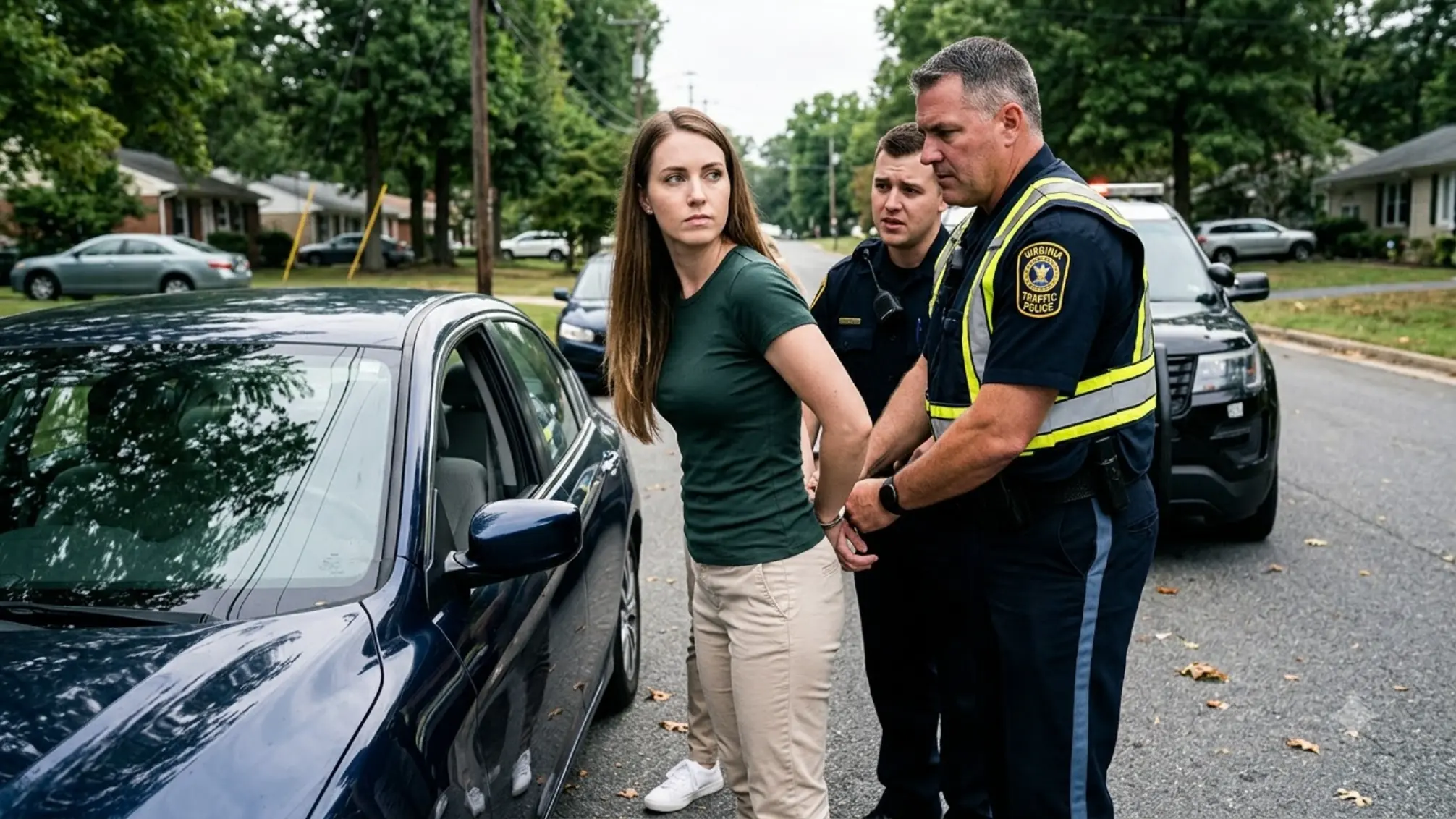
Reeves shoved her shoulder toward the car. “You don’t ask questions. You do what I tell you.” His partner, Officer Marcus Bell, stood behind Emily holding her other arm, but his grip was noticeably weaker and his expression lacked Reeves’s certainty. Emily turned her head just far enough to see the body camera clipped to Reeves’s chest. “Then say the reason for the stop while your bodycam is recording.”
Reeves leaned closer. “Keep talking and I’ll give you a reason to spend the night in a cell.” Emily went still. There was no point struggling physically, and Reeves seemed almost disappointed that she refused to provide the resistance he appeared eager to describe later. Instead, Emily memorized the time displayed on the dashboard clock through her open car door. 2:41 p.m.
Five minutes earlier, she had been driving home from a meeting in Richmond. Emily was a senior attorney for the Virginia Office of Professional Accountability, a state-level investigative division that reviewed serious misconduct complaints involving public agencies and law-enforcement departments receiving state funding. Most of her work happened quietly inside conference rooms, through subpoenas, interviews, records, and administrative hearings. She did not wear a uniform, carry herself like an investigator, or advertise her position when she was off duty.
That afternoon, Emily’s credential case sat inside her purse on the passenger seat. She had spent the morning reviewing a complaint involving another department nearly eighty miles away and was mentally outlining a report when she saw flashing lights behind her. She checked her speed immediately. Forty-two miles per hour in a forty-five zone.
She signaled and pulled over. Reeves approached the driver’s side while Bell remained near the rear of the vehicle. Emily lowered her window and placed both hands visibly on the steering wheel. “Good afternoon, Officer.”
“License.”
Emily waited a moment. “Can you tell me why I was stopped?”
Reeves’s expression changed almost instantly. “License and registration.”
“I’ll provide them. I’m asking why you initiated the stop.”
“Are you refusing?”
“No.”
Emily reached slowly toward the center console only after telling him what she was doing. She produced her license and registration and handed both documents through the window. Reeves looked at her driver’s license, then at her face.
“Step out.”
Emily’s eyebrows rose. “For what reason?”
“Out of the vehicle.”
Bell looked toward Reeves. “Daniel, maybe we should—”
“I said out.”
Emily stepped from the car because roadside arguments rarely became safer when conducted through an open driver’s door. She kept her hands visible. “I am complying. I am also asking what violation you observed.”
Reeves pointed toward the rear of her sedan. “Your plate came back suspicious.”
“What does suspicious mean?”
“Stop arguing.”
“I’m asking for clarification.”
That was when Reeves reached for her wrist.
Everything accelerated.
Emily’s hands were pulled behind her. Her chest pressed briefly against the side of the sedan, and Reeves ordered Bell to cuff her. Bell hesitated for approximately one second before obeying.
Emily felt the steel close around one wrist.
Then the other.
She did not resist.
Instead, she began building the incident in her mind exactly as she built professional misconduct cases for a living.
Time.
Location.
Names.
Commands.
Responses.
Body-camera status.
Witnesses.
The reason given.
Or in this case, the absence of one.
Reeves began searching the exterior of the car, pulling each door handle and looking through the windows. Emily turned slightly. “I do not consent to a search.”
Reeves laughed. “Nobody asked.”
“Then I’m making my position clear.”
Bell looked uncomfortable again. “Daniel, the registration matches her license.”
Reeves ignored him.
Emily focused on Bell. “Officer Bell, are you stating on camera that the registration matches?”
Bell’s eyes met hers.
“Yes.”
Reeves turned sharply. “Stop answering her.”
Emily almost smiled.
That was useful.
A woman walking a golden retriever had stopped half a block away. She raised her phone, clearly recording. Reeves noticed her and shouted, “Keep moving.”
The woman remained where she was.
“I’m on a public sidewalk.”
Reeves stepped toward her.
Emily spoke immediately. “Officer Reeves, threatening a witness will not improve this situation.”
He spun back toward her.
“Witness?”
“Yes.”
“You think you’re in charge here?”
“No.”
Emily held his stare.
“I think you’re creating evidence.”
That finally got to him.
Reeves came within inches of her face. “You’ve got some kind of attitude problem.”
Emily answered calmly. “If asking why I’m handcuffed is an attitude problem, your report should say exactly that.”
Bell looked away.
Reeves’s bodycam indicator was visible now.
Recording.
Good.
Reeves opened Emily’s rear passenger door.
She spoke louder.
“I do not consent to the search of my vehicle.”
“You were stopped for investigative purposes.”
“Investigating what?”
Reeves did not answer.
He searched the back seat anyway.
A laptop bag.
Two bottles of water.
A folded cardigan.
Nothing else.
Then he moved toward the front passenger seat and saw Emily’s leather purse.
Bell stepped closer.
“Daniel.”
Reeves looked at him.
“We should call Sergeant Mason.”
“No.”
“The plate is clean. License is valid. Insurance is valid.”
Reeves lowered his voice.
“She’s hiding something.”
Emily heard him.
“No, Officer. I asked you one question.”
Reeves looked back.
“What question?”
“Why did you stop me?”
Silence.
Emily nodded slightly.
“That’s what I thought.”
Reeves reached into her purse.
Emily’s expression changed.
“Do not search that bag.”
He pulled it toward him.
“I said I do not consent.”
Reeves opened it.
Wallet.
Keys.
A notebook.
Lip balm.
Credential case.
His hand stopped.
Emily watched carefully.
Reeves removed the black leather case.
For the first time, uncertainty appeared on his face.
Bell saw it.
“What is that?”
Reeves opened the case.
A state seal appeared inside.
Beneath it was Emily’s official photograph, full name, title, and agency identification.
Senior Investigative Counsel. Virginia Office of Professional Accountability.
Reeves stared.
Bell’s face changed immediately.
“Oh, no.”
Emily remained handcuffed.
Reeves looked from the credentials to her.
“You work for the state?”
Emily’s voice stayed even. “You already had my identification.”
“That’s not what I meant.”
“I know.”
Bell stepped closer.
“Ma’am, I’m going to remove the cuffs.”
Reeves snapped, “Wait.”
Bell looked at him.
“For what?”
Reeves struggled to recover.
“We’re not finished.”
Emily stared at him.
“You still haven’t stated the reason for the stop.”
Reeves held her credential case like it had personally betrayed him.
“You could have told us who you were.”
Emily’s eyes sharpened.
“Would that have changed whether you needed lawful cause to stop me?”
Reeves said nothing.
“Officer Reeves?”
He looked away.
Emily continued.
“Would you have treated me differently if I had shown you those credentials before asking why I was stopped?”
Bell lowered his head.
Nobody needed to answer.
The woman with the dog was still filming.
Another resident had appeared on a porch.
Then a third.
Reeves handed the credential case to Bell.
“Call Mason.”
Bell did.
Sergeant Kevin Mason arrived twelve minutes later.
By then Emily’s cuffs had finally been removed, but she remained beside the sedan with red marks around both wrists. Reeves stood near his patrol car writing notes while Bell paced several feet away. Mason stepped from his cruiser, took one look at the scene, and asked Reeves for a summary.
“Suspicious vehicle,” Reeves said.
Mason frowned.
“What made it suspicious?”
“Possible plate issue.”
“What issue?”
Reeves hesitated.
“Dispatch flag.”
Bell immediately spoke.
“There was no dispatch flag.”
Reeves turned toward him.
Mason’s expression hardened.
“Bell?”
Bell swallowed.
“The plate came back valid.”
Mason looked at Reeves.
“Then why was she detained?”
Reeves gestured toward Emily.
“She was argumentative.”
Emily said nothing.
Mason looked toward her.
“Ma’am, can you explain what happened?”
Emily answered in chronological order.
No emotion.
No exaggeration.
She gave the initial speed.
The location.
The first question.
Reeves’s commands.
The plate explanation.
The cuffing.
The search.
Her repeated refusal of consent.
The credential discovery.
Then she pointed toward Reeves’s chest.
“His body camera should verify most of it.”
Mason looked at the indicator.
Still recording.
“Officer Reeves, return to your unit.”
Reeves stiffened.
“Sergeant—”
“Now.”
Reeves walked away.
Mason then turned toward Bell.
“You too.”
Bell stopped.
“I’d like to make a statement first.”
Mason stared at him.
“That can happen at the station.”
Bell nodded.
Emily noticed something important.
Bell looked relieved.
Not frightened.
Relieved.
That meant the problem probably went beyond this single stop.
Mason asked Emily whether she needed medical attention.
“No.”
“Would you like photographs taken of your wrists?”
“Yes.”
That answer surprised him.
Emily explained.
“I would like this handled exactly as it would be if I were any other citizen.”
Mason nodded slowly.
“Understood.”
She looked toward Reeves.
“And I do not want my position to become the reason it receives attention.”
“What do you mean?”
“I mean if this conduct was improper when he thought I was an ordinary driver, it doesn’t become more improper because he learned I work for the state.”
Mason absorbed that.
“Yes, ma’am.”
Emily corrected him.
“Emily is fine.”
Thirty minutes later, she drove home.
She did not call the governor.
She did not call a news station.
She did not post anything online.
She called her supervisor.
Director Helen Price listened without interrupting.
When Emily finished, Helen asked one question.
“Were you acting in any professional capacity during the stop?”
“No.”
“Did you identify yourself before they searched the purse?”
“No.”
Helen became quiet.
“That simplifies one issue.”
“What issue?”
“No one can credibly claim the officer reacted to your authority.”
Emily nodded.
“He didn’t know.”
“Exactly.”
Helen instructed Emily not to participate personally in any formal investigation because her direct involvement created an obvious conflict. Instead, the office referred the matter to an independent regional review unit and requested preservation of all footage and dispatch records.
Emily agreed.
She knew procedure mattered most when emotions made shortcuts tempting.
The first surprise came the following morning.
There had been no dispatch error.
None.
No plate flag.
No stolen-vehicle alert.
No BOLO.
No matching suspect description.
Nothing.
Reeves had simply run Emily’s plate after seeing her car and initiated the stop.
The second surprise was worse.
The department’s automatic license-plate database showed Reeves had performed dozens of discretionary plate checks in the same corridor over the previous six months, followed by several stops where no citation was ultimately issued.
Investigators pulled the reports.
Many contained vague phrases.
Suspicious behavior.
Driver appeared nervous.
Investigative detention.
Possible registration discrepancy.
The language looked familiar.
Too familiar.
Then complaints surfaced.
A college student claimed Reeves pulled him over without explanation and searched his trunk.
A nurse said Reeves detained her for nearly forty minutes after she questioned why he stopped her.
A contractor reported that Reeves threatened arrest after the man refused permission to search his work van.
Most complaints had been marked unsubstantiated.
Emily read none of them personally.
Helen made sure of it.
But investigators did.
Bell requested a formal interview on the second day.
His attorney accompanied him.
Bell admitted that Reeves sometimes initiated stops first and searched for justification afterward. Younger officers had joked about it privately but rarely challenged him because Reeves had seniority and a strong relationship with a former shift commander.
“Why did you participate?” the investigator asked.
Bell looked down.
“Because it was easier than being the next person he targeted.”
“Targeted how?”
“Bad assignments. Complaints about attitude. Training notes. He could make you look incompetent.”
The investigator waited.
Bell continued.
“And because I convinced myself he knew something I didn’t.”
“Did he?”
“No.”
Bell’s voice dropped.
“I knew before we put the cuffs on her that there wasn’t enough.”
That admission mattered.
The investigation expanded.
Reeves was placed on administrative leave.
Bell remained on duty temporarily but was removed from traffic enforcement pending review.
Sergeant Mason voluntarily turned over shift communications showing he had previously warned Reeves about initiating stops without clearly articulable reasons.
The warning had never become formal discipline.
That raised another question.
Why not?
The answer led investigators toward former Lieutenant Patrick Sloan, who had supervised the unit until retiring four months earlier. Sloan’s emails showed he repeatedly discouraged formal complaints against productive traffic officers because he believed “aggressive interdiction” reduced crime.
No policy authorized suspicionless stops.
But culture could exist without written policy.
Emily understood that better than most people.
Systems rarely failed because someone wrote, Please violate citizens’ rights.
They failed because supervisors rewarded numbers, ignored complaints, accepted weak explanations, and taught younger employees which questions were unwelcome.
The woman with the golden retriever became one of the strongest witnesses.
Her name was Rachel Owens, a high-school history teacher.
She had recorded nearly eight minutes.
Her phone captured Reeves saying, “You don’t ask questions. You do what I tell you.”
It captured Emily asking for the reason.
It captured Bell confirming the registration was valid.
It captured Reeves opening the purse.
And it captured the exact moment his demeanor changed after seeing Emily’s credentials.
Rachel submitted the original video directly to investigators.
She did not post it.
That decision preserved the cleanest evidentiary version.
Three weeks later, the department held an emergency community meeting.
Emily did not attend.
She did not want the issue turned into a spectacle built around one recognizable victim.
Residents came anyway.
Some had their own stories.
Most were smaller than Emily’s.
A warning that became threatening.
A search request framed like a command.
A stop extended unnecessarily.
A driver treated differently after asserting a right.
Individually, the complaints had been easy to dismiss.
Together, they formed a pattern.
Chief Laura Bennett stood before more than two hundred residents and acknowledged something departments often resisted admitting publicly.
“We focused too heavily on whether each incident independently justified discipline.”
She paused.
“We failed to ask whether repeated similar complaints showed a larger problem.”
That became the turning point.
The department commissioned an external audit.
Traffic-stop reporting changed.
Officers had to document the specific reason for discretionary stops before initiating non-emergency searches whenever practicable.
Supervisors received automatic alerts when officers accumulated unusual rates of consent searches, extended detentions, or stops ending without citations.
Body-camera compliance reviews increased.
Complaint files became linked by officer instead of remaining isolated.
Nothing guaranteed perfect policing.
But the system became harder to manipulate through vague language.
Reeves faced a disciplinary hearing two months later.
His attorney argued he had genuinely suspected something irregular about Emily’s vehicle.
The review panel asked what.
He could not answer consistently.
First it was the plate.
Then her driving behavior.
Then her “attitude.”
Then an undefined instinct based on experience.
Body-camera footage contradicted several details in his written report.
That became devastating.
His report stated Emily had been “repeatedly noncompliant.”
The footage showed her obeying every physical command while repeatedly requesting the reason for the detention.
It stated she “attempted to interfere with a lawful vehicle search.”
The recording showed her saying, calmly, “I do not consent.”
It stated Bell supported the plate concern.
Bell testified otherwise.
Reeves eventually stopped defending every detail.
“I thought she was hiding something.”
A board member asked, “Because she asked why she was stopped?”
Reeves leaned back.
“It was how she asked.”
“What does that mean?”
He had no good answer.
The board found multiple serious policy violations.
Improper detention.
Unauthorized search.
Inaccurate reporting.
Failure to articulate lawful basis.
Unprofessional conduct.
Reeves was terminated.
Bell received a suspension and mandatory retraining, but investigators credited his cooperation and truthful testimony.
Some people believed he deserved termination too.
Bell himself understood why.
He requested a meeting with Emily months later through her attorney.
She agreed only after the investigation concluded.
They met inside a public conference room.
Bell looked nervous.
“I’m sorry.”
Emily waited.
“I knew something was wrong.”
“Yes.”
“I should’ve stopped him.”
“Yes.”
Bell looked toward the table.
“I keep thinking about when you asked me whether the registration matched.”
Emily remembered.
“You answered honestly.”
“Too late.”
“Later than it should’ve been.”
He nodded.
“I’m trying to do better.”
Emily studied him.
“That matters.”
Bell looked up.
“But?”
“There doesn’t need to be a but.”
He seemed surprised.
Emily continued.
“You don’t fix one bad decision by spending the rest of your life announcing how guilty you feel.”
She folded her hands.
“You fix it by making a different decision when the next moment comes.”
Bell absorbed that.
“Thank you.”
“Don’t thank me.”
Emily stood.
“Use it.”
Nearly a year after the stop, Emily drove the same Virginia road again.
Same trees.
Same speed limit.
Same stretch where flashing lights had appeared in her mirror.
For several seconds she felt her wrists remember the cuffs before her mind did.
Then the sensation passed.
She kept driving.
The department’s reforms had been in place for eight months.
Complaints declined.
Not disappeared.
Declined.
Searches decreased dramatically while citation rates remained almost unchanged, suggesting some previous searches had contributed little to actual traffic safety.
Bell became a field-training officer two years later.
During his first week training recruits, he showed them the footage of Emily’s stop.
A recruit asked why he would show a video where he looked terrible.
Bell answered without hesitation.
“Because I’m in it.”
The room went quiet.
“I want you to understand something.”
He pointed toward the screen.
“The officer doing the most damage isn’t always the only person responsible.”
Then he pointed toward himself.
“Sometimes responsibility belongs to the person standing two feet away who knows better and stays quiet.”
That lesson remained.
Emily never became famous from the incident.
She rejected interviews.
Her name appeared briefly in public disciplinary documents and then disappeared beneath newer stories.
That suited her.
She had never wanted revenge.
She wanted a record accurate enough that nobody could later rewrite what happened.
And that was exactly what existed.
A traffic stop at 2:41 p.m.
A valid plate.
A valid license.
No observed violation.
Questions answered with commands.
Commands escalating to handcuffs.
A purse searched without consent.
A body camera recording all of it.
And finally, a credential case that changed nothing about whether the original conduct had been lawful.
Years later, Helen Price asked Emily which moment she remembered most strongly.
Emily could have chosen Reeves discovering the state identification.
Or Mason arriving.
Or the disciplinary ruling.
She chose something else.
“The second Bell said the registration matched.”
Helen understood immediately.
Because that was the moment somebody inside the encounter confirmed reality.
One honest sentence.
Small.
Almost forgettable.
But investigations often turned on small things.
A timestamp.
A body-camera light.
A witness who kept filming.
A partner who eventually answered correctly.
A report that did not match video.
Power relied heavily on controlling the story.
Evidence took that control away.
And that became the enduring lesson of the roadside stop.
Emily’s state credentials did not save her.
They only made Reeves realize too late that the woman he thought he could intimidate understood exactly how accountability worked.
What saved the truth was simpler.
She remained calm.
She remembered everything.
The cameras kept recording.
And when the evidence was finally placed beside the officers’ explanations, only one version survived.