The first helicopter appeared beyond the rain-streaked windows of Seattle General Hospital just as Dr. Adrien Prescott raised his fist. Its dark silhouette swept between two office towers, banking so sharply that the people inside the emergency department could see the open side door and the armed crew member secured inside. A second helicopter followed, then a third, each flying low enough to make the glass tremble in its frame. By the time eight Blackhawks descended toward the hospital parking lot, no one was looking at the surgeon anymore.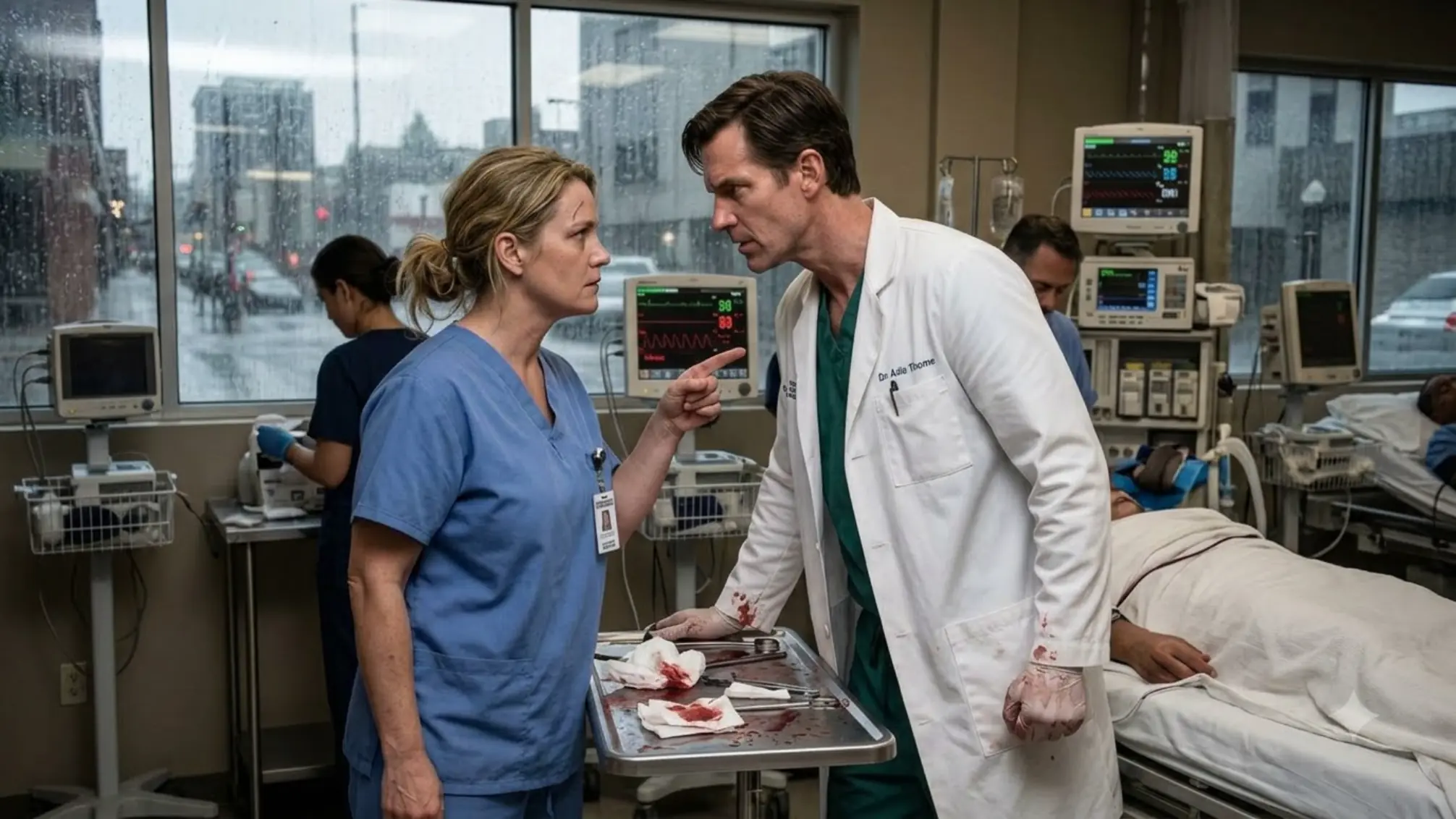
Clara Halloway stood beside the trauma bay in oversized blue scrubs, one foot angled slightly outward to ease the pressure on her damaged left leg. For two years, the staff had known her as the slow nurse who could not run during emergencies. She changed bedpans, updated charts, and handled the patients senior physicians considered unimportant. No one knew that three titanium pins held her leg together, or that she had once kept a wounded Marine alive inside a burning aircraft while treating her own shattered thigh.
Prescott lowered his fist, but only because the vibration beneath his feet had become impossible to ignore. The forty-five-year-old trauma surgeon had built his reputation on speed, confidence, and an almost theatrical refusal to admit uncertainty. Residents admired him, administrators protected him, and frightened nurses stepped aside whenever his voice rose. Clara had spent two years doing exactly that.
Not today.
Behind them, a seventeen-year-old crash victim gasped for air as his blood pressure collapsed. Prescott had diagnosed internal bleeding and ordered more blood, but Clara had seen the boy’s distended neck veins, uneven chest movement, and shifting trachea. She had warned him twice that the patient was suffering from a tension pneumothorax. He had responded by ordering her out of the trauma bay.
The monitor screamed another alarm.
Clara looked past Prescott. “Your patient has less than a minute.”
“I told you to leave.”
“And I told you what is killing him.”
Prescott stepped toward her again, but the automatic doors at the entrance burst open before he could speak. Three uniformed military personnel entered first, moving with disciplined speed rather than panic. They kept their weapons pointed safely downward, but their presence froze the nurses, residents, and security guards throughout the department.
A towering Marine captain with a scar through his left eyebrow surveyed the room. Rainwater ran from his tactical helmet onto his armored vest. He ignored Prescott, the stunned hospital security team, and every raised phone.
“I’m looking for Clara Halloway,” he announced. “Military call sign Angel Six.”
Every head turned toward the limping nurse.
Prescott gave a short, disbelieving laugh. “You landed eight military helicopters for her?”
The Marine captain’s expression changed. “Watch your tone.”
“She changes bedpans.”
“You are speaking about a recipient of the Navy Cross.”
The silence that followed was broken only by the dying teenager’s monitor.
Clara closed her eyes for one breath. She had not heard the name Angel Six spoken aloud in seven years. She had buried it beneath civilian credentials, oversized scrubs, and quiet apologies. That name belonged to a flight nurse who descended into combat zones, treated casualties beneath gunfire, and refused evacuation until every wounded service member had been loaded before her.
The Marine captain snapped to attention and saluted.
“Lieutenant Commander Halloway, Captain Silas Thorne, First Reconnaissance Battalion. We require your assistance.”
Clara did not return the salute immediately. “I’m no longer active duty.”
“We know.”
“My flight certification expired.”
“Your emergency combat rating remains valid under reactivation authority.”
“My leg cannot handle a standard insertion.”
Thorne stepped closer and lowered his voice. “Seven Marines are trapped in a ravine thirty miles north. Their aircraft went down during a classified operation. The corpsman is dead, the flight surgeon is missing, and Commander David Ricks is bleeding out.”
Clara’s face lost its color.
Ricks had carried her three miles through hostile territory after the crash that destroyed her leg. He had refused morphine for his own broken ribs so the limited supply could be used on Clara. When she had awakened in a military hospital, he had been sitting outside her room with blood still dried on his boots.
“How long does he have?” she asked.
“Maybe forty minutes.”
Clara turned toward the trauma bay. “Your aircraft have blood and a complete surgical kit?”
“Everything you requested during Kandahar deployments is loaded on the lead bird.”
Prescott finally recovered his voice. “She is not going anywhere. She is scheduled until seven, and she has been removed from patient care for insubordination.”
Clara pulled her hospital identification badge from her neck and placed it inside the breast pocket of his white coat.
“The boy in Bay One needs immediate needle decompression on the right side,” she said. “Do it now.”
Prescott stared at the badge.
“If you walk out,” he warned, “you are finished here.”
Clara looked directly into his eyes. “I finished here the moment you valued your ego above a patient’s breathing.”
She turned toward Captain Thorne.
“Take me to the helicopter.”
The Marines moved around her in a protective formation as she limped toward the entrance. Young nurse Sarah Jennings stood near the medication station with tears in her eyes. She had been one of the few people who treated Clara with kindness, though even she had assumed the limp came from an old accident rather than a battlefield.
“Clara,” Sarah called.
Clara stopped.
“What do we tell people?”
“Tell them to listen when a nurse sees something they missed.”
Then she walked outside.
The rotor wash struck her like a wall. Rain flew sideways across the parking lot as military personnel secured a perimeter around the eight aircraft. Hospital employees crowded the windows, watching the woman they had treated as invisible move toward the lead Blackhawk.
Clara climbed slowly, gripping the frame with both hands when her left leg failed to lift high enough. Captain Thorne started to assist her, but she shook her head and pulled herself inside. A sealed duffel bag waited on the floor beneath the seat.
“Commander Ricks kept your equipment,” Thorne said through the headset once they were airborne. “He said Angel Six might be needed again.”
Clara unzipped the bag.
Inside was her dark flight suit, tactical boots, trauma vest, and a faded patch bearing a winged number six. The equipment smelled faintly of canvas and machine oil. Her hands remained steady until she touched the patch.
For seven years, she had blamed herself for the crash in Kandahar. She had saved four people, but two others died before rescue reached them. Doctors repaired her leg, awarded her medals, and called her heroic, but she remembered only the lives she could not bring home.
She left the military and chose the busiest civilian hospital she could find. She told herself she wanted a quieter life. In truth, she believed humiliation was easier to endure than the possibility of failing someone again.
Clara changed into the flight suit while the Marines looked away. When she tightened the left boot over her scarred ankle, pain shot through her leg. She welcomed it.
“Situation report,” she ordered.
Thorne handed her a tactical tablet. “Training mission in the North Cascades. Commander Ricks’s aircraft discovered an illegal weapons transfer. Unknown shooters opened fire. The Osprey crashed inside a narrow ravine, and the surviving team has been holding the position for almost four hours.”
“Casualties?”
“Seven alive. Three critical.”
“Ricks?”
“Gunshot wound to the abdomen, penetrating injury near the neck, declining consciousness.”
Clara examined the topographic map. The ravine was too narrow for landing, surrounded by steep rock and dense forest. Extraction would require the Blackhawk to hover while Clara descended on a cable.
She looked at Thorne. “You said my leg would not matter.”
“It matters,” he admitted. “We simply have no alternative.”
The pilot’s voice entered their headsets. “Two minutes to the ravine. Visibility deteriorating.”
Clara opened the trauma kit. She inventoried chest seals, airway equipment, blood products, clamps, surgical tools, medications, and warming blankets. Her breathing slowed as familiar procedures replaced old fear.
The helicopter banked violently.
Small-arms fire struck the armored underside in a burst of metallic impacts. The Marines raised their weapons while the door gunner returned controlled fire toward the tree line. Snow and freezing air poured into the cabin as the side door opened.
Through the storm, Clara saw the wreckage below.
A broken Osprey lay against the ravine wall, smoke rising from one damaged engine. Muzzle flashes appeared between the trees above it. A Marine beside the wreckage waved a green signal light.
“We cannot land,” the pilot warned. “Thirty-second hover.”
Captain Thorne connected Clara’s harness to the descent cable. “I can send one of my medics first.”
“Your medic cannot perform field surgery.”
“He can cover you.”
“He can cover me after I reach the wounded.”
Clara moved to the open door. The ravine waited sixty feet beneath her.
For a moment she was back inside the burning aircraft in Kandahar, hanging upside down while flames moved across the ceiling. Her shattered leg had been trapped beneath a seat frame. Ricks had crawled through smoke, cut her free, and carried her away while ammunition detonated behind them.
Thorne placed one hand on her shoulder.
“Angel Six?”
Clara lowered her goggles.
“Send me.”
She descended through freezing wind and gunfire, gripping the rope hard enough to burn through her gloves. Her injured leg shook as the ground approached. She attempted to land on her right foot, but loose stone shifted beneath her boot.
Clara fell heavily.
Pain exploded through her hip and knee. For several seconds, she could not breathe. Bullets struck the rocks nearby, sending sharp fragments across her flight suit.
A young Marine crawled from behind the wreckage, grabbed her vest, and dragged her into cover.
“You’re Angel Six?” he shouted.
“Where is Commander Ricks?”
The Marine pointed toward the aircraft’s torn fuselage. “Inside. He keeps losing consciousness.”
Clara forced herself upright. “Then move.”
The interior of the wreckage smelled of burned wiring, fuel, and blood. Four wounded Marines held defensive positions near openings in the hull. In the center, David Ricks lay on a thermal blanket with a soaked dressing pressed against his neck.
He looked older than Clara remembered. His hair had turned silver, and his skin was almost gray. Yet when his eyes opened and found her face, the corner of his mouth lifted.
“You took your time,” he whispered.
“You chose a terrible place for a reunion.”
“I knew you would come.”
Clara cut away his uniform and examined the wounds. The neck injury was dangerous but controllable. The abdominal injury was worse. His stomach was rigid and swollen, signs of severe internal bleeding.
“What is his pressure?” she asked.
“Seventy over forty and falling.”
Clara inserted another intravenous line and ordered warmed blood. She packed the neck wound, stabilized the airway, and searched for any sign that the bullet had exited.
It had not.
“Clara,” Ricks said weakly. “You have to evacuate the younger Marines first.”
“You carried me through three miles of desert with broken ribs.”
“That was different.”
“No. You were simply more stubborn then.”
An explosion struck near the wreckage, showering the interior with debris. The young Marine beside Clara reached for his rifle, releasing pressure from Ricks’s neck.
Clara seized his wrist.
“Your job is the wound.”
“They’re moving down the ridge.”
“Then let the reconnaissance team handle the ridge. If you lift that hand again, your commander dies.”
The Marine pressed down harder.
Ricks’s monitor sounded a continuous alarm.
His heart had stopped.
Clara ordered chest compressions, but the abdomen continued filling with blood. Standard resuscitation would not save him. He needed an emergency thoracotomy and temporary control of the main blood supply below the heart.
The procedure belonged inside an operating room.
There was no operating room.
Clara opened the surgical pack.
“What are you doing?” the young Marine asked.
“Buying him enough time to reach a hospital.”
She made a controlled incision and used the compact field equipment to access the chest. The Marines around her fell silent despite the battle outside. Clara worked by the light of two tactical lamps while snow blew through the damaged fuselage.
Her hands remembered what fear had tried to erase.
She located the descending aorta, applied temporary control, and began manual cardiac massage. The heart remained still beneath her gloved hand.
“Medication in.”
The Marine pushed the drug through the intravenous line.
Clara compressed the heart again.
“Come on, David.”
Nothing.
She remembered waking after Kandahar and asking Ricks why he had returned to the burning aircraft for her. He had looked offended by the question.
Because you were still alive, he had answered.
Clara pressed again.
A faint movement touched her palm.
“I have activity.”
The monitor registered a weak rhythm. Then another.
The young Marine stared at the screen. “Pulse returning.”
Clara secured the temporary clamp and packed the surgical area. “Prepare the rescue basket. We move now.”
Captain Thorne’s voice came over the radio. “Hostiles are pulling back, but we have only three minutes before they regroup.”
“Lower the hoist.”
The Blackhawk appeared through the snow, hovering above the ravine while its rotors scattered loose branches and debris. A rescue basket descended on a steel cable, swinging violently in the wind.
Clara and the Marines lifted Ricks into it. She attached herself beside him, refusing to be raised separately while the clamp required constant monitoring. As they began ascending, shots rose from the tree line.
One struck the basket frame.
Another hit the helicopter’s lower armor.
Halfway to the aircraft, the cable stopped.
“Winch failure,” the crew chief shouted through the headset. “Switching to manual recovery.”
Clara and Ricks hung fifty feet above the ravine, exposed beneath the hovering helicopter. Below, armed figures emerged from the forest. One raised a shoulder-fired weapon toward them.
Captain Thorne shouted a warning.
Clara drew the sidearm secured to her vest. The basket swung left, then right. She steadied her arm against the frame and waited for the movement to align.
She fired once.
The gunman fell backward, and the weapon discharged harmlessly into the mountainside. The explosion sent snow and rock into the air but missed the helicopter.
“Target down,” Clara said. “Continue the recovery.”
The manual winch pulled them upward inch by inch. Strong hands finally reached from the helicopter and dragged the basket inside. The aircraft banked away from the ravine while the remaining Blackhawks covered the retreat.
Clara remained beside Ricks, managing his airway, circulation, and temperature. His pulse weakened twice during the flight. Each time, she restored it.
“Nearest surgical center?” she asked.
“Seattle General,” the pilot answered. “Seven minutes.”
Captain Thorne looked uncomfortable. “Command prefers a military facility.”
“The military facility is twenty-one minutes away.”
“The operation is classified.”
Clara looked down at Ricks’s open chest. “Classification will not revive him.”
Thorne hesitated.
“If we fly twenty-one minutes, he dies,” she continued. “Choose whether you want to protect a secret or a living commander.”
Thorne keyed his radio. “Divert to Seattle General. Medical emergency.”
The eight helicopters returned over the city in formation.
At Seattle General, employees gathered beside the windows as the aircraft approached. Prescott stood near the nurses’ station holding a cup of coffee. He had successfully decompressed the teenage patient’s chest minutes after Clara left, and the boy’s condition stabilized almost immediately.
Prescott had told no one that Clara’s diagnosis saved the patient.
The rooftop doors opened, and Marines rushed through with Ricks on a gurney. Clara walked beside him in a blood-stained flight suit, one hand maintaining control of the surgical clamp. Her limp was severe now, but she moved with purpose that made every person in the corridor step aside.
Prescott stared at her.
“You resigned,” he said.
Clara continued toward Trauma Bay One. “Male, fifty-two. Penetrating abdominal and neck trauma. Emergency thoracotomy performed in the field. Temporary aortic control established. Prepare ten units of blood and call vascular surgery.”
Prescott reached for her arm. “You cannot bring an unauthorized military patient into my department and start giving orders.”
Captain Thorne moved between them.
“Touch her,” he said quietly, “and you will become the next patient.”
Prescott looked around. Nurses, residents, security officers, and hospital administrators were watching. None of them appeared willing to support him.
Clara connected Ricks to the trauma monitor.
“I need a surgeon capable of repairing the vessel,” she said. “Are you capable, Doctor?”
Prescott looked at the field procedure, the stable airway, and the rhythm Clara had maintained through the flight. He understood the level of skill required to keep Ricks alive under those conditions.
“I can repair it.”
“Then scrub in.”
For the next four hours, Clara directed the resuscitation while Prescott performed the vascular repair. She did not humiliate him, but she corrected him whenever speed threatened precision. For the first time in his career, he followed the instructions of a nurse without argument.
Ricks survived the operation.
When Clara emerged, exhaustion overtook her. Her injured leg buckled, and Captain Thorne caught her before she struck the floor. He supported her toward the waiting area, where more than twenty uniformed service members stood beside the hospital board.
A four-star general stepped forward.
He was the father of one of the young Marines Clara had treated in the ravine. Without speaking, he raised his hand in salute. Every uniformed person behind him did the same.
“Lieutenant Commander Halloway,” the general said, “you saved seven Marines and recovered a commander no one believed could survive extraction.”
Clara returned the salute slowly.
“I saved people who were still alive.”
The general looked toward the hospital director. “Did this institution know it had a Navy Cross recipient emptying bedpans?”
The director could not answer.
Prescott stood at the edge of the room, still wearing blood-stained surgical scrubs. Clara looked at him, but there was no triumph in her expression.
“You were correct about the teenager,” he admitted.
“He needed you to recognize that before someone more important entered the room.”
Prescott lowered his eyes.
The hospital board ordered an immediate review of his conduct. Investigators interviewed nurses, residents, technicians, and former employees. Fifteen people described intimidation, retaliation, and repeated refusal to consider observations from staff members he viewed as beneath him.
Prescott was removed as trauma chief. He resigned several weeks later rather than complete the corrective program required for reinstatement.
Sarah became part of a new clinical-response committee that allowed nurses to escalate urgent concerns without fear of retaliation. The teenage crash victim recovered fully and later visited the emergency department to thank the nurse who had recognized his collapsed lung.
Clara was not there.
She accepted a position as chief instructor at the Joint Special Operations Medical Training Center. Her job was to prepare military nurses and medics to make impossible decisions in hostile environments.
On her first morning, forty students waited inside a training hall. Some noticed her limp and exchanged doubtful glances as she walked toward the front. Clara placed a heavy trauma bag on the table.
The room became silent.
“My name is Clara Halloway,” she said. “Some people once called me Angel Six.”
Several students straightened.
“You may have heard stories about the ravine, the Osprey, or Commander Ricks. Forget the stories. Legends do not stop bleeding, and reputations do not maintain airways.”
She opened the trauma bag.
“What saves people is preparation, discipline, and the willingness to listen when someone sees what you missed.”
A young corpsman in the front row raised his hand. “Ma’am, is it true eight helicopters landed at a civilian hospital just to find you?”
Clara looked toward the window, where distant training aircraft crossed the morning sky.
“No,” she said. “They landed because seven people were still alive.”
She paused, then gave the class the faintest smile.
“I was simply the person who refused to let them die.”