He was just another old man wearing a faded bomber jacket.
At least, that was what the TSA agent seemed to think when he scoffed at the dented metal case in the man’s hands.
“Souvenirs do not count as carry-ons,” the agent said with a smirk.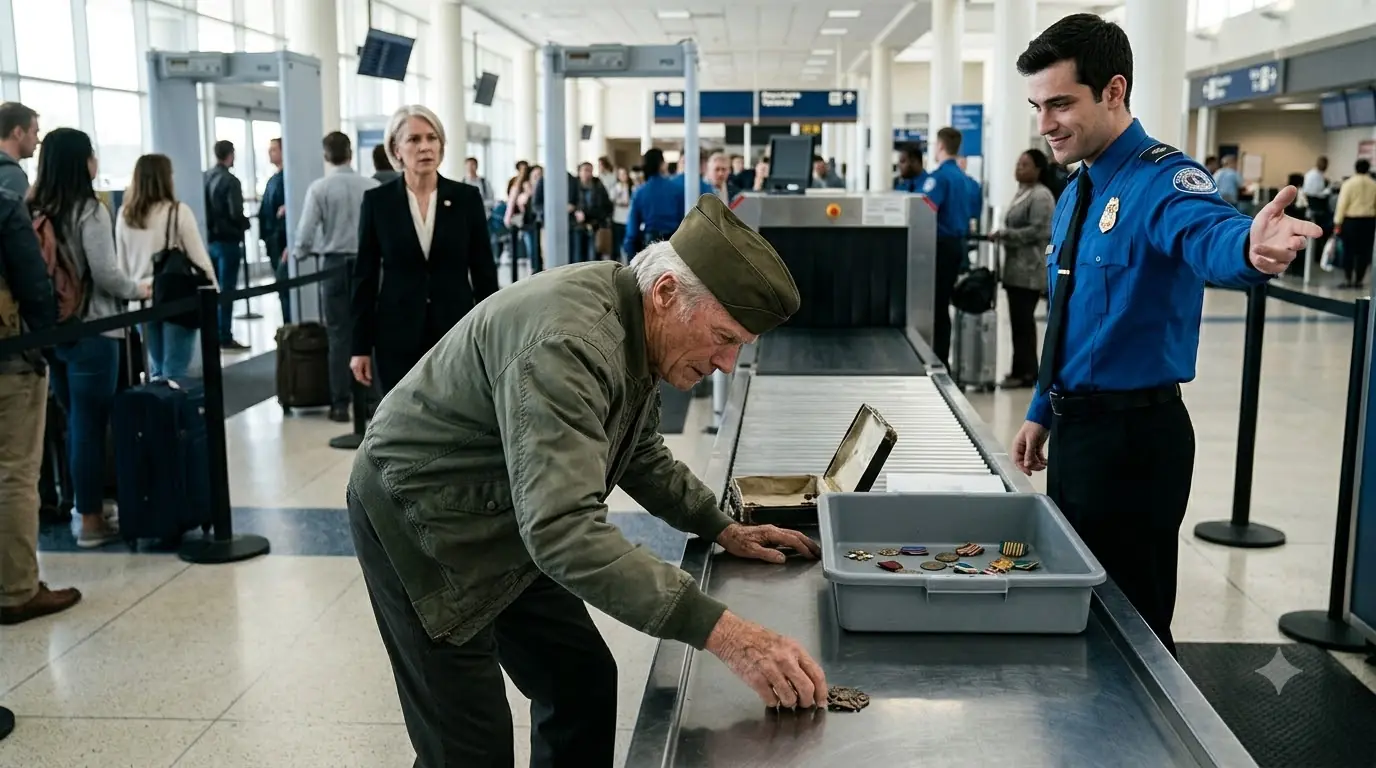
He tossed the small case into a gray plastic inspection bin as though it held nothing but rusty junk.
The case struck the side of the bin, flipped over, and burst open.
Medals spilled across the conveyor belt like forgotten coins at a yard sale.
Nobody moved.
Nobody appeared to care.
Ten minutes later, the entire terminal fell silent, and the sound of polished uniform shoes striking the tile echoed like thunder inside a church.
The old man everyone had ignored had once carried the burdens of a nation on his shoulders.
They had thrown his legacy into a plastic bin.
His name was Henry Dalton.
Master Gunnery Sergeant, retired.
He was eighty-two years old, wiry, disciplined, and quietly proud.
Henry walked with a limp no cane could completely correct. He wore his scars not as burdens, but as parts of a uniform no one had ever asked him to remove.
He moved slowly but deliberately. His eyes remained sharp beneath the brim of a worn olive cap embroidered with a patch most people no longer recognized.
Force Recon.
Second Marine Division.
Terminal C at Southgate International Airport buzzed with its usual confusion.
Suitcase wheels dragged across the tile. Babies cried. Telephones chimed, boarding announcements echoed overhead, and travelers hurried toward gates as though the next five minutes would determine the direction of their entire lives.
In the middle of it all, Henry waited patiently in the security line.
He carried only a weathered duffel bag, a manila folder containing his boarding pass and travel documents, and the dented metal case.
The inside of the case was lined with old velvet. To Henry, it still carried faint traces of gun oil, desert dust, and memories he rarely explained.
He was traveling to Washington, D.C., for a memorial ceremony at Arlington.
It was one final invitation to speak on behalf of his unit.
For once, someone wanted to hear from the men who were still alive.
Before Henry could reach his gate, or even pass through the scanner, he was stopped by a bored young agent wearing mirrored glasses.
The name badge on his uniform read TRENT.
Trent looked at the metal case without interest.
“What is this?”
“Military awards,” Henry answered. “Personal effects.”
“I am taking them to Arlington.”
“Cannot do that,” Trent muttered.
He was already opening the case.
Inside rested a Bronze Star, a Purple Heart, two campaign medals associated with Vietnam and Desert Shield, and a custom unit crest made many years earlier in Saigon.
Each piece occupied its own place in the faded velvet.
The medals had tarnished with time, but there was no mistaking that they had been earned.
Trent turned the case upside down.
The medals dropped into the plastic bin with a hard metallic clatter, like loose change emptied from a pocket.
The custom unit crest bounced out of the bin, rolled across the floor, and stopped beside the wheel of a woman’s stroller.
Henry bent down.
His knees resisted him, and pain crossed his face as he reached for the fallen emblem.
He picked it up with a low grunt.
“Hey, buddy,” Trent called, loudly enough for nearby passengers to hear. “Next time, ship your antiques ahead.”
He leaned against the screening table.
“This is not a museum.”
Laughter came from behind the security desk.
One of Trent’s coworkers nudged him with an elbow.
“Probably bought them online.”
Henry said nothing.
He carefully returned each medal to its place inside the case.
He adjusted the unit crest in its slot and closed the damaged lid.
“You finished?” Henry asked.
“You can go,” Trent said, waving him forward without a second look.
Several passengers witnessed what happened.
A few looked uncomfortable.
Most turned away.
One person did not.
Her name was Lana Rivera, a senior flight attendant assigned to United Flight 1875.
She had noticed Henry before he entered the security line.
She saw the precision in his step, the controlled posture, and the way his eyes assessed each corner of the terminal.
It was habit rather than paranoia.
Lana stood inside the priority line, helping pilots complete their check-in procedures, when she witnessed the agent empty Henry’s medals into the bin.
She did not confront Trent.
Instead, she stepped aside and made one telephone call.
The person answering was not an airport supervisor or a public-relations representative.
The call was answered on the second ring.
Lana explained what had happened.
The voice on the other end asked only one question.
“What gate?”
Henry sat alone near Gate 12.
He occupied one of the rows of metal chairs nobody selected unless the rest were taken.
The damaged case had been taped shut with TSA inspection labels.
Henry held it gently across his lap as though it were something sacred.
Outside the large terminal window, an aircraft taxied toward a runway.
A boarding announcement for another flight echoed through the terminal like distant static.
Nobody paid attention to Henry.
He was only an elderly man holding a box.
The world had already decided he no longer mattered.
Henry did not want applause.
He did not want special treatment.
He only wanted to reach Arlington.
Respect, it seemed, had to be earned again, even by people who had already surrendered almost everything.
At the security checkpoint, Trent continued joking with another agent about a bottle of perfume confiscated from a passenger.
He did not notice the message appearing on the internal Department of Homeland Security system.
He did not hear the first measured footsteps crossing the polished floor.
He certainly did not see four black vehicles entering through a restricted tarmac access gate with authority no ordinary airport badge could challenge.
Everyone else noticed.
Heads turned when she entered.
Secretary of Defense Margaret Holston.
There was no press entourage.
There were no television cameras.
She entered carrying only the unmistakable gravity of her position.
Her eyes scanned the terminal once and immediately found the elderly man seated near Gate 12.
Ten minutes had passed.
The reckoning had arrived.
The moment Secretary Holston stepped through the glass doors of Terminal C, the atmosphere inside the building changed.
At first, the shift was subtle, like the sensation that came before thunder.
She was not visiting for a scheduled appearance or a press conference.
She had come because someone informed her that a man who deserved dignity had instead received a smirk and an inspection sticker across his legacy.
Holston wore a regulation civilian black suit.
Her shoes struck the floor with purpose as she crossed the concourse, her eyes fixed on Gate 12.
The surrounding conversations, overhead jazz, and repeated boarding announcements seemed to fade beneath the weight of her presence.
Nobody needed to announce who she was.
Passengers who did not recognize her still stood straighter without understanding why.
Travelers stopped in the middle of the concourse. Parents drew their children slightly closer, and airline employees turned from their monitors to watch power moving quietly through the terminal.
At the security checkpoint, Trent looked up.
He appeared confused by the sudden silence descending around him.
He stretched his neck and saw a woman in black accompanied by three officers in crisp dress uniforms.
“Someone must have missed a flight,” he muttered.
Then a supervisor’s voice broke through the communication device at his collar.
“All personnel, be advised. Senior Department of Defense officials have entered Terminal C.”
Trent’s smile disappeared.
“Full cooperation is required. Do not approach without authorization.”
His jaw tightened.
The agent beside him slowly turned and gave him a deliberate look.
Whatever was happening, Trent assumed it had nothing to do with them.
At Gate 12, Henry had not moved.
His back remained straight despite the stiffness in his spine. The taped metal box rested on his lap as though it were too fragile to be handled carelessly again.
He did not notice the silence spreading behind him.
He did not see people stepping aside.
What he heard was the measured sound of regulation dress shoes approaching.
Deliberate.
Precise.
Familiar.
Secretary Holston stopped in front of him.
The remaining noise inside the terminal disappeared, as though power had been cut to the building and time itself had paused to allow dignity onto the floor.
Holston did not speak immediately.
She removed her hat.
Then she rendered a crisp and deliberate salute.
It was not the casual gesture used during public photographs.
It was the kind of salute reserved for warriors.
It was the kind she had rendered at funerals.
Henry looked up.
Slowly, he rose from the chair, using one armrest to steady himself.
His free hand lifted in response.
It was not reflex.
It was respect.
“Master Gunnery Sergeant Dalton,” Holston said clearly.
Her voice was rough but controlled.
“You were disrespected by this institution.”
She lowered her hand.
“That ends now.”
Behind her, an aide opened a sleek government-issued case.
Inside was a new presentation box lined with dark velvet.
Henry Dalton’s name had been engraved into a brass plate.
Beneath it were four words.
FOR VALOR CARRIED QUIETLY.
Secretary Holston accepted Henry’s damaged case.
She removed the TSA tape herself and opened the bent lid carefully.
With gloved hands, she transferred each medal into the new display.
Every movement was deliberate and reverent.
The Bronze Star.
The Purple Heart.
The Vietnam campaign medal.
The Desert Shield medal.
Finally, she lifted the unit emblem created in Saigon.
Holston held it for a few seconds longer than the others.
Her thumb moved gently across its worn edge.
“My father wore this same emblem,” she said quietly.
Henry’s expression changed.
“He always told me men like you built this country piece by piece and paid for it in silence.”
Henry did not answer.
He did not need to.
His eyes communicated enough.
Holston turned toward the terminal while holding the new case.
She did not use a microphone.
Her voice carried without one.
“Ten minutes ago, a man who served this country with distinction was humiliated inside this airport.”
The passengers became even more still.
“Not by an angry crowd and not during a protest.”
She looked toward the security area.
“He was humiliated by a uniformed federal employee who forgot that respect is not optional.”
Cell phones rose.
Passengers who had been preparing to board stopped to listen.
Across the terminal, Trent stood frozen.
“This is not only about one man’s medals,” Holston continued. “It is about the belief that service ends when a war ends.”
Her gaze moved across the crowd.
“It is about the way men and women who carried burdens for the rest of us become invisible after they put on civilian clothes.”
Her voice dropped lower.
“Remember something today.”
The terminal remained silent.
“Medals do not shine because they have been polished.”
Holston touched the edge of Henry’s display case.
“They shine because of sacrifice, endurance, and the distance someone traveled to earn them.”
A Marine officer stepped forward and respectfully offered Henry his arm.
Secretary Holston placed the new case into Henry’s hands.
“Would you walk with me?” she asked.
Henry nodded.
He rested one hand against the Marine officer’s arm. His olive cap sat slightly lower across his forehead, and his medals now rested somewhere worthy of them.
Together, they moved through the terminal.
The crowd opened around Henry like water parting before a ship.
Nobody attempted to stop them.
Military officers saluted.
Passengers stepped back in silence.
As they approached the security checkpoint, Secretary Holston paused.
Her gaze found Trent.
He stood pale and motionless behind the inspection table.
Holston did not raise her voice.
She spoke only loudly enough for him to hear.
“You do not handle carelessly what you have never earned.”
Then she continued walking.
The reckoning had arrived without violence or public rage.
It had arrived as truth.
The kind of truth that remained long after footsteps faded and changed the way witnesses remembered an ordinary morning.
At Terminal C, respect did not arrive through procedure or permission.
It arrived with purpose.
From that moment, nobody looked at Henry Dalton in the same way.
Henry did not ask for applause as he crossed the terminal.
He received it anyway.
One hesitant clap began somewhere near the gate counter.
Then another joined it.
More followed until the sound moved through the concourse like a storm of realization.
The applause was not pity.
It was awakening.
The elderly man passengers had ignored, the man with the disciplined posture and taped-shut box, now walked through the terminal beside the Secretary of Defense and a Marine officer.
His medals rested inside a case bearing his name on brass rather than a barcode sticker.
The silence broke completely.
What filled it was not ordinary noise.
It was reverence.
People stood.
Airline personnel, maintenance workers, pilots, and jet bridge operators placed their hands over their hearts.
A young boy slipped from his mother’s side and approached closely enough to be heard.
“Were you a hero?”
Henry stopped.
He lowered himself slowly until he was near the child’s eye level. His bones resisted the movement, and his breath tightened.
“I served,” Henry said.
Then he stood.
Heroes did not always need to explain themselves.
When Henry reached the entrance to the aircraft, the pilot had already left the cockpit to greet him.
The pilot’s eyes were glassy, but his expression remained firm.
“We will hold the aircraft,” he said. “Take whatever time you need.”
Henry nodded once and boarded.
Outside the aircraft, the story was not finished.
Secretary Holston turned toward the gathered passengers and raised one hand.
She was not asking for silence.
She was asking them to remember.
“This country has always been divided by the way it treats its past,” she said.
Her voice remained controlled.
“Some people bury it. Some reshape it for their own purposes.”
She looked toward the aircraft Henry had entered.
“A few people carry it.”
No one moved.
“Master Gunnery Sergeant Dalton carried fallen brothers, missions that could never be discussed, and years of silence most of us could not endure, much less carry with grace.”
Holston took one step forward.
“When his name disappeared from active rosters and his rank became something spoken only in memories, he still continued serving.”
She let the statement settle.
“Service is not merely what you once did.”
Her voice softened.
“It is what you carry forward.”
The TSA supervisor arrived while she was still speaking.
He was breathless and pale, offering apologies that had come too late.
Trent stood behind the crowd.
There was no longer a trace of his earlier smile.
His eyes remained fixed on Henry’s aircraft.
The man he mocked was now being honored by the same institution Trent represented without understanding.
Secretary Holston briefly addressed the security employees.
She was not cruel.
She was unmistakably clear.
“You do not have the right to judge what you have never possessed the strength to become.”
She did not mention anyone by name.
She did not need to.
Everyone understood.
Within hours, recordings from Terminal C appeared online.
Passengers, journalists, and airline employees uploaded different angles of the same event.
The story spread rapidly.
An elderly veteran had been disrespected, recognized, and publicly restored within the span of one airport morning.
A gate agent uploaded a recording with a simple caption.
He did not need a parade. He only needed one person to see him.
By nightfall, Henry Dalton’s name was being discussed throughout the country.
Comment sections filled with messages.
“My grandfather served with him.”
“My father wore the same emblem.”
“I saw that man at a veterans’ clinic once. He held the door for ten people.”
Henry did not read any of it.
He arrived in Washington the following day.
At Arlington, Henry stood before the memorials of men who had never grown old enough to be ignored inside an airport.
He saluted his fallen brothers.
Then he delivered a quiet and precise speech on behalf of his unit.
The speech ended with five words.
“I was proud to serve.”
When Henry stepped away from the podium, he approached a young corporal.
The young man had never experienced combat but trained every day with the seriousness of someone who understood that one day he might.
Henry held out the new medal case.
“Keep this safe,” he said.
The corporal stared at him.
“You will need its meaning more than I do.”
Back at Southgate International Airport, a small brass plaque was later installed beside the TSA checkpoint.
There was no public ceremony.
No press release announced it.
Four lines had been engraved into the metal.
MASTER GUNNERY SERGEANT HENRY DALTON
BRONZE STAR, PURPLE HEART
VIETNAM, DESERT SHIELD
DISRESPECTED HERE, THEN RIGHTFULLY HONORED. LET THIS NEVER HAPPEN AGAIN.
Anyone who witnessed that morning remembered the same image.
An elderly man bending painfully to retrieve a fallen medal from the airport floor.
He held it between both hands like a memory too sacred to describe.
The story had never truly been about punishment.
It had been about recognition.
A person could lose rank, position, youth, and physical strength.
He did not lose the right to be seen.
On that day, Henry Dalton was finally seen.
Not as a burden.
Not as an antique from another generation.
Not as an old man whose most important years had already passed.
He was seen as what he had always been.
A Marine.
A leader.
A living legacy still moving forward.
And he was alive to witness it.