“He isn’t asking for help,” the nurse said. “He’s warning us.”
For the first time in nearly twenty minutes, the packed trauma room went completely silent.
Twenty-six-year-old Elena Marlowe stood beside the gurney with one gloved hand resting on the metal rail, her luminous hazel eyes fixed on the wounded man lying beneath the bright ceiling lights. Dark-brown hair had been pulled into a neat low ponytail at the beginning of her shift, but several loose strands now framed her face. Her blue scrubs were still clean except for a faint streak near one sleeve where she had helped stabilize the patient when he arrived.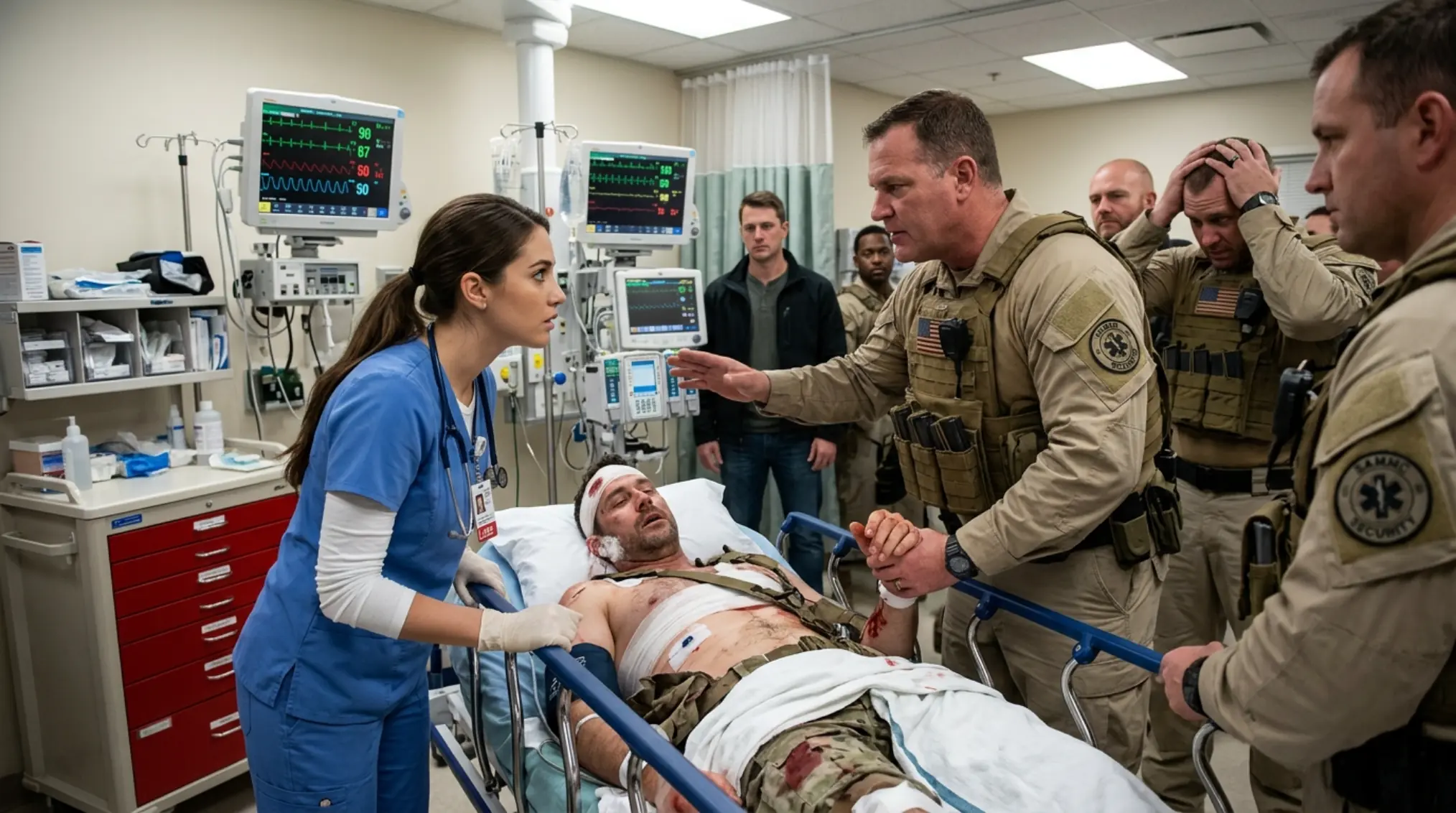
Across the bed, forty-four-year-old Grant Mercer, director of field security for Meridian Response Group, tightened his grip on the rail.
“Twelve interpreters listened to him,” Grant snapped. “None of them understood a word. Stop guessing.”
Elena did not look at Grant.
The patient’s name was Nathan Vale, thirty-eight, a senior field investigator for Meridian, a private organization hired by corporations, insurers, and humanitarian groups to recover personnel and document fraud in unstable regions. Three hours earlier, Nathan had been brought into the secure San Antonio medical center after an extraction went catastrophically wrong.
His left leg was heavily bandaged.
A white dressing wrapped his head.
Bruises covered one side of his face.
But what worried the doctors most was not the visible damage.
It was what Nathan kept trying to say.
He had been repeating the same broken sequence of sounds since arriving.
Again.
And again.
And again.
The medical staff initially assumed he was confused from medication.
Then Grant recognized that the sounds had a linguistic structure.
Meridian began calling interpreters.
Arabic.
Turkish.
Persian.
Kurdish.
Pashto.
Uzbek.
Azeri.
Russian.
Two specialists in regional dialects.
A university professor.
Finally, an independent language consultant patched in through video.
Nobody could translate Nathan’s words with confidence.
Now Elena leaned closer.
Nathan’s bloodshot eyes locked onto hers.
He whispered the phrase again.
“Dar vah… selan… ketir… Varik.”
Elena froze.
Grant noticed.
“What?”
She slowly repeated one part.
“Varik.”
Nathan’s fingers tightened around the blanket.
His eyes widened.
Elena repeated the earlier sounds carefully, changing the rhythm.
“Darvah selan ketir?”
Nathan suddenly grabbed her wrist.
Every man around the bed moved at once.
Grant reached toward him.
Elena lifted her free hand.
“Don’t.”
Nathan stared past her shoulder.
His trembling hand rose.
One finger extended.
Not toward Grant.
Not toward the door.
Toward a man standing beside the cardiac monitor.
Elena followed his gaze.
The man was Daniel Cross, forty-one, Meridian’s logistics coordinator.
Daniel had been in the room since Nathan arrived.
Quiet.
Helpful.
Almost invisible.
He had coordinated transportation from the airfield.
Delivered Nathan’s medical records.
Provided the names of the missing team members.
And stood beside the monitors listening to every failed attempt to translate Nathan’s warning.
Daniel saw everyone looking at him.
“What?”
Elena’s face hardened.
Nathan whispered the final word again.
“Varik.”
Daniel’s expression changed.
Only slightly.
But Elena saw it.
Grant demanded, “What did he say?”
Elena looked directly at Daniel.
“He just named the man who sold them out.”
Grant released Nathan’s wrist.
“What?”
Daniel gave a short laugh.
“That’s ridiculous.”
Nathan began trying to sit up.
His heart monitor accelerated.
Elena immediately pressed him gently back.
“Stay down.”
Daniel stepped toward the bed.
“You don’t even know what language he’s speaking.”
Elena turned.
“I do now.”
“You’re a nurse.”
“And?”
“You’re not an interpreter.”
“No.”
Daniel smiled coldly.
“Then stop pretending.”
Elena studied him.
“You understood the word Varik.”
Daniel stopped smiling.
Grant noticed.
“So did I,” Elena continued. “Not because it’s a name.”
Nathan whispered again.
Elena nodded.
“It means something closer to ‘the one beside you.’ But only in a mountain dialect spoken in a handful of villages near the eastern border.”
Grant stared at her.
“How do you know that?”
“My grandmother grew up speaking it.”
Nobody in the room moved.
Elena had been a nurse at Stonebridge Medical Center for only eleven weeks.
Most of the security personnel surrounding Nathan assumed she was inexperienced because she was young.
That assumption was partly correct.
She was new to trauma nursing.
But they knew nothing else about her.
Elena’s grandmother, Mira Petrosian, had emigrated to the United States decades earlier from a mountain community where several languages overlapped so heavily that outsiders often mistook local speech for corrupted versions of larger regional languages.
Mira had raised Elena after her parents died in a car accident.
Their house had been filled with old expressions, songs, arguments, recipes, and stories spoken in a dialect Elena rarely heard anywhere else.
As a child, Elena hated it.
At sixteen, she begged her grandmother to speak English when friends visited.
At twenty, she started appreciating what she had nearly lost.
By twenty-four, she was recording Mira’s stories so the language would survive inside their family.
Now that forgotten knowledge had followed Elena into a trauma room.
Grant stepped closer.
“Translate everything.”
“I can’t.”
His jaw tightened.
“You just said—”
“I understand pieces. Nathan’s pronunciation is damaged and he’s mixing words.”
Nathan whispered again.
Elena listened.
This time she heard more.
“Stone… river… three… brother… Varik.”
Her eyes narrowed.
Grant asked, “What?”
Elena looked at Nathan.
“Three?”
He blinked once.
She tried again.