Rain had been falling over Pine Ridge County for thirty-one hours when Highway 17 disappeared beneath the water. It had begun as a steady spring storm on Thursday afternoon, nothing unusual for western North Carolina, but by sunrise Friday the creeks had broken their banks and the low valleys had turned brown with runoff. County crews closed secondary roads one after another while deputies pushed barricades into intersections already disappearing beneath fast-moving water. By ten that morning, everybody in the county understood the storm had become something else.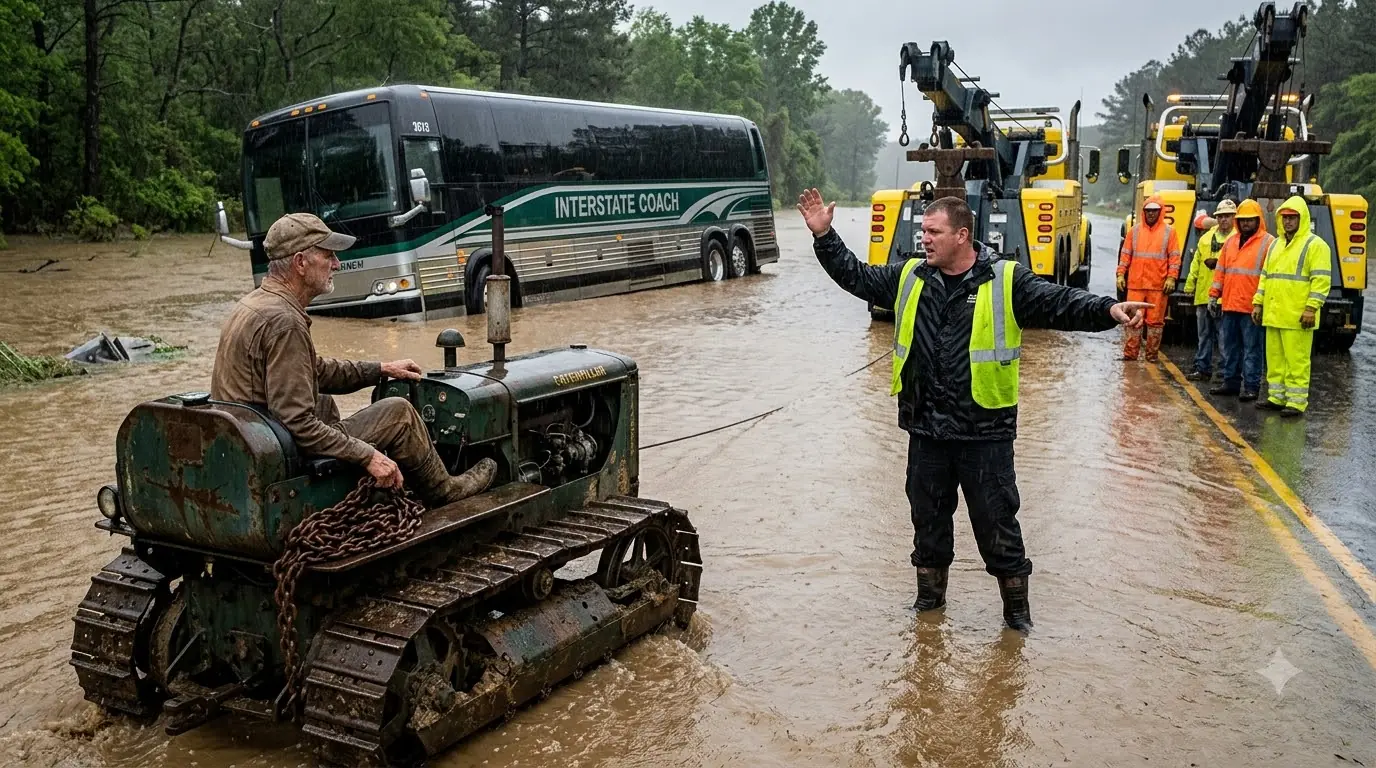
The worst trouble came six miles north of Pine Ridge, where Highway 17 crossed a low section between two wooded ridges. Water from Beaver Creek spilled across the road and began cutting through the soft shoulder on the eastern side. A southbound interstate coach carrying thirty-eight passengers entered the flooded stretch before the driver realized how deep it had become. Halfway through, the rear wheels dropped into a collapsing section of pavement and the forty-five-foot bus lurched toward the ditch.
The driver, Raymond Ellis, slammed on the brakes. Passengers screamed as suitcases fell from overhead racks and muddy water rushed past the windows. The bus stopped at an angle with its rear axle buried and its right side leaning toward the washed-out shoulder. Raymond shut down the engine before water could climb high enough to destroy it, then began moving passengers toward the front.
Nobody was seriously injured, but the situation worsened by the minute. The current pressed against the broad side of the coach, and every new surge shifted the rear wheels another inch toward the ditch. County emergency workers arrived and began evacuating passengers through the front door using a rope line. Within twenty minutes, all thirty-eight people were standing on higher pavement beneath blankets and rain jackets.
The bus remained.
That mattered more than it first appeared.
The ditch beside Highway 17 did not lead to an ordinary drainage channel. Forty yards downhill stood a concrete culvert carrying Beaver Creek beneath the road. If the coach slid completely sideways and blocked the culvert, county engineers feared the backed-up water could divert toward a neighborhood of seventeen homes below the ridge.
The county called Vaughn Heavy Recovery.
Derek Vaughn arrived forty minutes later with two machines that looked capable of pulling a building off its foundation. Each recovery truck had cost nearly $345,000 before specialized equipment, and Derek reminded people of that fact often enough that most employees knew the number by heart. The trucks carried hydraulic boom systems, massive winches, outriggers, stabilizers, and enough polished equipment to dominate every photograph taken at the scene.
Derek himself seemed designed for the machines he operated. At thirty-nine, he was broad across the shoulders, loud, confident, and obsessed with efficiency. He had taken over the family towing company six years earlier and expanded it aggressively, buying newer equipment, winning state contracts, and posting dramatic recovery videos online. To Derek, experience mattered, but only if experience came with horsepower.
His senior operator, Mike Talley, studied the bus from beside the first recovery truck.
“The shoulder is going,” Mike said.
“I can see that.”
“If we pull straight back, she’ll dig deeper.”
Derek pointed toward the road. “We anchor one truck here, one thirty feet behind it. Double-line through the boom. We’ll bring the nose toward us while lifting the rear.”
Mike hesitated.
“Water’s pushing the opposite direction.”
“That’s why we brought two rigs.”
Derek turned toward the county road supervisor, who stood beneath a yellow raincoat.
“Keep everybody back. Once we start pulling, I don’t want anybody near those lines.”
The first attempt began at eleven eighteen.
Chains were attached to the bus frame, steel cables ran through the recovery truck’s boom, and both trucks dropped their hydraulic stabilizers into the flooded roadway. Engines increased to a roar. The forward winch tightened.
For a moment, nothing happened.
Then the bus moved.
Only six inches.
The rear sank deeper.
Mike immediately raised one hand.
“Stop!”
Derek ignored him for another second.
“Keep pulling!”
The coach twisted.
One rear wheel vanished completely into the muddy shoulder.
“Stop it!” Mike shouted.
The winches released.
Derek swore.
Rain hammered against his reflective vest while he walked through knee-deep water toward the bus. He crouched, examined the rear axle, then returned to the trucks with mud reaching halfway up his black pants.
“We change the angle.”
Mike shook his head.
“We need to reduce the pressure on that side first.”
“We don’t have time to dig.”
“I didn’t say dig.”
Derek glared at him.
“You have a better idea?”
Mike looked toward the water.
“No.”
“Then reset.”
The second attempt used both trucks at different angles. One winch pulled the front of the coach while the other tried lifting from the rear. The theory was reasonable on dry ground.
The road was no longer dry ground.
When the winches tightened, the second recovery truck began sliding.
Its tires lost grip beneath the muddy water. The enormous yellow machine moved sideways almost a foot before its driver released tension.
Derek struck the side of the truck with his fist.
“Damn it!”
The county supervisor approached.
“You’re running out of shoulder.”
“I know.”
“Water’s rising.”
“I know.”
“And the engineers say if that bus blocks the culvert—”
“I said I know!”
Derek immediately regretted shouting at him, but anger had already taken control.
Behind the barricade, local residents watched beneath umbrellas. Several passengers from the coach had been taken away, yet a handful remained because luggage and medication were still trapped inside. Phones were raised everywhere.
Derek hated being watched when machinery failed.
He climbed onto the truck step.
“We reposition fifty feet north and use the road crown.”
Mike wiped rain from his face.
“The pavement’s soft.”
“These trucks weigh thirty-six thousand pounds each. They’ll hold.”
“That might be the problem.”
Derek stared at him.
“What?”
Mike pointed toward the water.
“We’re heavy, Derek. Every time we pull, we sink.”
Before Derek could answer, a strange mechanical sound drifted through the rain.
It did not resemble a modern diesel engine.
It was slower.
Rougher.
Metallic.
Clank.
Clank.
Clank.
Several workers turned.
Something rust-colored appeared around the bend.
Derek stared.
An old tracked tractor crawled through the floodwater.
The machine looked as if it belonged in a farm museum. Its faded orange paint had oxidized nearly brown, the grille was scratched, and the steel tracks carried decades of scars. A vertical exhaust pipe coughed dark smoke into the rain.
Painted across the side, barely visible beneath rust, were the words:
CATERPILLAR D4.
The man driving it looked nearly as old.
Earl Mercer sat upright behind the controls wearing a brown canvas jacket soaked dark by the storm. His work pants were patched at one knee, his boots were covered in mud, and an old cap shielded a deeply lined face framed by gray stubble. Coiled behind his seat rested enough heavy chain to make the small tractor appear even older.
Derek watched the machine approach.
Then he laughed.
One of the younger recovery operators laughed with him.
“What the hell is that?” the worker asked.
Mike did not laugh.
“Old D4.”
“I can see that.”
“No, I mean old.”
The crawler continued forward.
Unlike the recovery trucks, its steel tracks did not slide across the submerged pavement. They bit slowly through mud and water, spreading the machine’s weight across a much larger contact surface.
Earl stopped twenty feet from Derek.
The engine idled unevenly.
Derek stepped toward him.
“This road is closed.”
Earl looked toward the stranded coach.
“I noticed.”
“You can’t be here.”
Earl leaned slightly to one side, studying the current.
Derek raised his voice.
“Sir, I’m serious. Turn that thing around.”
Earl finally looked at him.
“Road’s flooded behind me too.”
Several workers smiled.
Derek did not.
“We’re conducting a professional heavy recovery operation.”
Earl looked toward the two yellow trucks.
“Looks expensive.”
A worker snorted.
Derek’s jaw tightened.
“Each one of those rigs costs more than most farms in this county.”
Earl nodded slowly.
“Probably.”
“They couldn’t move that bus safely, so I can promise you that antique tractor isn’t doing anything except getting in our way.”
Earl looked at the bus again.
Then toward the flooded ditch.
“You’re pulling wrong.”
The laughter stopped.
Derek stepped closer.
“Excuse me?”
“You’re pulling against the water.”
“We’re pulling against twelve tons of buried rear axle.”
Earl shook his head.
“No.”
His voice remained quiet.
“You’re pulling against the creek.”
Derek pointed angrily at the bus.
“I’ve been doing heavy recovery for seventeen years.”
Earl glanced at him.
“I’ve been watching that creek for sixty.”
“That doesn’t make you a recovery operator.”
“No.”
Earl reached behind the seat and dragged one end of the heavy chain forward.
Derek raised his hands.
“What are you doing?”
“Checking something.”
“You’re not attaching anything to my recovery scene.”
Earl climbed down from the tractor.
The floodwater reached above his boots.
Instead of walking toward the coach, he moved downstream.
Derek stared after him.
The old farmer stopped near the ditch and pushed a long metal rod into the brown water. He moved several feet and repeated the process.
Mike watched closely.
“What’s he doing?” Derek asked.
Mike shook his head.
“Don’t know.”
Earl drove the rod downward again.
This time it struck something solid.
He shifted left.
Another strike.
Then right.
Earl looked toward the bus.
A realization crossed his face.
He returned to the tractor.
Derek blocked him.
“That’s it. Whatever point you’re trying to prove, you’ve proved it.”
Earl looked past him.
“Drainage line’s still there.”
“What drainage line?”
“The old one.”
“There’s a culvert right there.”
“New culvert.”
Derek frowned.
Earl pointed beneath the floodwater.
“County rebuilt this road in eighty-seven. Before that, the creek crossed thirty feet north.”
Mike stepped closer.
“You’re saying there’s another culvert?”
“No.”
“Then what?”
“Stone drainage bed.”
Earl pointed toward the submerged shoulder.
“Farmers laid it before the highway. Flat rock over gravel. Runs diagonal under the road.”
Derek stared at the muddy water.
“That was forty years ago.”
“Seventy-two.”
“How would you know?”
“My father helped lay it.”
The county road supervisor approached quickly.
“You’re Earl Mercer?”
Earl nodded.