A female billionaire was driving her Rolls-Royce through the snowy mountains on her way to sign a $2.3 billion deal.
But with one sudden explosion, her car skidded off the road and got buried in a whiteout blizzard.
She frantically grabbed her phone, but there was not a single bar of signal.
And just when she was at her most desperate, two teenage brothers rode up on their bicycles through the storm, fixed her car in minutes, and refused to take a single dollar.
What she did not know was that just a few days later, she would make a decision that changed the lives of those two boys and an entire town.
The Rolls-Royce Phantom glided through the Wyoming mountains like a white ghost, its heated leather seats wrapping Olivia Harrington in luxury.
She drummed her fingers on the steering wheel, humming along to Fleetwood Mac’s “Dreams” pouring through the premium sound system.
6:47 a.m.
Three hours to Denver.
Three hours until she signed the deal that would make her the youngest self-made female tech billionaire in America.
God, what a beautiful morning.
She had woken up energized, practically buzzing with anticipation.
The Jackson Hole resort had been perfect.
A night of excellent wine, a view of the Tetons that took her breath away, and the certainty that today, everything she had built over the last twenty years would crystallize into legend.
$2.3 billion.
The number sang in her mind like a symphony.
She turned up the volume, belting out the chorus with uncharacteristic abandon.
Thunder only happens when it’s raining.
When was the last time she had felt this good?
This alive?
Maybe never.
There was something about being alone on an open road, master of her own destiny, the world laid out before her like a gift waiting to be unwrapped.
Her phone sat silent in the cup holder.
She had turned off notifications an hour ago.
For once, she did not want the noise.
She did not want her assistant asking about logistics or David Sloan’s team trying to rattle her with last-minute leverage plays.
Today was hers.
Snow drifted lazily across the windshield.
Picture-perfect postcard stuff.
The Rolls handled it like a dream, barely a whisper of resistance.
She had declined the company driver that morning.
She wanted to make this drive herself.
Wanted to arrive on her own terms.
Wanted to walk into that boardroom with the confidence of someone who had literally driven through mountains to get there.
Players only love you when they’re playing.
She sang, grinning.
The road curved gently through pine forests heavy with fresh snow.
Morning light filtered through the clouds, turning everything silver and gold.
It was the kind of beauty that made a person believe in fresh starts, in second chances.
Then the snow suddenly thickened.
Olivia blinked and sat up straighter.
What had been a gentle dusting turned into a curtain of white within seconds.
The wipers kicked into higher gear automatically.
“Okay, that’s dramatic,” she murmured, turning down the music.
The road ahead narrowed, the trees closing in on both sides.
She could not see the mountains anymore.
Just walls of white pressing in from every direction.
Her phone buzzed.
She glanced down.
Weather alert.
Severe blizzard warning.
“Little late for that,” she said to the empty car, but her voice had lost its playful edge.
The Rolls-Royce pushed forward steadily, but Olivia found herself leaning closer to the windshield, hands tightening on the wheel.
The road had disappeared beneath a fresh layer of snow.
She was following tire tracks now, probably from a truck that had passed an hour ago.
Visibility dropped to maybe twenty feet, then ten.
“Come on. It’s just snow,” she told herself. “You’ve handled worse than this.”
But even as she said it, a small knot of anxiety began to form in her stomach.
The cheerful confidence from fifteen minutes ago suddenly felt naive.
She slowed to forty miles per hour, then thirty-five.
The wind picked up, buffeting the car.
Snow swirled in dizzying patterns across her field of vision.
Maybe she should pull over and wait it out.
But where?
There was no shoulder she could see.
Just road and trees and an endless wall of white.
And if she stopped now, she would be late.
Then came the explosion.
It ripped through the morning like a gunshot.
The Rolls-Royce lurched violently to the right, throwing Olivia against the door.
Her coffee, forgotten in the cup holder, flew across the interior, splattering hot liquid across the cream leather.
“What the—”
The steering wheel spun in her hands, alive with violent force.
The car skidded sideways, tires screaming against ice she could not see.
Her heart slammed into her throat.
Every muscle in her body went rigid.
“Oh God. Oh God. Oh God.”
Time fractured into strobe-light moments.
The white blur of snow.
The dark shape of trees rushing closer.
Her own panicked breathing loud in her ears.
Turn into the skid.
Turn into it.
Her hands fought the wheel, arms shaking with the effort.
The car fishtailed once.
She felt the back end sliding out, weightless and terrifying.
Then twice.
For one horrible moment, she was spinning, completely out of control.
Then the tires caught.
The Rolls shuddered violently and lurched to a stop, tilted at an angle, half buried in a snowbank.
Olivia sat frozen, hands still locked on the wheel in a death grip.
Her breath came in sharp, ragged gasps that fogged the interior.
The engine purred quietly as if nothing had happened.
Her whole body was shaking.
“Holy hell,” she whispered.
She forced her fingers to release the wheel one by one.
They were trembling so badly she had to press them against her thighs to make them stop.
The music was still playing.
Stevie Nicks sang about players and games, absurdly cheerful in the sudden silence.
Olivia jabbed the power button, cutting it off.
Outside, the blizzard raged on.
Snow hammered against the windows in thick sheets.
She could barely see five feet in any direction.
Okay.
Assess.
What just happened?
A tire.
It had to be the tire.
That sound.
The way the car pulled right.
A blowout.
She grabbed her phone with shaking hands.
No service.
The words glowed on the screen like a cruel joke.
Olivia stared at them, then looked up at the wall of white surrounding her car.
The mountains were gone.
The road was gone.
Everything was gone except snow and wind and the creeping realization that she was very, very alone.
The confidence from half an hour ago, the singing, the joy, the certainty, evaporated like steam.
She sat in her tilted luxury car, in her $3,000 coat, with her dead phone and her billion-dollar deal waiting in Denver, and felt something she had not felt in twenty years.
Fear.
Real, cold, animal fear.
“Okay,” she said aloud, trying to steady her voice. “Okay, it’s just a flat tire. People change tires every day. You can do this.”
But even as she said it, she knew she was lying to herself.
She pushed open the door.
The cold hit her like a fist to the chest, stealing the air from her lungs.
Wind screamed through the mountain pass, driving snow into her face with stinging force.
Her cashmere coat, so warm and luxurious in the heated car, might as well have been paper.
“Jesus.”
Olivia stumbled out, her Italian leather heels immediately sinking into six inches of fresh snow.
Ice water flooded over the tops, shocking her feet with cold so intense it burned.
She circled to the back of the car, nearly losing her balance twice on the hidden ice beneath the snow.
The wind tore at her hair and pushed against her coat.
The right rear tire was completely destroyed.
Rubber hung in shredded strips from the rim, the wheel sitting at an ugly angle.
“No, no, no, no.”
She popped the trunk with numb fingers and stared down at the spare tire in its pristine compartment.
The toolkit beside it looked like it had never been touched.
Because it had not.
When was the last time she had changed a tire?
The question hung in the freezing air unanswered.
Twenty years ago.
Back in Cleveland, when she had been driving that awful old Honda.
Back when she had to know how to fix things because paying someone else was not an option.
But that was a different life.
A different person.
Olivia grabbed the jack, its weight awkward and foreign in her hands.
She knelt in the snow and felt it soak instantly through her wool slacks.
The wet cold was a shocking violation.
Her fingers, even inside her leather gloves, were already going numb.
“Okay. Jack goes under the frame. I remember that much.”
She positioned it and started to crank the handle.
Her hand shot forward, knuckles slamming into the frozen metal of the undercarriage.
Pain exploded bright and sharp.
“Damn it!”
She sucked in a breath, cradling her hand, then tried again, more carefully this time.
The jack rose an inch.
Two inches.
Then her glove slipped on the icy handle, and the whole thing collapsed with a metallic crash.
Olivia fell backward into the snow, landing hard on her tailbone.
The impact sent a jolt of pain straight up her spine.
She sat there stunned, snow melting into her hair and soaking through her clothes.
Around her, the storm raged on, indifferent.
She looked at the scattered tools in the snow.
At her phone with its mocking no service.
At the Rolls-Royce tilted uselessly in the snowbank.
Thirty minutes ago, she had been singing.
Happy.
Invincible.
Now she could not even change a tire.
The woman who commanded three thousand employees, whose signature was worth billions, who had been written up in Forbes as the most powerful self-made woman under fifty, was sitting in a snowbank, helpless.
She felt tears prick at her eyes.
Not from sadness.
From pure, white-hot rage.
Rage at her own uselessness.
Rage at the storm.
Rage at the fact that all her money, all her power, all her carefully constructed empire could not help her now.
Olivia pulled herself to her feet, legs unsteady, her whole body shaking from cold and adrenaline.
She checked her phone again and held it up, turning in a slow circle.
Nothing.
The wind picked up, howling through the pass.
The temperature was dropping.
She could feel it.
Her soaked coat was worse than useless now.
Her feet had gone from numb to burning.
What were her options?
Stay with the car.
Wait for someone to pass.
But it was seven in the morning on a Sunday in a blizzard.
She had not seen another car in over an hour.
Try to walk and find help.
But where?
And in this weather, in these shoes, she would freeze before she made it a mile.
Fix the tire herself.
She looked at the tools scattered in the snow, then at her shaking hands.
I built a billion-dollar company from nothing.
I should be able to figure out a tire.
But even as she thought it, she knew the truth.
Building companies required intelligence, strategy, ruthlessness.
This required something else entirely.
Something she had left behind in her climb to the top.
Practical skills.
Survival knowledge.
The ability to function without a support system.
Olivia stood there in the falling snow, the wind cutting through her wet clothes, breath coming in visible clouds.
Her fingers burned with cold.
Her feet felt like blocks of ice.
The joy from that morning, the singing, the confidence, the certainty that the world was hers, felt like it had happened to someone else.
She was alone on a mountain in Wyoming, freezing, helpless, and about to miss the most important meeting of her career because she could not change a tire.
The irony would have been funny if it were not so terrifying.
Olivia had just picked up the jack for the third time when she heard it.
Laughter.
Faint.
Almost swallowed by the wind, but unmistakable.
The high, clear sound of kids laughing.
She looked up, squinting through the snow.
Two figures emerged from the white curtain like ghosts materializing from fog.
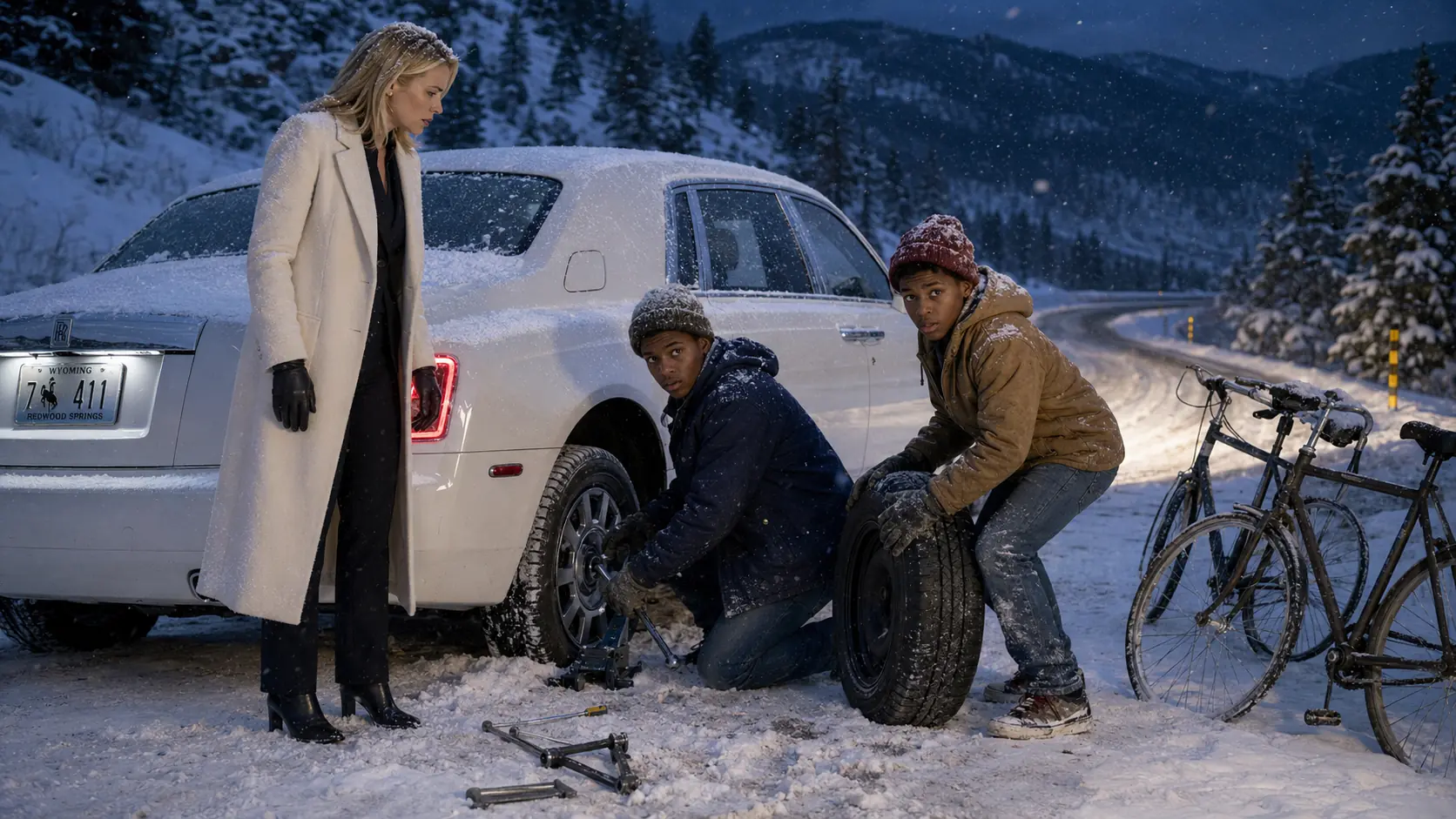
Boys on bicycles, pedaling through the blizzard as if it were a summer day.
They wore threadbare coats, mismatched gloves, and knit hats pulled low over their ears.
Both were African American, probably fourteen or fifteen, their dark skin stark against the endless white.
The older one rode in front, confident and steady.
The younger one followed, his bike weaving slightly in the deeper snow.
They slowed when they saw the Rolls-Royce.
“Whoa,” the younger one said, eyes wide. “Is that a Phantom?”
“Malik, focus,” the older one said, but he was staring too.
They pulled to a stop about ten feet away, bikes crunching in the snow.
For a moment, they just looked at the scene.
The tilted luxury car.
The scattered tools.
Olivia kneeling in the snow, soaked and shaking.
The older boy cleared his throat.
“Ma’am, you need help?”
Olivia’s first instinct was to say no.
She had spent twenty years proving she did not need help from anyone.
But as she opened her mouth, another gust of wind cut through her wet coat, and her teeth started chattering.
“I...” Her voice came out rough. “Yes. The tire blew.”
“We can see that,” Malik said, grinning.
The older boy shot him a look.
“I’m Jaden,” he said, climbing off his bike. “This is my brother, Malik. We’re heading into town to shovel driveways, but we can help you first.”
“You know how to change a tire?”
The question came out more skeptical than Olivia intended.
Jaden’s expression did not change, but something flickered in his eyes.
“Yes, ma’am. We know how.”
He walked over, Malik following.
Both boys moved with the easy competence of people who had grown up working with their hands.
Jaden crouched beside the car, assessing the damage with a practiced eye that made Olivia feel even more useless.
“Blowout’s pretty bad,” he said. “But the rim looks okay. You got a spare in the trunk?”
Olivia nodded and stepped back.
She watched as Jaden opened the trunk and lifted out the spare tire like it weighed nothing.
Malik grabbed the jack and lug wrench without being asked.
“You don’t know how to change a tire?” Malik asked, his tone curious rather than judgmental.
Olivia’s face heated despite the cold.
“I used to. It’s been a while.”
“How long’s a while?”
“Malik,” Jaden warned.
“What? I’m just asking.”
“Twenty years,” Olivia heard herself say. “Maybe more.”
Both boys looked at her.
For a second, she could not read their expressions.
“Well,” Jaden said finally, “good thing we came along then.”
He positioned the jack with quick efficiency, pumping the handle in smooth, practiced strokes.
The car rose steadily.
Malik knelt beside him, ready with the lug wrench.
“Counterclockwise first, right?” Malik asked.
“Right. And remember, star pattern when we put the new one on.”
“I know, Jay. I’m not stupid.”
They worked in tandem, a rhythm born from repetition.
Jaden loosened the lug nuts while Malik held the wrench steady.
Their movements were precise despite the wind, despite the cold, despite gloves that were more holes than fabric.
Olivia stood there uselessly, watching two teenagers do in minutes what she had not been able to start in half an hour.
“Your dad teach you this?” she asked, trying to fill the awkward silence.
Jaden’s hands paused for just a second.
“Yeah. Our dad taught us everything about cars.”
“He was a mechanic,” Malik added, wrestling with a stubborn lug nut. “Best one in Redwood Springs. Maybe all of Wyoming.”
There was another pause.
Longer this time.
“He passed,” Jaden said quietly. “Two years ago.”
“Oh.”
Olivia felt the word land hollow and inadequate.
“I’m sorry.”
“It’s okay.”
Jaden pulled off the damaged tire and set it aside.
“He made sure we knew how to take care of ourselves first, and how to help other people.”
Malik rolled the spare tire over.
Together, they lifted it onto the wheel studs.
Their breath came in white puffs.
Their fingers were red with cold despite the gloves.
But they never slowed.
“Star pattern,” Jaden reminded.
“I know,” Malik said, but he was smiling.
They tightened the lug nuts in a precise sequence, then lowered the car.
Jaden gave each nut a final check, his movements methodical and sure.
Eighteen minutes.
Olivia checked her watch in disbelief.
Eighteen minutes from start to finish, in the middle of a blizzard, by two kids on bicycles.
“That should hold you to Denver,” Jaden said, standing and brushing snow from his knees. “But get it checked properly when you get there. And drive slow. Roads are only getting worse.”
Olivia nodded, then reached into her coat pocket.
Her wallet was damp but intact.
She pulled out five hundred-dollar bills and held them out.
“Here. Thank you. This is... you saved me.”
Both boys stared at the money.
“That’s five hundred dollars,” Malik whispered.
Jaden’s jaw tightened.
He shook his head.
“We don’t want your money, ma’am.”
Olivia blinked.
“What?”
“We helped because you needed help. Not because we wanted to get paid.”
“But—”
She gestured at their worn coats, their patched gloves, their bikes that had to be ten years old.
“You were going to shovel driveways for money. This is the same thing.”
“No,” Jaden said firmly. “It’s not.”
“Why not?”
He looked at her then.
Really looked at her.
And Olivia felt something shift in the air between them.
“My dad used to say, ‘When you help someone because they’ll pay you, that’s a transaction. When you help someone because it’s right, that’s a connection.’”
Jaden picked up his bike.
“Money turns the second thing into the first thing, and we don’t want to do that.”
“But you need it,” Olivia said, hearing the desperation in her own voice. “I can see you need it.”
“Yeah, we do,” Malik said, grabbing his bike too. “But Dad also said once you start putting a price on doing the right thing, you stop doing it when there’s no price. And then what kind of person are you?”
They started to walk their bikes back toward the road.
“Wait,” Olivia called. “At least tell me your names. Your full names.”
Jaden looked back over his shoulder.
“Jaden Brooks. This is Malik Brooks.”
“Brooks,” Olivia repeated. “And your father? What was his name?”
“Marcus Brooks.”
Pride rang clear in Jaden’s voice.
“Best mechanic in Wyoming. And the best man too.”
“He didn’t have much,” Malik added. “But he helped everyone. Even when he only had forty dollars left, he’d give it away if someone needed it more.”
They climbed onto their bikes.
“Drive safe, ma’am,” Jaden called. “And maybe learn to change a tire when you get home. Never know when you’ll need it again.”
Then they were pedaling away, disappearing back into the white curtain of snow, their laughter fading into the wind.
Olivia stood beside her Rolls-Royce, five hundred dollars still clutched in her hand, and watched them go.
For the first time in twenty years, she felt poor.
The Denver skyline rose from the plains like shards of steel and ambition.
Olivia made it with forty minutes to spare.
The Rolls-Royce purred into the underground parking garage of the Millennium Tower as if the morning’s drama had never happened.
She changed in a gas station bathroom an hour outside the city.
She kept an emergency outfit in the trunk for exactly these situations.
The wool slacks and wet coat were stuffed in a shopping bag.
Now she wore a sharp black suit, her hair pulled back, her armor restored.
But her hands still shook slightly as she pressed the button for the fiftieth floor.
The elevator rose in silence.
That peculiar quiet of expensive buildings where even the machinery whispered.
Olivia watched the numbers climb and tried to summon the confidence she had felt that morning, singing in the car.
It would not come.
Instead, she kept seeing Jaden’s face when she offered the money.
That moment of something like disappointment, maybe pity, before he refused.
When you help someone because they’ll pay you, that’s a transaction.
When you help someone because it’s right, that’s a connection.
The elevator chimed.
Fiftieth floor.
The doors opened onto glass and chrome and the kind of wealth that did not bother announcing itself because everyone already knew.
Floor-to-ceiling windows framed the Rocky Mountains like a painting.
The reception desk was a single slab of polished marble.
Even the air smelled expensive, some custom scent piped through the ventilation.
“Miss Harrington.”
David Sloan’s assistant, a severe woman in her thirties, approached with a tablet.
“We were starting to worry. The weather—”
“I’m here,” Olivia said. “Let’s get started.”
The conference room was a monument to corporate power.
Twenty-foot ceilings.
A table that could seat thirty.
Windows on two sides offering views that made a person feel like a god looking down on the world.
David Sloan stood at the far end, flanked by his lawyers and CFO.
He was fifty-two, silver-haired, with the kind of tan that came from yacht clubs and golf courses.
Old money trying to play in new money’s game.
“Olivia.”
He smiled, but it did not reach his eyes.
“Glad you could make it. Heard there was quite a storm in the mountains.”
“Nothing I couldn’t handle,” she said smoothly, taking her seat.
The lies came easily now.
They always had.
For the next two hours, they negotiated the final terms.
Olivia’s legal team had prepared everything perfectly, as always.
The acquisition of Sloan’s logistics network would give her company control of seventy percent of the Western supply chain.
$2.3 billion.
The number that had made her sing that morning.
She watched Sloan’s lawyers whisper urgently to him.
Watched him realize he was boxed in, that she had outmaneuvered him at every turn.
Watched the moment he decided to surrender with grace rather than drag it out.
“You drive a hard bargain,” he said finally.
“I drive the only bargain,” Olivia replied. “Take it, or I walk. And you know the Renton Group is waiting in the wings.”
He signed.
His CFO signed.
His lawyer signed.
Then Olivia signed.
Her fountain pen scratched across the paper with a sound like finality.
Applause rippled around the table.
Someone popped champagne.
Crystal flutes appeared, filled with gold liquid that probably cost more per ounce than most people made in an hour.
“To new partnerships,” Sloan said, raising his glass.
Olivia raised hers, smiled, said all the right things.
But inside, she felt nothing.
Or worse than nothing.
She felt hollow.
She looked around the room at the celebration.
The lawyers congratulating each other.
The assistants already drafting press releases.
Everyone was smiling.
Everyone was excited.
And all she could think about was two boys on bicycles in a blizzard, their fingers red with cold, refusing five hundred dollars because their father had taught them that some things mattered more than money.
My dad didn’t leave us much, but he left us a good name.
Keep it for him.
What name was she keeping?
The thought came unbidden, unwelcome.
Olivia Harrington, tech billionaire, self-made success story.
The girl from Cleveland who had clawed her way to the top through sheer will and ruthless intelligence.
But when was the last time she had helped someone without expecting something in return?
When was the last time she had done something just because it was right?
The champagne tasted like ash in her mouth.
“Excuse me,” she said, setting down the glass. “I need to make a call.”
She walked out before anyone could respond, her heels clicking on the marble floor.
The hallway was empty, pristine, the kind of space designed to make you feel important.
Olivia found the restroom.
All gold fixtures and heated floors and mirrors lit like a movie star’s dressing room.
She locked herself in a stall and pulled out her phone.
Her hands were shaking again.
She opened the browser and typed:
Redwood Springs, Wyoming.
The results came back.
Population: 2,000.
Median household income: $38,000.
Thirty percent below the poverty line.
She clicked on images.
A small main street with brick buildings from the 1950s.
A diner with a neon sign.
The kind of town that time and money had forgotten.
Somewhere in that town, two boys were probably shoveling driveways right now, making twenty dollars, maybe thirty if they were lucky.
Saving up for what?
College?
To help their mother?
To survive?
And they had turned down five hundred dollars because their father had taught them about integrity.
Olivia looked at herself in the mirror above the sink.
Designer suit.
Diamond watch.
Hair perfect despite the morning’s chaos.
Behind her, someone had left a copy of Forbes on the counter.
Her own face stared back at her from the cover.
The Future Of Tech: Olivia Harrington’s Billion-Dollar Empire.
She picked it up and stared at the glossy photo.
The woman in the picture looked confident, powerful, untouchable.
She looked like a stranger.
If I died tomorrow, Olivia thought, would anyone cry?
Really cry?
The way people probably cried at Marcus Brooks’s funeral?
Her assistant would be upset about the stock options.
Her board would panic about succession planning.
The business press would write obituaries about her empire.
But who would mourn the person?
The question sat in her chest like a stone.
She thought about her penthouse in Manhattan.
Fifteen thousand square feet of empty space.
She had bought it five years ago, hired a famous interior designer, and filled it with art and furniture that cost more than most people’s houses.
She could not remember the last time she had a guest who was not there for business.
Could not remember the last time someone called just to see how she was.
Could not remember the last time she had laughed the way Jaden and Malik had laughed.
Easy and genuine, even in a blizzard.
When you help someone because they’ll pay you, that’s a transaction.
When you help someone because it’s right, that’s a connection.
How many connections did she have?
Real ones.
Not business contacts or networking opportunities or strategic partnerships.
Real human connections.
The answer came swift and brutal.
None.
Olivia set down the magazine.
She pulled up the search again.
Brooks family, Redwood Springs, Wyoming.
Nothing came up.
Too small.
Too insignificant for the internet to care about.
But they existed.
Two boys and probably a mother, living in a town she had never heard of until that morning.
Carrying on the legacy of a man who had died with forty dollars in his pocket and a reputation for helping everyone.
She thought about the deal she had just signed.
$2.3 billion.
She thought about the Rolls-Royce in the parking garage, the penthouse in Manhattan, the vacation home in Aspen, the stock portfolio, the offshore accounts, the vast machinery of her wealth.
And she thought about Marcus Brooks, who had helped people even when he only had forty dollars left.
Which one of them had been rich?
The thought was so absurd, so contrary to everything she had built her life around, that she almost laughed.
But she could not.
Because somewhere deep down, in a place she had locked away twenty years ago when she decided to never be poor again, she knew the answer.
And it terrified her.
Someone knocked on the bathroom door.
“Miss Harrington? They’re asking for you for the press conference.”
“I’ll be right there,” she called.
But she did not move.
She stood there, phone in hand, staring at the search results for a town of two thousand people where two boys on bicycles had just taught her more in eighteen minutes than Harvard Business School had taught her in two years.
Finally, she typed one more search.
Redwood Springs, Wyoming driving directions.
Three hours and forty-seven minutes from Denver.
Olivia stared at the route on her screen.
Then she put away her phone, fixed her lipstick, and went back to the celebration.
But she was not celebrating anymore.
She was planning.
The next morning, Olivia was back on the road.
She told her assistant she needed a few days for personal matters.
The words felt strange in her mouth.
She had not had personal matters in years.
Everything was business.
Everything was strategy.
But this was not.
This was something else entirely.
The Rolls-Royce glided through Redwood Springs just after 10:00 a.m.
The blizzard had passed, leaving everything buried under fresh snow that sparkled in the sunlight.
Main Street was a single row of brick buildings.
A diner.
A hardware store.
A gas station.
A post office.
American flags hung from lampposts.
A hand-painted sign advertised the Rotary Club pancake breakfast.
It looked like a postcard of small-town America, or a movie set.
Olivia followed the directions she had gotten from the woman at the gas station.
East on Maple Street, past the elementary school, into the neighborhood where the houses got smaller and the yards got bigger.
She found it on the corner of Maple and Fifth.
A small house with weathered blue siding, a chain-link fence sagging under snow, and a pickup truck in the driveway that had to be fifteen years old.
The Rolls-Royce looked obscene pulling up to the curb.
Olivia turned off the engine and sat for a moment, suddenly uncertain.
What was she doing here?
What was she going to say?
Hi, I’m the woman your sons helped yesterday, and I’ve been having an existential crisis ever since.
Through the front window, she could see movement.
Someone pulled back a curtain and peered out.
No turning back now.
She got out of the car.
Immediately, she felt eyes on her.
A man shoveling his driveway across the street stopped to stare.
Two kids playing in the snow dropped their makeshift hockey sticks.
A woman getting mail looked up, mouth open.
The Rolls-Royce had that effect in neighborhoods like this.
Olivia walked up the unshoveled path to the front door, her boots crunching in the snow.
Before she could knock, the door opened.
A woman stood there.
Early forties.
African American.
Tired eyes.
Strong hands.
She wore scrubs under a cardigan, her hair pulled back in a practical bun.
“Can I help you?”
Her tone was cautious.
Protective.
“Are you Mrs. Brooks? Jaden and Malik’s mother?”
The woman’s eyes narrowed.
“Who’s asking?”
“My name is Olivia Harrington. Your sons helped me yesterday on the mountain road. My tire blew out in the blizzard, and they...”
She stopped, feeling suddenly emotional.
“They saved me. I wanted to thank them. And you.”
The woman’s expression shifted, softening slightly.
“You’re the lady with the fancy car.”
“That’s me.”
“Boys told me about you.”
She studied Olivia for a long moment.
“Said you tried to give them five hundred dollars.”
“They wouldn’t take it.”
“I know. I raised them right.”
A hint of pride crept into her voice.
Then she seemed to catch herself.
“I’m Monica. Monica Brooks. You want to come in?”
“If it’s not too much trouble.”
Monica opened the door wider.
“Trouble showed up the second a Rolls-Royce parked in front of my house. Might as well come in before the whole street decides to have a block party to meet you.”
The interior was small but spotlessly clean.
Worn furniture arranged carefully.
Family photos covering one wall.
A crucifix above the doorway.
The smell of coffee and something baking.
Everything was old, but everything was cared for.
“Boys,” Monica called. “We have a visitor.”
Footsteps thundered from somewhere in the back of the house.
Jaden appeared first, then Malik, both stopping dead when they saw Olivia.
“No way,” Malik breathed.
“You came back.”
“Is everything okay with the tire?” Jaden asked immediately. “Did it hold?”
“The tire’s perfect,” Olivia said. “I’m not here about the car. I’m here because... I wanted to talk to you, to all of you, about your father.”
The room went quiet.
Monica’s expression became unreadable.
Jaden and Malik exchanged glances.
“Why?” Monica asked finally.
“Because...”
Olivia stopped trying to find words for something she did not fully understand herself.
“Because yesterday, your sons told me about a man who helped people not for money, but because it was right. And I realized I didn’t know anyone like that. I’ve spent twenty years building an empire, and I don’t know a single person who would do what your boys did. What your husband did.”
She looked at Jaden and Malik.
“You said he taught you everything. I want to know what kind of man does that. What kind of man leaves that kind of legacy.”
Monica’s eyes glistened.
She turned away, busying herself with the coffee pot.
“You want coffee?”
“That would be nice. Thank you.”
They sat in the small living room.
Olivia on the couch.
Monica in the armchair that was clearly her spot.
Jaden and Malik on the floor.
Monica poured coffee into mismatched mugs and handed one to Olivia.
“Marcus was a good man,” Monica said quietly. “Best man I ever knew. Worked at Redwood Auto for twenty-three years. Could fix anything. Cars, trucks, farm equipment, didn’t matter. People came from three counties over because they knew Marcus would treat them fair.”
“He charged way less than he should have,” Jaden added.
“Mom used to fight with him about it.”
Monica smiled sadly.
“I did. We needed the money. But Marcus would say, ‘These are our neighbors, our friends. I can’t take advantage of them just because their truck broke down and they’ve got no other choice.’”
“Tell her about the Hendersons,” Malik said.
“The Hendersons,” Monica repeated, shaking her head. “January, about three years ago. Middle of the night. Their car breaks down on Route 89. Young couple with two babies, everything they owned in the car, trying to get to California where the husband had a job waiting.”
Jaden picked up the story.
“Dad got the call at like two in the morning. Threw on his coat, drove out there in the snow. Car needed a new alternator. They didn’t have money for it. Spent everything they had on gas trying to make it west.”
“So Marcus fixed it for free,” Monica said. “Drove to the shop, got a used alternator, installed it by the side of the road. Took him four hours in the freezing cold.”
“They tried to give him their last forty dollars,” Malik said.
“Dad wouldn’t take it. Told them they’d need it for food when they got to California. Told them to pay it forward someday. Help someone else who needed it.”
Olivia sat very still, the coffee warming her hands.
“That’s what he told you about helping people.”
“Every day,” Jaden said. “Dad used to say, ‘You measure a man’s wealth not by what’s in his bank account, but by how many people will cry when he’s gone.’”
The words hit Olivia like a physical blow.
Monica stood abruptly and walked to the photos on the wall.
She took down one in a simple frame.
A man in his forties, dark-skinned and smiling, wearing coveralls with Marcus embroidered on the chest.
His arms were around two younger versions of Jaden and Malik.
“This was Marcus,” she said, handing the photo to Olivia. “Took this about six months before he got sick.”
Olivia studied the photo.
Marcus Brooks had kind eyes.
The kind of face that made you trust him immediately.
“What happened?” she asked softly.
“Pancreatic cancer,” Monica said, her voice steady but strained. “Diagnosed in March. Gone by September. Fastest six months of my life.”
“The whole town came together,” Jaden said. “People brought food, helped with bills, sat with Dad when Mom had to work. Mr. Patterson from the hardware store organized a fundraiser. Raised almost eight thousand dollars for medical costs.”
“Because that’s what Dad had done for them,” Malik added. “Every single person he’d helped over the years came back to help him.”
“Even in the hospital,” Monica said, wiping her eyes. “At the end, he was worried about other people. Worried about me and the boys. About the Johnsons, who needed their truck fixed. About whether someone would take care of old Mrs. Chen’s car because she couldn’t afford dealership prices.”
She sat back down and looked at Olivia directly.
“The day before Marcus died, he made the boys promise him something. Made them swear on the Bible.”
“What was it?” Olivia asked.
Jaden answered.
“He said, ‘I’m not leaving you money or a house or college funds. I’m leaving you something better. I’m leaving you a good name. The Brooks name means something in this town. It means honest. It means helpful. It means you can trust it. Keep that name clean. Help people because it’s right, not because they’ll pay you. And remember, money comes and goes, but how you treat people stays forever.’”
The room fell silent except for the ticking of a clock somewhere.
Olivia set down her coffee cup carefully, afraid her shaking hands would spill it.
“How many people came to his funeral?” she heard herself ask.
“Over four hundred,” Monica said. “Had to hold it at the high school gym because the church wasn’t big enough. Standing room only. Some drove five hours to be there.”
Four hundred people for a mechanic with forty dollars in his pocket.
Olivia thought about her own life.
The galas she attended where people only showed up because of who she was, what she could do for them.
The business dinners where every smile was calculated, every conversation a negotiation.
If she died tomorrow, would four hundred people come to her funeral?
Would anyone come who was not paid to be there?
“Ms. Harrington?”
Malik was looking at her with concern.
“You okay?”
“I...”
Her voice cracked.
She cleared her throat.
“I’m fine. I just... thank you for telling me about your father. He sounds like he was an incredible man.”
“He was,” Jaden said simply. “Best man in Wyoming. Maybe the world.”
Olivia stood.
“I should go. I’ve taken up enough of your time.”
“Wait,” Jaden said. “If you really want to know about Dad, about what he left us, there’s one more place you should see.”
Twenty minutes later, Olivia’s Rolls-Royce followed Jaden and Malik’s bikes down Elm Street to the edge of town.
The Redwood Youth Center sat on a corner lot surrounded by a chain-link fence and bare trees.
It was a single-story brick building that had probably been built in the 1960s, with a flat roof and narrow windows.
A faded sign hung above the door.
Even from the parking lot, Olivia could see the problems.
Shingles missing from the roof.
Paint peeling from the window frames.
A gutter hanging loose on one side.
“This is it,” Jaden said as she got out of the car. “Dad volunteered here three days a week. Fixed stuff, taught car repair classes to teenagers, helped with homework.”
They walked to the front door.
Inside, the building was worse than the outside suggested.
The main room was large but dim, lit by fluorescent lights that flickered intermittently.
Folding tables were set up in clusters where kids worked on homework or art projects.
The floor was scuffed linoleum patched in places with duct tape.
Water stains bloomed across the ceiling tiles.
And it was cold.
Olivia could see her breath.
About twenty kids were scattered around the room, ranging from maybe six to sixteen, all bundled in coats and hats.
Some were African American, some white, some Latino, all American kids trying to work despite fingers that had to be numb with cold.
A space heater in the corner fought a losing battle against the chill.
“Miss Brooks,” a young girl, maybe eight, with pigtails and a bright purple coat, ran over to Jaden. “Is the heat going to get fixed today?”
“Not today, Kesha,” Jaden said gently. “But soon.”
“Okay. Ms. Patricia’s working on it.”
“But it’s so cold,” another kid complained from a nearby table.
“I know, buddy. Just keep your coat on, all right?”
A woman emerged from a back office.
African American, mid-fifties, wearing layers of sweaters and a resigned expression that spoke of too many battles with too few resources.
“Jaden. Malik,” she said warmly.
Then she noticed Olivia.
Her expression shifted to polite curiosity.
“Can I help you?”
“Ms. Patricia, this is Ms. Harrington,” Jaden said. “She wanted to learn about Dad’s work here.”
Patricia Miller’s eyes widened slightly.
“You’re the woman with the Rolls-Royce out front.”
“Guilty,” Olivia said, extending her hand. “Olivia Harrington.”
Patricia shook it, her grip firm despite the cold.
“Patricia Miller. I’m the director here. Marcus Brooks was one of our most dedicated volunteers.”
She smiled sadly.
“Still haven’t found anyone to replace him.”
“Can you show her around?” Malik asked. “Show her what Dad did here?”
Patricia hesitated, glancing around the shabby space with evident embarrassment.
“I’m not sure there’s much to show. We’re kind of in survival mode right now.”
“Please,” Olivia said. “I’d like to see.”
Patricia sighed.
“All right. But don’t say I didn’t warn you.”
They walked through the center.
Patricia pointed out the computer lab.
Five ancient desktop computers on a table.
Three of them working.
The library, donated books on sagging shelves.
The kitchen, a room with a refrigerator that hummed ominously and a stove with only two working burners.
“Marcus fixed that stove four times,” Patricia said, tapping it affectionately. “Kept telling me we needed a new one, but we couldn’t afford it. So he’d rig it to work for another few months.”
She showed Olivia the gym.
A basketball court with a warped floor and a hoop with no net.
The bathrooms with cracked tiles and leaking faucets.
The roof that leaked when it rained.
The windows that did not seal properly.
The heating system that had finally given up last month.
“Marcus would have had the heat fixed by now,” Patricia said quietly. “He always knew how to make things work with nothing. But I don’t have his skills, and I can’t afford to hire someone who does.”
They returned to the main room.
Olivia watched a teenage boy help a younger kid with math homework.
Both of them wore fingerless gloves.
“How many kids come here?” she asked.
“We serve about eighty families,” Patricia said. “Kids come here after school, during the day, on weekends, and in summer. For a lot of them, this is the only warm meal they get, the only help with homework, the only safe place.”
She paused, her voice catching slightly.
“Or it was warm until the heating system died.”
“What happens if you can’t fix it?”
Patricia looked away.
“We close. Building inspector came last week. Said if we don’t fix the roof, the heating, and the electrical by the end of March, we’re done. Too many code violations.”
“How much would it cost to fix everything?”
“You really want to know?”
“Yes.”
Patricia walked to her office and returned with a folder stuffed with estimates and inspection reports.
She spread them on a table.
“Roof replacement, ninety thousand. New heating system, sixty-five thousand. Electrical upgrades, forty thousand. Plumbing repairs, twenty thousand. New kitchen equipment, fifteen thousand.”
“That’s...”
Patricia did quick math in her head.
“Two hundred thirty thousand just to get us up to code. Then there are operational costs, utilities, insurance, supplies. I’d need another hundred thousand minimum for a year of operations.”
She closed the folder.
“So about three hundred fifty to four hundred thousand all in. Might as well be a million. We operate on donations and a tiny county grant. Last year’s total budget was seventy-two thousand.”
Olivia stared at the folder.
Four hundred thousand dollars.
Less than the wine budget for her corporate holiday party last year.
Less than she had spent on her last vacation to Bora Bora.
Less than the monthly insurance on her car collection.
“What happens to the kids if this place closes?” she asked.
Patricia’s face hardened.
“Nothing good. A lot of these kids, this is the only stability they have. Parents working two jobs. Some in foster care. Some dealing with addiction or abuse at home. This center is their refuge.”
A little girl at a nearby table was drawing with crayons, her breath visible in the cold air.
She looked up at Olivia and smiled, missing two front teeth.
“Are you a princess?” she asked. “You look like a princess.”
“No, sweetie,” Olivia said, kneeling down. “I’m just a businesswoman.”
“What’s that?”
“Someone who makes money.”
The girl’s eyes lit up.
“Are you rich?”
“Destiny,” Patricia said sharply. “That’s not polite.”
“It’s okay,” Olivia said.
She looked at the girl’s drawing.
A house with a yard and a swing set.
The kind of house kids in this neighborhood probably dreamed about.
“Yes. I’m rich.”
“Cool. Can you buy us a new heater?”
The question, asked with such innocent hope, hit Olivia harder than any business negotiation ever had.
“Destiny, come on,” Patricia said, clearly mortified. “I’m so sorry, Ms. Harrington.”
“Don’t apologize.”
Olivia stood, her mind racing.
“She asked a fair question.”
She looked around the room.
At the kids studying despite the cold.
At the peeling paint and water-stained ceiling.
At Jaden and Malik watching her with expressions she could not quite read.
She thought about Marcus Brooks spending three days a week here fixing stoves, teaching car repair, and helping with homework.
Not because he was paid.
Patricia confirmed he had never taken a dime.
But because these kids needed him.
And he had left behind sons who biked through blizzards to help strangers, who refused five hundred dollars because their father had taught them that some things mattered more than money.
What had she left behind?
What would she leave behind?
In that moment, standing in a freezing youth center in a town of two thousand people, Olivia Harrington made a decision that would change everything.
“Ms. Miller,” she said. “Can we talk in your office privately?”
Patricia’s office was barely larger than a closet.
A metal desk covered in paperwork.
Two folding chairs.
A filing cabinet with a broken drawer.
A space heater doing its best.
Olivia sat down, and Patricia closed the door, looking anxious.
“If this is about Destiny, I really am sorry. She’s eight. She doesn’t understand.”
“It’s not about Destiny.”
Olivia opened her purse and pulled out her phone.
“You said you need four hundred thousand to save this place.”
“About that, yes, but Ms. Harrington, we’re not asking for—”
“I’m going to give it to you.”
Silence.
Patricia stared at her.
“I’m sorry. What?”
“Four hundred thousand dollars. I’ll wire it to the center’s account today. Roof, heating, electrical, plumbing, kitchen, operational costs, all of it.”
Patricia’s mouth opened and closed.
No sound came out.
“I don’t understand,” she finally managed. “You just walked in here thirty minutes ago. You don’t know us. You don’t know this town. Why would you?”
“Because yesterday, two boys changed my tire in a blizzard and wouldn’t let me pay them,” Olivia said. “Because they told me about their father, a man who helped everyone even when he had nothing. Because I just closed a deal worth $2.3 billion and it meant nothing.”
She gestured around the shabby office.
“But this means something.”
Patricia’s eyes filled with tears.
“Ms. Harrington, I don’t... I can’t.”
“Yes, you can. And you will.”
Olivia pulled up her banking app.
“What’s the center’s account information?”
“This is insane,” Patricia whispered, but she was reaching for a folder with shaking hands. “This is absolutely insane.”
She read out the routing number and account number.
Olivia typed them carefully, then entered the amount.
$450,000.
She added an extra fifty thousand for good measure.
Her finger hovered over the confirm button.
$450,000.
It was nothing to her.
Barely a percentage point of her quarterly earnings.
But it was everything to this place.
To these kids.
When you help someone because it’s right, that’s a connection.
She pressed confirm.
“It’s done,” she said quietly.
Patricia grabbed her own phone with shaking hands and logged into the center’s bank account.
Olivia watched her face as the balance updated.
“Oh my God,” Patricia breathed. “Oh my God. It’s there. It’s actually there.”
She looked up at Olivia, tears streaming down her face.
“Do you understand what you just did? You saved us. You saved eighty kids. You saved this entire program.”
“I haven’t saved anything yet,” Olivia said. “That money is just numbers in an account. Now you have to use it.”
“I will. I swear to God, I will.”
Patricia wiped her eyes.
“We can fix the roof. Get the heating going. Upgrade everything. The kids won’t have to freeze anymore. We can stay open. We can keep helping them.”
There was a knock on the door.
Jaden stuck his head in.
“Everything okay? Ms. Patricia, you’re crying.”
“Happy tears, Jaden.”
Patricia laughed through her tears.
“Very happy tears. Ms. Harrington just... she just saved the center.”
Both boys stared at Olivia.
“What do you mean?” Malik asked.
Olivia stood.
“I mean this place isn’t closing. I mean you’re getting a new roof and heating and whatever else you need.”
“You’re paying for it?” Jaden’s voice was careful, controlled.
“Yes. All of it.”
“All of it?”
Malik whooped and grabbed his brother in a hug.
But Jaden was still looking at Olivia, his expression complex.
“Why?” he asked.
“Because your father would have,” Olivia said simply. “If he’d had the money, he would have done this in a heartbeat. Right?”
Jaden’s eyes reddened.
He nodded, not trusting his voice.
“Then I’m doing it for him,” Olivia said. “And for you too. And for every kid out there who needs a place like this.”
She turned back to Patricia.
“I want to be involved. Not just writing a check. I want to see how the money is used. I want to help plan the renovations. Can I do that?”
“Can you?” Patricia laughed incredulously. “Ms. Harrington, you can do whatever you want. You just gave us almost half a million dollars.”
“Good, because I’m not done yet.”
“What do you mean?”
Olivia had not planned this.
Had not thought it through.
But the words came anyway, feeling right in a way that nothing in her business life ever had.
“How many centers like this are there in Wyoming? In America? Struggling to stay open?”
Patricia’s expression turned somber.
“Hundreds. Maybe thousands. Especially in rural areas, poor communities. We’re always the first thing cut when budgets get tight.”
“Then we’re going to help them too.”
“We?”
“I’m going to start a foundation,” Olivia said, the plan crystallizing as she spoke. “The Marcus Brooks Foundation. Dedicated to funding youth centers in underserved communities. Not just keeping them open, but making them excellent. State-of-the-art facilities, qualified staff, real programming.”
She looked at Jaden and Malik.
“Your father helped everyone in this town. I’m going to help his legacy help the whole country.”
Jaden turned away, shoulders shaking.
Malik was not even trying to hide his tears.
Patricia sat down heavily.
“A foundation for Marcus.”
“If you think he’d approve.”
“Approve?”
Patricia laughed wetly.
“Ms. Harrington, Marcus would be honored. Humbled. He’d probably tell you it’s too much. But he’d be so proud.”
“Then it’s settled.”
Olivia pulled out her phone again.
“I need to make some calls. I have lawyers in New York who can set up the foundation structure. CPAs who can handle the funding.”
“Wait,” Jaden said.
He turned back around, composed himself.
“You’re really doing this? Not just talking about it?”
“I’m really doing it.”
“Why? And don’t say because of Dad. There’s more to it than that.”
Olivia met his gaze.
This boy who had refused five hundred dollars.
This boy who had taught her more in eighteen minutes than two decades of success.
“Because you were right,” she said. “What you said about helping people, about transactions versus connections. I’ve spent twenty years making transactions, building wealth, climbing higher. And I woke up yesterday realizing I’m the poorest person I know.”
“You’re a billionaire,” Malik said.
“I know. That’s what makes it so pathetic.”
She smiled sadly.
“Your father died with forty dollars in his pocket and four hundred people at his funeral. I could die with a billion dollars, and I don’t know if twenty people would genuinely mourn me. Which one of us was actually rich?”
The room was silent.
“So yes,” Olivia continued. “I’m doing this for your father’s memory. For you. For me. Because maybe if I spend the rest of my life trying to be one-tenth the person Marcus Brooks was, I’ll finally feel like my life meant something.”
Jaden walked over and, without warning, hugged her.
Olivia froze.
She could not remember the last time someone had hugged her with simple, genuine gratitude.
Then slowly, she put her arms around him.
“Thank you,” he whispered. “For seeing what Dad was. For honoring him like this.”
When he pulled back, Malik hugged her too.
Patricia was crying again, smiling through her tears.
“This is the best day this center has had since Marcus was here. Maybe the best day ever.”
“It’s going to get better,” Olivia promised. “But I need your help. I need to understand how these centers operate, what they need, what works and what doesn’t. Will you help me?”
“Every day of the week,” Patricia said immediately. “Whatever you need.”
“Good.”
Olivia checked her watch.
“I should go. I have calls to make, lawyers to mobilize. But I’ll be back tomorrow. We’ll start planning the renovations.”
“You’re staying in town?” Jaden asked.
“For a while, yes. There’s a motel, right?”
“The Redwood Inn,” Patricia confirmed. “It’s... well, it’s not fancy.”
Olivia thought about her penthouse in Manhattan with its heated floors and city views.
“I think I can manage.”
She walked to the door, then paused.
“Ms. Miller, don’t tell the kids yet. Not about the money. I want to surprise them when the work starts. Can you keep it quiet for now?”
“Of course.”
“And boys, thank you for saving my life yesterday. For teaching me what really matters. Your father raised you right.”
“We know,” Malik said, grinning through his tears. “We’re Brooks men.”
Olivia walked out of the youth center into the bright winter sunshine.
Kids were playing in the snow outside, their laughter ringing across the frozen playground.
She got in her Rolls-Royce, turned on the engine, then sat there for a moment.
In her purse, her phone was buzzing.
Probably her assistant.
Probably her board.
Probably people wondering where she was, what she was doing, when she was coming back to run her empire.
She did not care.
For the first time in twenty years, she knew exactly where she needed to be.
The Redwood Inn was exactly as advertised.
Not fancy.
Olivia’s room had a double bed with a floral comforter, a TV from 2005, and a view of the parking lot.
The bathroom had chipped tile and water pressure that fluctuated wildly.
It was perfect.
She checked in for a week, then called her assistant in New York.
“Cancel everything for the next month,” she said.
“Everything, Ms. Harrington? You have the board meeting on Thursday, the investor call Friday, the Tokyo trip next week—”
“Cancel all of it. Tell the board I’m taking personal time. Tell investors I’m unreachable. Delegate Tokyo to Henderson.”
“But—”
“Emily.”
Olivia softened her voice.
“I need to do this. Trust me, the company will survive a month without me.”
A pause.
“Are you okay? Is something wrong?”
“No,” Olivia said, looking out at the snowy parking lot. “For the first time in a long time, something is very right.”
The next morning, she met with Patricia, Jaden, and Malik at the center.
Together, they made lists.
Contractors to call.
Materials to order.
Permits to file.
Timelines to establish.
Olivia had built a tech empire.
She knew how to manage projects.
But this was different.
This was personal.
Within a week, work began.
A roofing crew from Cheyenne arrived on a Monday morning.
Olivia was there at six a.m., wearing jeans and work boots she had bought at the Redwood Hardware store, helping unload materials from trucks.
“Ma’am, you don’t need to—” the foreman started.
“I want to,” she said. “Put me to work.”
They did.
She carried shingles, held tarps, cleaned up debris, got splinters in her hands and paint in her hair and sweat on her borrowed flannel shirt.
And she loved every second of it.
Jaden and Malik were there every day after school, helping however they could.
They showed the contractors where the worst leaks were.
Explained how their dad had rigged temporary fixes.
“He tied that section with wire,” Jaden explained to a confused electrician. “Said it would hold six months. Held two years.”
The electrician whistled.
“Your dad was some kind of wizard.”
“Best mechanic in Wyoming,” Malik said proudly.
Local volunteers started showing up.
Word had spread that the youth center was being saved, and people wanted to help.
Mrs. Patterson from the hardware store donated paint.
The Johnsons, who owned the diner, brought coffee and sandwiches for the workers.
Teenagers came after school to help clean and paint.
The whole town seemed to rally.
One afternoon, Olivia found herself painting a wall alongside a woman named Sarah Chen, an elderly Chinese American woman with kind eyes and steady hands.
“You’re the woman who’s paying for all this,” Sarah said.
It was not a question.
“Word travels fast in small towns,” Olivia replied.
“Especially good news.”
Sarah dipped her brush in paint.
“Marcus fixed my car for free for fifteen years. Never charged me more than parts cost. Said I reminded him of his grandmother.”
“He sounds like he was special.”
“He was. This town lost something when he died.”
Sarah looked at Olivia.
“But maybe we gained something too. You being here, doing this.”
“I’m just writing checks,” Olivia said uncomfortably.
“No, you’re not. You’re here every day in work boots and paint-stained clothes. That’s not writing checks. That’s honoring Marcus properly.”
At the end of the first week, the new heating system was installed.
When Patricia turned it on and warm air flooded through the building for the first time in months, the kids who were there cheered.
Little Destiny ran up to Olivia and hugged her legs.
“Thank you for the heat, Princess Lady.”
Olivia laughed.
A real, genuine laugh that surprised her.
“You’re welcome, sweetheart.”
By the second week, the roof was completely replaced.
The electrical system was upgraded.
The plumbing was fixed.
Contractors started on the cosmetic work.
New paint.
New flooring.
New light fixtures.
The center transformed before their eyes.
One evening after the workers had left, Olivia sat on the floor of the newly painted gym with Jaden and Malik.
They were exhausted, covered in paint and drywall dust.
“This is crazy,” Malik said, looking around. “A month ago, this place was falling apart. Now it looks like a real center. Like something from a city.”
“It’s not done yet,” Jaden said. “We still need the new computers, the kitchen equipment, the library books.”
“All ordered,” Olivia said. “Arriving next week.”
She pulled out her phone and showed them the plans.
“State-of-the-art computer lab. Commercial kitchen for cooking classes. Library with two thousand new books. Art room with real supplies. Music room with instruments.”
“Holy crap,” Malik breathed.
“Malik,” Jaden said, punching his arm.
“Sorry, but holy crap.”
Olivia grinned.
She had stopped being the polished businesswoman weeks ago.
Now she was just Olivia.
Tired.
Paint-stained.
Happier than she had been in years.
“Wait until you see the playground,” she said. “I hired a company out of Denver. New equipment, rubber safety surface, accessible design. Should be installed in two weeks.”
“Dad would freak out,” Jaden said quietly. “He always talked about getting the center a real playground. Said the kids deserved better than rusty swings and gravel.”
“Now they’ll have it.”
They sat in comfortable silence, watching snow fall past the new windows.
“Can I ask you something?” Malik said.
“Sure.”
“Why are you still here? You could have just sent the money and left. Let other people do the work.”
Olivia considered the question.
“Would you believe me if I said I needed this more than the center did?”
“What do you mean?”
“I mean...”
She struggled for words.
“For twenty years, I’ve been building things. Companies, wealth, reputation. But I’ve never actually built anything with my hands. Never been part of a community working together. Never felt like what I was doing mattered beyond quarterly earnings and stock prices.”
She gestured around the gym.
“This matters. These kids matter. And being here, doing this work, being part of something real... it’s the first time I’ve felt like a real person in decades.”
“You were always a real person,” Jaden said.
“Was I? I’m not sure anymore.”
Olivia smiled.
“But I’m becoming one. Thanks to you two. Thanks to your dad’s example.”
Malik leaned his head on her shoulder.
Casual.
Trusting.
The way kids do when they have decided you are safe.
It was such a simple gesture that it made Olivia want to cry.
By the third week, word had spread beyond Redwood Springs.
A reporter from the Wyoming Tribune drove out to do a story.
Olivia declined to be interviewed and insisted they focus on the center and on Marcus Brooks’s legacy.
The headline read:
Mystery Benefactor Saves Rural Youth Center In Honor Of Beloved Local Mechanic.
Her assistant called.
“Miss Harrington, Forbes is asking questions. They want to know if the mystery benefactor is you.”
“Tell them nothing.”
“The board is getting nervous. They want to know when you’re coming back.”
“I don’t know.”
“You don’t know? Miss Harrington, you’re the CEO. You can’t just—”
“Emily, I’m going to tell you something, and I need you to really hear me.”
Olivia sat on her motel bed, watching snow fall past the window.
“For the first time in my adult life, I’m happy. Actually happy. Not successful, or powerful, or wealthy. Happy. Do you understand?”
Silence.
“I understand,” Emily said finally. “But the board won’t.”
“Then maybe I need a new board.”
She hung up before Emily could respond.
That night, Olivia had dinner at the Redwood Diner, a place she had eaten at almost every day for three weeks.
Meatloaf and mashed potatoes.
Coffee in a chipped mug.
A five-dollar meal that tasted better than any Michelin-starred restaurant she had ever visited.
Sarah Chen was there and waved her over to join her booth.
“How’s the project going?” Sarah asked.
“Almost done. We’re doing the grand reopening in ten days.”
“I heard. Whole town’s talking about it.”
Sarah sipped her coffee.
“Can I tell you something?”
“Of course.”
“When Marcus died, part of this town died too. He was our heart. The person who reminded us that we should take care of each other. Without him, people got more isolated, more defeated.”
She looked at Olivia.
“But you brought that back. By honoring him, by doing this work, you reminded us what he taught us. You brought back our heart.”
Olivia’s eyes stung.
“I didn’t do anything. I just wrote checks.”
“Stop saying that,” Sarah said firmly. “You’ve been here every day for three weeks. You know half the kids’ names. You painted walls and carried lumber and sat on the floor helping with homework. That’s not writing checks. That’s being part of a community.”
She reached across the table and put her weathered hand over Olivia’s.
“Marcus would be so proud of the center, yes. But more than that, he’d be proud of you. Of who you’re becoming.”
That night, alone in her motel room, Olivia made a decision.
She called her lawyer in New York.
“David, I need you to draft papers to sell my majority stake in the company.”
“What? Olivia, you can’t be serious.”
“I’m completely serious. Sell to the current minority stakeholders or find an outside buyer. I don’t care. But I’m done.”
“Done? You built that company from nothing.”
“I know. And now I’m going to build something else. Something that matters more.”
She hung up and immediately called her financial adviser.
“Rebecca, I need you to set up a charitable foundation. Initial funding, four hundred million dollars. Name it the Marcus Brooks Foundation. Purpose: funding youth centers in underserved communities across America.”
Rebecca was silent for a long moment.
“Four hundred million. That’s more than half your liquid assets.”
“I know.”
“Miss Harrington, I have to advise you—”
“Don’t. I know exactly what I’m doing.”
She spent the next hour on the phone with lawyers and accountants, setting everything in motion.
Selling the company she had spent twenty years building.
Pouring her wealth into a foundation named for a mechanic who died with forty dollars in his pocket.
It should have felt terrifying.
It felt like freedom.
The grand reopening of the Redwood Youth Center was scheduled for a Saturday in late February.
The whole town showed up.
Olivia arrived early, nervous in a way board meetings had never made her.
She wore simple jeans and a sweater.
No designer labels.
No power suit.
Just clothes.
The center was transformed.
New roof.
New paint.
Warm air flowing from the heating system.
Through the windows, she could see the renovated interior.
Bright lights.
Clean floors.
Cheerful walls covered in the kids’ artwork.
Outside, the new playground gleamed in the morning sun.
Slides and swings and climbing structures on a soft rubber surface.
A basketball court with fresh paint and real nets.
Picnic tables where families could gather.
A banner hung above the entrance.
Redwood Youth Center
Rebuilt In Honor Of Marcus Brooks.
Patricia found Olivia standing in the parking lot, staring at the banner.
“You okay?” Patricia asked.
“I’m terrified,” Olivia admitted.
“What if they don’t like it? What if we missed something important? What if—”
“Stop.”
Patricia took her hand.
“It’s perfect. Everything is perfect. You gave these kids a palace. They’re going to lose their minds.”
People started arriving.
Families from all over town.
Kids bouncing with excitement.
Adults carrying covered dishes for the potluck celebration.
Olivia recognized faces.
People she had worked alongside.
Families whose kids came to the center.
Sarah Chen arrived with her daughter and grandchildren.
The Johnsons from the diner.
The Pattersons from the hardware store.
Families Marcus had helped over the years.
All coming to see what had been done in his name.
Then Monica arrived with Jaden and Malik.
All three dressed in their Sunday best.
Jaden was carrying something.
A framed photo of Marcus.
“We thought Dad should be here for this,” he said, showing it to Olivia.
She took the frame with trembling hands.
Marcus Brooks smiled out at her, wearing his work coveralls, looking proud and kind and real.
“He should be,” she agreed. “Let’s put him somewhere special.”
They placed the photo in the main lobby on a shelf specially built for it.
Below it, a plaque read:
Marcus Brooks
Mechanic. Volunteer. Friend.
A man who measured wealth by the lives he touched.
This center stands as a testament to his legacy of service and love.
At 10:00 a.m., Patricia called everyone to gather outside the front entrance.
“Thank you all for coming,” she said, her voice carrying across the crowd. “Today, we celebrate not just a building, but a legacy. Marcus Brooks gave this center and this town everything he had. He taught us that real wealth isn’t measured in dollars, but in connections, in community, in helping each other.”
She gestured to the renovated building.
“Thanks to an extraordinary person who learned that lesson from Marcus’s sons, this center will continue his work for generations to come.”
People turned to look at Olivia.
She felt herself blushing.
“I’m not going to make a speech,” Olivia said. “This isn’t about me. It’s about Marcus, and about every kid who will walk through these doors. But I will say this.”
She took a breath.
“Three months ago, I thought I had everything. I was wrong. I had nothing that mattered. Marcus Brooks, through his sons, taught me what real wealth looks like. This center is my way of saying thank you.”
She nodded to Jaden and Malik.
“Would you boys do the honors?”
Together, they cut the ribbon.
The doors opened, and kids poured inside.
The noise was immediate.
Shrieks of joy.
Running feet.
Laughter bouncing off the walls.
Olivia followed the crowd in and watched as kids discovered room after room.
The computer lab with twenty new computers and tablets, all connected to high-speed internet.
The library with comfortable reading chairs and thousands of books organized by age group.
The art room with supplies that would have made her private school jealous.
The commercial kitchen where Patricia would teach cooking classes.
The music room with guitars, keyboards, drums, and a sound system.
The gym with a polished floor and basketball hoops that actually had nets.
Little Destiny found Olivia in the crowd and grabbed her hand.
“Come see. Come see the princess room.”
She dragged Olivia to a corner of the main room that had been set up as a quiet reading nook, with beanbag chairs, soft lighting, and a mural of a castle on the wall.
“Is it really for us?” Destiny asked, eyes huge. “Forever?”
“Forever,” Olivia confirmed. “This is your place. All of you.”
Destiny hugged her fiercely, then ran off to show her friends.
Jaden appeared at Olivia’s elbow.
“Ms. Patricia wants you to see something.”
He led her to the gym, where Patricia had gathered a group of teenagers.
On the wall, they had hung a large photo of Marcus in his garage, smiling, holding a wrench, in his element.
Below it, painted in careful letters:
You measure a man’s wealth not by what’s in his bank account, but by how many people will cry when he’s gone.
Marcus Brooks.
Olivia’s vision blurred.
“Every kid who comes through this center is going to see that,” Patricia said. “Going to learn that lesson. Marcus’s legacy isn’t just this building. It’s the values we’re going to teach here in his name.”
The celebration continued for hours.
Food.
Music.
Kids playing on the new equipment.
Adults touring the facility, marveling at the transformation.
As the afternoon sun slanted through the new windows, Olivia found herself sitting on the floor of the gym with a group of kids, showing them pictures on her tablet of the foundation she was setting up.
“So you’re going to help other kids like us?” a boy named Marcus asked.
“That’s the plan,” Olivia said. “Centers in other towns, other states, anywhere kids need a safe place.”
“That’s so cool,” Marcus breathed. “You’re like a superhero.”
“I’m really not,” Olivia laughed. “I’m just someone who finally figured out what’s important.”
Later, as people started to leave, Monica found Olivia sitting on the new playground, watching the sun set over the mountains.
“Can I join you?” Monica asked.
“Please.”
They sat in comfortable silence for a moment.
Two women from completely different worlds who had been brought together by circumstance, tragedy, and hope.
“My boys love you,” Monica said finally. “They talk about you all the time. About how you’re going to help kids everywhere. About how you honor Marcus.”
“They saved my life,” Olivia said. “Literally and figuratively.”
“They saved mine too. After Marcus died, I didn’t know how to go on. But those boys, they reminded me every day what he taught them. They kept his spirit alive.”
She looked at Olivia.
“Now you’re doing the same thing on a bigger scale.”
“I’m trying.”
“Are you going back to New York?”
Olivia had been dreading this question.
She had been avoiding it in her own mind.
“I don’t know,” she said honestly. “My assistant calls every day. My board wants me back. My company needs a CEO. But...”
“But?”
“But I’m happier here. Happier than I’ve been in twenty years. I like eating at the diner. I like knowing my neighbors. I like helping kids with their homework and painting walls and being part of something real.”
She turned to Monica.
“Does that sound crazy? Giving up a billion-dollar company to stay in a town of two thousand people?”
“It sounds like something Marcus would do,” Monica said. “Follow your heart instead of your wallet.”
That evening, Olivia made her choice.
She called her assistant, Emily.
“I’m not coming back.”
“What?”
“I’m resigning as CEO. Effective immediately. The board can choose my replacement. I’ll stay on as a consultant if they need me, but I’m done with day-to-day operations.”
“Miss Harrington, you can’t just walk away from everything you built.”
“I’m not walking away. I’m walking toward something better. There’s a difference.”
She hung up before Emily could argue.
Then she called her lawyer.
“David, accelerate the sale. I want to be completely divested within three months. And finalize the foundation structure. I want to be operational by June.”
“You’re really doing this?”
“I’m really doing this.”
Her last call was to her real estate agent.
“Sell the penthouse. Sell the Aspen house. Sell everything except the Rolls-Royce. I have a feeling I’m going to need a reliable car.”
She sat in her motel room, which she was starting to think of as home, and felt a weight lift from her shoulders.
For twenty years, she had been climbing, building, accumulating, proving that the poor girl from Cleveland could become someone important.
And now, she was choosing to step away from all of it.
To stay in a small town in Wyoming.
To run a foundation honoring a mechanic she had never met.
To help kids who would never make her richer or more powerful.
It was the best decision she had ever made.
Six months passed.
The Redwood Youth Center thrived.
Eighty kids became ninety, then one hundred.
Patricia hired two full-time staff members and expanded the programming.
Coding classes.
Art therapy.
College prep.
Job training.
The Marcus Brooks Foundation officially launched in June.
Olivia rented a small office on Main Street.
Nothing fancy.
Just three rooms and a coffee maker that worked half the time.
But from there, they were changing lives.
The foundation’s first major grant went to a youth center in rural Mississippi.
$300,000 to renovate a building and expand services.
The second went to Montana.
The third to New Mexico.
Olivia traveled to each location personally, met the kids, talked to the directors, and made sure the money was being used right.
But she always came home to Redwood Springs.
Home.
When had this become home?
She had moved out of the motel after the first month and rented a small house on Maple Street.
Two bedrooms.
A yard.
Neighbors who waved hello and borrowed sugar.
The Rolls-Royce looked absurd in the driveway, so she bought a sensible SUV for daily driving.
The Rolls only came out for special occasions now.
Her wardrobe changed too.
Fewer designer suits.
More jeans and sweaters.
Her expensive coats stayed in the closet.
She lived in flannel and work boots.
She ate at the diner three times a week, knew everyone’s name, and got invited to potlucks and town meetings and kids’ birthday parties.
She was, for the first time in her adult life, part of a community.
Jaden and Malik became regular fixtures in her life.
They stopped by the foundation office after school, helped with mailings, told her stories about their father, and made her laugh.
“You’re like our aunt,” Malik said one day. “Weird rich aunt.”
“Weird rich aunt who used to be scary but is actually cool,” Jaden corrected.
Olivia pretended to be offended, but secretly she loved it.
One August afternoon, she was at the youth center helping Patricia organize the new school supply drive when her phone rang.
Unknown number.
“Hello?”
“Ms. Harrington? This is James Chen from the Wyoming Tribune. We’re doing a follow-up story on the youth center renovations and the Marcus Brooks Foundation. Could we interview you?”
“I’d rather you didn’t. The story isn’t about me.”
“With respect, ma’am, I think it is. At least partly. You’re Olivia Harrington, former tech CEO worth over a billion dollars. You walked away from everything to start a foundation in a town of two thousand people. That’s news.”
Olivia sighed.
She had been avoiding this conversation for months.
“Fine. But on one condition. You include interviews with Jaden and Malik Brooks, Patricia Miller, and at least five kids from the center. And you make sure people understand this is about Marcus Brooks’s legacy, not about me playing savior.”
“Deal.”
The article ran three weeks later.
Front page of the Sunday edition.
From Boardroom To Main Street: How A Billionaire Found Real Wealth In Rural Wyoming.
It told the whole story.
The blowout in the blizzard.
The boys who would not take payment.
The foundation.
The choice to stay.
Quotes from Patricia about the center’s transformation.
From Jaden about his father’s legacy.
From Monica about the impact on the community.
And yes, quotes from Olivia.
“I spent twenty years accumulating wealth, and I was the poorest person I knew. I met two boys who had almost nothing, but they were rich in the ways that actually matter. They taught me that we measure our lives not by what we accumulate, but by what we give away and who we help along the way.”
The article went viral.
Within days, Olivia’s phone was ringing constantly.
News outlets wanted interviews.
Philanthropists wanted to partner with the foundation.
People from all over the country were sending donations.
But the most meaningful response came from someone closer to home.
A knock came on her office door one afternoon.
Olivia looked up from paperwork to see an elderly man standing there in a janitor’s uniform from the hospital.
“Can I help you?” she asked.
“Miss Harrington, I’m Robert Johnson. Marcus Brooks was my best friend for thirty years.”
Olivia stood immediately.
“Mr. Johnson, please come in.”
He sat down carefully, holding his cap in his hands.
“I read the article about what you’re doing. About how you met the boys. How you’re honoring Marcus.”
“Your friend deserved to be honored.”
“He did.”
Robert’s eyes were bright.
“Marcus was the best man I ever knew. When my wife was sick, he drove her to every chemo appointment for six months. Wouldn’t take a dime. When I lost my job, he gave me money for groceries. Told me it was a loan, but we both knew I’d never pay it back.”
He wiped his eyes.
“I came here to say thank you for seeing what Marcus was. For making sure his boys know their daddy mattered. For making his memory do good in the world.”
“Mr. Johnson, I should be thanking you. Your friend changed my life.”
“He changed a lot of lives.”
Robert stood to leave, then paused.
“You know what Marcus used to say? He’d say, ‘Rob, I might not have a fancy house or a new car, but I’m the richest man in Wyoming because when I die, people are going to cry. Real tears. That’s the only wealth that matters.’”
After he left, Olivia sat at her desk for a long time, thinking.
Four hundred people had come to Marcus Brooks’s funeral.
How many would come to hers now?
The answer surprised her.
Maybe not hundreds.
But dozens.
Real people.
Friends.
Kids she had helped.
Community members who had welcomed her.
People who would cry real tears.
That night, she had dinner at the Johnsons’ diner.
It was their anniversary.
Forty years in business, and half the town had shown up.
Potluck style.
Everyone brought dishes.
Tables pushed together.
Kids running around.
Olivia brought a casserole she had learned to make from Monica.
It was not fancy, but it was made with care.
She sat between Jaden and Malik, eating and laughing and feeling happier than any board meeting had ever made her.
“Speech!” someone called. “The guest of honor should give a speech.”
“I’m not the guest of honor,” Olivia protested.
“You kind of are,” Patricia said, grinning. “You saved the youth center, started a foundation, brought jobs to town. Yeah, you’re definitely guest-of-honor material.”
Olivia stood reluctantly.
Everyone quieted down.
“I’m not good at speeches,” she started. “I’m much better at PowerPoint presentations with quarterly earnings projections.”
Laughter.
“But I’ll say this. Eight months ago, I drove through this town thinking it was just a place to pass through on the way to somewhere more important. I was wrong. Redwood Springs is the most important place I’ve ever been.”
She looked around the room.
“You all taught me something I had forgotten. Wealth isn’t about how much you have, but about how much you give. It’s not about what you own, but about who you love and who loves you back. It’s not about climbing higher, but about reaching back to help others climb too.”
She raised her glass.
“To Redwood Springs. To the Johnsons and forty years of feeding this town. And to Marcus Brooks, who taught all of us, through his life and through his sons, what it really means to be rich.”
“To Marcus,” everyone echoed.
The party went late into the night.
When Olivia finally drove home, she passed the youth center, still lit up even though it was closed.
Through the windows, she could see the photo of Marcus in the lobby.
She parked, got out, and walked up to the door.
Inside, the building was quiet, peaceful, ready for another day of changing lives.
Olivia pressed her hand against the glass, looking at Marcus’s photo.
“Thank you,” she whispered. “For your sons. For your example. For showing me what I was missing.”
She felt like he was smiling back.
One year after the blowout, Olivia stood in the parking lot of the Redwood Youth Center, which now also bore her name at Patricia’s insistence: the Marcus Brooks and Olivia Harrington Community Center.
She watched kids pile off the school bus.
The Marcus Brooks Foundation had funded twelve centers in the last year.
Montana.
Mississippi.
New Mexico.
Oklahoma.
West Virginia.
Kentucky.
Poor communities where kids needed safe spaces and adults needed hope.
But this was still home base.
Jaden walked up beside her.
He was taller now, filling out, looking more like his father every day.
He had been accepted to the University of Wyoming Engineering Program on a full scholarship, but had deferred for a year to work with the foundation.
“Still feels weird seeing your name on the building,” he said.
“Patricia insisted. I tried to fight it.”
“You should have fought harder.”
Olivia laughed.
“Probably. But she’s scary when she’s determined.”
They watched Malik race past with a group of younger kids heading for the playground.
He was teaching them basketball, following in his father’s footsteps as a volunteer mentor.
“How’s the New York trip planning?” Jaden asked.
Olivia made a face.
“Necessary but annoying. Forbes wants to do a big feature on the foundation, and I have meetings with potential donors.”
“You’ll charm them.”
“I’ll try. But I’m bringing you and your mom. I need backup.”
“Deal.”
A car pulled into the lot.
Expensive.
New.
Clearly not from around here.
A woman in a business suit got out, looking around with the slightly confused expression of someone who had never been in a small town before.
“Ms. Harrington?” she called.
“That’s me.”
The woman approached, extending a hand.
“Jennifer Morrison. I’m with the Community Development Foundation. We read about your work, and we’d like to partner with you. We have funding available for youth centers in fifteen states.”
“Let’s talk in my office,” Olivia said.
Her office was still the small space on Main Street.
Three rooms.
Terrible coffee.
Walls covered in photos of the centers they had helped.
They talked for two hours.
Jennifer’s foundation could match Olivia’s funding, essentially doubling their reach.
“This could help hundreds of centers,” Jennifer said, excited. “Thousands of kids.”
“As long as we do it right,” Olivia cautioned. “Not just throwing money at problems. Real support. Understanding what each community needs.”
“Agreed. That’s why we want to partner with you. You’re doing this the right way.”
After Jennifer left, Olivia sat alone in her office, looking at the photos on the wall.
Kids playing on new playgrounds.
Centers with new roofs and fresh paint.
Teenagers learning job skills.
Families finding community.
Her phone buzzed.
Text from Malik.
Destiny wants to know if you’re coming to her birthday party Saturday.
Olivia smiled and typed back.
Wouldn’t miss it.
Another text came in, this one from her former assistant in New York.
Board approved final sale. You’re officially no longer CEO. Congratulations.
Olivia stared at the message.
A year ago, that would have devastated her.
Now she felt relief.
Thanks, Emily, she typed. Best decision I ever made.
That evening, she drove out to the cemetery on the edge of town.
Marcus Brooks’s grave was in the older section under a big oak tree.
The headstone was simple.
Marcus Brooks
Beloved Husband. Father. Friend.
He Measured His Wealth In Lives Touched.
Olivia set down the flowers she had brought and sat on the grass beside the grave.
“Hi, Marcus,” she said quietly. “I never met you, but I feel like I know you. Your boys talk about you all the time, and I see you in everything they do.”
A breeze moved through the oak leaves.
“I wanted to update you on the foundation. We’ve helped fifteen centers now. Planning for thirty more next year. Your legacy is spreading, touching kids all over the country. Kids you’ll never meet, in towns you’ve never heard of, but they’re all being helped because of the values you taught your sons.”
She traced the letters on the headstone.
“I sold my company, gave up my penthouse, walked away from everything I thought mattered. And you know what? I’ve never been happier. Your boys were right. You measure wealth differently when you understand what actually matters.”
She stood and brushed off her jeans.
“Thank you, Marcus. For raising those boys right. For showing them, and through them showing me, what real wealth looks like. I promise I’ll keep honoring your memory. Keep helping kids. Keep teaching them the lessons you taught.”
The sun was setting as she drove back to town.
The mountains glowed gold and purple in the fading light.
Her phone rang.
Monica.
“You coming to dinner? I made pot roast.”
“Be there in fifteen minutes.”
“Good. Boys want to talk to you about the new center in Alabama. They have ideas.”
“Of course they do.”
Olivia pulled into Monica’s driveway.
Still the same small house with weathered siding.
Monica refused to move, even after Olivia offered to buy her something bigger.
This is Marcus’s house, she had said.
This is where we raised our boys.
I’m not leaving.
Inside, it smelled like home.
Pot roast and fresh bread.
The particular warmth that comes from people who genuinely care about each other.
Jaden and Malik were setting the table, arguing good-naturedly about something.
Monica was pulling dishes from the oven.
It was chaos and noise and perfect.
This was Olivia’s family now.
Not by blood.
But by choice.
By connection.
By the kind of wealth that actually mattered.
They sat down to dinner, holding hands while Monica said grace.
“We thank you for this food, for this family, for the blessings we’ve been given. We thank you for bringing Olivia into our lives and for the work she’s doing in Marcus’s name. We ask that you continue to guide us in helping others and living the way Marcus taught us. Amen.”
“Amen,” they echoed.
As they ate, Malik launched into his ideas for the Alabama center.
Jaden added suggestions.
Monica talked about a woman she had met at work whose kids could use the foundation’s help.
Olivia listened, contributed, laughed, and felt more alive than she had in twenty years.
After dinner, she helped with dishes while the boys did homework at the kitchen table.
Normal.
Domestic.
Real.
As she was leaving, Monica walked her to the door.
“You know what Marcus would say if he could see you now?” Monica asked.
“What?”
“He’d say, ‘You finally figured out the secret.’”
Monica hugged her.
“That the richest people aren’t the ones with the most money. They’re the ones with the most people who will cry when they’re gone.”
Driving home, Olivia thought about that.
If she died tomorrow, how many people would cry?
A year ago, maybe twenty, all business associates.
Now, hundreds.
Kids whose lives had been changed.
Families who had been helped.
Communities that had been given hope.
Friends who had become family.
She passed the youth center, lit up for evening programs.
Through the windows, she could see kids playing basketball, working on computers, reading in the library.
Lives being changed.
Legacies being built.
Wealth being redefined.
Olivia pulled into her driveway.
Her small, modest, perfect house on Maple Street.
She sat for a moment in the quiet car.
The Rolls-Royce was in the garage, barely used now.
She drove the SUV most days, wore jeans instead of suits, ate at diners instead of five-star restaurants.
She had given away over half a billion dollars in the last year.
And she had never felt richer.
Her phone lit up with a message from little Destiny.
A drawing of a princess labeled You.
Olivia smiled and saved it to her photos.
She got out of the car, walked into her house, and felt the kind of peace that no amount of money could buy.
Because she had finally learned what Marcus Brooks had known all along.
You measure wealth not by what you have in the bank, but by what you have in your heart.
Not by the empire you build, but by the lives you touch.
Not by how high you climb, but by how many people you help rise with you.
She was, for the first time in her life, truly rich.
And it had nothing to do with money.