The rain came down hard and cold over downtown Chicago.
Malik Brown pulled his thin jacket tighter around his body, but it did almost nothing. The fabric was already soaked through, clinging to his skin like ice, and the broken zipper only reached halfway up his chest.
Beside him, his twin brother, Micah, hunched his shoulders against the wind, his old sneakers making wet, squelching sounds with every step.
“Man, I’m so hungry,” Micah muttered, his breath turning white in the freezing air.
“I know,” Malik said.
His stomach had been growling for the past hour. Lunch at school had been three hours ago, just a small sandwich and an apple that had not come close to filling him up. All he could think about was getting back to Hope Street Home before the dinner line closed, though even that promise was uncertain.
They were walking through Chicago’s financial district, a route they usually avoided. The bus cost money they did not have, and the regular way back to the shelter added another twenty minutes. Twenty minutes in freezing rain felt like forever.
Malik glanced up at the glass towers around them. Their lobbies glowed with warmth, polished floors, bright lights, people in expensive coats holding coffee cups and phones. Inside those buildings, adults laughed, rushed, and lived in a world that seemed to belong to them by birthright.
It was a world Malik and Micah had never touched.
“Maybe Miss Jackson saved us something,” Micah said, trying to sound hopeful.
“Maybe,” Malik answered.
He did not say what they both knew. With twenty-four kids at Hope Street and a budget that barely stretched, “saved dinner” usually meant cold toast, half a banana, or whatever peanut butter was left at the bottom of the jar.
His hands were numb. He shoved them deeper into his pockets, but there was a hole in the left one, and his fingers pushed straight through to the cold air outside.
That was when he saw her.
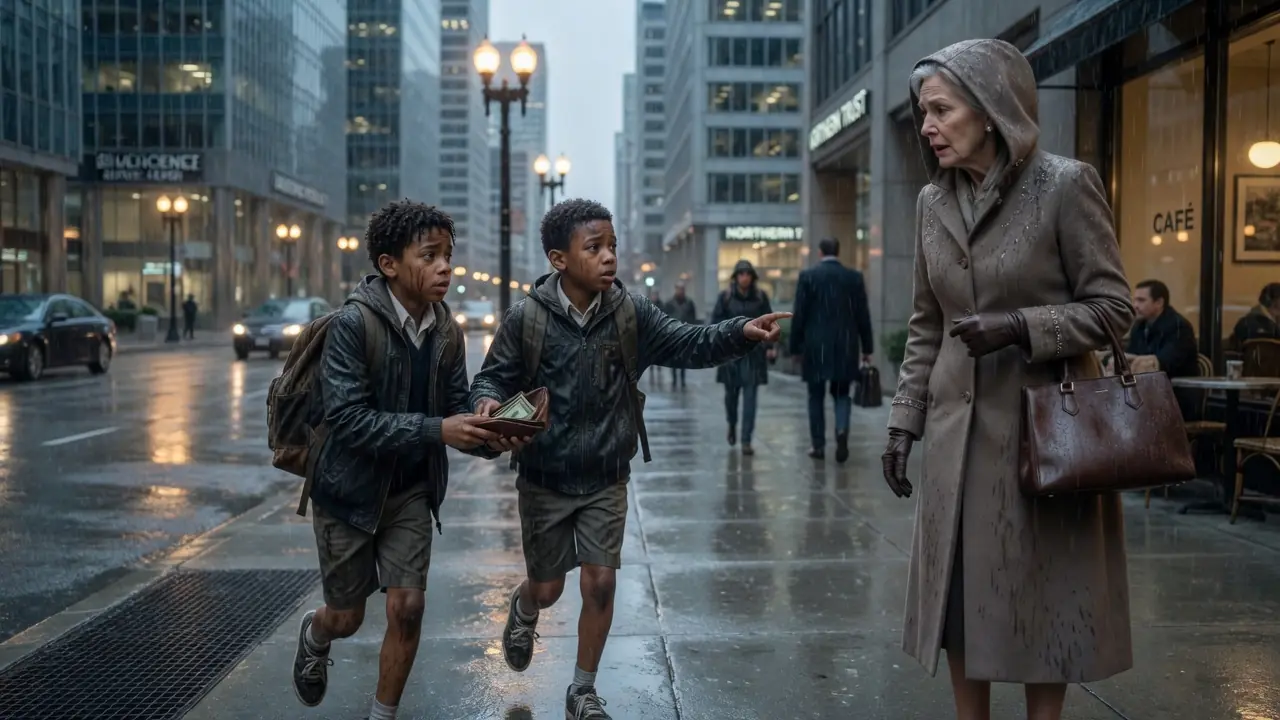
An older white woman stood on the corner ahead, maybe seventy or more, wrapped in a long wool coat that looked like it cost more than the shelter’s monthly grocery bill. She carried a leather handbag and stood with the kind of posture that made the sidewalk look like it belonged to her. She was on her phone, one hand gesturing sharply as she spoke, clearly upset about something Malik could not hear over the rain.
“Yes, I understand the market is volatile,” she said as she stepped off the curb, still absorbed in the call.
Her foot hit a slick patch of wet pavement. She stumbled, caught herself, and kept walking, but her purse swung wide. A brown leather wallet flew out, tumbled through the air, and hit the ground with a wet slap.
The woman did not notice.
She continued down the street, still talking into her phone, disappearing around the corner as if nothing had happened. The wallet sat on the sidewalk for only a second before rainwater began pushing it toward the storm drain.
“Yo,” Micah said, grabbing Malik’s arm.
But Malik was already moving.
He ran hard, his worn sneakers slipping on the wet pavement. The wallet was six feet from the drain, then five, then four. Malik dropped to his knees, his pants soaking instantly, cold concrete biting into his skin as his hand shot out.
His fingers scraped against wet leather just as the wallet reached the edge of the grate.
“Got it,” he gasped.
He stayed there for a moment, kneeling in a puddle with the wallet clutched tightly in his hand. Rain ran down his face, into his eyes, dripping from his chin. His knees stung where gravel had torn through the wet fabric of his pants.
“Dude, you okay?” Micah crouched beside him, breathing hard.
“Yeah.”
Malik pushed himself up slowly and looked down at the wallet in his hands. It was heavy. Real leather, soft and expensive, the kind of thing that did not fall apart even after years of use.
He opened it, and his breath caught.
The first thing he saw was money.
Lots of it.
Crisp bills were stacked thick in the main compartment. Twenties, fifties, hundreds. More money than Malik had ever held in his life. More money than he had ever seen in one place.
“Holy…” Micah’s voice faded.
Malik’s hands started shaking, but not from the cold this time. He carefully pulled out the stack and tried to count, but the numbers blurred in his head. There had to be at least three thousand dollars, maybe more.
Three thousand dollars.
That was food. Real food. Hot meals. Enough to feed every child at Hope Street for a week, maybe longer. That was new shoes without holes, winter coats that actually kept out the cold, medicine when someone got sick, bus passes so kids did not have to walk miles in rain like this.
“Malik,” Micah said quietly. “That’s a lot of money.”
“I know.”
“Like, a lot a lot.”
Malik swallowed hard. His fingers moved through the rest of the wallet almost automatically. Credit cards, black and heavy. A driver’s license. He pulled it out and tilted it toward the light from a nearby streetlamp.
Eleanor Price.
Date of birth, March 4, 1953.
The address was in the Gold Coast, one of the richest neighborhoods in Chicago. Behind the license was a business card on thick white paper with embossed letters.
Eleanor Price
CEO, Price Holdings
Malik stared at the card.
He had seen that name before on buildings around the city. Price Holdings owned offices, apartments, developments, half the skyline if people at school were telling the truth. This woman had everything, more than everything, and she would probably not even notice three thousand dollars missing.
“She’s loaded,” Micah whispered, reading over his shoulder. “Like crazy loaded.”
Malik stared at the money.
His stomach cramped with hunger. His fingers hurt from the cold. His knees throbbed where he had scraped them on the sidewalk. His jacket was soaked through, and he knew he would probably shiver all night under the thin blanket on his bunk.
In his hands, he held enough money to fix all of that.
Not only for himself.
For Micah. For Destiny, the six-year-old at Hope Street who cried at night because she was still hungry after dinner. For eight-year-old Marcus, whose toes pressed against the front of shoes that had become too small two months ago. For tiny Carmen, who sometimes did not get a snack because the kitchen ran out before her turn.
“Nobody would know,” Micah said softly.
Malik looked at him.
“We could take a little,” Micah continued, almost ashamed of the words even as he said them. “Like a hundred. Maybe two. She’s not going to miss it, Malik. Look at this. She probably spends more than that on lunch.”
Malik closed his eyes.
A voice rose in his memory.
Do what’s right, even when it’s hard. Especially when it’s hard.
He did not know exactly where the voice came from. Maybe a teacher. Maybe Miss Jackson. Maybe something his mother would have said if he had ever known her. All he knew was that the words had stayed with him, buried somewhere deeper than hunger.
He opened his eyes and looked at his brother. Micah’s face was wet with rain. His lips were almost blue from the cold. In his eyes was a look Malik knew too well, hope mixed with fear, because hope hurt when it had been crushed too many times.
“She dropped it,” Malik said quietly. “It’s not ours.”
Micah looked down at the money.
“But…”
Something flickered in Micah’s face. Disappointment, maybe. Relief, too. Probably both.
Malik shoved the cash back inside the wallet, carefully closing every flap and making sure nothing fell out. Then he held it tight in his fist.
“Come on,” he said. “Let’s find her.”
They ran back the way they had come, splashing through puddles. The woman had turned the corner, and Malik remembered which way. His lungs burned from the cold air, but he pushed harder, Micah right beside him.
There she was half a block ahead, still on her phone, walking fast like the rain had personally offended her.
“Ma’am!” Malik called.
His voice cracked. He was only eleven, and sometimes it still did that.
The woman did not turn.
“Ma’am!” he called louder. “You dropped something!”
This time she stopped. She turned slowly, her phone still pressed to her ear. Her eyes scanned the street, landed on Malik and Micah running toward her, and something changed in her expression.
Malik saw it instantly.
She clutched her purse tighter and took half a step back.
She thought they were going to rob her.
The realization hit him like a punch to the stomach, but he did not stop. He reached her, breathing hard, and held out the wallet with both hands.
“You dropped this,” he said. “Back there on the corner. It almost went down the drain.”
The woman stared at him. Then at the wallet. Then back at him.
Slowly, she lowered her phone from her ear.
“I’ll call you back,” she said into it, her voice distracted.
She ended the call, but her eyes never left the wallet.
“That’s yours, right?” Micah asked. “Eleanor Price. We saw your license.”
“You opened it?” Her voice was sharp.
“We had to check who it belonged to,” Malik explained. “So we could find you.”
The woman reached out and took the wallet. She opened it immediately, her fingers moving quickly through the compartments. She checked the cash, counted it, looked through the cards.
Malik and Micah stood there dripping wet, shivering under the gray Chicago sky.
Finally, she looked up.
“This is all of it?” she asked. “Everything is here?”
“Yes, ma’am.”
“You didn’t take anything?”
The question stung. Malik felt Micah tense beside him.
“No, ma’am,” Malik said, keeping his voice steady. “It’s not ours.”
Eleanor Price stared at them for a long moment. Really stared. Her gaze moved over their soaked jackets, worn shoes, trembling hands, and Malik’s scraped knees. Suspicion faded slowly from her face, replaced by something that looked almost like shock.
“You boys ran after me in the rain to return this?”
“Yes, ma’am.”
“There is almost three thousand dollars in here. You saw that?”
“Yes, ma’am. We did.”
“And you still brought it back?”
Malik met her eyes.
“Yes, ma’am.”
Her hand rose to her throat, touching the pearl necklace at her collar. For a moment, she seemed unable to speak. Rain kept falling around them, bouncing off the pavement, sliding down the edges of her expensive coat.
“Most people would not have done that,” she said quietly.
Malik did not know how to answer, so he said nothing.
A car rushed past, splashing water near the curb. Eleanor blinked as if suddenly remembering where they were. She looked at the boys again, and this time her face changed with a decision.
“Come with me,” she said. “There’s a cafe right there. You need to get out of this rain.”
“We should get home,” Micah said.
“Please.” The word came softer than anything else she had said. “I would like to thank you properly. Just a few minutes. At least get warm.”
Malik and Micah exchanged a glance.
It was a public place. They were already soaked. And warm sounded like something close to heaven.
“Okay,” Malik said. “Just for a minute.”
Eleanor nodded once, sharp and decisive, as if closing a business deal. Then she led them toward a small cafe where warm light spilled onto the wet sidewalk.
Malik followed with his scraped knees stinging and his stomach still empty. He did not know it yet, but the choice he had made on that street corner was about to change everything.
Before the rain, before the wallet, before Eleanor Price, there had been the morning.
The same morning had started at 4:30 a.m., like every other morning at Hope Street Home. Malik did not need an alarm anymore. His body had learned the schedule after three years of waking before dawn in a room full of other children.
He opened his eyes in darkness. Above him, the top bunk creaked.
“You up?” Micah whispered.
“Yeah.”
Malik swung his legs over the side of the lower bunk, his bare feet finding the cold floor. Around them, twenty-two other kids slept in various stages of quiet. Some were peaceful. Some twisted under thin blankets. A few whimpered in dreams they were too young to carry.
Hope Street Home had been their home for three years. The room was crowded, twelve bunk beds crammed into a space meant for far fewer. Clothes hung from hooks, chairs, bed rails, and corners. The radiator hissed near the window, producing just enough heat to keep the room from freezing.
Malik grabbed his jeans from the end of the bed. They were the same ones he had worn yesterday, and the day before that. He owned two pairs, and this was the better pair.
“Destiny’s crying again,” Micah said quietly as he climbed down.
Malik heard it now, soft sniffling from across the room. He moved carefully between the bunks, stepping over shoes and backpacks. The little girl was curled on her side, her face pressed into a pillow that had seen better days.
“Hey, Destiny,” he whispered, crouching beside her. “What’s wrong?”
“I had a bad dream,” she said, her voice tiny. “Mommy was there, but then she wasn’t.”
Malik’s chest tightened.
Destiny’s mother was in rehab. Third time. Destiny had been at Hope Street for six months and still woke up crying almost every night.
“You want Mr. Patches?” Malik asked.
She nodded, wiping her nose with the back of her hand.
Malik searched the tangled sheets until he found the stuffed dog with one missing eye and half its stuffing gone. He tucked it into her arms.
“There,” he whispered. “Try to sleep a little more. We’ve got another hour before breakfast.”
But he knew she would not sleep.
Honestly, neither would he.
Across the room, Marcus, eight years old and big for his age, was sitting up, trying to tie his sneakers. The laces were so frayed they barely held together, and his feet had grown too large for the shoes months ago.
“Here,” Micah said, kneeling down. “You’re making it worse. Let me.”
“I can do it,” Marcus muttered, embarrassed.
“I know you can. I’m faster.”
Micah’s fingers worked quickly, double-knotting the laces to keep them from coming undone.
“There. Good to go.”
“Thanks,” Marcus said quietly.
This was their routine. Wake up early. Help the younger kids find socks, tie shoes, calm nightmares, and get ready before Miss Jackson did her morning rounds. Malik and Micah were eleven, but at Hope Street, eleven could make you one of the responsible ones.
In the bathroom, Malik splashed cold water on his face and looked at himself in the cracked mirror. Someone had written kings and queens across the glass in faded marker. His reflection stared back in fractured pieces, brown eyes, serious mouth, hair that needed cutting, a face adults said looked “grown.”
That was just a polite way of saying he had stopped looking like a child.
At 5:30, Miss Jackson came through the room. She was an African American woman in her mid-forties with tired eyes and shoulders that carried more than anyone should. She had been running Hope Street for seven years, longer than anyone else had lasted.
“Morning, babies,” she said, her voice rough from not enough sleep. “Breakfast in twenty. Marcus, you’ve got that doctor’s appointment. Destiny, your social worker comes at three. Malik, Micah…”
“We know,” Malik said. “School, straight home, no messing around.”
“That’s right.”
She gave them a look that was half warning, half affection.
“You two are my rocks. Don’t make me worry.”
Breakfast was toast and peanut butter if you were lucky. Malik took his thin piece and sat down at the folding table. Beside him, four-year-old Carmen stared at her plate, her bottom lip trembling.
“What’s wrong?” Malik asked.
“Mine’s too small.”
She did not understand yet that everyone’s portions were small.
Malik looked at his own toast. His stomach already hurt with hunger. One piece would not be enough. It never was.
He broke it in half and put the bigger piece on Carmen’s plate.
“There. Now it’s bigger.”
Her face lit up. “Thank you, Malik.”
Across the table, Micah did the same thing with his food, sliding half to Marcus. Miss Jackson noticed. She always noticed. But she only pressed her lips together and turned back toward the stove before anyone saw her eyes shine.
Jamal, a thirteen-year-old at the end of the table, smirked.
“Yo, Malik, always playing hero. What do you get out of it?”
“Nothing,” Malik said.
“Exactly. That’s dumb, man. You going to starve yourself for these little kids?”
“They’re hungrier than me.”
“How do you know?”
“Your stomach growls louder than anyone’s,” Jamal said, laughing.
Some of the older kids joined in. Malik did not answer. He had learned that Jamal’s anger was bigger than any argument. Jamal was angry at the world, and the world was not sitting at that table to be punished, so he punished whoever was closest.
Micah could not help himself.
“At least he cares about someone besides himself.”
Jamal’s chair scraped back.
“What did you say?”
“You heard me.”
“Boys,” Miss Jackson snapped. “Enough.”
The room quieted.
After breakfast, chaos took over. Twenty-four children searched for backpacks, homework, jackets, hats, and gloves that may or may not have matched. Miss Jackson stood by the door checking them one by one.
When Malik and Micah reached her, she put a hand on each of their shoulders.
“You two okay?”
“Yes, ma’am.”
“Got lunch money?”
They shook their heads.
Her face tightened. She reached into her pocket and pulled out two granola bars.
“It’s not much.”
“It’s enough,” Malik said. “Thank you, Miss Jackson.”
She looked at them with an ache in her eyes.
“You’re good boys. Your mama would be proud.”
The words hit harder than they should have. Malik forced a smile.
“We’ll see you after school.”
Outside, November hit them immediately. Chicago cold had teeth. Malik zipped his jacket as far as it would go and followed Micah down the sidewalk.
“Two miles,” Micah said, staring ahead. “In this.”
“We’ve done it before.”
“Doesn’t make it suck less.”
They walked in silence for a while. Other kids waited at bus stops or climbed into cars with parents. Normal kids, with homes, with packed lunches, with someone to notice whether their jackets were warm enough.
“You ever wonder what it’s like?” Micah asked.
“What?”
“Having a real house. All the time.”
Malik knew this game. They played it when the walk felt too long.
“I’d want a kitchen,” Malik said. “Big enough to cook in. We’d make breakfast every morning. Eggs, bacon, pancakes.”
“Man, stop. You’re making me hungrier.”
“Your turn.”
“A bedroom,” Micah said. “Just ours. Two beds, not bunks. A door that closes.”
“And a dog.”
“A big dog.”
They built the imaginary house in their minds as they walked. It was easier than thinking about the shelter possibly closing. Micah had overheard Miss Jackson talking on the phone about budget cuts, city funding, and emergency meetings. If Hope Street closed, the younger children might be scattered, and twins were not always kept together.
“We stay together,” Malik said suddenly.
Micah looked at him.
“No matter what happens,” Malik continued. “We find each other. Promise me.”
“I promise,” Micah said, voice cracking. “You promise, too?”
“I promise.”
At school, they kept their heads down.
That did not always help.
“Look who it is,” Brandon Chen called from behind them in the hallway. “The shelter twins.”
Malik kept moving.
Brandon stepped closer, surrounded by his friends. “Yo, I’m talking to you. You guys shower this morning or nah? Because I swear I can smell that group home funk from here.”
Micah’s hands balled into fists. Malik touched his brother’s arm.
“We’re good, Brandon,” Malik said evenly. “Just getting to class.”
“That’s what I thought. Know your place.”
Brandon laughed and walked away.
Micah’s breathing was hard. “I hate him.”
“I know.”
“One day, I swear…”
“Not worth it,” Malik said quietly. “He wants you to swing. Then you get suspended, Miss Jackson has to deal with it, and nothing changes except we’re in deeper trouble.”
“So we just take it?”
“We survive it. There’s a difference.”
English class was the one place Malik felt almost safe. Mrs. Miller had taught at Lincoln Middle School for twenty-three years, and she still remembered every student’s name. She wore her gray hair in a bun and kept reading glasses on a chain around her neck.
When she collected homework, she paused at Malik’s desk.
“This looks good, Malik. I’m looking forward to reading it.”
“Thank you, Mrs. Miller.”
Behind them, Brandon had no paper.
“I forgot it at home,” he muttered.
“That’s the third time this month,” Mrs. Miller said.
“Yeah, well, some of us have actual houses to forget stuff at.”
A few kids snickered.
Mrs. Miller’s eyes flicked briefly to Malik and Micah, then back to Brandon.
“Detention today at three.”
“What? That’s not fair.”
“Life rarely is,” she said. “But disrespect in my classroom has consequences. Open your books.”
At lunch, Malik and Micah sat at their usual table near the windows. Malik pulled out the granola bar Miss Jackson had given him and split it in half. They ate slowly, trying to make it last while the smell of pizza and fries filled the cafeteria.
“Hey, boys.”
Mrs. Miller appeared beside them with a brown paper bag.
“I packed too much today,” she said, setting it down. “Turkey sandwiches, apple slices, chips. I hate wasting food. You two mind helping me out?”
Malik stared at the bag.
He knew what this was. Mrs. Miller never packed too much. She did this every week, always with a different excuse.
“You sure?” he asked.
“Positive.”
“Thank you,” Micah said, his voice thick.
“You’re welcome, sweetheart.”
She squeezed his shoulder and walked away before they could see her eyes.
After school, the boys went to the public library. Mrs. Thompson, the head librarian, was in her sixties with kind eyes behind thick glasses. She let them sit at the same corner table every afternoon.
Around five, she came by with two granola bars and a thermos.
“Hot chocolate,” she said. “It’s getting cold out there.”
“Mrs. Thompson, you don’t have to…”
“Hush. I made too much. Story of my life.”
She winked and walked away.
When she was gone, Micah stared at the granola bar in his hand.
“She thinks we have parents waiting at home.”
“Yeah.”
“Should we tell her?”
“Why?”
“So she feels bad.”
“She’s just being nice.”
Micah nodded, but his eyes were distant.
Malik reached into his backpack and pulled out the one thing that mattered more than anything else. A worn photograph in a plastic sleeve. The young woman in it was African American, maybe nineteen or twenty, with bright eyes and a smile that could light up a room. She held two tiny babies, one in each arm.
On the back, written in fading ink, were the words:
Malik and Micah. Mommy loves you forever.
Alicia.
“You think she’d be proud?” Micah whispered.
Malik looked at the photo.
“Yeah,” he said. “I think she would be.”
By the time they left the library, the sky was dark and the rain had started. They walked back toward Hope Street with their shoulders hunched and their fear about the shelter closing sitting heavy between them.
Then, in the financial district, they saw Eleanor Price drop her wallet.
And Malik made a choice.
Now, less than an hour later, the twins sat in a warm cafe booth while steam rose from hot chocolate they had not asked for. The cafe was small, polished, and filled with businesspeople who smelled like coffee and expensive coats.
A waiter appeared almost instantly.
“Mrs. Price, good to see you.”
“Hello, David,” Eleanor said. “Two bowls of chicken noodle soup, two large hot chocolates, and…” She looked at the boys. “Are you hungry?”
“We’re okay,” Malik said automatically.
Eleanor’s eyes narrowed. “When was the last time you ate?”
“Lunch.”
“What did you have?”
Malik hesitated. “A granola bar.”
“That’s not lunch.” She turned back to the waiter. “Two burgers as well, with fries.”
When the food arrived, Malik stared at it. A real burger, thick and hot, cheese melting over the sides. Fries golden and crisp. Soup with actual chicken and vegetables.
“Go ahead,” Eleanor said.
Malik took a bite. He had to force himself not to eat too fast. Beside him, Micah did the same, chewing slowly as if he wanted to memorize every taste.
“What are your names?” Eleanor asked.
“Malik Brown. This is my brother, Micah.”
“Twins?”
“Yes, ma’am.”
“How old are you?”
“Eleven.”
“And you live…”
Malik glanced at Micah. There was no point lying.
“Hope Street Home. It’s a group home on the South Side.”
Something flickered across Eleanor’s face.
“How long have you been there?”
“Three years,” Malik said. “Before that, different homes. We’ve been in the system since we were born.”
“And your parents?”
“Our mom died when we were born,” Malik said. The words came out flat from repetition. “Our dad, we don’t know. Never met him.”
“I’m sorry,” Eleanor said.
“It’s okay.”
It was not okay. It would never be okay. But it was what people said when they wanted adults to stop looking sad.
Eleanor asked about school, their dreams, and what they wanted to do when they grew up. Malik told her he wanted to go to college and maybe become a teacher or social worker. Micah said they were going to stay together, get an apartment, and help kids who had no one.
“That’s a good dream,” Eleanor said.
“It’s not just a dream,” Malik replied. “We’re going to make it happen.”
Then Eleanor asked the question that had been sitting between them.
“Why didn’t you take the money?”
Malik set down his burger.
“Because it wasn’t ours.”
“But that money could have helped you.”
“Helping ourselves by stealing isn’t really helping,” Malik said. “It’s just becoming someone we don’t want to be.”
Eleanor’s eyes glistened. “Who taught you that?”
Micah shrugged. “Miss Jackson says you can’t control what hand life deals you, but you can control how you play it.”
Malik nodded. “Taking that money would have been playing it wrong.”
Eleanor sat back, quiet for a long moment. Then she asked if they had anything from their mother.
Malik hesitated before pulling out the photograph. He handed it across the table carefully.
Eleanor took it like it was made of glass.
For a long time, she stared at the young woman in the picture. Her fingers trembled.
“Her name was Alicia,” Malik said. “Alicia Brown.”
Eleanor’s face went pale.
“She’s beautiful,” she whispered.
“You okay?” Micah asked.
“Yes.” Eleanor blinked quickly and handed the photo back. “I’m sorry. Thank you for showing me.”
Something had changed. Malik could feel it. Eleanor became quieter after that, distracted, as if a door had opened inside her and she could not close it.
When they finished eating, she tried to give them a reward, five hundred dollars in a white envelope.
Malik pushed it back.
“No, thank you.”
“It’s for your honesty.”
“We didn’t do it for money,” he said. “If you pay us, then it wasn’t really the right thing. It was just a transaction.”
He looked her straight in the eyes.
“We’re not for sale, Mrs. Price.”
For a second, he thought he had offended her. Then her face softened, and tears filled her eyes.
“You are remarkable,” she said. “Both of you.”
Instead of money, she gave them a business card with her personal number.
“If you ever need anything,” she said, “anything at all, you call me. Day or night. Do you understand?”
“Yes, ma’am.”
“I mean it.”
Outside, the rain had stopped. Eleanor offered them a ride, but Malik refused. He did not want her to see Hope Street.
As they walked away, Micah looked over his shoulder.
“She got really intense about Mom’s picture.”
“I noticed.”
“You think we’ll ever see her again?”
Malik touched the business card in his pocket.
“I don’t know,” he said. “Probably not.”
But something deep inside told him he was wrong.
That night, Eleanor Price stood in her penthouse, staring out at the Chicago skyline. The city glittered beneath her, all glass and steel and money, an empire she had spent decades building.
None of it mattered.
She could not stop thinking about the boys. Their wet clothes, their hungry eyes, their scraped knees, and the way they had returned every dollar without hesitation.
And that photograph.
Alicia Brown.
The name circled in Eleanor’s mind like a ghost.
She walked into her office and dialed her assistant.
“Miss Carter, I need you here now.”
“Mrs. Price, it’s almost one in the morning.”
“I know what time it is. Bring the archived files from 2013 and 2014. Everything related to my son.”
A pause.
“Daniel?” Miss Carter asked softly.
“Yes. Daniel.”
Thirty minutes later, Miss Carter arrived carrying three file boxes. Eleanor’s hands shook as she opened them. Paper by paper, memory by memory, the past came back.
Then Miss Carter found it.
Death certificate. Alicia Marie Brown. Age twenty. Cause of death, complications following childbirth. Date of death, November 15, 2013.
Eleanor’s breath caught.
“There’s more,” Miss Carter said softly.
She pulled out birth certificates.
Twins. Born November 14, 2013.
Malik Daniel Brown. Micah James Brown.
The room seemed to tilt.
Eleanor sat down hard, papers slipping from her hands.
“They’re my grandsons,” she whispered.
Her son, Daniel James Price Jr., had fallen in love with Alicia Brown when he was twenty-three. Eleanor had hated the match before she even truly knew the girl. Alicia was poor, African American, and from a world Eleanor’s circle looked down on while pretending not to.
Daniel had shown her a photograph.
“You’re going to love her, Mom,” he had said.
Eleanor had not.
She had asked about Alicia’s family, her background, her people, her place. Daniel had looked at her as if she had become a stranger.
“I love her,” he said.
“Love is not enough,” Eleanor replied.
But Daniel had chosen Alicia anyway. He married her in a small ceremony, moved out, and told Eleanor he was going to be a father. Eleanor screamed, threatened to remove him from the will, and told him if he chose Alicia, he was choosing to lose everything.
“Then I guess I’m choosing,” Daniel had said quietly.
Three months later, police came to Eleanor’s door.
Daniel had been driving Alicia to the hospital during early labor. A truck ran a red light on the rain-slick road. Daniel died before help arrived. Alicia survived long enough to deliver the twins by emergency surgery, then passed less than an hour later.
Eleanor had gone to the hospital. She had seen the babies in the NICU, tiny and fragile, hooked to machines and fighting to breathe.
Her grandsons.
When the social worker asked if Eleanor would take custody, she froze. She thought of the board, the clubs, the whispers, the shock of raising African American grandsons in a family that had spent generations protecting its image.
So she said no.
She said she was too old, too busy, not suitable.
Then she walked away.
Now those same boys had stood in the freezing rain and returned her wallet with every dollar inside. They had been starving, and they had chosen honesty. They had been alone because she had abandoned them, and they still had more character than anyone in her world.
Eleanor covered her mouth and sobbed.
“I let them grow up in the system,” she whispered. “They were here all along. Miles away. Hungry. Cold. And I sat here in this tower.”
“What are you going to do?” Miss Carter asked gently.
Eleanor looked at the birth certificates again.
Malik Daniel Brown. Micah James Brown.
“I’m going to fix what I can,” she said. “I don’t know if they’ll forgive me. I don’t know if I deserve forgiveness. But those boys deserve to know who they are.”
The next morning, Eleanor drove herself to Hope Street Home.
The building looked tired. Peeling paint, cracked steps, dull windows, a rusted playground with crooked swings. Eleanor sat in the car for a long moment, gripping the steering wheel.
This was where her grandsons lived.
Inside, the home smelled of industrial cleaner and overcooked food. Children’s drawings covered the walls, bright attempts to soften a hard place. Miss Jackson appeared from a side office, her expression cautious.
“Can I help you?”
“Are you Miss Jackson?”
“I am. And you are?”
“Eleanor Price,” she said. “I need to speak with you about Malik and Micah Brown. It’s a family matter.”
Miss Jackson’s eyes narrowed.
“Family? Those boys don’t have family.”
Eleanor swallowed.
“They do now. I’m their grandmother.”
Twenty minutes later, Malik and Micah sat across from Eleanor in a small conference room. Miss Jackson stood by the door with her arms crossed, watching like a guard dog.
The boys looked confused and wary. Malik’s hand rested near Micah’s wrist, protective as always.
“You wanted to see us?” Malik asked.
Eleanor’s throat tightened.
“Yes. I need to tell you something about your family. Your real family.”
“We don’t have family,” Micah said flatly.
“That’s what I thought, too,” Eleanor said. “Until yesterday.”
She opened the folder and slid a marriage certificate across the table.
“When you showed me the photograph of your mother, I recognized her name. Alicia Brown married my son twelve years ago. His name was Daniel James Price Jr.”
Silence.
“What?” Malik whispered.
Eleanor pointed to the paper.
“He was your father.”
Micah grabbed the certificate and scanned the names. Daniel James Price Jr. Alicia Marie Brown.
“Your middle name,” Eleanor said to Malik, “is Daniel. And yours, Micah, is James. She named you after him.”
“But our birth certificates say father unknown,” Malik said, his voice shaking.
“Because Daniel died before you were born,” Eleanor said.
She pulled out the report, explaining as gently as she could. Daniel had been taking Alicia to the hospital. He died trying to get her there. Alicia lived long enough to bring them into the world.
Micah’s eyes filled.
“So our dad tried to save us?”
“Yes,” Eleanor whispered. “He loved you before you were even born. He had painted a nursery. Bought two cribs. Read every parenting book he could find. He was so excited.”
“Then why weren’t we with you?” Malik asked.
The question deserved an honest answer.
Eleanor took a breath.
“Because I was a coward.”
Miss Jackson shifted near the door, her face hard.
“When Daniel told me he had married your mother, I was cruel. I judged her because she was poor and African American. I cared more about reputation than love. I told him terrible things, and he walked away from me because he was braver than I was.”
“Good,” Micah said, his voice hard. “He should have.”
“You’re right,” Eleanor said. “He should have.”
She slid a photograph across the table. Daniel and Alicia on their wedding day. He wore a simple suit. She wore a white dress and held a small bouquet. They were looking at each other like nothing else in the world existed.
Malik picked it up with trembling hands.
“That’s them?”
“That’s your parents.”
The boys stared at the picture, at Daniel’s face so much like their own, and Alicia’s smile, the same smile from the photograph they carried every day.
“After the accident,” Eleanor continued, “I went to the hospital. I saw you both in the NICU. And when the social worker asked if I would take custody, I said no.”
Malik stared at her.
“Why?”
“Because I was afraid,” Eleanor said. “Afraid of what people would think. Afraid of raising grandsons who did not fit the image I had built. Afraid of admitting I had been wrong. I chose pride over family, and you paid the price.”
Tears streamed down Malik’s face. Micah wrapped an arm around him, though tears ran down his own cheeks, too.
“I don’t expect you to forgive me,” Eleanor said. “I don’t deserve that. But you deserve the truth. You deserve to know your father loved you. Your mother fought to bring you into this world. And you were never unwanted. You were failed by me.”
Malik’s voice broke.
“We have family? Real family?”
Eleanor leaned forward, tears falling freely now.
“Yes. You have family. You always did. I just failed to be worthy of you.”
Malik stood abruptly and walked to the window. His shoulders shook.
“All this time,” he whispered. “We thought nobody wanted us.”
Eleanor moved toward him carefully.
“You were always wanted,” she said. “I just wasn’t strong enough to show it.”
Malik turned.
Then he stepped into her arms.
“Grandma,” he whispered. “Can we call you that?”
Eleanor wrapped both arms around him and broke completely.
“Yes,” she sobbed. “Please call me Grandma.”
Micah joined them a moment later, and the three of them stood in that small conference room crying for everything they had lost and everything they might still have.
Miss Jackson turned away, wiping her eyes.
When they finally pulled apart, Eleanor cupped both boys’ faces in her hands.
“I cannot fix the past,” she said. “But I swear on your father’s memory, I will not fail you again.”
Three days later, Eleanor brought Malik and Micah to her penthouse in the Gold Coast. The building was glass and steel, with marble floors and a doorman in uniform. The elevator opened directly into her apartment, where huge windows overlooked Lake Michigan.
The boys stood frozen near the entryway.
“Come in,” Eleanor said gently.
They moved carefully, as if afraid to touch anything.
Eleanor sat with them in the living room.
“I asked you here because we need to talk about your future,” she said. “Not what I want. What you want.”
“We’ve never really thought about it,” Micah admitted. “We just survive.”
“Then think about it now,” Eleanor said. “If you could have anything, what would make you feel safe?”
“To stay together,” Malik said immediately. “No matter what.”
“Done,” Eleanor said. “That is non-negotiable.”
“A real place to live,” Micah said. “Not just a bed in a crowded room.”
Eleanor nodded. “This penthouse has empty bedrooms. They can be yours if you want. Or we can find a house with a yard. Whatever feels right.”
“You mean live with you?” Malik asked.
“If you want to,” Eleanor said. “I know trust takes time. We will need therapy, legal help, patience, and probably a lot of difficult conversations. But yes, I want you to live with me. I want to be your family.”
Micah’s eyes filled.
“We’ve never had our own rooms.”
“You will now.”
They wanted to stay in school. They wanted college. They wanted to keep the last name Brown because it was their mother’s name. Eleanor agreed to all of it.
Then she told them her plan.
“I want to create a foundation in your parents’ names,” she said. “The Daniel and Alicia Foundation. It will help kids in foster care, kids in group homes, children who have been forgotten by the world.”
Malik sat up straighter.
“What would it do?”
“Scholarships,” Eleanor said. “Better housing support. Mental health services. After-school programs. Food. Clothing. Legal help. Whatever children need most. And I want you two involved, not as symbols, but as real voices. You know what kids in the system need because you have lived it.”
Micah leaned forward.
“We have conditions.”
Eleanor smiled slightly. “Tell me.”
“Hope Street,” Malik said. “If we leave, the kids there still need help. New beds, better food, more staff, so Miss Jackson isn’t doing everything alone.”
“Absolutely.”
“And the people who helped us,” Micah added. “Mrs. Miller buys school supplies and food with her own money. Mrs. Thompson at the library makes a safe place for kids. They should get support, too.”
“Done,” Eleanor said.
“And we still want to visit Hope Street,” Malik said. “We can’t just leave everyone behind.”
Eleanor’s eyes shone.
“Of course.”
Then Micah looked at her seriously.
“One more thing. No more secrets. No more running when things get hard.”
Eleanor reached for both their hands.
“I promise,” she said. “All the way. No matter what.”
Malik looked at Micah. That silent twin conversation passed between them again.
Then Malik said softly, “Okay, Grandma Ellie. Let’s be a family.”
For the first time in twelve years, Eleanor Price’s penthouse felt like a home.
One year later, Malik stood in front of his bedroom mirror adjusting his tie. His bedroom. His actual bedroom. A bed he had chosen, a desk by the window, books that belonged to him, clothes that fit him and had never belonged to anyone else first.
Micah appeared in the doorway, wearing slacks, a button-down shirt, and the same nervous expression.
“You ready?”
“Not really.”
“We practiced the speech fifty times.”
“I know. But this time it’s real.”
The Daniel and Alicia Foundation was hosting its first major public event that night. Donors, board members, press, community leaders. Malik and Micah were expected to speak.
Downstairs, Eleanor waited in a navy suit. When she saw the boys, her face softened.
“Look at you two,” she said. “So handsome.”
“Grandma Ellie, you’re going to make us late,” Micah teased.
“Let me have my moment. I’m allowed to be proud.”
The first year had changed many things, but not everything. Malik and Micah refused to transfer to a private school.
“Our friends are at Lincoln,” Malik told Eleanor. “Kids there need to see that things can change.”
So they stayed, but they brought help with them.
At lunch, a sign now hung above a table in the cafeteria.
Big Brother, Big Sister Program. Signups Today.
Malik and Micah helped run it with Mrs. Miller’s support and foundation funding. Students in foster care, unstable housing, or difficult home situations could be paired with older students who understood.
“You’re not alone,” Malik told a nervous sixth-grade girl one afternoon. “There are more of us than you think.”
Hope Street Home changed, too. The building was repainted yellow with blue trim. The windows were replaced. The playground was rebuilt. Inside, every child had a cubby with their name on it, new beds, clean blankets, books, art supplies, and more staff.
Miss Jackson looked ten years younger.
“Thanks to the foundation,” she told the boys, “I’m not just keeping kids alive anymore. I can actually care for them.”
Destiny ran to Malik and Micah whenever they visited. Marcus showed them his math tests. Carmen had started preschool and carried a new stuffed dog named Mr. Patches Jr.
The foundation launch was held in a downtown hotel ballroom. A banner stretched across the stage.
The Daniel and Alicia Foundation
Where Every Child Belongs
Eleanor stood at the podium, her voice steady.
“A year ago, I thought I knew what legacy meant,” she said. “I thought legacy was buildings with my name on them, business deals, headlines, and wealth that would outlast me.”
She looked at Malik and Micah in the front row.
“I was wrong. Real legacy is not what you build. It is who you lift.”
Photos appeared behind her. Hope Street before and after. Children smiling. New programs. Safe spaces.
“In our first year, the Daniel and Alicia Foundation renovated three group homes, provided scholarships to forty-seven students, and funded mental health services for more than two hundred children in the foster system.”
Applause filled the room.
“But the heart of this foundation is not me,” Eleanor said. “It is them.”
Malik and Micah walked onto the stage.
Malik had prepared a speech, but when he looked at the crowd, the practiced words felt wrong. He glanced at Micah, who nodded.
Tell the truth.
“A year ago,” Malik began, “my brother and I were walking home in the rain. We were hungry and cold. Our shoes had holes. We had nothing.”
The room became silent.
“We found a wallet with three thousand dollars in it,” he continued. “That money could have changed our lives for a little while. Food, clothes, maybe something saved for when we aged out of the system.”
Micah stepped forward.
“We gave it back because it wasn’t ours.”
Malik looked out at the crowd.
“People asked us why. The truth is, other people had already shown us what doing the right thing looks like. Mrs. Miller bought us lunch with her own money. Mrs. Thompson gave us a safe place at the library. Miss Jackson kept loving us when she was tired and underpaid and carrying too much.”
Micah’s voice grew stronger.
“That wallet belonged to our grandmother. We didn’t know it then. We didn’t even know we had a grandmother. But returning it brought us together.”
Malik looked at Eleanor.
“This foundation is not charity. It is a promise that no child should go to bed hungry, cold, scared, or believing nobody cares whether they exist.”
The applause began slowly, then grew into a standing ovation.
Two years after the wallet, Malik and Micah sat in the backseat of Eleanor’s sedan at a red light near the same corner where everything had changed. They were thirteen now, taller, their voices deeper, but still watchful.
“Grandma Ellie, look,” Micah said.
Across the street, a small girl stood alone in the rain. She was African American, maybe eight years old, wearing a jacket too thin for the weather. Her backpack hung open, and papers were scattered across the wet sidewalk around her.
A group of kids walked away laughing.
“Pull over,” Malik said.
Before he and Micah could get out, two boys appeared. Travis and Kevin, brothers who had once lived at Hope Street and were now with their aunt because the foundation helped her secure custody. They wore Daniel and Alicia Foundation hoodies.
Travis knelt and began gathering the girl’s papers. Kevin took off his own hoodie and draped it over her shoulders.
“Hey,” Travis said gently. “It’s okay. We got you.”
“They ruined my homework,” the girl sobbed.
“We can fix it,” Kevin said. “Dry the pages, press them flat. My brother and I used to do it.”
“Why are you helping me?” she asked. “You don’t even know me.”
Travis smiled.
“Because someone helped us once when we had nothing. Now we help others. That’s how it works.”
In the car, Micah let out a breath.
“They’re doing it,” he whispered. “They’re actually doing it.”
Malik’s throat tightened.
“Yeah,” he said. “They are.”
Eleanor watched through the windshield as the boys led the little girl toward the Daniel and Alicia Community Campus three blocks away, where any child could walk in and find food, tutoring, safety, and warmth.
“You taught them that,” Eleanor said softly.
Malik shook his head.
“We just passed it on.”
That night, they sat in the penthouse eating pizza from the box while a movie played in the background. Eleanor brought up a new idea: expanding the foundation board to include former foster children, teachers, social workers, and people who truly understood the system.
“And I want to start a mentorship training program,” she said. “Teach kids who have been helped how to help others.”
“Like a whole generation paying it forward?” Micah asked.
“Exactly.”
Malik smiled.
“That little girl today will remember Travis and Kevin. Someday, when she is safe, she will help someone else.”
“And they’ll help someone else,” Micah added.
Eleanor looked at them with tears in her eyes.
“That is how kindness multiplies.”
Three years after the wallet, the foundation held its anniversary event. The ballroom was packed with donors, families, volunteers, reporters, and children whose lives had been touched by the work.
Eleanor stood at the podium with Malik and Micah beside her.
“Three years ago,” she began, “two eleven-year-old boys found my wallet on a rainy street corner. Inside was three thousand dollars. They were homeless, hungry, wearing shoes with holes, and they had every reason to take that money.”
The room listened in complete silence.
“But they did not. They ran after me in the rain, returned every penny, and refused a reward. When I asked why, one of them said something I will never forget. ‘It’s not ours.’”
Her voice trembled, but she kept going.
“Those boys were my grandsons. I just did not know it yet. I had abandoned them at birth because of prejudice and pride, but they saved me anyway. Not because I deserved it, but because that is who they are.”
She turned to Malik and Micah.
“In three years, the Daniel and Alicia Foundation has helped more than eight hundred children. We have renovated twelve group homes, provided scholarships to one hundred thirty-four students, opened three community centers, and funded programs across Chicago. But numbers are not the real story. The real story is kindness multiplying.”
Malik stepped to the microphone.
“Everyone has a wallet,” he said.
People leaned in.
“Maybe yours isn’t money. Maybe it’s time. Maybe it’s knowledge. Maybe it’s privilege. Maybe it’s noticing someone everyone else walks past.”
Micah continued.
“The question is not whether you have something to give. The question is whether you will give it when it matters.”
Malik smiled.
“We were two kids with nothing, but we had integrity. We had each other. And when we needed help, people gave us their wallets in different ways. Mrs. Miller gave food. Mrs. Thompson gave safety. Miss Jackson gave care. Grandma Ellie gave us family.”
That night, after the event, Eleanor drove them back to the corner where it all began. Rain had started again, gentle this time, falling softly on the pavement.
They stood together under the streetlight.
“Do you ever regret it?” Eleanor asked. “Returning the wallet?”
Malik and Micah exchanged a glance.
“Never,” they said together.
“That money would have run out,” Malik said. “But what we have now, family, purpose, the chance to help others, that lasts.”
Micah grinned.
“Plus, we got something better than three thousand dollars.”
“What’s that?” Eleanor asked.
“We got you.”
Eleanor pulled them both into her arms right there on the corner. Cars passed. Water splashed against the curb. People hurried by under umbrellas, unaware that this small patch of sidewalk was sacred ground to the three people standing there.
Across the street, a teenage boy stopped to help an elderly man pick up groceries that had spilled from a torn paper bag. No one had asked him to help. He simply saw someone struggling and stepped forward.
Malik smiled.
“It’s working,” Micah whispered.
“Yeah,” Malik said. “It really is.”
Eleanor drove them home through the rain, toward the penthouse that had become a home, toward the life they were building one kind act at a time.
Three years earlier, two hungry boys had found a wallet full of cash and chose not to take what they needed. They chose to do what was right.
That choice gave them a grandmother, gave Eleanor a second chance, gave Chicago a foundation, and gave hundreds of children proof that they were not forgotten.
One wallet. One rainy afternoon. One decision.
That was all it took to begin changing lives.
And somewhere in Chicago, another child would one day face a choice between taking what they needed and doing what was right.
Because kindness, once passed forward, does not end.
It becomes a circle.
It becomes a home.
It becomes a legacy.