Harold Coleman entered Iron Brew Coffee at 8:17 on a Monday morning wearing a faded brown cap, an old tan work jacket, and trousers marked with dust from his farm outside Atlanta. He carried no assistant, driver, or visible sign of wealth, only a worn leather wallet containing a few folded bills and several coins. To everyone inside the crowded shop, he appeared to be an ordinary working-class customer stopping for breakfast. No one guessed that he had founded Iron Brew thirty-one years earlier and still owned the entire company.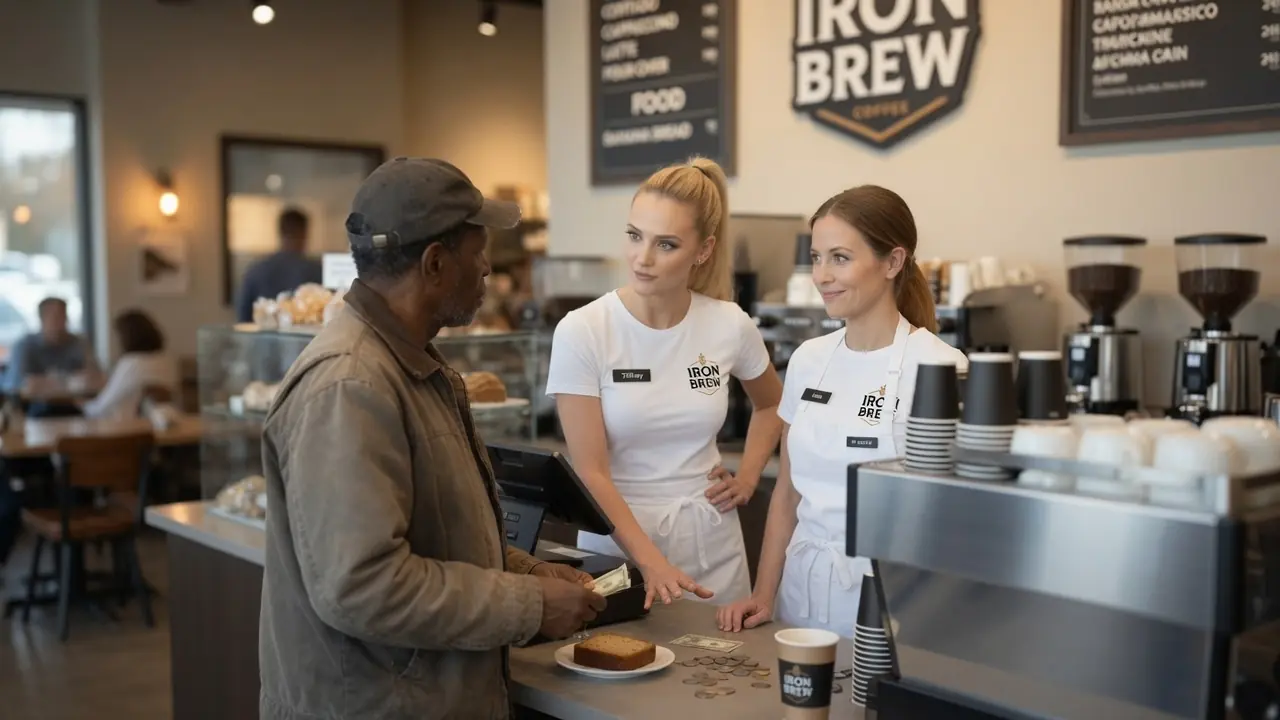
Harold had opened the first Iron Brew after losing his factory job at thirty-seven. He began with one secondhand espresso machine, six tables, and enough borrowed money to frighten him every night. His wife, Denise, baked banana bread before sunrise, while Harold served coffee, cleaned floors, and learned every regular customer’s name. By the time Denise died, Iron Brew had grown into eighty-four stores across five states.
The company had changed during the years Harold gradually stepped away from daily operations. Professional executives replaced handwritten schedules, polished branding replaced mismatched furniture, and regional supervisors measured everything from transaction speed to pastry waste. Iron Brew was more profitable than ever, yet Harold worried that something important had been lost beneath the reports. Customer complaints suggested some employees were judging people by clothing, age, and apparent income before deciding how much respect to offer them.
The Midtown location received more complaints than any other store. Several customers described two cashiers, Tiffany Blake and Jenna Marsh, laughing at elderly patrons, refusing to explain the menu, and treating anyone who paid with coins as though they were wasting the store’s time. District manager Kevin Lawson investigated twice, but each visit ended with glowing service and perfect smiles. Harold suspected the employees knew when management was watching.
He decided to visit without warning.
The morning line stretched almost to the entrance when Harold stepped inside. Businesspeople stared at phones, students worked on laptops, and delivery drivers waited near the pickup counter. Behind the register stood Tiffany, a twenty-nine-year-old blonde cashier with a high ponytail, a fitted black Iron Brew shirt, and a name badge polished more carefully than the espresso machine. Jenna worked beside her, smirking at customers whenever Tiffany made a joke.
Harold joined the line and studied the store quietly. One barista greeted every customer warmly, while Tiffany saved her best attention for people wearing expensive clothing. She complimented a businessman’s watch, offered a free pastry sample to a woman carrying a designer handbag, and ignored an elderly cleaner waiting for napkins. Jenna watched these interactions with the satisfied expression of someone who believed proximity to wealthy customers increased her own importance.
When Harold reached the counter, Tiffany looked first at his dusty jacket and then at the old wallet in his hand. Her welcoming smile disappeared before he spoke. She did not greet him, ask his name, or offer the menu. Instead, she crossed her arms and waited.
“I’d like a medium coffee and one slice of banana bread,” Harold said.
Tiffany glanced at Jenna. “You’re sure you can afford that order?”
The customers immediately behind Harold became silent. He looked at the digital menu even though he knew every price on it. The coffee and bread cost six dollars and eighty-five cents.
“Ring it up before you decide what I’m worth,” Harold replied calmly.
Tiffany sighed as though he had confirmed her worst expectations. She entered the order and pointed toward the payment screen without telling him the total. Harold placed five folded one-dollar bills on the counter, then counted the remaining amount in quarters, dimes, and nickels. Jenna leaned against the espresso machine and laughed.
“Is this going to take all morning?” Jenna asked.
Harold continued arranging the coins. “Accurate counting usually takes less time than insulting a customer.”
Tiffany swept several coins back toward him with one hand. “Take your money and leave. We don’t serve people like you when there’s a line.”
Harold looked behind him. The next customer, a nurse wearing hospital scrubs, shook her head in disbelief. A young man near the pastry case raised his phone and began recording.
“What kind of people do you believe I am?” Harold asked.
“Someone who should be buying gas-station coffee instead of holding up real customers.”
Jenna laughed again. “He probably came for free refills.”
Harold’s expression remained controlled, but grief moved beneath it. Denise had created the banana bread recipe when the first store could barely pay rent. She insisted that every customer receive the same welcome, whether they purchased one coffee or catered an entire office. The company’s earliest rule had been printed above the original register: No one should have to prove they belong before being served.
Tiffany had replaced that principle with her own judgment in less than a minute.
Harold reached into his wallet and removed a black metal card. It carried the Iron Brew emblem, his engraved name, and an executive authorization number used only by the founder and corporate board. He placed it beside the coins.
“Then call headquarters,” he said, “and explain why you refused service to Iron Brew’s owner.”
Tiffany stared at the card. Jenna stopped smiling, but only briefly.
“That’s fake,” Tiffany said.
Harold removed his cap and placed it on the counter. “Check the employee portal.”
“You expect us to believe the owner walks around dressed like that?”
“I expect you to treat people properly before knowing who owns anything.”
Jenna leaned toward the card. “Anyone can order something online and engrave a name.”
Harold opened his phone and called Kevin Lawson. The district manager answered immediately because Harold’s number appeared on every executive emergency list. Harold activated the speaker.
“Mr. Coleman?” Kevin said.
“I’m standing inside your Midtown store.”
A long pause followed.
“I’ll be there in ten minutes.”
“Bring corporate counsel and the customer complaints you told me were resolved.”
Tiffany’s face changed. “Who are you talking to?”
“The man who investigated you twice and apparently learned nothing.”
The nurse behind Harold stepped forward. “I saw the whole thing. They mocked him before he even paid.”
Tiffany pointed toward the door. “This is none of your business.”
“It became my business when you called the rest of us real customers.”
Several people nodded. Phones emerged across the store, and the atmosphere shifted completely. Tiffany had once controlled the counter through confidence and intimidation, but now every person watching understood that her certainty had been built on a terrible mistake.
Jenna moved closer to Harold. “Sir, perhaps we should start over.”
“You had that opportunity when I walked in.”
“We were only joking.”
“A joke requires everyone to laugh.”
Tiffany grabbed the executive card from the counter and turned it over. “Even if this is real, you can’t fire us over one cheap order.”
Harold took the card back. “The order was not cheap. Your conduct was.”
He picked up the coffee cup Tiffany had never filled and placed it upright near the register. “Complete the transaction.”
Tiffany looked confused. “What?”
“I ordered coffee and banana bread. Serve me exactly as you should have before learning my name.”
Jenna began preparing the coffee, but her hands trembled badly enough to spill it across the counter. Tiffany placed the banana bread on a plate without warming it, then pushed it toward Harold. He inspected the slice and noticed it was dry along the edges.
“How long has this been in the case?”
“It was baked this morning.”
Harold pressed one finger against the crust. “It was baked yesterday afternoon.”
Tiffany said nothing.
The problems were expanding beyond disrespect. The store had been labeling old pastries as fresh, something Iron Brew’s policies strictly prohibited. Harold looked toward the shift log and saw several unsigned temperature checks.
Kevin Lawson arrived eleven minutes later with attorney Monica Reyes and two corporate security officers. The district manager entered quickly, his expression tight with panic. He had met Harold many times at company meetings, though never while the founder wore farm clothes.
“Mr. Coleman, I’m terribly sorry.”
Harold gestured toward Tiffany and Jenna. “Do not apologize before understanding what happened.”
Monica placed a folder on the counter. Inside were seven customer complaints connected to Tiffany, five involving Jenna, and three employee statements describing repeated mistreatment. Kevin had marked each issue resolved after speaking only with the cashiers.
Harold opened the first complaint. An elderly man claimed Tiffany refused to accept his coins and told him to return when he had “real money.” Another described Jenna laughing at a homeless veteran who asked for water. A third came from a delivery driver who was denied restroom access while expensive customers entered freely.
“You told corporate there was insufficient evidence,” Harold said.
Kevin swallowed. “Both employees denied the claims, and camera footage had no audio.”
“Did you speak to other workers?”
“They were reluctant.”
“Did you ask why?”
Kevin looked down.
Harold turned toward the staff. Four employees had gathered near the service area, watching cautiously. One of them, a young barista named Luis, finally stepped forward.
“Tiffany cuts our hours if we disagree with her,” he said. “She handles the schedule when the manager is away.”
Tiffany’s voice sharpened. “That is a lie.”
Luis flinched but continued. “Jenna takes food home and marks it as waste. When customers complain, they blame whoever worked beside them.”
Another employee admitted that Tiffany regularly refused service to people she believed might cause trouble. Her definition included construction workers with dirty clothes, teenagers carrying backpacks, and elderly customers who needed extra time to count money. Jenna supported her because Tiffany gave her preferred shifts.
The store manager, Brian Cole, had left two hours earlier for a medical appointment. Kevin called him and requested his immediate return. Brian sounded confused when told that Harold Coleman was standing inside the store, then became silent when he heard why.
Harold looked at Tiffany. “You said this happened once.”
She crossed her arms defensively. “These employees are using the situation to attack us.”
Monica removed two printed documents from the folder. “These are preliminary suspension forms pending investigation.”
Harold shook his head. “No.”
Tiffany’s confidence returned slightly. She thought he had decided suspension was excessive.
Harold continued, “The complaints, witness statements, current video, falsified food labels, and retaliation establish enough evidence. Prepare termination documents.”
Jenna covered her mouth. Tiffany stepped backward.
“You can’t do that,” she said. “Not without giving us a chance to explain.”
“You explained yourselves when you believed I had no authority.”
“I have worked here four years.”
“And how many people did you humiliate during them?”
Tiffany looked toward Kevin. “Tell him how many sales records I broke.”
Kevin remained silent.
“I bring in more loyalty memberships than anyone,” she continued. “Customers love me.”
“Customers you consider valuable love you,” Harold replied. “Everyone else learned to avoid your register.”
Jenna’s eyes filled with tears. “I need this job.”
“So did the employees whose hours you cut.”
“I never made the decisions. Tiffany did.”
Tiffany turned on her. “You laughed too.”
“I was following your lead.”
Harold raised one hand. “Do not reduce your choices by blaming each other. You both participated.”
Monica completed the documents and placed them on the counter beside their name badges. Tiffany refused to sign, saying she would sue for wrongful termination. Monica calmly explained that signing acknowledged receipt, not agreement, and that the video, witnesses, and documented policy violations would be preserved.
Tiffany looked around the store. Customers who once watched her control the counter now stared without sympathy. The young man recording had captured the entire confrontation from the first insult.
“This will go viral,” Jenna whispered.
Harold heard her. “You should be concerned about what you did, not how many people will see it.”
Tiffany pulled off her name badge and threw it onto the counter. “This company is nothing without employees like us.”
Harold studied the badge. “Iron Brew became something because employees served people with dignity. You were damaging what thousands of others built.”
Security escorted both women into the back room to collect their belongings. As Tiffany passed Harold, she paused.
“If you had dressed like a billionaire, none of this would have happened.”
“That is exactly why you are leaving.”
Jenna followed with tears streaking her face. “I’m sorry.”
Harold looked at her. “Are you sorry you shamed me, or sorry that I owned the company?”
She could not answer.
The store remained quiet after the two cashiers disappeared. Harold turned toward the waiting customers.
“I apologize to everyone whose morning was disrupted.”
The nurse shook her head. “You don’t owe us an apology.”
“The company does. Their behavior was allowed to continue under our name.”
He instructed Luis to prepare a fresh coffee and warm a new slice of banana bread. Harold paid using the same bills and coins Tiffany had rejected, then placed a generous tip inside the jar. He sat at a corner table while Monica and Kevin began interviewing employees.
Brian, the store manager, arrived twenty minutes later. He looked exhausted and ashamed before anyone questioned him.
“I knew Tiffany could be cruel,” he admitted.
“Why did you allow it?” Harold asked.
“She was fast. She hit every sales target, and customers with large orders asked for her.”
“What about the customers she drove away?”
“They didn’t complain directly to me.”
“Several complained to corporate.”
“Kevin told me the issues were handled.”
Harold looked toward the district manager. Kevin’s face tightened.
The failure had not begun with two cashiers. Tiffany and Jenna survived because supervisors valued speed, sales, and polished appearances more than character. Complaints became inconveniences to close rather than warnings to investigate.
Harold suspended Brian and Kevin pending a complete review. Neither man protested. They understood that allowing abuse through indifference was different from committing it, but it still carried responsibility.
Corporate investigators reviewed six months of security footage and transaction records. They found repeated occasions when Tiffany canceled small orders after customers struggled to count money. Jenna frequently marked pastries as waste before placing them inside her bag. Scheduling files showed that employees who questioned them received fewer hours the following week.
The investigation expanded across the company.
Harold requested every unresolved discrimination and service complaint from all eighty-four locations. The report contained hundreds of incidents categorized as misunderstandings, insufficient evidence, or customer sensitivity. Many involved people who were elderly, homeless, disabled, or dressed in work clothing.
The company’s culture had not become cruel everywhere, but its measurement systems encouraged workers to prioritize profitable speed. Store leaders received bonuses for transaction time and membership sign-ups. Helping a confused customer could lower performance scores, while pushing an expensive drink increased them.
Harold called an emergency executive meeting.
He entered headquarters wearing the same dusty jacket from the coffee shop. The board members stared at the coins he placed in the center of the conference table.
“These were enough to buy my order,” he said. “Two employees decided they were proof I did not belong.”
Chief Operations Officer Melissa Grant opened the performance reports. “Their actions violated policy.”
“Our policies also rewarded the behavior that made them successful.”
Melissa started to object, then stopped.
Harold ordered the company to remove transaction speed as a primary measure of individual performance. Customer respect, complaint resolution, teamwork, and accessibility would become equally important. Employees would no longer be pressured to rush elderly or disabled patrons, and every complaint involving discrimination would require interviews with witnesses rather than a simple conversation with the accused worker.
He also created a customer dignity rule based on Denise’s original principle.
Every person belongs before purchasing anything.
The sentence appeared behind each register within a month.
Some executives considered the phrase sentimental. Harold reminded them that Iron Brew existed because Denise once served free coffee to factory workers who had not received their wages. Several later returned with entire crews, turning compassion into the store’s first regular customer base.
Kindness had always been part of the business model.
The Midtown location closed for two days of retraining. Luis became acting shift supervisor because he had spoken despite fearing retaliation. Corporate offered every affected employee restored hours and back pay where scheduling records showed punishment.
When the store reopened, Harold returned again.
This time, no one knew he was coming. He wore the same cap and jacket, joined the line, and ordered identical coffee and banana bread. Luis greeted him professionally but did not make a performance of recognizing the founder.
“You paying with the famous coins?” Luis asked quietly.
Harold smiled. “They’ve gained a reputation.”
A woman ahead of him struggled to understand the menu because English was not her first language. The cashier patiently explained each drink while the line waited. No one rushed her.
That mattered more to Harold than any executive welcome.
Three months later, Tiffany filed a wrongful-termination claim. Her attorney argued that Harold had staged the undercover visit to provoke misconduct. The customer video proved otherwise. Harold had asked for ordinary service, and Tiffany initiated every insult before knowing his identity.
Further evidence showed that she had received written warnings for retaliation and mislabeling food. Jenna chose not to join the claim. She submitted a written apology to the company and several employees, though Iron Brew did not rehire her.
Jenna later found work at a small grocery store. She completed a customer-service course voluntarily and wrote to Harold six months afterward.
I kept telling myself Tiffany made me cruel. The truth is that laughing made me feel included, and I chose belonging over decency. I understand why you fired me.
Harold answered with one sentence.
Understanding matters only when it changes how you treat the next person.
Tiffany never wrote.
Iron Brew’s changes produced unexpected results. Transaction times became slightly slower, but customer retention increased. Complaints fell, employee turnover decreased, and stores began attracting older customers who previously avoided complicated menus.
The company introduced a “patient service” symbol customers could place on the counter if they needed additional time, help reading prices, or assistance carrying drinks. No explanation was required.
Harold visited locations regularly without announcing himself. Sometimes employees recognized him, but often they did not. He never again entered specifically hoping to catch someone failing. He wanted to see whether the system helped ordinary workers succeed before a crisis exposed them.
One year after the Midtown incident, Iron Brew held its annual employee gathering inside the warehouse where Harold had roasted his first coffee beans. Instead of presenting awards only for sales, the company honored employees who helped customers, supported coworkers, and improved accessibility.
Luis received the Denise Coleman Service Award.
He stepped onto the small stage looking uncomfortable with the applause. Harold handed him a plaque bearing the original handwritten rule from the first store.
“No one should have to prove they belong before being served,” Luis read.
Harold nodded. “You understood that before management did.”
After the ceremony, a reporter asked Harold whether he regretted firing Tiffany and Jenna publicly.
“I did not intend for their dismissal to become entertainment,” he said. “But I do not regret protecting customers and employees from repeated cruelty.”
The reporter asked whether he believed people deserved second chances.
“Of course.”
“Then why not give them one?”
“A second chance does not always require returning to the same position of power.”
The answer appeared in several articles. Some readers agreed, while others accused Harold of destroying two young women’s careers over an insensitive joke. He refused to debate strangers online.
He had reviewed the complaints, heard the employees, and watched the video. The terminations were not caused by one sentence. The sentence merely exposed a pattern everyone else had learned to tolerate.
Several years later, Harold donated the original Midtown counter to Iron Brew’s training center after the location was renovated. Beside it, the company displayed his old wallet, the black executive card, and replicas of the coins Tiffany pushed away.
New employees heard the story during orientation.
The trainer never began by revealing Harold’s identity. She described an elderly customer in worn clothing who entered a coffee shop and tried to buy breakfast. Then she asked the class whether his treatment would have been wrong if he truly had possessed nothing.
The correct answer was always yes.
Harold continued working on his farm and visiting stores until his health required a slower schedule. He still preferred basic coffee and Denise’s banana bread, though nutritionists repeatedly advised him to reduce sugar.
On the final anniversary he attended, a young cashier recognized him and became visibly nervous.
“Mr. Coleman, your order is free.”
Harold placed seven dollars on the counter.
“Why?” she asked.
“Because paying is part of the experience.”
She accepted the money and returned the correct change without commenting on the coins. Harold carried his coffee toward a table near the window, then noticed a construction worker entering with mud covering his boots.
The cashier smiled.
“Good morning. What can I get started for you?”
Her voice contained the same respect she had offered the company’s founder.
Harold sat down and opened the paper around his banana bread. That simple greeting told him the company had finally understood the lesson.
Tiffany and Jenna had believed Harold mattered only after seeing the executive card. Their mistake was not merely failing to recognize the owner. Their mistake was assuming an ordinary customer could be shamed without consequence.
Harold founded Iron Brew to create a place where workers, executives, students, elderly neighbors, and anyone with enough coins for one coffee could share the same counter.
Two cashiers forgot that promise.
Then the man they rejected placed down his card, revealed who he was, and fired them before the next order was called.