Rain had been falling over the Port of Oakland since before sunrise, turning the access lanes slick and covering rows of shipping containers with a dull silver sheen. At 7:42 a.m., seventy-two-year-old Evelyn Brooks stepped from a black sedan near Gate 14 carrying a brown leather document case beneath one arm. Her silver-gray curls were perfectly arranged despite the weather, and a long deep-purple wool coat covered the matching skirt beneath it. She walked toward the security building with the quiet confidence of someone who knew exactly why she was there.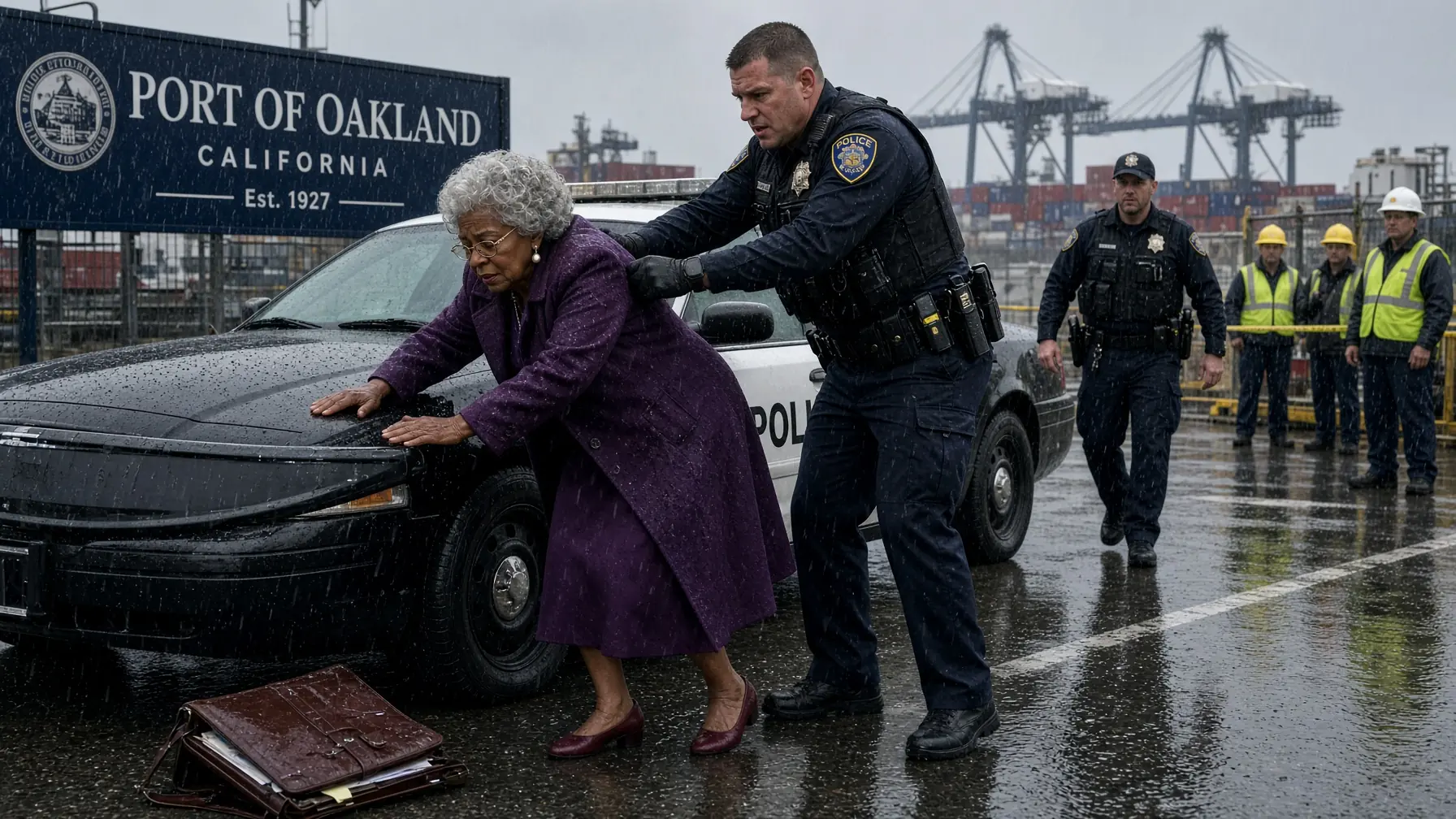
Officer Ryan Keller noticed her before she reached the gate. He was thirty-nine, broad-shouldered, impatient, and already irritated after spending half his shift dealing with trucks whose drivers had arrived with incomplete paperwork. Keller looked at Evelyn’s expensive but understated coat, then at the document case in her hand, and immediately decided she was another confused visitor who had wandered somewhere she did not belong. He stepped directly into her path and held up one gloved hand.
“Restricted zone.”
Evelyn stopped.
“I know.”
“Then turn around.”
“I have an appointment inside.”
Keller’s expression tightened.
“With who?”
“The executive operations team.”
He looked her up and down.
“For what?”
Evelyn reached toward the document case.
Keller’s hand snapped toward his belt.
“Keep your hands where I can see them.”
She froze.
“My identification is inside the bag.”
“Set it down.”
Evelyn looked at him for a moment, then carefully placed the leather case on the wet pavement.
Keller nudged it away with his boot.
“Name?”
“Evelyn Brooks.”
He typed something into the handheld terminal clipped near his vest.
Nothing appeared.
That should not have surprised him. Evelyn was not a port employee, contractor, truck driver, or visitor listed in the regular gate system.
Instead, Keller took the absence of a result as proof.
“You’re not authorized.”
Evelyn remained calm.
“I’m not supposed to appear on the visitor list.”
Keller laughed.
“That’s convenient.”
A second officer, Michael Trent, walked over from the cruiser parked nearby. He was forty-three and had worked port security longer than Keller, though not long enough to recognize Evelyn. Trent looked at the older woman, then at Keller.
“Problem?”
“She says she’s meeting executive operations.”
Evelyn corrected him.
“I said I have official business with executive operations.”
Trent glanced at her shoes.
Then at the wet pavement.
“Ma’am, people don’t just walk into a federal security zone and announce official business.”
“This is not a federal facility.”
Trent frowned.
Evelyn continued.
“The port is publicly governed. Certain areas are federally regulated. Those are different things.”
Keller stepped closer.
“You trying to teach us our jobs?”
“No.”
Evelyn looked directly at him.
“I’m trying to stop you from making this worse.”
That sentence triggered exactly the opposite reaction.
Keller reached for her arm.
Evelyn pulled back instinctively.
“Do not touch me.”
“There it is,” Keller said. “Noncompliance.”
“With what lawful order?”
Trent moved behind her.
“Hands on the hood.”
Evelyn stared at him.
“No.”
Keller’s voice rose.
“Hands on the hood. Now.”
Three dockworkers wearing fluorescent safety vests stopped near a forklift lane and began watching. One quietly reached for his phone. Another port employee, a middle-aged woman named Sofia Ramirez, recognized Evelyn from a board meeting photograph but could not immediately place the name.
Evelyn looked toward the officers.
“You have not identified any offense.”
Keller reached for her shoulder.
“You want one?”
“Officer.”
“Hands on the hood.”
He pushed her forward.
Evelyn caught herself against the wet front of the patrol cruiser.
Her palms struck the metal.
Her glasses slipped down her nose.
Trent grabbed her other arm.
The brown leather document case remained on the pavement behind them.
“Stay down, old lady,” Keller said. “People like you don’t walk into a restricted port and start demanding answers.”
Evelyn slowly turned her face toward him.
“You threw my credentials on the ground because you were too arrogant to read them.”
“I don’t care what’s in that bag.”
Keller tightened his grip.
“One more word and you’re leaving this port in cuffs.”
Evelyn looked beyond him.
Three black SUVs had just entered the access road.
They moved slowly past the security checkpoint.
No sirens.
No dramatic rush.
Only deliberate movement.
Evelyn’s expression changed slightly.
“Then cuff me now.”
Keller glanced at her.
“What?”
“The investigators behind you came here to audit your unit.”
She looked at the SUVs.
“And you just gave them their opening evidence.”
Keller turned.
The first SUV stopped.
Its rear door opened.
A woman in a navy suit stepped out carrying a sealed evidence folder.
Behind her came two state investigators, an attorney from the city controller’s office, and the Port of Oakland’s executive director.
The executive director saw Evelyn against the cruiser.
He stopped walking.
“What the hell is happening?”
Keller released her arm.
Too late.
Evelyn Brooks had spent forty-one years working around ports.
She began as a young accountant reviewing cargo manifests for a shipping cooperative. From there she moved into compliance, then infrastructure oversight, eventually becoming one of the most respected public-sector auditors on the West Coast. She had investigated procurement fraud, cargo theft, falsified inspection records, contractor kickbacks, and enough creative accounting schemes to know that misconduct rarely began with dramatic crimes. It usually began with someone believing nobody would compare two pieces of paper.
Three years earlier, California’s regional transportation oversight board had appointed Evelyn to chair the Port Accountability Commission. The commission was independent from daily port management and existed precisely because the port handled billions of dollars in cargo, contracts, leases, and infrastructure spending. Evelyn’s reputation rested on one habit: she never announced an inspection earlier than necessary. If people had time to prepare, records became cleaner than reality.
That morning’s visit had been scheduled quietly.
Only five senior people knew.
A small group of investigators would meet Evelyn inside operations headquarters to begin an unannounced review of security procedures connected to a larger cargo-loss investigation. For six months, investigators had been examining discrepancies between container-release records, gate-entry logs, and surveillance data. Thirty-seven containers had been recorded as properly cleared even though associated digital security scans showed irregularities.
The losses were not enormous individually.
Together they represented almost $11 million in missing electronics, auto parts, and specialty equipment.
Someone was manipulating records.
The commission did not yet know who.
That was why Evelyn arrived without an entourage.
She wanted to walk through Gate 14 the same way an ordinary authorized visitor might.
Instead, she met Ryan Keller.
Executive Director Thomas Avery hurried toward her.
“Chairwoman Brooks?”
Keller stared.
Evelyn pushed herself slowly upright.
Her purple coat was soaked across the front.
One knee had struck the bumper, and although she remained composed, the pain was visible in the way she shifted her weight.
Avery looked at Keller.
“What did you do?”
Keller recovered quickly.
“She refused to identify herself.”
Evelyn pointed toward the brown leather case.
“My credentials are lying where he kicked them.”
Everyone looked down.
Investigator Dana Whitfield walked over, picked up the bag, and handed it to Evelyn.
Evelyn opened it.
She removed a laminated credential.