Judge Claudia Hayes entered the federal courthouse in Philadelphia at 7:42 on a cold October morning, carrying a leather briefcase in one hand and her folded judicial robe in the other.
She was fifty-two years old, with deep-brown skin, sharp dark eyes, and long gray-streaked braids gathered neatly behind her shoulders. Beneath the robe, she wore a charcoal pantsuit, a cream silk blouse, pearl earrings, and low black heels chosen for a day that promised many hours on the bench.
The courthouse looked ordinary from the outside.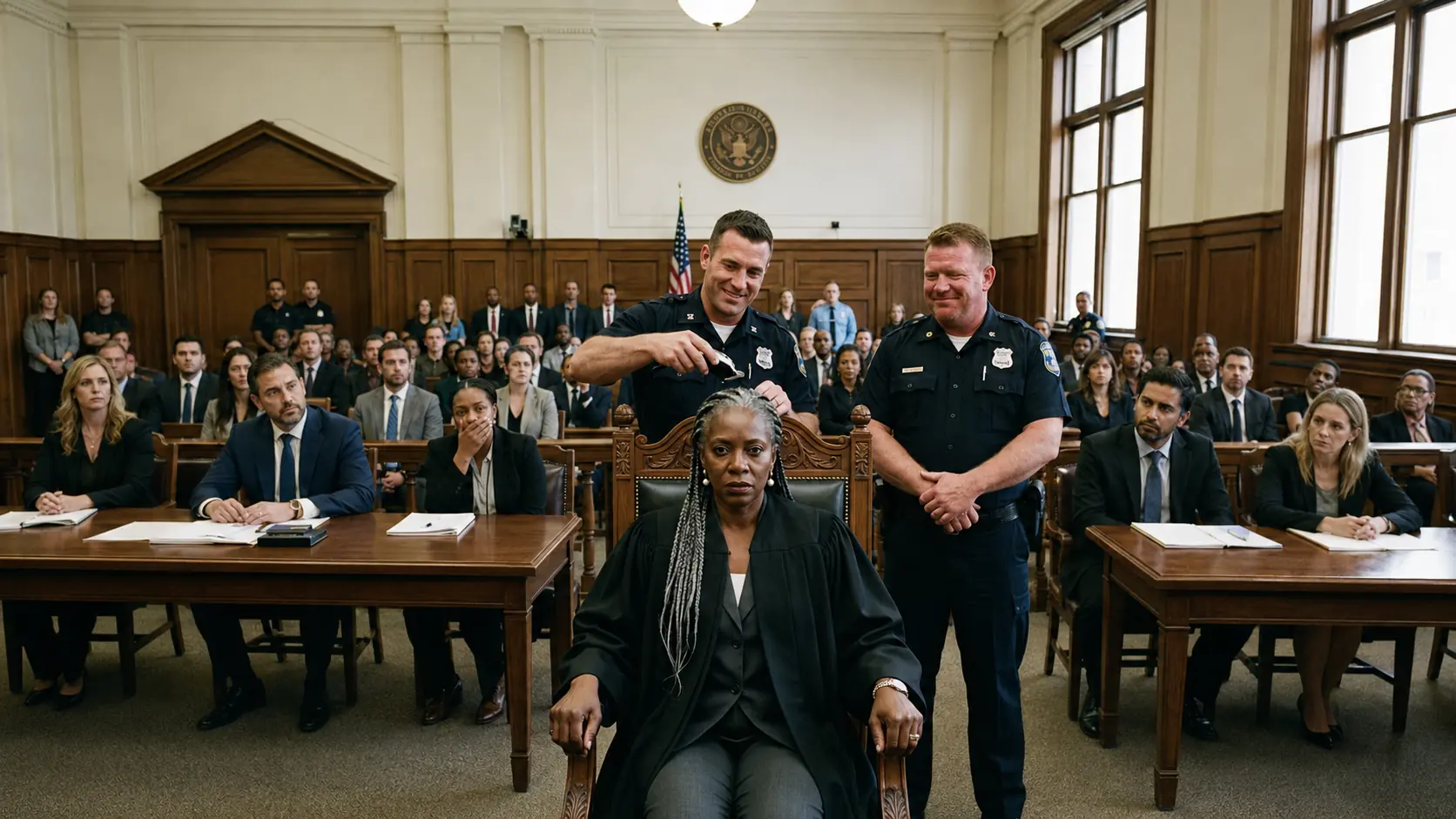
Inside, everyone knew the day would be anything but ordinary.
At nine o’clock, Claudia was scheduled to begin a federal civil-rights hearing involving Officers Richard Donnelly and Brent Karns. The two Philadelphia police officers were accused of using excessive force during several arrests, falsifying reports, and intimidating witnesses who attempted to file complaints.
The case had drawn reporters, activists, union representatives, and attorneys from across Pennsylvania.
Claudia had spent four months reviewing motions, disciplinary files, medical records, and video evidence. She knew every name in the case and every attempt the defense had made to delay it.
What she did not know was that Donnelly and Karns had been assigned to courthouse security that morning.
The courthouse had opened a secondary screening line near the east entrance because of the expected crowd. Deputy Wallace Jenkins stood behind the metal detector, speaking with Donnelly and Karns while attorneys placed bags on the conveyor belt.
Wallace had worked courthouse security for twenty-seven years. His reputation depended on who was describing him.
To senior judges, he was experienced.
To Black attorneys, immigrant interpreters, and young public defenders, he was the man who always found a reason to inspect their belongings twice.
Claudia approached the checkpoint.
“Good morning,” she said.
Wallace’s eyes moved over her pantsuit, her braids, and the robe draped across her arm.
“Place everything on the belt.”
She set down her briefcase and robe.
The metal detector sounded when she walked through.
Claudia stopped and waited.
Wallace smiled without warmth.
“Step aside.”
“My identification and courthouse credentials are in the front pocket of the briefcase.”
“I didn’t ask where they were.”
Donnelly moved toward her from the right. He was forty-three, tall and muscular, with short dark hair and a heavy jaw. Karns, three years older and broader through the shoulders, approached from the opposite side.
Donnelly looked at the folded black robe.
“What’s that supposed to be?”
“My judicial robe.”
Karns laughed.
“Your judicial robe?”
Claudia met his stare.
“I am Judge Claudia Hayes. I am scheduled in Courtroom Four.”
Wallace folded his arms.
“Of course you are.”
Several courthouse employees looked over.
A young clerk named Lydia Cruz stopped near the elevators. She recognized Claudia immediately, but Donnelly’s hand had already moved toward his cuffs.
Claudia reached slowly toward her briefcase.
“My federal identification is inside.”
Donnelly seized her wrist.
“Keep your hands where I can see them.”
“Release me.”
“You don’t give orders here.”
“I have identified myself. Open the briefcase and verify it.”
Karns lifted the robe from the conveyor belt.
“Anybody can buy one of these.”
The courthouse grew quieter.
An attorney standing behind Claudia spoke.
“She said she’s a judge. Check the credentials.”
Donnelly turned toward him.
“Back up before you join her.”
The attorney fell silent.
Claudia saw the fear moving through the crowd. Some people recognized her. Others did not. None wanted to become the officers’ next target.
She kept her voice controlled.
“Officer, you are creating a record that will follow you for the rest of your career.”
Donnelly smiled.
“Still pretending you’re a judge?”
“I am a federal judge.”
Karns stepped behind her.
“And I’m the President.”
Claudia looked toward Wallace.
“You know who I am.”
Wallace’s expression changed only slightly.
“I know you’re causing a disturbance at a security checkpoint.”
That answer told her everything.
He recognized her.
He simply believed the other officers could still control the situation.
Donnelly forced Claudia’s hands behind her back and locked the cuffs around her wrists.
A gasp moved through the entrance hall.
Lydia discreetly raised her phone.
Claudia did not resist.
She knew every sudden movement could be described later as aggression. She also knew Donnelly and Karns were already defendants in a civil-rights case, and that their conduct was confirming the allegations against them in front of dozens of witnesses.
“You are detaining the judge assigned to your hearing,” Claudia said.
Karns leaned close to her ear.
“Keep talking. We’ll teach you who runs this court.”
They pushed her through a side door marked SECURITY PERSONNEL ONLY.
Wallace followed and closed the door behind them.
The room was narrow, windowless, and cold. A metal chair had been bolted to the floor beneath harsh fluorescent lights. A cabinet stood against one wall beside a desk cluttered with old coffee cups and incident forms.
Donnelly forced Claudia into the chair.
The cuffs pressed painfully into her wrists.
Karns placed her folded robe on the desk.
“So, Your Honor,” he said, exaggerating the title, “what court do you supposedly run?”
“The United States District Court for the Eastern District of Pennsylvania.”
Donnelly searched her jacket pockets.
“You practice that line?”
“My credentials are ten feet away.”
“We’ll decide when to check them.”
Claudia stared at Wallace.
“You permitted this after recognizing me.”
Wallace leaned against the door.
“I recognized someone who’s been causing problems for law enforcement.”
“You mean someone who refused to bury misconduct cases.”
His face tightened.
Donnelly stepped between them.
“You think sitting behind a bench makes you better than us?”
“No.”
Claudia’s voice remained level.
“I think the Constitution places limits on your power.”
Karns clamped both hands onto her shoulders.
“There it is. That superior attitude.”
Donnelly opened the cabinet.
He removed a pair of electric clippers and unwrapped the cord.
Claudia watched him plug them into the wall.
“What exactly do you think you are doing?”
He switched them on.
The blades began to buzz.
Donnelly smiled.
“You came in wearing a fake robe and pretending to be important. Maybe we should take away the costume.”
Claudia’s pulse accelerated, but she refused to lower her head.
“Turn those off.”
“Or what?”
“You will lose your badge.”
Karns tightened his grip on her shoulders.
“We run this court, not women like you.”
Claudia looked directly at Donnelly.
“Touch my hair, then learn whose courtroom this is.”
For a moment, he hesitated.
Wallace could have stopped him.
Karns could have released her.
Either officer could have opened the briefcase and ended the confrontation.
Instead, Donnelly pressed the clippers against the side of Claudia’s head.
The first braid fell across her shoulder.
Lydia stood outside the partially opened door, recording through the narrow gap.
Inside, Donnelly laughed.
Karns removed his phone and began taking photographs.
Dark and silver hair dropped to the floor as Donnelly made another careless pass. He cut unevenly, leaving patches of hair and scraping too close to Claudia’s scalp in several places.
“Smile,” Karns said. “We need a picture for the courthouse wall.”
Claudia focused on her breathing.
She thought of every victim whose testimony she had read while preparing their case.
A college student thrown against a patrol car.
A store owner threatened after his security camera captured an unlawful search.
A Black father arrested in front of his children after asking why his vehicle had been stopped.
The officers had written that each person was aggressive, suspicious, or noncompliant.
Now Claudia understood exactly how those reports had been created.
Donnelly made one final pass.
He stepped back and admired the damage.
Claudia’s head was nearly bare on one side, while pieces of several braids hung unevenly from the other.
“Not looking very judicial now,” he said.
Wallace checked the clock.
“That’s enough. Get her out before someone starts looking.”
Karns removed the cuffs.
Claudia stood slowly.
Her wrists were red, but her hands did not shake.
She bent down and lifted one severed braid from the floor.
Donnelly laughed again.
“You keeping that as a souvenir?”
“No.”
She placed it carefully on the desk.
“I’m preserving evidence.”
His smile weakened.
Claudia picked up her robe and walked toward the door.
Karns blocked her.
“You tell anyone what happened, we’ll say you became violent during screening.”
Lydia stepped away before the door opened.
Claudia looked into Karns’s eyes.
“You have already chosen the statement you intend to falsify.”
“You think anyone will believe you over three officers?”
Claudia moved past him.
“They will not need to believe me.”
She returned to the public checkpoint.
Her briefcase remained on the conveyor belt.
The lobby fell silent when people saw her.
A courthouse employee covered her mouth. Another turned away in anger. Several attorneys began taking photographs of Claudia’s damaged hair and bruised wrists.
She opened the briefcase.
Her federal identification sat exactly where she had said it would be.
Claudia held it up.
Wallace looked away.
She removed a second item: the docket for the morning hearing.
Across the top were the names UNITED STATES v. RICHARD DONNELLY AND BRENT KARNS.
Claudia handed both documents to the chief courtroom clerk.
“Make copies.”
Then she walked toward Courtroom Four.
At 8:59, the gallery was full.
Donnelly and Karns entered through the side door wearing polished uniforms and expressions they believed showed confidence. They had not yet learned who was scheduled to preside.
Their defense attorney whispered with them at the table.
The clerk rose.
“All rise.”
The courtroom stood.
“The United States District Court for the Eastern District of Pennsylvania is now in session. The Honorable Judge Claudia Hayes presiding.”
The rear doors opened.
Claudia entered wearing her black judicial robe.
Every conversation stopped.
The uneven remnants of her hair remained exactly as the officers had left them. Red marks were visible across her scalp. She had made no attempt to hide the evidence.
Donnelly’s face emptied of color.
Karns gripped the edge of the table.
Their attorney looked from Claudia to his clients.
“What did you do?” he whispered.
Claudia climbed the steps to the bench.
She sat in the carved wooden chair, adjusted the microphone, and looked down at the men who had told her they ran the courthouse.
“Good morning.”
Neither officer answered.
The attorney stood.
“Your Honor, the defense requests an immediate conference.”
“Your request is noted.”
“This concerns a serious conflict.”
Claudia looked at Donnelly.
“Does it?”
His eyes dropped.
Claudia addressed the courtroom.
“Before this hearing proceeds, the court must place several matters on the record.”
She described the encounter at the security checkpoint in careful, unemotional language. She stated the time, location, names of the officers involved, witnesses present, and the location of her briefcase and credentials.
She did not exaggerate.
She did not describe how it felt to hear her hair falling against the concrete floor.
She simply recited facts.
The defense attorney stood again.
“Your Honor, based on these allegations, you must recuse yourself.”
Claudia had already anticipated the motion.
“The defendants’ alleged conduct this morning will be investigated separately. I will not preside over any criminal proceeding arising from that incident.”
Relief briefly appeared on the attorney’s face.
“However,” Claudia continued, “today’s hearing concerns allegations predating this morning by several years. The matter will recess until the chief judge determines whether reassignment is necessary.”
She turned to the clerk.
“Before recess, the court orders immediate preservation of all courthouse surveillance footage, security logs, body-camera recordings, mobile devices used by courthouse personnel, and access records for the security room.”
Karns looked sharply at Donnelly.
Claudia saw it.
“The court further orders that no officer involved may access, alter, delete, or transfer evidence without written authorization from the United States Marshal and the Department of Justice.”
The defense attorney objected.
Claudia overruled him.
Her gavel struck once.
The sound echoed through the room.
“Court is in recess.”
Federal marshals entered before Donnelly and Karns could leave.
They collected the officers’ phones and escorted them into separate rooms for questioning.
Wallace was removed from his security post.
By noon, the story had spread across the country.
A federal judge had been handcuffed and forcibly shaved inside her own courthouse by officers scheduled to appear before her.
News stations replayed footage of Claudia entering the courtroom with her damaged hair. Police union representatives insisted the officers had made an identification error. Commentators questioned whether Claudia had somehow provoked the encounter.
Then Lydia Cruz came forward.
She entered Claudia’s chambers carrying a small flash drive.
“I recorded everything,” she said.
Claudia looked at the young clerk.
“You understand what this could cost you?”
Lydia nodded.
“They saw me near the door. They’ll know eventually.”
Marcus Lee, Claudia’s senior clerk, copied the video onto three encrypted drives. One went to the Department of Justice. One went into federal evidence storage. The third remained with Claudia’s attorney.
The recording left no room for excuses.
It showed Wallace acknowledging Claudia before the detention.
It captured Donnelly ignoring repeated requests to inspect her credentials.
It recorded Karns saying, “We run this court, not women like you.”
Most damaging of all, it showed the officers laughing while Claudia sat handcuffed beneath the clippers.
Donnelly and Karns were suspended before sunset.
Wallace was placed on leave.
But the case did not end there.
Detective Alan Price contacted federal investigators two days later. He had worked beside Donnelly and Karns in narcotics and had preserved copies of reports he believed they altered.
“There were dozens of incidents,” he told investigators. “They targeted people they thought could not fight back.”
Price produced photographs, audio recordings, and original reports that differed from the versions entered into official databases. Several complaints had been dismissed after evidence disappeared. Witnesses had been threatened. Body-camera files had been mislabeled or deleted.
Wallace’s name appeared repeatedly.
He was not merely a courthouse guard who failed to intervene.
He had helped bury complaints against favored officers for more than a decade.
The investigation expanded.
District Attorney Harold Denton publicly called the accusations exaggerated. Chief Judge Morton privately pressured Claudia to remain silent until the scandal passed.
“You have already become the face of this controversy,” he told her inside his chambers. “Anything you say will be viewed as personal retaliation.”
Claudia touched the smooth section of her scalp.
“What happened to me is evidence, not a public-relations problem.”
“You risk damaging the dignity of the judiciary.”
“The judiciary was damaged when officers believed they could assault a woman inside a courthouse and walk away laughing.”
Morton leaned across his desk.
“Recuse yourself from every related matter and let the institution handle this quietly.”
“No.”
“You are risking your career.”
“My integrity is not negotiable.”
The pressure intensified.
Police supporters gathered outside Claudia’s home.
Her car was vandalized in the courthouse garage.
Anonymous messages warned her to stop cooperating with federal investigators.
Then Detective Price was attacked outside his house.
He survived with broken ribs, a fractured arm, and internal injuries. The assault convinced the Department of Justice that the misconduct involved more than two reckless officers.
Federal agents raided the police union office, the courthouse security department, and several internal-affairs storage rooms.
They recovered sealed complaints, altered reports, and deleted video fragments.
One email chain revealed regular meetings between Wallace, union officials, and senior administrators who decided which misconduct allegations should disappear.
Donnelly and Karns had operated confidently because the system had protected them for years.
They had not realized Claudia’s case would expose the machinery behind them.
The original civil-rights trial was transferred to another federal judge to avoid any appearance of bias. Claudia accepted the decision without protest. Her goal was not to personally sentence the men who attacked her.
Her goal was to ensure the truth could not be buried.
She testified as a witness.
The jury watched Lydia’s recording in complete silence.
On the screen, Donnelly raised the clippers.
Karns held Claudia’s shoulders.
Wallace stood at the door and told them not to leave visible marks.
When the video ended, Donnelly stared at the defense table.
Karns closed his eyes.
Neither officer looked toward Claudia.
The prosecution then presented evidence from twenty-seven additional complainants. Their stories followed the same pattern: unnecessary detention, escalating threats, fabricated resistance, and official reports that transformed victims into aggressors.
Donnelly took the stand against his attorney’s advice.
He claimed Claudia had behaved suspiciously.
The prosecutor asked a single question.
“What specific crime did you believe Judge Hayes had committed before you placed her in handcuffs?”
Donnelly had no answer.
Karns attempted to blame his partner.
The video showed him encouraging every stage of the assault.
Wallace accepted a plea agreement and testified about years of cover-ups. In exchange for a reduced sentence, he identified the administrators who helped suppress complaints and intimidate witnesses.
Chief Judge Morton resigned before federal charges were announced.
District Attorney Denton followed two days later.
Donnelly and Karns were convicted of civil-rights violations, unlawful detention, assault, conspiracy, witness intimidation, and filing false reports.
At sentencing, the courtroom was filled with people whose complaints had once disappeared.
Claudia sat in the gallery rather than behind the bench.
Her hair had begun to grow back, but she had chosen to keep it closely shaved. What the officers intended as a mark of control had become a visible reminder of their failure.
Donnelly received twelve years in federal prison.
Karns received fifteen.
Wallace received eight after cooperating with investigators.
All three were permanently barred from law-enforcement or courthouse-security employment.
The judge handling sentencing looked toward the packed gallery.
“These defendants believed authority belonged to whoever held the badge,” he said. “They were wrong. Authority belongs to the law, and the law belongs equally to every person standing before it.”
Months later, Claudia was nominated to become chief judge of the district.
She accepted under one condition.
The courthouse would establish an independent civilian oversight office with complete access to security complaints, camera records, and disciplinary files.
No courthouse employee could investigate complaints against his own department.
All security personnel would complete annual civil-rights and bias training.
Every complaint would receive a public tracking number so it could not silently disappear.
Lydia Cruz became the oversight office’s first evidence coordinator.
Alan Price, after recovering from the attack, became an adviser on whistleblower protection.
The courthouse where Claudia had been restrained changed slowly, then visibly.
The extra searches aimed at minority attorneys stopped.
Security staff began wearing body cameras.
Public reports documented every use of force and every complaint resolution.
One year after the assault, Claudia entered Courtroom Four for an ordinary morning docket.
The clerk called the room to order.
Attorneys stood.
Defendants waited beside their lawyers.
Sunlight crossed the polished wooden bench as Claudia took her seat.
Her hair remained short, silver beginning to show along the sides. She no longer touched it out of pain or disbelief.
It had become part of her judicial presence.
Before beginning the first case, Claudia looked across the courtroom.
The officers who once told her they ran the court were gone.
The officials who protected them were under investigation or out of power.
The people who had once lowered their eyes at the security checkpoint now knew silence carried a price.
Claudia raised her gavel.
“The court is ready to proceed.”
The sound rang through the chamber.
Donnelly and Karns had tried to strip away what they believed made her powerful.
They cut her hair because they thought dignity could be removed with clippers.
They restrained her because they believed authority flowed only from uniforms and force.
But the moment Claudia entered the courtroom and took her rightful place behind the bench, they learned the truth.
The robe had never created her power.
The chair had never created her courage.
And the hair they took had never contained her dignity.
Everything that made Claudia Hayes a judge had remained untouched.