Every conversation inside the roadside diner stopped.
Forks remained suspended above plates. A waitress stood beside the counter with a coffee pot trembling in one hand, while customers stared at the two uniformed officers surrounding the beautiful young nurse in the wheelchair. Red-and-white booths lined the restaurant, morning sunlight passed through the front windows, and the smell of bacon and coffee hung over a confrontation that had become dangerously quiet.
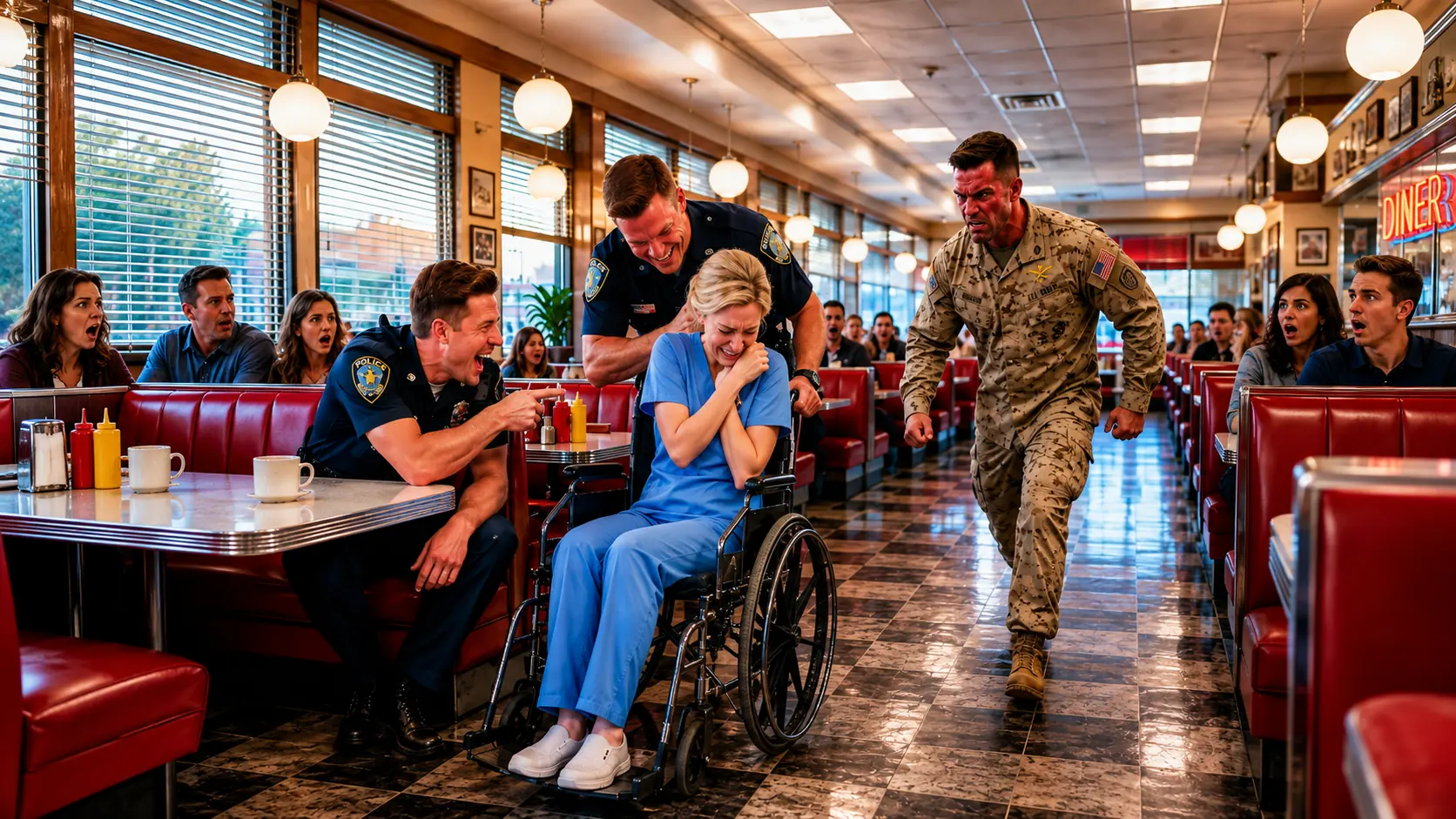
The Nurse was twenty-nine, with fair skin, luminous blue eyes, and long blonde hair tied into a loose ponytail. She wore fitted sky-blue scrubs and white nursing shoes, though one shoe rested awkwardly against the metal footplate because her left leg remained too weak to support her weight. Her hospital identification badge hung from her chest, and a fading scar ran beneath her right ear.
Six weeks earlier, she had been walking without assistance.
Now she could barely stand.
The Lead Officer leaned over her, his thick forearm pressing against the back of the wheelchair. Beside him, a younger officer laughed while pointing at the Nurse’s shaking hands. Both men wore the uniform of the Bellhaven Police Department, an institution that had controlled the city through fear for longer than most residents were willing to admit.
The Navy SEAL had entered from the rear hallway only seconds earlier.
He was forty, tall and heavily built, with a square jaw, short dark hair, and a face marked by years of hard training. His desert service uniform carried his name, insignia, and evidence of a career spent entering situations where hesitation could cost lives. He was not shouting now.
That made him more dangerous.
The Lead Officer removed his hand from the wheelchair and straightened.
“This is police business,” he said. “Walk away.”
The SEAL glanced at the Nurse’s tear-streaked face, then at the officer’s hand hovering near his weapon. “She’s my sister.”
The younger officer stopped laughing.
The Nurse looked up at her brother, relief briefly breaking through the terror in her eyes. “They know about the recording.”
The SEAL lowered himself beside her without turning his back on the officers. “Did they take your phone?”
“No.”
“Did you send the files?”
Her breathing steadied.
“Every one of them.”
The Lead Officer’s expression changed.
He had spent most of his career frightening people who had nowhere to turn. He knew how to intimidate undocumented workers, poor business owners, recovering addicts, and parents afraid of losing their children. He knew how to make witnesses doubt themselves before they reached a courtroom.
What he did not know was where the Nurse had sent the evidence.
“Give me the phone,” he ordered.
The SEAL stood again.
The Lead Officer took one step forward.
So did the SEAL.
Only inches separated them.
The younger officer moved toward the side, trying to create an angle behind the military man. The SEAL noticed without looking directly at him. His posture shifted slightly, placing his body between both officers and the Nurse.
“Last warning,” the Lead Officer said.
The SEAL’s voice remained low. “That was mine.”
The confrontation inside the diner had begun long before that morning.
The Nurse worked at Bellhaven Community Medical Center, a small nonprofit clinic serving patients without insurance. She treated construction workers, elderly residents, homeless families, and children whose parents could not afford the emergency room. She often stayed after her shift ended because leaving on time meant sending someone home without care.
The clinic struggled financially, but its administrator kept the doors open through donations and state grants. For years, it had survived inspections, budget cuts, and pressure from private hospital groups that wanted the property. Nothing threatened it more seriously than the men wearing Bellhaven police badges.
The first demand came disguised as a safety fee.
The Lead Officer visited the clinic with another officer and told the administrator that the neighborhood had become dangerous. For a monthly payment, police patrols would pass the building more frequently, respond quickly to disturbances, and ensure patients were not harassed outside.
The administrator explained that a public police department could not charge private protection fees.
The Lead Officer smiled.
Two days later, officers began stopping patients in the parking lot.
They searched bags, questioned parents, and threatened homeless patients with loitering charges. Ambulances were delayed at the entrance because cruisers blocked the loading zone. Anonymous complaints accused the clinic of illegally distributing prescription medication.
The message was clear.
Pay, or the department would make survival impossible.
The administrator quietly began placing two thousand dollars in an envelope every month.
The Nurse discovered the arrangement by accident.
She returned to the clinic late one evening after realizing she had left her apartment keys inside her locker. As she passed the administrator’s office, she heard the Lead Officer threatening to close the clinic before the end of the week.
The door was partly open.
The Nurse raised her phone and recorded through the gap.
The Lead Officer stood beside the desk while the younger officer counted cash from an envelope. A third man, dressed in a city inspector’s jacket, carried a list of businesses that had failed to make payments.
The list included restaurants, pharmacies, shelters, repair shops, and a daycare center.
The Lead Officer tapped the page.
“Anyone late twice gets inspected,” he said. “Anyone who talks gets raided.”
The city inspector laughed.
“And the clinic?”
The Lead Officer held up the envelope. “They finally learned.”
The Nurse recorded forty-seven seconds before backing away.
She should have left immediately.
Instead, she photographed the list when the officers stepped into the hallway. She sent the video and photographs to a private email account before returning home.
The following afternoon, her car was struck while she drove through an intersection.
A black police SUV ran the red light and slammed into the driver’s side. The impact spun her vehicle into a concrete divider and crushed the front door inward against her legs. Witnesses said the SUV stopped for several seconds before driving away.
The department denied that any police vehicle had been near the intersection.
Traffic-camera footage disappeared.
The Nurse woke in the hospital with a fractured pelvis, nerve damage in her left leg, and no memory of the first twenty-four hours after the crash. Doctors told her she might recover fully, but walking could require months of therapy.
The Lead Officer visited her hospital room.
He brought flowers.
He stood beside her bed wearing the expression of a concerned public servant and asked whether she remembered anything before the collision.
The Nurse lied.
She said she remembered nothing.
The officer touched the rail of her bed.
“Sometimes forgetting is a blessing.”
After he left, she called her brother.
The Navy SEAL had been preparing for an overseas assignment when her message reached him. She did not ask him to return. She simply sent the video and wrote that she was afraid the police would finish what they started.
He arrived in Bellhaven two days later.
His first instinct was to confront the officers.
The Nurse stopped him.
“If you hit them, they become the victims.”
“They tried to kill you.”
“And they’ll say you attacked local police because you thought your uniform made you untouchable.”
The SEAL hated that she was right.
He had spent his career studying threats, but this enemy was protected by paperwork, false reports, political relationships, and frightened witnesses. Charging directly at the problem would only give the department time to destroy evidence.
So the brother and sister began building a case.
The Nurse contacted clinic owners and business managers named in the photographed list. Most refused to speak. A few ended calls the moment she mentioned the police department.
One restaurant owner finally agreed to meet in secret.
He explained that businesses paid between five hundred and five thousand dollars monthly. Those who refused faced health inspections, zoning complaints, traffic stops, vandalism, and planted evidence.
A pharmacy owner had been arrested after officers claimed to find illegal pills in his vehicle.
A shelter director lost city funding after reporting the extortion.
A diner owner paid because the Lead Officer threatened to arrest every undocumented employee working in the kitchen.
The scheme reached far beyond two officers.
City inspectors falsified reports. Prosecutors reduced charges for cooperating businesses while pursuing harsh cases against those who resisted. A deputy mayor approved redevelopment projects after targeted properties were forced to close.
The police chief received a percentage of every payment.
The SEAL did not use military channels to investigate the city. Instead, he helped his sister contact a federal public-corruption task force and the state attorney general’s office. An investigator instructed them to preserve original files, record every threat legally, and avoid warning the department.
The Nurse followed those instructions.
She continued physical therapy while carrying a small backup camera inside her hospital badge. The SEAL rented a room under another name and watched the apartment building at night.
Three times, unmarked vehicles passed slowly outside.
Then the diner owner called.
The officers were collecting payments there every Friday morning. He had hidden copies of the extortion ledger beneath a loose floor panel behind the counter. He was willing to surrender them if federal investigators protected his family.
The Nurse agreed to meet him.
Her brother insisted on coming.
The diner owner asked him to wait in the rear office because the officers would leave if they saw a military uniform. The Nurse entered alone, took a booth near the front, and waited with her phone inside her scrub pocket.
The Lead Officer arrived earlier than expected.
The younger officer followed.
They ignored the owner and walked directly toward the Nurse.
The Lead Officer slid into the booth across from her.
“You recover quickly.”
The Nurse kept her voice steady. “My doctors disagree.”
His eyes dropped toward the wheelchair.
“Still can’t walk?”
“Not yet.”
“That must be difficult.”
“It’s temporary.”
The younger officer leaned against the booth. “Some injuries last forever.”
The Nurse understood.
They knew the diner owner had spoken.
They also knew she had continued investigating.
The Lead Officer reached across the table. “Give me your phone.”
“No.”
He smiled.
Customers nearby lowered their eyes. They had seen police intimidation before and understood that witnesses often became targets.
The officer stood and moved behind the wheelchair.
He grabbed both handles.
The Nurse locked the wheels.
“Let go.”
He jerked the chair backward so violently that her injured leg struck the table. Pain shot through her hip, and a cry escaped before she could stop it.
The younger officer laughed.
That was the moment the SEAL entered.
Now the two men faced one another between the booths while the entire diner watched.
The Lead Officer’s hand remained close to his holster.
“You are interfering with an investigation,” he said.
“What crime did she commit?” the SEAL asked.
“Possession of stolen police documents.”
The Nurse held up her phone. “You mean the ledger proving you extorted half the city?”
The younger officer looked toward the diner owner.
The owner backed against the counter.
The Lead Officer pointed at him. “You’re finished.”
The diner owner’s fear returned instantly.
The SEAL saw it.
“You don’t control him anymore.”
The Lead Officer drew his weapon.
Gasps erupted throughout the diner.
The SEAL moved before the barrel cleared the holster. He trapped the officer’s wrist against the man’s body, twisted the weapon away from the Nurse, and drove the officer against the nearest booth. Plates crashed to the floor.
The younger officer reached for his own gun.
The Nurse shouted, “Behind you!”
The SEAL released the Lead Officer, turned, and struck the younger man’s forearm before the weapon came up. The gun fell beneath a table. The SEAL swept the officer’s legs and pinned him against the floor with one knee.
The Lead Officer lunged from behind.
A waitress smashed the coffee pot against the counter beside him.
“Don’t move!”
The sharp explosion of glass made everyone freeze.
The waitress pointed toward six customers holding up their phones.
“You’re on every camera in this room.”
The Lead Officer looked around.
The situation had changed.
For years, the department controlled official footage. Body-camera files disappeared, security recordings became corrupted, and witnesses altered statements after receiving threats.
This time, too many people were recording.
The Nurse raised her phone.
“And mine has been streaming since you touched my chair.”
Sirens approached outside.
The Lead Officer smiled with relief.
“My department is coming.”
The Nurse shook her head.
“Not yours.”
Black SUVs stopped outside the diner, followed by state police vehicles. Federal agents wearing plain jackets entered through the front and rear doors. The public-corruption investigator who had been working with the Nurse displayed his credentials.
“Step away from the weapons.”
The SEAL immediately raised both hands and moved backward.
The Lead Officer did not.
“You have no jurisdiction here.”
The investigator looked toward the Nurse.
“Did he threaten you?”
“He grabbed my wheelchair, demanded my phone, and drew his weapon at my brother.”
Several customers confirmed the account.
The investigator ordered the two officers handcuffed.
The Lead Officer stared at the Nurse as steel closed around his wrists.
“You think this changes anything?”
She looked directly at him.
“It already did.”
Agents searched the diner and recovered the ledger beneath the floor. It contained dates, payments, business names, and percentages divided among officers, inspectors, prosecutors, and political officials.
One column was marked closures.
Another was marked pressure.
Beside the clinic’s name were the words: Accident failed. Increase leverage.
The Nurse stopped breathing when she saw it.
Her brother steadied the wheelchair.
The line proved the crash had not been random.
Federal agents executed search warrants across Bellhaven before noon. They entered the police department, city hall, the inspection office, and the homes of senior officers. The chief attempted to destroy financial records in an industrial shredder, but agents found digital copies on a hidden server.
The deputy mayor tried to leave the state.
He was arrested at the airport.
The city prosecutor claimed he had never accepted money until investigators found payment records hidden inside a campaign account. Several inspectors began cooperating within hours.
The scheme had operated for nine years.
More than eighty businesses had paid protection money. Twenty-three people had been arrested after refusing. Six properties were condemned and sold to developers connected to city officials.
Two witnesses had died in suspicious accidents.
The Nurse had nearly become the third.
The Lead Officer was charged with extortion, conspiracy, obstruction, assault, attempted murder, and civil-rights violations. The younger officer agreed to testify after learning the chief planned to blame everything on him.
The department tried to portray the Navy SEAL as a violent outsider.
Diner footage destroyed that defense.
Every recording showed him waiting until the Lead Officer drew his weapon. He used only enough force to redirect the gun and stop the second officer. The moment federal agents arrived, he stepped away and raised his hands.
The Nurse became the central witness.
At trial, defense attorneys attacked her memory, her injuries, and her motives. They suggested pain medication had affected her judgment. They accused her brother of coaching her and claimed the video from the clinic was taken out of context.
The prosecutor played the footage.
The jury watched the officers count money.
They heard the threat against businesses.
They saw the ledger entry describing the Nurse’s crash.
Then the diner recording played.
The Lead Officer appeared on-screen jerking the wheelchair backward while threatening to break her again. His laughter filled the courtroom.
He stopped smiling at the defense table.
The Nurse testified for four hours.
She described the clinic, the payment, the collision, the hospital visit, and the diner confrontation. Her hands shook only once—when she explained how the officer brought flowers after helping arrange the crash.
“What did you think when he entered your hospital room?” the prosecutor asked.
“That surviving had made me evidence.”
The courtroom remained silent.
The Lead Officer was convicted on every major count.
The police chief, deputy mayor, city prosecutor, and three inspectors were also convicted. Civil courts overturned several false cases connected to the scheme, and families received compensation after years of being treated as criminals.
Bellhaven dissolved its internal-affairs unit and created an independent civilian oversight office with authority to preserve footage outside department control. Businesses no longer paid police for protection, and every complaint involving officer retaliation went directly to an outside investigator.
The community clinic remained open.
Recovered extortion money funded a new physical-therapy wing for uninsured patients. The Nurse returned gradually, first for two hours a day, then four. She could stand with braces by the following spring.
Her brother attended the first day she walked across the clinic hallway without assistance.
He stayed several feet away.
“You’re not going to catch me?” she asked.
“You told me not to.”
“What if I fall?”
“Then I’ll be there before you hit the floor.”
She took another step.
Then another.
At the end of the hallway, the diner owner, the waitress, and several patients waited with tears in their eyes. No cameras recorded the moment.
The Nurse reached the final chair and sat down.
Her brother knelt beside her.
“You okay?”
She looked at the scar near her knee, then toward the people whose courage had completed the case.
“I’m not afraid of them anymore.”
The Navy SEAL smiled.
“That’s not the same as being healed.”
“No,” she said. “But it’s where healing starts.”
Months later, the diner placed a small plaque beside the booth where the confrontation occurred.
It contained no names.
It read:
Truth entered this room in a wheelchair. Fear left in handcuffs.
The officers had believed physical weakness made the Nurse easy to silence. They saw her injured leg, frightened expression, and shaking hands and assumed they still controlled the outcome.
They were wrong.
The phone in her hand held more power than the weapons on their belts because it carried evidence beyond the city they controlled. Her brother did not expose the scheme through rank or military authority.
He simply stood between his sister and two armed men long enough for the truth to arrive.
And when it did, an entire city finally stopped looking away.