The laughter started before Nora Bell had both hands around the box.
It came from the right side of the auction truck, where Wade Bristow stood with one boot hooked against the bottom rail and his hat pushed high on his forehead.
Wade laughed from the chest.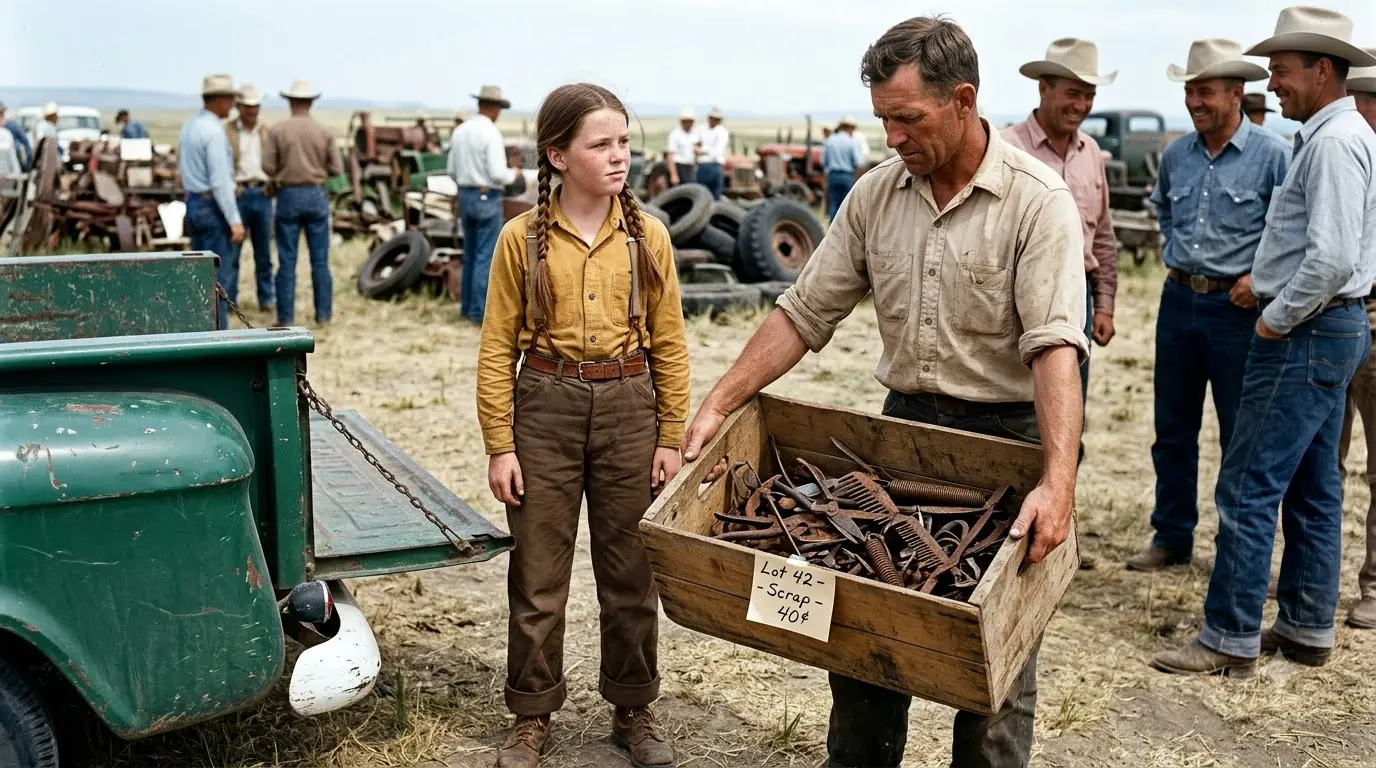
Big.
Easy.
The kind of laugh a man used when he believed everybody nearby ought to join him.
Beside him, Earl Pike slapped one hand against his thigh.
“Well, Samuel,” Wade called, “looks like your girl just bought herself the finest collection of rust in Fremont County.”
A few men near the sheep pens turned.
Nora heard them.
She did not look.
The wooden box was heavier than she expected.
Her father, Samuel Bell, had already taken one side.
She took the other.
Together they lifted it from the auctioneer's truck bed and lowered it onto the tailgate of Samuel's old red Ford.
The contents shifted with a miserable metallic crash.
Rusted hand shears.
Machine cutters.
Combs with broken teeth.
Springs.
Screws.
Two cracked handles.
Bent strips of steel.
A handpiece casing without its gears.
Pieces Nora could not identify.
Pieces that looked like they had been abandoned in rain, then forgotten in a shed for fifteen years.
The auctioneer had tried to sell the box for one dollar.
Nobody bid.
Fifty cents.
Nothing.
Then he said:
“Forty cents and I'll call it gone.”
Nora had four dimes in the front pocket of her brown trousers.
Every cent she had brought.
She raised her hand.
Now the box belonged to her.
Wade walked closer.
He was forty-nine, thick through the shoulders and stomach, wearing a dusty tan hat and plaid shirt tucked tightly beneath a wide leather belt.
He leaned over the box.
Picked up a rusted comb.
Two teeth were missing.
He held it between finger and thumb.
“This one's good.”
Earl laughed.
Wade tossed it back.
“Good for scratching a fence post.”
Earl stepped closer too.
He was leaner, older-looking despite being only forty-six, with a sunken face and permanent squint from years in Wyoming light.
He pointed at Nora.
“You saving for college, little lady?”
Nora looked at him.
“Yes.”
Earl smiled.
“Should've kept the forty cents.”
More laughter.
Samuel did not join.
He rested one hand on the tailgate and looked into the box.
Not dramatically.
Not like he saw hidden treasure.
He simply looked.
That mattered to Nora.
Samuel Bell did not lie to children.
He did not tell her every idea was good because she was young.
He did not tell her every mistake contained a lesson before she had finished making it.
He looked at the box the same way he looked at a tractor making a strange sound.
Carefully.
Wade asked:
“Well, Sam?”
Samuel picked up a pair of hand shears.
They were almost completely brown with rust.
He squeezed the handles.
Nothing.
Frozen.
He turned them.
Looked along the spine.
Then handed them to Nora.
“What do you see?”
Wade laughed.
“Rust.”
Samuel ignored him.
Nora held the shears.
Heavy.
Heavier than the newer pair Samuel kept in his workshop.
She rubbed one thumb against the blade.
Red dust stained her skin.
Then she looked along the edge.
“Thick steel.”
Samuel nodded.
“What else?”
“Forged.”
Wade stopped laughing for half a second.
Samuel asked:
“How can you tell?”
Nora pointed.
“No welded joint here.”
“Good.”
“And the handles taper.”
“Good.”
She looked closer.
“There used to be a mark.”
Samuel wiped the side with his sleeve.
Under the corrosion, faint letters appeared.
Not readable.
But stamped.
Samuel smiled slightly.
“Maybe.”
Wade scoffed.
“Maybe what?”
Samuel put the shears back.
“Maybe she wasted forty cents.”
Earl laughed.
Nora looked at her father.
Samuel continued:
“Or maybe she bought forty cents worth of practice.”
That ended the conversation for him.
He closed the truck tailgate.
Wade called:
“You planning to shear with those?”
Nora looked back.
“Maybe.”
Earl shouted:
“Better find some very patient sheep.”
Nora climbed into the truck.
Samuel started the engine.
As they pulled away, she watched Wade and Earl through the dusty rear window.
Still smiling.
Nora looked down at her hands.
Rust beneath her fingernails.
Forty cents gone.
For the first time since bidding, doubt arrived.
“What if it's all junk?”
Samuel drove.
Did not answer immediately.
The auction yard disappeared behind them.
Riverton summer stretched gold and dry in every direction.
Irrigated fields near the river.
Sage farther out.
Cottonwoods.
Distant mountains.
Samuel finally said:
“Then you'll know forty cents more than you knew this morning.”
Nora frowned.
“That sounds like something adults say when a child wastes money.”
Samuel smiled.
“It is.”
She crossed her arms.
He glanced toward her.
“Want me to tell you it was a brilliant purchase?”
“Yes.”
“It wasn't.”
Nora stared.
Samuel laughed.
She frowned harder.
He continued:
“You bought something without knowing what was inside.”
“I looked.”
“For two minutes.”
“Three.”
“That's gambling.”
She looked out the window.
Samuel continued:
“But forty cents is cheap tuition.”
Nora asked:
“What's tuition?”
“Money people pay to learn things.”
“So I bought school?”
“Something like that.”
“That sounds terrible.”
Samuel laughed again.
Then he reached over and squeezed her shoulder.
“Don't worry about Wade.”
“I don't.”
“Earl?”
“No.”
“Good.”
She waited.
Then:
“I hate them.”
Samuel smiled.
“That sounds more honest.”
Back at the Bell ranch, Nora carried the box directly to the workshop.
Samuel did not stop her.
The Bell workshop occupied one side of an old timber shed attached to the machine barn.
It smelled of oil, filings, leather, dust, and hot steel.
Samuel's father had built the first bench in 1928.
Samuel had added shelves.
Grinding wheel.
Bench vise.
Hand drill.
Small electric motor.
Sharpening stones.
Files.
Tins containing screws nobody would ever throw away because the exact one might become important twelve years later.
Nora loved that room.
Her mother, Margaret Bell, said the workshop was where broken things went to negotiate.
Margaret had died when Nora was six.
Influenza complications.
Fast.
The kind of death adults called unexpected as though any child could understand why expecting something mattered after it happened.
Afterward, Nora spent more time beside Samuel.
First because he did not know what else to do with her.
Then because both of them discovered she genuinely liked his work.
At seven, she sorted washers.
At eight, she learned file directions.
At nine, Samuel taught her that a grinding wheel could destroy a blade faster than it sharpened one.
“Heat is the thief,” he told her.
“What does it steal?”
“Temper.”
“What is temper?”
“The part of the steel that remembers what it was made to do.”
Nora loved that explanation.
Now she placed the forty-cent box beneath the workbench.
Samuel came in carrying two coffee mugs.
One coffee.
One milk.
He handed Nora the milk.
She grimaced.
“I'm not five.”
“You're ten.”
“Almost eleven.”
“In seven months.”
She took it.
Samuel sat on a stool.
“First rule.”
Nora looked at the box.
“Don't grind anything.”
“Good.”
“Second?”
“Don't throw anything away.”
“Wrong.”
She looked up.
Samuel smiled.
“Second rule is don't become sentimental.”
Nora frowned.
“About tools?”
“Especially tools.”
He reached into the box.
Removed a shearing comb split nearly in half.
“This?”
“Junk.”
“Why?”
“Cracked.”
“Can it be welded?”
“Maybe.”
“Should it?”
Nora examined.
The crack ran through the base near the mounting slot.
She shook her head.