The wallet lay half-open in the rain, stuffed with more money than Jerome and Javier Davis had ever seen in their lives.
It was brown leather, soft and expensive, with a silver clasp and the kind of smooth stitching that told the twins it belonged to someone who had never worried about wearing shoes with holes in them.
Rain hammered the sidewalk outside Lincoln Elementary. Water rushed along the curb in a dirty stream, carrying leaves, candy wrappers, and little branches toward the storm drain at the corner.
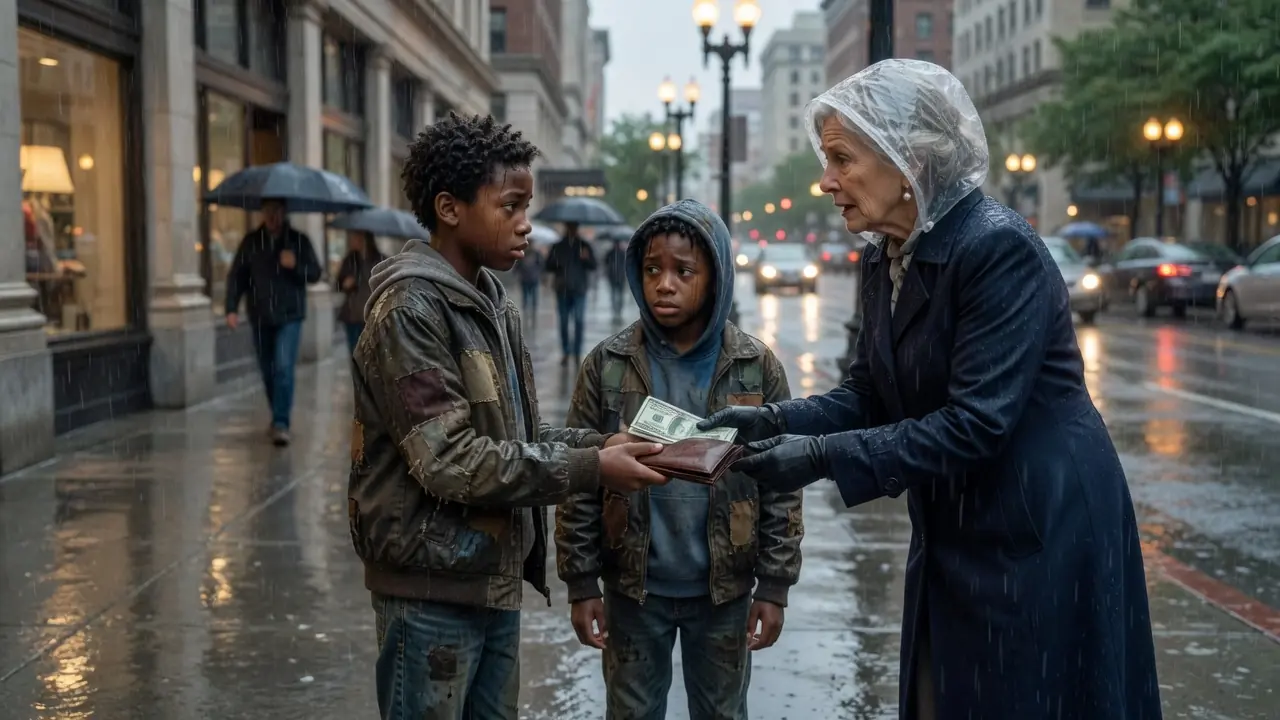
Jerome had snatched the wallet just before it disappeared into the water.
Now he and Javier stood beneath the broken awning of a closed pharmacy, soaked to the skin, staring down at the impossible thing in Jerome’s hands.
Inside were stacks of hundred-dollar bills.
Credit cards.
A driver’s license.
Business cards printed on thick white paper.
Raymond Whitmore
Chief Executive Officer
Whitmore Industries
The name meant nothing to two eleven-year-old boys who lived in Angel’s Group Home and walked two miles to school because bus fare was a luxury.
But the cash meant something.
Javier swallowed hard.
“We could eat for months,” he whispered.
Jerome did not answer.
His fingers trembled around the wallet.
Three thousand dollars.
Maybe more.
Enough money to buy new shoes for both of them. Enough to get winter coats before the weather turned. Enough to buy Maria the asthma medicine Miss Carter was always fighting to afford. Enough to make sure Tommy stopped going to bed hungry and pretending he was only tired.
Enough to change everything.
For a moment, Jerome let himself imagine it.
A warm meal every day.
A pair of sneakers without cardboard inside the soles.
A real umbrella instead of the broken one Miss Carter had given them last Christmas, the one now hanging uselessly from Javier’s hand, bent inside out by the storm.
Then he looked at the driver’s license again.
Raymond Whitmore’s photograph showed an older man with silver hair, a stern mouth, and tired eyes. A man who, from the look of the wallet, could probably lose three thousand dollars and still eat dinner without worry.
But Jerome saw something else.
The man in the photograph looked lonely.
Javier’s voice shook.
“Jerome… just twenty dollars. He’d never know.”
Jerome closed the wallet.
“It’s not ours.”
Javier looked at him helplessly.
“I know. But we’re hungry.”
“I know.”
“And Maria’s sick.”
“I know.”
“And the group home might close next year.”
Jerome looked down at the water rushing near their feet.
That was the fear neither of them liked to say out loud.
Angel’s Group Home was scheduled to close the following summer because of budget cuts. The younger kids would be moved first. The older ones would be placed wherever the state could find room. Jerome and Javier had heard Miss Carter crying in her office about it when she thought everyone was asleep.
Twins did not always get kept together.
That knowledge sat inside them like a stone.
Javier wiped rain from his face.
“This could help us stay together.”
Jerome’s throat tightened.
He wanted to say yes.
He wanted to be selfish once.
Just once.
But then he remembered Miss Carter’s voice from a hundred bedtime talks, spoken to children who had already seen too much of the world’s unfairness.
“Character is not what you do when people are watching. It is what you do when no one would ever know.”
Jerome held the wallet tighter.
“We have to find him,” he said.
Javier stared at him.
“He’s probably scared,” Jerome added.
“Rich people don’t get scared over wallets.”
“Everybody gets scared when they lose something important.”
Javier looked toward the downtown towers blurred by rain.
The address on the business card was twenty blocks away.
Twenty blocks in a storm.
No bus money.
No phone.
No dry clothes.
Finally, Javier sighed.
“You’re impossible.”
Jerome looked at him.
“Promise?”
Javier rolled his eyes, but his mouth almost smiled.
“Promise.”
That word had been theirs for as long as they could remember.
It meant, Whatever happens, we do it together.
So they stepped back into the rain and started walking.
To understand why that choice mattered, you have to understand the life Jerome and Javier had come from.
Angel’s Group Home woke before sunrise.
At four-thirty every morning, the old building began to stir. Pipes knocked in the walls. Children coughed under thin blankets. Someone always cried softly in the dark, usually one of the newer kids who still woke expecting a mother who was not coming.
Jerome and Javier slept in the bottom bunk of a triple-stacked bed in the boys’ room.
They shared it not because they had to anymore, but because they always had.
When they were babies, Miss Carter said, they screamed if separated. As toddlers, they held hands through every nap. At eleven, they slept shoulder to shoulder because the room was drafty and because knowing the other was there made the night less frightening.
They learned to wake before the alarm.
Those few extra minutes mattered.
Jerome helped six-year-old Maria find the shoe she always kicked under Tommy’s bed during the night.
Javier helped little Caleb button his shirt because Caleb’s fingers were still clumsy and he cried when the older boys laughed.
They wiped faces, tied laces, found missing socks, and whispered courage into children too young to know why they needed it.
“Jerome,” Maria whispered one morning, her voice thick with sleep, “my other shoe ran away again.”
“Check under Tommy’s bed,” Jerome said, already pulling on his own worn sneakers. “Your shoe likes it there.”
Maria frowned seriously.
“My shoe is rude.”
“Very rude,” Javier agreed.
Their world was crowded, noisy, and always short of something.
Short of staff.
Short of food.
Short of money.
Short of time.
Miss Carter, the head caretaker, moved through it all with tired patience. She was not perfect. No one caring for twenty-three children with three adults and a budget that never stretched could be perfect. But she loved them fiercely, and the children knew it.
“Morning, angels,” she said to the twins every day. “Can you help with breakfast?”
They always did.
Jerome passed out the toast.
One slice per child.
Javier poured watered-down orange juice into plastic cups and made sure the younger kids got the fullest ones.
When Maria cried because her toast was smaller than Tommy’s, Jerome broke his own in half and slipped part of it onto her plate.
Javier saw.
“You didn’t eat much yesterday,” he whispered.
“I’m not that hungry.”
That was a lie.
They both knew it.
But hunger was one of the first things the twins had learned to hide.
The walk to school was two miles each way.
They could have taken the bus if there had been money for passes, but Angel’s Group Home did not have money for comfort. So they walked in heat, cold, rain, and snow, making up stories to distract themselves from shoes that pinched and stomachs that ached.
“When we grow up,” Jerome said one morning, stepping around a puddle, “we’ll have a house where every kid gets their own bed.”
“And a kitchen,” Javier added, “where nobody has to ask if there’s enough.”
“And nobody gets moved away from their brother.”
Javier looked at him.
“That’s the first rule.”
“The first rule,” Jerome agreed.
At Lincoln Elementary, they were known as the group home twins.
Some children said it cruelly.
Others said nothing but stared at their secondhand clothes and free-lunch cards.
Jerome and Javier learned early that pity and cruelty sometimes wore similar faces.
Their teacher, Miss Williams, saw more in them than most people did. She bought extra pencils and pretended they came from the supply closet. She left granola bars in her desk and acted surprised when the twins found them. She gave them books to take home and never asked why the pages came back wrinkled from being read under blankets with a flashlight.
“You boys have something rare,” she told them once after Jerome gave his only pencil to a classmate who had snapped hers.
“What?” Javier asked.
“Hearts that refuse to harden.”
They did not fully understand then.
They only knew they had to take care of each other because no one else could do it the way they could.
After school, they went to the public library.
Mrs. Rodriguez, the librarian, pretended not to notice that they stayed until closing because it was warm. She pretended not to notice when they read cookbooks with glossy pictures of food. She pretended not to notice the way they sometimes saved half a granola bar for later.
Good adults, the twins had learned, often pretended not to notice things so children could keep their dignity.
Once, while helping them find a book about architecture, Mrs. Rodriguez said, “Your parents raised you well.”
Jerome only smiled.
“Yes, ma’am.”
It was easier than explaining that they did not remember being raised by anyone.
Their only treasure was a faded photograph tucked under their mattress.
It showed a young woman in a hospital gown holding two newborn babies. Her skin was brown, her hair was braided back, and though she looked exhausted, her smile was radiant. On the back, in fading ink, someone had written:
Jerome and Javier.
Mommy loves you forever.
Sarah.
Sarah Davis.
Their mother.
She had died the day they were born. The files said complications from childbirth. The line for father was marked unknown.
Every night, before the lights went out, the twins looked at the photograph.
“Do you think she would be proud of us?” Javier always asked.
Jerome always answered the same way.
“I think she’s watching to make sure we take care of each other.”
The day they found the wallet began like any other hard day.
October rain started during lunch and became a downpour by dismissal. Children ran to cars and buses. Parents shouted names beneath umbrellas. Tires hissed through puddles.
Jerome and Javier stood under the narrow school overhang with their broken umbrella.
“Ready?” Jerome asked.
“No,” Javier said.
They stepped into the rain anyway.
The first ten blocks were manageable. They knew how to use awnings, bus shelters, and store entrances as temporary cover. They knew which sidewalks flooded worst and which alleys to avoid.
Then the wind came.
It caught their umbrella and turned it inside out.
“Just leave it,” Javier said.
“Miss Carter saved for this,” Jerome said, fighting the bent metal. “We’re not throwing it away.”
That was when they saw the man.
He was walking fast along the business district sidewalk, wearing a dark expensive coat and holding a phone to his ear. Even through the rain, the twins could tell his clothes belonged to another world.
“The Shanghai contracts can’t wait,” the man said sharply. “I need those documents tonight or we lose everything.”
He stumbled near a lamppost, caught himself, and cursed under his breath.
His phone slipped from his wet hand and shattered against the pavement.
At the same moment, his wallet fell from his coat pocket.
The man bent to grab the broken phone.
He did not see the wallet slide across the sidewalk toward the storm drain.
Jerome did.
He lunged.
His knees hit wet concrete hard enough to sting, but his hand closed around the leather just before the water took it.
That was how the test began.
The twins could have walked away.
No one would have known.
The man was still turned away, angry over his broken phone. Pedestrians rushed past with their heads down. Rain blurred everything.
But Jerome called out.
“Excuse me, sir!”
The man turned, irritation still on his face.
“Did you drop something?” Jerome asked.
He held out the wallet.
The man stared.
Rain ran down his face, but he seemed not to feel it.
“That’s mine,” he said slowly.
“Yes, sir. It almost went down the drain.”
The man took it with trembling fingers and opened it quickly.
His expression changed as he saw the cash, cards, identification, and documents still there.
“You didn’t take anything?”
Javier looked genuinely confused.
“No, sir.”
“It’s not ours,” Jerome said.
The man looked from one boy to the other.
They were soaked, thin, and shivering. Their umbrella hung broken between them. Their shoes were worn through, and their clothes were carefully mended but too light for the weather.
Still, they had returned everything.
“My name is Raymond Whitmore,” the man said.
“We saw that on your card,” Jerome answered.
Raymond looked down at the wallet, then back at them.
“Where do you boys live?”
“Angel’s Group Home,” Javier said.
“Group home?”
“Yes, sir. About fifteen blocks from here.”
“And you walk?”
“We always walk,” Jerome said. “Bus costs money.”
Something shifted in Raymond’s face.
The rain intensified.
He looked toward the corner.
“There’s a diner just around the block. Let me buy you something hot.”
Both boys stepped back.
“That’s okay,” Jerome said politely. “Miss Carter worries if we’re late.”
“I will call her from the diner,” Raymond said. “Or you can. Please. I can’t let you walk all the way back in this storm after what you did.”
The twins exchanged one of their silent looks.
Javier’s lips were turning pale from cold.
Jerome nodded once.
“Just until the rain slows.”
The Broadway Diner was warm, bright, and filled with the smell of coffee and grilled onions.
Raymond led them to a corner booth and ordered hot chocolate, chicken soup, grilled cheese, and extra fries before the twins could object.
When the mugs arrived, the boys wrapped both hands around them and sat very still, letting warmth climb back into their fingers.
“What are your names?” Raymond asked gently.
“Jerome and Javier Davis,” they answered together.
Raymond’s cup paused halfway to his mouth.
“Davis?”
“Yes, sir,” Jerome said. “We’re twins.”
“I noticed.”
He tried to smile, but something about the name had touched an old place in him.
“You said you’ve been at Angel’s since you were babies?”
“Yes,” Javier said. “We don’t remember our parents.”
Jerome hesitated, then pulled the photograph from his backpack.
“We remember our mama from this.”
He handed it over carefully.
Raymond took the photograph.
For a second, the noise of the diner seemed to fade.
The young woman in the picture looked out from the hospital bed, holding two tiny babies. Her smile was exhausted and full of love.
Raymond turned the photo over.
Jerome and Javier.
Mommy loves you forever.
Sarah.
His face went pale.
“Sarah,” he whispered.
Jerome leaned forward.
“Did you know her?”
Raymond swallowed.
“No,” he said too quickly. “No, I… I don’t think so.”
But he could not stop staring.
He handed the photo back with hands that shook slightly.
“She looks like she loved you very much.”
“We think so too,” Javier said.
Their food arrived, and Raymond watched them eat.
Not greedily.
Carefully.
As if they had learned to stretch every bite.
“What do you want to be when you grow up?” he asked.
Jerome dipped his sandwich into the soup.
“I want to help kids like us. Maybe be a social worker.”
“I want to build places where kids can be safe,” Javier said. “Not like a group home exactly. Something better. With a kitchen where everyone can eat whenever they’re hungry.”
Raymond’s throat tightened.
“Those are good dreams.”
“Miss Carter says dreams need work,” Jerome said. “So we work hard.”
“And stay good,” Javier added.
“What does that mean to you?” Raymond asked.
The twins looked at each other.
“It means helping people even when it’s hard,” Javier said.
“And doing the right thing when nobody’s watching,” Jerome added.
“Like returning wallets in rainstorms,” Raymond said softly.
Jerome frowned.
“That wasn’t hard.”
Raymond stared at him.
“It wasn’t?”
“It was normal.”
In Raymond Whitmore’s world, almost everyone wanted something.
Access.
Money.
Favor.
Leverage.
These children, who needed more than most, had asked for nothing.
When the rain slowed, the twins stood.
“Thank you for the food, Mr. Whitmore,” Jerome said.
Raymond reached for his wallet.
“Please let me give you something.”
Both boys stiffened.
“No, thank you,” Javier said.
“You returned three thousand dollars. You deserve a reward.”
“We didn’t help for money,” Jerome said.
“But you could use it.”
Javier’s chin lifted.
“So could other people. But it still wasn’t ours.”
Raymond slowly lowered the wallet.
“At least let me call you a cab.”
“We like walking,” Jerome said.
“It gives us time to talk,” Javier added.
At the door, Raymond called after them.
“Boys.”
They turned.
“If you ever need anything, you can find me at Whitmore Industries.”
Jerome smiled.
“We’ll be okay. We always take care of each other.”
Then they disappeared into the drizzle.
Raymond sat alone in the booth long after they left.
The wallet lay on the table in front of him, full and untouched.
But it no longer felt valuable.
The photograph haunted him.
Sarah Davis.
The name pulled at a locked door in his memory.
That night, in his penthouse office overlooking the city, Raymond could not focus on the Shanghai contracts. He kept seeing the twins’ faces. Jerome’s careful seriousness. Javier’s protective glance. The way they moved together. The name Davis. The photograph.
At 11:47 p.m., he called his assistant.
Jennifer Hayes answered on the third ring, her voice groggy but alert.
“Sir?”
“I need you to pull old records.”
“How old?”
“Twelve years. Maybe eleven. Search for Sarah Davis. Birth records, marriage records, death certificates. Anything in this city.”
There was a pause.
“May I ask what this is about?”
Raymond looked at the frozen security image on his laptop, pulled from the diner’s camera after a request he did not bother justifying. Two small figures walking into rain beneath a broken umbrella.
“I think,” he said slowly, “I may have met my grandsons.”
Jennifer arrived at his office just before dawn.
She placed a thin folder on his desk.
“There was one Sarah Davis matching the timeline.”
Raymond opened it.
Death certificate.
Sarah Marie Davis.
Age nineteen.
Cause: complications following childbirth.
Date: October 15.
Children: twin boys, Jerome and Javier Davis.
Father listed as unknown.
Raymond’s hands went cold.
Jennifer slid another document across the desk.
“There’s more.”
A marriage certificate.
Sarah Marie Davis had married a man named Michael James five months before her death.
Raymond stared at the groom’s signature.
Michael James Whitmore.
His son.
His only son.
Michael had used his middle name on the public filing, perhaps to avoid being found, perhaps to avoid his father’s reach.
Raymond pressed one hand over his mouth.
Eleven years earlier, Michael had come home and told him he was in love with a young woman named Sarah. She was kind, intelligent, strong, and pregnant with twins.
Raymond, proud and cruel and poisoned by prejudices he had dressed up as tradition, had refused to accept her.
“She is not our kind,” he had said.
Michael had stared at him as if seeing a stranger.
“She is my family.”
“Then you are choosing her over us.”
“No,” Michael had said, voice breaking. “You are choosing pride over me.”
Those were the last words his son had spoken to him in person.
Five months later, Michael died in a car accident while driving through a storm, trying to get Sarah to the hospital. Sarah survived long enough to deliver the twins, then died before morning.
Raymond had been told nothing.
Or perhaps he had made himself so unreachable that no one tried.
For eleven years, his grandsons had lived twenty blocks away in a group home.
Hungry.
Cold.
Unknown.
While he sat in towers of glass and marble with more money than he could spend and no family at his table.
Jennifer’s voice was quiet.
“Sir?”
Raymond looked at the photograph of the twins from the diner footage.
“They returned my wallet,” he said. “They had nothing. They returned everything.”
His voice broke.
“And they were mine.”
The next morning, Raymond arrived at Angel’s Group Home in a plain sweater and dark jeans instead of a suit.
Miss Carter answered the door, wiping her hands on a dish towel.
She recognized him immediately and stiffened.
“Mr. Whitmore?”
“I need to speak with Jerome and Javier.”
Her eyes narrowed.
“Did something happen?”
“Yes,” he said softly. “But not something bad.”
He swallowed.
“It’s about their family.”
Miss Carter’s face changed.
“They don’t have family.”
Raymond looked past her into the crowded hallway, where children’s coats hung from hooks and a little girl laughed somewhere in the back.
“They do,” he said. “They have me.”
Twenty minutes later, Jerome and Javier sat across from him in the small visiting room.
They looked smaller in daylight.
Younger.
Their clothes were clean but worn. Their hair was brushed. Their eyes were cautious but hopeful.
“Hi, Mr. Whitmore,” they said together.
Raymond held the folder on his lap, but for a moment he could not open it.
“Boys,” he began, “I learned something last night. Something important.”
Jerome leaned forward.
“About what?”
“About your family.”
Javier’s hand found Jerome’s under the table.
Raymond took a breath.
“May I see your mother’s photograph again?”
Javier pulled it from his pocket and handed it over.
Raymond looked at Sarah Davis’s face.
This time, he did not look away from the truth.
“She was beautiful,” he said.
Jerome nodded.
“We think so.”
“What do you know about your father?”
“Nothing,” Jerome said. “The papers say unknown.”
“We made up stories when we were little,” Javier added.
“What kind of stories?”
“That he was a good man,” Jerome said. “And maybe he would have loved us if he knew.”
Raymond’s eyes filled.
“He knew.”
The twins went still.
“What?” Javier whispered.
“Your father knew about you. He loved you before you were born.”
Jerome’s voice trembled.
“How do you know that?”
Raymond opened the folder and took out an old photograph.
It showed Raymond years earlier, standing beside a young man with the same smile Jerome carried and the same thoughtful tilt of the head Javier had when he was concentrating.
“This was my son,” Raymond said. “Michael Whitmore.”
The boys stared at the photo.
Raymond placed the marriage certificate beside it.
“Your mother married him before you were born. She and Michael were husband and wife.”
The silence in the room deepened.
Jerome looked from the paper to Raymond’s face.
“Sarah Davis,” he whispered.
“Yes.”
“Our mother.”
“Yes.”
“And Michael Whitmore…”
“Was your father.”
Javier’s lips parted.
Raymond’s voice shook.
“Jerome. Javier. I am your grandfather.”
Jerome began to cry first.
Not loudly.
Not like a child throwing himself into grief.
The tears simply spilled over, helpless and overwhelmed.
Javier stared as if the words were too large to enter him all at once.
“We have a family?” Jerome asked.
Raymond nodded.
“You have always had one. I just did not know you existed.”
Javier’s eyes sharpened.
“Why didn’t you know?”
That was the question Raymond had dreaded.
He deserved it.
He took the full weight of it.
“Because when your father told me he wanted to marry your mother, I said terrible things. I was prejudiced. Proud. I thought I knew what kind of woman belonged in our family, and I was wrong.”
Jerome wiped his face with his sleeve.
“Because Mama Sarah was African American?”
Raymond closed his eyes briefly.
“Yes.”
The shame tasted like metal.
“I was a foolish man who mistook prejudice for principle.”
Javier’s brow furrowed.
“Were you sad when you said those things?”
The question broke him more than anger would have.
“Yes,” Raymond whispered. “I was the saddest I had ever been. But I was too proud to admit I was wrong.”
“Daddy Michael must have been sad too,” Jerome said.
“He was,” Raymond said. “And he still tried to write to me. Your father wanted us to reconcile before you were born.”
He took out a copy of a damaged letter Jennifer had found in old legal files. The original had been recovered from Michael’s car after the accident and placed in storage with other personal effects.
The ink was faded, but some words remained clear.
Dad,
I know you are angry. I know you think I have thrown my life away. But Sarah is my life now. The babies are coming soon. Twin boys. I want them to know their grandfather. I want you to know them before pride steals more from us than it already has.
Jerome traced the words with trembling fingers.
“He wanted you to know us,” he said.
“More than anything,” Raymond replied.
Javier looked down at the photograph of Sarah.
“So Mama wasn’t alone.”
“No,” Raymond said. “She was loved.”
“And Daddy wanted us.”
“He wanted you desperately.”
The twins looked at each other, processing the pieces of a life they had never been allowed to know.
Then Javier asked, very quietly, “Does this mean we’re not alone anymore?”
Raymond leaned forward.
“If you will have me, you are not alone anymore.”
Jerome looked at him for a long moment.
Then he said, “Grandpa.”
The word hit Raymond harder than any accusation could have.
He bowed his head and wept.
Eleven years of pride, regret, wealth, loneliness, and grief poured out in front of two boys who had every right to reject him.
Instead, Jerome stood and walked around the table.
Javier followed.
They both wrapped their arms around him.
Raymond held them as carefully as if they were made of light.
“I’m sorry,” he whispered. “I’m so sorry.”
Jerome’s voice came against his shoulder.
“We forgive you.”
Raymond shook his head.
“You don’t have to.”
“We know,” Javier said. “But we want to.”
“Why?”
Jerome pulled back and looked at him with Sarah’s kindness and Michael’s eyes.
“Because you didn’t know love was bigger than what people look like. Now you know.”
Raymond covered his face with one hand.
“Yes,” he whispered. “Now I know.”
That afternoon, Raymond brought the twins to his penthouse.
He did not do it to impress them. In truth, he worried it would frighten them. Everything was too large, too polished, too quiet.
The marble floors.
The high windows.
The leather furniture.
The kitchen no one cooked in.
Jerome and Javier sat side by side on the edge of the enormous couch, looking as if they were afraid to touch anything.
Raymond sat across from them.
“We need to talk about your future.”
“Are we really going to live here?” Javier asked.
“If you want to,” Raymond said. “But I won’t force anything. Miss Carter and I will handle everything properly. Lawyers, social services, all of it. I will not take you from the only home you’ve known without making sure you feel safe.”
Jerome looked relieved.
“What about the other kids?”
Raymond smiled sadly.
“I had a feeling you would ask that.”
Javier sat up straighter.
“Maria needs medicine sometimes. And Tommy needs shoes. And Miss Carter works too hard.”
“I know.”
“How do you know?”
“Because tomorrow, I’m going back to Angel’s with contractors, doctors, counselors, and a very large check.”
The twins stared.
“Not to show off,” Raymond added. “To listen. You two are going to help me understand what children there actually need.”
Jerome blinked.
“We are?”
“You know better than I do.”
Javier’s face changed.
For the first time since the truth had been revealed, something like excitement appeared.
“They need beds that don’t squeak. And lockers so nobody takes their stuff by accident. And the younger kids need nightlights. And Maria needs a nebulizer that works.”
“And food,” Jerome said. “Not just enough to survive. Real food.”
“And a room where you can be quiet when everything is too loud.”
Raymond took out a notebook.
“Slow down,” he said. “I’m writing all of this down.”
The twins looked at each other.
Then they began.
That was the beginning of the Michael and Sarah Foundation.
Raymond named it, but Jerome and Javier shaped it.
The first project was Angel’s Group Home.
Not a paint job for photographs.
A true rebuilding.
Every child received a bed of their own. New shoes. Winter coats. A drawer and a locker. A doctor came twice a month. A counselor came weekly. The kitchen was repaired and stocked. Miss Carter received a full staff, a real salary, and the authority she had always deserved.
When Raymond offered to make her director, she cried in the hallway and then told him to stop staring because she had children to feed.
Jerome and Javier moved into Raymond’s penthouse slowly.
At first, weekends.
Then school nights.
Then permanently, after every legal step was finished and Miss Carter approved with tearful pride.
Their rooms were the first warm, private rooms they had ever had.
Jerome filled his shelves with books about social work, law, and child advocacy.
Javier filled his walls with sketches of buildings he imagined for children who needed safety.
Raymond learned how to make pancakes because Jerome insisted breakfast tasted better when someone made it themselves.
Javier taught Raymond how to braid Maria’s hair badly, because Raymond wanted to help on volunteer days and needed to understand “basic kid skills.”
The penthouse changed.
Finger paintings from Angel’s covered the refrigerator.
A formal dining room became a homework table.
A marble hallway gained a row of backpacks and muddy sneakers.
Raymond’s life, once polished and silent, became loud with purpose.
Within a year, the foundation opened the Davis Community Campus in an old industrial neighborhood Raymond had once planned to redevelop into offices.
Javier helped design the first sketches.
He insisted on gardens.
Jerome insisted on a kitchen where any hungry child could eat without explaining why.
They named that part Grandpa’s Kitchen, though Raymond protested until the boys ignored him.
There were classrooms, counseling rooms, art studios, a library, a clinic, and a playground built from ideas gathered from children in group homes across the city.
On opening day, Jerome stood at the microphone, small for the stage but steady in his voice.
“This is for every kid who thinks nobody is looking for them,” he said. “Sometimes family is already on the way. Sometimes it just got lost for a while.”
Javier stood beside him.
“Our mom and dad loved us,” he said. “We didn’t know that before. Now we want every kid to know they are loved too.”
Raymond stood behind them with tears in his eyes.
Reporters called it a miracle story.
Two orphaned twins return a billionaire’s wallet and discover he is their grandfather.
But Raymond knew the miracle was not the discovery.
The miracle was who the boys had become before anyone rich or powerful ever found them.
Kind when hungry.
Honest when unseen.
Generous when they had nothing.
Two years later, on another rainy afternoon, Jerome and Javier walked home from school under a shared umbrella.
They no longer needed to walk.
A driver waited nearby.
But some traditions were worth keeping.
At the same corner where they had once found Raymond’s wallet, they saw an eight-year-old girl crying beside a bus stop. Her backpack had torn open, spilling notebooks, pencils, and papers into puddles.
Two older boys approached her.
Jerome recognized them immediately.
Marcus and Devon, boys from the foundation’s mentorship program.
“Hey,” Marcus said gently. “Are you okay?”
“My foster mom’s going to be mad,” the girl whispered. “Everything’s ruined.”
Devon knelt in the rain and began gathering wet papers.
“It’s okay. We can help.”
Marcus pulled lunch money from his pocket.
“We’ll get you new supplies.”
“But then you won’t have lunch,” she said.
Marcus shrugged.
“We’ll figure it out. That’s what friends do.”
Jerome and Javier stopped beneath their umbrella.
“Looks familiar,” Jerome said.
Javier smiled.
“Very.”
The little girl wiped her face.
“Where can we go?”
Marcus pointed down the street.
“The Davis Community Campus. Jerome and Javier built it for kids like us.”
“Who are they?” the girl asked.
Devon grinned.
“Everybody’s big brothers.”
The three children walked together through the rain, sharing Marcus’s umbrella.
Jerome and Javier followed at a distance.
From the forty-fifth floor of Whitmore Industries, Raymond stood at the window, watching the scene below. He could not hear what the children were saying, but he knew enough.
Kindness had learned to repeat itself.
Javier looked up at the tower and waved.
Raymond lifted one hand to the glass.
Jerome smiled.
“We used to think family was only about blood,” he said.
Javier looked toward the campus sign glowing through the rain.
“Then we learned it’s about love.”
Jerome nodded.
“And now?”
Javier watched Marcus, Devon, and the little girl disappear into the warm light of the community center.
“Now we know family is teaching other people how to love too.”
The rain continued to fall, soft and steady.
At the corner, flowers bloomed in the small memorial garden planted where the wallet had been found. The plaque read:
The Sarah and Michael Davis Memorial Garden
Where love found its way home.
And beneath it, in smaller letters:
A small honest act can change generations.
Jerome and Javier stood there for a moment, shoulder to shoulder, the way they had stood all their lives.
They were no longer hungry.
No longer unknown.
No longer waiting for someone to claim them.
But they still carried the lesson of that stormy day.
The money had looked like salvation.
It had not been.
The real salvation had been the choice.
To return what was not theirs.
To believe character mattered even when hunger argued louder.
To do the right thing when no one would have known.
That choice led them to Raymond.
It led Raymond back to Michael.
It gave Sarah’s sons the family she had wanted them to have.
And it turned a wallet full of cash into something far more valuable.
A home.
A grandfather.
A foundation.
A future.
Jerome tucked one hand into his pocket and felt the worn corner of their mother’s photograph, still carried with them after all these years.
Javier looked at him.
“Promise?”
Jerome smiled.
“Promise.”
Then the twins walked toward the glowing doors of the campus, where children were waiting, dinner was warm, and no one had to earn the right to belong.