Malcolm Hayes noticed the police cruiser before the officers noticed him.
It was parked half a block ahead beneath a maple tree, angled slightly toward the curb, its engine running while sunlight reflected from the windshield. Malcolm saw the driver turn his head, saw the passenger lean forward, and understood immediately that both men were watching him.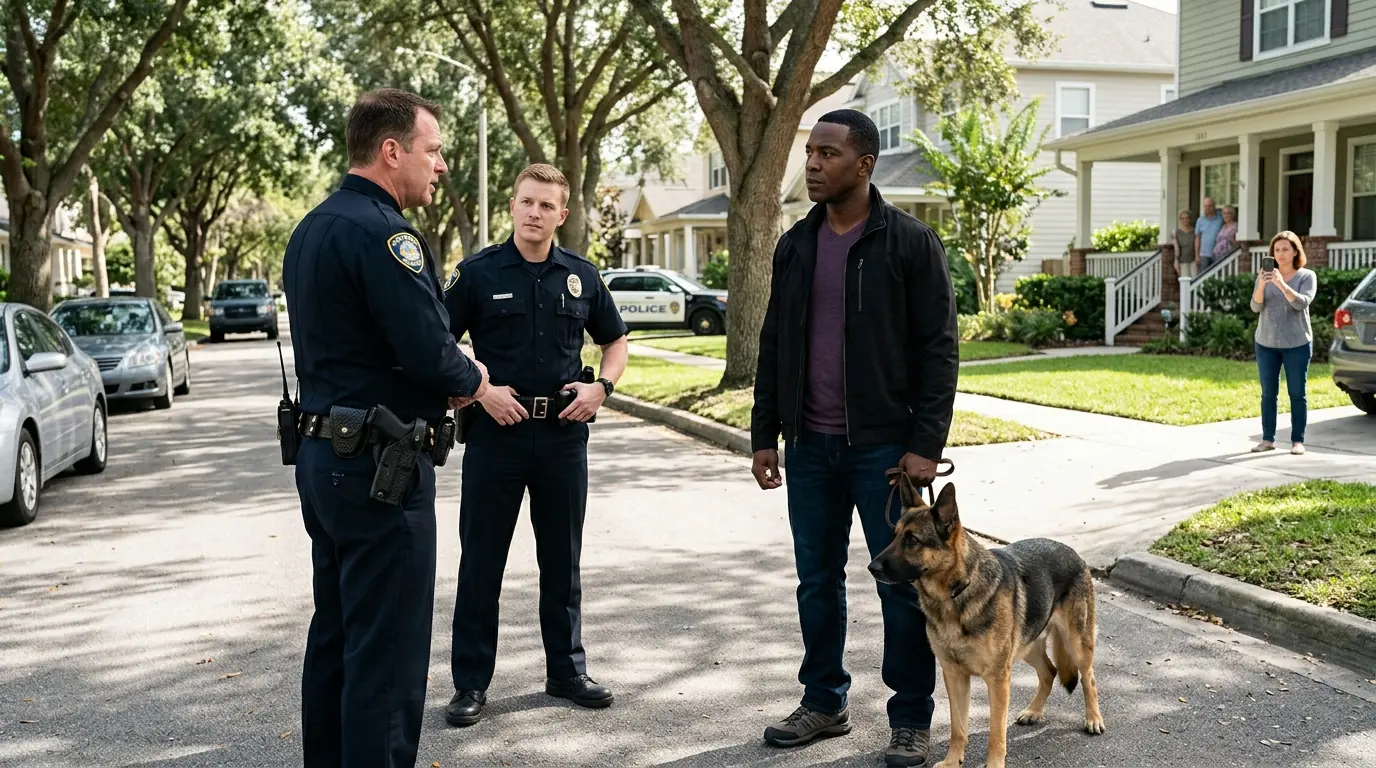
He kept walking.
Rex walked beside his left leg with the steady rhythm he had learned years earlier, his black-and-tan coat clean, his ears upright, and his heavy paws landing quietly on the concrete sidewalk.
The German Shepherd did not pull at the leash.
He did not bark.
He barely looked toward the police car.
Malcolm had spent years teaching Rex that attention was different from reaction.
That lesson applied to people too.
It was a clear Saturday afternoon in the Brookhaven neighborhood outside Richmond, Virginia, the kind of afternoon when families worked in their yards and children rode bicycles between patches of shade.
Two-story houses with broad porches lined the street, old oak trees formed a canopy above parked cars, and somewhere behind a white fence a lawn mower growled steadily.
Malcolm had walked this route hundreds of times.
He knew which house belonged to the retired teacher who fed squirrels from her porch.
He knew which corner had a broken sprinkler.
He knew which golden retriever would bark from behind a wooden fence whenever Rex passed.
He also knew the police cruiser did not belong there.
Brookhaven was not free of crime, but patrol cars rarely sat on Hawthorne Avenue unless someone called them.
Malcolm glanced down at Rex.
“Easy.”
The dog’s ears moved once.
That was enough.
As Malcolm passed the cruiser, the driver’s door opened.
“Sir.”
Malcolm stopped.
He turned slowly.
The officer stepping onto the sidewalk was heavyset, broad through the shoulders, with short brown hair and the confident posture of someone accustomed to having strangers obey him before he finished speaking.
His name tag read CALLAWAY.
Officer Gregory Callaway was forty-eight years old and had worked patrol for almost nineteen years.
The passenger door opened next.
Officer Anthony Miller was younger, perhaps in his mid-thirties, leaner than Callaway and visibly more alert.
Miller looked first at Malcolm.
Then at Rex.
His right hand drifted toward his equipment belt.
Malcolm noticed.
He noticed everything.
Callaway approached.
“Where are you headed?”
Malcolm looked down the street.
“Home.”
“Where’s home?”
“Nearby.”
Callaway gave a small smile.
Not friendly.
“You live around here?”
“Yes.”
“Which house?”
Malcolm studied him.
“Why?”
The smile disappeared.
“I asked you a question.”
“And I answered one.”
Miller stepped closer.
Rex turned his head toward him.
The dog remained quiet.
Miller’s hand moved nearer his holster.
Malcolm’s eyes dropped toward it.
Then returned to the officer’s face.
“What’s going on?” Malcolm asked.
Callaway crossed his arms.
“We’ve had reports.”
“Reports of what?”
“Suspicious activity.”
Malcolm looked around at the peaceful street.
A woman watering flowers across the road had stopped moving.
“Describe the suspicious activity.”
Callaway’s jaw tightened.
“You asking questions now?”
“Yes.”
“Why?”
“Because you stopped me.”
Callaway laughed once.
“There it is.”
Malcolm frowned.
“There what is?”
“The attitude.”
Malcolm’s expression remained calm.
“I asked why I was stopped.”
“And I told you.”
“No. You said there were reports.”
“That’s enough.”
“For what?”
Callaway stepped closer.
“For me to ask for identification.”
Malcolm looked directly at him.
“For walking my dog?”
Callaway’s face hardened.
“Give me your ID.”
“No.”
The answer came without anger.
That seemed to irritate Callaway more.
Miller shifted his stance.
“Sir, just cooperate.”
Malcolm looked at him.
“I am cooperating.”
“You just refused identification.”
“Because nobody has explained why I’m legally required to provide it.”
Callaway moved closer again.
“You think you’re above the law?”
Malcolm held his stare.
“No.”
He tightened the leash slightly as Rex shifted his weight.
“I simply know my rights.”
Something changed in Callaway’s face.
A tiny tightening around the eyes.
A slight forward movement of the chin.
Malcolm recognized it immediately.
Escalation.
He had spent years recognizing the moment before people made bad decisions.
Callaway pointed toward Rex.
“Control your dog.”
“He is under control.”
The German Shepherd stood quietly against Malcolm’s leg.
Callaway looked at the animal.
“He looks aggressive.”
Malcolm glanced down.
Rex’s mouth was slightly open.
His tail was low.
His body remained relaxed.
“No, he doesn’t.”
Miller’s right hand moved again.
Closer to the holster.
Malcolm’s voice changed.
It became quieter.
Colder.
“Take your hand off the gun.”
Miller froze.
Callaway stepped forward.
“You don’t tell officers what to do.”
Malcolm looked only at Miller.
“The dog is calm. I am calm. Keep it that way.”
Miller’s fingers remained near the holster.
“Or what?”
Malcolm’s eyes hardened.
“Or you create danger where none exists.”
For the first time, Miller seemed uncertain.
He moved his hand slightly away.
Callaway noticed.
“What’s your name?”
Malcolm answered.
“Malcolm Hayes.”
The name meant nothing to Callaway.
It meant nothing to Miller.
Across the street, however, someone reacted.
Linda Warren had been standing on her porch recording since the officers approached.
Her husband, Thomas, emerged from the house carrying a coffee mug.
“What happened?”
Linda lowered the phone slightly.
“Police stopped the man with the shepherd.”
Thomas looked across the street.
Then he frowned.
“Wait.”
“What?”
He stepped down from the porch.
“That’s Malcolm Hayes.”
Linda looked at him.
“You know him?”
“I know of him.”
“How?”
Thomas kept staring.
“I’ve seen him at the veterans’ center.”
Malcolm was not a veteran.
But his work had brought him into the same circles.
Thomas remembered hearing the name during a fundraiser two years earlier.
Former diplomatic security consultant.
Hostage evacuation specialist.
Civilian adviser.
A man who had spent nearly fifteen years working in places where ordinary mistakes could become deadly.
Thomas did not know the details.
Most people did not.
Malcolm preferred it that way.
He had started his career in corporate security after college.
Then came overseas assignments.
Embassy protection contracts.
Journalist evacuations.
Aid-worker escorts.
Negotiation support.
Risk assessment.
Places with names that appeared briefly on evening news before disappearing from public attention.
Malcolm never described himself as brave.
He described himself as prepared.
Preparation had saved his life.
It had saved other people too.
He learned to watch hands.
Doors.
Windows.
Breathing patterns.
Tone changes.
The direction people pointed their feet when they lied.
He learned that panic made the world smaller.
Calm made it wider.
Those habits never left him.
Neither had the scars.
One small line beneath his left shoulder.
Another near his ribs.
Nobody on Hawthorne Avenue could see them beneath the black jacket and dark-purple shirt he wore that afternoon.
Callaway saw only a Black man refusing to produce identification.
“You live around here?” the officer asked again.
“Yes.”
“Where?”
Malcolm sighed.
“I already told you I live nearby.”
“That’s not an address.”
“No.”
Callaway looked at Miller.
“You hearing this?”
Miller said nothing.
Callaway turned back.
“You’re making a simple situation difficult.”
Malcolm stared at him.
“No. I’m asking you to state the legal basis for the stop.”
“There you go again.”
“Again what?”
“Trying to sound smart.”
Malcolm’s mouth tightened slightly.
Across the street, Linda’s recording captured everything.
Two other neighbors had now stepped onto their porches.
One man stood in his driveway with a phone at chest level.
Callaway noticed them.
The audience made him more aggressive.
“What are you doing in this neighborhood?”
Malcolm looked almost surprised.
“Walking.”
“With that dog?”
Malcolm glanced at Rex.
“Yes.”
Callaway looked toward several houses.
“People called about a man checking properties.”
“Was he Black?”
Miller looked at Callaway.
Callaway ignored him.
Malcolm continued.
“Was he wearing a black jacket?”
“Maybe.”
“Walking a German Shepherd?”
Callaway hesitated.
“I don’t have to give you all the details.”
Malcolm nodded.
“Then you don’t have enough details to explain why you stopped me.”
Callaway stepped closer until barely two feet separated them.
“Show some respect.”
Malcolm did not move.
“I have.”
“You don’t sound respectful.”
“Respect isn’t surrender.”
Linda whispered behind her phone.
“Oh, boy.”
Thomas stepped onto the sidewalk.
“Linda, stay back.”
“I am.”
“Keep recording.”
Callaway pointed toward Malcolm’s pocket.
“ID. Now.”
“No.”
“You refusing a lawful order?”
“I’m refusing an unlawful one.”
The sentence landed differently.
Even Miller looked toward Malcolm.
Callaway’s face reddened.
“You want to find out how lawful it is?”
Malcolm’s gaze sharpened.
“That sounds like a threat.”
“It’s advice.”
“No.”
Malcolm’s voice stayed level.
“It’s what people say when they want compliance without justification.”
Callaway reached toward Malcolm’s shoulder.
It happened quickly.
Not a punch.
Not a grab.
Just a sudden forward motion.
Malcolm reacted before the officer’s hand reached him.
One step backward.
A slight pivot.
Rex moved with him automatically.
Perfectly synchronized.
Callaway’s hand touched nothing.
Miller’s eyes widened.
The movement had been effortless.
Controlled.
Professional.
Callaway stopped.
“What the hell was that?”
“You reached for me.”
“I was directing you.”
“Use words.”
Callaway stared.
“You trained?”
Malcolm said nothing.
Miller studied him differently now.
The posture.
The awareness.
The controlled breathing.
The dog.
Something did not fit the picture Callaway had created.