“Stolen wallet. Your jacket. You’re done.”
The police officer slammed the tattooed man against the black marble counter inside the luxury Manhattan hotel. Two fingers twisted the man’s right arm behind his back while the officer’s partner stood close enough to block every path through the crowded lobby. Guests stopped beside the elevators, restaurant servers froze with trays in their hands, and the hotel manager watched from behind the reception desk with carefully rehearsed concern.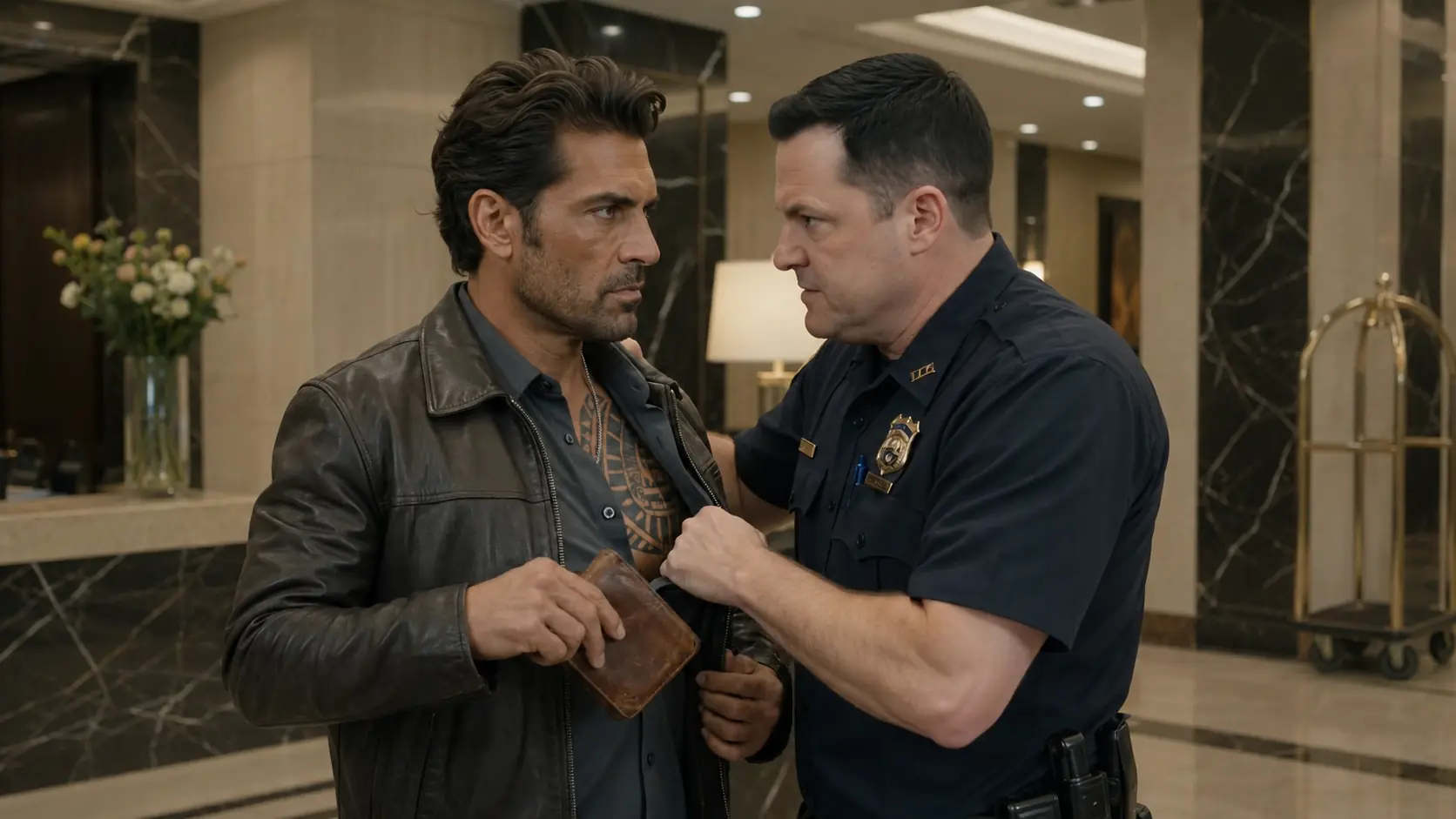
The accused man did not struggle.
At forty-four, he had the powerful build of someone who had spent years training his body to remain useful under pressure. A charcoal dress shirt stretched across his shoulders beneath a dark-brown leather jacket, and the open collar revealed part of the black tribal tattoo crossing his chest. His shaved head, scarred forearms, tailored black trousers, and polished boots made him look more like private security than a hotel guest.
The officer pulled a dark leather wallet from inside the man’s jacket and held it above the counter. “Room 1804 reported this missing ten minutes ago.”
The tattooed man turned his head slowly. “Take your hand out of my jacket and check the badge beneath it.”
The officer shoved him harder. “I don’t care what fake badge you carry. Move again, and both arms go in cuffs.”
The man glanced toward a brass security camera near the ceiling. “Then keep digging. The FBI team upstairs just watched you plant that wallet.”
For the first time, the officer’s grip loosened.
Only slightly.
His partner reached beneath the leather jacket and found a slim black credential case clipped inside the waistband. He opened it, stared at the gold badge, and then looked at the identification beside it. The man pinned against the counter was not a thief, a private guard, or a nervous tourist caught in the wrong place.
He was a supervisory special agent with the Federal Bureau of Investigation.
A service elevator opened behind them.
Four federal agents stepped into the lobby wearing plain clothes and tactical identification vests. A fifth agent emerged from the hotel’s security office carrying a tablet displaying synchronized footage from six cameras. The recording showed the officer removing the wallet from his own duty bag, stepping behind the tattooed man, and pushing it beneath the edge of his jacket seconds before announcing the arrest.
“Release him,” the lead federal investigator ordered.
The officer did not move.
The tattooed agent looked over his shoulder. “You heard her.”
The officer’s hand fell away.
What had begun in front of nearly a hundred witnesses was not a spontaneous confrontation. It was the final stage of a seven-month federal investigation into a police extortion network operating around Manhattan’s most expensive hotels. The tattooed agent had entered the lobby that evening because investigators believed the network would mistake him for exactly the kind of victim it preferred.
Wealthy enough to carry cash.
Unfamiliar enough to stand alone.
Visually intimidating enough that a fabricated arrest could be explained as a necessary response to aggression.
The first complaint had come from a surgeon visiting from Chicago. He reported that officers stopped him inside a hotel garage, searched his luggage, and claimed to discover a stolen watch beneath his car seat. The watch belonged to another guest, and the officers offered the surgeon a choice: accept arrest and public humiliation or surrender the nine thousand dollars he carried for a private medical equipment purchase.
He paid.
The watch disappeared.
The police report described the encounter as a misunderstanding resolved after ownership could not be confirmed. There was no record of the cash, the search, or the threat.
A second victim was a jewelry wholesaler from Miami. Officers entered his hotel room after the manager reported “suspicious activity,” found unregistered diamonds in a bag, and threatened to seize the entire shipment. The wholesaler later admitted he had paid fifteen thousand dollars to avoid missing an international flight and losing a business contract.
He never received a receipt.
A third complaint involved a restaurant owner whose wallet was returned after officers accused a hotel guest of theft. The guest insisted the wallet had been planted, but his claim was dismissed because two uniformed officers and a hotel manager all provided matching statements. The man spent three nights in jail before prosecutors declined the case.
His name was placed in a criminal database anyway.
The complaints appeared unrelated because they occurred at different hotels, involved different victims, and were written by different officers. Yet the same names surfaced repeatedly in supporting records. The same hotel security consultant appeared on incident reports, the same private towing company removed vehicles, and the same precinct sergeant approved the officers’ incomplete body-camera explanations.
Most importantly, expensive property kept disappearing before it reached evidence storage.
The tattooed agent had been assigned after a federal prosecutor noticed that several victims were interstate business travelers. He spent weeks reviewing arrest reports, hotel access logs, security recordings, insurance claims, and financial withdrawals. What appeared at first to be aggressive policing soon revealed a disciplined criminal operation.
Hotel employees selected targets.
A concierge or manager identified guests carrying cash, jewelry, luxury goods, or confidential business materials. The information passed through an encrypted messaging group to officers working nearby. One officer created a reason for contact while another planted an item already reported missing by a cooperating hotel employee.
The victim was then isolated.
Some were threatened with arrest. Others were warned that local media would receive their names, that immigration authorities might be contacted, or that business property would be held for months. The officers always offered a path out, though they never called it a payment.
They called it resolving the situation.
The tattooed agent was chosen for the hotel operation because his appearance could support several false narratives. The officers might claim he intimidated staff, carried stolen property, belonged to organized crime, or resisted identification. His tattoos made those stories easier to sell to witnesses who noticed only the final confrontation.
But his clothing had been prepared by the evidence team.
Every pocket had been photographed, sealed, and documented before he entered the building. The leather jacket contained fiber markers invisible under normal light. Any object planted inside it would preserve the exact point and time of contact.
The wallet used by the officer had been reported missing earlier that evening by a hotel guest secretly cooperating with investigators. The guest was a former victim who agreed to help after federal agents reopened his case. His wallet contained no cash, but a hidden transmitter inside its lining recorded every movement from the eighteenth floor to the officer’s duty bag and finally to the agent’s jacket.
The officer had planted federal evidence on a federal investigator while the object transmitted its own location.
He still tried to lie.
Standing in the lobby with guests recording on their phones, he claimed the tattooed man had placed the wallet inside his own jacket after stealing it near the elevators. He insisted the security footage had been edited or misunderstood. His partner nodded until the lead investigator asked why both officers had muted their body cameras before entering the hotel.
Neither answered.
The tattooed agent adjusted his jacket and faced the hotel manager. “You called them before I entered the building.”
The manager’s expression remained professional. “We contact law enforcement whenever a suspicious person approaches our guests.”
“What made me suspicious?”
“You were watching the lobby.”
“I was waiting for a meeting.”
“You refused to identify yourself.”
“You never asked.”
The manager looked toward the officers as if expecting them to regain control. Instead, federal agents closed around all three men.
The lead investigator displayed a message recovered from the manager’s phone. It had been sent eleven minutes before the tattooed agent arrived.
Large bald male. Expensive watch. Alone. Leather bag likely in vehicle. Good pressure target.
The manager’s face changed.
The message had been deleted, but investigators were already monitoring the encrypted account through a court-authorized intercept. Every word had reached the federal operation center before the first officer entered the lobby.
The two officers were disarmed.
Their duty weapons, radios, body cameras, phones, handcuffs, and patrol vehicle were taken into federal custody. The hotel manager was escorted away from the front desk while guests watched in stunned silence. Another federal team sealed the hotel security office before employees could erase or replace footage.
The tattooed agent remained beside the counter.
He looked down at the wallet the officer had pulled from his jacket. For months, it had existed only as a planned piece of controlled evidence. Yet seeing it on the marble surface reminded him of every victim who had stood in similar places without federal agents waiting upstairs.
Most had been alone.
Most had been frightened.
Some had paid because they believed surrendering money was the only way to protect their families, careers, or freedom.
The next morning, federal investigators searched the officers’ homes, vehicles, lockers, and storage units. One officer had more than sixty thousand dollars hidden inside an old tool chest. The other kept watches, hotel key cards, jewelry, foreign currency, and sealed envelopes containing photocopies of guests’ passports.
A storage facility in Queens revealed the scale of the operation.
Investigators found luxury luggage, designer handbags, electronic devices, business records, and property taken during unofficial searches. Several items had already been reported stolen by hotel guests who never knew police had handled them. Others belonged to people falsely accused of crimes.
One locked cabinet contained evidence bags from the precinct.
Some seals had been cut and replaced. Property numbers matched cases dismissed years earlier, suggesting the officers had used official evidence to construct new accusations. Stolen wallets, jewelry, prescription bottles, and small packets of narcotics could be planted depending on the victim and the amount of pressure required.
The precinct sergeant was arrested before noon.
His messages showed that he approved reports, arranged body-camera “failures,” and warned officers when complaints reached internal review. In exchange, he received a percentage of cash collections and free stays at participating hotels. He also protected the officers from undesirable assignments and disciplinary scrutiny.
The private security consultant was taken into custody at an airport.
His laptop contained spreadsheets ranking hotels by guest wealth, camera blind spots, management cooperation, and distance from precinct patrol routes. Each target received a risk score based on nationality, occupation, local connections, and willingness to involve attorneys.
The operation was more organized than many businesses.
It maintained schedules, payment records, backup stories, and lists of previous victims. Hotel employees received bonuses for identifying guests who traveled alone or carried valuable property. Officers received larger shares when victims paid quickly and created no public scene.
The tattooed agent spent the following week interviewing victims.
The surgeon from Chicago arrived first. He entered the federal building wearing the expression of a man who still expected to be doubted. When the agent placed recovered photographs and financial records before him, the surgeon stared at the pages without speaking.
“You believed me?” he finally asked.
“We found proof.”
“That is not what I asked.”
The agent understood.
“Yes,” he said. “I believed something happened before we proved exactly what it was.”
The surgeon lowered his eyes. For months, colleagues had treated his story as an embarrassing excuse for losing money. His own family wondered whether he had concealed a gambling debt or private mistake. The officers’ reports had been written so confidently that even people who loved him began questioning his memory.
The jewelry wholesaler cried when investigators returned part of his seized property.
He had lost clients, insurance coverage, and his reputation because the officers suggested his inventory might be connected to criminal activity. No charge had ever been filed, but the suspicion remained searchable online. Federal prosecutors began the process of correcting records and notifying licensing authorities.
The hotel guest jailed for stealing the wallet arrived with his older daughter.
She had been fifteen when her father was arrested in front of her. She remembered officers pulling his arms behind him while the hotel manager told guests to move away from the dangerous man. For years, she avoided hotels because every lobby brought back the sound of her father’s body striking a counter.
The tattooed agent showed them the same model wallet used in the controlled operation.
“This is how they did it,” he explained. “They created a complaint, planted the property, and used the arrest to make the report appear true.”
The father looked at his daughter. “I told you.”
“I always believed you,” she said.
He began crying before she finished the sentence.
The case soon became public.
News coverage focused first on the confrontation inside the luxury hotel: the aggressive officers, the planted wallet, and the moment the tattooed man revealed his FBI badge. The video spread because it offered a clean reversal that viewers understood immediately.
Yet the agent disliked the headline suggesting the officers’ mistake was arresting an FBI employee.
Their crime was not failing to recognize his authority.
Their crime was assuming every person without visible power could be framed, frightened, or purchased into silence.
At the first press conference, he said exactly that.
“I was protected before I entered the lobby,” he told reporters. “The vehicle, clothing, wallet, cameras, and federal teams were part of a controlled operation. The other victims had none of those protections. This case matters because the law should not depend on whether the person being searched carries a federal badge.”
Prosecutors charged the two officers, the sergeant, hotel manager, security consultant, and three additional employees with conspiracy, extortion, evidence tampering, obstruction, theft, civil-rights violations, and falsification of records. More arrests followed as financial evidence revealed involvement from other hotels.
One officer attempted to cooperate.
He claimed the sergeant had pressured him into joining the scheme after threatening his career. The prosecutor acknowledged the coercive culture but reminded him that he had planted evidence on at least eleven people and personally collected thousands of dollars.
Fear explained his choices.
It did not erase them.
The second officer denied everything until investigators played the lobby footage beside recordings from two previous incidents. His movements were nearly identical in each case. He always approached from the victim’s blind side, pressed the object against clothing, announced the discovery loudly, and then controlled the witness narrative before anyone could question what happened.
The jury watched the same technique performed three times.
It convicted him on every major count.
The hotel corporation initially blamed isolated employees, but investigators uncovered internal complaints dating back four years. Guests had reported suspicious searches, missing cash, and coordination between police and managers. Regional executives closed the complaints after the hotel’s security consultant assured them that cooperating with officers protected the brand from criminal guests.
The corporation agreed to independent monitoring, victim compensation, and major changes to its security practices.
Hotels could no longer provide guest financial details to police without legal process or immediate safety concerns. Security footage automatically uploaded to a protected external archive. Employees were required to document every police request, preserve original recordings, and provide guests with access to complaint procedures.
The police department faced deeper reforms.
Body cameras could no longer be muted or deactivated during hotel searches without triggering an automatic review. Property discovered outside a formal arrest had to be photographed in place before any officer touched it. Evidence transfers required two signatures and immediate digital tracking.
The precinct’s complaint unit was removed from the local command structure.
Civilian reports involving missing money, planted property, or disabled cameras went directly to an independent investigative office. Supervisors who closed complaints without interviewing witnesses became subject to discipline.
The department also reviewed every case involving the convicted officers.
Dozens of arrests were reopened. Charges were dismissed where evidence could no longer be trusted, and several convictions were vacated. Seized property was returned when ownership could be established, though investigators admitted some items would never be recovered.
The tattooed agent attended several court hearings.
He watched victims speak about lost careers, damaged families, medical problems, and years spent doubting whether anyone would believe them. Their statements lacked the clean satisfaction of the hotel video. No badge had appeared at the perfect moment to protect them.
Justice arrived late.
Sometimes too late to restore everything.
The former hotel manager received a federal prison sentence after admitting that he targeted guests who appeared isolated or unlikely to receive sympathy. Asked why he had selected the tattooed man, he answered that the man looked dangerous enough for witnesses to believe the officers.
That answer became one of the case’s most repeated lines.
The agent heard it differently.
The manager had not seen danger. He had seen a story he believed other people would accept without evidence. The shaved head, visible tattoos, muscular frame, and leather jacket became tools for constructing guilt.
The officers had relied on appearance because appearance was faster than truth.
Months after the convictions, the agent returned to the hotel.
The lobby had been renovated. The black marble counter remained, but new cameras covered every entrance, corridor, and elevator. A sign near reception explained that guests could request independent review of any security incident.
The surgeon, jewelry wholesaler, and falsely arrested father joined him for a private meeting with the hotel’s new accountability director. They were not there for publicity. They were there to examine whether promised reforms actually worked.
The agent stood beside the same section of counter where the officer had forced his arm behind him.
The father touched the marble lightly. “Mine looked almost exactly like this.”
The agent nodded.
“Did you know they would plant the wallet?”
“We believed they might.”
“Were you afraid?”
The agent considered giving the easy answer. He had entered with a team, a plan, and years of experience. But confidence did not remove the knowledge that armed officers were willing to fabricate evidence.
“Yes,” he said. “Not of being convicted. Of how comfortable they were doing it.”
The father understood.
That comfort had been the real danger.
The officers did not panic or improvise. They planted the wallet with practiced movements, confident that their uniforms, reports, and shared testimony would overpower the truth. They had succeeded many times because the systems surrounding them valued official certainty more than civilian contradiction.
The operation ended because evidence finally became stronger than their authority.
A year after the hotel arrest, the tattooed agent received a departmental commendation. He accepted it on behalf of the entire investigative team, then asked that the ceremony include the victims who had first reported the scheme.
The surgeon stood beside him.
So did the wholesaler and the father once accused of wallet theft. Their presence changed the meaning of the event. The investigation had not begun because an FBI agent was falsely arrested.
It began because ordinary people continued telling the truth after powerful institutions dismissed them.
After the ceremony, the father shook the agent’s hand.
“When I saw that video, I thought the best part was the badge,” he said.
“What do you think now?”
“The best part was that the cameras were already running.”
The agent smiled.
He still wore the dark-brown leather jacket occasionally, though the evidence team had removed the fiber markers and repaired the lining where the credential case had been clipped. The tattoos remained visible whenever his collar opened, unchanged by the assumptions other people attached to them.
He did not want to look harmless.
He wanted a system in which appearance never replaced proof.
Inside the hotel lobby, the officers had believed they were arresting a man without influence. They saw tattoos, expensive clothing, and a solitary traveler, then constructed the crime they needed around him.
They were wrong about his identity.
But the investigation proved something more important.
Even if he had carried no badge, the arrest would still have been corrupt, the wallet would still have been planted, and the truth would still have deserved protection.
The FBI badge did not make him innocent.
The evidence did.