Vincent Marrow had taken exactly three bites of mashed potatoes when a large hand landed on his right shoulder.
He did not look up immediately. The temporary dining tent around him remained loud with lunch conversation, plastic trays sliding over folding tables, coffee being poured into paper cups, and nearly a hundred field employees trying to finish their meals before the afternoon training blocks began. Vincent simply set his fork beside the green tray and looked at the fingers pressing into the black leather of his jacket.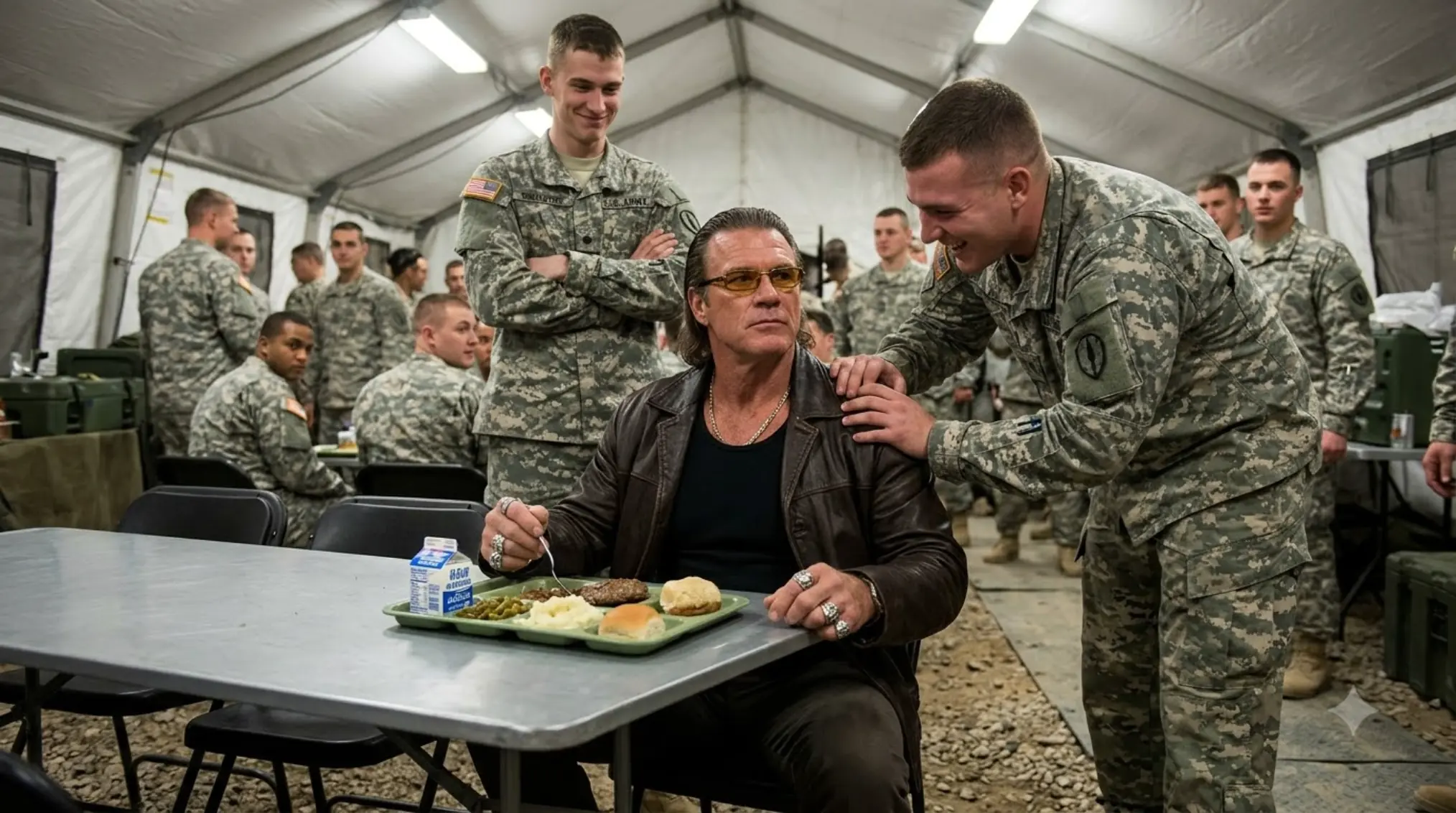
“Why are you eating here?” a voice asked behind him.
Vincent slowly turned his head.
The man touching him was perhaps forty, thick through the neck and shoulders, with a closely trimmed mustache and the easy grin of someone who believed the room belonged to him. His tan work shirt carried the stitched name MASON REDDICK, and beside him stood a younger supervisor named Travis Cole with his arms folded across his chest, laughing before anything funny had happened.
Vincent looked at Mason’s hand again.
“Take your hands off me.”
Mason’s grin widened.
“Or what, old man?”
Vincent lifted his eyes.
“Keep touching me and you’ll find out before lunch gets cold.”
The laughter around the nearest tables faded.
Mason’s fingers remained on Vincent’s shoulder for another second, perhaps because removing them immediately would have looked like obedience. Then he gave Vincent one exaggerated pat and stepped back as though the contact had been friendly all along.
Travis laughed.
“You hear this guy?”
Vincent picked up his fork.
“I heard him.”
“You got a visitor badge?”
Vincent cut another piece of meat.
“No.”
“That’s what I thought.”
Travis stepped around the table and planted both palms against its edge. He was younger than Mason, perhaps thirty-three, tall, lean, and confident in the particular way people became confident when they had spent too long being protected by someone stronger.
“This dining section is for active field personnel.”
Vincent chewed.
“Is that so?”
“Yes.”
“Where is that written?”
Travis’s smile disappeared slightly.
“You always this difficult?”
“Only when people invent rules while I’m eating.”
A few people nearby looked down at their trays.
Vincent noticed.
That mattered more than the supervisors’ expressions.
Nobody appeared surprised by the confrontation.
Embarrassed, perhaps.
Uncomfortable.
But not surprised.
Vincent had spent four decades learning that the most revealing reaction to bad behavior was often not the behavior itself, but the way everyone around it behaved as if they had seen it before.
Mason leaned over him.
“What unit are you attached to?”
“None.”
“Vendor?”
“No.”
“Inspector?”
Vincent took a sip of milk.
“Would it matter?”
“It matters if you’re sitting where you don’t belong.”
Vincent glanced around the tent.
Long folding tables filled most of the space. There were no reserved signs, no ropes, and no seating charts beyond one table near the front labeled for food-service staff with dietary requirements.
“This chair was empty.”
Mason’s nostrils flared.
“That isn’t the point.”
“What is?”
Travis answered.
“The point is, when a supervisor tells you to move, you move.”
There it was.
Vincent looked at him carefully.
Not a rule.
Not safety.
Not logistics.
Power.
He returned his attention to lunch.
“No.”
A fork hit a tray somewhere behind Travis.
Nobody laughed now.
Travis leaned closer.
“What did you say?”
Vincent looked up.
“I said no.”
Mason stepped beside Travis.
“You really want to make a problem out of lunch?”
Vincent’s expression remained neutral.
“You walked over here.”
Travis pointed toward the tent entrance.
“Get up.”
“No.”
“I’m telling you for the last time.”
“That makes three.”
Travis’s jaw tightened.
Mason laughed, but the sound lacked humor.
“You know what your problem is?”
Vincent took another bite.
Mason continued.
“You think because you’re older, everybody has to respect you.”
Vincent swallowed.
“No.”
He placed the fork down.
“I think because I’m sitting quietly eating food I was given, grown men should be capable of walking past without placing their hands on me.”
The nearest table went completely still.
Mason’s face hardened.
“You accusing me of something?”
“I described what you did.”
“Watch yourself.”
Vincent looked at him.
“Why?”
The simplicity of the question irritated Mason more than any insult would have.
His shoulders tightened.
Vincent recognized that reaction too.
People who were accustomed to obedience often heard questions as challenges because questions forced them to explain authority they preferred to leave undefined.
Mason bent lower.
“You don’t know who you’re dealing with.”
Vincent almost smiled.
That sentence, of all sentences, seemed perfectly chosen.
“No,” he said. “I suppose neither of us does.”
Travis stepped around behind Vincent.
Several employees looked away.
That was when Vincent became certain he had not wasted the trip.
Three weeks earlier, he had been sitting on the thirty-seventh floor of Marrow Holdings headquarters in Dallas when the first anonymous complaint reached his personal email.
That alone was unusual.
Vincent Marrow was the founder and majority owner of Sentinel Response Group, a national emergency logistics and disaster-recovery company operating across twenty-two states. Sentinel supplied mobile shelters, communications systems, food distribution, heavy equipment, emergency transportation, medical-support logistics, and temporary infrastructure whenever hurricanes, floods, fires, chemical accidents, or major utility failures overwhelmed local resources.
The company employed more than nine thousand permanent staff and thousands of temporary workers during large deployments.
Vincent rarely appeared publicly anymore.
At twenty-eight, he had been everywhere.
At thirty-eight, employees recognized him immediately.
At fifty-eight, after years of delegating public leadership to presidents, regional directors, and operating executives, younger employees mostly knew his name from the company history page.
Old photographs showed a thinner man with short hair.
The man eating lunch in Louisiana wore his black hair longer, amber-tinted glasses, a leather jacket, and enough gray around the temples to confuse anyone expecting the founder from a fifteen-year-old corporate photograph.
The anonymous email had been short.
People at Bayou Ridge are afraid of Mason Reddick and Travis Cole.
Vincent initially forwarded it to the ethics department.
Then a second message arrived.
Don’t send this back through regional management. They know.
That changed things.
Vincent asked General Counsel Hannah Price to quietly collect every complaint associated with Sentinel’s Bayou Ridge Response Training Center during the previous eighteen months.
There were twelve.
Not all against Mason or Travis.
Some involved food vouchers.
Others involved missing overtime.
Two employees alleged safety inspections had been signed before equipment was actually checked.
One temporary worker claimed he had been threatened with blacklisting after reporting a faulty lifting cable.
Three complaints had been closed as misunderstandings.
Four disappeared after employees resigned.
The rest remained open.
Vincent read everything.
Then he asked one question.
“Who knows I’m coming?”
Hannah answered:
“No one if you want it that way.”
“I do.”
She disliked the idea immediately.
“You are not twenty-eight anymore.”
“I’m aware.”
“You have professional investigators.”
“I’m also aware.”
“Then why are you personally going?”
Vincent looked at the complaint file.
“Because every report says the same thing in different words.”
“What?”
“People act differently when leadership visits.”
Hannah sighed.
“That is not an argument for pretending to be a stranger.”
“No.”
Vincent closed the folder.
“It’s an argument for becoming one.”
He arrived at Bayou Ridge under his middle name, Vincent Hale, carrying temporary consultant credentials connected to an equipment-utilization review. Only the site’s head administrator knew someone from corporate auditing would be present, but even he did not know Vincent’s identity.
For two days, Vincent watched.
He saw excellent work.
Technicians repairing generators in brutal humidity.
Cooks serving hundreds of meals on schedule.
Drivers practicing convoy coordination through narrow staging lanes.
Medical-support staff running mass-casualty exercises in temporary tents.
He also saw something else.
Junior workers stiffened whenever Mason entered.
Temporary laborers stopped talking around Travis.
Meal breaks ended early if either supervisor appeared.
One employee removed food from his tray and wrapped it in napkins before leaving the dining tent.
Vincent asked why.
The young man hesitated.
Then whispered:
“They’ll say we’ve been sitting too long.”
“Who?”
The worker glanced over one shoulder.
“You’re new.”
“Yes.”
“Stay that way.”
He left.
Vincent made a note.
That morning he watched Mason berate a forklift operator for requesting a replacement safety strap.
“The strap passed inspection,” Mason said.
“It’s frayed.”
“Then stop rubbing it against things.”
The operator stared.
Mason stepped closer.
“You want to run equipment, or do you want somebody else taking your hours?”
The operator backed down.
Vincent photographed the strap after Mason left.
The fibers were visibly damaged.