“Don’t touch another wire—you probably damaged it so we’d have to pay you.”
The blonde woman slapped Daniel Reed’s hand away from the open engine compartment as rain hammered the highway shoulder around them. Water streamed from her beige trench coat, and strands of glossy hair clung to her frightened face as though the storm had stripped away every layer of confidence she normally wore. Daniel remained beside the disabled sedan, holding the loose battery connector he had just discovered. Behind him, his aging pickup idled with its hazard lights flashing through the gray Pennsylvania rain.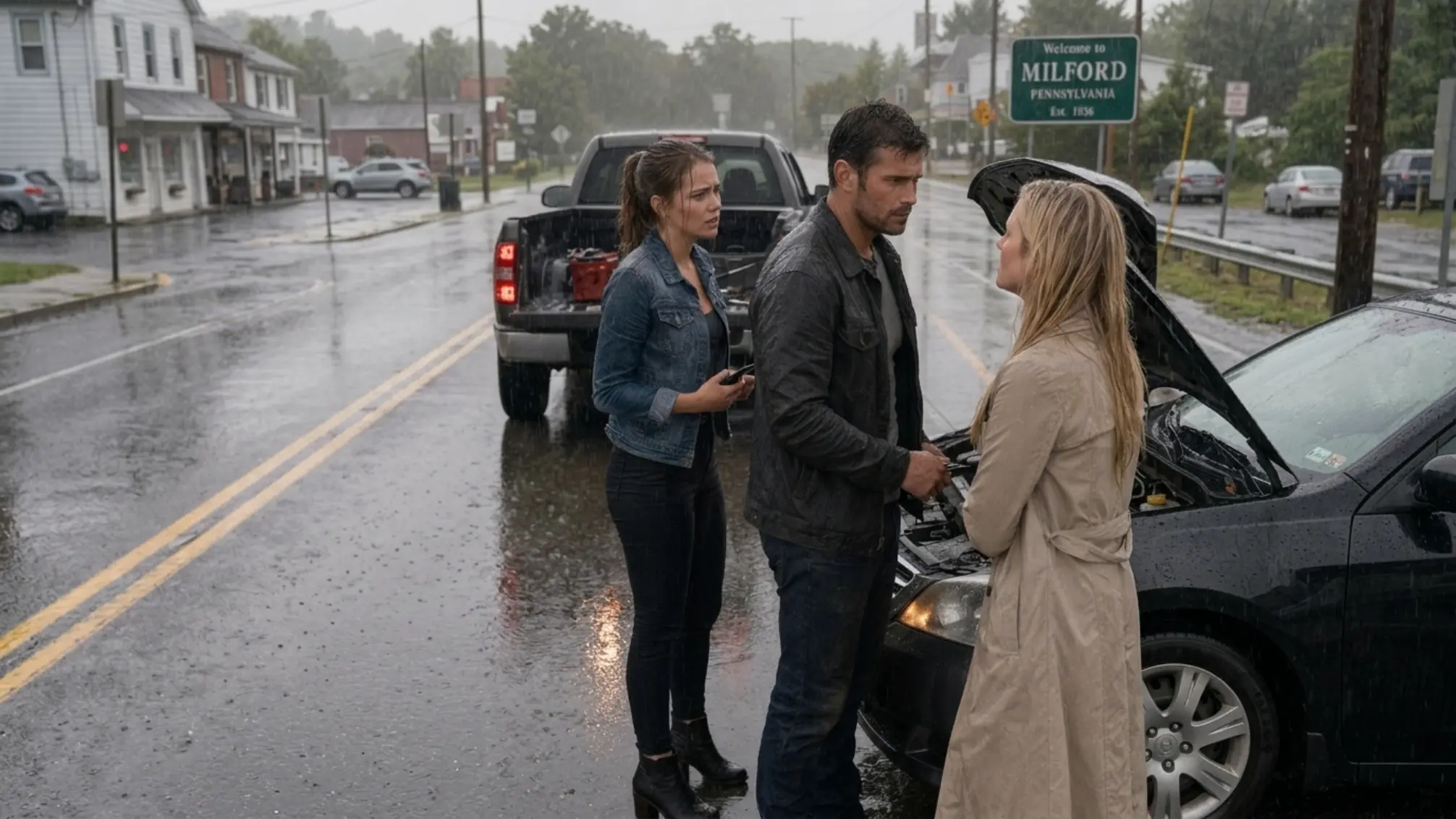
“Then keep accusing me,” Daniel said coldly, “while the storm leaves you here.”
The second woman, a beautiful brunette gripping a dead phone in both hands, stepped between them. “Enough, Emma. Twenty cars ignored us, and he’s the only person who stopped.”
Emma Dalton looked toward the empty highway, then back at Daniel. “That doesn’t mean I trust him.”
Daniel pointed toward the driver’s seat. “Turn the key. Then decide whether kindness still looks like a scam.”
Emma hesitated before climbing behind the wheel. She looked once through the windshield at Daniel, as though expecting him to demand money before allowing her to test the repair. Instead, he stepped away from the engine and waited beside the brunette.
Emma turned the ignition.
The engine started immediately.
The sound cut through the storm so suddenly that both women froze. The headlights brightened, the dashboard returned to life, and the windshield wipers began sweeping rain aside with steady mechanical rhythm. Emma stared at the steering wheel while the brunette released a breath that sounded half like a laugh and half like a sob.
“You fixed it,” she whispered.
Daniel closed the hood. “The positive battery terminal was loose. It probably shifted enough during the drive to break the connection.”
“That’s all?” Emma asked as she stepped out.
“That was enough.”
The brunette smiled despite the rain. “I’m Lily Hayes.”
“Daniel.”
Emma remained near the door, embarrassment replacing suspicion. “How much do we owe you?”
“Nothing.”
“You pulled over, got soaked, and used your own tools.”
“It took ten minutes.”
“That doesn’t make your time worthless.”
Daniel looked toward the road. “I have a daughter waiting at home. I’d rather lose ten minutes than drive away knowing two people might spend the night stranded here.”
The answer silenced Emma more completely than anger could have.
Daniel packed his tools into a small metal box. The rain had soaked through his charcoal jacket, and cold water ran from his hair into the collar of his shirt. He was already late, and the thought of his eight-year-old daughter waiting beside the kitchen window created an ache beneath his ribs.
“Get the battery checked tomorrow,” he said. “The terminal is secure now, but the corrosion needs cleaning properly.”
Emma opened her handbag. “At least take something for fuel.”
Daniel shook his head. “Help somebody else when the opportunity comes.”
“That sounds like something people say in movies.”
“My father said it whenever I complained about stopping.”
“Was he always this stubborn?”
“Worse.”
Lily laughed. Emma did not, but the tension in her face softened.
“Drive carefully,” Daniel said.
He returned to his pickup before either woman could prolong the conversation. As he pulled onto the highway, he saw their sedan following several car lengths behind, its headlights remaining visible in his mirror until the road divided near Milford.
Daniel reached home nearly an hour late.
His daughter, Sophie, sat at the kitchen table wearing pajamas and a construction-paper crown. Mrs. Harper, the elderly neighbor who watched her after school, stood near the sink packing leftover pasta into a container.
Sophie folded her arms the moment Daniel entered.
“You promised seven-thirty.”
“I know.”
“It’s eight-fifteen.”
“I stopped to help two women whose car broke down.”
Sophie looked at Mrs. Harper. “I told you.”
Mrs. Harper lifted one eyebrow. “She predicted either a broken car or an injured animal.”
“There were no animals.”
Sophie climbed from the chair and hugged Daniel despite her effort to appear angry. “Were they scared?”
“A little.”
“Did you fix it?”
“Yes.”
“Did they say thank you?”
“One of them did.”
Daniel glanced toward the stove. “Did you save dinner?”
“No,” Sophie answered seriously. “Mrs. Harper did because she understands responsibility.”
The elderly woman covered a smile.
Daniel carried Sophie back to the table, reheated his dinner, and listened while she described the reading presentation she would give at school on Friday. Since the death of her mother four years earlier, Sophie had become unusually alert to his moods. She noticed every unpaid bill, every exhausted sigh, and every moment he stared too long at a photograph he thought she had forgotten.
Daniel tried never to place adult worries on her shoulders.
He worked as a construction supervisor for a regional contractor, earning enough to keep their small house and maintain an aging truck that required constant repair. Most mornings began before sunrise. He packed Sophie’s lunch, checked her homework, drove her to Mrs. Harper’s house, and then spent ten hours managing crews, materials, inspections, and deadlines.
After work, he became the only parent again.
He cooked, cleaned, attended school meetings, learned how to braid hair from online videos, and read bedtime stories even when his eyes could barely remain open. Life had not been gentle, but Sophie’s presence gave every difficult hour a purpose.
That evening, after she fell asleep, Daniel removed his wet clothes and found a folded business card inside his jacket pocket.
Emma Dalton — Willow Street Books.
A phone number was written beneath the printed address.
On the back, in hurried handwriting, were six words:
I’m sorry. Thank you for stopping.
Daniel placed the card beside his keys and went to bed.
Three days passed before he thought about the roadside encounter again.
Friday morning arrived with clear skies, but Daniel’s construction site fell behind schedule after a concrete delivery was delayed. He called the school and explained that he might miss Sophie’s reading presentation. Her teacher promised to place Sophie near the end of the program, but the disappointment in his daughter’s silence followed him through the rest of the morning.
At twelve-thirty, Daniel finally left the site.
His pickup started, shuddered, and died before reaching the main road.
He struck the steering wheel once.
Then he leaned back and closed his eyes.
The alternator warning light had appeared twice that week, but replacing the part would have required money already committed to groceries and electricity. Daniel had convinced himself the truck could survive until payday.
It had chosen the worst possible moment to prove him wrong.
He called a towing company. The earliest truck was forty-five minutes away. Sophie’s presentation began in thirty.
Daniel climbed out and opened the hood, knowing the gesture would not create a miracle. The alternator belt remained intact, but the battery was nearly dead. He searched the employee parking lot for someone with jumper cables, yet most crews had left for lunch.
His phone rang.
The unfamiliar number belonged to Emma.
“I hope I’m not interrupting,” she said.
“What do you need?”
“Nothing. Lily and I wanted to buy you coffee and apologize properly.”
Daniel looked at his truck. “Today isn’t good.”
Emma heard something in his voice. “What happened?”
“My truck died.”
“Where are you?”
He nearly refused to answer. Then he looked at the time.
Daniel gave her the construction-site address.
Emma arrived twelve minutes later in the same sedan from the highway. Lily sat in the passenger seat, and both women stepped out before the car had fully settled into its parking space.
“What’s wrong with the truck?” Lily asked.
“Alternator.”
Emma held up the sedan keys. “Take our car.”
Daniel stared at her.
“Your daughter’s school is seven miles from here,” Emma continued. “You mentioned the presentation when we spoke on the roadside.”
“I’m not taking your car.”
“Why?”
“Because I barely know you.”
Emma folded her arms. “Interesting. You expected us to trust you with our engine after knowing you for thirty seconds.”
“That was different.”
“It was raining?”
“That isn’t what I meant.”
Lily opened the driver’s door and placed the keys on the seat. “Daniel, your daughter won’t care whether your pride had valid reasons. She’ll remember whether you were in the room.”
The sentence landed harder than Emma’s challenge.
Daniel looked toward the highway, then back at the keys.
“I’ll return it immediately.”
Emma smiled. “Go.”
He arrived at the school two minutes before Sophie walked onto the stage.
Daniel entered quietly and stood against the back wall. Sophie searched the audience while another student finished reading. Her eyes found him, and the fear on her face transformed into a smile so bright it made every argument in the parking lot irrelevant.
She read a story about a girl who rescued an injured bird.
Her voice trembled on the first paragraph but strengthened as she continued. When she finished, Daniel applauded louder than anyone else in the room.
After the program, Sophie ran toward him.
“You came!”
“I promised.”
She glanced through the window at Emma’s sedan. “Where’s the truck?”
“Broken.”
“Whose car is that?”
“Someone I helped.”
Sophie studied him. “Did they help you back?”
“Yes.”
“That’s efficient kindness.”
Daniel laughed. “Where did you learn that phrase?”
“I made it up.”
They returned to the construction site together. Emma and Lily were seated on the lowered tailgate of a work truck, sharing coffee while waiting for the tow company. Sophie approached them cautiously.
Emma stood. “You must be Sophie.”
“You must be the lady who thought Dad was scamming you.”
Lily nearly spilled her coffee.
Emma looked directly at Daniel. “You told her?”
“He tells me important things,” Sophie said.
Emma crouched to the child’s height. “Then he probably told you I was wrong.”
“He said you were scared.”
The answer surprised all three adults.
Sophie continued. “Sometimes scared people become rude because being angry feels stronger.”
Emma glanced toward Daniel. “Your daughter is terrifying.”
“She gets that from her mother.”
A shadow passed briefly across his expression. Emma noticed but did not ask.
The tow truck arrived, and Daniel prepared to take the borrowed sedan back. Emma refused.
“We’ll follow the tow truck to the repair shop,” she said. “Keep the car until yours is ready.”
“I can’t.”
“You can.”
“I don’t accept things because someone feels guilty.”
“This is not guilt.”
“What is it?”
Emma looked toward Sophie, who was showing Lily the certificate from her reading presentation.
“An opportunity to help someone when it isn’t convenient.”
Daniel recognized his own words.
He kept the car for two days.
On Sunday afternoon, he returned it to Willow Street Books. The shop occupied a narrow brick building in downtown Milford, with flower boxes beneath the windows and handwritten recommendations displayed beside the entrance.
Emma stood behind the counter arranging new releases. Without the fear and rain of the highway, she seemed calmer and younger. Lily sat on a ladder near the children’s section, organizing books while a group of families attended story hour.
Sophie immediately disappeared toward the shelves.
Daniel placed the keys on the counter. “Thank you.”
“Was your truck repaired?”
“Enough to survive.”
Emma examined him. “That answer does not inspire confidence.”
“It only needs to last until I can replace the alternator.”
“You should have told me.”
“You already lent me your car.”
“I know a trustworthy mechanic.”
“So do I.”
“Is he affordable?”
“It’s me.”
Emma smiled. “That explains the confidence.”
Daniel expected to leave after returning the keys, but Sophie joined the story-hour group and refused to abandon a chapter halfway through. Emma made coffee while Daniel waited.
They spoke for almost an hour.
Emma had inherited the bookstore from her aunt and spent eight years keeping it alive against online retailers and rising rent. Lily was her closest friend, though they often referred to each other as sisters because their families had been connected since childhood. Lily was completing a teaching degree and worked part-time at an elementary school.
Neither woman had been traveling home from a casual visit when the car failed.
Emma’s grandmother had suffered a fall.
The two women were returning from the hospital, exhausted and frightened, after learning she would require months of rehabilitation. Emma had already received a fraudulent roadside-assistance bill earlier that year, which explained why she reacted so harshly when Daniel touched the battery connection.
“It doesn’t excuse what I said,” Emma told him.
“No.”
“I thought you were taking advantage of us.”
“I noticed.”
“I’m not usually that awful.”
Lily called from the children’s section. “She sometimes is.”
Emma threw a bookmark toward her.
Daniel began visiting the bookstore with Sophie on Saturdays.
At first, he told himself the trips were entirely for his daughter. Sophie loved the children’s corner, and Lily helped her choose books that challenged her without becoming frustrating. Emma kept coffee ready for Daniel and gradually learned which subjects drew him into conversations.
Their friendship formed without anyone naming it.
Some weeks, Daniel repaired shelves or fixed the bookstore’s aging delivery van. In return, Emma and Lily helped Sophie prepare projects, choose gifts, and navigate the emotional problems she did not always want to discuss with her father.
Daniel remained cautious.
After losing his wife, Rachel, he had built a life defined by responsibility rather than possibility. Friendship felt safe. Anything deeper threatened the careful balance that kept him functioning.
Emma did not pressure him.
She understood grief better than he realized. Her younger brother had died in a motorcycle accident when she was twenty-four, and the experience changed how she responded to uncertainty. The fear she displayed on the highway had not been only about the disabled car.
She hated feeling trapped beside fast-moving traffic because that was where her brother’s life ended.
One evening, Daniel noticed her becoming quiet when a motorcycle roared past the bookstore window. She eventually told him the story.
“I’m sorry,” he said.
“So am I.”
“That response sounds familiar.”
Emma looked at him. “People always say they’re sorry like they expect grief to become easier if enough strangers acknowledge it.”
“It doesn’t.”
“No.”
“But sometimes it becomes less lonely.”
Emma’s eyes remained on him.
“That was almost optimistic.”
“Don’t repeat it.”
Their friendship reached an unexpected test during the first major winter storm.
Heavy snow closed schools and knocked out power across several neighborhoods. Daniel’s construction company suspended work, but he spent the morning helping elderly neighbors clear walkways and restart generators.
Emma called shortly after noon.
Her grandmother had been discharged from rehabilitation that week. A home-health aide could not reach the house, and the furnace had stopped working.
Daniel drove there despite the storm.
He repaired a loose ignition sensor in the heating system, checked the vents, and remained until the house warmed. Emma attempted to pay him, but he refused again.
“You can’t keep rescuing people for free,” she said.
“I’m not running a business today.”
“You gave up your entire afternoon.”
“Your grandmother needed heat.”
The elderly woman watched them from her chair. “He argues like your grandfather.”
Emma smiled. “That isn’t a compliment.”
“It was to me.”
Before Daniel left, Emma’s grandmother took his hand.
“My granddaughter trusts very few people.”
Daniel glanced toward Emma.
“She stopped trusting herself long before she stopped trusting others,” the older woman continued. “Be patient with her.”
Emma protested from across the room. “Grandma.”
Daniel smiled. “I’m familiar with difficult women.”
Sophie became sick two weeks later.
The illness began as a fever but worsened overnight. Daniel took her to urgent care, where doctors diagnosed pneumonia and admitted her for observation. He sat beside the hospital bed through the entire night, watching monitors and remembering too many hours beside Rachel.
Fear made time disappear.
At three in the morning, Emma entered carrying coffee, clean clothes, and Sophie’s favorite book. Lily followed with a small bag containing toiletries Daniel had forgotten.
“How did you know?” he asked.
“Mrs. Harper called the bookstore.”
“You didn’t need to come.”
Emma sat beside him. “Neither did you when our car broke down.”
Sophie opened her eyes briefly.
“Efficient kindness,” she whispered.
Daniel lowered his head and laughed through tears.
Sophie recovered fully, but the night changed something between them. Daniel stopped treating Emma and Lily like temporary visitors to his life. He invited them to dinner without inventing practical reasons, and he allowed them to help without immediately searching for a way to repay every gesture.
On the first anniversary of the highway breakdown, Lily organized a small event through her university.
The program encouraged drivers to assemble emergency roadside kits containing jumper cables, flashlights, reflective vests, basic tools, blankets, and local assistance numbers. Emma hosted the event at the bookstore, while Daniel demonstrated how to identify safe situations and avoid dangerous repairs beside moving traffic.
They named it The Next Car Project.
The idea was simple: when people could help safely, they should stop. When they could not, they should contact someone who could.
More than one hundred residents attended the first event.
The county sheriff’s department participated, as did local mechanics, towing companies, and volunteer firefighters. Donated kits were distributed to elderly drivers, students, and low-income families.
During the presentation, Emma stood before the audience and described the rainy afternoon when twenty cars passed without stopping.
“By the time Daniel pulled over, I had convinced myself anyone approaching us wanted something,” she said. “I accused the only person helping us of creating the problem.”
Daniel called from beside the demonstration car, “She was charming.”
The crowd laughed.
Emma continued. “He fixed our battery, refused payment, and told us to help somebody else. I thought that was a polite way to end an uncomfortable encounter.”
She looked toward Lily.
“We didn’t understand it was an instruction.”
Lily stepped forward. “He gave us the chance to prove that one person’s kindness doesn’t have to end with the person who receives it.”
Sophie stood beside Daniel holding the original loose battery connector inside a small display box. She had insisted they keep it after Emma’s mechanic replaced the corroded terminal.
Beneath it, Sophie had written:
ONE SMALL CONNECTION CAN START MORE THAN AN ENGINE.
Daniel read the message and looked toward Emma.
She smiled.
Months passed, and the roadside project expanded to three neighboring counties. The bookstore became its coordination center, Lily developed educational materials for schools, and Daniel trained volunteers in basic vehicle safety.
No one became wealthy.
No impossible secret transformed their lives overnight.
Something quieter happened.
Three lonely adults and one child formed a family-shaped friendship from a decision made on a wet highway. Their lives became connected through shared dinners, hospital nights, school events, bookstore mornings, and arguments over whether Daniel’s truck qualified as a vehicle or a mechanical warning.
Eventually, friendship shifted into love between Daniel and Emma.
Neither announced the change.
Sophie noticed first.
“You look at her differently,” she told Daniel one evening.
“How?”
“Like you’re checking whether she’s still there.”
Daniel looked toward Emma, who stood across the bookstore helping a child reach a shelf.
“And?”
“She always is.”
Daniel understood that loving Emma would not betray Rachel. Grief had once convinced him that opening the door to someone new meant closing it on the woman he lost.
Sophie had never believed that.
Children often understood the heart with less fear than adults.
One spring afternoon, almost two years after the breakdown, Daniel and Emma drove the same highway where they met. Lily and Sophie followed in another car as part of a roadside-project delivery.
Emma pointed toward the shoulder.
“That was the place.”
Daniel slowed. “You’re sure?”
“I remember the tree and the guardrail.”
He pulled into a safe turnout farther ahead. They stepped from the car beneath a clear sky, with no rain, fear, or passing vehicles spraying water across them.
Emma leaned against the hood.
“I was horrible to you.”
“You were.”
“You could soften that memory.”
“I prefer accuracy.”
She smiled. “Why did you really stop?”
Daniel looked down the long road.
“Because I imagined Sophie standing there someday.”
Emma’s expression changed.
“I kept thinking that if everyone always drives past because they’re tired, late, or suspicious, eventually the person stranded will be someone we love.”
She reached for his hand.
“You were late because of us.”
“Yes.”
“You got soaked.”
“Yes.”
“I insulted you.”
“Repeatedly.”
“And you still helped.”
Daniel looked at her. “You needed help before you needed to deserve it.”
Emma’s eyes filled with tears.
“That might be the kindest thing anyone has ever said to me.”
“It’s also inconveniently true.”
Behind them, Lily honked impatiently from the second car.
Sophie leaned out the window. “Are you two getting married or blocking traffic?”
Daniel and Emma turned toward her.
Lily shouted, “I vote for both!”
They laughed as they returned to the vehicles.
Daniel had believed he was giving up ten minutes to tighten a battery connection. Emma believed she was accepting help from a stranger she would never see again. Lily thought the entire event would become a story they occasionally told over coffee.
None of them understood how far one choice could travel.
A loose connection had stopped a car.
Distrust nearly stopped kindness.
But Daniel remained long enough to turn the key.
The engine started.
And so did the family none of them knew they were waiting to find.