"Excuse me, Grandma, but the charity kitchen closed an hour ago." Derek Martinez's words sliced through the Hamiltons' elegant atmosphere like broken glass. He towered over the elderly woman in the corner booth, his sneer visible to diners across the room.
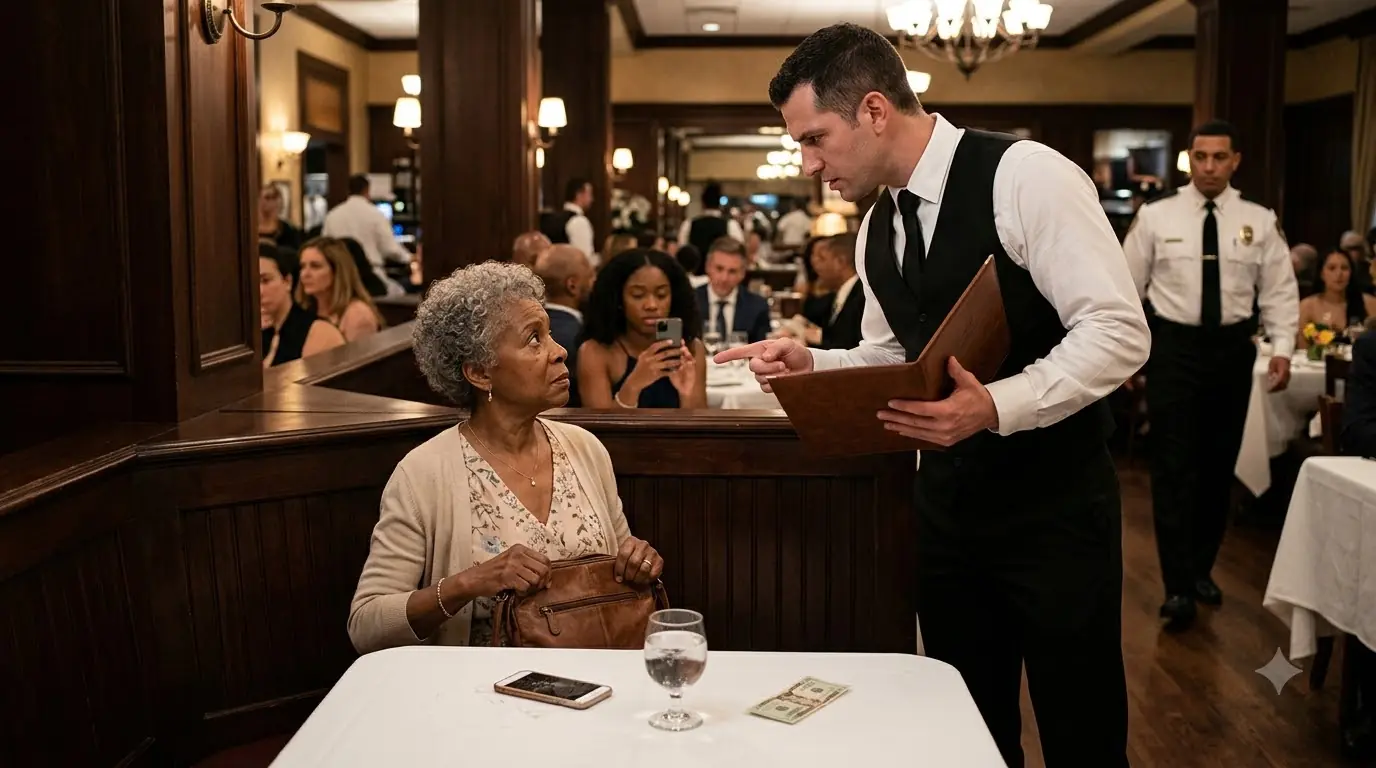
Dorothy Jenkins looked up from her worn purse, confusion flickering across her weathered face. "I'm sorry, what did you say?" "You heard me. Derek snatched the leather menu from the table and held it up as if presenting evidence. "This isn't where people like you eat. There's a Salvation Army down the street." Dorothy, sixty-five years old, sat frozen in the corner booth. Her simple cardigan and floral dress suddenly felt like rags beneath the stares of well-dressed diners. She clutched her purse more tightly. She had raised four children, buried a husband, and worked double shifts for thirty years, but nothing had prepared her for being publicly reduced to an assumption about how she looked. At 6:35 p.m., her son was expected in twenty-five minutes. Dorothy reached for her phone, and the text message glowed on the cracked screen: "Running late from city hall meeting. Order an appetizer. Be there by 7. Damon." She had arrived fifteen minutes early, as always. Her son hated being late, and Dorothy never wanted to disappoint him, especially after everything he had accomplished. "Ma'am, did you hear what I said? Derek's voice cut through her thoughts. He stood with his arms crossed, blocking her view of the rest of the dining room. "You need to leave now." "I'm waiting for my son," Dorothy said quietly, her voice barely above a whisper. "He should be here soon." Derek gave a harsh laugh. "Right. And I'm sure he's the governor." He leaned closer, his voice dripping with condescension. "Listen, lady, I'm trying to be nice. This place charges thirty-five dollars for a salad. If you want somewhere cheap, the exit is behind you." At the table beside them, Kesha Washington looked up from her date. The twenty-six-year-old social media manager had been recording short videos all evening, but something about the interaction made her stomach turn. She discreetly raised her phone and began recording. A live stream opened almost automatically as she tapped through the app. "Please," Dorothy tried again, her voice steady despite the tremor in her hands. "I just need to wait twenty minutes. My son texted me to order an appetizer." "Show me the money first," Derek said loudly enough for several tables to hear. "Fifty dollars cash or you walk." Dorothy opened her worn leather purse. Inside, beneath old receipts and a small packet of tissues, were several items Derek never noticed: a city parking validation sticker, a business card with the official city seal, and a simple gold watch engraved, "To Mom. Love, your mayor son, DJ." Instead, Dorothy pulled out a twenty-dollar bill. "I have this," she said, holding it up without apology. Derek took the bill from her fingers and examined it as if he expected something suspicious. "Twenty bucks? Our appetizers start around eighteen. You can barely cover anything here." At 6:42 p.m., her son was eighteen minutes away. The humiliation burned in Dorothy's chest, but she had learned long ago how to swallow pain without surrendering dignity. She had worked as a hotel housekeeper for thirty years, cleaning after people who often refused to look her in the eye. She had raised four children on minimum wage after her husband died in a factory accident. She had survived worse than a rude waiter. Yet this felt different because Derek was not simply questioning her ability to pay; he was telling her she did not belong. "Young man," she said, her voice growing firmer, "I would like to speak with your manager." Derek rolled his eyes. "Oh, here we go. Let me guess. You want to complain? File a lawsuit?" He turned toward the nearby tables. "Folks, sorry for the disturbance. Some people just don't understand how upscale dining works." A few diners shifted uncomfortably. An elderly white couple at table eight exchanged worried glances, and the man started to stand before his wife caught his arm. Kesha kept recording. The live viewer count rose from dozens to more than a hundred as people began sharing the stream. "The manager is busy with paying customers," Derek continued, enjoying the attention. "But I'll tell you what. Order a thirty-dollar entree right now, and I'll pretend this conversation never happened." Dorothy checked her phone again. The lock screen showed a photograph of her standing beside Damon at his inauguration six months earlier, one hand resting proudly on the same Bible she had once used when he became student council president as a boy. At 6:45 p.m., her son was fifteen minutes away. "I'll wait for my son," Dorothy repeated, this time with quiet steel in her voice. Derek's patience snapped. "That's it. I'm calling security." He dialed the restaurant's internal number. "Yeah, we need someone at table twelve. I've got a customer refusing to leave." The way he described her landed like another insult. Dorothy had worked every day of her adult life, put four children through college, volunteered at three churches, and organized neighborhood watch programs for fifteen years. But to Derek, she was simply an elderly woman in the wrong room. He announced that security was on the way and told her she should think twice about where she belonged. Kesha's live stream kept climbing. Comments appeared rapidly: "This is wrong. "Someone needs to help her. "Is this really happening?" Kesha felt sick. She wanted to intervene, but fear and uncertainty kept her in her chair, and she hated herself a little for it. At 6:48 p.m., Dorothy sat straighter. She considered calling Damon, but he was likely still in the emergency city council session over the downtown development project, a vote that could affect thousands of jobs. Instead, she folded her hands in her lap and waited. She had learned patience from a mother who waited tables during segregation and dignity from a father who had been refused service at lunch counters without allowing bitterness to consume him. Derek paced beside the booth. "You know what? I'm being too nice. Get up now." "No," Dorothy said simply. The single word carried thirty years of raising teenagers, years of difficult bosses, and a lifetime of standing up for herself when no one else would. Derek's face reddened. "What did you just say to me?" "I said no. Dorothy looked up at him calmly. "I'm not moving until my son arrives." At 6:50 p.m., the restaurant had grown quieter. More diners turned to watch, and Kesha's live stream moved past five hundred viewers. Then heavy footsteps approached across the marble floor. Security was coming. At 6:52 p.m., Marcus Thompson reached table twelve. The forty-two-year-old former Marine had worked restaurant security for three years and had handled his share of difficult situations. This one felt wrong immediately. Dorothy sat with perfect posture and folded hands, while Derek looked far more agitated than the woman he had described as a problem. "Finally," Derek muttered. "This woman has been causing trouble for twenty minutes. She's refusing to order anything substantial and won't leave." Marcus studied Dorothy's face. In his experience, genuinely dangerous people rarely looked this calm. "Ma'am," he said gently, "is there something I can help you with?" "I'm waiting for my son," Dorothy replied. "He asked me to meet him here at seven." Derek snorted. "She's been saying that forever. Claims her son is coming, but won't prove she can pay for anything. This is a business, not a shelter." Kesha's live stream climbed again, and more comments accused the restaurant of discrimination. Other diners began recording from different angles. Marcus frowned at Derek's tone. He had grown up on Hamilton's east side and remembered his own grandmother being treated differently in places where people judged her by clothing before character. "Ma'am, do you have a way to contact your son?" Marcus asked. Dorothy's fingers moved toward her phone. The contact "Damon - Mayor's Office" sat at the top, but she hesitated because the development vote mattered to the entire city. "He's at work," she said simply. Derek laughed again. "Right. Let me guess. He's the president, too." At 6:56 p.m., Manager Patricia Collins arrived. The thirty-eight-year-old had worked her way from hostess to manager over twelve years and prided herself on maintaining a polished dining room. "What's the situation?" Patricia asked Derek first, barely looking at Dorothy. "She has been here a long time, ordered nothing but water, and claims she's waiting for her son," Derek said. "I've been trying to handle it diplomatically." Patricia's gaze moved over Dorothy's cardigan, floral dress, and worn purse. In her mind, people who belonged at the Hamilton usually looked different. "Ma'am," Patricia said with forced politeness, "we have a minimum order policy during dinner hours. I'm going to have to ask you either to place an order or allow us to seat other customers." "I understand your policy," Dorothy said. "But my son specifically asked me to wait here. He's running late from a city meeting." "A city meeting? Patricia asked skeptically. "What kind?" Dorothy hesitated again. She had raised her children never to rely on name-dropping for respect, even after Damon became mayor. "City council business," she said vaguely. Derek rolled his eyes. "She's making it up. Probably saw something on the news." By 6:58 p.m., Kesha's live stream had passed one thousand viewers. Comments poured in from across the city, and someone noted that the Hamilton was known as one of Mayor Jenkins's preferred restaurants for official dinners. That detail made Kesha's heart jump. She had covered city events for her social media job and suddenly remembered the mayor's biography: Damon Jenkins had been raised by a widowed mother who had worked low-wage jobs and put four children through college. A terrible possibility began taking shape in her mind. She zoomed her camera slightly toward Dorothy's face. At 7:00 p.m., Damon was officially late. Dorothy checked her phone and saw no new message. "That's it," Patricia said. "Either order a full entree or leave immediately." "I'd like to call my son," Dorothy replied, strain finally entering her voice. "You can call him from outside," Derek snapped. "We've been more than patient." Marcus shifted uneasily. Dorothy was neither drunk nor disruptive; she was simply waiting for someone. "Maybe you could wait in the lobby until your son arrives," Marcus suggested. "That way we can free the table without putting you outside." It was a reasonable compromise, but Derek rejected it immediately. "No. She's had her chance. She needs to go now." He turned toward the dining room. "I'm sorry, everyone. We're trying to maintain the quality dining experience you expect from the Hamilton." Several diners looked away. A few nodded, and one businessman even applauded. At 7:02 p.m., Patricia called over two more staff members. Savannah, the young hostess, and another waiter named James joined Derek, Patricia, and Marcus around the booth. Five restaurant employees now surrounded one elderly woman. "This is your final warning," Patricia announced. "Leave voluntarily or we'll have you removed." Dorothy looked around at the circle of younger faces. She thought of her late husband, Robert, who had faced worse working construction in the 1980s, and of the four children they had raised through sacrifice. She thought about Damon, who had overcome poverty and prejudice to become the youngest mayor in Hamilton's history. She remembered all the moments she had chosen peace over principle and decided this would not be one of them. "No," she said clearly. At 7:04 p.m., the word seemed to ripple across the room. Kesha's stream passed two thousand viewers, and conversation disappeared entirely. Derek's face darkened. "Did you just tell us no?" "I told you no," Dorothy repeated. "I'm not leaving until my son arrives." Patricia pulled out her phone. "That's it. I'm calling the police." Dorothy understood exactly how serious that threat could be for an elderly woman surrounded by people already portraying her as hostile. But she also knew what no one around the booth knew yet. At 7:05 p.m., Patricia contacted police dispatch and reported a trespassing dispute. Dorothy closed her eyes briefly, then looked toward the security camera over the bar. "My son is going to be very disappointed about this," she said quietly enough for Kesha's stream to capture every word. Marcus heard something in Dorothy's tone that made him pause. After years in the military, he had learned the difference between an empty threat and a person stating a fact. Derek did not hear the difference. "Lady, I don't care who your son is. You're trespassing, and the police can sort it out." At 7:06 p.m., Dorothy finally opened the contact marked "Damon - Work Cell." Her finger hovered above the call icon. Outside, a SUV with government plates pulled into the parking lot. Dorothy had not yet pressed call. At 7:07 p.m., the SUV doors closed behind three people walking toward the Hamilton. Leading them was a tall man in a charcoal suit, his tie loosened and his sleeves slightly rolled after a long council session. Behind him came a woman in a business suit carrying a leather briefcase and a younger man wearing a press badge. Savannah saw the well-dressed trio first and immediately hurried toward the entrance. "Good evening. Welcome to the Hamilton. Table for three?" she asked brightly. The man's eyes swept the restaurant and stopped on table twelve. His expression changed when he saw five employees surrounding the elderly woman seated there. "I'm looking for my mother," he said. "Dorothy Jenkins. She texted that she'd be waiting at table twelve." Savannah's smile faltered. "Your mother?" "Dorothy Jenkins," he repeated, handing her a business card. "I'm Mayor Damon Jenkins. We had dinner plans at seven." The official city seal and the word MAYOR seemed to transform the card in Savannah's hand into a warning. She went pale. The woman with the briefcase stepped forward. "Sarah Miller, city attorney. We were leaving a council meeting when the mayor said his mother was waiting here." The young reporter lifted a digital recorder. "Tom Rodriguez, Hamilton Tribune. Mayor Jenkins, can you comment on reports of discrimination at the Hamilton?" At 7:09 p.m., Damon did not answer the reporter. He walked straight toward table twelve, where Patricia was still trying to explain the situation to police dispatch. "Mom," he called, his voice cutting through the room. Dorothy's face brightened with immediate relief. "Damon, there you are, baby. I was starting to worry." That single word, baby, changed the room. Derek's mouth opened, Patricia's phone slipped lower in her hand, and Marcus took a small step back. "I'm sorry I'm late," Damon said, moving through the circle of staff to reach his mother. "The development vote ran long. How long have you been waiting?" "About forty minutes," Dorothy replied calmly. "These folks have been very attentive." At 7:10 p.m., Damon helped his mother stand and then faced the employees. His expression remained controlled, but his voice carried the authority of someone accustomed to chairing contentious meetings. "Which one of you referred to my mother as a vagrant?" No one answered. Derek tried to disappear behind Patricia, but there was nowhere to hide. Patricia spoke first. "Mayor Jenkins, we had no idea she was your mother. She didn't identify herself, and--" "And what? Damon interrupted. "You assumed that because she's an elderly woman in simple clothes, she didn't belong here?" Sarah Miller stepped closer. "Mayor, perhaps we should discuss this privately." "No," Damon said. "This happened publicly. We'll address what happened publicly, and any formal process will happen through the proper channels." Tom Rodriguez was already taking notes. By then, the Hamilton Tribune had enough material for a breaking story. At 7:11 p.m., Kesha's live stream passed four thousand viewers. Comments raced by so quickly she could barely read them. People recognized the mayor immediately. Other diners raised their phones, and the businessman who had applauded earlier suddenly looked desperate to distance himself from the scene. Marcus approached Dorothy. "Mrs. Jenkins, I want to apologize. I should have done more." "You were kind," Dorothy replied gently. "You suggested the lobby. That was more than most people offered." Damon noticed the exchange. "You're security?" "Yes, sir. Marcus Thompson, former Marine. I tried to find a compromise, but I should have stepped in sooner." At 7:12 p.m., Damon turned back to his mother. "Mom, what exactly happened?" Dorothy straightened her shoulders. "I arrived early like you asked. Derek told me this wasn't a charity kitchen and said people like me don't eat at places like this." Derek's face turned gray. Dorothy continued without raising her voice. "He suggested I go to the Salvation Army, called me a vagrant, and demanded that I prove I could afford the restaurant. When I refused to leave before you arrived, security was called, then the manager, and then they threatened to have me removed for trespassing." Damon turned to Patricia. "You threatened to have my mother removed even though she told you she was waiting for someone and was not disrupting anyone?" "We have policies," Patricia said weakly. "She had money," Damon replied. "She was waiting for me. What policy authorizes degrading a customer because you assume she is poor?" Sarah Miller began taking careful notes. She knew the Hamilton held several city-issued permits and contracts that carried anti-discrimination obligations. At 7:13 p.m., Patricia's phone lit up with a call from corporate headquarters. Word had already reached the Hamilton Restaurant Group through social media. Derek had stopped speaking entirely. He looked at Dorothy with the sick realization that his worst behavior had been recorded from several angles. James, the waiter, raised one hand. "Mayor Jenkins, I want you to know I wasn't involved in the earlier conversation. I came over when Patricia called for additional staff." "Additional staff? Damon asked. "Against my sixty-five-year-old mother?" At 7:14 p.m., Dorothy reached into her purse and removed the items she had deliberately kept hidden: the parking validation, the business card with the mayoral seal, and the engraved watch. "I didn't want to name-drop," she said. "I raised my children to make their own way, and I don't believe I should need my son's title to receive basic respect." She looked from Derek to Patricia and then to the rest of the staff. "Sometimes people need to remember that everyone deserves dignity, regardless of who their children are." Damon put an arm around her shoulders. "Mom, you should never have to carry a business card to be treated decently." "I know, baby," Dorothy said. "But I also know the world we live in." At 7:15 p.m., Tom Rodriguez asked for comment while Kesha's stream continued. Damon looked directly toward the phones recording the moment. "My mother worked as a hotel housekeeper for thirty years," he said. "She raised four children after my father died, put all of us through college on wages and tips, volunteered at churches, organized neighborhood watch programs, and never stopped helping people." His voice strengthened. "The fact that anyone judged her worth by a cardigan, an old purse, and a twenty-dollar bill says everything about the people making that judgment and nothing about her." At 7:16 p.m., Patricia finally answered the corporate call. Regional Manager Robert Williams was watching the live stream from another location. "Is that really Mayor Jenkins?" he asked. Patricia looked across the restaurant. "Yes, sir." "And did Derek really say those things to his mother?" Patricia closed her eyes. "Yes, sir." Williams told her they would discuss employment decisions after an immediate review and ordered Derek removed from customer-facing duties. Damage control had started too late. At 7:17 p.m., Dorothy looked at Derek with something closer to sadness than anger. "Young man, I hope you learn something from this." "Not about who my son is," she continued. "About how you treat people when you think they have no power." Derek lowered his eyes. "Mrs. Jenkins, I'm sorry. I really am." "I believe you're sorry," Dorothy said. "But sorry has to become different behavior before it means anything." Damon checked his watch. "Mom, are you still hungry? I can take you to Bella Vista." "That sounds lovely," Dorothy said, rising with the same composure she had maintained all evening. Before leaving, she turned toward the employees. "For what it's worth, the young man in security tried to find a better solution. Remember that when you're deciding what happens next." At 7:18 p.m., Damon escorted his mother toward the exit. Sarah Miller and Tom Rodriguez followed, while Kesha's live stream passed six thousand viewers. The last image Kesha captured before the doors closed was Derek standing against the wall, finally understanding that an hour of prejudice had become a public record he could not erase. Outside, Damon helped Dorothy into the SUV. "I'm proud of you, Mom." "For what?" "For not backing down, and for keeping your dignity while everyone around you was losing theirs." Dorothy smiled. "Your father would have expected the same." They drove away without looking back. But the internet would continue replaying what had happened at table twelve long after their SUV disappeared. At 7:20 p.m., only a short time after leaving with Dorothy, Damon returned to the Hamilton with Sarah Miller, Tom Rodriguez, and David Park, the city's director of consumer affairs. Dorothy continued on to Bella Vista with a trusted family friend while Damon dealt with the official follow-up through city procedures. Sarah carried a folder marked BUSINESS LICENSE DIVISION. Tom balanced a laptop and recorder, while David carried compliance forms and licensing records. "Are you sure you want to begin this tonight? Sarah asked as they crossed the parking lot. "We can schedule a formal hearing and preserve every procedural step." "My mother spent nearly an hour being humiliated here," Damon replied. "We begin the review tonight, and the formal process continues exactly by the book." Through the windows, the Hamilton was in chaos. Patricia paced behind the hostess stand with a phone pressed to her ear, Derek sat at the bar with his head in his hands, and several diners had left half-finished meals behind. At 7:22 p.m., Sarah reviewed the legal framework aloud. The Hamilton Restaurant Group held business license BL-7394, renewed annually through the city, along with food-service, entertainment, and outdoor-seating permits. David noted that the restaurant reported approximately $2.3 million in annual revenue. Its liquor business alone represented close to $890,000 in yearly sales, and the restaurant had received roughly $156,000 in city catering work over the previous eighteen months. Those contracts included police department events, council retirement dinners, and the annual chamber of commerce gala. City anti-discrimination ordinance 847.2 required a formal review whenever a licensed public accommodation faced a substantiated discrimination complaint. "A review doesn't mean punishment has already been decided," Sarah said. "But it does mean evidence preservation, interviews, and temporary suspension of certain city contracts while the complaint is investigated." Damon nodded. "Good. I don't want favors. I want the same process any resident should be able to rely on." At 7:24 p.m., a silver Mercedes arrived. Regional Manager Robert Williams stepped out with Amanda Foster, legal counsel for the Hamilton Restaurant Group. Williams looked as if he had aged ten years in an hour. His phone had been ringing continuously as hashtags criticizing the restaurant spread across social media. "Damage control," he muttered to Foster as they hurried toward the entrance. "Whatever it takes, but we do it legally and we do it now." At 7:25 p.m., Damon approached Patricia near the hostess stand. "Miss Collins? Restaurant manager, twelve years?" "Yes, Mr. Mayor," Patricia said. "We're deeply sorry about the misunderstanding." "Misunderstanding? Sarah repeated. "The available video shows a customer being called degrading names, pressured to prove she could afford the restaurant, and threatened with removal while she waited for a dinner companion." Patricia's hands shook. "We didn't know who she was." Damon looked at her steadily. "You didn't need to know who she was. You needed to know she was a customer and a human being." At 7:26 p.m., Williams introduced himself and offered a full apology. He promised an immediate internal investigation, suspension of Derek, and mandatory retraining for staff. "Those may be appropriate corporate steps," Sarah said. "They do not replace the city's review under ordinance 847.2." Williams's confidence faltered. Amanda Foster asked for the specific consequences the company might face during the review. David explained that city catering contracts could be suspended while the complaint was investigated. Entertainment and other permits could also be reviewed if the evidence showed the restaurant had failed to meet anti-discrimination requirements tied to those licenses. At 7:27 p.m., Damon asked Williams to consider what was actually at stake. The liquor operation brought in hundreds of thousands of dollars each year, city catering produced significant revenue, and weekend entertainment increased customer traffic substantially. Sarah cited the company's own filings showing that live entertainment increased weekend customer volume by roughly thirty-seven percent. "Compliance is not a symbolic issue for this business," she said. Amanda Foster tried to redirect the conversation toward an informal resolution. "Surely there is a way to address this without creating unnecessary economic harm." "There is a way to address it," Damon replied. "Take responsibility, cooperate with the investigation, and prove that what happened to my mother will not happen to the next person who doesn't look wealthy enough for your staff." At 7:28 p.m., Tom Rodriguez turned his laptop toward Williams. Kesha's live stream had been shared thousands of times, local stations were requesting interviews, and the restaurant's review pages were filling with angry reactions. Customers were posting photographs of receipts with messages saying they would not return. Williams stared at the screen, realizing the reputational damage was already larger than any city penalty. At 7:29 p.m., Sarah completed a formal discrimination complaint under ordinance 847.2. She explained that the standard investigation could take several weeks and would include interviews, security footage, internal policies, and employment records relevant to the incident. During that period, David said, certain city contracts would remain paused. The company would also be expected to preserve all surveillance footage and internal communications related to table twelve. Williams did quick mental math and looked ill. "What can we do tonight to demonstrate cooperation?" At 7:30 p.m., Damon answered carefully. "You can start with a real plan instead of a public-relations statement." Sarah outlined the elements the city expected to see in a corrective proposal: a written zero-tolerance discrimination policy, mandatory bias training, an anonymous customer-reporting system, regular community advisory meetings, and public progress reporting. David recommended that the company establish ongoing partnerships with civil-rights and senior-advocacy organizations. Tom suggested publishing measurable diversity and service metrics so improvements could be evaluated instead of merely advertised. Williams looked toward his attorney. "Can we have a preliminary plan ready tonight and a formal version tomorrow?" Amanda Foster nodded. "Yes, if corporate leadership authorizes it." At 7:31 p.m., Derek finally walked toward the group. His arrogance had disappeared. "Mr. Mayor," he said quietly. "I know I messed up. I know sorry isn't enough, but I have two daughters, eight and six. I've been raising them alone since my wife passed." The revelation changed the emotional temperature without changing what he had done. Damon studied him for a long moment. "Your family situation does not erase how you treated my mother," Damon said. "But accountability should leave room for someone to become better if they are willing to do the work." Williams confirmed Derek would be removed from his position at the Hamilton. Damon asked that, if corporate policy allowed, Derek be permitted to complete the company's training program and become eligible to apply elsewhere in the future only after demonstrating real change. Derek's eyes filled with tears. "I'll do it. I promise." "Don't promise me," Damon replied. "Prove it to the next person you are tempted to judge." At 7:32 p.m., Williams agreed to the corrective framework and promised full cooperation with the formal review. Sarah emphasized that no private agreement could erase the complaint or guarantee a licensing outcome. The company could, however, demonstrate good faith by beginning training immediately, creating an advisory board, strengthening complaint procedures, and reporting its progress. Williams authorized the first staff session for the following morning. Marcus Thompson was instructed to attend as well, not as punishment, but because he had witnessed the incident and could speak honestly about what happened. He quietly accepted. At 7:34 p.m., Amanda Foster and Sarah drafted a written memorandum of immediate corrective commitments pending the city's formal review. Williams signed the document after reading it with counsel. The memorandum required evidence preservation, mandatory staff attendance at training, monthly progress reports, and prompt investigation of any new discrimination complaint. It also required Hamilton corporate leadership to present a long-term reform plan at a public community meeting. Damon looked at Williams one final time. "If something like this happens again, the city will evaluate it based on the evidence and the law. No one gets immunity because a restaurant is expensive or politically connected." "Understood," Williams said. Tom Rodriguez asked Williams for a statement for the Tribune. The regional manager looked exhausted but answered without trying to minimize what had happened. "The Hamilton Restaurant Group deeply regrets the treatment Dorothy Jenkins received tonight," he said. "We are cooperating with the city review and committing to changes designed to ensure every guest is treated with dignity." At 7:36 p.m., Damon, Sarah, Tom, and David walked back toward the parking lot. Sarah exhaled slowly. "Less than an hour from public discrimination to a formal complaint and a corrective framework," she said. "That's fast." "My mother should never have had to endure any of it," Damon replied. "If something good comes from tonight, it has to be bigger than an apology to her." David was already contacting other licensed restaurants in the district to remind them of existing anti-discrimination requirements. He expected many would review their policies before the Hamilton story reached the late news. Inside the restaurant, Patricia addressed the remaining employees. Everyone understood that the Hamilton would not return to business as usual. Three weeks later, the Hamilton reopened after a temporary period of review, retraining, and management restructuring. From the outside, the building looked nearly unchanged, but a small placard near the entrance now read, "Welcome to the Hamilton, where every guest is valued." Derek Martinez no longer worked there. After completing the first phase of required training, he moved back to Ohio and took a job at his uncle's auto shop while continuing counseling and community-based education recommended through the corporate program. Patricia Collins also left the Hamilton after corporate leadership concluded that her handling of the incident reflected a larger failure of judgment. Her twelve years of experience could not erase the footage showing her accepting Derek's assumptions without independently evaluating Dorothy's behavior. Regional Manager Williams brought in Maria Santos, a Latina hospitality professional with fifteen years of management and diversity-training experience. Her first meeting with the staff was direct. "Your jobs are not automatically safe because you weren't the person speaking," Maria told them. "We're rebuilding trust, and everyone has to prove they understand what dignity-first service actually means." She held up the new operating manual. "Every customer receives the same baseline respect, regardless of age, race, clothing, perceived income, disability, accent, or how much they spend." Marcus Thompson had been promoted to assistant manager. Corporate leaders cited both his security background and the fact that, even under pressure, he had tried to find a humane compromise rather than escalate the situation. "Marcus will participate in monthly service reviews," Maria explained. "Bias complaints will be investigated immediately, and retaliation against anyone reporting discrimination will not be tolerated." The restaurant also installed anonymous feedback links at every table. Complaints related to licensed-service requirements could be forwarded to the city's consumer affairs office for independent review. A community advisory board began meeting monthly. It included civil-rights advocates, senior-citizen representatives, neighborhood business owners, and hospitality professionals. Most unexpectedly, Dorothy agreed to serve as an informal community adviser. Once a month, she would dine at the Hamilton, sometimes alone and sometimes with friends, and give Maria candid feedback about how ordinary customers were treated. "Mrs. Jenkins," Maria asked during their first meeting, "what should we be watching for?" Dorothy answered without hesitation. "Watch how your staff treats the person they think cannot afford to be here. That's when you see character clearly." A separate financial-compliance review uncovered $67,000 in overdue property-related obligations connected to the restaurant group, which corporate leadership paid within two weeks. The company also made a voluntary $50,000 contribution to local civil-rights and community-service programs as part of its broader public reform effort. The donation was presented publicly with representatives from several neighborhood organizations, including the local NAACP chapter. Damon and Dorothy attended but insisted the event focus on programs rather than on them. Revenue had fallen sharply during the initial boycott, dropping roughly forty percent at its lowest point. Over time, customers began returning as the company demonstrated that its changes were more than slogans. The local university's Student Union eventually held a monthly meeting at the restaurant. Maria considered it one of the clearest signs that trust, though damaged quickly, could be rebuilt slowly. "We're not just surviving," she told corporate leadership. "We're building something better than what was here before." On one Thursday evening, Dorothy returned alone to table twelve, the same booth where everything had begun. This time, a hostess greeted her warmly without performing surprise at her clothing or asking her to prove what she could afford. "Good evening, Mrs. Jenkins. Your usual table?" "That would be lovely. Thank you." Her server that evening was a young woman named Jasmine. She approached with calm professionalism rather than exaggerated deference. "Mrs. Jenkins, can I start you with something to drink while you wait for your son?" "Just water for now, dear. He's running a few minutes late from another council meeting." "Of course. Take all the time you need." Three weeks earlier, the same situation had triggered a crisis. Now it was simply hospitality. The effects extended beyond the Hamilton. Six other upscale restaurants in the city proactively updated staff training, complaint procedures, and service standards after watching the incident unfold publicly. The city council also passed a measure requiring anti-discrimination training for businesses holding certain public-facing city licenses. The new requirements emphasized documented procedures, recurring training, and transparent complaint review. Dorothy began receiving letters from elderly people across the country describing similar experiences. Many thanked her for remaining composed while refusing to disappear. One letter read, "You showed us that standing firm does not require becoming cruel." Derek also wrote Dorothy through the mayor's office. He did not ask for his job back. "Mrs. Jenkins," the letter began, "I know I don't deserve forgiveness just because I finally understand how wrong I was. I think about that night every day." He admitted that he had judged her before she spoke, allowed arrogance to become cruelty, and damaged his own life as well as hers. He wrote that he hoped to prove through future behavior that he could become better than the man seen in the video. Dorothy read the letter twice and filed it away. She believed in redemption, but she also believed change was demonstrated through conduct rather than eloquent apologies. Sitting again in table twelve, she reflected on what had happened. No one had needed to answer humiliation with destruction, and the final result had come through documentation, law, public pressure, and institutional reform. The Hamilton had changed. Other businesses had changed before being forced to, and the city had created clearer protections for residents who might never have a mayor for a son. When Damon arrived at 7:15 p.m., he found his mother talking comfortably with Maria Santos about service reports. He slid into the booth across from her. "How was everything tonight, Mom?" "Excellent," Dorothy said. "But more importantly, I watched them serve three other elderly customers. They received the same respect I did." Damon smiled. "That's what we wanted." "Yes," Dorothy replied. "Change that lasts after the cameras leave." They ordered dinner, and Dorothy finally had the salmon salad she had originally intended to eat weeks earlier. The simple meal felt like a quiet completion of something that had started with a twenty-dollar bill and an assumption. Six months later, Dorothy still did not consider herself a civil-rights icon. She had wanted dinner with her son, not a public platform. Yet the Hamilton incident had become a case study used in business and hospitality programs. Instructors discussed how customer bias, bystander behavior, social-media documentation, leadership accountability, and regulatory systems had all intersected in one evening. Dorothy still lived in the same modest home where she had raised her children. She still drove her ten-year-old Honda Civic, clipped coupons, looked for sales, and told Damon not to waste money buying her things she did not need. Recognition changed how strangers treated her, but Dorothy remained more interested in whether people treated the next unknown customer properly. To her, that was the only meaningful measure of progress. Restaurants in other cities began adopting similar dignity-first policies. Several state hospitality associations opened discussions about recurring anti-bias training and independent complaint systems. The incident also changed some bystanders. People who had once looked away from discrimination began understanding that documentation, witness support, and calm intervention could matter. Kesha Washington's live stream became the turning point in her own career. Channel 7 later hired her as a civil-rights and community-affairs reporter after seeing how carefully she had documented the event without provoking the confrontation. At a community forum, someone asked Dorothy what she had learned. She answered in the same quiet tone she had used at table twelve. "Dignity isn't something another person gives you," she said. "You carry it with you, and someone else's prejudice does not get to define your worth." She paused before adding, "And real change cannot stop with anger. Anger can wake people up, but accountability, law, education, and better choices are what make the change last." Damon later reflected on the same lesson in an interview. "My mother didn't want to destroy a restaurant or ruin a stranger's life. She wanted the system to work better for the person who comes after her." The monthly dinners at the Hamilton became a quiet tradition. Mother and son shared meals in the booth where Dorothy had once been told she did not belong. The staff no longer competed to serve them because Damon was mayor. Maria made certain the real standard was simpler: every table was supposed to receive the same courtesy whether it held a mayor, a housekeeper, a student, or someone counting the last twenty dollars in a worn purse. Dorothy understood that heroes rarely look like the stories people tell afterward. Sometimes courage is simply refusing to leave a restaurant booth when you have done nothing wrong. Sometimes it is keeping your voice steady while other people try to make you ashamed. Sometimes it is trusting documentation, law, community, and time to expose a truth that prejudice tried to hide. And sometimes a city changes because an ordinary woman insists, without shouting, that she deserves the same thing every person deserves when they walk through a door: basic human respect."Excuse me, Grandma, but the charity kitchen closed an hour ago."
Derek Martinez's words sliced through the Hamilton's elegant atmosphere like broken glass. He towered over the elderly woman in the corner booth, his sneer visible to diners across the room.
Dorothy Jenkins looked up from her worn purse, confusion flickering across her weathered face. "I'm sorry, what did you say?"
"You heard me. Derek snatched the leather menu from the table and held it up as if presenting evidence.
"This isn't where people like you eat. There's a Salvation Army down the street."
Dorothy, sixty-five years old, sat frozen in the corner booth. Her simple cardigan and floral dress suddenly felt like rags beneath the stares of well-dressed diners.
She clutched her purse more tightly. She had raised four children, buried a husband, and worked double shifts for thirty years, but nothing had prepared her for being publicly reduced to an assumption about how she looked.
At 6:35 p.m., her son was expected in twenty-five minutes. Dorothy reached for her phone, and the text message glowed on the cracked screen: "Running late from city hall meeting.
Order an appetizer. Be there by 7.
Damon."
She had arrived fifteen minutes early, as always. Her son hated being late, and Dorothy never wanted to disappoint him, especially after everything he had accomplished.
"Ma'am, did you hear what I said? Derek's voice cut through her thoughts.
He stood with his arms crossed, blocking her view of the rest of the dining room.
"You need to leave now."
"I'm waiting for my son," Dorothy said quietly, her voice barely above a whisper. "He should be here soon."
Derek gave a harsh laugh. "Right.
And I'm sure he's the governor."
He leaned closer, his voice dripping with condescension. "Listen, lady, I'm trying to be nice.
This place charges thirty-five dollars for a salad. If you want somewhere cheap, the exit is behind you."
At the table beside them, Kesha Washington looked up from her date. The twenty-six-year-old social media manager had been recording short videos all evening, but something about the interaction made her stomach turn.
She discreetly raised her phone and began recording. A live stream opened almost automatically as she tapped through the app.
"Please," Dorothy tried again, her voice steady despite the tremor in her hands. "I just need to wait twenty minutes.
My son texted me to order an appetizer."
"Show me the money first," Derek said loudly enough for several tables to hear. "Fifty dollars cash or you walk."
Dorothy opened her worn leather purse. Inside, beneath old receipts and a small packet of tissues, were several items Derek never noticed: a city parking validation sticker, a business card with the official city seal, and a simple gold watch engraved, "To Mom.
Love, your mayor son, DJ."
Instead, Dorothy pulled out a twenty-dollar bill. "I have this," she said, holding it up without apology.
Derek took the bill from her fingers and examined it as if he expected something suspicious. "Twenty bucks?
Our appetizers start around eighteen. You can barely cover anything here."
At 6:42 p.m., her son was eighteen minutes away. The humiliation burned in Dorothy's chest, but she had learned long ago how to swallow pain without surrendering dignity.
She had worked as a hotel housekeeper for thirty years, cleaning after people who often refused to look her in the eye. She had raised four children on minimum wage after her husband died in a factory accident.
She had survived worse than a rude waiter. Yet this felt different because Derek was not simply questioning her ability to pay; he was telling her she did not belong.
"Young man," she said, her voice growing firmer, "I would like to speak with your manager."
Derek rolled his eyes. "Oh, here we go.
Let me guess. You want to complain?
File a lawsuit?"
He turned toward the nearby tables. "Folks, sorry for the disturbance.
Some people just don't understand how upscale dining works."
A few diners shifted uncomfortably. An elderly white couple at table eight exchanged worried glances, and the man started to stand before his wife caught his arm.
Kesha kept recording. The live viewer count rose from dozens to more than a hundred as people began sharing the stream.
"The manager is busy with paying customers," Derek continued, enjoying the attention. "But I'll tell you what.
Order a thirty-dollar entree right now, and I'll pretend this conversation never happened."
Dorothy checked her phone again. The lock screen showed a photograph of her standing beside Damon at his inauguration six months earlier, one hand resting proudly on the same Bible she had once used when he became student council president as a boy.
At 6:45 p.m., her son was fifteen minutes away. "I'll wait for my son," Dorothy repeated, this time with quiet steel in her voice.
Derek's patience snapped. "That's it.
I'm calling security."
He dialed the restaurant's internal number. "Yeah, we need someone at table twelve.
I've got a customer refusing to leave."
The way he described her landed like another insult. Dorothy had worked every day of her adult life, put four children through college, volunteered at three churches, and organized neighborhood watch programs for fifteen years.
But to Derek, she was simply an elderly woman in the wrong room. He announced that security was on the way and told her she should think twice about where she belonged.
Kesha's live stream kept climbing. Comments appeared rapidly: "This is wrong.
"Someone needs to help her. "Is this really happening?"
Kesha felt sick. She wanted to intervene, but fear and uncertainty kept her in her chair, and she hated herself a little for it.
At 6:48 p.m., Dorothy sat straighter. She considered calling Damon, but he was likely still in the emergency city council session over the downtown development project, a vote that could affect thousands of jobs.
Instead, she folded her hands in her lap and waited. She had learned patience from a mother who waited tables during segregation and dignity from a father who had been refused service at lunch counters without allowing bitterness to consume him.
Derek paced beside the booth. "You know what?
I'm being too nice. Get up now."
"No," Dorothy said simply.
The single word carried thirty years of raising teenagers, years of difficult bosses, and a lifetime of standing up for herself when no one else would. Derek's face reddened.
"What did you just say to me?"
"I said no. Dorothy looked up at him calmly.
"I'm not moving until my son arrives."
At 6:50 p.m., the restaurant had grown quieter. More diners turned to watch, and Kesha's live stream moved past five hundred viewers.
Then heavy footsteps approached across the marble floor. Security was coming.
At 6:52 p.m., Marcus Thompson reached table twelve. The forty-two-year-old former Marine had worked restaurant security for three years and had handled his share of difficult situations.
This one felt wrong immediately. Dorothy sat with perfect posture and folded hands, while Derek looked far more agitated than the woman he had described as a problem.
"Finally," Derek muttered. "This woman has been causing trouble for twenty minutes.
She's refusing to order anything substantial and won't leave."