The sound of shattering glass sliced through the soft clatter of dinnerware and quiet jazz floating through Sapphire Table, a polished restaurant nestled in the historic district of Cambridge, Massachusetts.
For a brief second, time stalled.
Conversations paused.
Forks hovered midair.
Several heads turned in unison toward the source of the disruption.
Tiana Hughes was already kneeling, her hands moving quickly to collect the pieces of the broken water glass that now sparkled like ice across the tile floor.
Her hands trembled slightly as she swept the largest shards into a folded napkin, her dark brown skin flushed with embarrassment. Her name tag, slightly tilted on her chest, read:
Tiana — Server.
She was twenty-eight years old, tall and graceful, with smooth skin, tight coils of hair pulled back into a bun, and sharp features that often made people assume she was younger than she was.
But nothing about her life felt young anymore.
Her navy-blue work uniform was neat, but faded at the seams. Her non-slip sneakers were worn through at the soles. Her shoulders ached from carrying trays. Her fingers were lined with faint burn marks and calluses, the kind you get from years of hot plates, tray balancing, coffee pouring, and double shifts that blur one day into the next.
Across the dining room, Darren Klein, her manager, stood with his arms folded and his permanent frown pressed deeper into his pale round face.
He was a man in his forties who wore his authority like cheap cologne, too heavy and only for show.
“Third one this month, Hughes,” he barked, loud enough for the nearest four tables to hear. “That’s coming out of your check.”
Tiana did not respond.
She kept her eyes on the floor and nodded once, careful not to show her humiliation.
A couple nearby pretended to read the wine list.
A man stirred his soup a little too intently.
Another woman glanced over, then quickly looked away, as if witnessing someone’s embarrassment required politeness only after it had already happened.
“Sorry, Darren,” Tiana said, standing slowly and brushing glass dust from her knees. “Won’t happen again.”
She turned toward the trash bin without looking up, swallowing the bitterness like old coffee.
She could not afford to lose this job.
Not with rent due on Monday.
Not with the electric bill already overdue.
Not with her mother’s medication costing eight hundred dollars a month, even after insurance.
At twenty-eight, Tiana had never planned on being a waitress.
Four years earlier, she had been halfway through her second year at Harvard Medical School, white coat crisp, stethoscope always on hand, textbooks stacked beside her bed like a promise she was determined to keep.
She had ranked near the top of her class, especially in pediatric neurology, where her professors had taken notice.
“Your presence calms the kids before you even speak,” her adviser, Dr. Samuel Rodman, had told her once. “That’s not something we can teach.”
She remembered that moment often, especially on nights like this.
Long shifts filled with aching feet, lukewarm food, and customers who would not even look her in the eye.
All of it had ended the night her mother collapsed in their kitchen, a bowl of soup slipping from her hands before she sank to the tile floor.
The diagnosis came swiftly.
Aggressive multiple sclerosis.
Then came the bills.
Then the insurance denials.
Then the endless calls, the specialist referrals, the treatments that might help but cost more than Tiana had ever imagined.
In the weeks that followed, Tiana made a choice that did not feel like a choice at all.
She withdrew from Harvard.
She packed away her textbooks.
She folded her white coat and placed it in the back of her closet.
Then she stepped into the world of tipped labor and rotating schedules, telling herself it was temporary.
Just one semester.
Then one year.
Then four.
“Table twelve needs more bread,” Darren snapped from behind the counter, yanking her out of memory.
“Right away,” Tiana called back.
She grabbed a basket and moved between tables with practiced ease.
She did not complain.
Complaining did not pay co-pays.
Sapphire Table was beautiful in the way expensive restaurants often were, sleek and carefully designed to feel both upscale and intimate. Tall windows framed the exposed brick buildings outside. Candles flickered on every table. Silverware gleamed beneath warm overhead lights. Jazz hummed softly through hidden speakers.
But behind the polished surface, the restaurant operated like every other place Tiana had worked.
Understaffed.
Underpaid.
Full of politics.
Tiana had worked the same double shifts for over a year, lunch into dinner, noon to close. Most of the other servers were college students working for book money or car payments. They came and went quickly. They did not stay long enough to learn who Darren favored, who he punished, and how quietly unfairness could become routine.
“Hey, Tiana,” came a chirpy voice behind her.
Tiana turned and saw Lindsay, blonde, twenty-one, with flawless skin and the kind of effortless charm that made her a favorite among customers and Darren alike.
“Can you cover my section for like twenty minutes?” Lindsay asked. “My boyfriend just showed up with Thai food, and I really need to talk to him.”
“I’ve got my own tables, Lindsay. And I’ve been here since noon.”
Lindsay tilted her head, pouting slightly.
“Come on. Remember when you stepped off the floor to take that call from your mom’s doctor last week? I didn’t rat you out.”
That call had lasted seven minutes.
Tiana had stood behind the walk-in fridge, tears brimming as the neurologist explained how the latest treatment was no longer working as well as they had hoped.
Tiana exhaled.
“Twenty minutes,” she said. “No more.”
“Thank you. You’re amazing.”
Lindsay squealed and was already halfway to the front door before Tiana could answer.
By nine o’clock, Lindsay still had not returned.
Tiana’s feet throbbed inside her shoes. The arch support had collapsed two months ago, but she had kept pushing off buying new ones. Every dollar counted. Her mother needed a new walker. The water heater had gone out. And now Darren was pinning next week’s schedule on the corkboard beside the kitchen.
Tiana waited until the crowd cleared, then stepped forward and scanned the list.
Her eyes stopped.
Three shifts.
She usually had seven.
Heart thudding, she followed Darren into the narrow office near the back hallway.
“There must be a mistake,” she said, holding the paper. “I’m down four shifts next week.”
“No mistake,” Darren replied without looking up. “Lindsay asked for more hours. You’ll adjust.”
“She lives at home,” Tiana said carefully. “I’ve got rent and my mother.”
“Not my problem,” Darren cut in. “Schedule’s final.”
Tiana did not respond.
She walked out slowly, lips pressed tight.
She could not cry.
Not here.
Not in front of him.
She still had three hours left in her shift. Still had tips to earn. And somehow, someway, she would figure it out.
She always did.
She just did not know that before the night was over, the girl waiting alone at table fifteen, the one no one else had wanted to serve, was about to change everything.
The last wave of the dinner rush was thinning out when the hostess appeared beside Tiana, looking flustered, her headset slightly crooked.
“Hey,” the hostess said. “Table fifteen. Just the girl for now. She’s alone. Dad’s running late or something. Nobody else wants it. Can you?”
Her voice trailed off, already bracing for a no.
Tiana glanced across the dining room.
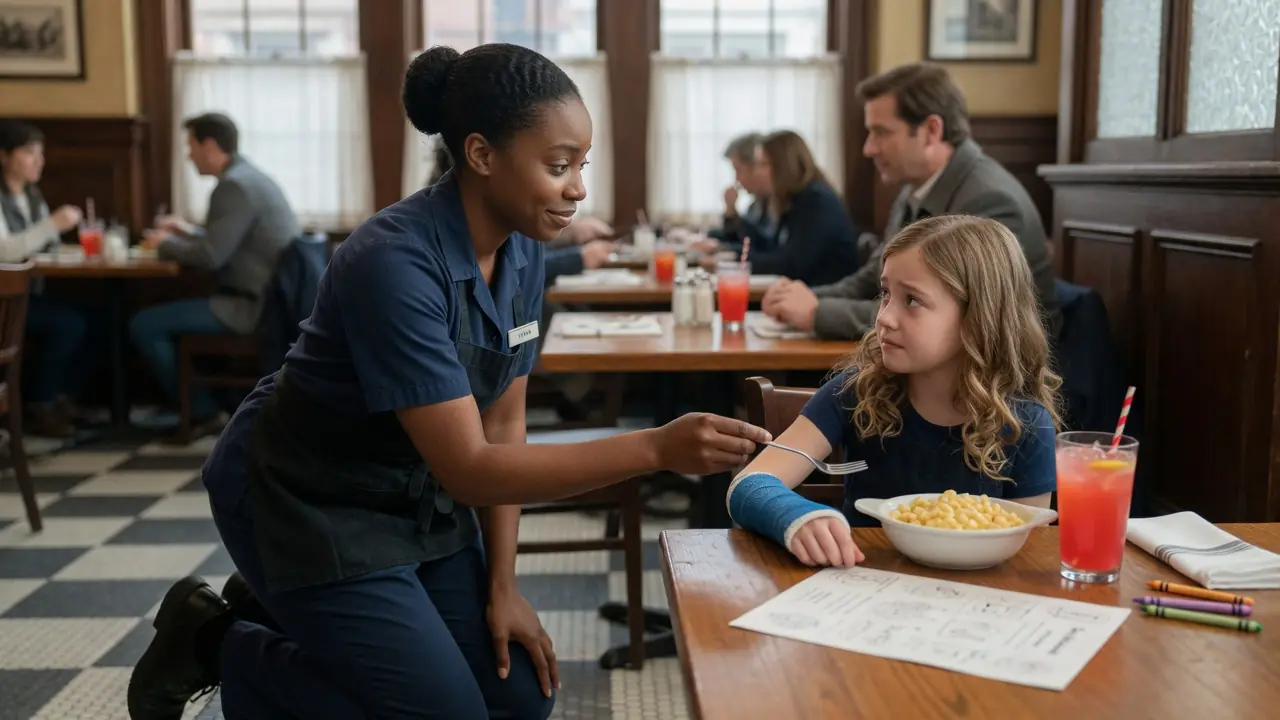
Table fifteen was tucked into a quiet corner near the windows, away from the foot traffic. A young white girl, ten, maybe eleven, sat at the edge of her seat, legs dangling just above the floor. A blue cast covered her right forearm up to the elbow. Her long honey-blonde hair spilled over her shoulders, partly shielding her face as she picked at the corner of the kids’ menu with her left hand.
A glass of untouched water sat in front of her.
Her wheelchair was parked just behind the chair she had transferred into, its large wheels catching the low evening light.
Tiana sighed softly.
“Yeah,” she said. “I’ll take it.”
She tucked a small pad and pen into her apron, smoothed the front of her shirt, and made her way across the floor.
“Good evening,” she said gently, kneeling slightly so she could meet the girl’s eyes without towering over her. “I’m Tiana, and I’ll be taking care of you tonight. What’s your name?”
The girl hesitated.
Her left hand fidgeted with the edge of her napkin.
Then, barely audible, she said, “Laya.”
Tiana smiled.
“It’s very nice to meet you, Laya. Can I get you something to drink while you look over the menu? We’ve got lemonade, apple juice, strawberry soda.”
“Strawberry lemonade,” Laya said, almost a whisper.
“You got it. One strawberry lemonade coming right up.”
Tiana returned a few minutes later, balancing the drink on a small tray with a bendy straw already unwrapped and waiting.
She noticed that Laya’s shoulders tensed slightly as a group of servers passed by, laughing loudly near the kitchen doors. The cast on her arm rested awkwardly on the edge of the table.
Tiana placed the drink in front of her and smiled again.
“Here you go. One strawberry lemonade, extra chilled. Just the way I like it, too.”
She gave a little wink.
“Are you ready to order, or would you like a few more minutes?”
Laya did not answer.
She stared down at the menu, her lips pressed tight.
“Okay,” Tiana said softly. “How about this? If you’re hungry but not sure what to pick, I can tell you a secret.”
Laya’s eyes lifted slightly.
“Our mac and cheese?” Tiana continued, lowering her voice like she was sharing classified information. “Best in Boston. It has three cheeses, toasted breadcrumbs, and it’s not on the kids’ menu, but I bet I can make it happen.”
Laya looked at Tiana.
Really looked.
There was something uncertain behind those eyes, like she was waiting for permission to be a kid again.
Then she gave the smallest nod.
“Mac and cheese it is,” Tiana said, writing it down like it was the most important order of the night. “I’ll get that started for you, okay?”
As she stood, she glanced toward the main entrance, then froze.
A tall man in a tailored gray overcoat had just stepped into the restaurant, scanning the room quickly. His face was tight with concern. It was clear from the way he moved, controlled and deliberate, that he was not used to being late.
When he spotted Laya at the far table, a measure of relief passed over his features.
But he did not approach.
Instead, he gestured discreetly to the hostess and was seated two tables away, partially hidden behind a partition, his back angled to the dining room, but his eyes on his daughter.
Tiana noticed it all without slowing.
Her years in food service had trained her to see what most people missed.
She delivered a few refills, checked in on another table, then slipped into the kitchen to place Laya’s order.
When she returned, Laya was trying to adjust her cast, clearly frustrated as she attempted to use the fork with her left hand. The mac and cheese had just been set down by another server, someone who had not stayed long enough to help.
Tiana approached quietly.
“Hey,” she said. “May I sit for a moment?”
She pulled up a chair, facing Laya so they were eye level again.
“Looks like that cast is making dinner a little tricky, huh?”
Laya nodded slowly. Her cheeks flushed, her fingers clenched, and her eyes were starting to shine, though no tears had fallen.
Tiana kept her tone casual.
“You know, when I was in medical school, well, almost in medical school long enough to finish, I learned something interesting. Sometimes when one part of your body gets hurt, the other parts start working harder to help. Your brain is amazing like that.”
Laya blinked.
“You were a doctor?”
Tiana smiled, correcting gently.
“I was studying to be one. A pediatrician at first. Later I got interested in pediatric neurology. That’s the part of medicine that helps understand how children’s brains and nerves work.”
Laya stared at her.
“Why did you stop?”
Tiana’s smile softened.
“Life had other plans for me.”
She demonstrated how to steady the fork with a different grip, supporting Laya’s wrist gently as she guided her toward a successful bite.
“There you go,” Tiana said. “Look at that. Your brain’s already figuring things out.”
Laya chewed slowly, the tension easing from her face.
“It’s not broken,” she said suddenly, lifting her cast slightly. “Just fractured. Skateboard accident. My fault, kind of.”
“Well, then that means it’s healing,” Tiana said. “And I bet you’re pretty good at a lot of things that don’t need two hands.”
Laya brightened just slightly.
“I like to draw. But now I have to use my left hand.”
“That’s impressive,” Tiana replied genuinely. “Most people can’t even draw with their good hand. I’m not even allowed near a pencil.”
Laya giggled.
The sound was so light and unexpected that it made Tiana’s chest tighten.
She had not realized how long it had been since she heard a laugh like that from someone who truly needed it.
Across the restaurant, the man in the gray coat leaned forward, eyes fixed on his daughter.
He had heard the laugh, too.
And he stayed where he was.
He did not interrupt.
Did not call out.
Did not announce himself.
He just watched.
Tiana stood slowly.
“I’ve got to check on a few other tables, but I’ll be back, okay? You just focus on the mac and cheese masterpiece.”
As she turned, she caught one more thing.
The way Laya’s eyes followed her, not with need, but with trust.
And from two tables away, the man she did not yet recognize as the owner of Sapphire Table watched her, too.
But unlike the last time someone had stared at her across a restaurant, this gaze was not cold.
It was careful.
Curious.
And perhaps, quietly, beginning to hope.
By the time the dessert menus were passed out, Laya was chatting.
Really chatting.
Not full conversations yet, but small, unguarded pieces of herself slipping out between bites of macaroni and sips of strawberry lemonade.
She told Tiana about the cat her dad was allergic to but let her keep anyway. She told her about the sketchbook she now had to use sideways because her right hand was “on vacation.” She told her how weird everything had felt since the accident, how everyone kept looking at the chair first, the cast second, and her last.
Tiana listened, not politely, but attentively.
She did not interrupt.
She did not fill the silence.
She let Laya take the lead, even when the words came slow.
It was the kind of attention the girl clearly was not used to receiving.
At one point, Tiana gently adjusted the napkin tucked under Laya’s cast so it would not press into her skin, and the girl did not flinch.
She smiled.
Not because she was being served.
Because she felt seen.
Nearby, Miles Whitaker watched.
His coat was now folded neatly beside him. He had not touched the wine the server had brought. His eyes stayed on his daughter, and every so often, a muscle in his jaw would twitch.
Not in anger.
In something closer to regret.
He had come prepared to apologize for being late.
Instead, he sat in silence, watching his daughter laugh again after months of quiet sadness, after therapists and tutors and specialists had failed to crack the shell she had sealed herself inside.
And the woman responsible was not a doctor.
She was a waitress with tired shoes and a way of speaking that left no room for pity.
Across the room, Darren’s voice sliced through the quiet like a dull knife.
“Hughes, you’re falling behind. Jessica’s been waiting on her drinks for ten minutes.”
Tiana turned from Laya’s table, face neutral.
“I’m managing my section.”
“Then manage it faster,” Darren snapped. “And stop babying the kid in the corner. This isn’t a charity.”
A few customers turned their heads.
Laya stiffened, her fingers curling into the edge of the table.
Tiana’s jaw tensed, but her voice stayed even.
“Her name is Laya,” she said. “And she’s not a charity case. She’s a guest.”
Darren scoffed.
“Just get the orders out before someone else drops the ball.”
He turned on his heel and stalked toward the bar.
Tiana exhaled slowly. She returned to her section, smoothing her apron as she walked, but the sting lingered.
When she passed table fifteen again, Laya was watching her.
“Is he always like that?” she asked softly.
“Only on days that end in Y,” Tiana said with a small smile.
Laya giggled again, covering her mouth with her casted arm.
From his seat, Miles leaned forward slightly, eyes narrowing.
The smile on his face was not quite a smile.
It was realization.
Calculation.
A door he had not known was closed now creaking open just enough to let something in.
By the time Tiana brought the check, Laya had finished her meal and was coloring a small illustration on the back of the kids’ menu.
It looked like a crooked cat with two mismatched eyes, drawn left-handed.
“I think you’re on to something,” Tiana said, tapping the edge of the picture. “That could be a comic strip someday. You should give him a name.”
“Maybe,” Laya said, scrunching her face. “Crash.”
Tiana laughed.
“Crash the Cat. I like it.”
She reached into her apron and pulled out a small pack of crayons.
“On the house,” she said. “And for the record, I think Crash has a lot of stories left to tell.”
Laya beamed.
That smile, wide, toothy, full of pride, landed harder than anything Miles had expected to feel that night.
When the check came, Miles stood quietly and walked over, slipping his card into the leather folio.
He did not introduce himself.
Not yet.
Tiana processed it without comment, handing it back with her usual professionalism.
She did not notice the name printed on the card.
Miles Whitaker.
As she returned it, he slid something into her hand.
A folded one-hundred-dollar bill.
“You made this evening easier than it should have been,” he said quietly. “Thank you.”
Tiana hesitated, caught off guard.
“Just doing my job.”
“No,” he said. “You were doing far more than that.”
Before she could respond, Darren appeared again, this time with a clipboard in one hand and annoyance in the other.
“Tiana. Office. Now.”
She looked from Laya to Miles, who was watching Darren now with new interest.
“I’m just finishing up with my tables,” she said, not raising her voice.
“I said now.”
Miles turned to his daughter.
“You good for a second, sweetheart?”
Laya nodded.
“I’m finishing Crash.”
He looked back at Tiana, and this time the gaze held something different.
Not curiosity.
Not politeness.
Intent.
Tiana nodded once, then followed Darren toward the back hallway, shoulders squared.
She did not know it yet, but every step away from that table was walking her closer to the moment her life would change.
And sitting at table fifteen, Laya continued to color, calm and focused, her world already altered by a woman she had only met an hour ago.
The hallway behind the kitchen was narrow and hot, filled with a faint smell of fryer oil and cheap cologne. Tiana followed Darren toward the back office, heart steady even as her body buzzed with exhaustion.
Her shoes stuck slightly to the tile with every step, soles long past worn thin.
The office door was already ajar, fluorescent light flickering overhead like it could not decide whether to stay alive.
“Close the door,” Darren said, not looking at her.
Tiana stepped inside and pulled it shut.
The space was cramped, cluttered with old menus, disorganized invoices, and a plastic ficus that had not been dusted in years. Darren dropped into his chair with a theatrical sigh, the fake leather creaking beneath his weight.
“You want to explain what that was out there?” he said, gesturing vaguely toward the dining room.
“I was helping a guest,” she replied evenly. “She needed assistance using her utensils because of the cast.”
Darren cut her off with a dismissive wave.
“I don’t care if she had her leg in a sling. This is a restaurant, not a rehab center. You spent almost half an hour at one table while Jessica had to cover for you.”
“Jessica has been gone for over an hour,” Tiana said, trying to keep her voice steady. “She left to meet her boyfriend.”
Darren smirked.
“She asked. You agreed. You take responsibility.”
He leaned back, fingers laced behind his head.
“Look, this isn’t personal, Tiana. It’s business. I need servers who turn tables, not social workers with sob stories.”
She did not speak.
There was nothing to say.
“I’m making a note in your file,” Darren continued. “And since we’re being honest, I’ve cut your shifts again next week. One lunch. One dinner.”
The words hit harder than she expected.
Two shifts.
That would not even cover groceries.
“Darren, please,” she said, the last of her pride giving way to necessity. “I need those hours. My mother—”
“Your mother’s medical bills are not this restaurant’s problem,” he snapped, suddenly impatient. “Jessica brings in more tips. Customers like her. She doesn’t lecture me about fairness, and she doesn’t turn her section into a therapy circle.”
Tiana stood straighter, hands clenched at her sides.
“I don’t ask for special treatment. I work harder than anyone here.”
Darren reached into the drawer and pulled out a small envelope.
“Tonight’s tips. Redistributed under the new pooling policy.”
He had put that policy in place a month ago, and somehow the same people always lost money under it.
Tiana took the envelope silently.
The weight was too light in her hand.
She already knew what it meant.
“You’ll be here Tuesday,” Darren said, already turning back to his computer screen. “Don’t be late.”
Tiana left without a word.
She walked past the empty booths, through the quiet lobby, and out into the cool night air.
The parking lot was mostly empty now, just a few lingering taillights blinking in the distance. She made it to her car, her old Honda Civic, fifteen years and counting, before she opened the envelope.
Forty-three dollars.
Ten hours.
Dozens of guests.
At least one hundred twenty dollars in tips before the split.
She did not cry.
Not yet.
Crying did not fix anything.
Crying did not pay for her mother’s MS injections or the water bill sitting under a magnet on their refrigerator with the words FINAL NOTICE printed in red.
It was past midnight by the time she eased the front door open to their small apartment on the second floor of a quiet, crumbling complex just off Massachusetts Avenue.
The hall light was still on.
There was a faint hum from the kitchen and the lingering scent of lentil soup.
Tiana slipped off her shoes and moved quietly down the hall.
She peeked into the bedroom where Dorothy Hughes lay sleeping, a soft fleece blanket pulled to her chin. A medication chart rested neatly on the bedside table, checked and initialed by Mrs. Chen.
Bless her.
The woman from down the hall had agreed to sit with Dorothy during Tiana’s shifts, refusing to take more than a few bags of groceries in return.
In the kitchen, Tiana set the envelope beside the unpaid bills and slumped into a chair.
The silence of the room pressed in from all sides.
The overhead light flickered once, then held.
She opened her laptop out of habit, unsure whether she wanted answers or distractions.
The Harvard medical portal was still bookmarked.
It opened with a chime.
A red notification bubble blinked.
One new message from Rodman.
Subject: Pediatric Neurology Fellowship — Late Application.
Tiana stared at it.
Her hands hovered over the keyboard.
Then she clicked.
Tiana,
I never unsubscribed your student credentials. I couldn’t. Not after the potential I saw.
A position has opened again. Pediatric neurology, partial research, full clinical rotation, full tuition remission plus stipend.
The deadline was yesterday, but I’ve convinced the committee to look at a late submission if it comes from you.
Please call me.
Rodman.
Her chest tightened.
She opened her inbox and scanned for missed emails.
There it was.
A formal application email dated three weeks ago.
She had not seen it.
She had been working double shifts every day that week.
Tiana typed quickly, her fingers flying over the keys. A reply, a plea, an apology, a desperate hope. When she hit send, it was already two-seventeen in the morning.
She closed the laptop, sat back, and stared at nothing.
Even if Dr. Rodman said yes, even if she got the position, how could she do it?
Who would care for her mother?
What would pay the bills until the stipend started?
What would happen if she dared to hope and everything collapsed again?
The alarm on her phone buzzed three hours later.
Six o’clock.
Time for her mother’s first dose.
Tiana rose, poured a glass of water, counted the pills, and placed them gently on a napkin. Her hands moved automatically now, the way someone’s might braid hair they know by heart.
A knock came at the door.
Sharp.
Measured.
Tiana blinked.
No one knocked at this hour.
She glanced at the clock again.
6:07 a.m.
She moved toward the door cautiously and peered through the peephole.
A courier stood outside holding a thick envelope.
When she opened it, he said simply, “Tiana Hughes?”
She nodded.
“Signature required.”
She signed, hands cold.
Then she took the envelope, heavy, cream-colored, embossed with an unfamiliar logo.
Whitaker Holdings
Cambridge Office
Inside was a single card and a letter.
The card read:
Miles Whitaker
CEO, Whitaker Restaurant Group
Tiana stared at the name.
Then she unfolded the letter.
Miss Hughes,
Last night, you showed my daughter a level of care and respect that reached her in a way no specialist, educator, or counselor has been able to in over a year.
You did this without knowing who she was or who I am. That makes it even more extraordinary.
My car will arrive at your address at 9:00 a.m. to bring you to my office, should you choose to accept the invitation.
The driver will wait ten minutes.
Laya asks that you come. She says you are the first person who looked her in the eye and treated her like she was not broken.
Respectfully,
Miles Whitaker
Tiana read it once.
Then again.
Her fingers shook.
Her pulse roared in her ears.
She looked down the hall toward her mother’s door, then back at the letter.
The clock ticked past 6:15.
The sky outside was starting to brighten.
And with it came something else.
Something she had not allowed herself to feel in a long, long time.
Possibility.
At exactly nine o’clock, the sleek town car pulled up in front of the worn Cambridge apartment building.
Tiana stood by the window, fully dressed in her only professional outfit: a navy blazer, pressed slacks, low heels, and the same pearl stud earrings she used to wear during clinical rounds.
She had almost forgotten how it felt to wear them.
She had kissed her mother’s forehead gently, whispered that she would be back soon, and left Mrs. Chen with a full list of medications and instructions taped to the fridge.
Then she stepped into the car, unsure whether her world was ending or beginning again.
The elevator opened onto the fortieth floor of a glass-and-steel office building overlooking the Charles River. The receptionist barely had time to greet her before a familiar voice called out.
“Tiana!”
Laya sat in a small waiting area near the windows, her wheelchair positioned beside a round table covered in pastries, sketchbooks, and a tall glass of strawberry lemonade.
“I told Dad you’d come,” Laya said with a grin that lit up the entire corner. “He’s on a call, but he said I could start breakfast without him. You should eat, too. Adults forget.”
Tiana smiled, already easing into the chair beside her.
“Strawberry lemonade before ten in the morning? You must have connections.”
“I do,” Laya said proudly, pushing a chocolate croissant toward her. “And a question.”
Tiana lifted an eyebrow.
“A serious one?”
“Very serious.”
“Okay. Go ahead.”
“If brains can rewire after an accident,” Laya said, “does that mean I can still be who I used to be?”
Tiana paused.
The question was too careful for a child.
Too heavy.
She leaned forward.
“I think you can still be you,” she said. “But I also think healing sometimes helps people discover parts of themselves they didn’t know were there. So maybe you don’t have to be exactly who you used to be. Maybe you can be someone even stronger.”
Laya looked down at her cast.
“Even if I’m scared?”
“Especially if you’re scared.”
By the time Miles entered the room ten minutes later, the two of them were hunched over a sketchbook, deep into designing a comic about Crash the Cat, complete with sidekick crutches and an archenemy named Gravity.
Miles watched them a moment before clearing his throat.
“I see I’ve been replaced,” he said, smiling faintly.
Laya rolled her eyes.
“It’s not a competition, Dad. But if it was, I’d still pick her.”
Miles gave a low, surprised laugh.
Then his expression turned serious as he gestured Tiana toward the adjoining conference room.
She followed, pulse steady.
She was ready now.
No matter what this was, she would face it head-on.
“I imagine you have questions,” he began.
“Only one,” Tiana replied. “Why me?”
Miles did not sit.
He stood near the window, arms crossed. Not defensive, but reflective.
“Because last night, I saw my daughter laugh. I heard her speak. And I saw someone treat her like a person instead of a diagnosis.”
He slid a folder across the table.
“I hadn’t planned to be at the restaurant in that way. I was late. I saw her at that table and stayed out of sight because I wanted to understand how she was doing when I wasn’t beside her. What I witnessed was remarkable. What I learned after was unacceptable.”
Tiana opened the folder.
Inside were financial records, employee logs, and her own personnel file. Highlighted were discrepancies in tip distribution, scheduling abuses, and internal complaints that had never been processed.
“Darren was terminated this morning,” Miles said plainly. “There will be a full audit. The staff will be protected. You should have been protected.”
Tiana said nothing.
She scanned the documents slowly.
This was not a gesture.
This was accountability.
“I’d like to offer you three options,” Miles continued. “The first: general manager at Sapphire Table, effective immediately. Triple salary, full benefits, and authority to rebuild the staff culture.”
Tiana blinked, but did not speak.
“The second: join our community health initiative. We partner with clinics across underserved areas. It would utilize your medical training and come with higher pay plus housing assistance.”
Still, she waited.
“Third,” Miles said, sliding a second envelope toward her, “return to Harvard Medical School. Full tuition. Housing for both you and your mother. In-home care covered. Dr. Rodman is expecting your call.”
Tiana stared at the envelope.
Her name was printed across the top in bold font.
She did not touch it.
“Why are you doing this?” she finally asked. “I’m not your project. I’m not a pity case, and I won’t be someone’s hired emotional insurance.”
Miles nodded slowly.
“You’re none of those things. This isn’t charity, Miss Hughes. It’s recognition of skill, integrity, and the difference one person can make in another person’s life.”
Her voice steadied.
“If I do this, it’s not to be anyone’s personal doctor. Not for your daughter. Not for you.”
“I wouldn’t want it any other way,” he said.
She looked toward the door where Laya’s laughter filtered through the glass.
“She said I helped her breathe,” Tiana whispered.
“She wasn’t wrong,” Miles replied.
Tiana closed her eyes for one brief second.
For four years, she had told herself that the life she wanted was gone.
She had told herself not to dream too loudly.
Not to hope too hard.
Not to look back at Harvard because looking back hurt too much.
But sometimes the past does not stay behind you because it is finished.
Sometimes it waits because you are not finished with it.
When she opened her eyes, they were bright.
“Then yes,” she said softly. “I think I know which path I’m taking.”
Miles smiled.
Small.
Respectful.
Certain.
“I hoped you would.”
The next few weeks unfolded with a speed that made Tiana feel as though she were walking inside someone else’s miracle.
Whitaker Holdings arranged immediate in-home care for Dorothy Hughes. Mrs. Chen cried when she found out someone would finally be helping Tiana carry the burden properly. Dorothy cried too, though she tried to hide it behind jokes about not wanting strangers rearranging her pill bottles.
Dr. Rodman called the same afternoon.
“Tiana,” he said, his voice thick with emotion. “I knew you’d come back.”
“I don’t know if I remember how to be a student,” she admitted.
“You remember how to care,” he said. “The rest will return.”
Miles did not hover.
That mattered to Tiana.
He did not turn her into a public story or parade her kindness around for applause. He did not ask her to speak at company events or pose for photographs. He respected the boundaries she placed. He communicated through proper channels. The scholarship was structured legally, clearly, and without hidden obligations.
Sapphire Table changed too.
The audit exposed years of manipulation under Darren’s management. Tip pooling records had been altered. Scheduling had been used as punishment. Complaints had been buried. Several employees received back pay. Patricia Sloan, an experienced restaurant operator known for building fair workplace systems, was brought in as interim manager.
Lindsay left two weeks later when the new rules required everyone to work their assigned sections.
Tiana did not celebrate that.
She had no time for bitterness anymore.
She was too busy rebuilding her life.
On her last day at Sapphire Table, the staff gathered near the bar. Some hugged her. Some thanked her. A few cried. Tiana stood in the middle of the room where she had once been humiliated and looked around at the polished tables, the candles, the windows, the space that had both broken and saved her.
Laya arrived with Miles, carrying a framed drawing.
It showed Tiana in a white coat standing beside Crash the Cat, who wore a tiny stethoscope and a heroic cape.
At the bottom, in careful left-handed handwriting, it read:
Dr. Tiana and Crash save the day.
Tiana laughed through tears.
“I’m not a doctor yet.”
Laya tilted her head.
“Yet.”
Miles stood slightly behind his daughter, watching Tiana with that same quiet intensity.
“Thank you,” he said.
Tiana shook her head.
“You’ve already said that.”
“Not enough.”
Their friendship grew slowly after that.
Not dramatically.
Not in the kind of way people imagine when one life crashes into another. There were boundaries, schedules, school obligations, medical appointments, and real life between them.
But Laya wrote letters. Sometimes she sent drawings. Crash the Cat became an entire comic series, with villains like The Wobble, The Doubt Monster, and Captain Gravity.
Tiana wrote back whenever she could, sometimes explaining simple neuroscience in child-friendly language, sometimes just reminding Laya that healing was allowed to be slow.
Miles called only when appropriate at first, usually to coordinate something related to Laya’s therapy program or the rehabilitation center he had begun quietly developing.
Then, little by little, the calls became warmer.
“How was class?”
“How is your mother?”
“Did Laya really send you a drawing of me as a grumpy owl?”
“She did. And honestly, the resemblance is strong.”
Tiana found herself smiling more than she expected to.
One year later, the lecture hall at Harvard Medical School buzzed with early morning chatter.
Tiana sat in the front row, white coat crisp, her name embroidered in navy thread.
T. Hughes
M.D. Candidate
Pediatric Neurology Track
Her notes were color-coded. Her tablet was open to slides on neuroplasticity and fine motor rehabilitation. Her coffee sat untouched beside her because she was too focused to remember it.
She was back.
And this time, nothing would pull her away.
Her phone buzzed beside her.
A message from her mother.
Therapy went great today. Mrs. Chen says I’m walking smoother. Laya sent another drawing. Dinner at our place Sunday. I’m making the casserole you hate.
Tiana smiled.
A second message came in from Laya.
Crash the Cat learned to draw with his left paw today. He says brains are cool.
Tiana typed back quickly.
Crash is correct. Brains are very cool.
Later that evening, she stood at the threshold of the Laya Whitaker Center for Pediatric Rehabilitation, a sleek, sunlit facility built with child-friendly therapy spaces designed by architects with input from one very particular eleven-year-old girl.
Inside the lobby, children moved between therapy rooms filled with color, art, and soft natural light. Some used walkers. Some wore braces. Some moved carefully, slowly, proudly. Their parents watched with the particular mix of worry and hope that Tiana understood deeply now.
Near the entrance hung a framed drawing.
Three figures stood in front of a hospital.
Dad, Tiana, and me.
Underneath, in Laya’s handwriting, were the words:
She saw me when no one else did. Now we’ll help other kids be seen, too.
Tiana read those words and felt it again.
That quiet, steady knowing.
That the life she thought she had lost had not ended.
It had simply rerouted.
Miles joined her near the frame.
“She insisted it go in the lobby,” he said.
“She has strong opinions,” Tiana replied.
“She gets that from me.”
Tiana glanced at him.
“I was going to say the cat.”
Miles laughed softly, then looked through the glass wall toward the therapy gym where Laya was helping a younger child color with his non-dominant hand.
“She talks again,” he said quietly. “She laughs. She draws. She argues with me about breakfast. I had almost forgotten what ordinary happiness sounded like.”
Tiana’s voice softened.
“She did the hard part. I only gave her a little room to remember herself.”
Miles looked at her then.
“You have a gift for making people feel whole before they believe they are.”
Tiana did not answer immediately.
For once, she let the words land.
She did not shrink from them.
She did not deflect them with a joke or bury them beneath duty.
She had spent too long surviving to recognize praise when it was true.
Finally, she said, “I’m learning to believe that.”
“Good,” Miles said. “Because it’s true.”
Years later, Tiana would look back on that night at Sapphire Table not as the night everything changed, but as the night everything that had been waiting finally found its way to her.
The broken glass.
The cruel manager.
The little girl with the blue cast.
The father sitting two tables away, silently watching.
The mac and cheese.
The crayons.
Crash the Cat.
All of it had seemed ordinary in the moment.
But life often changes through ordinary doors.
Sometimes the future waits at a corner table.
Sometimes it begins with a coloring page and a child brave enough to laugh again.
Sometimes it arrives exactly when it is meant to, rebuilt from what felt broken and stronger because of it.
Tiana Hughes did become a doctor.
Not because someone saved her.
But because someone finally saw what she had already been carrying inside her.
And when she stood years later in a children’s hospital room, kneeling beside a frightened little boy learning to use his hand again after an injury, she heard herself say the same words she once told Laya.
“Your brain is amazing. It’s already figuring things out.”
The boy looked up at her, uncertain.
“Really?”
Tiana smiled.
“Really.”
And across the room, his mother began to cry quietly, not from fear, but from relief.
Because someone had finally made room for hope.
Tiana rose, adjusted her white coat, and stepped into the hallway where sunlight poured through the windows.
Her phone buzzed.
A message from Laya, now twelve.
Crash the Cat has officially become a doctor. He says you inspired him.
Tiana laughed softly and typed back.
Tell Dr. Crash I’m honored.
Then she put the phone away and continued down the hall, toward the next room, the next child, the next life waiting to be seen.
One patient at a time.
One act of kindness at a time.
One quiet moment of dignity at a time.
Tiana had found her way back.
And now she would spend the rest of her life helping others find theirs.