The first time Emily Carter noticed Daniel Brooks, it was not because he looked important, confident, or even memorable in the way some customers did when they walked into Rosie’s Diner on a cold Friday evening in Des Moines, Iowa.
She noticed him because he looked tired.
Not ordinary tired, either. Not the kind that came from a long shift or a bad night of sleep. Daniel looked like a man who had been carrying too much for too long and had learned to do it quietly because no one was coming to help.
He stepped into the diner holding the hand of a little girl no older than six. Her name, Emily would soon learn, was Sophie. She wore a pink winter coat with one missing button, purple sneakers, and a backpack shaped like a rabbit. Her brown curls were messy from the wind, and she kept leaning against her father’s leg as if he were the safest place in the world.
Daniel looked around the diner before choosing a booth near the back window. He was in his early thirties, tall but slightly hunched from exhaustion, with dark hair that needed trimming and a face that was handsome in a quiet, worn-down way. His faded denim jacket had a tear near the cuff. His boots were clean but old. He held himself carefully, as though every movement had to be measured against how much energy he had left.
Emily had seen many customers like him.
People who opened the menu from right to left, checking prices before choices.
People who ordered one meal and pretended they were not hungry while their children ate.
People who smiled too quickly when a waitress asked, “Can I get you anything else?” because the answer was yes, but the money was no.
Emily understood that kind of quiet math. She was twenty-nine years old and had been waiting tables since she was eighteen. Her mother had been sick for years before passing, and Emily had spent most of her twenties paying medical bills, rent, and debts that never seemed to shrink. She knew what it felt like to count coins in a grocery aisle. She knew how shame could sit in someone’s throat and make even kindness feel painful.
So when she approached Daniel’s booth, she smiled softly.
“Hi there,” she said. “Welcome to Rosie’s. I’m Emily. What can I get started for you?”
Sophie looked up at her with bright, hungry eyes. “Do you have pancakes?”
Emily smiled wider. “We have the best pancakes in Iowa.”
Daniel gave his daughter a tired but gentle look. “Maybe something small, sweetheart.”
Sophie’s smile faded just a little.
Emily caught it.
She turned a page on her order pad. “Actually, pancakes are on special tonight.”
Daniel looked at the menu. “They are?”
“They are if I say they are,” Emily replied lightly.
Daniel blinked, not sure whether to smile.
Sophie leaned forward. “Can I have chocolate chips?”
Emily lowered her voice like they were sharing a secret. “That is the only correct way to eat pancakes.”
Sophie giggled.
Daniel’s face softened. For one brief second, the tiredness lifted, and Emily saw the father beneath the worry. A man who loved his child so deeply that even her small laugh seemed to give him strength.
“I’ll have coffee,” Daniel said. “And she’ll have the pancakes.”
Emily looked at him. “Anything for you to eat?”
He shook his head. “Just coffee.”
Sophie looked at him. “Daddy, you need dinner too.”
“I’m not that hungry.”
“You said your stomach hurt.”
Daniel’s expression tightened. “Soph.”
Emily kept her face calm. She had learned not to embarrass people with pity.
“Our meatloaf plate is also on special,” she said. “Comes with mashed potatoes and green beans.”
Daniel gave a small, polite smile. “Maybe next time.”
Emily nodded. “Coffee and chocolate chip pancakes.”
When she walked back to the counter, Rosie, the diner owner, glanced at her.
“Table six?” Rosie asked.
Emily nodded.
“Looks rough.”
“Yeah.”
Rosie had owned the diner for twenty-seven years. She was tough, blunt, and secretly soft-hearted, though she denied the soft-hearted part. She watched Daniel through the service window.
“Don’t start giving away the kitchen,” Rosie muttered.
Emily grabbed the coffee pot. “I’m not.”
Rosie narrowed her eyes. “That means you are.”
Emily said nothing.
She returned with coffee for Daniel and a small hot chocolate for Sophie.
Daniel looked surprised. “We didn’t order that.”
Emily placed it carefully in front of Sophie. “Complimentary. Friday night rule.”
“There’s a Friday night rule?” Daniel asked.
“There is now.”
Sophie wrapped both hands around the mug. “Thank you.”
Daniel looked at Emily, and for a moment she thought he might refuse. Pride moved across his face, then gratitude, then discomfort.
He finally said, “That’s kind of you.”
Emily only smiled. “I’ll be right back with those pancakes.”
In the kitchen, she quietly added a meatloaf plate to the order.
Rosie saw the ticket and sighed. “Emily.”
“I’ll pay for it.”
“You already paid for Mrs. Harris’s soup yesterday.”
“She forgot her wallet.”
“Mrs. Harris forgets her wallet every Tuesday.”
Emily looked through the window toward Sophie, who was now showing Daniel something in her backpack. A crayon drawing, maybe. Daniel leaned close, listening like it mattered more than anything else in the room.
Emily’s voice softened. “He’s hungry.”
Rosie looked at her for a long moment, then turned toward the grill. “Fine. But I’m adding extra gravy.”
When Emily brought the food out, Daniel immediately straightened.
“I didn’t order that,” he said.
“I know.”
“I can’t pay for it.”
“It’s already taken care of.”
His face changed. Not relief first. Embarrassment.
Emily wished kindness did not so often have to pass through shame before it could reach a person.
Daniel lowered his voice. “I appreciate it, but I don’t take handouts.”
Emily set the plate down gently. “Then don’t think of it as one.”
“What should I think of it as?”
She looked at Sophie, who was watching them with worried eyes.
“Think of it as dinner,” Emily said. “That’s all.”
Daniel stared at the plate. The meatloaf steamed under brown gravy. The mashed potatoes were piled high. Rosie had added two rolls and extra green beans.
Sophie touched her father’s sleeve. “Please eat, Daddy.”
That broke him more than Emily’s words ever could.
Daniel swallowed hard. “Thank you,” he said quietly.
Emily nodded. “You’re welcome.”
She walked away before he could feel watched.
From across the diner, she saw him take the first bite slowly, like he still wasn’t sure he had permission. Sophie smiled when he did. Then she attacked her pancakes with serious focus, carefully saving every chocolate chip for last.
The diner grew busier for the next hour. Emily moved between tables, refilling coffee, carrying plates, clearing dishes. But her attention kept drifting back to table six.
Daniel cut Sophie’s pancakes into small pieces before eating more of his own meal. Sophie talked constantly, waving her fork, telling him something about school, a class rabbit, and a girl named Madison who stole the blue crayon. Daniel listened to every word.
There was no phone in his hand. No impatience. No distracted nodding.
Just a tired man giving his child the best of what little energy he had left.
When they finished, Daniel asked for the check.
Emily brought it with only the coffee and pancakes listed.
He stared at it. “You didn’t charge the dinner.”
“I told you it was taken care of.”
He took out a worn wallet. Emily saw only a few bills inside.
“Please,” he said. “At least let me pay something.”
“You did.”
He frowned. “How?”
Emily glanced at Sophie, who was putting on her rabbit backpack.
“You let your daughter laugh tonight.”
Daniel looked at her, and something in his expression shifted.
For the first time, he really saw Emily. Not just as a waitress. Not just as someone bringing food. He saw her kindness, her tired eyes, the way she carried her own invisible weight with grace.
“My name is Daniel,” he said.
“I figured,” she replied. “Sophie said it about twelve times.”
He smiled faintly. “She does that.”
“I’m Emily.”
“I know. You said.”
They both laughed softly, a little awkwardly.
Sophie slid out of the booth and looked up at Emily. “Thank you for the pancakes.”
“You are very welcome.”
Sophie hesitated, then said, “Daddy’s been sad.”
Daniel’s face tightened. “Sophie.”
Emily crouched slightly, keeping her voice gentle. “I think grown-ups get sad sometimes too.”
Sophie nodded seriously. “Mommy went to heaven last year.”
The diner sounds seemed to fade around Emily.
Daniel looked down.
Emily’s heart clenched. “I’m sorry.”
Sophie hugged her rabbit backpack. “Daddy says she can still hear me when I talk to her.”
Emily looked at Daniel, whose eyes had turned bright with pain.
“I think he’s right,” she said.
Daniel whispered, “Come on, sweetheart. We should go.”
At the door, he turned back.
“Emily,” he said, “thank you. Really.”
She nodded. “Take care of each other.”
Sophie waved. “Bye, pancake lady.”
Emily laughed. “Bye, Sophie.”
The bell over the door rang as they stepped into the cold.
Emily watched through the window as Daniel zipped Sophie’s coat, then lifted her into his old pickup truck. Before getting in, he stood for a second with one hand on the truck door, looking back at the diner.
Their eyes met through the glass.
Then he drove away.
For the next week, Emily thought about them more than she expected.
She thought about Sophie’s little voice saying, “Mommy went to heaven last year.”
She thought about Daniel’s careful pride.
She thought about how grief had a way of making even ordinary things, like ordering dinner, feel impossible.
She told herself customers came and went. That was diner life. Some people left an impression, but impressions faded.
Except Daniel and Sophie came back the next Friday.
Sophie burst through the door first, smiling. “Pancake lady!”
Emily turned from the counter and laughed. “Well, if it isn’t my favorite chocolate chip expert.”
Daniel followed, looking embarrassed but warmer than before.
“We were nearby,” he said.
Rosie, wiping mugs behind the counter, whispered, “Nearby means twenty minutes across town.”
Emily ignored her.
They sat at the same booth.
This time, Daniel ordered pancakes for Sophie and a burger for himself.
When Emily brought the coffee, he said, “I got paid today.”
His tone carried quiet dignity.
Emily understood. “Then I’ll make sure Rosie charges you double.”
He chuckled.
That night, they talked more. Not too much, but enough.
Daniel worked as a mechanic at a small auto repair shop. His wife, Claire, had died from complications after a sudden illness. Sophie had been five. Daniel’s mother helped sometimes, but she lived an hour away and had health problems of her own. Most days, Daniel worked, picked Sophie up from after-school care, made dinner, helped with homework, cleaned what he could, and fell asleep on the couch with bills still unopened.
“I’m not very good at it,” he admitted while Sophie colored on a kids’ menu.
“At what?”
“All of it.”
Emily looked at Sophie, who was humming softly while drawing a purple cat with wings.
“She seems loved,” Emily said. “That counts for a lot.”
Daniel’s eyes softened. “It doesn’t feel like enough.”
“Love rarely feels like enough to the person giving it,” Emily said. “But it may be what keeps someone standing.”
Daniel was quiet for a moment.
“That sounds like something you learned the hard way,” he said.
Emily smiled, but it was sad. “Most useful things are learned that way.”
He did not push.
She appreciated that.
After that, Fridays became a quiet tradition.
Daniel and Sophie came to Rosie’s Diner every Friday evening. Sometimes Daniel ordered a full meal. Sometimes just soup and coffee when money was tight, though Emily always found a way to add extra bread or a slice of pie “by accident.”
Sophie began bringing drawings for Emily. One showed Emily holding a giant pancake. Another showed Daniel fixing a car while Emily stood nearby with a crown. Rosie taped them behind the counter and pretended it was only because the wall had a stain.
Weeks passed into winter.
Emily learned Sophie liked dinosaurs, purple markers, and asking questions that made adults uncomfortable.
“Are you married?” Sophie asked Emily one evening.
Daniel nearly choked on his coffee. “Sophie.”
Emily laughed. “No, I’m not.”
“Why?”
“Soph.”
“What? I’m just asking.”
Emily leaned on the booth. “I guess I haven’t met the right person.”
Sophie looked at Daniel.
Daniel closed his eyes. “Please don’t.”
Sophie whispered loudly, “Daddy isn’t married either.”
Emily bit back a smile. “I heard.”
Daniel’s face turned red. “She’s six. She doesn’t represent my official opinions.”
Rosie walked by and muttered, “Smartest person at the table.”
By February, Daniel started arriving with small repairs done for the diner. The loose handle on the front door stopped wobbling. The squeaky hinge near the kitchen went quiet. One morning, Emily came in to find the broken back step replaced with fresh wood.
“Daniel did it before work,” Rosie said.
Emily turned. “What?”
“Said it was dangerous. Wouldn’t take money.”
Emily looked at the new step for a long time.
That Friday, when Daniel came in, she confronted him.
“You fixed the back step.”
He looked sheepish. “It was loose.”
“You didn’t have to do that.”
“You didn’t have to feed me.”
“That was different.”
“How?”
Emily opened her mouth, then closed it.
Daniel smiled slightly. “That’s what I thought.”
Something began changing between them, slowly enough that neither could name exactly when it started.
It was in the way Daniel looked for Emily when he entered.
It was in the way Emily saved the corner booth without admitting she was saving it.
It was in the way Sophie began asking if Emily could sit with them for “just one minute,” and that one minute often became five.
It was in the way Daniel started laughing again.
Not loud laughter. Not carefree. But real.
One snowy night, after the dinner rush, Daniel stayed behind to fix the old coffee machine because Rosie threatened to throw it into the street. Sophie had fallen asleep in a booth with her head on her backpack.
Emily wiped tables while Daniel worked behind the counter, sleeves rolled up, tools spread beside him.
“You’re good at fixing things,” she said.
He glanced up. “Machines are easier than people.”
“Are they?”
“Most of the time. Machines usually tell you where they hurt.”
Emily leaned against the counter. “People do too. Just not always with words.”
Daniel looked at her then.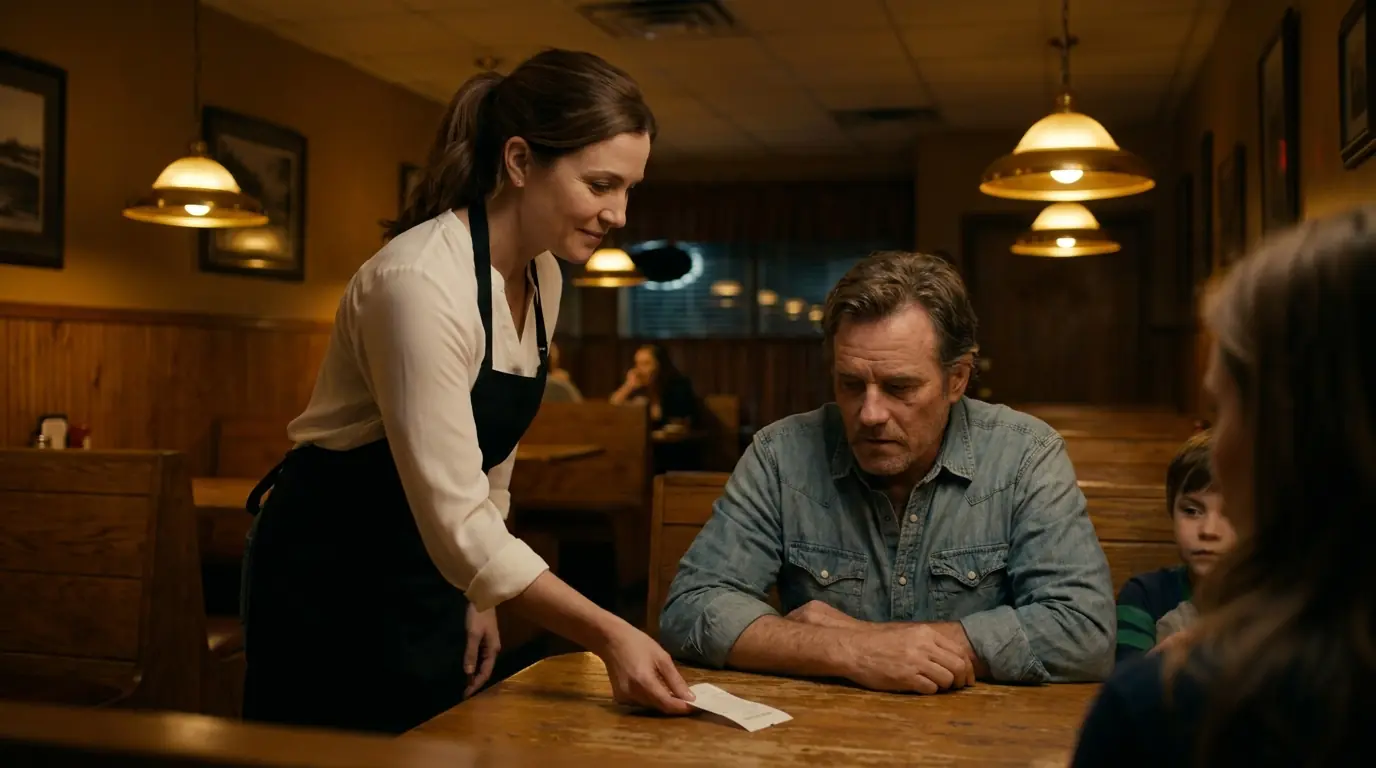
The diner was quiet. Snow pressed against the windows. Rosie was in the back office counting receipts, giving them space with suspicious timing.
Daniel wiped his hands on a rag. “Can I ask you something?”
“Sure.”
“Why did you help us that first night?”
Emily folded the towel in her hands.
“I told you. You were hungry.”
“A lot of people are hungry.”
“Yes.”
“So why me?”
She looked toward Sophie sleeping in the booth.
“Because you reminded me of my dad,” Emily said quietly.
Daniel’s expression softened.
Emily took a breath. “After my mom got sick, my dad tried to keep everything normal. He worked two jobs, cooked, cleaned, took her to appointments, smiled when he was exhausted. I was a teenager, but I could see it. I could see him pretending he wasn’t falling apart.”
“What happened to him?”
“He had a heart attack when I was twenty-two. He survived, but he was never the same. Mom passed two years later. Then he followed a year after that.”
Daniel’s face filled with quiet sympathy. “I’m sorry.”
Emily nodded. “When I saw you with Sophie, I saw that same look. Like you were trying to be strong enough for two people.”
Daniel looked down at his hands.
“I don’t know how to stop,” he said.
“Maybe you don’t stop,” Emily replied. “Maybe you just let someone stand nearby sometimes.”
He looked back up.
Neither of them moved.
Then Sophie stirred and mumbled, “Pancakes.”
Daniel laughed softly, and the moment settled into something tender instead of frightening.
In March, Daniel asked Emily if she wanted to come to Sophie’s school art show.
He asked it awkwardly, while paying the check.
“You don’t have to,” he said quickly. “She just kept asking if pancake lady could come, and I told her you’re busy, but then she said I should ask anyway because adults make excuses when they’re scared, which is something she probably heard from television.”
Emily smiled. “When is it?”
“Thursday at six.”
“I get off at five.”
“So… maybe?”
“I’d love to come.”
Daniel looked surprised. “Really?”
“Really.”
At the art show, Sophie ran to Emily the second she arrived.
“You came!”
Emily held up a small bouquet of grocery store flowers. “Of course I came. Artists need flowers.”
Sophie hugged her waist.
Daniel stood nearby in a clean button-down shirt, looking nervous in a way Emily found painfully sweet.
Sophie’s painting was of three people sitting in a diner booth. One man, one little girl, and one woman with yellow hair holding pancakes. Above them, Sophie had written in uneven letters:
MY FAMILY DINNER
Emily stared at it longer than she meant to.
Daniel saw.
“Sophie,” he said gently, “that’s a beautiful painting.”
Sophie beamed. “My teacher said family can be people who make you feel safe.”
Emily’s throat tightened.
Daniel did not say anything, but his eyes met Emily’s across the display table.
Something unspoken passed between them.
Something both beautiful and terrifying.
After the art show, they walked outside together. Sophie skipped ahead along the sidewalk, holding her flowers.
Daniel stopped near Emily’s car.
“I don’t want to make anything complicated,” he said.
Emily waited.
He struggled for words. “You’ve been kind to us. More than kind. And Sophie adores you. But I don’t want you to feel responsible for us.”
“I don’t.”
“I also don’t want to lean on you just because I’m lonely.”
Emily looked at him gently. “Are you lonely?”
He gave a small, honest laugh. “All the time.”
“So am I.”
The confession surprised them both.
Snowmelt dripped from the school roof. Cars pulled out of the parking lot. Sophie spun in circles near a lamppost.
Daniel took a breath. “Would you maybe want to have coffee sometime? Not at Rosie’s. Not while you’re working. Just… coffee.”
Emily smiled. “I serve coffee all day.”
“Tea, then.”
“I don’t like tea.”
“Dinner?”
She laughed. “Dinner sounds good.”
His shoulders relaxed.
Then Sophie shouted, “Does this mean Emily can come to the zoo with us?”
Daniel covered his face. “She hears everything.”
Emily laughed so hard she nearly cried.
Their first date was simple.
A small Italian restaurant across town. No fancy clothes. No big speeches. Daniel was nervous. Emily was nervous. Both of them admitted it halfway through dinner, which made everything easier.
Daniel talked about Claire with care, not as a ghost between them, but as part of the life that had shaped him. Emily listened without jealousy. She understood that love did not disappear just because life asked someone to love again.
Emily talked about her parents, about years spent taking care of others, about how she sometimes felt guilty wanting a life of her own after so much loss.
Daniel listened the way he listened to Sophie, fully and without rushing to fix the pain.
That was when Emily began to fall in love.
Not all at once.
Not like lightning.
More like warmth returning to a house room by room.
By summer, Emily joined Daniel and Sophie at the park on Sunday afternoons. She brought sandwiches. Daniel brought lemonade. Sophie brought questions.
“Are you Daddy’s girlfriend?” she asked one day while feeding ducks.
Daniel coughed. “Sophie.”
Emily glanced at him, smiling. “I don’t know. Am I?”
Daniel looked at her, startled. “I was going to ask more romantically.”
“Were you?”
“I had a plan.”
Sophie turned around. “Daddy’s plans take too long.”
Emily laughed.
Daniel looked embarrassed, then sincere.
“All right,” he said. “Emily Carter, would you like to be my girlfriend, even though my daughter has destroyed the moment?”
Emily looked at Sophie, then at Daniel.
“Yes,” she said. “Very much.”
Sophie threw her arms in the air. “Finally!”
That became the beginning of their new life together, though it was not always easy.
Love did not erase grief.
Some nights, Sophie cried because she missed her mother. Sometimes she felt guilty for loving Emily, as if her heart were betraying Claire. Emily never forced closeness. She never tried to replace anyone.
Instead, she sat beside Sophie and said, “Your mom will always be your mom. Loving me doesn’t take love away from her.”
Sophie asked, “Can a heart have two places?”
Emily answered, “A heart can have many rooms.”
Daniel heard this from the hallway and had to step away because his eyes filled with tears.
There were hard days with bills too.
Daniel’s truck broke down in August. Emily picked Sophie up from school for a week. The diner cut Emily’s hours for a while when road construction slowed business. Daniel helped Rosie repair a leaking pipe. Rosie paid him in cash and pie, then claimed the pie was unrelated.
By autumn, Emily was at Daniel’s little rental house more often than not. She helped Sophie with spelling words at the kitchen table. Daniel cooked badly but proudly. Emily taught him how not to burn chicken. Sophie declared them both “medium good adults.”
One evening, after Sophie went to bed, Daniel and Emily sat on the porch steps under a cool October sky.
“I used to think the house had to stay sad,” Daniel said.
Emily looked at him. “Why?”
“Because if it felt happy again, it meant I was forgetting Claire.”
Emily leaned her shoulder gently against his. “And now?”
“Now I think maybe she’d want Sophie to hear laughter in the kitchen.”
Emily looked through the window, where Sophie’s drawings covered the refrigerator.
“I think so too.”
Daniel took her hand.
“I love you,” he said.
The words were quiet, almost careful.
Emily looked at him. “I love you too.”
He closed his eyes for a second, as if letting himself believe it.
Months later, on a cold December evening almost exactly one year after Daniel first walked into Rosie’s Diner, he came in with Sophie wearing a red dress and a suspiciously excited expression.
Emily was wiping the counter.
“You two look fancy,” she said.
Sophie bounced on her toes. “We have a surprise.”
Daniel looked nervous.
Rosie appeared from the kitchen, pretending not to know anything, which immediately meant she knew everything.
Daniel guided Emily to table six, the same booth where he and Sophie had sat that first night.
On the table was a plate of chocolate chip pancakes, a mug of hot chocolate, and a folded napkin.
Emily laughed softly. “What is this?”
Daniel stood beside the booth, holding Sophie’s hand.
“One year ago,” he said, “I came in here with barely enough money to feed my daughter. I was embarrassed, exhausted, and scared I was failing her. You saw all of that, and instead of making me feel small, you gave me dinner.”
Emily’s eyes filled instantly.
Daniel continued, his voice thick with emotion. “But you gave us more than food. You gave Sophie a reason to laugh that night. You gave me a reason to believe I wasn’t alone. And somehow, without trying to replace anyone or fix everything at once, you became part of our home.”
Sophie reached into her little purse and pulled out a small box.
Emily covered her mouth.
Daniel took the box and lowered himself onto one knee beside the booth.
Rosie began crying behind the counter and loudly blamed the onions, though no onions were nearby.
Daniel opened the box.
Inside was a simple ring, delicate and beautiful.
“Emily Carter,” he said, “will you marry me? Will you let us love you for the rest of our lives?”
Sophie added quickly, “And will you still make pancakes sometimes?”
Emily laughed through tears.
She looked at Daniel, then Sophie, then the diner that had brought them together.
“Yes,” she whispered.
Daniel’s face broke into the most relieved smile she had ever seen.
“Yes?” Sophie shouted.
Emily nodded, crying and laughing at the same time. “Yes.”
Sophie threw herself into Emily’s arms. Daniel stood and wrapped them both gently together.
The customers in the diner began clapping. Rosie cried openly now and stopped pretending.
Six months later, Daniel and Emily were married in a small garden behind Rosie’s Diner. There were white chairs, simple flowers, and a bright sky after a week of rain. Sophie wore a lavender dress and walked down the aisle holding a framed photo of her mother, Claire, because Emily had suggested it.
“She should be here too,” Emily had said.
Daniel had loved her even more for that.
During the ceremony, Sophie stood between them.
When the officiant asked who gave their blessing, Sophie raised her hand and said, “I do.”
Everyone laughed, then cried a little.
After the wedding, Rosie hosted the reception inside the diner. There were pancakes on the dessert table because Sophie insisted love stories needed pancakes. Daniel danced badly. Emily danced with him anyway. Sophie fell asleep in a booth near the window, her lavender dress tucked around her and a smile still on her face.
Years later, people in Des Moines would still tell the story of the waitress who paid for a single dad’s dinner and ended up becoming his wife.
But Emily never told it that way.
To her, it was not a story about charity becoming romance.
It was a story about two lonely people meeting at the exact moment when kindness could still change the direction of a life.
Daniel had walked into the diner believing he had nothing to offer but exhaustion and a hungry child.
Emily had stood beside his table believing she was only giving him a meal.
Neither of them knew that love sometimes arrives quietly, wearing a waitress apron, carrying a plate of food, and asking for nothing in return.
And sometimes, the family a person thinks they lost forever begins again at a corner booth, over chocolate chip pancakes, on a cold Friday night.