“We heard you bought this gorgeous cabin in Aspen. We’re moving in to leave all the grudges behind.”
My daughter-in-law barked, shoving her suitcases through my door like she already owned the place.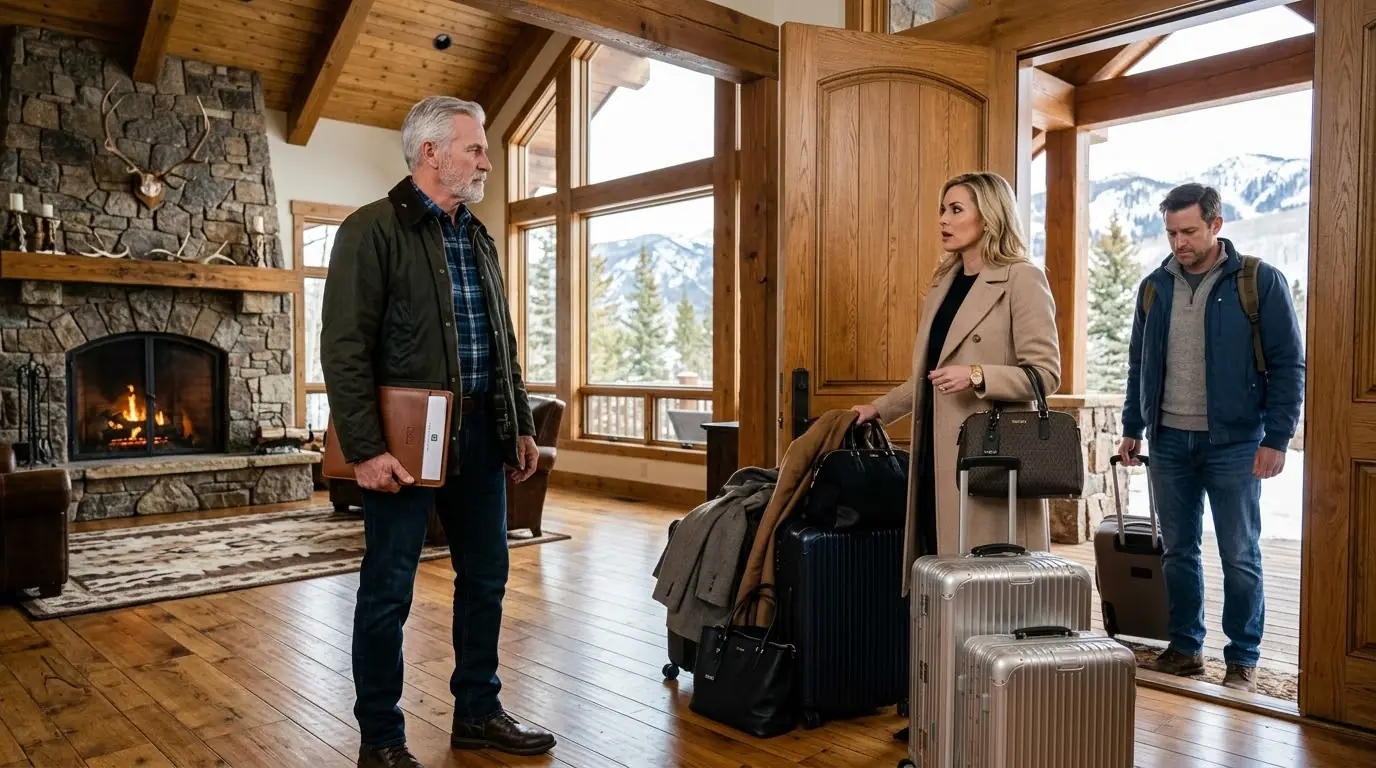
I just smiled and let them barge in.
But the second they stepped into the great room and saw what was waiting for them, every drop of color drained from their faces.
My name is Harold Winston. I’m 68 years old, and I live in a mountain cabin in Aspen, Colorado.
For 32 years, I built something from nothing. Started as a line cook at a diner in Denver. Ended up owning four restaurants under my own name, Winston’s Grill. Maybe you’ve heard of it.
Sold the whole chain 3 years ago for $3.8 million. Not bad for a kid who grew up washing dishes for minimum wage.
Now, I spend my days fly fishing on the Roaring Fork River and collecting rare 19th-century cookbooks.
Peaceful life. Quiet life. The kind of life I earned.
At least, that’s what I thought.
Let me tell you about my son, Trent.
He’s 41 now, works as a mid-level manager at some IT company in Aurora. Makes decent money, around $78,000 a year, last I heard.
Not that he ever talks to me about his life anymore.
That stopped about 7 years ago, right around the time he married Deborah.
Deborah Kelly, well, Deborah Winston now, is 38, doesn’t work, and has never met a mirror she didn’t like.
She used to be a real estate agent before she decided that being Trent’s wife was a full-time job.
Her full-time job, as far as I can tell, is spending money they don’t have and looking down her nose at people she considers beneath her.
That list, unfortunately, includes me.
I remember when Trent was a boy. He’d run to the door every time I came home from a shift, his little arms reaching up for me.
“Daddy! Daddy!”
He wanted to hear everything: what I cooked, who came in, what funny things happened.
He used to say he’d work in my kitchen one day.
That boy had stars in his eyes.
I don’t know where that boy went.
The change was gradual at first.
After the wedding, Trenton started calling less. Once a week became once a month. Once a month became holidays only.
Then even the holidays got shorter.
Christmas 2 years ago was the last time I saw them before everything fell apart.
I’d made a prime rib roast, my specialty, and was telling a story about a famous food critic who once tried to sneak into my kitchen.
Deborah rolled her eyes so hard I thought they might get stuck.
She picked at her food like it was beneath her, then announced she was watching her carbs and pushed the plate away.
Trenton said nothing.
He just stared at his hands.
But the moment that really opened my eyes happened about a year ago.
I’d called Trenton’s phone, and he must have pocket-answered because I heard voices.
Their voices.
“That old man still kicking around?”
That was Deborah. Her tone dripping with something I can only describe as contempt mixed with impatience.
“When’s he going to leave us the money and stop being such a burden?”
I waited for Trenton to defend me, to say something, anything.
“Soon, probably,” my son replied. “He’s not getting any younger.”
I hung up, sat in my kitchen for about an hour, just staring at the wall.
32 years of building a legacy, and my own son was just waiting for me to die so he could cash in.
That’s when I started paying attention.
Really paying attention.
Four months ago, I got a curious phone call.
Dr. Mitchell, an old acquaintance from the country club, called to ask if everything was all right with my health.
I said I was fine. Why?
He hesitated, then told me that a woman claiming to be my daughter-in-law had been asking him questions.
Very specific questions about the process for having an elderly relative declared mentally incompetent, about guardianship procedures in Colorado.
I thanked him and hung up.
Then I made some calls of my own, which brings me to 3 days ago.
The doorbell rang at 2:00 in the afternoon.
I wasn’t expecting anyone.
Vivian, my neighbor, usually just walks in through the back, and the delivery guys know to leave packages on the porch.
I set down my coffee and walked to the front door.
Through the frosted glass, I could see two figures.
Tall one, shorter one.
Lots of luggage.
I opened the door.
“Dad!”
“Deborah?”
Yes, she calls me Dad now. Isn’t that something?
Pushed past me before I could say a word.
She was dragging two massive suitcases behind her, their wheels scraping against my hardwood floors.
“We heard you bought this gorgeous cabin in Aspen. We’re moving in. Time to put all those silly misunderstandings behind us, don’t you think?”
Trenton stood behind her, looking everywhere except at my face.
He had three more bags.
“Deborah,” I said, keeping my voice pleasant. “Trenton, what a surprise. Isn’t it wonderful?”
Deborah was already surveying the living room, her eyes calculating, assessing.
I recognized that look.
I’d seen real estate agents wear it when they were mentally pricing a property.
“Family reunited at last. We’ve been so distant lately.”
And I said to Trenton, I said, “We need to fix this. Family is everything.”
“Family is everything,” I repeated.
The words tasted like ash.
Trenton finally met my eyes.
For just a moment, I saw something there.
Guilt, maybe, or shame.
Then it was gone, replaced by that blank look Deborah had trained into him.
“It’s good to see you, Dad,” he said.
“Is it?”
Deborah laughed, a high, brittle sound.
“Oh, Harold, always with the jokes. Now, which room is ours? We’ve had such a long drive from Aurora.”
I smiled, a genuine smile, which seemed to unsettle her slightly.
“Of course. Let me help you with those bags.”
As they struggled with their luggage in the hallway, bickering about which suitcase went where, I reached into my pocket.
My phone was there, right where I’d put it when I heard their car pull up.
I pressed record.
The first 3 days of our family reunion were educational.
Deborah started redecorating my home before she’d even unpacked.
“These curtains, Dad, they look so cheap. We should replace them.”
She ran her fingers along the hand-woven fabric I’d bought from a local artisan in Snowmass Village.
“I know a great designer in Denver. She could really transform this place.”
Transform?
That’s an interesting word choice.
Transform my $2.3 million cabin into something that fit her taste, her vision, her name on the deed, eventually.
“I’ll think about it,” I said, and went to make coffee.
Trenton was useless, of course.
He agreed with everything Deborah said, nodding along like one of those bobblehead dogs people put on their dashboards.
“She’s right, Dad. The place could use some updates.”
He wouldn’t look at me when he said it.
I remembered a different Trenton, 12 years old, standing in my kitchen after hours, carefully plating a practice dish.
“Is this right, Dad?”
“Perfect,” I told him. “You’re a natural.”
That boy had opinions, dreams, a spine.
Somewhere along the way, Deborah had surgically removed it.
On the second day, I conducted a small experiment.
I left some documents on the kitchen table, the property appraisal for the cabin, $2.3 million, right there in black and white.
Then I went to my study and watched through the crack in the door.
Deborah found them within 20 minutes.
She looked around, checking if anyone was watching, then pulled out her phone.
Click.
Click.
Click.
Photographing every page, I almost felt sorry for her.
Almost.
She thought she was being clever.
She had no idea she was dancing exactly to my tune.
That evening, I announced I was going for a walk.
“The fresh mountain air helps me think,” I said. “Might be gone a few hours.”
“Oh, take your time, Dad.”
Deborah’s smile was all teeth.
“We’ll hold down the fort.”
I drove to Denver instead.
Marcus Reynolds’ office was on the 15th floor of a building on Court Place.
He specialized in elder law, protecting seniors from exploitation, handling estate disputes, that sort of thing.
I’d found him through careful research, not through any personal connection.
When you’re planning for battle, you don’t want your general to have divided loyalties.
“Mr. Winston.”
He shook my hand firmly.
Mid-50s, gray at the temples, sharp eyes behind wire-rimmed glasses.
“You said on the phone this was urgent.”
I told him everything.
The overheard phone call, Dr. Mitchell’s warning, Deborah’s questions about incompetency proceedings, the photographs I’d just watched her take.
Marcus listened without interrupting.
When I finished, he leaned back.
“Colorado has strong laws protecting at-risk adults,” he said, “but guardianship cases can get complicated. They’ll need medical evidence that you’re incapable of managing your own affairs.”
“Which doesn’t exist,” I said, “because there’s nothing wrong with me.”
“That’s your advantage. Document everything. Record conversations. Colorado is a one-party consent state, and I think we should bring in additional help. I know a private investigator, former police detective, very discreet. If your daughter-in-law has been making moves, Carla will find out.”
Carla Summers.
I’d remember that name.
We spent 2 hours mapping out a preliminary defense strategy.
By the time I left, the sun had set, and the drive back to Aspen would take nearly 4 hours.
I didn’t mind.
I had a lot to think about.
I remembered another moment years ago.
Deborah had just started dating Trenton, and they’d visited the restaurant.
I’d cooked for them personally.
Seared duck breast with cherry reduction.
Deborah had taken one bite and pushed the plate away.
“It’s very rustic,” she’d said. “I prefer French cuisine. Refined, you know.”
Even then, she was reshaping him, filing down his edges.
Why didn’t I fight for my son back then?
Because I believed family was supposed to work itself out.
I was wrong.
The drive back to Aspen was dark and winding.
The mountains rose around me like silent witnesses.
I thought about my restaurants, the thousands of decisions I’d made over three decades.
Every hire, every menu change, every negotiation with suppliers and landlords and critics.
I’d built an empire from nothing because I understood one fundamental truth.
You can’t wait for problems to solve themselves.
You have to act.