Alex Bennett had chosen the bench beneath the old oak tree because it was the only place in Maplewood Park where the late-afternoon sun did not shine directly onto his phone screen. The tree was probably older than every house surrounding the park, its enormous branches stretching over the walking path and wooden benches like a roof made of leaves. Alex had been sitting there for eighteen minutes, one sneaker planted against the lower rail of the bench while he reread a chemistry worksheet and waited for his mother to finish a meeting downtown.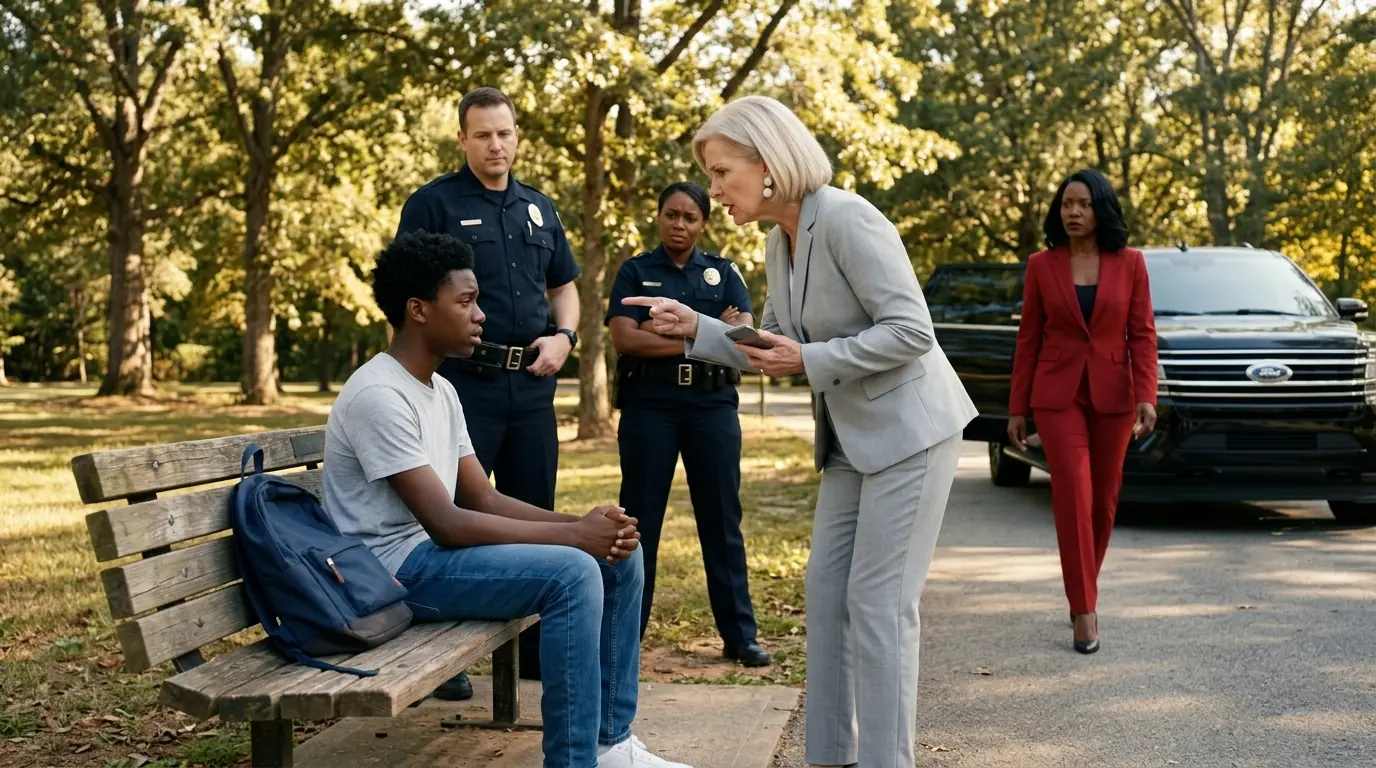
He was fifteen years old, slim, nearly six feet tall, and still growing quickly enough that his mother complained she seemed to buy him new jeans every three months. His short black curls had been freshly cut the previous weekend, and he wore a plain gray T-shirt, blue jeans, white sneakers, and the navy backpack he carried everywhere. There was nothing especially remarkable about him unless someone already wanted there to be.
Alex checked his phone.
Seven percent battery.
His mother had texted twelve minutes earlier.
Running late. Twenty minutes. Stay at Maplewood.
Alex replied:
Under the big oak.
Then he put the phone away.
Across the park, two small children chased each other around a fountain while their father watched from a picnic table. A woman jogged along the paved loop. An elderly man threw a tennis ball for a golden retriever near the open field. Cars moved slowly along the tree-lined street beyond the iron park fence.
Ordinary.
That was what Alex liked about Maplewood Park.
Nothing ever happened there.
At least, nothing had happened until Margaret Whitmore noticed him.
Margaret lived three blocks away in a brick Colonial home worth approximately four times what Alex’s family house had cost when his mother purchased it seven years earlier. She had lived in Maplewood for twenty-nine years, chaired the local historic-preservation committee twice, organized neighborhood fundraisers, and possessed the peculiar confidence of someone who had spent decades being told she was “involved in the community” until she began confusing involvement with jurisdiction.
She was sixty-seven, silver-blonde hair cut into an immaculate bob, pearl earrings, tailored light-gray pantsuit, and cream leather shoes that had probably never touched mud voluntarily. She carried an expensive smartphone in one hand and a reusable shopping bag in the other as she entered the park after leaving a nearby boutique.
She saw Alex.
Then slowed.
Alex did not notice.
He had pulled out a paperback science-fiction novel.
Margaret walked past once.
She looked toward him.
Continued.
Twenty seconds later she stopped near the fountain and looked back.
Alex turned a page.
Margaret watched.
Perhaps she expected him to do something.
He did not.
She took out her phone.
At first she pretended to photograph the flowers surrounding the fountain.
Then the camera shifted.
Alex appeared in the background.
She took another.
He still did not notice.
Margaret walked toward the northern end of the park, where the path curved near a row of expensive homes separated from public grass by ornamental fencing. She looked toward Alex again.
Still reading.
A reasonable person might have concluded that nothing was happening.
Margaret instead concluded that nothing had happened yet.
That distinction would shape the next several hours.
She approached the bench.
Alex noticed her shoes first.
He looked up.
Margaret stopped approximately six feet away.
“Do you live around here?”
Alex blinked.
“Sorry?”
“Do you live in this neighborhood?”
He looked toward the surrounding houses, then back.
“Near here.”
“That wasn’t my question.”
Alex frowned.
“I live in Maplewood.”
Margaret glanced at his backpack.
“Which street?”
He stared.
“Why?”
Her lips tightened.
“I asked a simple question.”
“I know.”
“Then answer it.”
Alex closed his book.
“My mom told me not to give strangers our address.”
Margaret looked offended.
“I’m hardly a stranger.”
Alex had never seen her in his life.
“Yes, ma’am.”
She stared.
“Who are you waiting for?”
“My mother.”
“When is she coming?”
“Soon.”
Margaret looked toward the empty street.
“Does she know you’re sitting here?”
Alex almost laughed.
“Yes.”
“What school do you attend?”
His patience started disappearing.
“Why do you need to know?”
Margaret crossed her arms.
“Because we’ve had problems.”
“With what?”
“People coming into the neighborhood.”
Alex looked around.
“This is a public park.”
“I know that.”
“Then I’m allowed to sit here.”
Margaret’s expression changed.
Not dramatically.
But Alex recognized the look adults sometimes got when a teenager answered too confidently.
“You should watch your tone.”
“I’m not doing anything.”
“I didn’t say you were.”
“You’re asking where I live and where I go to school.”
Margaret lifted her phone.
“I’m simply being aware of my surroundings.”
“Okay.”
Alex reopened his book.
Conversation finished.
At least for him.
Margaret remained.
“Young man.”
Alex looked up again.
“Yes?”
“You don’t dismiss adults when they’re speaking to you.”
He stared.
“I answered you.”
“No, you became disrespectful.”
Alex took a breath.
His mother had taught him something important years earlier.
When an adult is determined to call you disrespectful, arguing about respect rarely improves the situation.
So he said:
“Okay.”
Then looked back at the book.
Margaret stood another few seconds.
Then walked away.
Alex watched her.
He felt annoyed but not frightened.
Adults asked teenagers dumb questions all the time.
He returned to reading.
Five minutes later he noticed Margaret standing across the park with her phone against her ear.
He did not immediately understand.
Then she looked directly at him while speaking.
Alex’s stomach tightened.
He checked his own phone.
Five percent.
He texted his mother.
Some lady is acting weird. Think she called someone.
Message delivered.
No response yet.
Margaret continued talking.
What Alex could not hear was her conversation with the Maplewood emergency dispatcher.
“My name is Margaret Whitmore, and I’m at Maplewood Park.”
The dispatcher asked:
“What is the emergency?”
“I’m not sure yet.”
That should have been a warning.
Instead, Margaret continued.
“There’s a young man behaving suspiciously.”
“What is he doing?”
“He’s been sitting here for quite some time watching the houses.”
Alex had not been watching houses.
“What specifically is he doing now?”
“He has a backpack.”
The dispatcher paused.
“Is he threatening anyone?”
“No.”
“Has he entered private property?”
“Not that I’ve seen.”
“Does he have a weapon?”
“I don’t know.”
“Have you seen one?”
“No.”
“Can you describe the suspicious behavior?”
Margaret became irritated.
“I already told you. He’s been sitting here watching the neighborhood.”
“What direction is he looking?”
Margaret glanced.
At that exact moment, Alex was reading.
“He was looking around earlier.”
“Is he currently committing a crime?”
“I don’t know. That’s why I’m calling you.”
The dispatcher classified the call as a suspicious-person welfare check rather than an active crime.
Two nearby officers were sent.
Margaret hung up.
Then waited.
Alex saw the first patrol car six minutes later.
His stomach dropped.
Blue lights were not activated initially.
The cruiser pulled beside the curb.
A second arrived behind it.
Officer Daniel Reeves stepped out first.
Forty-two.
White.
Short brown hair.
Fourteen years with Maplewood Police.
Behind him came Officer Tasha Monroe, thirty-six, Black, eight years on patrol, hair pulled neatly beneath her police cap.
Margaret immediately walked toward them.
Alex remained seated.
He considered calling his mother.
Four percent.
He decided to save battery.
Officer Reeves spoke with Margaret first.
She gestured toward Alex repeatedly.
Tasha looked toward the bench.
Then toward Margaret.
Something about the conversation seemed to bother her.
Finally, both officers approached.
Alex placed the book beside him.
He kept his hands visible.
Not because he had done anything wrong.
Because his mother had taught him how to behave around police long before she became mayor.
Stay calm.
Do not reach unexpectedly.
Do not argue physically.
State clearly what happened.
Remember names.
Remember details.
Alex hated that those lessons existed.
But he remembered them.
Reeves stopped several feet away.
“Hey, buddy.”
Alex almost rolled his eyes at buddy.
Didn’t.
“Hi.”
“We got a call about someone hanging around the park.”
“I’m waiting for my mom.”
“Okay.”
Reeves looked toward the backpack.
“You live nearby?”
“Yes.”
“What’s your name?”
“Alex Bennett.”
Reeves nodded.
“How old are you?”
“Fifteen.”
“You got ID?”
Alex frowned.
“No.”
“School ID?”
“In my backpack.”
Reeves pointed.
“Go ahead.”
Alex looked toward Tasha.
She nodded slightly.
He slowly opened the backpack.
Margaret approached.
Tasha immediately raised one hand.
“Ma’am, please give us space.”
Margaret stopped.
“He has been watching those houses.”
Alex looked up.
“No, I haven’t.”
Margaret pointed.
“Yes, you have.”
Tasha turned.
“Ms. Whitmore, we’ll speak with you separately.”
“But he’s lying.”
Reeves looked toward Alex.
“School ID?”
Alex removed it.
Reeves inspected.
ALEXANDER BENNETT
Maplewood STEM Academy.
He returned it.
“All right.”
Margaret looked irritated.
“That proves nothing.”
Tasha stared at her.
“He gave us his identity.”
“But not why he’s here.”
Alex’s frustration broke through.
“I’ve told everybody why I’m here.”
Reeves looked toward him.
“Take it easy.”
Alex immediately regretted raising his voice.
“I am taking it easy.”
Margaret laughed sharply.
“Does that sound cooperative to you?”
Tasha turned again.
“Ma’am.”
Margaret held up her phone.
“I pay taxes in this city. I have a right to expect the park to be safe.”
Alex looked toward her.
“From me?”
She stared.
“I didn’t say that.”
“You called police on me.”
“Because you were acting suspiciously.”
“How?”
Margaret pointed toward the surrounding homes.
“You were watching people.”
“No, I wasn’t.”
“You were sitting here for almost half an hour.”
“It’s a bench.”
Tasha almost smiled.
She hid it.
Margaret did not.
“You see the attitude?”
Alex closed his eyes briefly.
Reeves placed one hand lightly on Alex’s shoulder.
“Just stay seated.”
Alex stiffened.
The touch changed everything.
Until then, it had felt like an irritating conversation.
Now an armed adult had physically indicated that Alex was not free to simply walk away.
He looked toward Reeves.
“Am I being detained?”
That question surprised the officer.
“Right now we’re figuring out what happened.”
“That doesn’t answer me.”
Tasha looked toward Reeves.
Reeves said:
“Just sit tight for a minute.”
Alex’s heart began beating faster.
Margaret saw uncertainty and interpreted it as victory.
“I told you.”
Tasha’s eyes sharpened.
“Told us what?”
“That something was wrong.”
Alex turned.
“What did I do?”
Margaret snapped:
“You’re hanging around a neighborhood where you clearly don’t belong.”
Silence.
Even Reeves looked at her.
Tasha’s expression changed completely.
“Ma’am.”
Margaret realized the sentence sounded worse than it had in her head.
“I mean he doesn’t live on this block.”
Alex stared at her.
“You asked whether I live in Maplewood.”
“You refused to give an address.”
“Because you’re a stranger.”
Margaret shook her head.
“This is exactly the problem. No respect.”
Alex felt anger rising.
He clenched his hands together.
Tasha noticed.
She stepped closer, lowering her voice.
“Alex.”
He looked at her.
“Take a breath.”
He hated being told to breathe.
But her tone was different.
Not patronizing.
Grounding.
He inhaled.
Margaret continued.
“I simply want him removed until his parents can be contacted.”
Alex looked toward her.
“My mother is coming.”
Margaret laughed.
“Your mother has been coming for thirty minutes.”
“She’s late.”