At twenty-four years old, Anna Birch had decided that life was not cruel if a person stopped asking too much from it.
Her world was small, but it was hers.
It began at the oval doorway of her dugout and ended at the round mouth of the clay oven she had built into the side of the hill. Beyond that, the Nebraska prairie stretched flat and wide beneath a hard blue sky, rolling with grass in summer, dust in autumn, and snow in winter.
People in town called her quiet.
Some called her odd.
A few, when they thought she could not hear, called her “the woman in the ground.”
Anna did not argue with any of them.
She did live in the ground.
Her home was dug into a low hillside near a dry creek bed, with packed-earth walls that smelled faintly of sweet grass and rain. In summer, the dugout stayed cool. In winter, the walls held heat from the oven like cupped hands around a coal. It was not grand, but it protected her from wind, weather, and the pity of relatives who had offered her a corner in their houses only after making it clear she would be another mouth to feed.
After her parents died within the same hard year, Anna had taken the little money left to her and refused to become anyone’s burden.
She bought flour, salt, yeast, a sturdy table, a few tools, and a secondhand iron kettle.
Then she built her oven.
Brick by brick.
Mud by mud.
Prayer by prayer.
The first loaf she baked came out heavy as a stone and dark enough to shame the crows. She cried over it, then sliced it anyway, ate the middle with butter, and tried again the next morning.
By the third month, people began noticing.
By the sixth, Mr. Henderson at the mercantile bought every loaf she brought him.
By the second year, folks in three nearby settlements knew Anna Birch’s bread, even if most did not know her face.
The bread was rustic and brown, with a burnished crust that cracked under a knife and a soft inside that smelled of honey, wheat, and prairie air. It was not fancy town bread, pale and soft and forgettable. It had weight. It had patience in it.
Anna’s hands knew dough better than they knew comfort.
She knew when it needed water, when it needed rest, when it needed pressure, and when it needed to be left alone. She thought sometimes that people were much the same, though no one had ever handled her with such care.
She woke before sunrise every day.
She mixed dough by lantern light.
She kneaded until her shoulders ached.
She baked while the prairie brightened outside her door.
Then she carried the loaves into town in a covered basket, sold them to Henderson, bought what little she needed, and returned before afternoon heat settled over the land.
That was her life.
Simple.
Useful.
Safe.
She had stopped looking in the cloudy little mirror nailed near the door. When she did, she saw only flour on her cheek, hair escaping its pins, and tiredness around her gray eyes.
She was the woman who made bread.
That identity was enough.
Or she had taught herself to call it enough.
Jesse Pryor first tasted her bread on a windy Wednesday in October.
He had ridden into Larkspur to buy coffee, nails, and harness oil for the Double P Ranch, the cattle spread he had built from land inherited and land earned through years of discipline. At thirty-three, Jesse was respected by men who valued hard work and avoided by women who wanted charm.
He was not unfriendly.
Only quiet.
He was tall, broad-shouldered, sun-browned, and steady in a way that made people expect little conversation from him. He had danced with ranchers’ daughters, sat politely beside widows at church suppers, and accepted more than one invitation to Sunday dinner, but nothing had ever taken root.
Some men were lonely because they were careless.
Jesse was lonely because nothing false interested him.
He wanted a life that felt built, not arranged.
Good leather.
Strong fences.
Honest work.
A woman who did not perform sweetness in public and grow sharp in private.
So he had stopped looking.
That morning at Henderson’s Mercantile, while the shopkeeper wrapped coffee beans in brown paper, Jesse noticed a loaf sitting near the counter.
It was round, dark, and slashed neatly across the top. Steam no longer rose from it, but the scent remained, deep and warm and strangely alive.
Jesse picked it up.
“Who made this?”
Henderson glanced over.
“Anna Birch. Best bread in the county.”
Jesse turned the loaf in his hands.
“She in town?”
“Not often. Brings them in and disappears back to that dugout of hers.”
“Dugout?”
“Out by the old creek road. Woman lives like a badger and bakes like an angel.”
Henderson laughed at his own joke.
Jesse did not.
He bought the loaf.
Back at the Double P, he set the bread on his kitchen table and cut into it while the afternoon wind rattled the windows. The crust cracked beneath the knife, and the smell rose rich and steady into the quiet room.
He took one bite.
Then he stopped moving.
It was the best thing he had ever tasted.
Not because it was sweet. Not because it was soft. Not because it was expensive or delicate or decorated.
It tasted like work done well.
Like warmth protected against weather.
Like a house he had never had but somehow remembered.
He ate the slice standing at the table, then cut another and sat down.
When that was gone, he wrapped the loaf carefully, saddled his horse again, and rode back to town.
Henderson looked surprised when Jesse walked in a second time.
“Forget something?”
Jesse placed the loaf on the counter.
“Where does she live?”
The shopkeeper blinked.
“Anna?”
“Yes.”
“What for?”
Jesse’s gaze stayed level.
“I want to ask her about the bread.”
Henderson’s mouth twitched.
“Bread don’t usually require interrogation, Mr. Pryor.”
“This one does.”
Henderson pointed toward the far road.
“Past Mrs. Gable’s place. Follow the creek road until it thins out. You’ll see smoke from the oven if she’s baking.”
Jesse thanked him, mounted again, and rode west.
He was not a man of sudden impulses, but something about that bread had unsettled him. Not only the taste. The certainty behind it. A person did not make something like that accidentally.
He wanted to meet the hands that had shaped it.
The neat houses of Larkspur gave way to scattered brush, open grass, and shallow earth ridges cut by wind. After twenty minutes, Jesse saw it.
A thin ribbon of smoke rising from a low hill.
He dismounted near a cedar, tied his horse, and walked toward the scent.
The dugout door stood open.
Inside, a woman moved with her back to him, sleeves rolled, hands deep in dough. The room was warm from the oven, and light from the doorway fell across the packed-earth floor. Flour dusted the worktable. Three loaves cooled on a rack. A kettle hissed softly near the stove.
Jesse stopped at the threshold.
His shadow crossed the floor.
The woman turned.
She was younger than he expected. Slight, fine-boned, with brown hair pinned loosely at the back of her head and clear gray eyes that widened in surprise. Flour marked one cheek like a pale fingerprint.
She wiped her hands on her apron.
“Can I help you?”
Jesse held up the loaf he had bought.
“Miss Birch?”
“Yes.”
“I bought this in town.”
Her posture changed at once, bracing for complaint.
“Was something wrong with it?”
“No.”
He looked from the bread to her face.
“I wanted to know who made it.”
A flush rose faintly under the flour on her cheek.
“I did.”
“I know that now.”
The words were simple, yet something in his voice made the small room feel even smaller.
Anna folded her hands in front of her apron.
“If you want more, Mr. Henderson buys what I make.”
“I want all you can spare.”
Her eyes flickered.
“For your ranch?”
“For my ranch. And for myself.”
She looked suspicious, but not unkind.
“I bake what I can. I don’t have a large oven.”
Jesse’s gaze moved to the clay dome.
“You built it?”
“Yes.”
“Alone?”
Her chin lifted slightly.
“Yes.”
Respect entered his face so plainly that Anna had to look away.
Most men, upon seeing her dugout, saw poverty first.
Jesse Pryor saw the oven.
He bought the three cooling loaves and asked for five more by the end of the week. He paid in silver dollars that felt heavy in her palm, more than fair, more than she would have dared ask.
When he turned to leave, he paused at the doorway.
“Miss Birch.”
“Yes?”
“That bread is not ordinary.”
Anna stood very still.
Then he put on his hat and stepped into the prairie wind.
After he left, the dugout felt changed.
Not better.
Not worse.
Only disturbed.
As if some invisible current had entered with him and had not gone out when he did.
Anna busied herself. She swept the floor. Fed the fire. Covered the next batch of dough. Counted the silver twice and tucked it into the old tin box beneath her bed.
He wanted bread.
That was all.
Men like Jesse Pryor did not seek out women who lived in dugouts unless they wanted something practical. He was a rancher with land, cattle, and a name that carried weight. He would marry a woman with lace gloves, a piano, and a family that could host dinners.
Not a baker with cracked hands and flour in her hair.
She repeated this to herself so often that night it became a kind of prayer.
He wants the bread.
Not you.
Still, when she woke before dawn, she caught herself smoothing her hair before lighting the oven.
Jesse returned three days later.
Then again the next week.
Then twice every week after that.
At first, he came only for loaves. He paid, asked practical questions, and left. But slowly, without Anna noticing exactly when, the visits lengthened.
He asked how long she had lived there.
“Three years.”
“Alone?”
“Yes.”
“Does the roof hold in hard rain?”
“It has so far.”
“That isn’t the same as yes.”
She almost smiled.
He noticed that too.
Another time, he found her struggling with the dugout door after rain had swollen the frame. He said nothing at first, only set down the sack he carried and examined the warped wood.
“I can fix that.”
“You don’t need to.”
“I know.”
“I didn’t ask.”
“I heard it scraping from outside.”
“That is not the same as being asked.”
This time, he did smile.
Small.
Brief.
Enough to trouble her for the rest of the afternoon.
The next day, Jesse arrived with lumber strapped behind his saddle and tools wrapped in leather. Anna argued for nearly ten minutes. He listened patiently, then repaired the door anyway.
He worked until the sun lowered and the dugout filled with warm evening light. Sawdust clung to his shirt sleeves. His large hands moved with sure, economical skill. He did not make unnecessary conversation, and Anna found she liked that. Silence around him did not feel empty. It felt permitted.
When he finished, the door swung shut with a solid sound.
“There,” he said. “That will keep winter out.”
Anna stood near the table, hands clasped too tightly.
“What do I owe you?”
His expression shifted.
“Nothing.”
“I don’t take charity.”
“It isn’t charity.”
“What is it, then?”
Jesse looked at her for a long moment.
“Attention.”
Anna did not know what to do with that answer.
He picked up his tools.
“You notice dough before it fails. I notice wood.”
“That doesn’t explain why you came all the way out here.”
“No,” he said quietly. “It doesn’t.”
Then he left.
Anna stood in the open doorway long after his horse disappeared.
Winter came early that year.
The prairie turned hard and white beneath low skies. Wind pressed against the dugout at night, but Jesse’s repaired door held. Anna hated that she thought of him every time it shut properly.
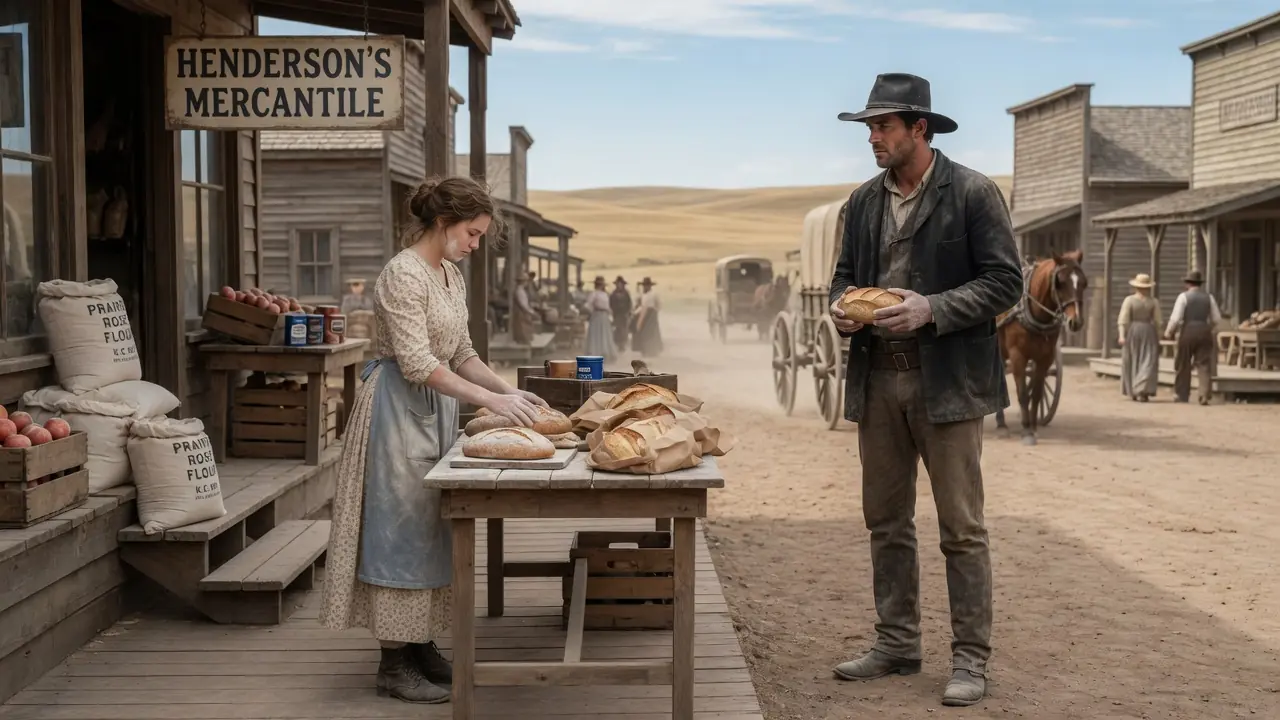
One morning, she arrived at Henderson’s Mercantile with twelve loaves and found two women from town waiting near the counter.
Mrs. Lydia Harlan, wife of the bank manager, wore a fur collar and a look of practiced concern. Beside her stood Miss Clara Boone, who had been trying to catch Jesse Pryor’s attention for years and had not forgiven the world for his lack of interest.
Mrs. Harlan looked over Anna’s basket.
“There she is,” she said brightly. “The famous bread woman.”
Anna stiffened.
“Good morning.”
Clara smiled thinly.
“I hear Mr. Pryor rides to your dugout quite often.”
Henderson, behind the counter, suddenly became very interested in stacking tins.
Anna placed the loaves down.
“He buys bread.”
“So we’ve heard,” Clara said.
Mrs. Harlan gave a soft laugh.
“People talk, dear. A woman alone must be careful. A man like Jesse Pryor has a reputation to consider.”
Anna’s face warmed.
“Mr. Pryor has behaved honorably.”
“I’m sure he has,” Mrs. Harlan said, in the tone of someone meaning the opposite. “But appearances matter.”
Anna took her payment from Henderson with fingers that did not tremble only because she refused to let them.
Clara leaned closer.
“Some women mistake business attention for personal interest. It can end badly.”
Anna looked at her then.
“Thank you for your concern.”
It was the only safe answer she had.
She left the store with her empty basket and walked home under a sky that seemed too large and too cold.
By the time she reached the dugout, humiliation had turned to anger, and anger had turned into something worse.
Doubt.
Perhaps the women were right. Perhaps she had allowed herself to imagine tenderness where there was only convenience. Perhaps Jesse did not understand what his visits looked like because men with land rarely had to think about the reputations of women without protection.
That evening, when Jesse came for bread, Anna had wrapped the loaves and set them outside on a crate.
He stopped at the sight of them.
Anna stood in the doorway.
“I thought this would be simpler.”
His brow furrowed.
“Simpler?”
“You can collect your order without coming inside.”
Jesse looked at the wrapped loaves, then at her face.
“Something happened.”
“No.”
“Anna.”
Her name in his voice nearly broke her composure.
She lifted her chin.
“People are talking.”
His expression darkened.
“Who?”
“That doesn’t matter.”
“It does.”
“No. What matters is that I cannot afford to be careless.”
Jesse stepped closer, then stopped when he saw her stiffen.
“You think I’ve been careless with you?”
“I think you are a man who can ride away clean from rumors that would bury me.”
The truth of it hit him. She saw it land.
For a moment, he said nothing.
Then he removed his hat.
“You’re right.”
Anna had expected defense. Denial. Perhaps offense.
Not agreement.
Jesse looked toward the snow-dark prairie, then back at her.
“I have been thinking only of what I meant. Not what others would make of it.”
His voice lowered.
“I’m sorry.”
The apology entered her more deeply than any argument could have.
She looked away.
“I know you meant no harm.”
“That isn’t enough.”
“No,” she said softly. “It isn’t.”
Jesse nodded once, picked up the bread, placed payment on the crate, and left without trying to cross the threshold.
For three days, he did not come.
Anna told herself this was better.
The dugout returned to its old shape. The oven fired. The dough rose. The days resumed. Yet everything felt flatter, as if the world had lost some sound she had not realized she was listening for.
On the fourth day, Mrs. Gable arrived.
Martha Gable was round, kind, and incapable of keeping news entirely to herself. She stepped carefully down the slope with a basket of eggs and a face full of meaning.
“Anna, dear,” she said, “have you heard what Mr. Pryor did?”
Anna’s hands tightened around the cloth she was folding.
“No.”
“He came to town this morning. Walked right into Henderson’s while Lydia Harlan and Clara Boone were there.”
Anna went still.
“And?”
Mrs. Gable’s eyes sparkled.
“And he ordered two hundred loaves a month for the Double P. Signed contract, proper rate, delivery schedule, everything written plain. Then he told Henderson to post the notice in the window.”
Anna stared.
Mrs. Gable continued, delighted.
“And when Clara made a remark about men doing foolish things over pretty faces, Mr. Pryor said, in front of half the store, ‘I hired Miss Birch because she is the finest baker in Nebraska, and I will thank this town to respect honest work when it sees it.’”
Anna sat down slowly.
Mrs. Gable softened.
“He gave you your name back before they could take it.”
Anna looked toward the oven.
For the first time in days, her eyes filled.
That afternoon, Jesse came to the dugout.
He did not step inside.
He stood outside the repaired door with a folded copy of the contract in one hand.
“I should have done it properly from the start,” he said.
Anna took the paper.
It was formal, fair, and generous. More than generous. It listed her as supplier, not charity, not dependent, not hidden arrangement.
Her name stood clearly at the top.
Anna Birch, Baker.
She ran her thumb over the ink.
“Why?”
Jesse met her eyes.
“Because you were right.”
“That isn’t what I mean.”
He drew a slow breath.
“Because I want to come here without making your life harder.”
Her heart moved painfully.
“And why do you want to come here?”
This time, he did not look away.
“Because the first time I tasted your bread, I wanted to know who could make something so whole from so little.”
The wind moved softly over the grass.
“When I found you, I understood it wasn’t the bread I was looking for.”
Anna forgot how to speak.
Jesse stepped closer, but still did not cross the threshold.
“I have no wish to shame you. No wish to rush you. No wish to make your life smaller by entering it.”
His voice was low and steady.
“But I would like to court you, Anna Birch, if you will allow it.”
The words were plain.
No poetry.
No performance.
Exactly right.
Anna looked down at the contract in her hand, then at the man standing outside her door in the cold because she had not invited him in.
She stepped aside.
“You may come in for coffee.”
A flicker of warmth entered his eyes.
“Yes, ma’am.”
Courtship changed everything and nothing.
Jesse still bought bread. Anna still baked before sunrise. The dugout still smelled of earth and yeast and smoke.
But now Jesse came openly.
On Sundays, he drove her to church in his wagon, sitting beside her with enough space between them to satisfy the sternest widow, though his presence alone silenced most gossip. He brought her books from town. She taught him how to shape dough properly and laughed when his first attempt collapsed like a tired hat.
He built a shelf for her cooling loaves.
She mended the tear in his coat sleeve.
He learned she liked coffee with more sugar than she admitted.
She learned he hated boiled carrots but ate them politely.
Slowly, Anna’s hard little certainties began to loosen.
Men did look for women in holes in the ground, it seemed.
At least one did.
In March, Jesse brought lumber.
Anna stood outside the dugout, staring at the load.
“What is that?”
“A kitchen.”
She blinked.
“A what?”
“A proper baking house. If you’re supplying the Double P and Henderson’s orders both, you need space.”
“Jesse.”
“I already bought the lumber.”
“You cannot simply build me a house.”
“It’s not a house. It’s a kitchen.”
“That distinction does not help.”
He smiled.
It was becoming less rare now.
“I’ll build it on your land. It stays yours.”
Anna stared at him.
That was the difference between Jesse and every person who had ever offered help with strings hidden in their sleeves.
He did not try to take her from her life.
He made room for her life to grow.
The baking house rose through spring.
Men from the Double P came to help. Henderson delivered hinges. Mrs. Gable brought curtains she claimed were extra but had clearly sewn for that purpose. Even some townspeople who had once whispered now arrived with nails, tools, or awkward compliments.
Anna stood in the doorway of the unfinished kitchen one evening, looking at the wide window Jesse had placed toward the east.
“Why so large?” she asked.
“So you can see morning.”
“I already see morning.”
“Not enough of it.”
She looked at him.
He shrugged, suddenly self-conscious.
“You spent too long looking out of a dugout door.”
Anna’s throat tightened.
“You say things like that and then expect me to keep standing upright.”
Jesse turned toward her, startled.
Then she laughed softly.
He smiled.
By summer, the baking house was finished.
It had a long pine table built to the height of Anna’s hands, shelves for flour and pans, a large clay oven set into brick, and a window that filled the room with sunrise.
On the first morning she baked there, Anna cried into the dough.
Jesse found her standing over the table, flour on her wrists and tears on her cheeks.
He did not ask what was wrong.
He simply stood beside her.
After a moment, she said, “I don’t know how to belong to something this good.”
Jesse looked around the room.
“You built most of it.”
“You built the walls.”
“You filled them.”
Anna turned to him.
“I’m afraid.”
“I know.”
“What if I lose it?”
His expression softened.
“Then I’ll help you build again.”
The simplicity of that answer undid her.
She leaned into him, and Jesse held her as if she were not fragile, but precious.
There is a difference.
They married in September.
Not because gossip demanded it.
Not because Jesse wanted to claim what he had helped build.
Because Anna, standing in her baking house with sunrise on her hands, finally understood that love did not always arrive as danger. Sometimes it arrived as a repaired door, a fair contract, a window facing east, and a man who waited until invited.
The ceremony was small.
Mrs. Gable cried loudly.
Henderson pretended dust had entered his eye.
The men from the Double P stood awkwardly in clean shirts, uncomfortable with emotion but loyal enough to endure it.
Anna wore a simple cream dress. Her hands shook only once, when Jesse slid the gold band onto her finger.
He noticed.
Of course he did.
He bent his head and whispered, “Still here.”
She smiled through tears.
“So am I.”
After the wedding, Anna did not leave herself behind.
That was what surprised her most.
She moved to the Double P Ranch, yes, but the baking house remained hers. Twice a week, she still worked there, producing loaves for town, ranch hands, travelers, and eventually settlements farther away.
At the ranch house, Jesse built her a kitchen larger than the entire dugout had been. The first time she saw the pantry stocked with flour, sugar, spices, dried fruit, and coffee, she stood speechless.
“You don’t like it?” Jesse asked.
Anna looked at him in disbelief.
“I’m trying not to faint.”
He nodded seriously.
“I’ll stand close.”
She laughed so hard she had to sit down.
Life with Jesse was not grand in the way storybooks made marriage sound. It was better.
It was boots by the door.
Coffee before dawn.
Jesse coming in from the cold and standing behind her while she kneaded dough, his chin resting gently near her shoulder.
Anna reading aloud while he repaired tack by lamplight.
The smell of bread moving through the ranch house until even the hired men claimed they could work twice as hard if Mrs. Pryor kept baking.
It was the quiet astonishment of being seen every day and not found lacking.
One autumn evening, nearly a year after Jesse had first tasted her bread, Anna stood at the great pine table in the ranch kitchen, pressing her palms into a mountain of dough. Rain tapped softly against the windows. The house was warm. The oven glowed.
Jesse came in from the barn, smelling of leather, rain, and open air.
He did not speak at first.
He crossed the kitchen, stood behind her, and covered her flour-dusted hands with his.
Together, they pressed the dough forward.
Anna leaned back against him.
“You’re getting better,” she said.
“At bread?”
“At standing close without ruining the shape.”
His chest moved with a quiet laugh.
“I had a good teacher.”
For a while, they worked in silence.
Then Jesse kissed her temple.
“You smell like bread.”
“You smell like weather.”
“I came in because the weather was less interesting than you.”
Anna smiled.
“Careful, Mr. Pryor. That sounded nearly poetic.”
“Don’t tell anyone.”
“I might.”
He tightened his arms around her, gentle and sure.
Anna looked around the kitchen, at the wide table, the glowing oven, the shelves stacked high, the rain-washed windows, the life that had somehow grown from one loaf bought on impulse.
She thought of the dugout, its cool earthen walls and narrow doorway. She did not hate that place. It had sheltered her when she needed shelter. It had taught her skill, discipline, patience, and the dignity of surviving on her own hands.
But she no longer mistook survival for the whole of living.
Jesse had not rescued her from the dugout.
He had found her there.
That mattered more.
He had looked at the woman everyone else passed by and seen not lack, but strength. Not poverty, but craft. Not loneliness, but a life waiting for room to expand.
Anna turned in his arms.
“Do you ever think about that first loaf?”
Jesse’s eyes softened.
“Every day.”
“Why?”
“Because I thought I was buying bread.”
“And?”
He brushed flour from her cheek with his thumb.
“I was being led home.”
Anna closed her eyes for a moment.
Outside, rain crossed the Nebraska prairie. Inside, the oven burned steady, turning flour and water into warmth as it always had.
Only now, when Anna looked across the room, someone looked back.
Not at the bread.
At her.
And that made all the difference.